Irish Government reaches agreement with IMO on free GP care for kids U6
Deal will provide for height and weight checks, plus cycle of care for asthma sufferers


The Government has reached agreement with the Irish Medical Organisation on a recommended fee for the introduction of free GP care for children
The Government has reached agreement with the Irish Medical Organisation on fees to be offered for a contract introducing free GP care for children under the age of six.
The deal will provide for a height and weight check of children at age two and five. There will also be a cycle of care for children with asthma.
It is understood the agreement will also involve the provision of diabetic care for everyone covered by a medical card or GP visit card.
The introduction of free GP care for young children is one of the Government’s key healthcare reforms.
However the move has been opposed by another group representing family doctors, the NAGP (National Association of General Practitioners).
The IMO said that, under the agreement, the Government will increase its investment in providing GP services to children under the age of six to €67 million, which it described as an 81 per cent increase on sum originally identified by Government.
It said that capitation fees for children under the age of 6 will be €125 – an 82 per cent increase on the €68.65 currently received. “Including additional payments and supports brings the price per patient up to €216 per child under 6,” the union said.
The agreement also includes a new Diabetic Cycle of Care contract, which the IMO said was a first step towards introducing chronic care into general practice and would involve separate funding of over €100 per diabetic patient per year.
Dr Ray Walley, chairman of the IMO GP committee, described the agreement as “a significant first step” in a process to get additional funds into general practice to enable it to deliver on its potential.
“We have stopped the cycle of cutbacks and begun the process of bringing new resources into general practice,” he said. “We have more to achieve but we are committed to the development of a new GP contract that is capable of delivering 21st century GP care to patients.”
Minister for Health Leo Varadkar and Minister for Primary Care Kathleen Lynch issued a statement welcoming the agreement.
“This agreement represents the first step in the phased introduction of a universal GP service without fees,” Ms Lynch said. “The commencement of this service this summer will make a real difference to the lives of the youngest in our society.”
Mr Varadkar said the deal was “a major step forward in improving access, quality and affordability of health care in Ireland”.
“I want to thank the IMO for their leadership in coming to this agreement and I firmly hope all GPs sign up to this new improved and expanded primary care service,” he added.
‘Ireland should consider new laws to deal with reckless bankers’
Says Governor Patrick Honohan *(below picture)*
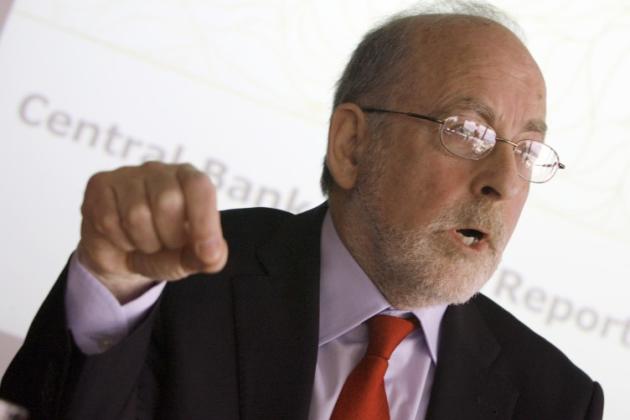

Former CEO of Irish Nationwide Michael Fingleton (right pic.) one of the guilty parties,
Patrick Honohan, Governor of the Central Bank at a briefing about the new mortgage rules at the Central Bank in Dublin.
Ireland should consider enacting laws to deal with reckless bankers similar to those being put in place in the UK, Central Bank governor Patrick Honohan has said.
Mr Honohan said the behaviour of bankers in the run-up to the crisis in Ireland was, for the most part, unwise rather than criminal.
And he also suggested the directors and managers of the banks were chiefly to blame for the banking crisis here and not the regulators, although there were “supervisory flaws”.
“There have been convictions of some senior Irish bankers found to have committed a criminal offence in the latter phases of the crisis (though no prison sentences), and a number of other cases, criminal and civil, are still in preparation,” Mr Honohan said, in a speech in Paris this morning.
“But the Irish legislative framework deserves to be strengthened to take account of egregious recklessness in risk-taking by those who were in charge of failed financial firms.
“Recently the UK enacted legislation of this type which I believe could be usefully mirrored in Ireland.”
New powers are being put in place in the UK to jail bankers for up to seven years for reckless misconduct.
Senior bankers will also be presumed guilty until proven innocent under strict new rules proposed by British regulators seeking to hold individuals accountable for bank failures.
Mr Honohan said it was a fact to say that it was the unrestrained and reckless behaviour of the banks that destabilised the economy and public finances.
“Of course there are many ways of allocating blame, but in my view the first line of defence against what has happened must be the directors and managers of the banks,” he said.
“With greater prudence by management and boards of the lending banks, this bubble could not have happened.”
He said it is partly true that lax supervision was to blame, because “any attempt to assign responsibility must start with the banks.”
“Still, we must not neglect the ineffectual supervision which failed to inhibit this banking behaviour.
“These supervisory flaws were similar in character to what happened in half a dozen other countries, reliant on un-intrusive supervision that presumed a well-managed bank would not create systemic failure.”
But what was happening here was different and should have precipitated closer scrutiny.
“In Ireland the scale of the bank credit expansion and the associated construction and housing price boom was of a different life-threatening order of magnitude.
“Credit expansion on such a scale should have rung alarm bells triggering much more intrusive examination of the vulnerabilities and corrective measures should have been introduced.”
NUI Galway researcher identifies ‘off-switch’ to reduce the spread of bowel cancer


Dr Aideen Ryan of NUI Galway.
Research funded by Irish Cancer Society and led by NUI Galway wins prestigious European Association for Cancer Research Award
Irish researchers have found that switching off a specific protein in bowel cancer cells can stimulate an anti-tumour immune response which can reduce the spread of cancer to other parts of the body. The breakthrough research by Dr Aideen Ryan of NUI Galway, which was funded by the Irish Cancer Society, has been awarded the prestigious European Association for Cancer Research (EACR) Young Investigator Award. Dr Ryan works in the area of Biosciences as an Irish Cancer Society Research Fellow with the Immunology Group in REMEDI.
Bowel cancer is one of the most common cancers affecting both men and women. With approximately 2,400 new cases and almost 1,000 people dying from this cancer each year, bowel cancer represents a significant health concern in Ireland. To date, therapeutic developments to tackle the problem of bowel cancer spreading to other parts of the body have had very little success and new methods are urgently needed to improve survival for patients.
This award winning research found that the activity of a key protein known as NF-kappaB, with the help of a type of immune cell, called tumour-associated macrophages (TAMs), promotes the spread of cancer cells from the bowel to the abdominal cavity. TAMs are present within or close to tumour tissue and can act in tumour-promoting or a tumour-killing manner, depending on their surrounding environment. Dr. Ryan and colleagues in NUI Galway found that TAMs can be switched from being tumour-promoting to being tumour-killing by turning off the NF-kappaB protein in bowel cancer cells, thereby causing a significant reduction in bowel cancer spread to the abdominal cavity.
Dr Ryan said “I am delighted to have been presented the EACR Young Investigator Award for this research. Our findings have, for the first time, uncovered the effect of targeting the NF-kappaB protein in bowel cancer cells. We are continuing this important research in order to develop a new treatment approach for bowel cancer which could potentially result in better treatments for patients with this disease.”
This research adds to recent developments in bowel cancer research conducted with the support of the Irish Cancer Society whereby Irish scientists are now developing a simple and inexpensive blood test which can be used as an early detection tool for bowel cancer. Irish Cancer Society funding, provided through the Society’s Research Fellowship Programme to Dr Gregor Kijanka, Dublin City University, was instrumental in the initial development and validation of this new test.
Commenting on the research, Dr Robert O’Connor, Head of Research, Irish Cancer Society said, “We are delighted to see that the Society’s investment in bowel cancer research is generating exciting new findings which will make a difference to patients. We congratulate Dr Aideen Ryan on receiving the EACR Young Investigator Award which is testament to the significant contribution she has made to the area of bowel cancer with her ongoing research. This research, which was made possible by Irish Cancer Society research funding, opens new avenues for the development of novel treatment approaches which will hopefully benefit bowel cancer patients in Ireland.”
The announcement of Dr Ryan’s award comes as the Irish Cancer Society launches Bowel Cancer Awareness Month. The campaign is calling on men and women throughout Ireland to be aware and act on the early signs and symptoms of bowel cancer. These include:
- A change in your normal bowel motion, such as diarrhoea or constipation
- Feeling you have not emptied your bowel fully after a motion
- Pain or discomfort in your abdomen (tummy) or back passage
- Trapped wind or fullness in your tummy
- Weight loss
- Tired and breathless (due to anaemia from blood loss)
- Rectal bleeding or blood in stools
- A lump in your tummy area
Dr Ryan’s research was published in Oncogene, one of the world’s leading cancer journals, and Dr Ryan was awarded the European Association for Cancer Research (EACR) Young Investigator Award at the annual Irish Association for Cancer Research (IACR) conference. This award is presented to outstanding young researchers in the field of cancer research for a recent, significant contribution to the field.
Anyone who is concerned about Bowel Cancer should call the Irish Cancer Society’s National Cancer Helpline on 1800 200 700.
Young Irish writers are ‘dazzling in their scope and originality’
Award-winning novelist Joseph O’Connor’s inaugural lecture as Professor of Creative Writing at UL

Ellen McCourt, wife of the late Frank McCourt, with Professor Joseph O’Connor before his inaugural lecture as Professor of Creative Writing at the University of Limerick.
Award-winning novelist Joseph O’Connor has described up and coming young Irish writers as “dazzling in their scope and originality”.
Speaking before his inaugural lecture as Professor of Creative Writing at the University of Limerick, the acclaimed novelist said teaching has brought him back to the “well spring of why he wanted to become a writer”.
Mr O’Connor was appointed as the inaugural Frank McCourt Chair in Creative Writing at UL last year.
“Young Irish writers are so hard working, they are much more focussed on having a career than my generation of writers would have been when we were in our twenties. They are influenced by writers from all over the world. They are very outward looking and not insular, passionate and hardworking . . . to be surrounded by that level of enthusiasm and is very replenishing.
“The applications we get from young Irish writers are just dazzling in their scope and their originality and their ambition,” he added.
Speaking about the advice he gives to his 12 students on the MA in Creative Writing programme at UL, the author of eight published novels, including the million-selling Star of the Sea said: “I say to the students that writing is actually a lot more like a marriage than it’s like falling in love. You make a commitment to writing and you have good days with it, and you have bad days with it.
“Some times you have a little row with writing and you’re not sure why you and writing should have ended up together at all, but then you make up, and you hope that in the long term it will be worth it and that’s the level of commitment that it requires.”
“Writing isn’t for everybody, one of the myths about writing is the muse; that I can only write when I am inspired, but a professional writer develops a skill of being able to write all the time. You have got to meet the muse half way, you don’t wait for her to come and knock on your door you go out and find her, so that’s just one of the realities of a writer’s life, you need to make writing a part of your life, preferably on a daily basis.”
Frank McCourt’s widow Ellen McCourt was among the guests of honour at last night’s inaugural lecture held at the Irish World Music Academy in UL.
Mrs McCourt said her late husband and Joseph O’Connor shared a “similar sensibility”.
“I think Frank would be extremely pleased that Joseph holds this first chair,” she said.
Mrs McCourt also spoke about the importance of having a liberal arts education. “Somewhere in there, the arts should play a part, because we are really educating the whole person and you really shouldn’t be just on a one track programme.”
Meet the terrifying 4ft tall terror bird who stalked the Earth 3.5 million years ago

“Scaglia’s Magnificent Bird” lived in South America and is now an exceptionally preserved fossil gives voice to the ancient terror bird
A flightless “terror” bird four foot tall with a hooked beak stalked the Earth 3.5 million years ago, new research reveals
“Scaglia’s Magnificent Bird” lived in South America during the Cenozoic period from the end of the Cretaceous Period and the extinction of non-avian dinosaurs 65 million years ago to the present.
The Cenozoic is sometimes called the Age of Mammals because the largest land animals were mammals at that time.
Scary: They roamed the Earth armed with hooked beaks
Now an exceptionally preserved fossil gives voice to the ancient terror bird called Llallawavis scagliai – and it’s hearing was below average for living birds.
The fossil is the most complete terror bird ever discovered, with more than 90 per cent of the skeleton exquisitely preserved shedding light on the diversity of the group and how these giant extinct predators interacted with their environment.
The new specimen also revealed details of anatomy that rarely preserve in the fossil record, including the auditory region of the skull, voice box, complete trachea, bones for focussing the eye, and the complete palate.
Skull: Evidence of the bird that stalked the Earth 3.5 million years ago
This allowed palaeontologists to build up an unprecedented understanding of the sensory capabilities of these extinct predatory birds.
Dr Federico “Dino” Degrange of the Universidad Nacional de C rdoba, Argentina said: “The mean hearing estimated for this terror bird was below the average for living birds.
“This seems to indicate that Llallawavis may have had a narrow, low vocalisation frequency range, presumably used for intraspecific acoustic communication or prey detection.”
Terrifying: The birds were 4ft tall
The study published in the Journal of Vertebrate Paleontology was the first to reconstruct the structures which indicate hearing sensitivity for any terror bird and may help explain the evolution, behaviour, and ecology of this group of fossil birds.
Terror birds, or phorusracids, were the predominant predators during the Cenozoic Age in South America and certainly one of the most striking groups that lived during that time.
Dr Claudia Tambussi added: “The discovery of this new species provides new insights for studying the anatomy and phylogeny of phorusrhacids and a better understanding of this group’s diversification.
The new species stood 4 feet tall and lived in Argentina approximately 3.5 million years ago in the Pliocene Epoch, towards the end of the reign of the group.
Dr Degrange said: “The discovery of this species reveals that terror birds were more diverse in the Pliocene than previously thought.
“It will allow us to review the hypothesis about the decline and extinction of this fascinating group of birds.”


