A recent report estimates there are almost 250,000 vacant properties in Ireland

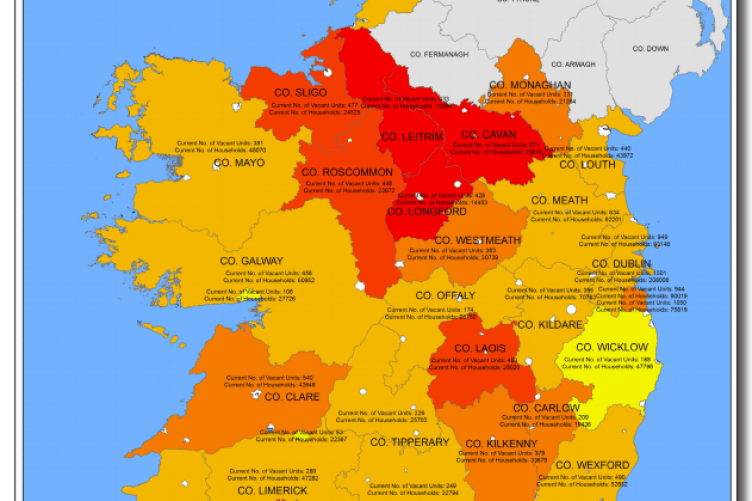

A RANGE OF SOLUTIONS HAVE BEEN SUGGESTED FOR THE GOVERNMENT TO INCENTIVISE OWNERS TO OPEN UP VACANT HOMES
Chairman of the Housing Agency Conor Skehan has said more needs to be done to solve the housing crisis than just building new homes.
It comes after a new report from the agency estimates that there are almost 250,000 empty houses across Ireland.
Speaking on RTÉ’s Morning Ireland, Mr Skehan said this is an opportunity for everyone as it translates to around two years’ supply of housing that could be used.
Mr Skehan said there are a range of solutions that the Government could use to incentivise owners of vacant homes to open them up.
He said refurbishment grants for vacant homes or short-term taxation breaks on rental income when someone puts a vacant property into use could be launched.
Other countries penalised those who had long-term vacant properties but the housing agencies would prefer to use “carrots”, Mr Skehan said.
“Countries like Scotland, England and France actually penalise long-term vacancies – once your house is vacant for more than a year in an area of high population density you would start to pay dramatically increased tax every year.”
He added that bringing property back into use is “the real trick”.
The Minister for Housing. meanwhile, has admitted something needs to be done about the vacant homes in Ireland.
Speaking on RTÉ’s News at One, Simon Coveney said a new housing policy will be launched by the end of July, adding that he will not be afraid to be radical.
Mr Coveney indicated that he “may well” look at the option of tax penalties to force vacant properties into use.
The Cork South Central said 40% of people looking for homes in the Dublin area are getting no supply at all.
He said there is a mismatch in terms of the number of housing units being built but also the type of units being provided.
The minister said that homelessness and housing is the Government’s number one priority.
Meanwhile, Focus Ireland said the Government may need to consider a moratorium on evictions as the number of families becoming homeless continues to rise.
74 families became homeless in Dublin in April. Figures from Focus Ireland show that 366 families became homeless in the first four months of the year.
The charity’s Director of Advocacy, Mike Allen, said it is simply not possible for the homeless sector to deal with that number of families losing their homes.
Mr Allen said the number of families ending up homeless us continuously rising, adding that figures released by the charity today do not indicate a downward trend.
He said with summer coming there will be more pressure on hotels, meaning less rooms available for families.
Mr Allen added what we want to avoid is a point where we hear of a family sleeping in a park.
Typical Irish motorist spending costs now €193.65 per month for fuel
FIGURES FROM AA’S SURVEY OF NATIONAL FUEL PRICES SHOW RISING COST


AA SAYS CHANGES IN THE GLOBAL OIL MARKET ARE NOT BEING PASSED DOWN TO CONSUMERS??
A typical Irish motorist is now spending around €193.65 per month on fuel as both diesel and unleaded fuel costs continued to climb this month.
A litre of petrol now costs an average of 129.1c, up 3.1c, while diesel rose by 2.1c to 113.2c, according to the AA’s survey of national fuel prices.
The survey added that growing pump prices are a result of the recent rise in the cost of oil which is now sitting at $47 per barrel, up from $44 last month.
The AA also found that a monthly average of €4.65 has now been added to the cost of filling up a car that runs on 150 litres of petrol per month. A typical Irish motorist is now spending around €193.65 per month on the fuel.
AA director of consumer affairs Conor Faughnan said changes in the global oil market were “far removed” from consumers.
“Huge trades made on international exchanges are far removed from the consumer,” he said. “In fact, you can sometimes see price movements even throughout a single day as trading can get spooked in response to headlines.
“The bigger issue is tax, and of your €190 or so monthly fuel bill, nearly €130 goes directly to the Government in tax. If oil pursues its current pattern, we could see fuel prices continue to accumulate well into 2016.
“We would like to see the new Government remove the austerity taxes slapped on between 2008 and 2012 by their predecessors. This is nothing short of an anti-stimulus measure and is effectively taking money out of the pockets of consumers.”
HSE commits to filling all vacant nursing posts in Galway UH emergency department


THE HSE CONFIRMED YESTERDAY THAT ALL VACANT NURSING POSTS IN THE COUNTRY’S EMERGENCY DEPARTMENTS, INCLUDING AT UHG, WILL NOW BE FILLED.
The Irish Nurses and Midwives organisation says the commitment comes despite a recent announcement by the HSE that recruitment would be paused.
The confirmation was given at the third Review of the ED Agreement between the HSE/Department of Health and the INMO, which was chaired by the Workplace Relations Commission today.
The ED Agreement provides for the filling of over 144 staff nurse posts in emergency departments across the country.
The A&E unit at UHG has been repeatedly branded the worst in the country for overcrowding – and concerns have been raised over staffing and facilities at the department.
Today’s review at the WRC also considered a number of other issues including the appointment of an Assistant Director of Nursing in each ED nationwide, with responsibility for patient flow.
The WRC will convene the parties again in July to undertake its fourth review of the implementation of the ED Agreement.
Secretary General of the INMO Liam Doran says hospitals including UHG now have to make greater effort in recruiting and retaining staff.
Two Irish government ministers to share broadband roll out responsibility


LAST MONTH IT EMERGED THAT THE GOVERNMENT’S PLAN TO ROLL OUT HIGH-SPEED BROADBAND CONNECTIVITY TO EVERY PREMISES IN THE COUNTRY HAD BEEN DELAYED.
Responsibility for the State-backed roll-out of high speed broadband to 757,000 premises around the country is to fall to two departments under the new Government.
The Department of Communications, Climate Change and Natural Resources will be responsible for the public procurement of the high-speed telecoms network, and will develop proposals for an entity to manage all of the State’s broadband contracts.
However, the Department of Regional Development, Rural Affairs, Arts and the Gaeltacht, led by Heather Humphreys, will be responsible for ensuring that rollout can be delivered quickly once a contract or contracts are in place.
The new arrangements were announced by Minister for Communications Denis Naughten at the installation of a new broadband service in a national school in Co Roscommon today.
The minister also revealed that Ms Humphreys will set up county or regional broadband task-forces and work with local authorities, Local Enterprise Offices, LEADER Groups and other agencies to help accelerate the broadband network build in rural Ireland.
The task-forces will develop rural digital strategies, he said, to ensure that planning permissions and road openings can be processed quickly, identify priority areas for the rollout of infrastructure and to develop regional digital hubs.
Separately, a national mobile phone and broadband task-force will be established, the minister said, which will consider immediate measures to alleviate broadband and mobile phone service deficits across rural Ireland.
Last month it emerged that the Government’s plan to roll out high-speed broadband connectivity to every premises in the country had been delayed.
The original plan foresaw the completion of the network by the end of 2020 at the latest, but a delay in the procurement phase means contracts will not be signed until the middle of next year – at least six months later than planned.
Further doubt was cast on the timeline for completion of the plan with the announcement of the formation of the new Government when the Taoiseach said responsibility for delivery of the pledge would be transferred from the Department of Communications, Climate Change and Natural Resources to the Department of Regional Development, Rural Affairs, Arts and the Gaeltacht.
But speaking today, Mr Naughten emphasised the Government’s strong commitment to revitalising rural Ireland through the implementation of the plan and other measures, and said the initiative was a top priority.
He described the The National Broadband Plan as a defining plan for Ireland, adding that it will be the most significant investment in rural Ireland since rural electrification.
He also gave an update on the progress of the delivery of the interventions, saying the procurement process is well under way.
The expectation is that interested companies will be shortlisted as bidders in the next month, with a contract or contracts signed by June 2017, Mr Naughten said.
Ryanair reveals its average fare and even you could soon fly for free


MICHAEL O’LEARY, CEO OF RYANAIR, RYANAIR’S SAYS THE AVERAGE FARE NOW STANDS AT €46.67, DOWN 1% THIS YEAR ON LAST YEAR.
RYANAIR’S AVERAGE FARE IS FALLING, AND ITS CEO SEES NO REASON WHY PASSENGERS COULDN’T FLY FOR FREE IN THE FUTURE.
The figure was announced with the airline’s annual results today, which showed a 43pc rise in profits to over €1.2bn despite terrorism fears and ATC strikes.
Fares are set to fall a further 7pc in the next six months, the airline says, with fuel savings and growing passenger numbers reflected in lower prices.
But that’s nothing on the prices you could pay in the future.
“My plan is that the average fares on Ryanair would be €10 in the next five years,” Michael O’Leary told the media at the recent launch of Year 3 of the airline’s Always Getting Better programme of customer service improvements.
“I’D SEE NO REASON WHY THEY CAN’T BE €15, €10, €5… WHY NOT EVEN FREE?”
His argument is based on the airline growing passenger numbers to 180 million a year, as is its aim by 2024, with fares dropping as sales of ancillary services ranging from checked bags to car hire, travel insurance and hotel rooms grow.
“As long as we can persuade people to buy additional, optional services, then I see no reason why we can’t keep driving down the underlying airfare,” O’Leary said.
RYANAIR AIRLINE IN NUMBERS:
- 31: Years since Ryanair’s launch
- €46.67: Current average fare
- 86: Ryanair routes from Dublin
- 340: Number of aircraft (with 330 Boeing 738s on order)
- 500: Ryanair flight cancellations following strikes and terrorist attacks
- 1,800: Daily flights operated
- 106m: Passengers flown in financial year
- 180m: Predicted passengers per annum by 2024
- €1.24bn: Full year profits, up 43pc on previous year
- €1.43bn: Expected net profits in FY2017
Sale fares are currently available from €9.99 on Ryanair’s website, but of course prices rise much higher than the average figure of €46.67, too.
As we publish, fares from Dublin to Bordeaux, where Ireland play the second of their Euro 2016 Group E games on June 17, were up to €299.99 one-way.
Irish researchers new breakthrough may accelerate hydrogen’s replacement of fossil fuels



HYDROGEN HAS BEEN DESCRIBED AS THE ULTIMATE CLEAN ENERGY SOURCE AND POTENTIALLY A REAL ALTERNATIVE TO FOSSIL FUELS
Researchers at the CRANN nanoscience institute at Trinity College Dublin have discovered a new clean energy material that will increase the adoption of hydrogen as a fuel in energy-efficient transport.
Hydrogen has been described as the ultimate clean energy source and, potentially, a real alternative to fossil fuels.
It is seen as very attractive as it is a pollution-free fuel and energy carrier that would satisfy much of the energy requirements of our society.
Hydrogen is readily prepared by splitting water electrically into its component parts hydrogen and oxygen; a process called electrolysis. However, this process requires a significant energy input.
‘Our disruptive materials breakthrough is momentous as it means much more energetically efficient and more economical hydrogen energy’
But now, researchers at CRANN have developed a material that enhances the splitting of water at a very low energy cost using Earth-abundant raw materials.
A realistic clean energy alternative?
“This scientific breakthrough brings us one step closer to a realistic energy alternative,” said Lorraine Byrne, executive director, CRANN Institute and AMBER National Centre.
The CRANN breakthrough, recently published in the prestigious international journal ACS Catalysis, has shown that the ruthenium content can be decreased by as much as 90pc and substituted with the Earth-abundant and inexpensive manganese oxide without diminishing the efficiency of the material to split water.
“We are very excited about this very significant breakthrough,” said Prof Mike Lyons, principal investigator at CRANN.
“The adoption of this material in industry will mean that electrochemical hydrogen generation using photo (electrolysis) is now far more economically viable and will hasten adoption of hydrogen as a fuel in energy-efficient transportation.
“It should be noted that this discovery could only have been accomplished using the world-class characterisation facilities and opportunity for interdisciplinary collaboration available within the School of Chemistry and CRANN.
“Our disruptive materials breakthrough is momentous as it means much more energetically efficient and more economical hydrogen energy. This means that the cost of producing hydrogen via water electrolysis will be significantly reduced, which will result in a more rapid uptake of hydrogen as an automotive fuel,” Lyons said.
