Pages

Showing posts with label Irish water bills. Show all posts

Tuesday, August 18, 2015

Donie's Ireland daily news BLOG update

A technical error sees Revenue ask foreign businesses for millions of euro

The issue relates to the new ‘VAT Moss’ system.


The Irish revenue has said that a “technical error” resulted in around 2,000 overseas businesses being sent incorrect invoices.

These were supposedly for the new VAT Moss system that has been put in place to allow businesses to pay tax abroad without having to register in each jurisdiction.
Revenue has said that it is working to update the system to prevent a recurrence of the problem.
Traders who received the invoices took to social media to express their disbelief, with the error being covered on the WebDevLaw blog. Earlier Alastair Houghton, a member of the HMRC/SME VAT Moss Working Group in the United Kingdom, said that the letters had come from the Irish Revenue Commissioners but had been sent in error.
There has been no financial impact on those who received the invoices and Revenue has issued an apology for the incident.
Earlier letters were asking some individuals for amounts in excess of €1 million.
Invoices were mostly sent to customers in the United Kingdom. Other correspondence is known to have been sent to the Netherlands and possibly the United States.
The letters sent out were addressed from Michael Gladney, the collector-general with the Revenue. Individuals were given instructions on where to transfer money to.

Irish Water staff start calling customers who fail to pay first bills


Irish Water Staff now calling customers who have not made a payment after first two bills, and they remind customers to pay the bill and the charges due.

Irish Water has started calling customers who have failed to make any payments on their first two utility bills to remind them to pay the charges.
Irish Water spokeswoman Elizabeth Arnett said call centre staff last week began phoning customers who had yet to make any payments 21 days following the issuing of their second water bill.
The company had stated five weeks ago that it intended to take this step, which was normal practice “in every single utility company”, she said. Ms Arnett denied suggestions made in some media that there was any targeting of older customers by the call centre staff.
“There is no age profiling, no targeting of older people. I absolutely categorically refute that, it is absolute nonsense.”
She also emphasised the calls were being made by the company’s call centre, and the debts had not been passed on to a debt collection agency. Suggestions made by anti-water charge protesters that some elderly people had been told their water supply would be cut were also false, she said.
“We record every single phone call, this would not and could not happen.”
Payment’s.
Call centre staff offer customers the opportunity to pay over the phone, and outline the different payment methods to those who do not wish to pay at that time, she said.
Figures released by Irish Water in mid-July showed 46 per cent of water charges issued for the first three months of the year had been paid, €30.5 million of the €66.8 million due
This equates to about 675,000 households or 43 per cent of the estimated 1.5 million households on the public water network.
While follow-up calling for non-payment of utility bills may be a common practice, the decision represents yet another public relations blunder for Irish Water. There have been a succession of incidents that have plagued the utility.
Questions were raised over executive remuneration and bonus payments. Head of Irish Water John Tierney revealed on RTÉ that the company had paid €50million to consultants. Then within weeks it emerged that 29 staff members earned more than €100,000 each.
The ESRI economist John FitzGerald calculated that the extra 2,000 staff the company absorbed from local authorities would cost Irish Water up to €2 billion by 2025.
Two weeks ago Eurostat raised a number of concerns about the Government’s considerable control of the utility company. The EU statistics agency confirmed the company had failed the Market Corporation Test which means it must remain on the exchequer balance sheet in the coming years. It also took issue with Government control regarding board appointments and operations.

A third of us have spotted people shaving or putting on make-up while driving


Almost a third of drivers say they regularly see people applying make-up or shaving while driving.

The figure comes from a survey by the AA, which also says that 83% of us have seen people using a phone while behind the wheel.
56% of those polled said they had seen people texting while driving, while another regular experience was witnessing people not indicating properly on roundabouts (84%).
Personal grooming – applying make-up or shaving – are not explicit offences, but the AA warned it could be considered “driving without reasonable consideration.”
“It is worrying to think that people are still taking risks despite the fact that everyone with an ounce of sense knows the dangers. There are stricter provisions on mobile devices that will soon become law and there are really no excuses,” said Conor Faughnan, Director of Consumer Affairs at AA Ireland. “Certainly not for personal grooming; that’s ridiculous behaviour.”
The AA also collected anecdotal evidence by positioning a fieldworker on a busy intersection to observe traffic. They reported that, out of 415 vehicles observed passing the intersection during one hour, 10 motorists – including two taxi drivers – were using mobile phones. Another four used their phones while first in the queue at lights.

Researchers target early warning system signs of concussion

Leinster Rugby and TCD have linked up in two promising brain injury studies.
  

Ulster’s Stuart Olding above picture left leaves the field after a head injury sustained against Munster at Thomond Park in last season’s Pro12 competition.

Concussion continues to hang over rugby like an unwelcome cloud. We can expect the World Cup to highlight the dangers and see how far the sport has travelled on what has been a steep learning curve. But the threat of brain trauma is becoming less sinister and more understood as academics in Trinity College Dublin begin to make inroads and promote some optimism.
In recent months researchers at the university doing work involving blood examinations, as well as using cadavers to see how body movement behaves on impact, have joined forces with Leinster Rugby for two innovative projects into the diagnosis and analysis of the injury.
Early warning system
Ultimately, the teams hope to identify incidences of concussion and predict when a player should be taken out of a match. They are not at that stage yet, but initial findings have moved both projects closer to the main objective of an early warning system that would increase player welfare.
One of the projects is based on studying the movement of human bodies in car accidents to help understand what positions and actions cause brain trauma in sports collisions.
The other is a simple blood test that shows up proteins that are associated with concussion. In time they hope a pin-prick test can be used to determine head injury. They have already identified what they call metabolic patterns that indicate trauma has taken place.
“Every activity in the body leaves a map,” says Dr Fiona Wilson, a former Irish rowing team physiotherapist, who along with physiologist Áine Kelly, is conducting the research into blood.
“The fluids of your body tell you a lot. It’s a protein and shouldn’t appear in the general circulation unless the blood brain barrier has been compromised. We are looking at these metabolites and early stages show we may have a map.”
Brain trauma
They have studied the blood from people with severe brain trauma and examined the proteins. They then took blood from rowers, who do not have any collisions in their sport but their metabolic systems work as hard as professional rugby players.
This was to determine that the proteins found in rugby players were from multiple collisions and not physical exercise. From the injured patients they knew what “brain damage” proteins would appear in the blood.
“It’s the same as having a heart attack,” adds Wilson.”You go in to hospital with a pain in your chest and they measure cardiac enzymes. It’s like a brain injury. We know patients with brain injury so we can match our players against that.
“Our initial findings indicate that we have made significant progress in identifying the blood test. Collaboration with Steno Diabetes centre in Denmark means progress can be made towards a finger-prick blood test already familiar to diabetes management.”
In time, debates like those around Irish outhalf Johnny Sexton and Welsh winger, George North – should they or shouldn’t they return to play – will be measurable, a sort of Hawkeye for head injury.
The movement patterns, of bodies involved in collisions may appear ghoulish, but in scientific endeavour there’s no such thing as squeamish and dead people can often keep the living alive for longer.
Associate professor Ciarán Simms and bioengineering PhD student Gregory Tierney are using multi-angled videos to look at collisions. They take real footage of rugby incidents and superimpose a model skeleton image on the players.
Based on previous knowledge from experiments conducted on cadavers and studies of pedestrian crashes, they use mathematics to conclude what forces are in play and identify various tolerance thresholds.
From a database compiled over years of research, they can look at the kind of body movements and collisions that cause concussion. It takes several weeks to do a study, but with automation the goal is for real time use during rugby matches.
“The aspiration is to have a real time use. But we’re at early stages,” says Simms. “We are also reconstructing collision cases with ‘what if’ scenarios. For coaches, for example, you could ask what could a player do to effect a tackle without getting injured.”
The findings are ready to be peer reviewed, with a draft of findings expected to be ready within a month. The perfect outcome would be that for each match a TMO equivalent could look at impacts and use the technology to instantly tell whether a concussive impact has occurred or not. In tandem with the blood markers and the other battery of neurological tests there is excitement about bringing the lab to the pitch.
“Leinster is very supportive of the research,” says Wilson. “They have been so invested in making sure this happens. Every time the players give blood it’s a favour because there is no immediate benefit to them. It’s unusual for athletes, because they are usually being pulled in all directions by different people, to be so helpful.”
The research is being funded from America by the NFL’s Head Health Challenge, a fund for the development of new materials and technologies that can detect early-stage mild traumatic brain injuries and improve brain protection. As collaborators, they are committing up to $20 million to a variety of projects.

Owls use a ‘stealth technique’ to capture their prey
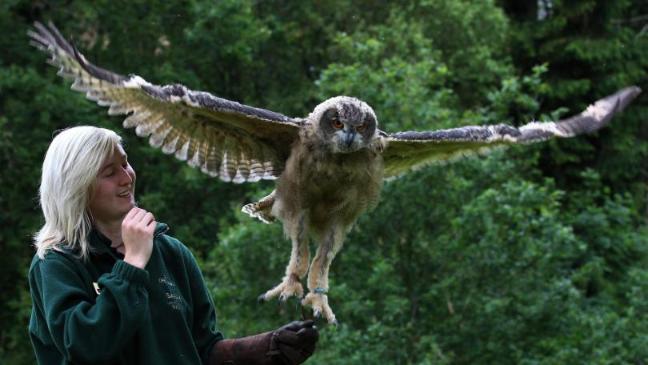
 

Owls are equipped with sophisticated ‘stealth technique’ to help them swoop on prey undetected, according to new study that unveils the secret behind the nocturnal bird’s silent flight.

Owls are equipped with sophisticated ‘stealth technique’ to help them swoop on prey undetected, according to new study that unveils the secret behind the nocturnal bird’s silent flight.
Scientists have long been puzzled by the owl’s ability to flap its wings hard enough to rise into the air without a sound while swooping silently on swift-moving rodents out of the still night.
The researchers crowned the owl the “king of acoustic stealth” after discovering that its wings absorbed the energy of flight vibrations and converted it to heat much more efficiently than other birds they examined.
Generating enough thrust to get aloft involves a large amount of force and disturbs a lot of air. Yet most owl species manage to do it at frequencies below 2 kilohertz (kHz), well out of their prey’s hearing range, ‘The Times’ reported.
Researchers used the feathers of a long-eared owl, a golden eagle and a pigeon.
Simulating wing-beats, they measured the vibrations and found that the owl feathers trapped much more of the energy as heat than the others.
Scientists could copy the owl’s noise-reduction mechanisms to quieten machine noises such as the thrum of onshore wind turbines, said Jinkui Chu, professor of mechanical engineering at Dalian University of Technology in China.
“The owl’s silent flight ability is even more superior than we thought,” said Jinkui.
“It not only manages to suppress aerodynamic noise when gliding, but also mechanical noise caused by vibration during flying. This is remarkable, considering the noise that creates for other birds,” he said.     

Saturday, June 27, 2015

Donie's Ireland daily news BLOG

Enda Kenny says a deal on Greece crisis still possible at weekend talks

If deal signed-off by finance ministers bailout could be extended, says Taoiseach

  
British prime minister David Cameron, speaks to Taoiseach Enda Kenny and Angela Merkel during a round table meeting at an EU summit in Brussels and right photo Greek finance minister Yanis Varoufakis.
Greece will get an extension of its current bailout for another six months if agreement can be reached with the euro zone finance ministers tomorrow, according to Taoiseach Enda Kenny.
Speaking to journalists at the end of the EU leaders’ summit in Brussels, he said time was running very short but a solution could still be found if there was proper engagement.
He said the EU Commission, the European Central Bankand the International Monetary Fund had undertaken to consider the latest set of proposals.
Mr Kenny said if there was agreement and it was signed off on by the euro zone finance ministers it meant there could be an extension of the current programme for six months.
“It shows the willingness of the institutions and everybody else to accommodate the proposals that have come in from Greece,” he said
Hr Kenny said at the meeting of EU leaders he had told them of the Irish experience and how “our focus was on ending instability and creating growth and providing opportunities for jobs” as a way out of the crisis.
“It was not a case of me telling him (Alexis Tsipras) what happened in our case and saying you have to do the same but saying what we did and how we were able to exit the bailout.”
The Taoiseach said he had pointed to the damage the current instability was causing and how that was impacting on the ordinary people of Greece.
“So I do hope that measures can emerge to deal with that and I spoke to the prime minister about that,” he added.
Mr Kenny also spoke about the briefing British prime minister David Cameron gave to the summit about his plans for an in/out referendum on EU membership.
“He gave a very brief outline of his proposals for reform before that referendum takes place. He did say that this was the start of a process and the ship was launched. He did talk to individual countries and individual governments and he hopes to have a more complete report by December. He recognises that agreement will take a great deal of work.”
The Taoiseach said Mr Cameron’s contribution had been short and to the point.
Mr Kenny said Ireland would have a problem around any proposals that involved changes in EU treaties.
“I think there would be serious difficulty about this for a number of other countries and not just Ireland.”
He added the solution might just well be what happened in the case of Ireland when it had problems with EU treaties. A legally binding attachment to the next treaty that might come along that might come along.
“He is very conscious of that himself,” said the Taoisaech.
He added that if the question was to open the treaties for further treaty change on an issue like this, there would be 95 per cent opposition.
Mr Kenny added, however, that aside from treaty changes Ireland would be constructive and supportive.
“We will obviously wait and see what comes of the technical work. We will have a better idea of what is involved when the issue comes on the council agenda for the December meeting,” said Mr Kenny.
On the issue of migration which was supposed to be the main focus of the summit Mr Kenny said the entire meeting had been impacted on by the Greek situation.
“So the discussion that took place on migration which might have been difficult in its own right.”
He added it had been agreed to rebalance the EU approach to migration and agreement between member states on a voluntary relocation plan.
It was agreed to help 60,000 people, 40,000 through relocation and 20,000 in resettlement.
Mr Kenny pointed out Ireland had an opt-out along with the UK and Denmark but would consider what we could do to help.
“At our meeting we also resolved to do more to address the factors that drive people to risk their lives to arrive inEurope. People are coming in from west Africa, from the horn of Africa and also through Libya, ” he said.
Mr Kenny also said he had expressed condolences and sympathies to president François Hollande and the French people about the appalling events that had taken place today.

Connemara Mining company identifies possible gold source in Co. Donegal


Irish exploration company Connemara Mining has identified a target area for more detailed investigations after finding material with gold values in Donegal.

In a statement published today the firm said that it has finished the first phase of prospecting on its newly acquired Inishowen block in Donegal.
The company said that quartz vein material with gold values in excess of 15 grams per tonne have been traced to a possible nearby source area.
Follow up work will now include a soil sampling programme to further refine the target and will be followed by an initial trenching programme and a later drilling programme, if justified.
Chairman John Teeling said: “This is an exciting time for Connemara, and Irish minerals exploration. The Ulster gold play was unlocked with previous discoveries in Tyrone and Monaghan.
“We believe that this geology extends from Donegal into central Scotland. It is early days but initial results seem to confirm our working model.”

Irish water bill amendments will bring some ‘clarity’, 

Says Minister Coffey


The Minister of State at the Department of the Environment Paudie Coffey above left.

But Paudie Coffey fails to confirm whether tenants face eviction if they do not pay their water bill

Irish Water provisions, which ensure a house cannot be sold until charges are paid, have been introduced to bring “clarity and certainty for landlords and tenants”, according to a Minister of State Paudie Coffey.
The Minister of State at the Department of the Environment described claims that tenants who don’t pay their Irish Water bills could face eviction as “scaremongering” on the part of the opposition.
Speaking on RTÉ’s Morning Ireland, Mr Coffey said the amendments to the bill had been introduced to create a method of enforcement “to ensure that those who are not compliant and are refusing to pay, that they do pay”.
Minister for the Environment Alan Kelly has introduced 33 pages of amendments to the Environment Miscellaneous Provisions Bill.
It contains a number of changes, including the setting up of a database for the water conservation grant and provisions to ensure a house can’t be sold until the charges are paid. The Bill also obliges local authority tenants to pay their water charges.
Mr Coffey failed to confirm whether tenants would be evicted if they did not pay their bill, saying payment was “a matter for the landlord and tenant as is the case in any contract situation for tenancy”.
Asked if the landlord would have to pay if the tenant failed to do so, he said the owner of the property would be responsible for discharging any unpaid bills before selling the home.
“We want to see people compliant with the law and we don’t want to see people ending up in trouble and that’s why we’re making measures that we feel are fair and bring certainty to the whole area.”
Mr. Coffey said users who applied for the Water Conservation Grant worth €100 before June 30th could expect to receive the money “before the end of this year”.
He also said an independent test due to be carried out by Eurostat, the EU statistics agency, was imminent and would take place in the “next few weeks or possibly months at the latest”.
Mr Coffey said he was unaware of how many people had actually paid their water bill so far, adding that it was a matter for Irish Water to respond to.
“I understand there’s a board meeting due to happen next week… and I would encourage them to publish the payment figures then.
People before Profit TD Richard Boyd Barrett said earlier this week the amendments to the bill were “desperate, devious and discriminatory”and were aimed at undermining the national movement against water charges.

German Shepard dog given award for saving a diabetic owner’s life

Looby Loo came to the rescue!


They say dogs are a man’s best friend and one devoted German Shepherd proved to be even more so than that to her sick owner.

Rescue dog Looby Loo saved the life of Toby Snow when he fell desperately ill and is now being awarded a PDSA Commendation, which recognises outstanding acts of devotion by pets.
When the 57-year-old was slipping into a diabetic coma in his bedroom, Looby Loo barked and whined until she woke his partner, Mary Friend.
The dog’s persistence in waking Mary who went on to dial 999 at their home in Westham, near Eastbourne, East Sussex in England prevented Toby from facing further danger.
Without his nine-year-old pet’s help in raising the alarm, Toby said he dreaded to think what would have happened to him.
Mary, 55, said: “I knew straight away that Toby was slipping into a hypoglycaemic coma as he was barely conscious and unable to move.
“I tried to increase Toby’s sugar levels with fizzy drinks and glucose tablets but I knew that it was vital to call 999 for urgent assistance.”
Paramedics then arrived to put Toby on a glucose drip and waited for his sugar levels to rise. And as he came round he remembered Looby Loo licking him.
Toby said: “I will be forever grateful to our wonderful dog for what she did that night. She was a true friend and her actions definitely helped me out of a very sticky spot.”
Richard Hooker, director of veterinary services at the PDSA, said: “Looby Loo is a very special pet and her total devotion to Toby is plain to see.”

BlackBerry are planning to launch a bacteria-free smartphone

  
Canadian smartphone maker Blackberry announced a cut in the prices of its latest handsets for existing enterprise customers.
BlackBerry may design a bacteria-free smartphone as it bids to become the secure mobile choice for the health-care industry, CEO John Chen said.
“Health-care workers have to be worried about one less thing to wipe down” with a bacteria-free handset, Chen told reporters at a hospital north of Toronto where BlackBerry unveiled a clinical alerts pilot project. Chen said BlackBerry is not developing the clean phone yet.
The Canadian mobile manufacturer is partnering with Thought Wire and Cisco Systems Inc to provide nurses and doctors in a Mackenzie Richmond Hill Hospital unit with a portable messaging and alert system. BlackBerry will be providing the software and devices. It wouldn’t disclose how much it’s spending on the project.
Transfer of infections and bacteria between patients in hospitals is a “huge issue,” said Dr. Aviv Gladman, chief medical information officer at Mackenzie Health. Medical equipment in patient rooms, including mobile phones, can carry bacteria through the hospital, he said.
Gladman said medical professionals are supposed to wipe their phone with alcohol before entering and exiting a patient’s room. A study published in the Journal of Applied Microbiology found that about 20% to 30% of germs transfer between a phone and a fingertip.
Hospitals don’t know how effective alcohol wipes are at removing bacteria from phones and medical professionals don’t always wipe, he said. Gladman said hospital-acquired infections are one of the top reasons patients die in hospital.
BlackBerry, based in Waterloo, Ontario, has switched its focus to high-security software as it has struggled to compete with Apple Inc. and Samsung Electronics Co Ltd as a device manufacturer.

Here’s what rats can dream about?


We’ve probably all had dreams about food and it's apparent that rats do too.

Researchers from University College London (UCL) studied sleeping rats and found when they were shown food in an unreachable location they displayed activity in their nervous system that indicated they were fantasising about successful foraging missions.
The scientist cannot be 100% sure the rats were dreaming but the evidence points that way and if true, the discovery further narrows the gap between humans and other animals by showing that rodents possess an ability to imagine future events.
The findings also shed light on why people who have suffered damage to the hippocampus, the brain’s memory centre, find it hard to contemplate the future.
Lead scientist Dr Hugo Spiers said: “During exploration, mammals rapidly form a map of the environment in their hippocampus.
“During sleep or rest, the hippocampus replays journeys through this map which may help strengthen the memory.
“It has been speculated that such replay might form the content of dreams.
“Whether or not rats experience this brain activity as dreams is still unclear, as we would need to ask them to be sure.
“Our new results show that during rest, the hippocampus also constructs fragments of a future yet to happen.
“Because the rat and human hippocampus are similar, this may explain why patients with damage to their hippocampus struggle to imagine future events.”
In the experiment, four rats were allowed to run along a T-junction track and see food being placed in an inaccessible arm.
Another arm of the track contained no food. 
The animals were then placed in a sleep chamber for an hour.
Electrode implants in the rats’ brains showed that as they slept, mapping nerve cells representing the route to the food were active.