Pages

Showing posts with label business. Show all posts

Friday, July 21, 2017

Donie's Ireland daily news BLOG.

Simon Coveney says he is happy at the direction of Brexit negotiations on Irish issues

Talks focused on avoiding a hard North-South border after Brexit

Image result for Simon Coveney says he is happy at the direction of Brexit negotiations on Irish issues  Image result for Simon Coveney happy at the direction of Brexit negotiations & Michel Barnier and his team

THE BRITISH IRISH CHAMBER OF COMMERCE HELD ITS FIRST MEETING WITH MINISTER FOR FOREIGN AFFAIRS AND TRADE, SIMON COVENEY TD IN LONDON TODAY.

Minister for Foreign Affairs Simon Coveney has expressed satisfaction at the direction of negotiations between Britain and the European Union over Ireland’s specific issues. Speaking in London after meetings about Brexit with academics, diplomats and business representatives, Mr Coveney said more work was needed on some areas.
“In particular, more detailed work is needed on how best to protect North-South co-operation, an essential aspect of the Good Friday Agreement. It has facilitated some of the most tangible benefits from the peace process and contributed directly to the normalisation of daily life in the border region. On the Common Travel Area, I welcome that both sides agreed that it should be maintained. It will now be for the UK side to confirm how it will ensure this,” he said.
The discussions in Brussels did not focus on the future of the Border but Mr Coveney said that talks between the British and EU teams this week about protecting the gains of the peace process were directly related to avoiding a hard Border after Brexit.
“My officials and I will continue to work closely with Michel Barnier and his team to ensure that sufficient progress is made on the Irish specific issues in phase one of the negotiations. Progress on these, on citizens’ rights and the financial settlement would allow parallel discussions to begin this autumn on the EU’s future relationship with the EU,” he said.
“This will require constructive engagement on all issues and a strong political willingness to achieve the best possible withdrawal agreement. Contrary to what some may think, no agreement would be disastrous for everyone. We must continue to work for the closest possible future relationship between the EU and the UK, facilitated by effective transitional arrangements.”
Theresa May on Thursday sought to reassure British business that its concerns would be considered as Britain continues its negotiations with the EU. The prime minister hosted representatives of big companies and business organisations at Downing Street for the first meeting of a new “business council”.
“The prime minister emphasised her desire to listen to the views of business, to channel their experience and to share with them the government’s vision for a successful Brexit and a country in which growth and opportunity is shared by everyone across the whole of the UK,” a Downing Street spokesperson said.
“On Brexit, the prime minister reiterated that the government’s overarching goal is for a smooth, orderly exit culminating in a comprehensive free trade deal with the EU, with a period of implementation in order to avoid any cliff-edges.”

Brexit win for the West of Ireland as medical conference moves from London to Sligo

FIREFLY FOUNDER AND MEDICAL DIRECTOR MARTIN MCGEOUGH AND BIG-WAVE SURFER DR. EASKEY BRITTON LAUNCH FIREFLY SUMMIT 2017, WHICH IS MOVING FROM LONDON TO SLIGO AS A RESULT OF BREXIT.

Image result for Brexit win for the West of Ireland as medical conference moves from London to Sligo   Image result for The Firefly Summit, a conference of 200 podiatrists,

THE FIREFLY SUMMIT, A CONFERENCE OF 200 PODIATRISTS, MAINLY FROM LONDON AND THE REST OF THE UK, WILL MOVE TO SLIGO THIS YEAR.

The summit will see 21 of the podiatry profession’s top minds deliver a series of quick-fire lectures, sharing their hands-on clinical practices.
Firefly, a custom-made orthoses company, made the decision to move the summit to Sligo as a result of the impact Brexit was having on its business.
“When sterling started devaluating on the back of the Brexit announcement, our margins were way down. We have managed to survive – but only just about. We had to decide how we were going to respond to it,” Martin McGeough, Firefly’s founder and medical director said.
While some companies are looking at how to reduce costs or increase prices, Firefly are looking at building relationships with customers who are podiatrists, and by moving the conference to Sligo the company hopes to cement existing relationships with customers and build more.
Firefly is also turning the concept of a medical conference on its head by taking speakers and delegates out of the lecture halls and into nature.
Surfing, hiking, stand up paddle boarding (SUP), golf and other activities are built into the programme of the Firefly Summit, which takes place from September 29-30.
This will allow attendees to connect with the UK and Ireland’s most renowned podiatric consultants and practitioners in a relaxed setting by removing the barriers of traditional conferences, Firefly said.
Podiatry or podiatric medicine is a branch of medicine devoted to the study, diagnosis and medical and surgical treatment of disorders of the foot and ankle.
It is expected that the conference will result in an economic boost of at least €320,000 to the local economy.

What makes a man’s best friend your dog ? It’s in their genes

Image result for What makes a man's best friend your dog ? It's in their genes   Image result for What makes a man's best friend your dog ? It's in their genes

TWO SAINT BERNARD DOGS REST ON A MEADOW AS THEY MAKE THEIR WAY TO THE GREAT SAINT BERNARD MOUNTAIN PASS, NEAR BOURG-SAINT-PIERRE, BETWEEN SWITZERLAND AND ITALY, ON JULY 

Dogs that are extra friendly share certain genetic similarities with people who are born with a developmental disorder sometimes called the “opposite of autism,” which makes them hyper social, researchers said Wednesday.
The report in the journal Science Advances pinpointed changes in two genes that are related to extreme social behavior in dogs, and also in people who are born with Williams-Beuren Syndrome.
People with this condition tend to be highly outgoing, gregarious, empathetic, interested in prolonged eye contact, prone to anxiety and may have mild to moderate learning disabilities and intellectual impairment.
The findings offer new insights into how dogs became domesticated and split paths from their wolf ancestors thousands of years ago.
“It was once thought that during domestication dogs had evolved an advanced form of social cognition that wolves lacked,” said co-author Monique Udell, an animal scientist at Oregon State University.
“This new evidence would suggest that dogs instead have a genetic condition that can lead to an exaggerated motivation to seek social contact compared to wolves.”
Survival of the friendliest
Researchers studied 18 domesticated dogs and 10 captive gray wolves to see how social they were toward people and how they performed on problem-solving tasks.
Given the task of lifting a puzzle box lid to get a sausage treat, the canines were rated on how much they turned to a human in the room for help.
The wolves were more likely to figure out how to get the treat than dogs. The dogs were more likely to stare longingly at the nearby people.
“Where the real difference seems to lie is the dog’s persistent gazing at people and a desire to seek prolonged proximity to people, past the point where you expect an adult animal to engage in this behavior,” said Udell.
Then, researchers took blood samples and to see how the wolves’ and dogs’ genetic traits lined up with their personalities.
They found variations in two genes — GTF2I and GTF2IRD1 — “appeared to be connected to dog hyper sociability, a core element of domestication that distinguishes them from wolves,” said the report.
These genes have previously implicated in the hyper social behaviors of humans with William-Beuren Syndrome.
The changes weren’t identical in humans and dogs. For instance, in dogs, unique genetic insertions called transposons in these genetic regions were linked to a strong tendency to seek out human contact.
Some of these transposons “were only found in domestic dogs, and not in wolves at all,” said the report.
In people, the deletion of genes from this region in the human genome is linked to Williams-Beuren syndrome.
“We haven’t found a ‘social gene,’ but rather an important [genetic] component that shapes animal personality and assisted the process of domesticating a wild wolf into a tame dog,” said a statement by co-author Bridgett vonHoldt, an assistant professor in ecology and evolutionary biology at Princeton University.
How wolves became dogs
Adam Boyko, an assistant professor at Cornell University and expert in dog genetics, called the study “truly interesting and important.”
“It may be one of the first studies to ever identify the specific genetic variants that were important for turning wolves into dogs,” he said in an email.
“That said, the overall sample size in the study is small, so validating the association of these variants in a much larger cohort of diverse dogs would be needed to prove that these are, in fact, the variants in the region driving both the association and the signature of positive selection.”
The topic of just when and how dogs become domesticated thousands of years ago is a subject of much debate in the scientific community.
A separate study out earlier this week in Nature Communications suggested dogs first split from wolves about 40,000 years ago.
It’s unlikely that humans sought out to tame wild wolves. Rather, the process would have started with the animals approaching hunter-gatherer camps in search of food, researchers said.
“Those wolves that were tamer and less aggressive would have been more successful at this” and more likely to befriend humans, explained the report.
The research by Udell and vonHoldt lines up with this theory — that sociability, rather than smarts, drove dogs to become man’s best friend.
“If early humans came into contact with a wolf that had a personality of being interested in them, and only lived with and bred those ‘primitive dogs,’ they would have exaggerated the trait of being social,” vonHoldt said.

Minerals firm plans market listing to fund Sligo zinc drill

ERRIS RESOURCES IS PLOTTING A FLOTATION ON LONDON’S AIM MARKET

‘Potential investors have been told that the company is looking to have its shares admitted to trading as early as August.
Image result for floating on the market listing to fund Sligo zinc drill   Image result for Zinc exploration Ireland

MINERALS EXPLORER ERRIS RESOURCES IS LOOKING TO FLOAT IN ORDER TO RAISE FUNDS FOR DRILLING A ZINC PROSPECT IN SLIGO.

The London-based company is plotting a potential listing on that city’s AIM market, raising as much as £5m (€5.7m).
Potential investors have been told that the company is looking to have its shares admitted to trading as early as August. Erris declined to comment.
The prospect is at Abbeytown in Co Sligo and was the site of a lead mine in the 1950s and 1960s.
Erris believes that zinc, lead, silver and copper are at the site, which it labels historically overlooked. Drilling work that the company has undertaken indicates that there is a potential new mineral zone at the site.
It has presented investors with two scenarios; one, in which it raises £3.5m, releasing just over £1.5m for work at Abbeytown, and another, where it raises £5m, with more than £2.8m for Abbeytown.
A £5m fundraise would give the company a market capitalisation of £9.7m on a fully diluted basis – meaning that share options are included in the calculation of the company’s value, as well as shares.
Meanwhile, another zinc explorer with interests in Ireland, Group Eleven Resources, has plans to float.
The company, which has been backed by former Davy corporate finance chief Hugh McCutcheon, is hoping to list in Canada in the autumn.
“The reason to go to Canada is that Vancouver is really the capital of the junior resource market in the world. But if it made sense for us, I’d love to be listed in Dublin at some stage in the not-too-distant future,” Group Eleven chief executive Bart Jaworski said.
Last week, the company announced a deal to buy 60pc of a prospect which covers areas of Co Longford and Co Westmeath.
It is buying the asset known as the Ballinalack prospect from the Canadian mining giant Teck. The other 40pc of the prospect is owned by a Chinese company. The asset is located 50km west of Europe’s largest zinc mine at Navan in Co Meath.
A big rise in the price of zinc has lifted activity in the Irish sector in recent months.
The island of Ireland is the biggest zinc producer in Europe.
Australian-listed Hannan Metals has been drilling at a prospect in Kilbricken in Co Clare and announced its estimates of the resource potential based on the results earlier this week.
Chief executive Michael Hudson said the result “ranks Kilbricken as one of the top 10 base-metal deposits discovered to date in Ireland. This is a significant initial achievement in a country that is ranked first in the world in terms of zinc discovered per square kilometre since the 1950s.”
He added: “While this resource is substantial, it is also lies open in all directions, with excellent potential for expansion.
“We currently have one drill rig operating a resource expansion programme and we will soon be mobilising additional drill rigs.”
Elsewhere, the mining giant Glencore has resumed drilling at its Pallas Green prospect in Limerick.
“The objective is to better understand certain aspects of the deposit,” a Glencore spokesman said, adding that any decision about building a fully fledged mine at the site was “a long way down the road”.

Potential treatment for Huntington’s disease discovered by NUIG researchers

Collaboration with University of Barcelona aims to find cure for ‘relentlessly fatal’ condition

Image result for Potential treatment for Huntington’s disease discovered by NUIG researchers   Image result for Potential treatment for Huntington’s disease discovered by NUIG researchers

RESEARCHERS AT NUI GALWAY HAVE DISCOVERED WHAT THEY SAY ARE ENCOURAGING EARLY SIGNS FOR A POTENTIAL TREATMENT FOR HUNTINGTON’S DISEASE.

Huntington’s is an inherited neurodegenerative disease that causes serious cognitive and movement defects.
Sometimes called Huntington’s chorea, it is “debilitating, untreatable and relentlessly fatal”, according to the researchers.
Prof Robert Lahue and his team at the Centre for Chromosome Biology and the Galway Neuroscience Centre at NUI Galway collaborated with scientists at the University of Barcelona.
They targeted an enzyme called histone deacetylase 3 (HDAC3), which is thought to alter important biochemical mechanisms in the brain of Huntington’s disease patients and thereby accelerate disease progression.
The study published on Thursday in the journal Scientific Reports shows that blocking HDAC3 with an experimental compound in a pre-clinical model of Huntington’s disease slows cognitive decline and delays the onset of molecular signs of neurodegeneration.
While these results are preliminary, the data shows that the onset of Huntington’s disease is delayed when HDAC3 is blocked in this pre-clinical setting. This is an encouraging first step because currently there are no effective treatments that target the root cause of the disease,” Prof Lahue said.
Prof Lahue noted the key role of the Spanish collaborators and co-authors, Dr Silvia Ginés and Nuria Suelves from the University of Barcelona.
Prof Lahue and Dr Ginés have applied for additional funding to develop the treatment further and to assess additional safety aspects.
Science Foundation Ireland and the European Huntington’s Disease Network supported the research in Ireland.
The Huntington’s Disease Association of Ireland estimates, based on research in Northern Ireland and a population of 4.67 million in 2011, that there are about 500 people here with the condition and a further 2,500 at risk.
While Huntington’s disease is relatively rare, over 9,000 family members in Ireland may require support and information, according to the organisation.
Huntington’s Disease is a genetic condition with each child of an affected parent having a 50 per cent likelihood of inheriting the gene.
Both men and women have equal chances of being affected and most people develop the symptoms between the ages of 30 and 50. About 5-10 per cent of people have onset of symptoms before the age of 20 and 10 per cent after the age of 60.
The average survival time after diagnosis is about 15-20 years, but some people have lived 30 or 40 years with the condition.

Artefact find suggests earlier arrival of humans in Australia
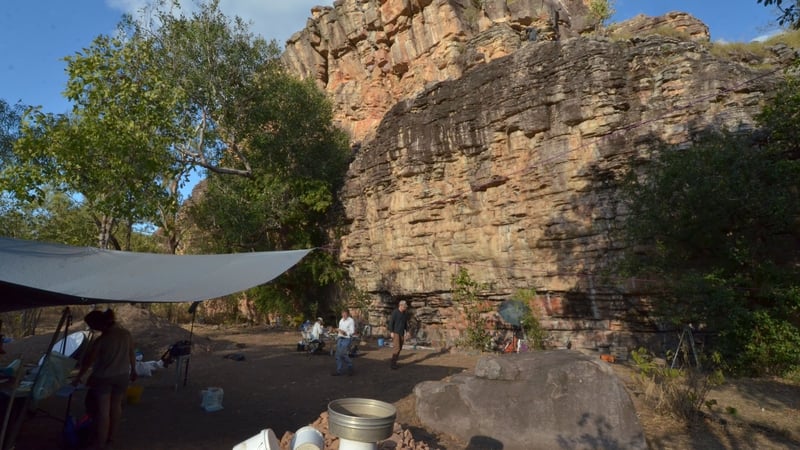
Image result for Artefact find suggests earlier arrival of humans in Australia  Image result for Artefact find suggests earlier arrival of humans in Australia
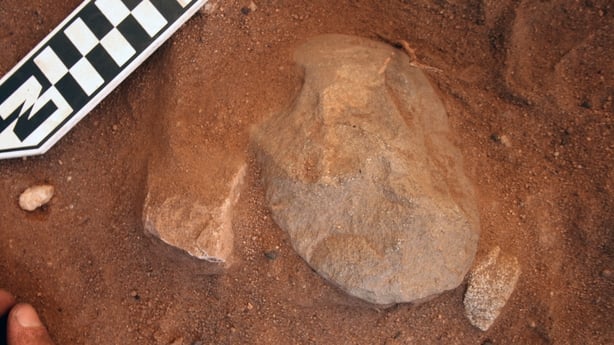
DIGS AT MADJEDBEBE HAVE UNEARTHED STONE TOOLS, OCHRES, PLANT REMAINS AND BONES

Humans arrived in Australia 10,000 years earlier than was previously thought, casting doubt on the theory that they killed off the giant kangaroo and other unique animals, scientists believe.
New artefact evidence suggests that the continent was first occupied about 65,000 years ago, long after the ancient ancestors of modern humans emerged in Africa.
The discovery challenges the theory that people caused the extinction of Australian megafauna including giant kangaroos, wombats and tortoises which disappeared more than 45,000 years ago.
Lead scientist Dr Ben Marwick, from the University of Washington, US, said: “Previously it was thought that humans arrived and hunted them out or disturbed their habits, leading to extinction, but these dates confirm that people arrived so far before that they wouldn’t be the central cause of the death of megafauna.
“It shifts the idea of humans charging into the landscape and killing off the megafauna.
“It moves toward a vision of humans moving in and coexisting, which is quite a different view of human evolution.”
Since 1973, digs at Madjedbebe, a rock shelter in Australia’s Northern Territory, have unearthed more than 10,000 stone tools, ochres, plant remains and bones.
A dating technique called optical stimulated luminescence (OSL) was used to determine the age of the oldest buried artefacts.
The process can show the last time a sand grain was exposed to sunlight up to 100,000 or more years ago.
This and other tests built up a picture of the environment and showed that when the first humans arrived, northern Australia was wetter and colder than it is today.
The findings, published in the journal Nature, support the theory that our species Homo sapiens evolved in Africa before dispersing to other continents, Dr Marwick said.

Tuesday, April 25, 2017

Donie's Ireland daily news BLOG update

Housing census figures in Ireland paints a bleak picture?

A BLEAK PICTURE OF HOMELESSNESS, OVERCROWDING AND RELIANCE ON OVERPRICED RENTALS

Image result for Housing census figures in Ireland paints a bleak picture?   Image result for Housing census figures in Ireland paints a bleak picture?
Even the Irish Government admits that its plans to increase the supply of new homes will fall woefully short of expanding demand. The State needs to build about 35,000 new homes every year to begin making a dent in the housing crisis,
The Minister for Housing Simon Coveney said last week. He admits that the current target is to build only some 25,000 new houses a year, a third less. It was a challenge, he confessed, that reflects a “fundamental structural problem in the housing sector”.
The first Central Statistics Office “thematic” report on housing from the 2016 census paints a bleak picture: homelessness, overcrowding, and forced reliance on an overpriced rental sector, on the rise, while home ownership and house-building have declined – a perfect storm of rising demand and falling supply.
Perhaps most dramatic is the stark contrast between the 0.4% growth (just 8,800 units) in the housing stock between 2011 and 2016 and the previous five-year period – the latter, at 225,232 new dwellings, was 26 times larger.
Close to one in 10 of the population now lives in some 95,013 overcrowded households which have more people than rooms, a rise in five years of 28%. The hidden homeless. And the number of owner-occupied homes also fell between 2011 and 2016 causing the overall rate to drop from 69.7% to 67.6%, a level last seen in 1971. We are moving backwards, fast.
For most young people renting is the only option and now exceeds owner-occupation among under-35s . And in a squeezed market like Dublin, rents have inevitably soared – up some 30 per cent in the capital since 2011, if you are lucky enough to find somewhere.
Yet, why is there not a more serious attempt to incentivise bringing the 183,000 homes that are currently vacant back into use? And why the obsession with building homes-to-buy for first-time buyers at ever-inflating prices, when the real demand is for affordable social and affordable housing and rental properties? Time for a broader range of solutions, Says Mr Coveney.

Meanwhile: —

New data shows just 2,076 homes built last year

FREEDOM OF INFORMATION FIGURES SHOW NEW HOMES FALLING FAR SHORT OF GOVERNMENT’S 15,000 ESTIMATE. 

Image result for New data shows just 2,076 homes built last year  Related image

THE NUMBER OF NEW HOMES BUILT IN THE STATE LAST YEAR WAS JUST 2,076, A FRACTION OF THE GOVERNMENT’S 15,000 ESTIMATE, ACCORDING TO NEW FIGURES.

The number of new homes built in the State last year was just 2,076, a fraction of the Government’s 15,000 estimate, according to new figures obtained under the Freedom of Information.
Taken from the Building Control Management System, which is widely acknowledged as the most reliable construction database, the figures cast further doubt on the Government’s estimate of homebuilding rates in the economy.
They show that, when one-off homes are excluded, just 848 estate houses and apartments were completed in 2016 compared to an official Department of Housing estimate of 8,729.
In Dublin city, the most populous part in the State, just 68 scheme homes and apartments were completed last year.
The figures for other local authorities were also well below official estimates; Fingal (121), DĂºn Laoghaire-Rathdown (78), South Dublin (69) and Cork City (21).
In three local authorities, Longford, Leitrim and Roscommon, there were no housing completions recorded at all in 2016, while a further eight counties recorded fewer than 10 completions.
The figures stand in stark contrast to the Department of Housing’s official housing completion figure for 2016 of 14,932.
The discrepancy stems from the department’s use of ESB metering data as a proxy to count new builds. Electricity connections can be triggered by work to existing buildings or by formerly vacant units coming back on stream.
Ghost estates in Ireland?
The official figures are also likely to have been inflated by the finishing out of so-called ghost estates built during the boom.
Dublin architect Mel Reynolds said the Government’s housing targets, contained in its Rebuilding Ireland strategy, are based on new-build levels that were “fictional”.
He said the remarkably low output figure for scheme homes and apartments also raised questions about the Government’s new Help-to-Buy scheme, which has been blamed for fuelling further inflation in the market.
Mr Reynolds said there were now almost five Help-to-Buy scheme applicants for every new home being built.
The Department of Housing has repeatedly defended its use of the 14,932 completion figure, suggesting electricity connections have been used as a proxy for completions since the 1970s, as developers would not connect a property to the grid until it is ready for sale.
It also claims the Building Control Management System database is not an accurate measure of homebuilding activity as it was only established in 2014 and may fail to capture projects commenced prior to that.
Last week, Minister for Housing Simon Coveney said he hoped the level housing supply could be accelerated to 25,000 units a year by the end of next year. However, he indicated the State may need to build 35,000 units before demand in the market can be met.

Minister Varadkar supports an SSIA-style scheme to top up personal pensions

VARADKAR SAYS A PLAN IS URGENTLY NEEDED TO ENCOURAGE MORE SAVING’S.

Image result for Minister Varadkar supports an SSIA-style scheme to top up personal pensions  Image result for an SSIA-style scheme to top up personal pensions
A new SSIA-style savings scheme should be introduced to try to tackle our ‘pensions time bomb’, according to Social Protection Minister Leo Varadkar.
The original State-backed five-year SSIA plan, introduced in 2001, offered a bonus of €1 for every €4 saved monthly, subject to an agreed maximum.
Now Minister Varadkar wants a similar type of incentive for workers to pay into their own “personal” pension fund. The plan would give them additional retirement cover – on top of their State pension entitlement – and employers would be required to match their contributions.
“The minister’s preferred option would be an SSIA-type top-up from the Government, rather than the current system of a tax-relief incentive,” a spokesperson confirmed to the Sunday Independent.
“The SSIA top-up is very well understood, much more so than tax relief.
“It costs much the same, and would add to an individual’s pension income, as the money would go into their personal pension savings account.”
The fund would have to be phased in over a period of time with contributions starting at a “low level” in the first year.
The most favoured model would be similar to the Australian, Singaporean and New Zealand systems, and specially “tailored” for Ireland.
Every worker would be automatically enrolled in the scheme – but would have the right to avail of an opt-out clause. The fund would be the “private property” of the individual, could not be expropriated by any government, and could be inherited by a partner or family members if the worker passed away before drawing down any benefits.
It could be transferred to another jurisdiction, and there would be flexibility as to when benefits accrued could be taken out. The SSIA scheme of 16 years ago was generally regarded as a success, generating a huge national savings kitty.
Only a third of private-sector workers have a pension. During the recession years, many people sacrificed saving for their retirement as they battled to cope with more immediate bills such as mortgages, heating and food.
Meanwhile, the latest census data shows the proportion of those in the older age bracket continues to increase.
There are now 296,837 males and 340,730 females aged 65 or older in Ireland.
The number of men in this age category has gone up by 22% since 2011, compared with an increase of 16% for women. Medical experts predict improved medical care and other lifestyle changes will result in people generally living longer.
Financial studies show the demise of the traditional ‘permanent pensionable job’ as the nature of the workplace changes. Problems in many company schemes are an added complication.
Dermot O’Leary, chief economist with Goodbody Stockbrokers, suggests an SSIA-style government initiative could help deal with the ‘ticking pensions time bomb’.
He said recent census figures provided further confirmation that the over 60s segment of the population will increase in the coming years.
He suggested there would be obvious benefits to an SSIA-style scheme linked to pensions provision.

Nutritionists now agree there’s only one fruit that must find a place in your shopping basket “Berries”?

Related image  Image result for Nutritionists now agree there's only one fruit that must find a place in your shopping basket "blue Berries"?

Every fruit has its nutritional benefits but there is only one that seems to be winning the battle across the board when it comes to the expert’s advice.
If you tend to opt for berries of the red variety over blue because of their appealing buy me attractions, it might be time to change that because blueberries have multiple health benefits with 17 different dietitians agreeing that they’re one of the best superfoods available.
After surveying a group of nutritionists and cross-referencing their answers, Byrdie found the non-assuming berry came out on top.

WHY IS THAT?

Nutritionist Frida Harju, sums it up perfectly, when explaining:
“If you are going to add one fruit to your diet, make it blueberries. They have been labelled a superfood due to their high levels of polyphenols, antioxidative, and anti-inflammatory compounds that help to combat memory loss and enhance your mood.”
Due to the high amount of antioxidants present in blueberries, they help cardiovascular health and brain health.
They’re also high in fibre, good for your skin, aid digestion and unlike other fructose-laden fruits, blueberries have been shown to improve blood glucose and insulin levels.
If food shopping is on your Weekly to-do list, make sure blueberries find their way into your basket…

‘Hobbits’ Now claimed as one of the earliest forms of the human species?

Image result for 'Hobbits' Now claimed as one of the earliest forms of the human species?  Image result for 'Hobbits' Now claimed as one of the earliest forms of the human species?
A model of a female Homo floresiensis right picture.

HOBBITS, KNOWN AS HOMO FLORESIENSIS, COULD BE ONE OF THE MOST ARCHAIC FORMS OF HUMAN ACCORDING TO NEW RESEARCH.

Remains of hobbits were discovered on an Indonesian island in 2003, and since then scientists have debated where they originated from.
While some claim they were just short Homo sapiens, new Australian National University (ANU) research claims the hobbits were most likely a sister species to Homo habilis – who lived in Africa about 1.75 million years ago.
There’s also a chance that they even proceeded the Homo habilis, making them one of the oldest forms of humans.
They were about 3.5ft tall and used stone tools.
“It’s possible that Homo floresiensis evolved in Africa and migrated, or the common ancestor moved from Africa then evolved into Homo floresiensis somewhere,” study leader Dr Debbie Argue says.
Dr Argue said the analyses could also support the theory that Homo floresiensis could have branched off earlier in the timeline, more than 1.75 million years ago.
“If this was the case Homo floresiensis would have evolved before the earliest Homo habilis, which would make it very archaic indeed,” she said.
The hobbits lived on the Indonesian island of Flores until as recently as 54,000 years ago.
Prior to the ANU study it was believed that the Homo floresiensis evolved from Homo erectus, a larger human that lived on the Indonesian mainland of Java.
However the ANU researchers say that’s almost certainly not the case.
“We can be 99 per cent sure it’s not related to Homo erectus and nearly 100 per cent chance it isn’t a malformed Homo sapiens,” Professor Mike Lee said.
The research was published in the Journal of Human Evolution.
It’s unclear whether Bilbo Baggins is connected to the Homo floresiensis, or how he and his relatives made their way to Hobbiton from Indonesia.  

Tuesday, April 4, 2017

Donie's Ireland daily news BLOG

Major broadband providers ordered to block illegal streaming sites

MAJOR FILM AND TV STUDIOS SAY UP TO 1.3 MILLION USERS HERE MAY BE INVOLVED IN ILLEGALLY ACCESSING THEIR OUTPUT

Image result for Broadband providers ordered to block illegal streaming sites  Image result for Broadband providers ordered to block illegal streaming sites

SIX MAJOR FILM AND TV STUDIOS HAVE SECURED INJUNCTIONS DIRECTING INTERNET SERVICE PROVIDERS TO BLOCK ACCESS TO WEBSITES INVOLVED IN ILLEGAL STREAMING OR DOWNLOADING OF FILMS AND TV SHOWS.

Mr Justice Brian Cregan made the orders against nine internet service providers after saying it was “clear” from evidence before the court breaches of the studios’ copyright had “manifestly occurred.”
The orders would not amount to a breach of lawful use of the internet and were not disproportionate, said the judge.
Their proceedings were brought against a number of ISPs – Eircom, Sky Ireland, Vodafone Ireland, Virgin Media Ireland, Three Ireland, Digiweb, Imagine Telecommunications and Magnet Networks.
None opposed the application for the injunctions and the court heard they had adopted a neutral stance.
The studios, all members of the Motion Picture Association, sought the orders on grounds including up to 1.3 million users here may be involved in illegally accessing their films via various websites.
  • Irish film industry lauds judgment blocking piracy websites
  • Online content: Studios’ battle with streaming services heats up
  • Music industry shows movie makers the way with illegal downloads
Represented by Jonathan Newman SC, the companies argued digital piracy is costing the studios hundreds of millions annually and, according to recent research, led to the loss of 500 jobs here in 2015 and €320 million in lost revenues.
The plaintiffs are Twentieth Century Fox, Warner Bros Entertainment, Paramount Pictures, Disney Enterprises, Universal Studios, Sony Pictures Television and Columbia Pictures. Their case was supported by independent distributors and film-makers in Ireland.
Disable access ???????
In a ruling on Monday evening, Mr Justice Cregan granted orders requiring the ISPs to block or disable access by subscribers to a number of websites, known as “streaming” websites, including movie4k.to, primewire.ag and onwatchseries.to.
There was no opposition to the orders but the court was asked to deal with issues raised by Eir.
Eir said it was prepared to pay the cost involved in dealing with the relevant websites to date but was concerned about the cost implications if it had to deal with a large number of these sites into the future.
It asked the court to put a cap on the number of notifications per month, which the movie companies could make directing the ISPs to block websites.
Conor McDonnell, solicitor for Eir, said it was suggesting a cap of perhaps 50 notifications per month but the movie companies were opposed to any cap.
The judge said there should be no cap on the amount of notifications for the time being.
The judge welcomed that Eir and the movie studios had resolved another outstanding issue in relation to the temporary blocking of certain websites.

American families desperate to flee to Canada from Donald Trump’s power grasp

Image result for American families desperate to flee to Canada from Donald Trump's power grasp  Image result for fleeing families to Canada

THE NUMBER OF PEOPLE TRYING TO CROSS THE US BORDER INTO CANADA HAS INCREASED DRAMATICALLY SINCE DONALD TRUMP CAME TO POWER.

At the end of a lonely country road in upstate New York, a taxi pulls up.
Five people get out and stand uncertainly in the freezing rain – two men from Yemen, a woman from Eritrea and her two small boys.
They’ve come to flee America through its northern border, in to Canada.
The Royal Canadian Mounted Police waiting on the other side of the snowy ditch tell them they will be arrested if they cross at this unofficial border point.
They know this, but it is still scary to hear and the group pauses, just a few feet from the border.
One man is starting to shiver in the cold? and another explains that his visa has expired and he cannot go back to his war-torn country.
“Can you help us, please?” asks the woman as she tries to hold both her children to stop them standing in the snow, but they are wriggling and she lets one go.
He is giggling and playing next to abandoned luggage and a baby stroller from previous crossings as his mother calculates if this is going to be worth the risk.
Suddenly an officer offers the information she is waiting to hear – she will be arrested, processed, and then if all is well, released to the immigration authorities.
The two men, the woman and her sons take just a few steps over the invisible border and in to police custody, hoping to one day become a refugee in Canada.
The next morning it happens again.
Three smartly dressed men from Turkey say they want to claim asylum in Canada.
They don’t speak much English but they’ve brought carefully written letters explaining why they want to leave.
One is a former history teacher who was arrested and harassed in Turkey and he has been living in the States but now feels he cannot remain here anymore.
Why not stay in America? We asked “Because of Trump” his friend says, shaking his head.
In just this one location these crossings are happening up to five times a day.
Up and down this vast border region thousands have done the same, the numbers increasing sharply since Donald Trump rode to power on a wave of populist anti-immigrant sentiment.
The Canadian Border Services Agency says there was a six-fold increase in refugee claims just at Quebec’s border in February compared to the same month in 2016.
Nationally, the agency says that in January and February 2017 more than 2,500 people crossed over and made asylum claims.
RCMP Corporal Francois Gagnon said: “It’s mostly families … parents with kids, strollers.
“We’re going to use compassion on every occasion, but definitely seeing those families crossing the border, you know it touch somewhere our hearts, you know we are all most of us fathers and mothers, so the approach is going to be softer.
For many, being detained by the Canadian police is actually the aim.
An agreement between the US and Canada prevents people from either country seeking refugee status in the other.
But if they are arrested while crossing illegally, most people are given a criminal background check and then are released and given access to housing, schools, emergency healthcare and work permits while they await immigration hearings.
Immigration lawyer and head of the Canadian Association for Refugee Lawyers Mitchell Goldberg said: “I think it’s decent, I think it’s the right thing to do, I think it’s an investment in the future of Canadians.”

‘A lot of the time’ I am just waiting on a system that may or may not work properly

COLIN MCSWEENEY IS JUST ONE OF 4,875 ADULTS NATIONWIDE RELYING ON EMERGENCY ACCOMMODATION EVERY NIGHT?

Image result for we am just waiting on a system that may or may not work properly  Colin, who told his story on Ireland's Property Crisis (Image via RTE)

AN RTÉ DOCUMENTARY HIGHLIGHTING IRELAND’S PROPERTY CRISIS TONIGHT SHONE A BIG LIGHT ON A HOMELESS TRINITY COLLEGE GRADUATE WHO IS WORKING BUT STILL CAN’T AFFORD SOMEWHERE TO LIVE.

Colin McSweeney, 45, above left pic began working in the IT sector after completing his degree in Dublin. When that company folded, he found himself not being able to afford his rent and relying on the emergency accommodation system to shelter him.
Although he has a job as a researcher in a library, Colin spends his nights searching for accommodation in different hostels.
The college graduate details the trouble with finding a bed in the city and revealed that he sometimes relies on using the 24-hour Starbucks, which is located at the former Anglo Irish Bank HQ on St Stephen’s Green, to keep him warm through the night.
“This is Dublin’s first and only 24-hour Starbucks. I’ve spent a few nights over the last five months here. I’ve gone an entire evening here on just a cup of tea. The one thing is that if you try and sleep, you’ll be woken up by the security guard. But they’re nice.”
Colin is forced to find ways of keeping warm and safe for a whole night when the emergency accommodation system lets him down.
He spends his days in Pearse Street library waiting for a call back to see whether or not he has somewhere to stay that night.lin receives the phone call telling him he has a bed for the night.
Waiting on the call, he says: “Today revolves around this phone call. At this point, the system should ring me back.
“A lot of the time, you’re just waiting on a system that may or may not work properly and call you back. The longer you wait, the worse it seems.”
Thankfully, just as he was about to give up hope, Colin receives a call telling him he has a bed for the night and he makes his way to Frederick Street. This is what he does every night of the week.
Other people featured on Ireland’s Property Crisis included single mother Selena who is trying to find a new home to rent since her landlord sold her current property. Selena must leave the property by Easter Monday but the new Housing Assistance Payment (HAP) scheme has found nothing suitable in her area.
In another example of people trying to make ends meet, the Sadlier family are paying rent on their house in Donnycarney, Dublin, while also trying to pay off the mortgage on a one-bed apartment they bought ten years ago.
The number of people presenting as homeless in Ireland was at an all-time high in February.
There were 4,875 adults staying in emergency accommodation. As well as this, there are 1,239 families with 2,546 children, according to the latest Housing Department figures.

Bowel cancer and doing this could reduce the risk of this cancer by nearly 50%

Image result for Bowel cancer and doing this could reduce the risk of this cancer by nearly 50% Image result for Bowel cancer and doing this could reduce the risk of this cancer by nearly 50%

BOWEL CANCER RISK IS 46% HIGHER IN PEOPLE WITH THE LARGEST WAIST CIRCUMFERENCE, COMPARED TO THOSE WITH THE SMALLEST.

Bowel cancer: Losing weight is key and could reduce the risk by as much as 50%, experts now claim
Research has revealed women in the UK are not considering their cancer risk when it comes to their weight.
According to 2017 statistics, only just over one in ten UK women – 11 per cent – would be motivated to lose weight to reduce their cancer risk.
Lee Dvorkin, consultant general and colorectal surgeon at BMI Healthcare said: “Factors thought to increase the risk include smoking, obesity and eating excessive red meat, alcohol, animal fat and sugar.”
Obesity and a high body mass index (BMI) ratio are strongly associated with an increased risk of bowel cancer, argue experts.
Additional body fat is classified by the International Agency for Research on Cancer (IARC) and World Cancer Research Fund as a cause of bowel cancers.
Bowel cancer: Over half of cancer cases are diagnosed too late
An estimated 13% of bowel cancers in the UK are linked to being overweight or obese.
Maintaining a healthy weight through diet and exercise is essential to lowering the risk of the second biggest cancer killer.
Bowel cancer can affect both men and women of any age.
It is the fourth most common cancer in the UK, and the second biggest cancer killer, with someone dying of bowel cancer every 30 minutes in the UK.
Factors thought to increase the risk include smoking, obesity
Over half of bowel cancer cases are diagnosed late, but an early diagnosis is crucial.
In line with new 2017 NHS Digital statistics, 58% of women in the UK are currently overweight or obese, and 27% of women are currently inactive – doing less than 30 minutes of exercise a week.
Maintaining a healthy weight is essential not just for overall health but also to help prevent cancer development.
Despite this the latest research, conducted on behalf of BMI Healthcare points to the vast majority of women in the UK not being motivated to lose weight to cut their risk of cancer.
Bowel cancer concern: Maintaining a healthy weight can prevent the cancer developing
The new research conducted independently on behalf of BMI Healthcare as part of its April Be Bowel Cancer Aware campaign reveals that 42% of UK women would feel embarrassed to tell someone if they had irregular bowel habits or blood in their stool, the two key warning signs of the cancer.
The new figures raise the concern that women are putting themselves at increased risk of late diagnosis because they are too embarrassed to tell anyone about their bowel habits.
More than a quarter – 27% – of women have or may have had bowel cancer related symptoms.
However some 40% of women did not discuss their bowel cancer related symptoms with anyone – this includes just talking to a partner, friend or a family member.

Fearless fanged Coral Reef fish’s heroin-like venom could lead to pain killing treatments

Image result for Fearless fanged Coral Reef fish’s heroin-like venom could lead to pain killing treatments   Image result for Fearless fanged Coral Reef fish’s heroin-like venom could lead to pain killing treatments

A FEARLESS FANGED CORAL REEF FISH THAT DISABLES ITS OPPONENTS WITH HEROIN-LIKE VENOM COULD OFFER HOPE FOR THE DEVELOPMENT OF NEW PAINKILLERS.

University of Queensland researcher Associate Professor Bryan Fry said the venomous fang blenny was found in the Pacific region, including on the Great Barrier Reef.
“The fish injects other fish with opioid peptides that act like heroin or morphine, inhibiting pain rather than causing it,” he said.

“ITS VENOM IS CHEMICALLY UNIQUE????

“The venom causes the bitten fish to become slower in movement and dizzy by acting on their opioid receptors.
“To put that into human terms, opioid peptides would be the last thing an elite Olympic swimmer would use as performance-enhancing substances. They would be more likely to drown than win gold.”
Fang blennies, also known as poison-fang blennies or sabre-tooth blennies, of the genus Meiacanthus, are popular as ornamental tropical aquarium fish.
“Fang blennies are the most interesting fish I’ve ever studied and have one of the most intriguing venoms of them all,” Associate Professor Fry said.
“These fish are fascinating in their behaviour. They fearlessly take on potential predators while also intensively fighting for space with similar sized fish.
“Their secret weapons are two large grooved teeth on the lower jaw that are linked to venom glands.”
Associate Professor Fry said the unique venom meant, the fang blenny was more easily able to escape a predator or defeat a competitor.
“This study is an excellent example of why we need to protect nature,” he said.
“If we lose the Great Barrier Reef, we will lose animals like the fang blenny and its unique venom that could be the source of the next blockbuster pain-killing drug.”
The research, published in Current Biology, was led by Associate Professor Fry, who works with the UQ School of Biological Sciences Venom Evolution Laboratory, and Dr Nicholas Casewell of the Liverpool School of Tropical Medicine in the UK.
It involved researchers from across UQ and from Leiden University and the Leiden University Medical Center in the Netherlands; Monash University; and the Bangor and Anglia Ruskin universities in the UK.