Gerry Adams ‘happy to debate the EU treaty with all Ireland’s leaders’
 V
V 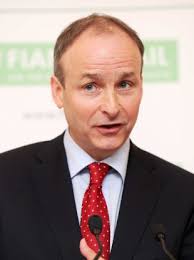
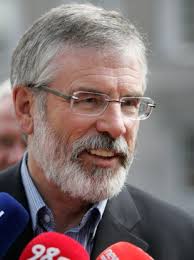
Sinn Féin leader Gerry Adams has said that he would be happy to debate with Micheál Martin on the EU fiscal treaty – along with all the other party leaders.
Deputy Adams was responding to a challenge from the Fianna Fáil leader who made the offer following the Sinn Féin TD’s refusal to participate in the recent TV3 referendum debate.
In a statement today, Deputy Martin said as president of the leading party advocating a No vote, Deputy Adams should be willing to debate, and to outline what he believes a No vote would mean for Ireland.
Today Deputy Adams said he is prepared to debate other party leaders on the fiscal treaty “given the importance of this referendum to Ireland’s future”.
But the Fianna Fáil leader is calling for a one-to-one debate.
“He (Deputy Adams) simply refused to go on that TV3 debate and I am now giving him another opportunity to debate on a head-to-head basis, one-to-one, in relation to the treaty and the issues around the treaty,” Deputy Martin said.
Ireland President Michael D. Higgins greets a crowd in downtown Boston yesterday Saturday.

The president of Ireland, Michael D. Higgins visited several sites in Boston Saturday, calling the city “the capital of Irish America.”
The visit, his first to Boston after being elected President last November, was planned as part of the annual remembrance of the Great Irish Famine that began in 1845.
In a probing and professorial speech at Faneuil Hall’s Great Hall, Higgins acknowledged the complex legacy of the famine, which he called Ireland’s “greatest social calamity.”
Higgins later participated in a wreath-laying ceremony at the Boston Irish Famine Memorial on the corner of School Street and Washington Streets.
Higgins participated in a wreath-laying ceremony at the Boston Irish Famine Memorial.
Sparked by a potato blight, the famine killed nearly 1 million Irish and drove an even greater number to emigrate to the United States and other countries. Boston in particular was a top destination for those fleeing the famine; In 1847 alone, 37,000 Irish arrived in a city whose population was just 115,000.
Boston was selected as the international location for the Irish government’s annual commeration of the famine.
In a pointed moment, Higgins decried the failure of the world community to stamp out hunger.
“To international relations, governments, and the institutions which generations place their trust [in], it remains one of the great unresolved ethical challenges of our time – the daily needless loss of life to hunger and preventable diseases,” Higgins said.
The speech drew many members of Boston’s Irish community, who packed the hall to near capacity. They greeted Higgins, who has made reconnecting with emigrated Irish a priority of his presidency, with warm applause.
Higgins’s extensive remarks were distinctly academic, a reflection of his unique background as a professor, scholar, and poet. A copy of his speech provided to the media included footnotes and long quotes from other scholars and primary sources. During an interview, Higgins frequently recalled specific dates and figures, and sat next to a thick text on the famine stuffed with page after page of his own notes.
Higgins, 71, acknowledged his academic pedigree is “unusual, perhaps even in the Irish case as well.” But he argues that last year’s election, in which he received more votes than any presidential candidate in Irish history, validates his thoughtful approach.
“During the campaign, I made an issue of the price that would be paid for anti-intellectualism, and addressing that it was in everyone’s interest to be able to discuss issues in their complexity,” he said in the interview. “I just stuck with it now. The vote shows that there was, in fact, support for ideas.”
Higgins cares deeply about the way issues are discussed. Recalling famine-era English criticism that stereotyped Irish people as lazy, ungrateful and unworthy of assistance, he lamented the use of similar rhetoric in contemporary immigration debates.
“Remember, I’m trained as a sociologist,” Higgins said. “To me, the use of stereotypes is one of the laziest, most ignorant ways of portraying a people.”
While the Irish presidency is a head-of-state position that generally precludes involvement in politics, Higgins seemed to signal his support for an E3 visa program proposed by Senator Scott Brown that would allow thousands of Irish to live and work in the US in two-year increments.
“I don’t get involved in the day-to-day legislation, but obviously I am interested and concerned for all Irish,” Higgins said. “I see myself as a president for all of the Irish at home and abroad, so, yes, of course, I am supportive of anything that helps their situation.”
Higgins described the difficulty Irish immigrants in the US face.
“They have Skype now, so the break with home isn’t as severe as it was,” he said. “But if somebody dies at home, or there’s a wedding, they have real difficulties both exiting and reentering.”
Higgins also recounted his many connections to the “handsome” city of Boston.
“Boston is maybe the most Irish of all the cities,” Higgins said. “And I was mayor of Galway twice, and Galway is a huge component of Boston’s Irish population.”
Higgins spent his honeymoon here in the 1974, staying at the Sonesta Hotel in Cambridge and dining at a restaurant on Boylston Street that served macrobiotic food, a culinary trend his wife, Sabina, followed.
Asked if he had a message for Boston’s Irish population, Higgins extended an invitation to “The Gathering,” an Irish tourism campaign that calls for Irish emigrants and their descendants to return to Ireland in 2013.
He also implored them to remember the famine.
“My message to them about it is, never to forget, but to use our memories in a way that empowers us and that enables us to make an amnesty of the bad part of it.”
Gardai fresh appeal over the murder of Eddie Fitzmaurice Charlestown Co Mayo in 1998
Gardaí are appealing for information on the murder of a man in Co Mayo 14 years ago.
Nobody has been charged in connection with Eddie Fitzmaurice’s death
Eddie Fitzmaurice, who was an 83-year-old from Bellaghy in Charlestown, was beaten to death in what gardaí described as a “callous and brutal attack on a defenceless elderly man”.
Despite exhaustive efforts and a number of arrests, nobody has been charged in connection with his death.
A reward has also been offered by Crimestoppers for information leading to the indentification and prosecution of those behind the attack.
The body of Mr Fitzmaurice was found in the bedroom of his home on 6 May 1998. He had been beaten, tied up and left to die.
The Miracle melanoma cancer drug ipilimumab ‘will save thousands of people in Ireland’
The life-saving ‘miracle’ drug with a proven record of curing cancer will be dispensed to hundreds of Irish patients over the coming years,
The plight of many desperately ill cancer patients touched the hearts of the nation this week as the HSE bowed to intense pressure and introduced the drug into the public health system.
The Evening Herald was at the forefront of the campaign to ensure ipilimumab, or ‘ipi’ is made available to cancer sufferers in this country.
Patients such as Martin McMahon and Cathy Durkin bravely spoke of the fear of knowing that their lives could be cut short because of malignant melanomas.
Now, both are on course to receive the drug ipilimumab– news that has left their families overcome with emotion.
And well-placed health sources today predicted that the drug will cure cancer for “generations to come”.
We can reveal that doctors will be encouraged to administer the drug to hundreds of patients over the coming years.
A senior health source told the Herald: “Some countries still have not introduced ‘ipilimumab’. We have done it and done it quickly. It means hundreds can avail of it over the coming months and years. It will be up to oncologists now to dispense it — it is available to them to do so.”
One patient, Shirley McEntee, spoke today about how her cancer “melted away” after being prescribed ‘ipi’.
“It was the greatest feeling imaginable. Things are still tough but I’m alive, happy and well. My cancer literally melted away. It disappeared,” she said.
“It doesn’t work for every-body, but it worked for me and it would be great to see it work for so many more people.”
People in Ireland were left appalled at the story of a Dublin father who was just one of many being people refused the miracle drug.
Dad-of-two Martin McMahon (44) spoke of his sheer relief at the news at ‘ipi’ will now be an option for him and other cancer sufferers.
“Our lives have been a dark tunnel — now we can see some light. I was overcome with emotion when I found out. The department and the HSE need to be thanked and praised for this — they have acted very quickly.”
He added: “I don’t yet know when or if I will be able to avail of ‘ipi’. I have another bout of chemotherapy and a further scan to see if it has been contained. But the fact that it is there as an option is simply incredible.”
In a statement, a Department of Health spokesperson said: “Internationally this drug is recognised as a significant advance in the treatment of melanoma. It is anticipated that 60 patients will be eligible for treatment in 2012.”

