Pages

Showing posts with label bank accounts. Show all posts

Wednesday, May 7, 2014

Donie's news Ireland daily BLOG Tuesday

Irish Taxes forcing our young & best educated to leave the country in droves Says Minister Hayes


BRIAN HAYES WANTS A MOVE ON TAX IN THE OCTOBER BUDGET. 

Ireland’s higher rate of income tax is a major factor in the exodus of our young professionals, according to Junior Finance Minister Brian Hayes.
Mr Hayes has become the latest Fine Gael minister to demand a consecutive cut in the income tax in the next two budgets.
Confirmation that the coalition favours tax cuts over wage increases has proved a thorny issue in recent weeks, particularly among union leaders.
SIPTU president Jack O’Connor said last month that the “key to intensifying the momentum in the economy must be pay increases”.
A CAUTIOUS approach, 
His remarks are at odds with those expressed by a number of government ministers who are very cautious about even discussing the prospect of wage increases.
Mr Hayes, who is Fine Gael’s European candidate in Dublin, said he believed tax measures in October’s budget must benefit those who pay the higher rate of income tax.
“Our current rate of tax is a huge disincentive for people to stay in Ireland and work and is encouraging a brain drain of young professionals,” Mr Hayes said.
“We need to keep our best and brightest here in Ireland making a contribution to their own country – not Australia, not Canada, not the US. Our very high tax rates on very modest incomes must be reversed. Young workers deserve a break.”
Government sources insist that Finance Minister Michael Noonan will examine how to “ease the burden” on middle income earners, particularly those with children.
Sources insist that changes to the Universal Social Charge (USC) are also on the table ahead of the budget.
But Mr Hayes said yesterday that while he favours changes to USC, the immediate focus must be on income tax.
His comments come just days after Mr Noonan clearly signalled that he is preparing to raise the band at which workers pay the higher rate of income tax.
At present, workers pay a marginal rate of 52pc on every euro earned above €32,800.
Mr Hayes, a Dublin-South West TD, said this represents a factor in the flow of young people who are being lost to emigration.
He said: “Trade union officials and other economic commentators have been calling for an economic stimulus. The best and fairest economic stimulus of all is a tax cut.”

Irish Central Bank insists people are switching bank accounts to escape fees

HOWEVER NEW FIGURES SHOW JUST ONE IN 10 SWITCHING BANK DESPITE a HIKE IN CHARGES


The Central Bank has insisted that more people are switching bank accounts in a bid to escape higher fees and bad service.

But the regulator also admitted this morning that despite a rise in the numbers moving accounts, the switching figures are still low.
Fewer than 11,000 people switched bank account in the second half of last year, using the Central Bank’s switcher code.
This is out of a total of 5.4 million current accounts. In percentage terms, less than 0.2pc of accounts were switched in the second six months of last year.
In the first half of last year 4,241 consumers moved bank.
This is despite higher fees and charges being imposed by the main banks and the decision of ACC and Danske Bank to pull out of retail banking here.
Director of Consumer Protection, Bernard Sheridan, said: “These new figures show that, while low, an increasing number of consumers are availing of the Central Bank’s Switching Code to manage the changeover when switching current accounts.
“Factors which appear to be influencing the choices that consumers are making include: changing fees and charges; service issues; and announcements regarding the withdrawal of current account providers from the market.”
The code is supposed to make it easier for consumers to move banks, and demands that the switch is completed within 10 days.

A total of 373 suspected abuse cases at Irish homes


Hiqa said it received 5,362 alerts of potentially harmful events in care homes. A total of 373 reports were made last year of alleged, suspected or confirmed abuse of older people in care homes.

The Watchdog Health Information and Quality Authority (Hiqa) said it received 5,362 alerts of potentially harmful events in care homes up and down the country during 2013.
Among them were 4,246 reports of serious injury to a resident.
But the most concerning figure involved the 373 instances of reported abuse in 195 out of the 566 care homes in either the state or private sector.
Phelim Quinn, Hiqa’s director of regulation and chief inspector of social services, said despite the high figures, safety and quality standards are improving.
But he warned: “It is clear from this report that there are areas where further improvement is required and we will focus on these areas as part of our continued regulatory activities.”
The Hiqa report is the first annual overview on the regulation of nursing homes since the rules were introduced more than four years ago.
Its report said inspectors carried out 814 checks of 565 residential centres for older people in 2013.
It recorded 293 notifications of outbreaks of infectious disease; 171 reports of unexplained absence from a home; and 95 reports of alleged misconduct by the care provider or a member of staff.
On abuse, Hiqa said its inspectors identified 303 actions needed to ensure homes complied with rules to prevent issues over residents’ finances in 174 of the centres.
Hiqa said it received unsolicited information 355 times relating to 213 centres last year, most of which came from concerned relatives of residents. Others came from staff in the care homes, health professionals visiting the homes to work and residents themselves.
Most of the information being relayed to inspectors centred on the quality and safety of care, staffing issues and other complaints associated with fees, discharge decisions and contracts of care.
Age Action said it was concerned about the high level of serious injuries reported by nursing homes and the notifications of abuse, which care homes are bound by law to report.
“The report not only highlights the great need which exists for an independent inspection authority, but also the need for nursing home management to improve their service when it comes to issues of health and safety and risk management,” spokesman Eamon Timmins said.
“This must involve training, supervision and strict adherence to the existing procedures and protocols.”
Issues were also identified with medicines in 325 care homes with changes required on the ordering, prescribing, storing and administering of drugs to residents and the handling and disposing of unused or out-of-date medicines.
Inspectors also looked at issues relating to food and found that more than half of the homes reviewed – 30 out of the 52 chosen for this area – were fully compliant in relation to food and nutrition.
It said there were only seven findings of moderate non-compliances and 15 minor non-compliances, such as a lack of choice or issues over staffing levels at meal times or small dining rooms.
Nursing Homes Ireland (NHI) said that of the 565 registered care centres and homes, one was forced to close last year.
“NHI recognises the critical role of Hiqa in supporting care provision and will continue to be proactive in engagement with the authority to continually drive improvements in care delivery for older persons in residential care,” the organisation said.

UK search police teams excavating sites in Portugal for Madeline McCann


Search teams are expected to start excavating a number of sites in Portugal as part of the investigation into the disappearance of Madeleine McCann.

Portuguese authorities are understood to have given permission for the search of several sites in Praia da Luz, where Madeleine went missing in 2007, aged just three.
The move comes just after the seventh anniversary of her disappearance on May 3 2007, part-way through a family holiday.
The request to search a number of sites is thought to be among a series of requests made by British detectives in connection with the search for Madeleine.
The excavations, which are expected to be conducted by forensic experts, are not thought to necessarily be in connection with a search for the youngster’s body or remains.
Detectives from Scotland Yard are expected to be in Portugal for the searches, but it is not thought that Madeleine’s parents Kate and Gerry will return to Praia da Luz.
Scotland Yard have refused to comment on reports about the latest development in the investigation.
The McCanns’ spokesman Clarence Mitchell said: “As always, we simply will not comment on operational details of Operation Grange, that is a matter for the Met Police.
“Kate and Gerry are being kept fully informed throughout.”
At the weekend, Mr and Mrs McCann thanked the public for their unstinting support at a prayer service on the seventh anniversary of her disappearance.
The couple were joined by around 100 well-wishers, friends and relatives for a low-key open-air service in the centre of Rothley, Leicestershire, which saw candles being lit for all children around the world who have been taken away from their parents against their will.
Mr McCann expressed his family’s gratitude that the Metropolitan Police team investigating Madeleine’s disappearance was now moving on to a “very active” phase in their investigation, saying: “They are chipping away and obviously there is new evidence so we are going to continue to hope that we will get a happy outcome.”
Earlier, Mrs McCann disclosed that she privately returns to the Portuguese resort where her daughter disappeared to “walk those streets” and “look for answers”, as she backed a revamped alert system triggered when missing children are kidnapped or their lives are at risk – known as Child Rescue Alerts.

Gut bacteria research could help regulate peoples weight and cholesterol


A Breakthrough research in the role gut bacteria have in regulating weight gain and cholesterol could lead to the design of probiotics for the control of obesity, high cholesterol, and diabetes.

That is according to researchers at the Alimentary Pharmabiotic Centre in University College Cork whose findings are published this week in the prestigious Proceedings of the National Academy of Sciences USA.
Dr Cormac Gahan, who together with Dr Susan Joyce, is leading the UCC team, said they had analysed a protein commonly made by gut bacteria that breaks down bile acids (chemicals produced in the liver) — and found that specifically increasing levels of this protein reduces cholesterol and weight gain in mice.
“We reasoned that in the gastrointestinal tract that if bacteria influence bile acids, they might have an influence on the host’s [mouse] weight gain and metabolism,” Dr Gahan.
“So we went about looking at it experimentally and we basically showed if bacteria can break down bile acids then it influences weight gain in mice,” Dr Gahan said.
However, even though they had shown that a specific mechanism exists by which bacteria in the gut can influence the host’s metabolism, Dr Gahan said they now needed to determine if the same mechanism existed in humans before embarking on the development of probiotics to target this mechanism to regulate weight gain or high cholesterol. Their research meant that they “now have the potential for matching probiotic strains with specific end-user needs”, Dr Joyce said. “Work is under way to determine how this system operates in humans,” she added.
Researchers in China have also looked at what impact gut bacteria have on people’s weight.
Their research has led them to believe that changing the type of bacteria found in the gut may be more effective at helping people to shed weight than cutting calories alone.

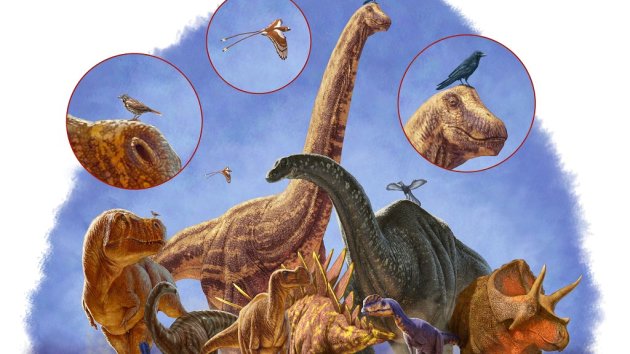
Incredible shrinking process helped the dinosaur’s survival

 A depiction of dinosaur body size evolution and shape over 170 million years

A DEPICTION OF DINOSAUR BODY SIZE EVOLUTION AND SHAPE OVER 170 MILLION YEARS

One of evolution’s greatest success stories is that of the Incredible Shrinking Dinosaur, scientists have revealed.
The reptiles that ruled the world for almost 200 million years never went away. At least some of them just got smaller and turned into birds.
Now researchers have shown that shrinking was key to survival for this group, which became one of the most diverse and abundant families of animals alive today.
Only those dinosaurs destined to be birds broke the lower body weight limit of one kilogram seen in their relatives.
Lead scientist Dr Roger Benson, from the Department of Earth Sciences atOxford University, said: “Dinosaurs aren’t extinct; there are about 10,000 species alive today in the form of birds. We wanted to understand the evolutionary links between this exceptional living group, and their Mesozoic relatives, including well-known extinct species like T rex, Triceratops, and Stegosaurus.
“We found exceptional body mass variation in the dinosaur line leading to birds, especially in the feathered dinosaurs called maniraptorans. These include Jurassic Park’s Velociraptor, birds, and a huge range of other forms, weighing anything from 15 grams to three tonnes, and eating meat, plants, and more omnivorous diets.”
Small body size may have been a vital difference that helped the ancestors of modern birds remain on Earth after other dinosaurs were wiped out 65 million years ago, say the researchers.
A huge asteroid impact off the coast of Mexico is generally thought to have brought the dinosaurs’ long reign to an end. However, many experts believe dinosaurs were already in decline when the meteor delivered the coup de grace that finished them off.
Together with Canadian colleagues from the Royal Ontario Museum, Dr Benson’s team estimated the body mass of 426 dinosaur species by measuring the thickness of their leg bones.
The scientists found that dinosaurs underwent rapid changes in body size shortly after they first appeared around 220 million years ago.
Thereafter only the evolutionary line leading to birds continued to change size at such a fast rate, and did so for a further 170 million years.
The study, published in the online journal Public Library of Science Biology, revealed that dinosaurs ranged in size from the 90 tonne Argentinosaurus – the largest creature ever to walk on land – to the bird-like Qiliania, which weighed 15 grams and was the size of a sparrow.
The team worked on the basis that if members of a family of related animals are similar in size, their evolution is likely to have been slow. On the other hand having close relatives that are very different in size implies fast rate of evolution.
“What we found was striking,” said co-author Dr David Evans, from the Royal Ontario Museum. “Dinosaur body size evolved very rapidly in early forms, likely associated with the invasion of new ecological niches. In general, rates slowed down as these lineages continued to diversify.
“But it’s the sustained high rates of evolution in the feathered maniraptoran dinosaur lineage that led to birds – the second great evolutionary radiation of dinosaurs.”
The bird ancestors kept experimenting with different and often radically smaller body sizes, allowing them to adopt new designs and adaptations more quickly than larger dinosaurs.
Other dinosaur groups became locked into narrow ecological niches from which they could not escape, say the researchers. This may have ultimately contributed to their extinction.
Commenting on the findings in the journal, doctors Daniel Moen and Helene Morlon from the Ecole Normale Superieure in Paris, France, wrote: “What explains why some groups of organisms, like birds, are so species rich? And what explains their extraordinary ecological diversity, ranging from large, flightless birds, to small migratory species that fly thousands of kilometers every year?
“(Benson and colleagues) find that body-size evolution did not slow down in the lineage leading to birds, hinting at why birds survived to the present day and diversified. This paper represents one of the most convincing attempts at understanding deep time adaptive radiations.”       

Saturday, April 5, 2014

Donie's Ireland daily news BLOG Friday

Irish ambassador in London gets ready for President Micheal D’s Palace visit


Dan Mulhall sees promising future for Anglo-Irish relations as he awaits first State visit by Irish head of State. 

Each day in the central lobby of the Palace of Westminster, one that separates the House of Lords and the House of Commons, visitors crane upwards to see four mosaics.
Representing Saints Andrew, George, David and Patrick, the mosaics have browned with age and few will have noticed the name of Banba written above the head of St Patrick.
For Dan Mulhall, Ireland’s ambassador to Britain, however, the presence of Banba a member of the legendary Tuatha Dé Danann – highlights the complex heart of Anglo-Irish relations.
Fifteen years ago, Mulhall was based in Edinburgh, as it made its first steps after the devolution of power to Holyrood from Westminster.
There, he became friends with the late Seamus Heaney, agreeing with the latter’s view that the two countries were “linked and separated in various degrees by history and geography, language and culture”.
“Considering our convoluted connections, it seems strangely appropriate that this ancient Irish goddess should occupy this perch,” Mulhall mused recently.
For months, the Waterford-born diplomat has led preparations, at the Irish Embassy in London, for President Michael D Higgins’ State visit to Britain.
Often, it has been a job of explaining – to a British audience or to those internationals who have become intrigued – why the first State visit by an Irish head of State is only taking place now.
“For a long time relations between an independent Ireland and our nearest neighbour were burdened by a legacy of history,” he told journalists last week.
The four-day programme will reflect the “huge divide” that has been overcome in relations between Ireland and Britain, but one also that offers “a platform for the future”, he said.
During the visit, Mr Higgins will lay a wreath at the Tomb of the Unknown Warrior at Westminster Abbey and inspect the colours of the Irish regiments disbanded when the Free State was founded.
“In the past we might not have seen that Ireland had any real connection with the first World War,” says Mulhall, noting the series of commemorations involving Irish ministers in recent years.
“It underlines our willingness yet again to see our past in its true colours and embrace our past without any reason to shy away from the fact that the Irish played such an important role,” he went on.
Since he moved to London from Berlin last year, Mulhall has spent time getting to know the Irish community, particularly those involved in a succession of Irish centres throughout Britain.
Last month, 350 Irish people were invited to Buckingham Palace for a reception that acted as the warm-up to President Higgins’ visit– one that is getting royal attention.
“It is a wonderful occasion for the Irish community in Britain; the biggest Irish community anywhere in the world outside Ireland,” said the diplomat on the night.
“They have made a huge contribution to Britain over the years. Many of the people here tonight have been here for 40, 50 or even 60 years,” he said.
The ties that bind are cultural too, says Mulhall, pointing to Mr Higgins’ visit to the Royal Shakespeare Company in Straford-upon-Avon and, later, Shakespeare’s birthplace.
“For the Irish, Shakespeare hardly counts as a foreign author; he has been part of our lives. Equally, here, people regard Irish authors as part of their own literary tradition,” he said.
Prone to quoting Heaney, Mulhall wondered, in a speech in Edinburgh some months ago, if Banba “was the goddess” the Derry poet had encountered “at the edge of centuries”.
“We are indeed at the edge of centuries on these islands, with centuries of contention behind us, significant centenaries upon us and, I think, a very positive vista ahead.
“This edge of centuries is a good place to be, a comfortable plateau rather than a threatening precipice. There are, of course, further uplands ahead of us.
“But we can be optimistic about our prospects. At the edge of centuries lies a friendly, cooperative, respectful partnership,” he said.

Pedestrians make up largest group of road users that die in Dublin from road accident's


Newly released stat's show two out of every five road fatalities in Dublin are pedestrians. 

Between 2008 and last year pedestrians accounted for 37 per cent of the 121 road deaths in Dublin, just a slightly higher proportion than drivers who made up 35 per cent of the total.
Almost two out of every five road fatalities in Dublin is a pedestrian according to newly released statistics, making them the single biggest group of road users to die in the capital.
The figures have been released by An Garda Síochána as part of their “Casualty Reduction Campaign” to run for the next two months.
“When we analyse the tragic year end figure(s), we can clearly see that pedestrians still remain the most vulnerable, even more so than drivers who traditionally figure higher in terms of fatal incidents,” said chief superintendent Aidan Reid, head of the city’s traffic corps.
Between 2008 and last year pedestrians accounted for 37 per cent of the 121 road deaths in Dublin, just a slightly higher proportion than drivers who made up 35 per cent of the total.
That represents 45 pedestrian deaths, as against 42 drivers, 18 passengers, 11 cyclists and five motorcyclists.
“This is not solely an enforcement issue. We must get drivers to slow down, particularly in 30 kilometre an hour and 50 kilometre an hour zones, but also appeal to pedestrians to ensure they do everything to remain safe on the roads,” said chief superintendent Reid.
“This is particularly relevant in relation to pedestrians who may have been drinking. Getting home safely is what everyone wants, so when our socialising be responsible.”
Figures also show that those struck by a vehicle travelling at around 60 kilometres an hour stand an 85 per cent chance of death.
Michael Rowland of the Road Safety Authority said: “Drivers need to play their part too by realising that in a collision with a pedestrian, regardless of who is at fault, the pedestrian will come off worse so it’s important to drive with your eyes wide open to possible danger and slow down.”

Eircom to send 30,000 customers backdated error bills


Direct debits not taken from bank accounts due to error in Bank system.

Thousands of Eircom customers will have to pay arrears of between €100 and €500 after an error in the company’s billing system resulted in direct debits not being collected.
Around 30,000 customers did not have some or all of their monthly payments taken from their bank accounts for phone broadband and TV services since January.
They received their bills as usual however, which incorrectly stated the direct debits had been paid.
Eircom’s director of corporate affairs Paul Bradley said around 4 per cent of their customers had been impacted.
He said most of those affected would owe around €100, but this could rise to around €500 for some customers whose payments had not been collected for a longer period of time.
He said two-thirds of affected customers had already been contacted. Their next bill will reflect the full amount owed, including arrears, which will be paid by direct debit.
Chairman of the Consumers’ Association of Ireland Michael Kilcoyne has called on Eircom to write off the outstanding debts.
“The customer arranged for the payment to be made, they gave them the facility to do it, and Eircom botched it up,” he said.
“There are many people living hand to mouth now, who won’t be able to afford this. It is totally unacceptable that Eircom would demand this money from them.”
Mr Bradley said Eircom would arrange a payments plan for customers who are not in a position to pay the outstanding amount with their next bill.
“If they have any difficulties whatsoever in terms of paying, we are asking them please to contact us. We will work with them in order to put a payment plan in place,” he said.
The error is believed to be related to the implementation of the Single Euro Payments Area (Sepa) payment integration initiative.
Customers with queries about the error can call a dedicated phone line on 1800 303 432, Monday to Friday 9am-8pm.

Identity fraud and cybercrime in Ireland cost firms over €600m


An increase in cybercrimes is costing Irish companies over €600m a year, according to a Grant Thornton new report.

Reports of data breaches are mounting in Ireland as both foreign and Irish criminals infiltrate business computer systems, according to a Grant Thornton business report.
Common crimes include identity fraud, online scams, cyber theft and cyber extortion.
Notifications of security breaches rose 36pc in 2012. Incidents are typically under-reported to the Data Protection Commissioner because companies fear a hit to their reputation should they disclose their security systems failed, according to Grant Thornton partner Mike Harris, who launched the company’s cybersecurity service.
SECURITY
Breaches since 2011 include attacks on Loyaltybuild, Eircom StudyHub and Recruit Ireland. Loyaltybuild suffered a breach of customer data and credit card information and had to invest €500,000 on security.
It is estimated that 55pc of cybercrime is by international organised crime gangs – typically operating in countries where regulation is weak.
Mr Harris said: “Our estimate of €630m is likely to be below the actual level given that many companies still do not report security breaches for fear of the reputational damage.”
He said Irish businesses should be focusing… on the ability to detect and react to data security breaches.
“It is not a question of if an Irish business will be subjected to an online attack, but a question of when,” he said.

Europe launches a satellite to monitor our planets natural disasters

   
The European Space Agency has successfully launched its Sentinel-1A satellite (above left), which is designed to monitor natural disasters such as floods and earthquakes.
Europe on Thursday launched the first satellite of its multi-billion-euro Copernicus Earth observation project that will supply valuable images in the event of natural disasters or even a plane crash.
The Sentinel-1a satellite, which blasted off into Earth’s orbit from Europe’s spaceport in French Guiana at 2102 GMT, will be used to monitor sea ice, oil spills and land use and to respond to emergencies such as floods and earthquakes.
The satellite, which carries a 12-metre-long (40-foot-long) radar antenna and has two 10 metre-long solar panels, is now orbiting the planet at 693 km (439 miles) above the earth.
The Copernicus project, for which the European Unionand the European Space Agency (ESA) have committed funding of around 8.4 billion euros ($11.5 billion) until 2020, is described by the ESA as the most ambitious earth observation programme to date.
Copernicus is designed to supply data that can help policymakers develop environmental legislation or react to emergencies such as natural disasters or humanitarian crises.
“The Sentinels will keep a watchful eye on our planet,” Thomas Reiter, ESA director of human spaceflight and operations and head of the ESA’s satellite control centre ESOC, said at the launch event in the German city of Darmstadt near Frankfurt, where ESOC is based.
The launch of the Copernicus project became especially urgent after Europe lost contact with its Earth observation satellite Envisat in 2012 after 10 years.
“The big step forward is that we can now cover every place on Earth every three to six days,” Volker Liebig, director of ESA’s Earth Observation programme, said ahead of the launch.
“This used to take much longer with Envisat. If you want to use images for disaster management support or to find a plane, then you want the images to be as fresh as possible.”
But he cautioned you would first need to know roughly where a plane had crashed, which is not the case with the missing Malaysian Airlines jet.
Chris Reynolds, director of the Irish Coast Guard in Dublin, said authorities needed more satellite images and data delivered as quickly as possible to catch “the bad guys”, such as people who purposely dump oil from their ships into the sea.
“At the moment, it’s very difficult to find out who has the data and to know what level of trust you can place in it,” he said at Thursday’s event.

Copernicus also offers new business opportunities.

Images can be downloaded free of charge, meaning companies can then use them to help deliver data to farmers on soil moisture or pest infestation, help oil companies decide where to drill new wells or make it easier for insurers to assess the risk of costly floods and fires.
Sentinel-1a, which will operate in tandem with a second satellite to be launched next year, Sentinel-1b, has high-tech instruments that will allow it to record radar images of Earth’s surface, even when the skies are cloudy or dark. As part of the Copernicus program, there will be 17 launches over the next decade.
Copernicus is one of the EU’s two flagship space programmes along with satellite-navigation initiative Galileo, which is meant to rival the dominant U.S. Global Positioning System, or GPS, Russia’s GLONASS and China’s new Beidou system.
The main suppliers for the first Sentinel are Italian-French venture Thales Alenia Space for the satellite and Airbus Defence and Space for the radar.

Ocean hidden under the frozen surface of the moon orbiting Saturn


Scientists measure the tiny gravitation pull exerted on satellite to predict what lies beneath the moon’s frozen surface

An ice encrusted moon of Saturn harbour’s a secret – a hidden ocean of liquid water. The Cassini satellite orbiting the giant ringed planet confirmed the huge body of water by studying the moon’s gravitational pull.
The moon Enceladus has proved something of a puzzle and a news maker since Cassini dropped into Saturnian orbit 10 years ago. Effectively Enceladus is a big ice-covered 500 km rock that attracted attention early as scientists wondered whether it might have liquid water underneath. Early pictures showed what have been described as the “tiger stripes” zig-zagging across the moon’s southern hemisphere. They looked very much like joints between giant ice floes.
Then in 2005 the probe detected jets of water vapour and ice emanating from the stripes, convincing scientists that there must be liquid water underneath. The question was how to prove it.
Years passed but observations continued and it was as a result of three Cassini fly-bys in April 2010 and May 2012 that the answer came. Scientists from Italy and the US were able to measure the tiny gravitation tug Enceladus exerted on the satellite and used this to predict what lies beneath the moon’s frozen surface.
The outer shell is ice 30 to 50km thick, but there is a small ocean of liquid water under part of the southern hemisphere, which must be the source of the water vapour jets, the scientists say in the current issue of the journal Science .
This was the first time that a geophysical method was used to understand the internal structure of Enceladus, says Prof David Stevenson, the Marvin L Goldberger Professor of Planetary Science at Caltech. “This is really the only way to learn about internal structure from remote sensing.”
It is assumed that the water stays wet rather than freezing solid because of the massive gravitational pull on the moon exerted by Saturn. The resultant orbital flexing generates heat that keeps the ice melted and probably drives the surface venting.
The Cassini Huygens mission is a joint enterprise involving the US, European and Italian space agencies. It includes the Cassini orbiter and also the Huygens lander that dropped onto the surface of another moon Titan back in 2005.