Pages

Showing posts with label Batteries. Show all posts

Saturday, February 13, 2016

Donie's Ireland daily news BLOG update

World markets rebound on better bank news

PROSPECTS FOR CO-ORDINATED OIL PRODUCTION CUT UNDERPIN POSITIVE INVESTOR SENTIMENT


IN LONDON, ROLLS-ROYCE SHARES JUMPED MORE THAN 14% AFTER A WELL-RECEIVED UPDATE.

It was a torrid week on the markets but global indices staged a rebound yesterday, as they took reassurance about the banking sector and prospects for a co-ordinated oil production cut. All of this was sufficient to lift the Irish market by close to 1% on the day.
DUBLIN
The Iseq index finished at 5,793.41, down 4.6% on the week. “Ireland sits up there like a beacon of growth, but, like everything else, if the market is going down, the market goes down,” said a trader at the close.
The trader cited a degree of market chatter reflecting a “early concerns” over the possibility of a British exit from the EU and “Spanish-type concerns” over talk of a hung Dáil after the election.
Bank of Ireland gained 2.3% on the day to reach 26.7% the stock was down from 28.3% week previously.
“Bank of Ireland has done absolutely nothing wrong, but European banks were decimated over the week. Bank of Ireland was [trading] 1.1 times book [value] at the start of the week, and it’s moved back with the sector,” the trader said.
Smurfit Kappa, which reported solid results during the week, finished 4.69% higher on the day at €21.20.
Citing a 12% swing in Kingspan shares this week, the trader said “savage” volatility was the only theme. Kingspan finished out at €21.17, up 0.83% on the day.
LONDON
Britain’s top share index ended higher, recording its best one- day percentage gain in more than five months, as banking and commodity-related stocks rebounded from a slump in the previous session.
Rolls-Royce jumped more than 14% after a well-received update, helping the FTSE 100 index to end 3.1% higher at 5,707.60 points, after falling to its lowest point since late 2012 on Thursday. The index, however, finished 2.4% lower this week. The oil and gas index gained 5.9% after prices of major industrial metals rose and oil prices rose 10 per cent on prospects for a co-ordinated production cut, sparked by comments from the energy minister of the United Arab Emirates.
Banks were also among the top gainers, led by an 11% rise in Standard Chartered and a 6.3% gain in Barclays.
EUROPE
European shares rebounded as Deutsche Bank and Commerz bank rallied, helping stock markets stage a partial recovery from stinging losses earlier in the week.
The Pan-European FTSEurofirst 300 index ended 3% higher, rising back up off its lowest level in more than two years. Fears about how well European banks can cope with slow growth and low interest rates had pushed European banking shares to multi-year lows.
But Deutsche Bank surged 11.8% after saying it would buy back more than $5 billion in senior debt, easing concerns about its bonds. Its rival Commerzbank also reported a return to profit in the fourth quarter, and its shares jumped 18%.
The STOXX 600 Europe Banks index rose 5.6%. Germany’s DAX advanced 2.5%, but it remains nearly 30% below a record high reached in April 2015.
NEW YORK
Wall Street rallied, led by a rebound in beaten-down financial and energy stocks after five straight days of a gruelling selloff on fears over the health of the global economy and the banking sector.
Nine of the 10 major S&P sectors were higher, led by a 3.7% rise in the financial sector. Energy and materials stocks, both of which have been hit by slumping commodities prices, were up about 2.5%.
Bank stocks, hit worst due to concerns about the impact of negative interest rates and energy-backed loan defaults, were the top gainers, led by JPMorgan’s near 8% gain.

Planned strike by Irish secondary teachers now called off

FEBRUARY 24TH STOPPAGE BY TUI MEMBERS COULD HAVE AFFECTED 350 SCHOOLS BEFORE POLLING DAY


TUI PRESIDENT GERRY QUINN SAID ON FRIDAY THAT ON FOOT OF CORRESPONDENCE FROM THE MINISTER THE UNION WAS NOW SATIFIED THAT SUCH AN ENGAGEMENT WAS POSSIBLE.

The planned strike by teachers, which could have closed up to 350 second level schools on Wednesday, February 24th, has been called off.
The Teachers’ Union of Ireland (TUI) said its executive committee had decided not to go ahead with the one-day strike in second level schools and the further/adult education sectors following contact with Minister for Education Jan O’Sullivan.
The TUI had previously stated that the strike would go ahead unless “meaningful” progress was made in talks with the Department of Education on issues such casualisation and income poverty for teachers.
TUI president Gerry Quinn said yesterday (FRI) that, on foot of correspondence from the Minister, the union was now satisfied that such an engagement was possible.
“As a sign of our good faith, the executive committee of the union decided not to hold our planned strike action in order to allow engagement in the hope of developing viable solutions to a range of crisis issues.”
He maintained the union had a a very strong mandate from members “to activate strike action at a later stage should it become apparent that sufficient progress is not being made”.
“Of key concern to TUI members are the precarious employment status and income poverty of new and recent entrants to the profession and the continuing, damaging effects of underfunding and understaffing on the service provided to students across all the sectors in which the union has members.”
Ms O’Sullivan said she welcomed the decision of the TUI executive to call off the strike. She said the decision was very welcome for parents and exam students in particular.
She reiterated that the Department of Education was open to engaging with TUI on matters of mutual concern in the context of continuing co-operation with collective agreements.
Earlier this month, the TUI staged a one-day strike in institute of technologies around the country.

You can soon power your smartphone by walking


SCIENTISTS AT THE UNIVERSITY OF WISCONSIN-MADISON HAVE DEVELOPED TECHNOLOGY THAT IS CAPABLE OF POWERING TECHNOLOGY AS YOU WALK.

We’re encouraged to take 10,000 steps per day, but it can be difficult to work up the motivation to do so. It may be more tempting in the future if these shoes that charge your smartphone as you walk take off.
Scientists at the University of Wisconsin-Madison have created the technology, which uses the kinetic energy of you walking to generate electricity. At the moment, it is capable of creating up to 10 watts of power per square metre walked, but it’s believed that it could one day hit 10kW. For reference, charging a smartphone only requires around 2 watts.
The University explains: “The researchers’ bubbler device — which contains no moving mechanical parts — consists of two flat plates separated by a small gap filled with a conductive liquid. The bottom plate is covered with tiny holes through which pressurized gas forms bubbles. The bubbles grow until they’re large enough to touch the top plate, which causes the bubble to collapse.”
“The speedy, repetitive growth and collapse of bubbles pushes the conductive fluid back and forth, generating electrical charge.”
Before we can power our handsets by going for a stroll, InStep NanoPower needs to commercialise the technology and find some way of connecting a smartphone to the shoes. But the company is looking to put the technology out there now.
You can see the general principle in action below as a demonstrator powers up a flashlight at walking pace.

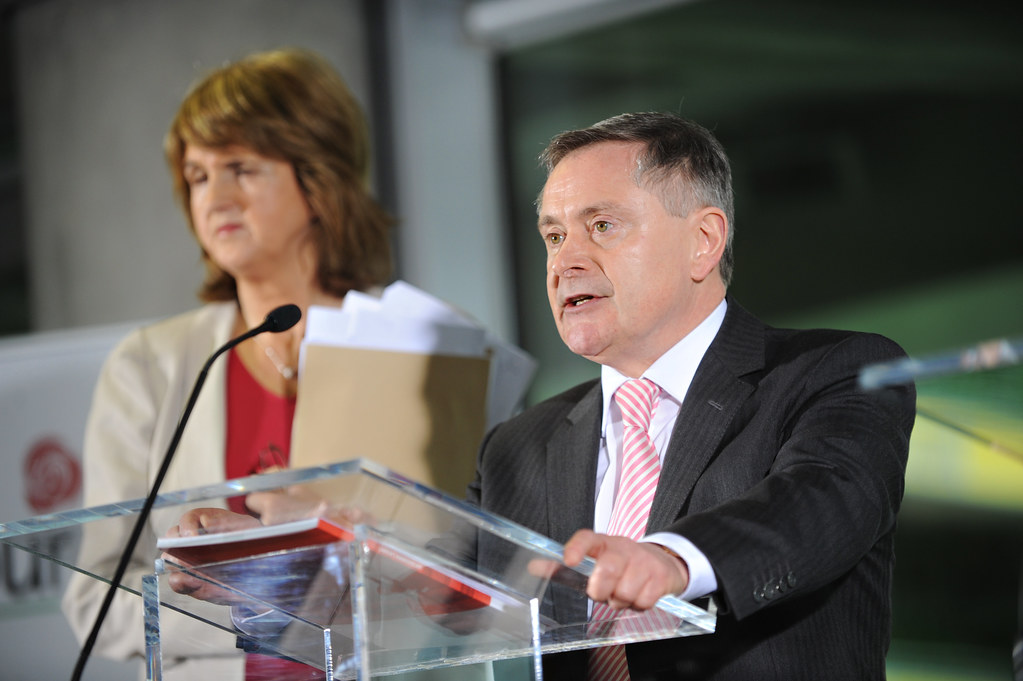
The Labour’s plan for Irish health: A dedicated cabinet Minister for primary care?


LABOUR HAS LAUNCHED THEIR PLAN FOR HEALTH – SAYING THEY WANT A DEDICATED CABINET MINISTER TO LOOK AFTER PRIMARY CARE.

Tanaiste Joan Burton also called for free GP care for all – saying it is something that can be achieved in the lifetime of the next government.
Health Minister Leo Varadkar has previously said it is an unrealistic target.

IT TAKES FOUR YEARS TO TRAIN GPS, AND WE HAVE A SHORTAGE OF AROUND 500.

However Junior Minister at the Department of Health Kathleen Lynch has said they have realistic targets to train enough people: “What people are forgetting is that this year, those people will be coming out of training as well.
“You know that didn’t stop, we have that amount of people coming out every year.
“We are not going to suddenly turn on the training this year and in four years’ time that they are coming out, they are coming out this year. They are coming out next year, they are coming out the year after.

“OUR TASK IS TO ENCOURAGE THEM TO STAY.”

A ‘Mini-brains’ breakthrough in neurological diseases and treatments.


LABORATORY-MADE “MINI-BRAINS” THAT SHOW A PRIMITIVE ABILITY TO THINK COULD TRANSFORM RESEARCH ON NEUROLOGICAL DISEASES AND TREATMENTS, SCIENTISTS NOW SAY.

THE TINY BALLS OF BRAIN CELLS, (LIKE ABOVE IMAGE CENTRE) ARE ABOUT THE SIZE OF A HOUSEFLY’S EYE, HAVE BEEN CREATED BY US RESEARCHERS WHO CLAIM THEY COULD BE MASS-PRODUCED IN LARGE NUMBERS.

Grown from stem cells, the brains contain many of the neurons and cells of their full-sized human equivalents.
Scientists believe they will provide far more reliable results in drug tests and other experiments than animal “models” such as mice and rats.
Lead researcher Professor Thomas Hartung from the Johns Hopkins Bloomberg School of Public Health in the US, said: “Ninety-five per cent of drugs that look promising when tested in animal models fail once they are tested in humans at great expense of time and money.
“While rodent models have been useful, we are not 150lb rats. And even though we are not balls of cells either, you can often get much better information from these balls of cells than from rodents.
“We believe that the future of brain research will include less reliance on animals, more reliance on human, cell-based models.”
The brains were created using induced pluripotent stem cells (iPSCs), adult cells that have been genetically reprogrammed into an embryonic stem cell-like state.
Stimulation with the right chemical cocktail causes the iPSCs to further develop into the different cells and layers of the brain.
Potentially, thousands of exact copies can be produced – a hundred in just one laboratory petri dish, say the scientists. They can also be customised to display certain traits or genetic defects associated with diseases such as Alzheimer’s, Parkinson’s and multiple sclerosis, as well as stroke or trauma.
He said one of the most exciting discoveries was that the brains displayed spontaneous electrophysiological activity that could be recorded with electrodes.
“It’s starting to produce a primitive type of thinking,” he added. “Obviously there’s no input or output. It is meaningless electrical activity but the neurons are trying to communicate with each other.
“This is the beauty of the third dimension. With a normal culture, which looks a little like eggs sunny-side up, there’s not a very dense cell wall where all these brain cells come together. In these new mini-brains they’re starting to produce functionality, and cellular communication on the level of using these electrical signals.”
After being cultivated for about two months, the brains developed four types of neurons and two kinds of support cell that nurture nerves.
One of the support cell types, oligodendrocytes, produce myelin, the fatty insulating sheath surrounding nerve fibres that is lost in multiple sclerosis.   

Sunday, November 22, 2015

Donie's Ireland daily news BLOG update.

Saturday 21st November 2015

Irish banking inquiry now fears mount its work on verge of collapse

Committee to hold emergency meeting amid concerns draft report flawed by ‘huge gaps’


The Irish Banking inquiry has over 1,000 amendments tabled for report described as “fundamentally flawed”.

The Banking inquiry with over 1,000 amendments tabled for report described as “fundamentally flawed”.
The Oireachtas banking inquiry members are to hold an emergency meeting today amid fears that the work of the committee is on the verge of collapse. The 11 members are deeply unhappy with the draft final report of the inquiry drawn up by its staff and have tabled more than 1,000 amendments.
The TDs and Senators will meet to decide whether the report, which was written by the investigation team working with the committee, can be saved within the allocated time frame. The inquiry has until January 20th to produce a final report. It will collapse if it has not completed its work before a general election is called early next year.
Members have warned the report will still not be satisfactory, even if all the amendments are accepted. They have described it as “not fit for purpose”.
One TD said yesterday: “The meeting is crucial. If we don’t come up with a solution at the meeting there won’t be enough time to fix it, and none of us will sign off on that report as it stands.
“It is fundamentally flawed; it has huge gaps and is not fit for purpose. If we cannot agree a way forward, none of us will sign off on that report and the whole thing collapses.”
The options available to members are limited. They can seek to make a series of amendments to the report or try to write a new one.
Second version
However, the members are reluctant to offer the investigation team the chance to write a second version in view of what they consider to be the weaknesses of the first one.
One proposal to be considered at today’s meeting is simply to publish the transcripts contained in the report and allow the members to write their own recommendations and conclusions.
One member said: “I don’t hold out a huge amount of hope. We don’t want it to collapse. Everyone is working to ensure it doesn’t happen, but it is looking more likely.”
Hundreds more amendments are expected to be tabled. The majority of the members of the inquiry will have to agree to changes before they can be accepted.
When it is agreed, the report will be distributed to anyone referenced in it and each of them will be asked to give their views on its contents. They will have 14 days to respond.
An Election rush
There is some concern among members that the banking committee is being rushed to complete its work ahead of the election.
The report has been split into three modules and runs to 750 pages. It is understood that up to 40 recommendations have been made, including making advice a future minister for finance gives to the cabinet accessible through Freedom of Information legislation.
The Irish Times understands that the report is highly critical of both the financial regulator and the European Central Bank.
The banking inquiry has cost €€4.9 million to date. Of this, €642,856 was spent on salary for inquiry investigators.

Why do we see such massive increases in Irish motor insurance?

This week’s Down to Business panel discusses why we are seeing such massive increases in motor insurance


The latest CSO stats have revealed that the cost of motor insurance has surged by just under 27% in the past 12 months.

This is compared to all other forms of insurance at an increase of 6½%.
Why are we seeing such massive increases in motor insurance? Is the trend likely to continue? What does it mean for consumers and businesses?
Those were just some of the topics explored in this week’s Industry Review on Down to Business, which focused on motor insurance.
Vincent Wall was joined by Conor Faughan, Director of Consumer Affairs at AA Ireland; Pádraig Lynch, a Director with Chill Insurance; and Brian Butterly, who is the Sales Manager with First Ireland.
Pádraig started by explaining “essentially what’s happened is, between 2003 and 2013, car insurance premiums have reduced by 47%. There was good stuff happening… [but then] really intense competition came in, and insurance companies focused on market share. Quite clearly they have driven the price down to a level which is not sustaniable”.
He pointed out that in 2014 in car insurance alone, insurance companies lost €175m. They are now attempting to get pricing back to a level where they can receive a return on their capital – which is naturally driving the premium prices upwards.
Brian agreed companies “were focusing on numbers rather than the actual amount of money they were bringing in versus the amount of money they were paying out”.
He added that unfortunately the fluctuating prices for customers are ‘very common’. “Like the housing crisis, prices go down, prices go up. It seems to be very similar in the insurance trade. They all follow a cycle”.
Conor had some very strong words on the subject, suggesting that “collectively the insurance sector has acted foolishly. They did underprice, that is part of what is going on”.
However he added it’s important to understand what the ‘real prices’ of insurance are. He said that ideally it “should just be the cost of compensating victims”, but he suggested that in Ireland “there’s so much waste”.
He highlighted €200m a year in legal fees, which he calls an ‘unnecessary burden’ for punters to pick up. He also observed that “fraud is rampant”.
“Insurance prices may need to go up, because of an element of correction. But we do not need to pay for waste. We do not need to pay for fraud. We do not need to pay for lawyers”, Conor argued.

UCC researchers develop new compound from Bloodhorn tree berries that reduces tumour’s

Plans to test compound to see if it works on patients after successful trials on mice


The tests, using molecules derived from berries from the Bloodhorn tree, found that the compound significantly reduced tumour size by up to 70% in experiments conducted on mice.

Dr Florence McCarthy, who leads the team on the project at the Analytical and Biological Facility at UCC, said the next step is to seek funding to see if the compound will kill leukaemia cells in patients.
He explained that the molecule in question is derived from an ellipticine which has been isolated from the berries of the Ochrosia Elliptica tree or Bloodhorn tree which grows inAustralia and Brazil.
The molecule was produced by a member of Dr McCarthy’s research group, Elaine O’Sullivan whose work as part of the group is funded by the Irish Research Council, he added.
Dr McCarthy said his research team partnered with the National Cancer Institute in the US where “the molecule showed promise against leukaemia cancer cells over other cancers.”
The research team then collaborated with Prof Tom Cotter, chair of Biochemistry at UCC, to identify if the molecule could be marketed as a drug and this led to seeing how the drug kills cancer cells.
The group then obtained funding primarily from the Children’s Leukaemia Research Project and the Irish Cancer Society and they set up a study to see how effective it might be in killing cancer cells.
“The fact that Tom ran across campus to deliver the results to me, rather than use the cursory email, indicated the significance of our findings,” said Dr McCarthy.
“Our plan is now see if other drugs can be accessorised in the same way and develop our drug to further improve the cancer killing effect,” he added.
Prof Cotter revealed: “We targeted acute leukaemia, which is a difficult to treat cancer, and to be honest I didn’t expect the experiments to work as well as they did.
“In fact I was so surprised with the results I kept looking at them for ages; I couldn’t really believe what I was seeing,” added Prof Cotter.
According to Dr McCarthy, the group’s research has “taken the natural product and restyled it with unique features to improve the potency and solubility.
“What is truly exceptional is these features are not common in drugs and so we aim to exploit this fully. There is also significant potential to apply this approach to other drugs in a similar fashion.”

Facebook shuts a man’s account after refusing to believe the name used is his real one

But apparently it is. 23-year-old Phuc Dat Bich isn’t one bit happy with the social network’s administrators.

   Column: Facebook’s early childhood was… complicated.
A Man with a deeply unfortunate name, from a phonetic English point of view at any rate, has expressed his profound irritation that no-one believes it is in fact his real one.
23-year-old Australian Phuc Dat Bich, who is of Vietnamese descent, posted a photograph of his passport on Facebook after his account was locked down a number of times as administrators felt it was a joke account.
“I find it highly irritating the fact that nobody seems to believe me when I say that my full legal name is how you see it,” Phuc said in the post.
I’ve been accused of using a false and misleading name of which I find very offensive. Is it because I’m Asian? Is it?
Having my fb shut down multiple times and forced to change my name to my “real” name, so just to put it out there. My name.
The post is signed “yours sincerely, Phuc Dat Bich”.
Phuc’s post was initially shared on 28 January of this year, but has only recently gone viral, with 72,000 shares and counting.
In case you’re wondering, the correct Vietnamese pronunciation of the name is ‘Phoo Da Bic’.
You can see how people might be confused though.
Not to worry, Phuc’s Facebook profile picture depicts him sitting in an opened car boot while eating a bag of kettle chips. So he may be a man with the ability to see the lighter side of things.

Graphene can now be produced with significantly cheaper materials,

High Capacity Batteries Coming Soon

      
Graphene has been focused on by researchers as it can do wonders for smartphone batteries and other electronic devices, but it has been too expensive to make.
Now, a more cost-effective manner in manufacturing the material has been found. Researchers from the University of Glasgow has a way to produce more graphene without spending too much.
The traditional process of producing the material is done via “chemical vapour deposition”. It involves combining several gases inside a reaction of chamber.
After the combination, a film of graphene will then be deposited on a substrate surface. The researchers still used the same process, but they utilized the cheaper copper foils for the surface.
Copper foils are not only significantly cheaper, the researchers also found out that they are an excellent medium for the formation of graphene, according to Irish Independent. The cost-effective way could finally pave the road for better batteries.
How cheap are the copper foils used by the researchers? For just more than a half pound per square meter, graphene can be produced. This is the copper used by the university researchers.
In contrast, the copper used in the traditional methods cost about £75. It also needs a special preparation process that also costs more, according to TechRadar. The method and copper used by the researchers does not require additional costs.
Dr Ravinder Dahiya, who led the researchers at the university, said: “Our process produces high-quality graphene at low cost, taking us one step closer to creating affordable new electronic devices with a wide range of applications, from the smart cities of the future to mobile healthcare.”
In addition, Dr Dahiya said that graphene could provide a conductive surface that will benefit not only the electronics industry, but also the world of advanced prosthetics. The field of synthetic skin is the focus of Dr Dahiya’s research.
Aside from being a great conductor, the material was also found to be ultra-flexible. In fact, researchers have also found a way to bend them more using the Japanese paper art technique called Kirigami.
The technique is not the same as the popular Origami. Instead of using folds, several cuts are used to form flexible structures out of the paper. Using the technique, researchers from the Cornell University were able to stretch the material.
To do the technique, the researchers used both magnets and micro-manipulators. Applying the technique to graphene will make it more stretchable, which can be also applied in the synthetic skin research of Dr Dahiya.
Graphene’s thinness makes it an ideal material for prosthetics and wearable tech. It does not easily break when it bends, and it can still conduct electricity. Microelectronics can be utilized along with the flexibility of the material to produce devices and prosthetics that aren’t possible with other materials.
However, the material is being praised most because of its endless potential for electronics applications. The usefulness of the material was demonstrated when researchers from Columbia Engineering managed to make the world’s thinnest light bulb using the material.
The graphene used in the light bulb was able to withstand temperatures of more than 2500 degrees Celsius. Focusing the heat on one spot enabled the light to shine brightly and be visible to the human eye.
With the cheaper way of manufacturing graphene, tech companies may finally be able to make better smartphone batteries. One of the main problems of the handsets is the short battery life.
Graphene can also be used in super fast computing, which could mean significantly faster chips on both mobile and desktop computers. It can also lead to flexible wearables and devices.