Pages

Showing posts with label European shares. Show all posts

Saturday, February 13, 2016

Donie's Ireland daily news BLOG update

World markets rebound on better bank news

PROSPECTS FOR CO-ORDINATED OIL PRODUCTION CUT UNDERPIN POSITIVE INVESTOR SENTIMENT


IN LONDON, ROLLS-ROYCE SHARES JUMPED MORE THAN 14% AFTER A WELL-RECEIVED UPDATE.

It was a torrid week on the markets but global indices staged a rebound yesterday, as they took reassurance about the banking sector and prospects for a co-ordinated oil production cut. All of this was sufficient to lift the Irish market by close to 1% on the day.
DUBLIN
The Iseq index finished at 5,793.41, down 4.6% on the week. “Ireland sits up there like a beacon of growth, but, like everything else, if the market is going down, the market goes down,” said a trader at the close.
The trader cited a degree of market chatter reflecting a “early concerns” over the possibility of a British exit from the EU and “Spanish-type concerns” over talk of a hung Dáil after the election.
Bank of Ireland gained 2.3% on the day to reach 26.7% the stock was down from 28.3% week previously.
“Bank of Ireland has done absolutely nothing wrong, but European banks were decimated over the week. Bank of Ireland was [trading] 1.1 times book [value] at the start of the week, and it’s moved back with the sector,” the trader said.
Smurfit Kappa, which reported solid results during the week, finished 4.69% higher on the day at €21.20.
Citing a 12% swing in Kingspan shares this week, the trader said “savage” volatility was the only theme. Kingspan finished out at €21.17, up 0.83% on the day.
LONDON
Britain’s top share index ended higher, recording its best one- day percentage gain in more than five months, as banking and commodity-related stocks rebounded from a slump in the previous session.
Rolls-Royce jumped more than 14% after a well-received update, helping the FTSE 100 index to end 3.1% higher at 5,707.60 points, after falling to its lowest point since late 2012 on Thursday. The index, however, finished 2.4% lower this week. The oil and gas index gained 5.9% after prices of major industrial metals rose and oil prices rose 10 per cent on prospects for a co-ordinated production cut, sparked by comments from the energy minister of the United Arab Emirates.
Banks were also among the top gainers, led by an 11% rise in Standard Chartered and a 6.3% gain in Barclays.
EUROPE
European shares rebounded as Deutsche Bank and Commerz bank rallied, helping stock markets stage a partial recovery from stinging losses earlier in the week.
The Pan-European FTSEurofirst 300 index ended 3% higher, rising back up off its lowest level in more than two years. Fears about how well European banks can cope with slow growth and low interest rates had pushed European banking shares to multi-year lows.
But Deutsche Bank surged 11.8% after saying it would buy back more than $5 billion in senior debt, easing concerns about its bonds. Its rival Commerzbank also reported a return to profit in the fourth quarter, and its shares jumped 18%.
The STOXX 600 Europe Banks index rose 5.6%. Germany’s DAX advanced 2.5%, but it remains nearly 30% below a record high reached in April 2015.
NEW YORK
Wall Street rallied, led by a rebound in beaten-down financial and energy stocks after five straight days of a gruelling selloff on fears over the health of the global economy and the banking sector.
Nine of the 10 major S&P sectors were higher, led by a 3.7% rise in the financial sector. Energy and materials stocks, both of which have been hit by slumping commodities prices, were up about 2.5%.
Bank stocks, hit worst due to concerns about the impact of negative interest rates and energy-backed loan defaults, were the top gainers, led by JPMorgan’s near 8% gain.

Planned strike by Irish secondary teachers now called off

FEBRUARY 24TH STOPPAGE BY TUI MEMBERS COULD HAVE AFFECTED 350 SCHOOLS BEFORE POLLING DAY


TUI PRESIDENT GERRY QUINN SAID ON FRIDAY THAT ON FOOT OF CORRESPONDENCE FROM THE MINISTER THE UNION WAS NOW SATIFIED THAT SUCH AN ENGAGEMENT WAS POSSIBLE.

The planned strike by teachers, which could have closed up to 350 second level schools on Wednesday, February 24th, has been called off.
The Teachers’ Union of Ireland (TUI) said its executive committee had decided not to go ahead with the one-day strike in second level schools and the further/adult education sectors following contact with Minister for Education Jan O’Sullivan.
The TUI had previously stated that the strike would go ahead unless “meaningful” progress was made in talks with the Department of Education on issues such casualisation and income poverty for teachers.
TUI president Gerry Quinn said yesterday (FRI) that, on foot of correspondence from the Minister, the union was now satisfied that such an engagement was possible.
“As a sign of our good faith, the executive committee of the union decided not to hold our planned strike action in order to allow engagement in the hope of developing viable solutions to a range of crisis issues.”
He maintained the union had a a very strong mandate from members “to activate strike action at a later stage should it become apparent that sufficient progress is not being made”.
“Of key concern to TUI members are the precarious employment status and income poverty of new and recent entrants to the profession and the continuing, damaging effects of underfunding and understaffing on the service provided to students across all the sectors in which the union has members.”
Ms O’Sullivan said she welcomed the decision of the TUI executive to call off the strike. She said the decision was very welcome for parents and exam students in particular.
She reiterated that the Department of Education was open to engaging with TUI on matters of mutual concern in the context of continuing co-operation with collective agreements.
Earlier this month, the TUI staged a one-day strike in institute of technologies around the country.

You can soon power your smartphone by walking


SCIENTISTS AT THE UNIVERSITY OF WISCONSIN-MADISON HAVE DEVELOPED TECHNOLOGY THAT IS CAPABLE OF POWERING TECHNOLOGY AS YOU WALK.

We’re encouraged to take 10,000 steps per day, but it can be difficult to work up the motivation to do so. It may be more tempting in the future if these shoes that charge your smartphone as you walk take off.
Scientists at the University of Wisconsin-Madison have created the technology, which uses the kinetic energy of you walking to generate electricity. At the moment, it is capable of creating up to 10 watts of power per square metre walked, but it’s believed that it could one day hit 10kW. For reference, charging a smartphone only requires around 2 watts.
The University explains: “The researchers’ bubbler device — which contains no moving mechanical parts — consists of two flat plates separated by a small gap filled with a conductive liquid. The bottom plate is covered with tiny holes through which pressurized gas forms bubbles. The bubbles grow until they’re large enough to touch the top plate, which causes the bubble to collapse.”
“The speedy, repetitive growth and collapse of bubbles pushes the conductive fluid back and forth, generating electrical charge.”
Before we can power our handsets by going for a stroll, InStep NanoPower needs to commercialise the technology and find some way of connecting a smartphone to the shoes. But the company is looking to put the technology out there now.
You can see the general principle in action below as a demonstrator powers up a flashlight at walking pace.

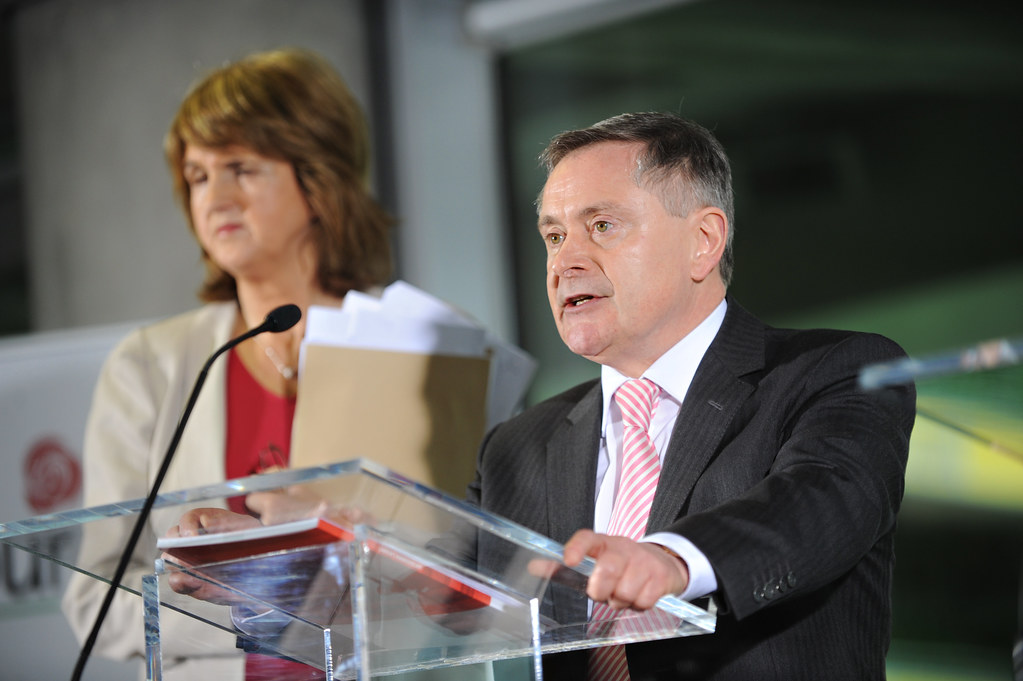
The Labour’s plan for Irish health: A dedicated cabinet Minister for primary care?


LABOUR HAS LAUNCHED THEIR PLAN FOR HEALTH – SAYING THEY WANT A DEDICATED CABINET MINISTER TO LOOK AFTER PRIMARY CARE.

Tanaiste Joan Burton also called for free GP care for all – saying it is something that can be achieved in the lifetime of the next government.
Health Minister Leo Varadkar has previously said it is an unrealistic target.

IT TAKES FOUR YEARS TO TRAIN GPS, AND WE HAVE A SHORTAGE OF AROUND 500.

However Junior Minister at the Department of Health Kathleen Lynch has said they have realistic targets to train enough people: “What people are forgetting is that this year, those people will be coming out of training as well.
“You know that didn’t stop, we have that amount of people coming out every year.
“We are not going to suddenly turn on the training this year and in four years’ time that they are coming out, they are coming out this year. They are coming out next year, they are coming out the year after.

“OUR TASK IS TO ENCOURAGE THEM TO STAY.”

A ‘Mini-brains’ breakthrough in neurological diseases and treatments.


LABORATORY-MADE “MINI-BRAINS” THAT SHOW A PRIMITIVE ABILITY TO THINK COULD TRANSFORM RESEARCH ON NEUROLOGICAL DISEASES AND TREATMENTS, SCIENTISTS NOW SAY.

THE TINY BALLS OF BRAIN CELLS, (LIKE ABOVE IMAGE CENTRE) ARE ABOUT THE SIZE OF A HOUSEFLY’S EYE, HAVE BEEN CREATED BY US RESEARCHERS WHO CLAIM THEY COULD BE MASS-PRODUCED IN LARGE NUMBERS.

Grown from stem cells, the brains contain many of the neurons and cells of their full-sized human equivalents.
Scientists believe they will provide far more reliable results in drug tests and other experiments than animal “models” such as mice and rats.
Lead researcher Professor Thomas Hartung from the Johns Hopkins Bloomberg School of Public Health in the US, said: “Ninety-five per cent of drugs that look promising when tested in animal models fail once they are tested in humans at great expense of time and money.
“While rodent models have been useful, we are not 150lb rats. And even though we are not balls of cells either, you can often get much better information from these balls of cells than from rodents.
“We believe that the future of brain research will include less reliance on animals, more reliance on human, cell-based models.”
The brains were created using induced pluripotent stem cells (iPSCs), adult cells that have been genetically reprogrammed into an embryonic stem cell-like state.
Stimulation with the right chemical cocktail causes the iPSCs to further develop into the different cells and layers of the brain.
Potentially, thousands of exact copies can be produced – a hundred in just one laboratory petri dish, say the scientists. They can also be customised to display certain traits or genetic defects associated with diseases such as Alzheimer’s, Parkinson’s and multiple sclerosis, as well as stroke or trauma.
He said one of the most exciting discoveries was that the brains displayed spontaneous electrophysiological activity that could be recorded with electrodes.
“It’s starting to produce a primitive type of thinking,” he added. “Obviously there’s no input or output. It is meaningless electrical activity but the neurons are trying to communicate with each other.
“This is the beauty of the third dimension. With a normal culture, which looks a little like eggs sunny-side up, there’s not a very dense cell wall where all these brain cells come together. In these new mini-brains they’re starting to produce functionality, and cellular communication on the level of using these electrical signals.”
After being cultivated for about two months, the brains developed four types of neurons and two kinds of support cell that nurture nerves.
One of the support cell types, oligodendrocytes, produce myelin, the fatty insulating sheath surrounding nerve fibres that is lost in multiple sclerosis.   

Sunday, December 22, 2013

Donie's Ireland daily news BLOG Sunday

‘Care and trust’ should define our Irishness for the New Year

SAYS PRESIDENT MD HIGGINS

Christmas message extends wishes ‘in a special way’ to emigrants abroad

Care and trust should define a shared sense of Irishness in the New Year, President Michael D Higgins has said.
He reflected on the sacrifice and hardship of recent times and said his next year would be dedicated to the service of the people.
He extended warmest Christmas wishes “in a special way to our emigrants abroad and to the members of the extended Irish family wherever they may be.”
“During 2014 I will be encouraging the widest possible discussion of ethics in every aspect of our lives, nationally and globally,” Mr Higgins said.
“This will, I hope, make a contribution towards moving beyond a version of our society and economy that has brought so much hardship, required so much sacrifice.
“As a new year beckons, I am confident that Irish people will draw on the character and resilience they have so often shown to craft a vision of our shared Irishness that is defined by the values of care, solidarity, trust and responsibility.
“In the year ahead, I will continue to dedicate my abilities to the service of the Irish people at home and abroad, and I greatly look forward to the state visit to our nearest neighbours and friends in the United Kingdom in April.”

Some of the jewels plucked from NAMA’s crown

  
The bank faced with the task of having to repay €7.5m in Nama bonds by the end of 2013, officials at the State’s ‘bad bank’ set about selling its most prized assets.
As one senior Nama source told the Sunday Independent last week: “It was 2010 and it was 2011 and we had to repay €7.5bn in Nama bonds by the end of 2013. It’s on the public record.
“We had a target to repay those bonds within three years.
“Where the hell were we going to get the money from? So we looked at who had the best assets and we said ‘let’s sell those’.”
So Nama went looking for the proverbial family silver and sold it off at a time when the credit which drives and supports property prices was all but absent.
The most valuable jewels in Nama’s crown included:

BATTERSEA POWER STATION

Widely held as London’s most exciting development opportunity in decades, and it was the dream of Treasury Holdings’ chiefs Johnny Ronan and Richard Barrett to finally bring it to fruition.
But when their companies’ debts went into Nama, that dream came to an end and the agency along with the Treasury duo’s other lender, Lloyd Banking Group, appointed administrators with a view to recovering the project’s combined £502m (€599m) debt.
Ultimately, the site was sold to a Malaysian consortium headed by SP Setia,Sime Darby and EPF, for a reported £400m (€477m).
The identity of the buyer proved to be bitterly ironic for Messrs Ronan and Barrett given that they themselves had very nearly agreed a deal with SP Setia and Sime Darby to sell Battersea before their loans were called in by Nama.
Claridge’s, the Berkeley and the Connaught HOTEL’S, 
The iconic hotels were acquired at the height of the boom by an Irish consortium led by financier Derek Quinlan and property tycoon Paddy McKillen; the establishment of Nama saw a massive portion of the debt behind them being transferred to the agency. In 2011, Nama sold those loans which underpin Mr Quinlan’s shareholding for €800m to the Barclay brothers, who are Mr McKiillen’s rivals for control of the London landmarks.

European shares set for best week in eight months


European shares rose on Friday, staying on track for their best week in eight months, with cruise ship operator Carnival up on forecast-beating results and broad sentiment boosted by greater clarity on US monetary policy.

The Federal Reserve this week said it would trim monthly bond purchases by $10 billion, sugar-coating the reduced stimulus with a signal that interest rates were likely to stay ultra-low for longer than previously expected.
Carnival rallies as results prompt broker upgrades 
Although the taper came earlier than many had forecast, markets had plenty of time to prepare for the move – first flagged in May – and the Fed’s decision removed the policy uncertainty that had kept many investors on the sidelines. “Clearly it’s still a very accommodative policy and will be remaining so for some time by the look of it,” Kevin Lilley, manager of the Old Mutual European Equity fund, said.
Strong US growth data on Friday bolstered investor confidence that the world’s biggest economy can withstand a scaling back of stimulus. With European equity investors already sitting on gains of nearly 30 percent from the past two years, traders said many had already closed their books for 2013, with few willing to gamble their profits in the final days of the year.
“It will be low volume, low volatility and going slightly higher,” said Peter Garnry, strategist at Saxo Bank. The FTSE urofirst 300 had risen 0.4% to 1,286.63 points by 1503 GMT. That takes its gains so far this week to 3.5 percent, putting it on track for its biggest weekly rise since April.
Carnival was one of the top gainers, up 2.8% after several brokers upgraded the stock following forecast-beating quarterly results the previous day. “We have been hoping that new CEO Arnold Donald could be a change agent and it appears that CCL is making some positive steps towards a business transformation. Additionally, following a better-than-expected Q4 and 2014 guidance, now is the right time to get onboard,” analysts at Credit Suisse said in a note, upgrading it to ‘outperform’ from ‘neutral’.
Volumes on Carnival stood at 2-1/2 times their 90-day daily average approaching the end of the session, compared to 85% on the FTSEurofirst 300. The rally pushed Carnival shares to three-month highs, breaking well above technical resistance at the 200-day moving average.
The charts outlook also brightened for the broader market, opening the door for more gains on the Euro STOXX 50 index of euro zone blue-chips, last up 0.3 percent at 3,041.46 points. . A rise of some 4 percent this week has hoisted the index back above its 50-day moving average, now at 3,025. “I think it could probably push a little higher in the near term and it’s quite possible that we could see a test of … 3,098 (the high posted towards the end of last month),” Charles Stanley analyst Bill McNamara said.

Cancer DNA model research helps pinpoint risks

SAYS CARDIFF UNIVERSITY SCIENTIST

   
A new DNA model for bowel and womb cancer will help diagnose those at high risk, it is claimed.
It follows work by an international group of scientists, including one from Cardiff University.
They have been researching how an inherited condition called Lynch Syndrome can increase the risk of bowel, womb and other cancers.
The new model of previously unhelpful DNA data can now be put to use.
  Dr Ian Frayling of Cardiff University: 
“As a result of this work, doctors will now be able to say much more confidently whether those patients have Lynch Syndrome, and therefore whether they are at a higher risk of cancer,” said Dr Ian Frayling from Cardiff University’s Institute of Medical Genetics.
He is one of the members of the International Society for Gastrointestinal Hereditary Tumours (InSiGHT) which organised the research.
“What we have been able to do is effectively refine genetic information in the InSiGHT database and provide a more accurate answer of the risk of getting cancer,” he said.
“This will help to save more lives, because by giving a definite answer to more patients, they will be able to access the specialist screening that they need.”
‘Genetic limbo’
The findings have been published in the journal Nature Genetics.
In the UK alone, about 16,000 people die from bowel cancer every year, and womb cancer affects about 2,000 women making it the commonest form of gynaecological cancer.
Wales also has the highest rates for womb cancer in the UK.
In all those cancer cases, it is estimated that some 5% develop the diseases as a result of having Lynch Syndrome.
Patients who currently have genetic testing for Lynch Syndrome are often given an inconclusive result which leaves them unsure of whether they face a high risk of cancer.
“It will also save NHS resources and be safer because we will be able to reassure people that they are not at risk and so don’t need the extra screening,” added Dr Frayling.
“As a result of this, colleagues and the families they care for all over the UK are now benefiting, and we are working on incorporating this into the UK guidelines on testing for Lynch Syndrome.”

Irish drug company Jazz Pharmaceuticals to Buy Gentium for $1 Billion


The Irish drug maker Jazz Pharmaceuticals agreed to acquire Gentium in a deal valued at about $1 billion, diversifying its portfolio of treatments for rare diseases.

A Jazz subsidiary will make an all-cash tender offer of $57 a share for all of Gentium’s ordinary stock and American depositary shares. Gentium’s shares were down 1.3 percent to $55.65 at the close of trading on Nasdaq on Thursday.
Gentium, an Italian biopharmaceutical company that develops treatments for rare diseases, was granted approval in October by the European Commission to sell its keynote drug Defitelio, a treatment for severe hepatic veno-occlusive disease.
“Incorporating Gentium into Jazz Pharmaceuticals is a strong strategic fit as Defitelio would diversify our development and commercial portfolio and complement our clinical experience in hematology/oncology and our expertise in reaching targeted physicians who treat serious medical conditions,” said Bruce Cozadd, Jazz’s chairman and chief executive.
The transaction has been approved by the boards of both companies and Gentium’s board, management and certain shareholders have agreed to tender their shares, representing about 15 percent of the company’s stock. The deal is conditioned on at least 66.7 percent of the company’s shares being tendered.
The deal is expected to close in the first quarter of 2014.
Through the first nine months of the year, Jazz posted revenue of $636.6 million, a 58 percent increase over the prior-year period.
Jazz is financing the transaction with a combination of cash on hand as well as an incremental term loan and borrowings under its existing senior secured credit facility. Barclays, its financial adviser, also has committed to a $500 million incremental term loan.
Jefferies served as Gentium’s financial adviser. Gentium’s legal advisers were Skadden Arps Slate Meagher & Flom and Gianni, Origoni, Grippo & Cappelli.
Jazz’s legal counsel were Weil, Gotshal & Manges; Baker & McKenzie; Cooley; Hogan Lovells; and Gattai, Minoli & Partners.

Experts Link Agriculture to Rising Levels of Climate Change Impacts


Climate change experts have directly linked agricultural sector to the global warming, causing the devastating effects of climate change to both flora and Fauna. 

The experts under the auspice of adaptation to climate change and Insurance (ACCI) say that the concentration of carbon dioxide in the atmosphere is ever increasing due to cutting down of trees and burning of fossil fuel to facilitate farming activities.
Speaking to Africa Science News in Busia County during a climate change adaptation workshop, the project national coordinator Joab Osumba noted that carbon molecules absorb heat rays causing an upward change in temperature, thus destabilizing the atmosphere.
Osumba further disclosed that methane gas and nitrous oxide emitted from livestock and fertilizers respectively have contributed immensely to the adverse effects of climate change in Africa.
Adaptation to Climate Change and Insurance is a Non Governmental Organization that advocates for crops that are adaptive to climate change in Busia and Homabay Counties for the last three years.
The Organization has been funded to the tune of 2.8m Euros, by the Government of Germany through giz, and implemented by the government of Kenya, Ministry of Agriculture.
However Mr. Osumba confirmed that following an independent study on adaptive crops in Western Kenya regions, sweet potatoes, sorghum and cassava are resilient and adaptive against climate change.
The experts regretted that despite the biting effects of climate change, most farmers in the region do not appreciate insurance services to carter for agricultural losses occasioned by the climate change.
Said Osumba, “I challenge farmers, not only in Busia and Homabay, but across the Country to embrace Insurance covers against crop failures since climate change is here to stay”
Most farmers have not been keen on the impact of agriculture on climate change and Osumba calls on experts in the agricultural sector to join hands with other entities in fight against menace of climate change.
He urged that farmers should be taken through the best farming practices as a mitigative measure against the upward temperature change.
He further observed that the UNEP’s carbon credit initiative and promotion of scientifically approved adaptive crops is the way to go in the 21st C  to tackle climate change problem.