Pages

Showing posts with label Brussels. Show all posts

Saturday, January 9, 2016

Donie's Ireland daily news BLOG

Paris attacks fugitive’s print found in‘bomb-making hideout’ in Brussels

     
People stand next to a banner reading Je suis Paris.

A BRUSSELS APARTMENT WAS PROBABLY USED TO MAKE BOMBS FOR THE PARIS ATTACKS AND ONE OF THE PLOTTERS ALSO HID OUT THERE AFTER ESCAPING A POLICE DRAGNET, BELGIAN PROSECUTORS HAVE SAID.

The prosecutors said they found Salah Abdeslam’s fingerprint in a search of the apartment on December 10, but would not say why they waited a month to announce it.
The search also turned up three suspected suicide belts, traces of the same explosive used in the November 13 attacks that killed 130 people and other material that could be used to manufacture bombs, according to the Belgian Federal Prosecutor’s Office.
The third-floor apartment was probably used as a hideout after Abdeslam fled the attacks, federal prosecutor Eric Van der Sypt said.
Abdeslam, who is still at large, called for two friends to pick him up amid the bloodshed and chaos that night that left 130 people dead and hundreds injured.
“We found material to make explosives, we found traces of explosives and we found three belts. So you don’t have to be Sherlock Holmes to make the right deduction,” Mr Van der Sypt told the Associated Press.
Abdeslam is believed to have played a key logistical role in the Paris attacks. A French gendarme stopped him and his two friends in their car near the border but released them. The friends are among 10 people arrested in Belgium in connection with the attacks.
Authorities now believe Abdeslam returned to the apartment, was eventually picked up by someone else “and we lost trace”, Mr Van der Sypt said.
The apartment in the Schaerbeek neighbourhood of Brussels had been rented under a false identity that may have been used by one of those who are now under arrest.
The three handmade belts discovered in the search at Rue Berge in Schaerbeek “could have been intended for the transport of explosives”, the prosecutor’s office said. Traces of the highly volatile TATP, which was packed into the suicide vests in November, as well as other material that could be used to manufacture explosives were also detected.
The November 13 attacks marked the height of a violent year for France that began with a January 7 assault on the offices of the Charlie Hebdo newspaper.
Paris was again jolted on Thursday when a man wearing a fake explosives vest and wielding a butcher’s knife ran up to a police station and was shot dead by officers standing guard.
Paris prosecutor Francois Molins said investigators are unsure of the man’s true identity.
Mr Molins told France-Inter radio that the assailant carried a paper marked with the Muslim declaration of faith, an emblem of the Islamic State group and his name, and gave his nationality as Tunisian. Mr Molins said he also had a phone with a German SIM card.
Stopped for a minor theft in 2013 in France’s south, the man had identified himself as Ali Sallah and gave his nationality as Moroccan.
IS extremists have claimed responsibility for the January 2015 and November 13 attacks in Paris.

A free vote on abortion for Fine Gael ministers, A promise by Kenny

STANCE CONTRADICTS DIRECTOR OF ELECTIONS WHO SAID MINISTERS SHOULD RESIGN IF DISAGREEING ON POLICY


TAOISEACH ENDA KENNY SAID FINE GAEL MINISTERS WOULD BE ALLOWED TO VOTE WITH THEIR CONSCIENCE ON THE EIGHTH AMENDMENT, REGARDLESS OF WHETHER THE PARTY WAS IN GOVERNMENT AFTER THE ELECTION.

Government ministers will be allowed to vote for or against a repeal of the eighth amendment to the Constitution without fear of repercussion, Taoiseach Enda Kenny has indicated.
Mr Kenny said members of Fine Gael would be allowed to vote with their conscience on the issue regardless of whether they were in government or not. “If it comes to a point where there is an issue to be decided by vote I’ve already said that the members of my party would have a free vote and that applies whether they are in government or not in government as ministers,” he said.
The Taoiseach’s statement contradicts the party’s director of elections, Brian Hayes, who insisted ministers should resign if they disagreed with future government policy on abortion.
Speaking in Germany, while on a trade mission, Mr Kenny said this was a sensitive and personal decision for everybody and it required a rational and comprehensive discussion. He said he had committed to allowing a free vote to Fine Gael TDs and he wanted to see a citizen-led forum examine the issue.
  • Ministers opposing abortion policy should resign – Hayes
  • Abortion legislation should be repealed, says professor
  • Diarmuid Martin welcomes FG free vote on abortion amendment
Asked if ministers would be allowed to campaign in favour of or against a possible referendum, the Taoiseach said: “If you get to a point, and I can’t predict the outcome of any of the conclusions of the process, if we get to the point where there is a vote they will be voting in respect of what their conscience tells them.”
A Government spokesman later said it was premature to discuss campaigning when the process had not been determined.
Mr Kenny has committed to a constitutional review of the eighth amendment, which bans abortion, within six months of the general election if Fine Gael is returned to government. The Taoiseach has said a citizens’ forum to debate changes to the eighth amendment, which gives an equal right to life to the mother and the unborn, would be established to examine the issue. The Taoiseach had committed to a free Dáil vote for his TDs on whatever the outcome of the forum is.
However Fine Gael’s director of elections had said the next government would adopt whatever position was recommended by the forum and cabinet and junior ministers who went against that policy should be fired.
Mr Hayes said: “Now whether it should apply to members of the government is another matter. That is not the same as backbenchers. I have always held the view that if the government, per se, including all ministers of State, are arguing for something in terms of a legislative proposal, then it is incumbent on you as a member of the government to support or leave the government. This would be post the people’s convention that the Taoiseach is proposing.”
Fine Gael said the forum would be “a process of consideration by citizens, expert groups and politicians” of the issue but added that its proposed structure had not been finalised.
Labour and Sinn Féin have committed to a repeal of the amendment, whileFianna Fáil will allow a vote of conscience on the issue.

IFA whistle-blower claims he was blocked from entering election race

DEREK DEANE SAYS POTENTIAL BACKERS WERE PREVAILED UPON TO WITHHOLD THEIR SUPPORT

   
The IFA’s Carlow chairman, Derek Deane, failed to get the required backing of at least six county executives ahead of Wednesday’s deadline for nominations, ruling him out of the race.
The Irish Farmers’ Association officer who exposed the pay issues which led to the resignation of its president and general secretary claims he has been “deliberately” blocked from contesting its presidential election.
The IFA’s Carlow chairman, Derek Deane, failed to get the required backing of at least six county executives ahead of Wednesday’s deadline for nominations, ruling him out of the race.
However, Mr Deane claimed potential backers were prevailed upon to withhold their support for him.
“A lot of the nominations were deliberately held up so I wouldn’t get to run on the day. They were deliberately held and distributed at the very end,” he told RTE Radio’s News at One programme.
Mr Deane also claimed the IFA’s deputy president Tim O’Leary, who also failed to get the required number of nominations, had blocked him.
“The critical question then for Tim O’Leary is this: did he deliberately shaft me by just sitting on the fence and not informing people he had withdrawn from the race,” he said.
Mr O’Leary, however, later told The Irish Times he never withdrew from the race and was canvasssing for support “right up until the deadline”.
He also said he had asked Mr Deane on Wednesday afternoon to step aside and support his campaign. “There was logic to this because two years ago he had nominated me for deputy president,” Mr O’Leary said.
Mr Deane has appealed to the IFA to be allowed to enter the race on foot of receiving the verbal backing of Monaghan chairman Brian Treanor late on Wednesday evening.
“Brian Treanor had stated on one of my voicemails that he was prepared to support me in the interests of democracy if Tim O’Leary was out of the race.”
Mr Deane claimed an email from Mr Treanor advising the IFA of his support for the Carlow chairman failed to get through because of a technology failure.
As a result, he is seeking a special meeting of the organisation’s executive council to consider the matter. “I am asking on the basis of democracy to be allowed to run,” he said.
The IFA again declined to comment on Mr Deane’s last-ditch efforts to contest the election but is understood to be adamant only three candidates secured the required nominations.
They were: Henry Burns from Laois, who is currently the IFA’s livestock chairman; Flor McCarthy from Kerry, the organisation’s rural development chief; and Joe Healy from Galway, an IFA farm business representative.
Asked if he had made a decision on possible legal action if he fails in his bid to be allowed to contest the election, Mr Deane said: “Absolutely not”.
The association’s returning officer Jer Bergin, meanwhile, announced nominations are now being sought for the positions of IFA deputy president and its four regional chairpersons.
He said the nominations were subject to the executive council adopting a rule change in February to allow the elections, scheduled for April, to go ahead.

‘Binge drinking left me in a coma’, says Nevada student who wants to warn others


A STUDENT FROM RENO, NEVADA, WANTS TO WARN OTHER PEOPLE ABOUT BINGE DRINKING AFTER SHE FELL INTO A COMA FOLLOWING A HEAVY NIGHT OUT.

One student, Hanna Lottritz, didn’t celebrate her 21st birthday this week with copious amounts of booze. She’s avoided bars and parties since she ended up in a critical condition in hospital, with respiratory failure and in a 24 hour coma.
“I didn’t realize the importance of drinking responsibly until I was waking up from a coma,” she wrote on her blog. Now she’s sharing the shocking photo in hospital and the story of how she ended up there.
On July 25 last year Hanna went to a gig with friends.
“I woke up, had breakfast and started what would end up being the worst 48 hours of my life,” she wrote. “At the concert I had two beers. Many of the people I was with had been drinking throughout the day and were already feeling good. I hadn’t started drinking until a little after dinner and I felt a little behind.”
After the concert she was began to feel “a bit of a buzz” and ended up at a campsite and began to play competitive drinking games with friends.
“Around 11:30pm, one of my guy friends and I were seeing who could take the longest chug from a bottle of Black Velvet whisky … Everything that happened from midnight on is information I gathered from friends because I have zero memory,” she wrote.
After she chugged from the bottle she downed her own cup full of the whisky. She told her friends she felt fine but five minutes later Hanna collapsed and wasn’t breathing. She was taken to a hospital in a critical condition, suffering from acute respiratory failure and acute alcohol intoxication. Her blood alcohol level was five times over the legal limit.
“Doctors thought I was brain dead because I was completely unresponsive. My pupils were sluggishly reactive, I had no corneal reflux and wasn’t responding to verbal or painful stimuli,” she wrote.
Hanna woke up 24 hours later with a tube down her throat and her hands restrained so she couldn’t pull it out. She had to pass a respiratory test to prove she could breathe on her own before they removed it, the first of which she failed.
“The doctors and nurses told me how lucky I was to be alive. They told me that they didn’t think I’d make it through the night. They asked me if I was trying to kill myself by drinking so much. This question hit me the hardest.
“From my hospital bed in the Intensive Care Unit, my eyes were opened to the seriousness of being irresponsible with alcohol. The next day when I was discharged from the hospital, I realised that the way I looked at alcohol would be changed forever.”
Hanna said that rumours were flying around about what happened to her, including that she’d overdosed on drugs, even died.
“The situation could have been so much worse. Fortunately for me, I had good people around when all of this took place,” she wrote. “I could have easily been taken advantage of when I passed out. I could’ve been left alone to ‘sleep it off’. I can’t tell you how many times I’ve heard the phrase, ‘Let them sleep it off, they’ll be fine in the morning’ but I’m alive today because my friends got me help. Don’t take a chance if you see a friend passed out from drinking too much.
“I’m very lucky to have made a full recovery, but I know there are others who won’t be as lucky. So please drink responsibly and make sure your friends do too.”

Balbriggan pair named Young Scientists of the Year

MARIA LOUISE FUFEZAN AND DIANA BURA CLAIM FIRST PLACE FOR RESEARCH INTO SOIL FERTILITY


MARIA LOUISE FUFEZAN AND DIANA BURA OF LORETO SECONDARY SCHOOL HAVE WON THE TOP PRIZE AT THE BT YOUNG SCIENTIST AND TECHNOLOGY EXHIBITION FOR THEIR PROJECT LOOKING AT THE DAMAGE BEING DONE TO SOIL FERTILITY BY ANIMAL FEEDS.

Two students from Balbriggan have captured the top prize in the BT Young Scientist and Technology Exhibition at the RDS.
Maria Louise Fufezan and Diana Bura of Loreto Secondary School have been declared the BT Young Scientists 2016 for their project looking at the damage being done to soil fertility by animal feeds.
The best individual award went to Shane Curran of Terenure College for his development of a computer programme that controls a courier service.
The runner-up group prize went to Gabriel Barat and Adrian Wolniak of Synge Street CBS, Dublin, for their computer model that tracks a coffee plant disease.
Renuka Chintapalli also of Loreto Secondary School in Balbriggan claimed the runner-up individual prize for her discovery of a possible early warning of when an oesophageal cancer is about to spread.
This may be the first time that all four top prizes at the young scientist went to students attending schools in greater Dublin. It is also a rare thing for a single school to claim two of the top four prizes.
Maria Louise (16) and Diana (15) are transition-year students and both were entering the exhibition for the first time.
Diana’s Grandmother’s farm
The idea for the project arose when Diana visited her grandmother’s farm and noticed the chickens there were much smaller than commercial birds so the two girls decided to find out why.
They discovered the cause was a food additive included in commercial feed that enhances animal growth, but they also learned that the enzyme included as a growth additive had the capacity to damage tiny worms or nematodes that live in and help fertilise soils.
They embarked on a highly detailed and thorough examination of the impact of the food additive on the nematodes. They found the enzyme had a range of effects including taking away its escape response to noxious substances and reducing the worm’s ability to search for and find food.
These nematodes are tiny, with more than five million found in a cubic metre of soil, the girls explain. This makes them an important contributor to soil fertility and they suggest that feed producers should stop using the enzyme to avoid the risk of long-term damage to soils.

Tuesday, November 10, 2015

Donie's Ireland daily news BLOG update

OECD upgrades Irish GDP forecasts for 2015/2016

Irish economy to expand by 5.6% in 2015 and 4.1% in 2016


In its review of Ireland, the OECD said on Monday that the Irish economy is projected to continue its strong expansion in the next two years.

The OECD increased its growth forecast for Ireland on Monday, noting that the economy will continue its strong expansion in the next two years, as it revised its GDP growth figure upwards from the 5 per cent it predicted in September, to 5.6%. It also raised its forecast for 2016 up from 4% to 4.1%.
Last week the European Commission said that Ireland’s economy is set to grow by 6 per cent this year, the fastest rate in the European Union.
Globally, the OECD trimmed its global economic forecasts for the second time in three months as slower growth in emerging markets spilled over into countries such as Germany and Japan.
World output will expand 2.9% in 2015 and 3.3% in 2016, down from the 3% and 3.6% predicted in September, the Organization for Economic Cooperation and Development said in a semi-annual report published Monday.
“Global growth prospects have clouded this year,” the Paris-based organization said. “The outlook for emerging-market economies is a key source of global uncertainty at present.”
With Russia and Brazil in recession and China poised to deliver its weakest expansion in more than two decades, the economies that powered world growth in recent years are now slowing it down. Developed economies are feeling the brunt in the form of reduced demand for both commodities and manufactured goods.
Ireland.
In its review of Ireland, the OECD said that the Irish economy is projected to continue its strong expansion in the next two years. Exports will rise in line with increasing demand in its trading partners, while business investment should remain “robust” the OECD said, thanks to rising profitability and favourable financing conditions.
“Growth will provide momentum to job creation and reduce the still high rate of unemployment, thereby spreading the fruits of the recovery more widely. Household consumption will be supported by labour earnings growth.”
And, the OECD noted that fiscal policy is expected to exert a “smaller drag” on activity than in past years, while the government remains on track towards its medium-term goal of balancing the budget.
“Fiscal windfall gains from strong economic growth and low interest costs should be used primarily for more rapid reduction of public debt,” the OECD said, noting that the fiscal package of €1.5 billion in 2016 (0.7% of GDP) “should prioritise getting more people back into work by revamping the tax and benefit system and enhancing activation policy”.
China & Russia
The OECD barely changed its forecasts for Chinese output, pegging growth at 6.8% this year and 6.5% in 2016. Yet Brazil’s economy is now seen shrinking 3.1% this year and 1.2% next, compared with contractions of 2.8% and 0.7% predicted in September. Russian gross domestic product is on track to drop 4% in 2015 and 0.4% next year, according to the report. Since the OECD didn’t give an estimate for Russia in September, that compares with a June prediction for a contraction of 3.1% in 2015 and expansion of 0.8% in 2016. For emerging markets, “challenges have increased,” the OECD said. Should their situation deteriorate, “growth would also be hit in the euro area, as well as Japan.”
Japanese GDP will grow 0.6% this year and 1% next, according to the report. While the 2015 forecast is unchanged, the 2016 one has been cut from 1.2%. “The outlook for Japan remains softer than in other advanced economies, despite an anticipated upturn in real wage growth,” the fiscal headwinds.”
Refugee crisis
The euro area’s expansion is now seen at 1.5% in 2015 and 1.8% in 2016, a reduction by 0.1 percentage point for each year. In terms of the economy, Europe’s immigration crisis represents a much needed potential boost, the OECD said. It estimates that the influx of refugees may add between 0.1 and 0.2 points to growth in 2016 and 2017 thanks to extra government spending. “Asylum seekers need not impose an unmanageable economic burden,” the OECD said. “If the refugees who stay are rapidly integrated into European society, they are likely to benefit the host countries.” The US expansion remains on track, with the OECD predicting growth of 2.4% this year and 2.5% in 2016. UK GDP is seen rising 2.4% in both years, little changed from September.
In the US, “output remains on a solid growth trajectory, propelled by household demand,” the OECD said. “Monetary policy remains very accommodative, which is consistent with stubbornly below-target inflation, subdued wage pressures and hints of downward pressure on inflation expectations.” The OECD also offered its first glimpse of 2017, predicting a global expansion of 3.6%. It sees growth of 2.4% in the U.S., 1.9% in the euro area and 6.2% in China.

Noonan confident of getting budget approval from Brussels

Trioka expressed concern that the spending plans are too expansionary.


German finance minister Wolfgang Schäuble and Minister for Finance Michael Noonan at yesterday’s eurogroup meeting in Brussels.

Minister of Finance Michael Noonan has said he is confident the European Commissionwill approve Budget 2016 in the coming weeks, despite concerns from members of thetroika that the Government’s spending plans are too expansionary.
Mr Noonan was speaking as representatives of the European Commission, EuropeanCentral Bank and IMF arrived in Dublin for a week-long meeting with officials from theDepartment of Finance, Central Bank and main pillar banks.
Speaking in Brussels ahead of a eurogroup meeting of finance ministers, the Minister said he had been assured that the budget would be acceptable within budget rules.
Fiscal rules
“We have given the commission all the documents, and the commission have assured us informally that the budget is totally in accord with the fiscal rules and are quite happy with the approach we’re taking.”
He said that this week’s visit was a separate process to the commission’s annual assessment of the budget.
“The primary purpose of the post-programme assessment is to see can Ireland continue to repay its debts, and in the context of the troika it’s to repay the official debt to the countries that lent to us, and of course, we’re absolutely confident that we’re in a very strong position to repay the debts.”
Ireland is subject to two post-programme surveillance missions by the Troika each year until 75 per cent of its bailout loans are repaid, a process that is likely to take decades.
The European Central Bank in particular is concerned that the budget unveiled by the Government last month fails to sufficiently address structural reforms and reduction of debt levels.
Windfall gains
Though the European Central Bank is not formally involved in the budgetary assessment process, it can technically demand budgetary changes if it feels the country is not in a position to repay its debts.
Minister Noonan also rejected criticisms of the budget from other quarters, including the Irish Fiscal Advisory Council, which criticised the budget’s “over-expansionary fiscal stance,” even after its head, Prof John McHale, retracted his suggestion that the budget could be in breach of EU budget rules.
“The criticism made by the Irish Fiscal Council was admitted by their chairman to be based on an error,” Mr Noonan said yesterday. “He had missed the fact that the commission published in June what the target was for adjusting the structural deficit, and subsequent to his initial criticisms he admitted he was wrong. He didn’t stand over anything. He admitted he was wrong.”
He also said he had taken on board pre-budget advice given to the Government ahead of the budget by Central Bank governor Patrick Honohan which warned of the danger of using “windfall fiscal gains to justify long-lasting spending commitments.”
The European Commission could rule on the budget of euro zone member states as early as next Wednesday, with a eurogroup meeting scheduled to review the assessments on November 23rd.

Increase in new business orders prompts spike in building activity


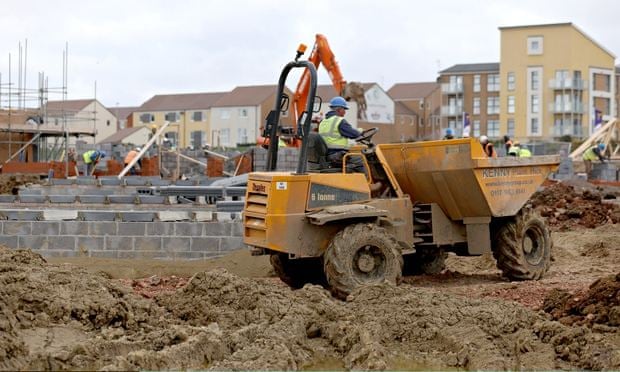
A rise in new business orders led to a strong increase in construction activity during October, bucking the recent trend of monthly declines.

The latest Ulster Bank Construction Index — seen as the primary barometer of health for the Irish building sector — shows a reading of 56.3 points for last month, up from 55.8 points in September, thereby signalling an accelerated expansion in activity during the month.
The survey has been posting readings of more than 50 points — the cut-off point between a sector in growth mode and one in decline — for more than two years now.
However, the latest monthly figures bring to an end a mini-run of three consecutive monthly declines.
“The pace of activity accelerated in both housing and civil engineering, and though there was a marginal easing of growth in commercial activity, all three sectors registered expansion for the second month in a row,” commented Simon Barry, Ulster Bank’s chief economist in the Republic of Ireland.
“The path of expansion in new orders and employment eased slightly last month, but in each case the growth rates remain very solid.
“Both overall activity and new business levels have been rising for well over two years now and the sustained expansion of activity in the sector continues to drive higher staffing levels among survey respondents.
“More generally, optimism about future prospects for the sector remains high and strengthened in October, with nearly 60% of respondents expecting a further rise in activity levels over the next 12 months,” he added.
In terms of outlook, more than 58% of respondents to the October survey predicted that activity will increase over the coming year, with just 6% of them pessimistic regarding the 12-month outlook.
Improvement in client demand supported the further growth in new business, extending the current sequence of expansion to 28 months.
The latest positive Irish construction data comes less than a week after a similar survey in the UK, which showed that country’s building sector to be slowing down, after hitting its fastest pace for six months in September.

Breaches of speed limits and rules of road revealed in survey

One in five drivers sees breaking 100km/h limit as acceptable, according to RSA


The Driver Attitudes and Behaviour Survey 2014 showed a catalogue of safety infringements, from drink driving to use of mobile phones and speed-camera “manipulation”.

More than 40% of Irish motorists consider it broadly acceptable to break the 100km/h speed limit, with almost 20% of drivers classed as “high-speeding rule violators”, according to latest research from the Road Safety Authority (RSA).
Based on questionnaires put to more than 1,000 motorists, Driver Attitudes and Behaviour Survey 2014 showed a catalogue of self-admitted safety infringements, from drink driving to use of mobile phones, speed-camera “manipulation” and negative attitudes to pedestrians.
The RSA said the research showed clearly that young, affluent male drivers were among the greatest breakers of speed limits and rules of the road.
Drink driving
The research found 11% of motorists – representing about 285,000 motorists if extrapolated – admitted they had driven after taking alcohol in the last year and more than a third of these had had two or more drinks.
The survey found older drivers were more likely to drive after taking alcohol, with the 65- plus age group the largest cohort. Men outnumbered women by more than two to one.
While more than 60 per cent of drivers claimed not to drink at all before driving (as opposed for instance to having one bottle of beer), this declined to 48% for those who drank alcohol on a weekly basis, and 40% for those who had a history of speeding and rule violations.
Hand-held mobile phones
Almost one in three drivers (31%) admitted they had spoken on hand-held mobile phones while driving, while 16% admitted texting and 7 per cent said they had checked their mobile apps while in control of a vehicle.
The figures showed some 45% of drivers said they had spoken on hands-free phones, with more than 400,000 motorists estimated to use hand-held mobile phones while driving. Fewer than half of transgressors thought it likely they would be caught by Gardaí.
One in three drivers were also found to be speed-camera “manipulators”, driving more slowly only at speed camera locations.
Motorists also showed a negative attitude to pedestrians, with 95% claiming pedestrians were frequently distracted by taking or making phone calls or texting.
Some 69% of drivers said they had exceeded the 50km/h speed limit by less than 10%, while 61% of respondents admitted breaking the 100km/h speed limit by less than 10km/h.

Belly fat deadlier than obesity alone, study suggests

RESEARCHERS FIND MORE EVIDENCE CONFIRMING THAT BMI DOESN’T TELL THE WHOLE STORY


It’s not just how much fat you have, but it’s where the fat is that matters for cardiovascular health, doctors say.

People who weigh a normal amount when they step on the scale may be at higher risk of dying in the medium term if their fat is concentrated in the abdomen, say doctors who want everyone to use a tape measure to measure themselves.
Researchers have long suspected the body mass index, or BMI, that tells you how appropriate your weight is to your height isn’t a good measure of body fatness — particularly fat that accumulates in the belly and within abdominal organs and leads to inflammation, glucose intolerance and other complications that increase the risk of cardiovascular disease and Type 2 diabetes.
“There are many different names for it,” said  study co-author Thais Coutinho, a cardiologist at the Ottawa Heart Institute. “There’s the apple shape as opposed to the pear shape, there’s a muffin top, there’s a beer belly. A spare tire.  But basically, it is exactly what it sounds like: if somebody has a disproportionately large abdomen compared to other parts of the body.”
Coutinho and her co-authors from the Mayo Clinic in Rochester, Minn., assessed the five- and 10-year mortality risk in men and women with normal BMIs and central obesity compared with those who are overweight or obese based on BMI. The study included more than 15,000 participants who were followed for an average of 14.3 years as part of the U.S.-based Third National Health and Nutrition Examination Survey, known as NHANES III.
“We found that the group of patients that actually has the highest risk of dying were precisely the patients who had normal BMI, so these are people who are not necessarily heavy for their height, but they were centrally obese,” Coutinho said.
The study is published in Monday’s issue of the scientific journal Annals of Internal Medicine.
For a man with central obesity and normal BMI, the mortality risk was double that of those who were overweight or obese based on BMI alone. For women with central obesity and normal BMI, the mortality risk was nearly 1.5 times greater than for those with a problematic BMI but without fat concentrated in the middle.

‘Worst fat is in the midsection’

Raj Padwal, a physician at the University of Alberta’s faculty of medicine who studies cardiovascular risks and obesity, said the results show “it’s not just how much fat you have, but it’s where the fat is.”
“The worst fat is in the midsection. It’s in the intra-abdominal cavity, in the organs,” Padwal explained. “Fat infiltrating that area of the body is definitely the worst in terms of future risk of cardiovascular complications and future risk of death.”
That’s because central obesity is linked to fat infiltrating the pancreas and liver, which in turn is linked to risk of Type 2 diabetes, fatty liver and eventually end-stage liver failure, he said.
Padwal said BMI has served its use and should no longer be used clinically. “Preferentially, I would say waist-hip ratio or waist circumference should be measured and BMI should be discarded.”
The study’s authors said their findings suggest those with normal weight but central obesity could be an important population to target for prevention and lifestyle changes.
While long-term weight loss is notoriously difficult, Coutinho said healthy lifestyle changes bring positive changes in the body regardless of fat loss, such as lower blood pressure.
To calculate your waist-to-hip ratio, measure your waist at its narrowest, and then divide that by the measure of your hips at their widest.
If the result is greater than .85 in women or greater than .90 in men, then lifestyle and exercise changes are recommended to improve health in the long run.
“It’s very simple. It’s just a tape measure,” she said. “Everybody can do and it can help us identify people at highest and lowest risk.”
There is also equipment to give a more sophisticated measure of fat directly, but doctors face a trade-off between what’s pragmatic and what’s the best measurement, Padwal said.

What is the Dark Web? How to access the Dark Web.

What’s the difference between the Dark Web and the Deep Web?  

The UK government has launched a dedicated cybercrime unit to tackle the Dark Web. But what is that? We explain what is the Dark Web, how it differs from the Deep Web, and how to access the Dark Web. Plus: the Deep Web, the Deepnet, the Invisible Web, the Hidden Web and the Dark Internet. Everything you need to know about the hidden internet.
The UK government has launched a dedicated cybercrime unit to tackle the Dark Web. But what is that? We explain what is the Dark Web, how it differs from the Deep Web, and how to access the Dark Web. Plus: the Deep Web, the Deepnet, the Invisible Web, the Hidden Web and the Dark Internet. Everything you need to know about the hidden internet. (Image by TheAutomotovatedCyclist.)
Update 20 August: The Deep Web is hitting the headlines this week after it has been reported that 10GB of data stolen from Ashley Madison, a site designed to enable bored spouses cheat on their partners, was dumped on to the Deep Web. Hackers stole the data last month and threatened to upload it to the web if the site did not close down. It has now acted on that threat. Here we look at how the Dark Web and Deep Web differ, and how you can turn out the internet lights – how to access the Dark Web.
Update 9 November: Today it has emerged that the UK government has launched a dedicated cybercrime unit to tackle the Dark Web, with a particular focus on cracking down on serious crime rings and child pornography. The National Crime Agency (NCA) and UK intelligence outfit GCHQ are together creating the Joint Operations Cell (JOC).
What is the Dark Web?
The Dark Web is a term that refers specifically to a collection of websites that are publicly visible, but hide the IP addresses of the servers that run them. Thus they can be visited by any web user, but it is very difficult to work out who is behind the sites. And you cannot find these sites using search engines.
Almost all sites on the so-called Dark Web hide their identity using the Tor encryption tool. You may know Tor for its end-user-hiding properties. You can use Tor to hide your identity, and spoof your location. When a website is run through Tor it has much the same effect.
Indeed, it multiplies the effect. To visit a site on the Dark Web that is using Tor encryption, the web user needs to be using Tor. Just as the end user’s IP is bounced through several layers of encryption to appear to be at another IP address on the Tor network, so is that of the website. So there are several layers of magnitude more secrecy than the already secret act of using Tor to visit a website on the open internet – for both parties (See also: How to delete your Google location history).
Not all Dark Web sites use Tor. Some use similar services such as I2P – indeed the all new Silk Road Reloaded uses this service. But the principle remains the same. The visitor has to use the same encryption tool as the site and – crucially – know where to find the site, in order to type in the URL and visit.
Infamous examples of Dark Web sites include the Silk Road and its offspring. The Silk Road was (and maybe still is) a website for the buying and selling of recreational drugs. But there are legitimate uses for the Dark Web. People operating within closed, totalitarian societies can use the Dark Web to communicate with the outside world. And given recent revelations about US- and UK government snooping on web use, you may feel it is sensible to take your communication on to the Dark Web. (I’ll stick to Facebook, but I like the attention.) See also:What does Google know about me?
Dark Web or Deep Web? (Or Deepnet, Invisible Web, or Hidden Web?)
Although all of these terms tend to be used interchangeably, they don’t refer to exactly the same thing. An element of nuance is required. The ‘Deep Web’ refers to all web pages that search engines cannot find. Thus the ‘Deep Web’ includes the ‘Dark Web’, but also includes all user databases, webmail pages, registration-required web forums, and pages behind paywalls. There are huge numbers of such pages, and most exist for mundane reasons.
We have a staging version of all of our websites that is blocked from being indexed by search engines, so we can check stories before we set them live. Thus for every page publicly available on this website (and there are literally millions), there is another on the Deep Web. The content management system into which I am typing this article is on the Deep Web. So that is another page for every page that is on the live site. Meanwhile our work intranet is hidden from search engines, and requires a password. It has been live for nearly 20 years, so there are plenty of pages there.
Use an online bank account? The password-protected bits are on the Deep Web. And when you consider how many pages just one Gmail account will create, you understand the sheer size of the Deep Web.
This scale is why newspapers and mainstream news outlets regularly trott out scare stories about ’90 percent of the internet’ consisting of the Dark Web. They are confusing the generally dodgy Dark Web with the much bigger and generally more benign Deep Web. Mixung up the act of delibarately hiding things, with that of necessarily keeping pages away from search engines for  reasons of security or user experience. (See also:How to use torrent sites in UK: how to access The Pirate Bay, blocked torrents.)
Wait, what about the ‘Dark Internet’?
Confusingly, ‘Dark Internet’ is also a term sometimes used to describe further examples of networks, databases or even websites that cannot be reached over the internet. In this case either for technical reasons, or because the properties contain niche information that few people will want, or in some cases because the data is private.
A basic rule of thumb is that the phrases ‘Dark Web’ or ‘Deep Web’ are typically used by tabloid newspapers to refer to dangerous secret online worlds, the ‘Dark Internet’ is a boring place where scientists store raw data for research. The Deep Web is a catch-all term for all web pages that are not indexed for search, the others refer to specific things. (See also: Take precautions when using public Wi-Fi networks.)
How to access the Dark Web
Technically, this is not a difficult process. You simply need to install and use Tor. Go to http://www.torproject.org and download the Tor Browser Bundle, which contains all the required tools. Run the downloaded file, choose an extraction location, then open the folder and click Start Tor Browser. That’s it. The Vidalia Control Panel will automatically handle the randomised network setup and, when Tor is ready, the browser will open; just close it again to disconnect from the network.
Depending on what you intend to do on the Dark Web, some users recommend placing tape over your laptop’s webcam to prevent prying eyes watching you. A tinfoil hat is also an option.
The difficult thing is knowing where to look. There, reader, we leave you to your own devices and wish you good luck and safe surfing. And a warning before you go any further. Once you get into the Dark Web, you *will* be able to access those sites to which the tabloids refer. This means that you could be a click away from sites selling drugs and guns, and – frankly – even worse things.
Aggregation sites such as Reddit offer lists of links, as do several Wikis, includinghttp://thehiddenwiki.org/  – a list that offers access to some very bad places. Have a quick look by all means, but please don’t take our linking to it as an endorsement.
Also, Dark Web sites do go down from time to time, due to their dark nature. But if you want good customer service, stay out of the dark!
And do heed our warning: this article is intended as a guide to what is the Dark Web – not an endorsement or encouragement for you to start behaving in illegal or immoral behaviour.