The housing shortage ‘will cost Ireland key jobs’ warn business leaders


THOUSANDS OF NEW JOBS ARE AT RISK OF BEING LOST TO IRELAND BECAUSE OF THE HOUSING CRISIS, BUSINESS LEADERS WARNED.
Representative bodies and business owners have urged the appointment of a dedicated housing minister by any new government to tackle the severe lack of accommodation which is stunting job creation.
While many Irish businesses are now looking to expand and multinational companies are seeking to lure staff on secondment from other countries, the major shortage of housing, coupled with soaring rents, is preventing job growth.
The owner of Cork-based multinational outsourcing company Voxpro said he may be forced to divert hundreds of new positions away from Ireland due to major housing shortages.
Voxpro chief executive Dan Kiely said small businesses looking to expand and global companies hoping to set up bases here are being limited by a lack of accommodation for staff.
“We want to do the best for Cork and deliver as many jobs as we can in the next three years, but the housing situation will affect the numbers we employ,” said Mr Kiely.
“If we don’t tackle this, then businesses like Voxpro will be looking to places outside of Dublin and Cork.
Last October, Paypal, with offices in Dublin and Dundalk, urged workers to rent spare rooms to new employees to help with a rental accommodation shortage.
The IDA acknowledged a “tightness of supply”, while Ibec said a shortage of office space had been an issue in recent years but companies are now encountering difficulty on the residential side.
“Businesses are now finding that they can find spaces for workers to work in but they can’t find space for the workers to live in,” said Peter Stafford, director of Property Industry Ireland, which is a business association within Ibec.
“It’s an issue in the cities, especially in Dublin where a lot of tech companies are clustering around the Docklands.”
Mr Stafford said many multinationals now find employees are reluctant to relocate to Ireland and are asking for salary increases to offset the higher cost of rental accommodation.
“There are companies who are paying staff a premium to move to Dublin because their cost of living is going to be so much higher here because rent is high,” he said.
Barrie O’Connell, president of Cork Chamber, said there is a “lack of coherence” when it comes to housing policy, with 12 government agencies having some involvement.
“Establishing a minister for housing and infrastructure would ensure improved oversight and a more connected approach at central level, which is required to address the rental and buyer crisis that currently presents a potential risk to our future economic development capacity,” he said.
This was echoed by Mr Kiely who said a “taskforce with teeth” made up of business leaders, Nama, and developers is also required “to come up with achievable solutions to solve the problem in the immediate term”.
Mr Kiely, who lives in Douglas, Cork, said there are around 30 homes in his area which are unoccupied but have not been put on the market and developments like these should be made available to workers.
“If we can’t accommodate young Irish graduates and EU graduates moving into Cork, then we will have to look elsewhere,” he said.
An IDA spokesperson said that although companies are continuing to invest in Ireland, there is “a tightness of supply in some city locations at present”.
“Any tightness of supply is very much a reflection of the success Dublin has had and much of the discussion around this issue concerns supply in one particular part of the city,” they said.
This is exactly what people around the world think of Ireland


HERE IS EXACTLY WHAT PEOPLE AROUND THE WORLD THINK OF IRELAND AND WE ALL AGREE THAT IRELAND IS THE BEST WEE COUNTRY ON EARTH, BUT WHAT DOES THE REST OF THE WORLD MAKE OF US?
In this love letter, an Argentinian-Spanish woman who called Dublin home for two years asks people from around the world: “What is Ireland?”
 On St Patrick’s Day, Clara Baez Morandi paid tribute to her former home by reaching out to people who have come to Ireland from all corners of the world to find out what makes our country so unique.
She used these interviews to tell a story about multiculturalism, reflecting what a melting pot the country has become.
According to the people in the video, Ireland is a multitude of things: it’s magical and it’s challenging, it’s happy and it’s sad.
They mention Niamh, Ciara and “Sean with an S-e-a-n” as the names they most associate with Ireland, and cite the beloved chicken fillet roll as our specialty food.
While their initial thoughts on arrival in Ireland were of disappointment – “it’s not so green”, “it’s such a small village”, “it’s raining!” – they spoke movingly about how their time here has made them stronger and more optimistic.
One young man observed: “It won’t jump at you with its marvels, you have to find them.”
The sound bites, which vary from light-hearted to poignant, beautifully capture how Ireland is changing in today’s increasingly multicultural world.
Warning over number of children knocked down in driveways
RSA RESEARCH SHOWS 38 CHILDREN KILLED AFTER COLLISIONS IN BUILT-UP AREAS OVER LAST FIVE YEARS


A STILL FROM ONE OF THE VIDEOS PRODUCED BY THE RSA HIGHLIGHTING THE DANGERS TO CHILDREN WHEN VEHICLES ARE MOVING.
The Road Safety Authority (RSA) has launched a new campaign to keep children safe in driveways as latest figures show over 40 per cent of child road fatalities occur in built-up areas.
There were 38 child fatalities involving motor vehicles between 2010 and 2015, and half of all road-related serious injuries among children occurred as a result of a collision in a built-up area during the same period.
The campaign features a series of videos focusing on child safety near driveways and in housing estates, and the RSA has issued specific advice to parents ahead of the Easter holidays.
The videos give step-by-step guidance on the different checks and routines drivers can employ when travelling with children or in areas where children may be exposed to danger such as driveways, housing estates and near schools.
“We cannot expect children to take responsibility for their own safety. It is up to us to make road safety part of their everyday routine and teach them how to share the road safely,” said RSA chief executive Moyagh Murdock.
“Children are the most vulnerable of our road-users so it is really important that we as adults take responsibility for their safety. The aim of these videos is to provide all of us with tools to do this,” she added.
Drivers are encouraged to develop a series of steps for checking that the area around their vehicle is safe prior to departure, and to perform a ‘cockpit drill’ when in the car to ensure the handbrake and gear lever are properly positioned and that all doors are locked.
New ‘Star Wars’ film to shoot in Donegal and along “Wild Atlantic Way”
IRISH FILM BOARD WELCOMES PLANS TO SHOOT ALONG ‘SOME OF OUR MOST SPECTACULAR LOCATIONS ALONG THE WILD ATLANTIC WAY’


.jpg)
THE PRODUCERS OF STAR WARS HAVE CONFIRMED THEY ARE RETURNING TO IRELAND THIS YEAR TO SHOOT SCENES FOR THE NEXT FILM IN THE BLOCKBUSTER SERIES AT LOCATIONS ALONG THE WESTERN SEABOARD.
Lucasfilm is preparing to film sequences for Star Wars: Episode VIII in May at the western tip of the Dingle Peninsula, where contractors are installing a 1.5km metal roadway to facilitate the transport of gear and crew.
Plans are also underway to film at Malin Head in Donegal, where a number of B&Bs and rental homes have already been booked out for the production.
The chief executive of the Irish Film Board, James Hickey, said it was “delighted to welcome the production of Star Wars: Episode VIII to some of our most spectacular locations along the Wild Atlantic Way”.
The closing scene of Star Wars Episode VII: The Force Awakens, the most recent release in the series, was shot on Skellig Michael off the coast of Kerry. The film currently ranks as the third highest-grossing release of all time, with more than $2 billion worth of cinema tickets sold worldwide.
The Government’s decision to grant permission to film on the UNESCO world heritage site was criticised by some heritage and environmental groups, but a further licence was granted to Lucasfilm to carry out filming last September for the new film.
Thrilled to return
Candice Campos, vice-president of physical production at Lucasfilm, said the company was thrilled to return to Ireland to film several sequences for the next chapter in the Star Wars saga.
“The beauty of Skellig Michael was stunning and we know the new locations along the Wild Atlantic Way will prove to be equally as beautiful in Star Wars: Episode VIII,” Ms Campos said. “We want to thank the people of Ireland for their warm welcome and continued support. Ireland has become an important part of Star Wars history.”
Minister for Arts, Heritage and the Gaeltacht Heather Humphreys said the return of Star Wars to Ireland was a further boost for the Irish film sector.
“My department has been working with Disney Lucasfilm over recent months in a bid to accommodate the return of Star Wars to Ireland,” Ms Humphreys said. “Disney Lucasfilm have developed a strong affinity for Ireland, and I am delighted to see them return to Ireland for further filming around our beautiful and dramatic coastline.
“We have already seen how the most recent Star Wars film has brought Sceilg Mhichíl and southwest Kerry to a global audience. Now, further locations around the Irish coast will experience similar exposure, providing untold benefits to the tourism and film sectors.”
Make angry Birds happy, UN chief Ban Ki-moon tells the world

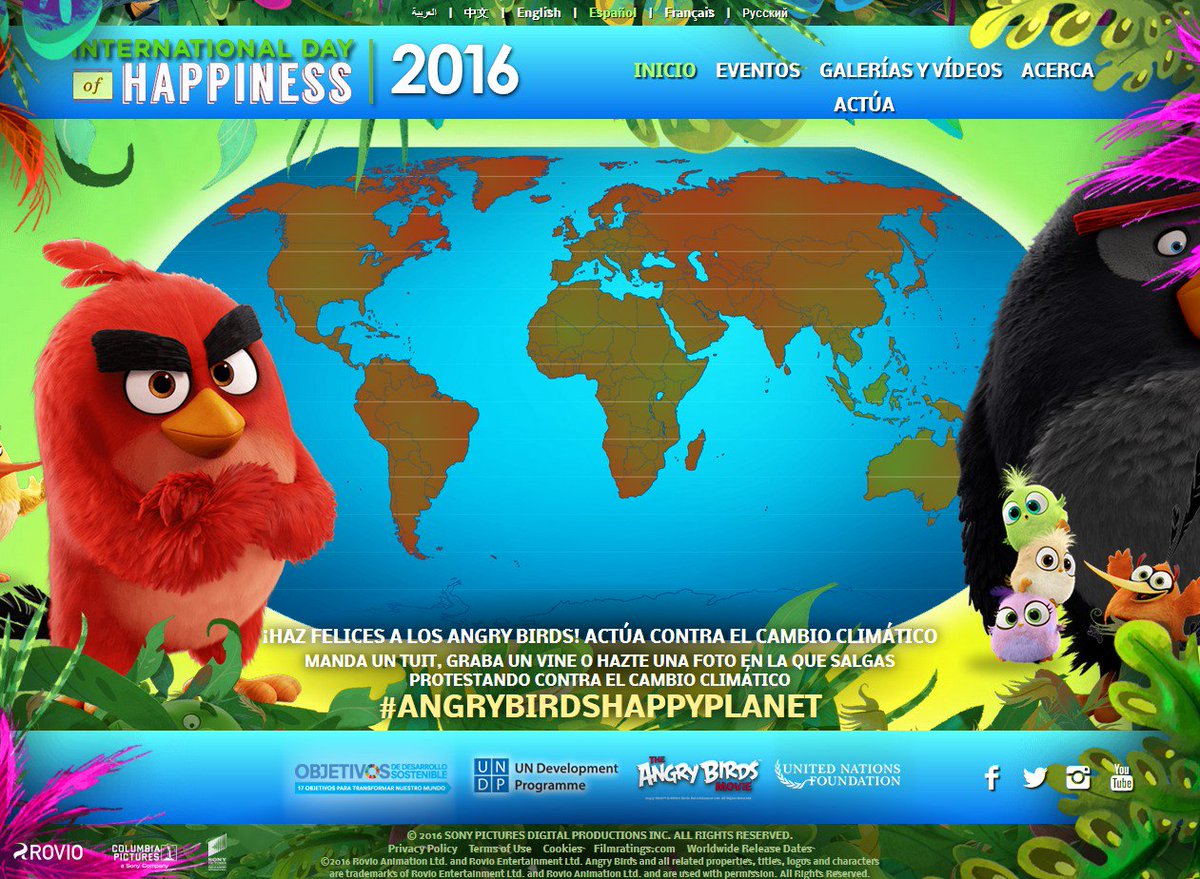

UN Secretary General Ban Ki-moon launches International Day of Happiness 2016-Help Red Go Green.
The sight of anything green is enough to enrage him, but in an ironic twist, Red, the leader of the Angry Birds computer game characters, has been named Honorary Ambassador for Green by the United Nations, the top bird given the mission of “inspir(ing) climate action toward a sustainable and happier future for all.”
“We are proud to give Red a reason to go Green,” UN Secretary General Ban Ki-moon said in a statement.
“There is no better way to mark the International Day of Happiness than to have our animated ambassador raise awareness about the importance of addressing climate change to create a safer, more sustainable and happier future for all,” Ban added.
Highly strung, easily provoked
The character’s creators describe Red as highly strung and easily provoked—even by the sound of the wind which it sees as a declaration of war. In the Angry Birds universe, the feathered protagonists are pitched against a group of pigs.
“The whole flock tries to keep Red calm and relaxed by telling him to follow a strict program of herbal tea, soothing bath salts and deep-breathing exercises,” says the website Angrybirds.com. “But this only takes the edge off his anger … Even the sight of something green can enrage him.”
 Make Angry Birds happy
But with Red being named Ambassador of Green, the warring flock is now part of making the world a better place, with the public being asked to “make the Angry Birds happy” by professing their commitment to address climate change, through photos posted on social media platforms using the hashtag#AngryBirdsHappyPlanet.
“By recycling, taking public transportation and conserving water, for example, individuals can share tips on how they can live sustainably and happily in their everyday lives,” Ban said.
Also behind this year’s campaign are Sony Pictures Entertainment (whose facilities produced and distributed the Angry Birds movie), as well as the UN Development Program and UN Foundation.
Fundamental human goal
In July 2011, the UN General Assembly passed a resolution declaring that “the pursuit of happiness is a fundamental human goal.”
Two years later, on March 20, 2013, the first International Day of Happiness was celebrated in the wake of the 2012 UN Conference on Happiness. The conference was convened by the government of Bhutan which, in the 1970s, introduced the concept of gross national happiness, or measuring a nation’s prosperity by emphasizing people’s well-being over economic productivity.
Happiness Day
In a separate statement, the UN chief said this year’s Happiness Day was an opportunity to assert the primacy of peace, well-being and joy, amid the pervasive suffering caused by grave injustice, devastating wars, mass displacement, grinding poverty and other man-made crises.
“The best way to celebrate this International Day of Happiness is by taking action to alleviate suffering,” Ban said.
“More than individual contentment, it’s an affirmation that we have a collective responsibility to humanity,” he added.
Spread happiness, secure peace
The UN chief said governments can help spread happiness and secure peace by working to fulfill the interlinked Sustainable Development Goals (SDGs) that the UN General Assembly had adopted in September 2015.
Included in these goals are: an end to poverty and hunger; good health and well-being; quality education; gender equality; clean water and sanitation; affordable and clean energy; decent work and economic growth; industry, innovation and infrastructure; reduced inequalities; sustainable cities and communities; responsible production and consumption; climate action, as well as peace, justice and strong institutions.

