Ex-Fianna Fail TD and sons among 126 repossession cases in Limerick
PTSB pursuing Noel O’Flynn and two sons in connection with Limerick buy-to-let property


Former Fianna Fáil TD Noel O’Flynn and his sons Gary and Kenneth O’Flynn have a mortgage debt of almost €117,000 on a buy-to- let property in Limerick, the court heard.
Members of a well-known Cork political family were among the 126 repossession cases heard before the Limerick County Registrar’s Court yesterday.
Former Fianna Fáil TD Noel O’Flynn and his sons Gary and Kenneth O’Flynn have a total mortgage debt of almost €117,000 on a buy-to- let property in Limerick, the court heard.
Mr O’Flynn was a TD for the Cork North Central constituency from 1997 until 2011. Gary O’Flynn, a former Cork city councillor, was jailed last month for three years for soliciting someone to kill a garda, a Revenue official and an accountant. Kenneth O’Flynn was co-opted on toCork City Council in December 2008, and is the current deputy Lord Mayor of Cork.
A solicitor representing Permanent TSB told Limerick County Registrar’s Court the initiation of proceedings had been halted because the bank had difficulty serving notice on the parties.
She also claimed that “various games were being played” by the borrowers.
Solicitor Conn Barry told the court the defendants were from a “well-known family in Cork”.
Mr Barry, who was acting as agent for a Cork solicitors’ firm, said it was the first time the case had come before the court.
County registrar Pat Wallace was told the last repayment on the buy-to-let property was in July 2013. No member of the O’Flynn family was present in court and the case was adjourned by consent until July 3rd.
Eleven homes were repossessed at the sitting of the court, many of them primary residences.
Among the orders granted by the registrar included a mother who told the court she could not meet the full amount of her monthly payments after separating from her husband.
Single mother
She said she was able to afford only half the mortgage and she had just returned to health from a three-month illness.
The Lithuanian mother of one said she could not claim from her home insurance to repair dampness and mould that was causing her sickness because the insurance company required her ex-husband’s signature on documents.
In excess of €191,000 was owing on the mortgage, with more than €60,000 in payments in arrears.
Mr Wallace granted the repossession order but put a stay on the bank executing it for 12 months.
“No one will throw you out in the street yet,” he told the woman. “Given your predicament, this might not be a bad outcome.”
In two cases, orders for repossession were granted to Ulster Bank and Permanent TSB after the borrowers had failed to turn up for any court hearing or engage with their lenders.
In one case, the borrower owed more than €301,000 and had not made a payment in 51 months.
Thousands take part in Darkness into Light walks in Ireland & worldwide
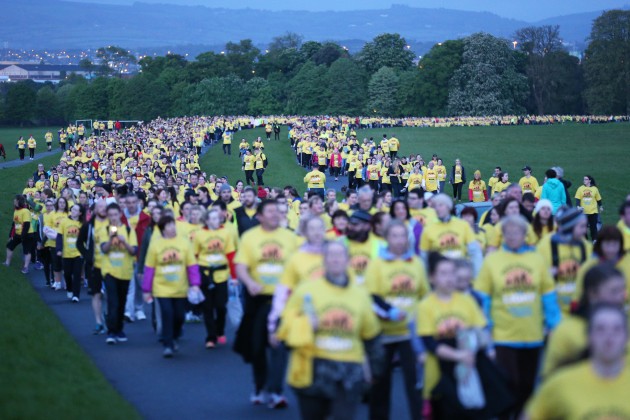

12,000 PEOPLE TURNED UP AT 4.15AM IN PHOENIX PARK TO WALK 5KM FOR SUICIDE PREVENTION
The 5km Darkness into Light walk/run, which kicked off at 4.15am on Saturday, was held at 80 locations in Ireland and around the world, and is believed to have attracted an estimated 100,000 participants.
More than 12,000 early risers descended on Phoenix Park this morning to take part in the annual Pieta House Darkness into Light mental health awareness event.
The 5km walk/run, which kicked off at 4.15am on Saturday, was held at 80 locations in Ireland and around the world, and is believed to have attracted an estimated 100,000 participants.
The first Darkness into Light walk was held in 2009 with just 400 participants.
“Pieta House’s intention has always been to save lives and to change the social fabric and the conversation around suicide and self-harm,” said Joan Freeman, founder of Pieta House, this morning in Phoenix Park. “It’s been nine years and we’ve come a long way towards reaching that goal. However, people are still afraid to face the reality that they may know someone who’s at risk of suicide or self-harm.
“You, the people, are the most important component of all in the fight against suicide.”
From Wicklow to Washington, Chicago to Perth, friends, families, children and pets turned out to walk together for suicide prevention. An estimated 4,000 people walked in Melbourne and Perth, which were among the first cities to kick the morning off, followed by almost 1,500 people walking in London, Manchester and Glasgow. The final walks of the day will take place in New York, Toronto and Chicago where 1,700 people are expected to turn up in support of Pieta House.
In celebration of the theme ‘connecting’ for this year’s Darkness into Light walk, Dublin Bus provided a free shuttle service connecting Heuston Station to the flagship walk in Phoenix Park in the early hours of Saturday morning. Elsewhere around Ireland, local businesses showed their support by opening early and providing weary walkers with complimentary teas, coffees and refreshments.
Jim Dollard, executive director of Electric Ireland which supported this year’s walks, congratulated all participants around the globe, thanking them for their support.
“This year has been the biggest year yet and there’s no doubt that it has captured the imagination of Irish people at home and abroad, including in Electric Ireland, where a large number of our staff walked with thousands of other people in venues across the country this morning.”
Pieta House is a suicide and self-harm crisis organisation and works with ten centres across the State. Pieta House is set to open its first overseas centre in Queens, New York this summer as it begins to reach out to members of the Irish diaspora who may be in need of support.
Europe’s Digital Single Market needs to foster tech startups and a global view


Europe has launched its strategy for a Digital Single Market throughout its member countries. The success of this strategy relies on the ability of European lawmakers and politicians removing barriers to digital trade and creating an environment to foster the growth in digital platforms and skills necessary to support a fast growing digital economy.
It is easy for others, especially the US, to see the Digital Single Market strategy as a pretext to regulate and restrict the popularity and pervasiveness of foreign companies like Google, Amazon, Facebook and Netflix. Certainly, the European Commission will need to demonstrate that its focus is more on enabling rather than simply protecting a future industry.
However, one of the central “pillars” of the strategy is to remove barriers to international online trade. This means removing the practice of “geo-blocking” which restricts content to certain countries, or places extra costs on those accessing these services from outside those boundaries. Achieving this will require a levelling between countries of their different regimes of value added tax, laws for consumer protection and copyright, and a host of other legislative and commercial idiosyncrasies.
Setting aside the hurdles of the Digital Single Market outlined in the agenda document, the largest real challenge is in the fact that 54% of e-commerce traffic in Europe is with services based in the US whereas only 4% of traffic in one European country is for a service in another European country. Creating a Digital Single Market is all well and good but if it mainly benefits US companies it is going to be far less strategic for Europe.
In the light of the dominance of US services in Europe, the fear held by the US that Europe’s Digital Single Market will essentially try and restrict this dominance are possibly not unfounded. The simple fact is that those firms succeed because that is what European consumers want. Making it simpler for those services to operate in Europe still has advantages to the EU because it enables firms like Amazon and Apple to operate more seamlessly across all of Europe, helping to keep costs down.
To truly benefit from the efficiencies of opening up the digital markets in Europe, what actually needs to happen is to apply this strategy globally. All of the points made within the Digital Single Market strategy are valid steps to removing barriers to online trade. The limitation of the strategy is that it stops at Europe’s borders, when the Internet that underpins the online world recognises no such boundary.
For a global Digital Single Market to be successful, in addition to the goals outlined in Europe’s strategy, there would need to be agreement on tax avoidance schemes that US companies in particular are carrying out when doing business globally. Ironically, these practices operate in Europe by leveraging different transfer pricing schemes between parts of their company set up in different countries. Allowing foreign multi-nationals to dominate in a local market is one thing but it adds insult to injury that tax revenue from business carried out in one particular country could be lost to another, or not collected at all.
Of course, the main aim of the European Commission in proposing the Digital Single Market agenda is to provide a platform that is conducive to surfacing digital entrepreneurs and growing new companies based in Europe. The entire world outside of Silicon Valley wants to emulate the success of that area by creating innovation centers that foster startups and the next Google or Uber. The trouble is that despite cities around the world trying to do this, they have so-far largely failed to bring together the ingredients that exist in California. At the heart of this though, it may simply be a case of not enough money being invested in seeding startups. Startups in London, which is considered the most successful of European startup locations, still only attract 6% of the funding amounts that startups in Silicon Valley do.
In the normal tech company life-cycle, successful companies produce a large number of wealthy individuals who not only have a specific set of skills in creating tech startups but have the money to invest either in their own projects or others. The conditions for this were driven by the opportunities created by stock markets and the insatiable appetite for tech stocks. Reproducing this elsewhere, is going to take time, money, an appetite for risk and the acceptance of failure. Unfortunately, none of that is part of the European Digital Single Market strategy. Whilst the aims of their agenda may be a good start, even if successful, it is still a long way from actually seeing any benefits result from it.
Craft Butchers of Ireland ambassador to make world’s largest gluten free pancake


Chef Adrian Martin is pictured on the left with Ethne Reynolds, Stephen Schmidt and championships organiser Brid Torrades at the World Irish Stew Championship, St Angela’s College, Co Sligo.
Adrian Martin, Associated Craft Butchers of Ireland ambassador, plans to break a world-record in association with the Irish Coeliac Society by making the world’s largest gluten free potato pancake.
The ambassador of the Associated Craft Butchers of Ireland, chef Adrian Martin, who has trained and worked under chef Neven Maguire for six years, is planning to make the world’s largest gluten-free potato pancake at an event held in Smithfield in Dublin on Monday, 11 May.
The event is being held to mark the beginning of Coeliac Awareness Week, organised by the Coeliac Society of Ireland.
Chef Adrian is planning to break a world record at the event at Smithfield, which is open to the public from 10.30 am on Monday morning.
Sonya Shiels from the Coeliac Society of Ireland said the pancake, if it is to break the world-record, will measure a metre and a half and will help raise the profile of the rest of the week’s events.
These events include a series of cookery demonstrations held in certified craft butchers in Dublin, Kilkenny, Cork, Limerick and Galway where chef Adrian will cook gluten free recipes involving meat.
Adrian, 23, has been the Craft Butchers of Ireland ambassador for the past two years and said he is “hopeful” about breaking the world record on Monday.
“I’ve never baked one of that size before obviously, so I’m going to have a practice run on the Sunday in my own kitchen to see how it goes,” he said.
If the pancake is made to the specified world-record breaking requirements of five feet, Adrian says it will be able to feed between 150 and 200 mouths.
“So if you know anyone who wants to try a gluten-free potato pancake, send them down here on Monday,” he said.
Coeliac Awareness Week
Coeliac Awareness Week is being promoted by the Coeliac Society of Ireland nationwide from 11 to 17 May. In particular the society wishes to encourage anyone who thinks they may be affected by coeliac disease to contact their GP.
Commenting in advance of Coeliac Awareness Week, Gráinne Denning, CEO of the Coeliac Society of Ireland, said, “When people are diagnosed with coeliac disease, they may feel overwhelmed. We’re encouraging people with coeliac disease to come along to the events we have organised during Awareness Week to meet the wider gluten-free community, learn some new recipes, and enjoy healthy walks and delicious food.
“For anyone with coeliac disease, or with a family member or friend affected by the disease, we hope Awareness Week events will help them embrace and live their gluten-free life to the full.”
The auto-immune disease is estimated to affect 46,000 people in Ireland and it can manifest itself at any stage in a person’s lifetime. The only treatment for the disease is a gluten-free diet.
Spectacular Martian sunset in a blue-tinged sky recorded by Curiosity’s Mast Camera


NASA’s Curiosity Mars rover used its Mascam (Mast Camera) to record the sun dipping to the horizon in a blue-tinged sky. The spectacular images, that were captured on 15 April, 2015, were sent home to Earth this week.
The photographs were taken between dust storms, but some dust was still floating high in the red planet’s atmosphere.
Scientists say the sunset observations help them assess the vertical distribution of dust in the atmosphere.
Mastcam sees colors very similarly to what our eyes do, although it is actually slightly less sensitive to blue than humans are.
Curiosity science team member, Mark Lemmon, of Texas A&M University, College Station, who planned the observations, said:
“The colors come from the fact that the very fine dust is the right size so that blue light penetrates the atmosphere slightly more efficiently.”
“When the blue light scatters off the dust, it stays closer to the direction of the sun than light of other colors does. The rest of the sky is yellow to orange, as yellow and red light scatter all over the sky instead of being absorbed or staying close to the sun.”
Martian sunset blue, daytime rusty
Just as with sunsets on Earth, when reddish colours are made more dramatic, on the red planet sunsets make the blue near the Sun’s part of the sky stand out much more, while normal daylight makes the dust’s rusty colour more prominent.
The Mars Curiosity Rover has been studying the planet’s ancient and modern environments since it landed inside the Gale Crater in August 2012.
Curiosity’s Mastcam was built and is operated by Malin Space Science Systems, San Diego, California. NASA”s Jet Propulsion Laboratory, a division of Caltech (California Institute of Technology) in Pasadena, built the rover and manages the project for NASA’s Science Mission Directorate in Washington.