Pages

Showing posts with label Disability. Show all posts

Monday, September 21, 2015

Donie's Ireland daily news BLOG

Irish offered 1 million dollars to eat more potatoes


A new marketing campaign wants young Irish consumers to eat more potatoes. 

A new $1 million marketing campaign has been launched in an effort to boost potato consumption among Irish consumers.
Bord Bia will coordinate and manage the three-year campaign, which will be co-funded by the EU, Ireland’s potato industry and the Department of Agriculture, Food and the Marine. The initiative will be run in conjunction with the British Potato Council,BreakingNews.ie reports.
Over the 10 years, retail sales of fresh potatoes in Ireland have declined by 25 percent, according to Kantar WorldPanel.
Speaking at the campaign launch on Thursday, Minister for Agriculture, Food and the Marine, Simon Coveney said: “The potato is part of our culture like no other food, inextricably linked to Ireland’s story and part of who we are.
“This campaign will bring the different varieties and versatility of the Irish potato to a younger generation.”
The Minister welcomed the EU Commission’s decision to approve a total fund of €4.6m “to promote potatoes on the Irish and British markets over the next three years of which 50% will be funded by the EU.
“My department is also availing of the opportunity to grant financial support to the Irish potato industry for this positive promotional activity. Combined with industry funding the total campaign will be worth €1m over the three years in Ireland.
Said Mike Neary, Bord Bia’s Horticulture Manager,  said: “Potatoes are still Ireland’s preferred main meal carbohydrate, however shoppers under-45 account for only 33% of potato sales and these consumers will ultimately make up a major part of the total market in the years to come.
“Younger consumers view potatoes as a traditional, unexciting food and less convenient than modern carbs such as pasta and rice.”
The promotional campaign, entitled “Potatoes – more than a bit on the side,” will focus on younger consumers, in particular 22-44 year old females.
“We really need to challenge consumer perceptions of fresh potatoes – particularly amongst younger age groups – in order to combat declining consumption,” said Neary.
“This integrated campaign will highlight the fact that potatoes offer enormous potential within the world of modern cooking and build awareness of the added health and nutritional benefits of potatoes in comparison to competitor carbohydrates.”
The campaign kicks off with National Potato Day on Friday, October 2

LEO hosting seminar on the new Companies Act

   
The Local Enterprise Office Wicklow will be holding a free seminar next Tuesday, September 22, from 2 p.m. to 4.30 p.m., in the Parkview Hotel, Newtownmountkennedy.
The seminar covers a topic relevant to many small businesses in the county – the new Companies Act and the impact this will have on businesses that must convert to the new ‘DAC’ type of company.
It will also be relevant to anyone thinking of setting up a business now, or in the next few years, as new companies can now be set up with one Director (instead of two under the old system) and reduced filing of documents is now possible – all of which benefits small businesses, due to less compliance and fewer disclosures.
The Companies Act 2014 commenced on June 1 this year. It is the single biggest piece of legislation enacted in the history of the state.
The commencement of the Act brings over 15 years of consultation, preparation and work to a conclusion.
This LEO seminar has been designed to assist the ordinary businessperson orentrepreneur through the transition to The Companies Act 2014, avoiding the pitfalls and availing of the opportunities.
The Local Enterprise Office Wicklow is hosting this free seminar, which will feature guest speaker David O’Connor of Omnipro Corporate Consultants.
The seminar is specifically designed for small and micro businesses – from one-person operations to those with dozens of employees – however it is open to anyone to attend.
Although the seminar is free of charge, those wishing to attend must book in advance, online at http://www.localenterprise.ie/Wicklow/Training-Events/Online-Bookings
Alternatively, anyone wishing to reserve a place or find out more information can call the Local Enterprise Office Wicklow on (0404) 30800 or email enterprise@leo.wicklowcoco.ie

Pope Francis meets Fidel Castro in Havana
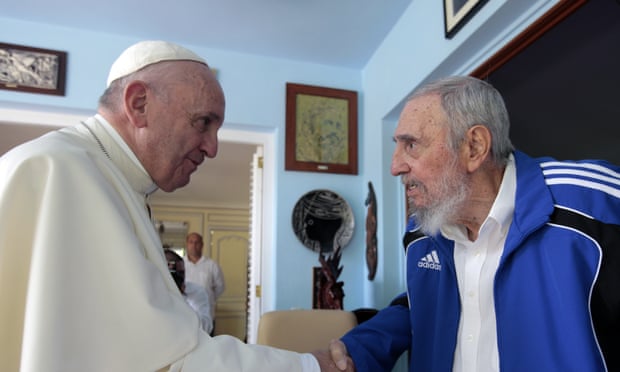
  

Pope Francis and Cuba’s Fidel Castro shake hands, in Havana, Cuba, Sunday,

What a day for the pontiff! Here’s are the key points from the first day of his tour, spent in Havana:
  • In an “intimate and familial” encounter, Pope Francis and former Cuban president Fidel Castro spoke about the environment and exchanged gifts. Pope Francis gave Castro books on spirituality by priests; Castro gave the pope a book of his own insights on spirituality. Well done, El Jefe.
  • At a papal megamass attended by thousands in Havana’s Revolution Square, the pope encouraged Cubans to serve one another, noting that service is never “servile” or ideological, “for we do not serve ideas, we serve people”. His homily was free of political messages but was nonetheless a strong statement. The liturgical music, a variation on Cuba’s Danzón, also a made a strong statement.
  • Prominent activists told the Guardian at least 31 protesters were arrested in a “repressive and aggressive” move to stop them attending the mass. This included members of a women’s group that campaigns for prisoner releases.
  • On the prospect of peace in Colombia between rebels and the government, Pope Francis said we do not have the right to another failure of reconciliation.
  • Cuban president Raúl Castro appears to have given Pope Francis the gift of a giant crucifix made out of oars.
  • Francis went “Pope Unplugged” for the afternoon, discarding his prepared speeches (to the chagrin of journalists and editors everywhere). He instead spoke from the heart on poverty, disability, and faith to clergy and young people.
Thanks for tuning in! The blog will be running all week as the pope continues his tour through Cuba and the US.
It was not as easy as you might expect to find Catholics among the crowd waiting for the pope this evening. But there was not shortage of excitements and optimism about seeing a pontiff who has played a major role in improving relations between Cuba and the United States.
Many students here want to emigrate to their wealthier neighbour as soon as they graduate. Others hope that closer ties will help their own country become a more desirable place to live.
“I’m not Catholic, but I respect the pope. He’s an important man for the world and he has done a lot of good for Cuba,” said 21-year-old Xavier Alexander Rodríguez, a students of computer science.
“Young people in Cuba want change. The closer ties with the US are a great step towards that. I wish that we can walk like brothers with the US.”
Vivian Rodríguez (no relation), a 23-year-old lecturer in psychology at the University of Havana, said international support and a positive message were important for people like her who want to stay in Cuba.
“Cubans are very excited by the arrival of the pope. We’re grateful for the help he has given us in relations with other countries,” she said. “It’s always good to know that there is backing for unity in Cuba and closer ties with the United States. That helps people make personal decisions (about whether to stay or go).”
Among the world leaders visiting Cuba for the papal visit is Argentina’s President Cristina Fernández de Kirchner, who attended this morning’s mass in La Plaza de la Revoluciónwrites Angela Bruno.
Some Twitter users have raised their eyebrows at la presidenta’s expensive tastes – she arrived yesterday at Havana’s José Martí Airport sporting a Hermès bag which can cost up to at $22,000.
Such a display of wealth seems somewhat at odds with the Pope’s message: he has repeatedly criticised excessive consumption, warning in his homily this evening that “wealth makes us poor.”
The Pope and Kirchner have had their share of differences. Guardian correspondent Stephanie Kirchgaessner spoke to their once-rocky relationship in her coverage of the Pope’s trip to Latin America during the summer:
There was bad blood between them when Francis was still known as Father Jorge Bergoglio, archbishop of Buenos Aires and a fierce critic of corruption in Argentinian politics.
The icy relationship worsened after Fernández passed a law legalising same-sex marriage in Argentina in 2010 when Bergoglio headed a march against the gay marriage bill.
‘Pity there is no ‘popess’; if not, I could compete for the post,’ Fernández said when she heard that Bergoglio had become pope.
Since then, however, the two have managed to improve their relationship: Relations have seemingly warmed and Fernández has become a frequent visitor at the Vatican.

Meanwhile:

Pope Francis gives an ‘unplugged’ homily on poverty and disability in the world
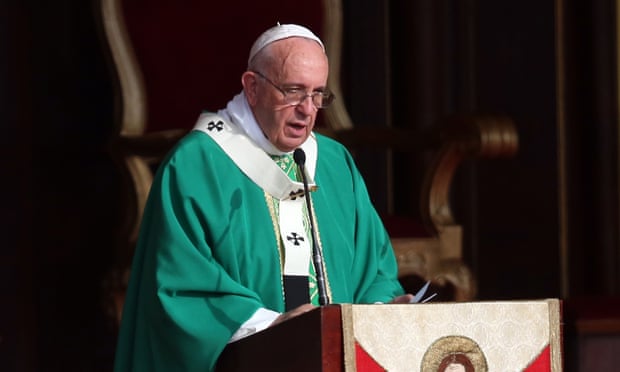
  

Pope Francis discarded his prepared homily and spoke off-the-cuff to the gathered priests and religious.

Pope Francis put his prepared homily aside and gave an extraordinary “unplugged” address on poverty, mercy, disability and service to Cuba’s priests, religious brothers and sisters and seminarians, during a Vespers service at Havana Cathedral.
“We always try to curtail poverty, as it were,” the pope said. “That’s a reasonable thing, but I’m talking about the heart.”
“Richness impoverishes you; it takes away from us the best we have. It makes us poor in the only richness which is worthy: trust in God.”
“Our holy mother church is poor. God wishes it to poor, as he wishes our holy mother Mary to be poor. Love poverty as a mother.”
The crowd smiled and some wiped away tears as the pontiff spoke. Cameras also caught some looks of consternation as the congregation grappled with Francis’s words, especially when he (jokingly) drilled in on the struggles of some religious and priests.
Nuns got it first: “May God spare us grey nuns, those who are always lamenting things! Saint Theresa used to say that to her nuns. Woe to that nun!”
Some nuns in the crowd (mainly the young ones) laughed. Others weren’t so amused.
Religious life as a consecrated brother or sister is, the pope said, about “burning” your life for the ones the world despises, the “disposable material” of humanity.
As an example, he mentioned those “who with new analytical methods, if it is discovered they have a degenerative sickness, the world wants to send them back before they are born”.
“Sometimes [a young religious sister] doesn’t know how good it is to see the smile of someone who is paralysed,” the pope said, smiling.
“The tenderness and mercy of God is like someone who is paralysed getting saliva all over your face. Or when a person with a disability gets angry and hits you!”
Priests were next: “Please to the priests,” the holy father said, “do not grow tired of forgiving.”
“Do not hide in fears or rigidities. Be like this nun [Sister Ponce, who spoke earlier in the service about her ministry], and those who are here. They are not angry when they find the sick person filthy; they just clean him. When the penitent comes to you, don’t feel bad. Don’t be neurotic. Jesus embraced them. Jesus loved them.”
“No corporation can be made, no money can be made from the least ones. In that place Jesus shines brightly,” the pope said.
The pope says he will give his printed homily to one of the cardinals to distribute and is going to speak off the cuff. This regular journalist quietly screams. Thanks, Frank.
The chanted psalms are sung beautifully by a choir. The pope is saving his voice, by the look of it.
The choir chants the psalms. Photograph: EWTN/Screenshot
Just a little church fact you might find interesting: the Catholic church’s communal prayer is the same around the world each day. I heard the same readings at mass this morning in New York as the pope heard in Havana, and in every other parish in the world.
In a sense, it’s like the church prays for you. That’s especially true of what’s called the Divine Office, the daily schedule of prayer, because few lay people perform it. Here’s the relevant bit for this particular service.
A Daughter of Charity, Sr Yaileny Ponce, speaks to the pope. She is is pouring her heart out about her ministry with the severely disabled. “I have to discern in a shout or a cry or a scream: Joy? Or pain?”
“[It’s] beautiful because there, in his weakest children, God lives and shows himself.”
“It is worth giving your life to serve these people because in them you find the kingdom of God.”
The congregation applauds her, and the pope begins the formal liturgical element of the service.

China’s new rocket carries a record 20 ‘micro’ satellites


The Long March-6 rocket blasting off yesterday in Taiyuan, Shanxi province.

The smaller rocket may make China more competitive in the market for commercial satellite launches.
China has launched a new, smaller type of rocket from its “Long March” family which will be used primarily for carrying satellites aloft, state media reported, as the country races ahead with an ambitious space programme.
The Long March-6, a newly developed carrier rocket which uses liquid propellant, took off from a launch base in northern Shanxi province yesterday morning carrying 20 “micro” satellites, the official Xinhua news agency said.
The rocket climbed into bluish-grey skies, footage aired by state broadcaster China Central Television (CCTV) showed.
One Chinese official suggested that the smaller rocket will make China more competitive in the lucrative market for commercial satellite launches.
“We believe it will greatly boost the competitiveness of Chinese carrier rockets in the international market,” said Mr Zhang Weidong, chief designer at the Shanghai Academy of Spaceflight Technology.
“The new model will also significantly improve our ability to access space,” he told Xinhua.
China launches its own satellites as it continues to build a navigation system, but also carries out launches for other countries and commercial companies.
The rocket is 29.3m high, shorter than others actively used in China’s space programme, reports said. Long March-6 uses fuel composed of liquid oxygen and kerosene, which is said to be free of toxicity and pollution.
State media hailed the achievement, saying the launch marked a record for the number of satellites carried by a Chinese rocket and its first time with the “environmentally friendly” fuel.
The small satellites will be used for “experiments” in technology and new products, CCTV said, but gave no details.
China’s space programme, which has potential military applications, is shrouded in secrecy.
“The separation control for 20 satellites required high accuracy, precision and reliability,” Mr Hao Yao- feng, a technician at the Taiyuan Satellite Launch Centre, told CCTV.
A 2011 policy paper issued by the State Council, or Cabinet, said the Long March-6 would be capable of placing a tonne of payload into orbit at a height of 700km.
State media publicly announced plans for the Long March-6 in 2009, but said at the time that the first launch was scheduled for 2013.
Chinese scientists earlier this month said the country is planning to land a lunar probe on the dark side of the Moon before 2020, according to state media.
In 2013, China landed a rover dubbed Yutu on the Moon, making it only the third nation after the US and the Soviet Union to land on the Earth’s natural satellite.
China completed its first return mission to the Moon last year with an unmanned probe landing successfully back on Earth.

Tuesday, September 1, 2015

Donie's Ireland daily news BLOG UPDATE

The Right-2-Water warns Irish Government that demonstrations will continue despite Alan Kelly’s stance


Right-2-Water protestors have warned the Irish Government that the campaign against the charges will continue after tens of thousands of demonstrators took to the streets in the fifth major demonstration against the utility.

Among them were 23 protesters facing charges over incidents in Jobstown, Tallaght in Dublin last November when Tánaiste Joan Burton was forced to remain in her car for more than two hours after being prevented from leaving a graduation ceremony.
The Right2Water group, which organised the weekend march in Dublin, estimated about 80,000 protesters turned out.
Sinn Féin deputy leader Mary Lou McDonald urged the Government to use the October Budget to abolish the charges and described Irish Water as “one fiasco after the other”.
Anti-Austerity Alliance (AAA) TD Paul Murphy said the demonstration showed the Government was “on the run” over water charges. Mr Murphy also said his organisation had been denied Garda permission for a collection in his Dublin South West constituency on grounds that it would “encourage an illegal act”.
Paul Murphy, and one of those expecting to be charged over the Jobstown protest, claimed that if the Government does not “bow to the inevitable” and abolish water charges the next government will be under immense pressure to do so.
Trade unions affiliated to the campaign like Unite, the Technical Engineering and Electrical Union, Mandate, the Communications Workers Union, the Civil Public and Services Union and Opatsi, the plasterers’ union also said they are now planning town hall meetings to gather more support.
Meanwhile, senior Gardaí in Cork are to conduct the internal Garda investigation into whether or not reports regarding water protest charges resulted from information emanating from within the force.
Chief Superintendent Mick Finn and Detective Superintendent John Healy have been tasked by commissioner Nóirín O’Sullivan with the inquiry.

Tens of thousands attend water charges protest in Dublin on Saturday last

Demonstrators demand end to Irish Water and ‘bully boy’ tactics of Government

   
Tens of thousands have attended a demonstration against water charges, organised by the Right2Water campaign in Dublin, having marched from the city’s railway stations and suburbs to congregate at the Spire on O’Connell Street.
Tens of thousands of anti-water charges protesters gathered at a stage at the Spire on O’Connell Street in Dublin on Saturday, after setting off from Heuston and Connolly train stations.
A number of smaller groups also marched in from the suburbs for the demonstration, which was organised by the Right2Water campaign.
The protest was the fifth official Right2Water demonstration.
It was supported by five trade unions, including Mandate, whose president John Douglas said the current Government will attempt to divide the population in the upcoming budget.
“The arrogance and the disrespect for the Irish people in the way Irish Water was set up typifies how rotten this country is,” Mr Douglas said, making his first public appearance at an anti-water charges rally.
“A society is judged by how it treats its most vulnerable, and by that test Irelandfails goddamn miserably. This economy, this society is broken- it’s rotten to the core.
“There is no recovery, it’s a bloody myth, they made it up to con us. We know best, we’re the people of Ireland, we know there’s no recovery in Ireland and the only recovery is for the elite few,” he said, adding that people were also mobilising against homelessness and under-investment in the public sector.
In her speech to the protesters, Sinn Féin TD Mary Lou McDonald denounced the “bully-boy” tactics of the Government in trying to impose domestic water charges.
However, she said afterwards that her party has not yet decided whether people who haven’t paid their bills should be entitled to receive the €100 conservation grant.
“You can see from the numbers here today that people have not been intimidated or bought off or persuaded that this issue is not important anymore- this still matters a great deal,” she said, before reaffirming Sinn Féin’s stance that refunds on water charges will not be provided if the party gets into government.
“We would not be making rebates to people who have paid the charges, but neither would we be asking for the conservation charge back.
“We’re just being honest with people. The figures have to add up and you have to balance the books.”
Feeder marches
Protesters from across the country arrived at Heuston and Connolly stations earlier this afternoon for feeder marches.
As with previous protests, there were traffic delays along the north and south quays, with O’Connell Street closed to traffic on both lanes and interruptions to bus and Luas services.
Gardaí reported no disturbances.
The organisers of the event vowed to keep up the pressure on Fine Gael and Labour to abolish the controversial utility, but details of follow-up protests in the coming months have not yet been revealed.
Right2Water spokesman David Gibney earlier said that the protest was also about other problems people faced, including access to healthcare, lack of housing and the right to education.
“This demonstration today it is not just about water. This is about the type of society we want to live in and a vision for the future,” he said.

Ireland has 25th-highest life expectancy in the world

  
The elderly should be cherished Life expectancy is climbing worldwide but we are spending more years living with illness and disability
Ireland has the 25th-highest life expectancy in the world – up from a ranking of 31 in 1990, according to a new global survey.
Life expectancy is climbing worldwide but we are spending more years living with illness and disability.
Countries with the highest life expectancy are Japan, Singapore, Andorra, Iceland, Cyprus and Israel, according to the Global Burden of Disease study, led by the Institute for Health Metrics and Evaluation (IHME) at the University of Washington.
Life expectancy in Andorra is almost 84 years, while it is 80.4 in Ireland. The UK is ahead of Ireland with people living to 81 years.
Since 1990 Ireland’s life expectancy has improved by around six years, the survey of 189 countries revealed.
People around the world are living longer, even in some of the poorest countries, but a complex mix of fatal and non-fatal ailments cause a tremendous amount of health loss, according to the analysis .
Healthy life expectancy takes into account not just mortality but also the impact of non-fatal conditions and summarises years lived with disability and years lost due to premature death.
The increase in healthy life expectancy has not been as dramatic as the growth of life expectancy, and as a result, people are living more years with illness and disability.
“The world has made great progress in health, but now the challenge is to invest in finding more effective ways of preventing or treating the major causes of illness and disability,” said Professor Theo Vos, the study’s lead author.
The differences between countries with the highest and lowest healthy life expectancies are stark. In 2013, Lesotho had the lowest, at 42 years, and Japan had the highest globally, at 73.4 years.
Even regionally, there is significant variation.
Cambodians and Laotians born in 2013 would have healthy life expectancies of only 57.5 years and 58.1 years, respectively, but people born in nearby Thailand and Vietnam could live nearly 67 years in good health.
The fastest-growing global cause of health loss between 1990 and 2013 was HIV/AIDS, which increased by 341.5%. But this dramatic rise masks progress in recent years.

Meanwhile:

A brisk daily walk can add seven years to your lifespan


Just about 25 minutes of brisk walking a day can add up to seven years to your life,

London health experts have said.
Research presented at the European Society of Cardiology (ESC) Congress over the weekend shows that regular exercise can reduce ageing and increase the average lifespan.
Sanjay Sharma, professor of inherited cardiac diseases in sports cardiology at St George’s University Hospitals NHS Foundation Trust in London, said an average person in their 50s and 60s can reduce the risk of dying from a heart attack by half with moderate exercise.
“This study suggests that when people exercise regularly they may be able to retard the process of ageing,” he said.
“We may never avoid becoming completely old, but we may delay the time we become old. We may look younger when we’re 70 and may live into our 90s.
“Exercise buys you three to seven additional years of life. It is an anti-depressant, it improves cognitive function and there is now evidence that it may retard the onset of dementia.”
He said everyone should be doing at least between 20 and 25 minutes of walking a day, involving brisk walking or slow jogging.
“People with a heart condition shouldn’t run but walk to a point where they can still speak — but they shouldn’t be able to sing. Following these simple directions is essential considering our sedentary lifestyles.”
He said exercise will bring benefits whatever age or condition. People who start exercising at the age of 70 are less likely to go on to develop atrial fibrillation, a rhythm disturbance that affects about 10% of people over 80.
The research was carried out by a team at Saarland University in Germany who introduced a group of non-exercising but otherwise healthy and non-smoking people to a staged exercise programme.
They showed that aerobic exercise, high intensity interval training and strength training all have a positive impact on markers of ageing.
The authors noted that endurance exercise and high intensity exercise may be more efficient than just lifting weights, as they further increase telomerase activity, which in turn helps to repair DNA as it gets old.
They said that by measuring the increase of telomerase activity and decrease of senescence marker p16 (both makers of cellular ageing in the blood) over a six-month period, doctors were able to show that regular exercise had triggered the anti-ageing process.
“The study brings a bit more understanding of why physical activity has that effect. It helps us understand the process of cellular ageing as that’s what drives our organ system and body ageing and the effects physical activity can have on the cellular level,” Christi Deaton, Florence Nightingale Foundation Professor of Clinical Nursing Research at Cambridge Institute of Public Health, University of Cambridge School of Clinical Medicine, said.
“The more active you are, and it doesn’t matter when you start, the more benefit you are going to have.”

“A girl’s depression tattoo” marks two perspectives on her secret battle with her mental health condition


A YOUNG WOMAN PICTURED ABOVE WANTED TO SHOW THAT PEOPLE WHO APPEAR FINE ON THE OUTSIDE MAY BE STRUGGLING WITHIN THEMSELVES ON THE INSIDE.

Bekah Miles wants her tattoo to start conversations about depression.
A young woman has revealed her struggle with depression by unveiling a heartfelt tattoo that says “I’m fine” to anyone looking at it, but from her perspective, upside down, it says “save me.”
Bekah Miles dreamed up the inking to show the struggle sufferers have in what they show to everyone around them, against what they see themselves.
The 21-year-old came out about her battle on Facebook, posting the pictures alongside an open letter to her parents, explaining why she had the tattoo done.
She wrote: “So today, I got this tattoo. I feel that my leg was the best place for the meaning behind it.
“When everyone else sees it, they see ‘I’m fine’, but from my viewpoint, it reads ‘save me’.
“To me, it means that others see this person that seems okay, but, in reality, is not okay at all.
“It reminds me that people who may appear happy, may be at battle with themselves.”
Bekah says she hopes her tattoo will start a conversation about the often misunderstood condition.
She said: “This forces me to talk about my own struggle, and why the awareness of it is important.”
People who read her letter praised her honesty and recounted their own battles with depression.
One wrote: “You’re a very brave girl – it’s an uphill struggle and I hope you reach a place where you find happiness with somebody you love xxxx.”
The post has since gone viral and has been shared more than 200,000 times.
She added: “I never expected it to go beyond my friends and family. I thought reaching out to them was enough, but I am completely and utterly in awe of how far this has traveled.
“This is exactly what I wanted–to reach out to people and let them know that they are not alone.
“Please keep sharing and spreading the awareness. This is the only way to get some real change in the stigma.”

Bekah’s letter in full

(Dear mom and dad, please don’t kill me over this permanent choice. I want you to hear me out.)
Today, I am coming out with something that only few of you know. I am ready to have a conversation about my mental illness.
Last year, I was diagnosed with depression. And in all honesty, I believe it was a problem for quite a while before that, but I think it just got worse to the point of hardly functioning.
So today, I got this tattoo. I feel that my leg was the best place for the meaning behind it. When everyone else sees it, they see “I’m fine,” but from my viewpoint, it reads “save me.” To me, it means that others see this person that seems okay, but, in reality, is not okay at all. It reminds me that people who may appear happy, may be at battle with themselves.
To me, depression is the days that I feel sad for no reason.
Depression is the mornings that I don’t feel capable of getting out of bed.
Depression is the sleeping too much, or sleeping too little.
Depression is the homework that I never completed, simply because I didn’t feel like I was capable.
Depression is the break downs I have over absolutely nothing.
Depression is the eating too much, or eating too little.
Depression is the nights I begin to cry because I feel so overwhelmed, even though everything is going right.
Depression is the 50 pounds I carry in my chest at all times.
Social media provides a welcome distraction for young people facing depression.
Depression is the need to constantly be distracted (being on social media, playing video games, watching movies or shows, or working all the time) because I can’t trust myself with my thoughts for longer than 3 minutes.
Depression is the friendships that have suffered because of my inability to function.
Depression is the hurtful thoughts and actions I have towards myself.
Depression is the tears I have because I don’t know why I feel so worthless, when I know I should feel happy.
This is one of the most difficult things to open up about because it’s extremely hard for me to feel vulnerable…but this needs to be talked about.
Mental illness is serious, but so shamed in our society. We care so much for our physical health, but hardly a thing about our mental state. And that is seriously messed up. Mental illness is not a choice and will likely hit everyone at some point in their life. If it’s such a huge issue, why aren’t we having this conversation about it?
That’s why I got this tattoo; they are great conversation starters. This forces me to talk about my own struggle, and why the awareness of it is important. You’d be surprised by how many people YOU know that struggle with depression, anxiety, or other mental illness. I may only be one person, but one can save another…and that’s all I could really ask for.
Maybe this is part of why I am so interested in psychology. I want to help people who feel the way I have—and still do—because it’s hell. And I don’t wish that upon anyone.
“I think the saddest people always try their hardest to make people happy because they know what it’s like to feel absolutely worthless and they don’t want anyone else to feel like that.” – Robin Williams

Sperm cells harpoon female egg to fertilize,

Says new research


Thanks to new discoveries at the University of Virginia in the US, new hypothesis on how conception occurs could be around the corner.
A sperm cell latches on to its target with spiky filaments that emerge from its head, say scientists at the University of Virginia (UVA) School of Medicine in the US whose 14 years of research led to the discovery.
Their finding is featured on the cover of the scientific journal Andrology, in which their corresponding paper was published.
“This finding has really captured our imagination,” says UVA reproduction researcher John Herr, PhD, of the Department of Cell Biology, adding that they have come up with an entirely new hypothesis about what happens at conception.
The research has implications for our understanding of the protein architecture of the sperm head, specifically in an organelle called the acrosomal matrix.
“One of the major proteins that is abundant in the acrosome [in the anterior region of the sperm head] is crystallizing into filaments, and we now postulate they’re involved in penetrating the egg,” says Dr. Herr.
This protein was discovered years ago in Dr. Herr’s lab in collaboration with the lab of Wladek Minor, PhD and they named it “sperm lyzosyme-like protein” (SLLP1).
Minor and his team captured the protein within a static crystal, which they chilled to cryogenic temperatures (approximately below 180 degrees C or below 292 degrees F) for protection, then zapped it with X-rays.
Observing the direction of the X-rays, the scientists were able to determine the protein’s shape in a process they compare to mapping out a shipwreck with a sonar.
It’s the first protein from that part of the sperm to have a crystal structure and it’s the first mammalian sperm protein that can bind to eggs, says Heping Zheng, the lead author of the paper.
Spring-boarding from their new understanding of the protein, the researchers aim to explore how fertilization works in the most precise detail.
The study builds on previous groundbreaking research from Herr’s lab — that time featured on the cover of the journal Biology of Reproduction, which published the corresponding paper in March.
Here, it was reported that the protein ESP1 (as it relates to the gene SPESP1) remains intact during fusion, acting as a stabilizer, while the rest of the sperm head undergoes dramatic changes.
“Getting at the molecular components of the fertilization event has a lot of practical applications — as well as intellectual value — because you want to account for all the major components involved in the essential events of the fertilization cascade,” says Dr. Herr.