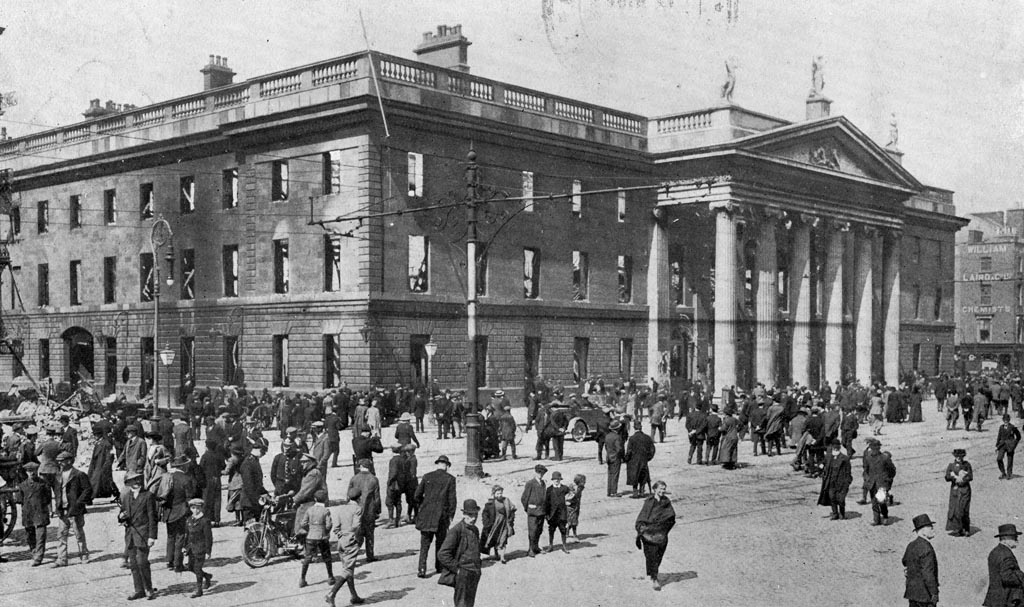
Irish centenary celabrations as many thousands attend military parade on the streets of Dublin
The Proclamation read outside GPO and wreath laid in Kilmainham for executed rebels


Captain Peter Kelleher from the 27th Infantry Battalion reading the Proclamation at the GPO as part of the 1916 Rising celebrations.
Tens of thousands of people lined the streets of Dublin on Sunday to witness a large military parade commemorating the centenary of the 1916 Easter Rising.
Crowds of people gathered along the 4.5km route across Dublin from 10am for the parade.
At about noon, the Proclamation was read out at the GPO on O’Connell Street by Capt Peter Kelleher .
President Michael D Higgins then laid wreath at the GPO, with relatives of those who fought in the rebellion in attendance.
The flag above the GPO was then raised to full mast and Amhrán na bhFiann was played as a fly-over of military planes took place 700ft above O’Connell Street.
Ahead of the reading, the flag over the GPO had been lowered to half-mast and the President inspected a guard of honour.
Head Chaplain of the Defence Forces Fr Seamus Madigan lead a specially-composed prayer for “ all who lost their lives in 1916 and throughout the troubled history of our island.”
Some 3,722 Defence Forces personnel marched in front of military vehicles along with emergency services personnel and army veterans, many of whom served on United Nations’ peacekeeping missions. The parade ended shortly after 2pm.
 The Kilmainham Gaol wreath laying
President Higgins earlier laid a wreath in the Stone Breakers’ yard in Kilmainham Gaol on the spot where 14 rebels were executed in the days after the 1916 Easter Rising. The ceremony was the first of the main commemorative events of the day in Dublin.
The Acting Taoiseach, Acting Tánaiste and Ministers for Defence and Justice stood to attention as the tricolour flapped at half-mast, casting a shadow across the high wall where the leaders of the Rising were shot by firing squad in 1916.
Representatives of the main political parties, including Fianna Fáil’s Micheál Martin and Sinn Féin’s Martin McGuinness, along with senior officers of the Defence Forces and descendants of the executed leaders, stood quietly along the opposite wall to pay their respects.
“In this place of final moments, we are reminded of the comfort brought by faith to the leaders of the 1916 Rising,” Fr Madigan, told those present. “We remember, reflect and re-imagine our belief in life after love. We recall the love and devotion of the executed leaders – for family, for country and for God.”
The President stepped forward to lay the wreath, followed by a minutes’ silence, which seemed particularly profound in this, the most evocative historical location of the Rising.
Fourteen men died on this spot between May 3rd and May 12th, 1916. The first was Patrick Pearse; the last the wounded James Connolly who was tied to a chair before being shot.
Glasnevin Cemetery:- The commemorations began on Saturday morning when Sabina Higgins lays a wreath at the grave of Countess Constance Markievicz in Glasnevin Cemetery.
Following that, the President laid a wreath in the Garden of Remembrance in honour of all those who fought and died for Ireland’s freedom.
As well as Kilmainham and the GPO, wreaths were also laid in Glasnevin on Sunday.
One was placed at the Sigerson Monument, which honours the dead of 1916, and others at the graves of Edward Hollywood, a silk weaver from the Liberties in Dublin who put together the Irish Tricolour in 1848, and the grave of Peadar Kearney, who wrote the lyrics to Amhrán na bhFiann.
Mr Kearney’s grandchildren Peader, Eva, Brid and Pearse were present for the event.
At Glasnevin, Minister for Arts Heather Humphreys said today was a moment for reflection. Ms Humphreys said the Rising was inspired by a vision for a better Ireland of equal rights and opportunity.
It was a sincere quest for independence in spite of the consequences, she said.
The Minister questioned what Mr Hollywood would think if he knew the tricolour had been presented to 4,000 schoolchildren across the country this year and what Mr Kearney would feel knowing his words had become the national anthem.
On Sunday night a State reception is being held in Dublin castle for 2000 relatives of those who took part in 1916 and 1,000 other guests.
On Saturday President Higgins used an address to descendants to call on Irish people to take responsibility for building a true Republic and said the ideals of the Proclamation can still inspire today.
Easter Monday:– On Easter Monday further commemorations are planned at each of the seven key battlefield sites in Dublin.
Wreath laying ceremonies, again open to the public, will take place at the 1916 garrisons including Boland’s Mill, the Jacob’s Factory on Bishop Street, Dublin Castle and City Hall, the Four Courts, the Royal College of Surgeons, Moore Street and at St James’ Hospital, which was the South Dublin Union100 years ago.
Outside of Dublin simultaneous wreath laying ceremonies will be held inAthenry, Cork, Enniscorthy and Ashbourne.
Also on Easter Monday cultural events are planned in more than 200 venues across Dublin city centre including 500 free talks, exhibitions, debates, film, performances and dramatizations, with six outdoor stages and lots of activities for children and families.
The suicide of a Tipperary farmer jailed over debt to sub-prime lender sends shivers through rural Ireland
LOBBY GROUPS PLAN PEACEFUL PROTEST AT CARLISLE MORTGAGES LTD IN SOLIDARITY WITH THE POPULAR TIPPERARY MAN.


Many farm families are living in dread of the letter arriving informing them they are facing a possession order for their lands.
Two weeks ago, a Tipperary farmer weighed down by debt for more than a decade took his own life. According to friends, he took out an expensive short-term loan from an unregulated lender at high interest rates, to be paid off when a long-term loan from a mainstream lender came through.
Main stream lenders often baulked when sub primes were involved. He was stuck in a sub-prime loan.
The lender took possession of his land, he was ordered to move his cattle and when he didn’t, he was committed to prison last month for contempt of court. He was a hard working and dedicated farmer.
According to those who knew him, jail broke him.
The farmer’s case was due back in the High Court in April but clearly he could no longer face it. He died on his farm last Tuesday week, leaving behind a haunting note for his family. His debt will now pass to his widow.
The creditor in this tragic case is no foreign vulture fund, but an Irish family business called Carlisle Mortgages Limited, an unregulated lender, founded in the late 1990s by a former motor dealer from Mayo, which specialised in arranging expensive loans for cash-poor clients.
According to other debtors who met the farmer on his many trips in and out of the High Court in recent years, he was a private man who didn’t like to discuss his financial problems with others even though they were all in the pretty much the same boat. He “hated” being in court, said one woman who knew him, and couldn’t wait to get back home to his farm. “He just wanted to go home and milk the cows,” she said.
According to friends, he tried over the years to get a long-term loan to pay back Carlisle and be rid of the mounting interest rates.
He was introduced to a woman called Susan Bourton, who promised to arrange this finance for a fee. But the long-term finance never materialised and she later ended up in jail for bank fraud in her native New Zealand.
The Tipperary farmer’s family do not want his name to be published and have asked for space and privacy to grieve. His death has not been reported in the media. Nevertheless, news of his passing has struck a chilling chord in rural communities across the country.
As one farmer who knew the man said last week, his death shocked the farming community because so many others in financial difficulties have found themselves staring into that same abyss.
According to those who attended, hundreds of people stood for hours on a dark cold night waiting to pay their respects at his removal. More than 2,000 people turned out to his funeral the next day, spilling on the road outside the tiny parish church in his village.
His death has prompted two public meetings in Tipperary, one in Cahir last Sunday night, and another to be held in Portlaoise on Saturday.
The purpose is to highlight the number of suicides that are directly linked to financial pressures from banks and financial institutions chasing down their debt.
On Tuesday morning, a peaceful protest with “black crosses” and “prayers” will be held at Carlisle Mortgages’ registered offices on Parnell Square, and possibly the homes of its directors, in Dublin on Tuesday. The organisers are the anti eviction campaigner, Jerry Beades, a Senate candidate and members of the Land League.
Carlisle Mortgage Ltd’s founder and director, Frank Fahey, 85, replied that he had “no comment” when contacted by the Sunday Independent last week.
He is well known in the motor business. Frank Fahey Commercials is credited with being the first to import Iveco and Fiat Trucks into Ireland in the 1970s. That business ran into difficulty and by the late 1990s, he had moved into finance, Carlisle Mortgages Limited operated in the same unregulated space as sub-prime lenders, offering credit at high interest rates usually to people who could not get it elsewhere. Until legislation was introduced 2007, such entities were not subject to licence or regulation. According to the Central Bank, Carlisle Mortgages Limited “is not” and “never was” a regulated entity.
Its client list included, among others, farmers who were asset-rich and cash poor. Although the company is registered to an address on Parnell Square, Mr Fahey wrote to Carlisle Mortgages clients from his home address – a large €2.5m period house in Dublin 4 – and gave them his personal landline number.
In a letter to one farmer who had defaulted on his payments and was facing a possession order on his lands, he explained the rationale of Carlisle Mortgages Ltd:
“People only come to us after failing to get the money elsewhere. We explain to them that we are expensive and before they sign we tell them to contact their solicitors and act on their advice. We will not loan money just to get a high interest rate. Unless we are satisfied that we are helping a client out of a difficult situation and that they are in a position to repay as per the agreement, we will not give them the loan,” he wrote.
“Once again, I want to remind you that you are fast running out of time.”
In another he wrote: “In fairness it is far too late to start complaining about the high-interest rate when all along you were fully aware of what it was costing.”
One farmer, who spoke to the Sunday Independent last week, said Mr Fahey was “very fair” in his dealings with him. He said he was introduced to Carlisle Mortgages in 2007 by a bank, when he wanted to buy land quickly that came up for auction. He borrowed €800,000 at 27pc interest to be paid back over two months, on the assumption that his long-term bank loan would come through. The long-term loan never materialised, and he was stuck in debt to Carlisle Mortgages Ltd.
After being in and out of court over the years, he said the best thing he did was to “start talking” to Frank Fahey and he now hopes to reach a settlement relating to the outstanding six figure debt he owes Carlisle Mortgages Ltd.
Other farmers report gruelling and bitter court battles with Mr Fahey’s company. Almost 40 cases taken by Carlisle Mortgages Ltd are listed in the High Court records since 2006.
One previously publicised case is that of Eugene Costello, a farmer from Ballinasloe, Roscommon, who borrowed €450,000 from Carlisle Mortgages Ltd in 2004. A broker who advertised in the Farmers Journal secured the offer for him – a short-term loan at 26pc until the bank processed his long-term loan.
Like the late Tipperary farmer, the loan never materialised from mainstream banks. He too was introduced to Susan Bourton as someone who could secure him long-term credit to pay off his crippling debt to Carlisle. He paid her €8,000 but the finance never materialised.
His debt to Carlisle Mortgages stood at €1.4m in 2014. The firm installed a receiver to sell his 160- acre farmer – Costello succeeded in having the receiver withdrawn for now but the possession order over his land remains. The case is still before the High Court.
Despite tales of tragedy and hardship, the law and the courts are firmly behind Carlisle Mortgages Ltd, a legitimate lending business that in its day clearly filled a gap in the market for short-term finance. The company is still trying to get its money back on loans dating back more than a decade.
BUT AT WHAT COST?
The organiser of next Saturday’s meeting, Ken Smollen, said the death of the Tipperary farmer was the seventh debt-related suicide he has heard of in a fortnight.
A former Garda and failed election candidate who has his own financial troubles, Mr Smollen said: “The vast majority of these deaths go unreported, meaning that the problem remains a very hidden and personal one for thousands of people in Ireland,” he said.
“We are almost on the eve of the centenary of the 1916 Rising when brave men and women fought and died for Ireland’s freedom from tyranny. Right now, 100 years later, the people of Ireland are once more being terrorised, this time in their own homes, not by foreign forces but by Irish – and foreign-owned banks that have received the full support of two successive Irish governments that have willingly thrown hundreds of thousands of our people to the aptly named vulture funds and banking wolves!”
A vitamin C rich diet may slow down the growth of cataract's
THE STUDY SUGGESTS THAT SIMPLE DIETARY CHANGES SUCH AS INCREASED INTAKE OF FRUIT AND VEGETABLES COULD HELP PROTECT PEOPLE FROM CATARACT.


CATARACT IS A COMMON CONDITION IN WHICH THE LENS OF THE EYE BECOMES CLOUDY AS A RESULT OF OXIDATION OVER TIME.
Eating a diet rich in vitamin C may slow the progression of cataract — a condition that may lead to blindness, reveals a study, adding that environmental factors and diet also influence cataract more than genetic factors.
The findings showed that those participants who had a higher intake of vitamin C were associated with a 33 per cent risk reduction of cataract progression and had “clearer” lenses 10 years after the study than those who had consumed less vitamin C as part of their diet.
“The findings of this study could have significant impact, particularly for the ageing population globally, by suggesting that simple dietary changes such as increased intake of fruit and vegetables as part of a healthier diet could help protect them from cataracts,” said lead study author Chris Hammond from the Kings College London.
“While we cannot avoid getting older, diabetes and smoking are also risk factors for this type of cataract, and so a healthy balanced diet and lifestyle generally should reduce the risk of needing a cataract operation,” Hammond added.
Cataract is a common condition in which the lens of the eye becomes cloudy as a result of oxidation over time. The study, published in the journal Ophthalmology, looked at the progression of cataracts in the eyes of 324 pairs of female twins over 10 years by examining photographs of the participant’s lenses that allowed them to analyse the level of opacity of the lens in detail.
Participant intake of vitamin C was also measured using a food questionnaire. The study found that environmental factors — including diet — influenced cataract more than genetic factors, which only explained a third of the change in lens opacity. It is thought that increased intake of vitamin C has a protective effect on cataract progression by increasing the vitamin C available in the eye fluid.
“The human body cannot manufacture vitamin C, so we depend on vitamins in the food we eat. We did not find a significantly reduced risk in people who took vitamin tablets, so it seems that a healthy diet is better than supplements,” added study’s first author Kate Yonova-Doing.
The third Act of life:- We just can’t ignore the fact that we are living longer


OPPORTUNITIES OFFERED BY INCREASED LIFE EXPECTANCY ARE A GIFT FOR US?
We are all growing old but no one wants to talk about it, according to a leading expert on ageing.
 Professor of Old-Age Medicine at the University of Copenhagen, Denmark, Rudi Westendorp, believes growing older is like teenage sex – it’s happening but no one wants to acknowledge it.
But however much we bury our heads in the sand, the facts are clear: every child born after the year 2000 will on average live to be a centennial.
Westendorp insists people should consider three facts:
(1) You are going to live longer than you than you think you are. An incredible thought, but a necessary fact you need to acknowledge. The opportunities offered by this extended Third Act are a gift that should not be ignored.
(2) If you say ‘number one’ to people, they say ‘no I will stop at the age of 80 years old because I will be frail, diseased and/or demented’. This is not true. Yes, there is a “wrecked” end of life where your health is failing but that is now delayed. It may start now at 70 years old but will move to 80. For children born after 2000, this will start at 90 years old. So the fact is we are living longer and in a better state than ever before.
(3) Once you are in this “wrecked” period and you are suffering from disability you will still enjoy life. It is not something you should be afraid of.
Westendorp points out that while nobody lives forever, there is nothing true about being healthy to the end and dying suddenly.
“Ageing is about crumbling down, you deteriorate, you develop diseases and become frail and ultimately die from the symptoms of ageing,” says Westendorp. “This is not something to worry about because people in old age still rate their lives, on average, 8 out of 10.
“What I ultimately hope is that people will have a reasonable expectation of what will happen over their lifetime and the opportunities offered by this extended lifespan. Prepare for your ‘Third Act’, it is a marvellous extended period when you prepare and go for it.”
Westendorp trained at the Leiden University Medical Centre (LUMC). In 2000, he was appointed professor of medicine, and, from 2005 to 2012, he was head of the Department of Gerontology and Geriatrics.
He was bestowed an honorary degree by the University of Newcastle in 2009 and received a knighthood in the order of the Dutch Lion in 2014.
The respected academic is also author of ‘Growing Older Without Feeling Old’ and is to speak at The Third Act Conference which will take place at the Royal College of Physicians in Ireland, Kildare Street, Dublin 2 on Tuesday April 26.
US retailers acquires a taste for non-battery hen eggs


US retailers adopting cage-free eggs and laid by non-battery hens now sooner rather than later could gain a profit advantage over competitors.
Retailers, including Albertsons, Kroger, and CVS Health announced plans this month to convert to 100% cage-free eggs in the next decade, amid a push from consumers and shareholders at US firms.
The change likely won’t hurt profits for retailers. US egg sales totalled $7.3bn (€6.53bn) last year, according to Nielsen, and that figure could rise if more retailers make the switch to cage-free eggs.
Consumers usually pay more than twice as much on average for cage-free eggs, $3.42 a dozen, versus conventional eggs, which cost an average $1.31 to $1.45 per dozen, according to the US Department of Agriculture.
But cage-free eggs only cost about 15c more to produce than conventional eggs for farmers, according to Daniel Sumner, director of the Agricultural Issues Center at University of California — meaning major profits may be ahead for the supply side.
“We have reached the tipping point and any companies — be they retailers, basic services or egg producers — that are still fighting this wave are going to be left behind,” said Maisie Ganzler, chief strategy and brand officer at café and catering service firm Bon Appetit Management Company.
Even so, it will take years for most retailers to make the necessary changes to their supply chains. While it can take 12 months to build housing for conventional egg-laying hens, it can take 10 years to do so for cage-free hens. Farmers often need to rebuild existing infrastructure or wait for new hens to hatch.
More than 60% of restaurants and about 90% of retailers who recently announced their move to cage-free eggs said it will take them at least five years to completely change their supply-chain, according to data from advocacy group Cage Free Future.
With a growing number of firms signing on to go cage-free, retailers are looking for new ways to differentiate themselves. Not having cage-free eggs by 2025 could be a major disadvantage, but having them first — well, that could be a golden goose.
The deluge of cage-free egg commitments could position the US to leapfrog over Europe, which currently has a much larger cage-free market than the US, Josh Balk, senior director of Food Policy at the Humane Society of the US, said. In the US about 14% of egg sales are either cage-free or free-range, according to Nielsen.
In the UK, the British Egg Information Service said 47% of egg sales last year came from free-range hens, an even more animal-friendly classification than cage-free. In the US, consumers and shareholders have been pushing restaurants, airlines, manufacturers, and grocers to move to cage-free eggs.
Word deforestation: Where in the world are we losing the most trees?
MILLIONS OF TREES ARE BEING LOST EVERY YEAR AS A RESULT OF DEFORESTATION – BUT WHICH COUNTRIES ARE MOST UNDER THREAT FROM THE LOSS OF TREES?


The world has lost the equivalent of 1,000 football fields of forests per hour for the last 25 years, according to official figures.
Experts warn that deforestation is a major issue facing the world, with the planet’s forests being depleted rapidly.
A recent study estimated that there are three trillion trees on Earth, following the International Day of Forests.
“We will not succeed in reducing the impact of climate change and promoting sustainable development if we do not preserve our forests”
However, the planet has lost 1.3 million square kilometres of forests since 1990 – an area larger than South Africa, according to data published by the World Bank.
While the Middle East and North Africa had the largest percentage increase in forest area between 1990 and 2015, the Latin America and Caribbean and Sub-Saharan Africa regions lost the most – with one in ten square kilometres of forest being lost.
Which regions lost or gained forests? The Percentage change in forest area, 1990-2015Middle East and North AfricaSouth AsiaEurope and Central AsiaEast Asia and PacificNorth AmericaLatin America and CaribbeanSub-Saharan Africa-15-10-505101520
Latin America and the Caribbean saw the biggest total decrease in forest area, losing 970,000 square kilometres between 1990 and 2015.
This region has the world’s second largest share of forests, with about one quarter of the world’s total.
Many of the forests in South Asia are under threat due to demand for such as palm oil
Russia, Brazil and Canada have the highest forest area of any country – unsurprising considering the land mass of these large countries.
The ten countries with the largest forest areas share two thirds of the world’s trees, and would have to be involved in any attempt to combat deforestation.
By 2012, more than 14% of the world’s land had been nationally protected
Latin America and the Caribbean region led this protection, with 21.2% total land area being protected.
José Graziano da Silva, Food and Agriculture Organisation Director-General, has said: “Forests play a fundamental role in combating rural poverty, ensuring food security and providing people with livelihoods. And they deliver vital environmental services such as clean air and water, the conservation of biodiversity and combating climate change.
“The direction of change is positive, but we need to do better. We will not succeed in reducing the impact of climate change and promoting sustainable development if we do not preserve our forests and sustainably use the many resources they offer us”.