Irish Water bills show 46m litres of water leaks per day
- Leaks see 150 customers use in excess of €1,000 worth of water over three months

Irish Water says an estimated 46 million litres of water per day & that’s enough to fill 18 Olympic size swimming pools, water that is leaking each day.
More than 30,000 Irish homes have been identified as having suspected water leaks with more than €1,000 worth of water draining from the pipes of some homes in just three months, according to Irish Water.
The leaks were detected during the utility’s first meter readings covering the period January to March this year.
It has now contacted 2,500 of the worst affected customers offering them a free leak investigation under its interim First Fix Scheme.
Water charges: Full coverage
The utility said the leaks identified were wasting an estimated 46 million litres of water per day – enough to fill 18 Olympic size swimming pools, or fulfil Limerick City’s water needs for 24 hours.
According to the meter readings, 2,500 customers were losing more than 2,000 litres of water every day through leaks.
Almost half of the water lost each day, at around 20 million litres per day, is as a result of leaks at just 1,100 properties.
That is enough water to meet the daily water demand of 70,000 homes.
“Our national metering programme is well ahead of schedule and is already of huge benefit in tackling leakage,” said Irish Water’s Head of Asset Management Jerry Grant.
“Customers who have a meter can see their usage on the reverse side of the bill.”
In the first week of billing 150 customers were found to have leaks that meant they used in excess of €1,000 worth of water over the three months.
While information on how much water is being used in a property is detailed on bills, no-one will be charged more than €65 for water in the first quarter.
In each case where significant amounts of water usage were identified, a constant flow alarm on the customers’ meter was activated.
This entitles the householder to a free leak investigation as part of Irish Water’s First Fix Scheme.
If the leak is found on the customer’s external supply pipe; which connects the meter box and the point of entry to the house, it will be fixed by Irish Water at no cost.
If the leak is inside the house then customers will have to arrange and pay for the repair.
Meanwhile, an Irish Water contractor carrying out a leak investigation on St Laurence Rd in Clontarf in north Dublin was briefly blocked in by up to 10 protestors on Wednesday afternoon.
Gardaí were called to the scene and the van was allowed leave.
About 6% of nurses in Ireland bullied on a daily basis,
- A study finds
- INMO survey says workplace bullying has increased by 13.4% in four years
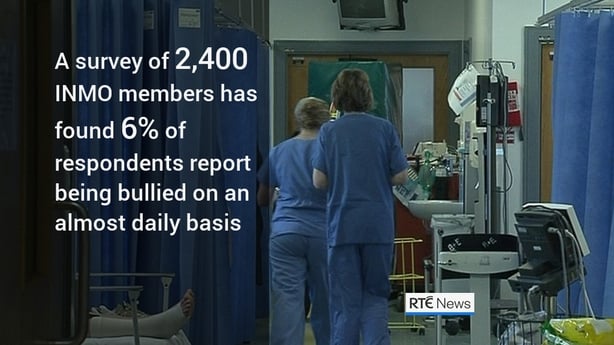

A new Irish Nurses and Midwives Organisation survey has found that almost 6 % of nurses and midwives are bullied on a near daily basis.
A large-scale survey carried out among nurses and midwives suggests that about 6% are being bullied on a daily basis.
The study findings indicate that the level of perceived bullying involving nurses and midwives has worsened significantly since a previous study undertaken in 2010.
The new study found that almost 6% of respondents reported that they were bullied on a near daily basis and that the percentage of non-union members who experienced this bullying was almost double that of union members.
It also found that over the past 4 years there had been a 13.4% increase in perceived incidences of bullying.
The survey suggested that Government cutbacks were a probable explanation for the significant rise in reported bullying between 2010 and 2014.
About 2,400 nurses and midwives took part in the survey, which was undertaken by theIrish Nurses and Midwives Organisation (INMO), in partnership with NUI Galwayand the National College of Ireland.
‘Very disturbing’
Prof Maura Sheehan of NUI Galway, who headed the study, said: “The finding that almost 6% of respondents perceive to be bullied on an almost daily basis is very disturbing.
“The personal consequences in terms of health, well-being and family relationships of people who experience workplace bullying are extremely serious.
“Almost all organisations have a formal anti-bullying policy in place. Clearly there is a significant gap between the presence and implementation of such policies.
“There needs to be a fundamental culture change in hospitals and care facilities – a zero tolerance policy for any bullying must be implemented. This must apply to all employees, no matter how senior, specialised and experienced.”
INMO director of industrial relations Phil Ni Sheaghdha said the results set out in the survey did not come as a surprise, as they confirmed some of the information which had been reported to the organisation by members.
“[Members] believe the problem has been accelerated due to the effects the cutbacks in healthcare have had in the workplace as hospitals are constantly overcrowded and staffing levels are reduced.
“Employers need to be proactive now and become aware of trends and intervene early to ensure policies are fit for purpose and managers are trained to intervene early and appropriately.”
Irish Banks lose millions in way they treat distressed borrowers
- Each personal-insolvency rejection costs banks €100,000, says insolvency service


Banks are losing more than €100,000 every time they reject a personal insolvency application but many continue to “defy commercial logic” by forcing distressed borrowers down the bankruptcy road, it has been claimed.
Banks are losing more than €100,000 every time they reject a personal insolvency application but many continue to “defy commercial logic” by forcing distressed borrowers down the bankruptcy road, it has been claimed.
In a new report published by the Insolvency Service of Ireland (ISI), Permanent TSB is exposed as the bank least likely to come to an arrangement with a borrower trying to reach a debt repayment agreement.
Since the ISI began accepting insolvency applications in September 2013, banks have exercised their controversial vetoes in one in four cases, with the number of cases rejected climbing to almost 30% when mortgage debt is involved.
Using case data provided by Personal Insolvency Practitioners (PIPs) covering the last quarter of 2014, the ISI highlighted 47 rejected cases involving debt of more than €30m.
In all circumstances the financial return for both secured and unsecured creditors was higher in the arrangements rejected than the alternative available if the applicant declared themselves to be bankrupt.
Proposals drawn up by PIPs involving mortgage debt would have seen creditors recover just over 68% of their loans from borrowers compared to just fewer than 45% if the borrower entered bankruptcy.
Unsecured creditors meanwhile stood to recover 8.6% of their debt through insolvency compared with less than 1% after bankruptcy proceedings were issued.
The overall potential loss for creditors voting down potential agreements was put at almost €5m in a single quarter which worked out at more than €100,000 per case.
“This is why I have always thought the voting system [which requires 65% of creditors back a deal] would work,” said the head of the ISI Lorcan O’Connor. “It seemed to me to be a no-brainer. I have always been of the view that commercial logic would win out.”
Veto
Sub-prime lender Start Mortgages rejected 80% of the Personal Insolvency Arrangements (PIA) put to it. All told it vetoed eight deals and accepted only two. Permanent TSB, meanwhile, voted down 46 deals – a rejection rate of 48%.
Bank of Ireland vetoed 21% of debt deals, Ulster Bank rejected 19% of deals while AIB and EBS combined voted against 14% of arrangements brought forward by PIPs.
Mr O’Connor said the ISI was in the process of arranging meetings with the individual banks to try and establish what are their perceived stumbling blocks when it comes to doing deals. “Once you have statistics and facts at your disposable it is a lot easier to have a conversation,” he said.
The ISI report shows continued growth in applications month on month with activity across all debt solution categories. Growth has been particularly strong since the launch of the ‘Back on Track’ information campaign last October which coincided with the waiving of application fees.
400 arrangements
The ISI’s latest raft of statistics shows that over 400 arrangements involving unsecured debt and mortgages had been reached.
There were 101 Debt Relief Notices involving debts of less than €20,000 A further 43 Debt Settlement Arrangements for unsecured borrowings over that amount were put in place while 129 Personal Insolvency Arrangements which typically involve mortgage debt were done. And 162 bankruptcies were processed.
Since it started processing applications in September 2013, 821 approved arrangements have been put in place while 610 bankruptcies have been declared since the term was reduced to three years from 12. All told the cases involved debt of almost €2 billion. Mr O’Conner accepted the level of applications was still some way off the 7,000 he would expect the ISI to handle annually.
“I can’t deny that the numbers using the insolvency service remain low relative to the scale of the personal debt problem,” Mr. O’ Connor said. However he suggested that many of the 100,000 restructured mortgage deals that banks have now down with borrowers had come about directly as a result of the establishment of the ISI.
He said the number of people using the ISI was “creeping up” and pointed out that in the last applications grew at its fastest rate since the service started 18 months ago.
New Beginning welcomed the ISI figures which, it said, confirmed that the system continues to get traction. “The figures show that in over 75% of cases creditors are agreeing to massive debt write down,” said its spokesman Ross Maguire.
However David Hall of the Irish Mortgage Holders Organisation was less upbeat. “The Insolvency Service press release tries to present what are pathetic figures in as positive a way as possible, but they are fooling no one,” he said.
IRISH COMPANY HOPES TO FIND GOLD IN THE HILLS OF DONEGAL


Samples suggest that there could be a considerable amount of gold in the north-west of Ireland.
Tellus boarder survey – darker shades indicate areas where gold is more likely to be found.
Connemara Mining has announced that it has acquired five new prospecting licences covering 187 sq km on the Innisowen peninsula in Donegal.
The company’s geologists believe that the area is a chance of making a high grade gold find in the region – and that there is also the potential for other base metal deposits to be discovered.
The release of the the most recent Tellus geochemical field survey data confirmed the presence of elevated gold in the area – rock samples containing up to 104g/t gold were identified in 2011 by a previous licence holder.
After studying the available data 16 target areas have been identified by Connemara.
The company’s chairman, John Teeling commented on the deal, he says that the company is taking an “aggressive stance” in targeting Ireland’s next gold discovery.
He adds, “It is worth noting that the new licence block is located within the Scottish-Irish Gold Belt along trend from the discovery by Dalradian Gold where they have recently announced an inferred gold resource of 3.5 million ounces.”
Gold has also been found on the Monaghan-Cavan boarder, Easky in Sligo, Killashandra in Co Cavan and Co Tyrone.
Sligo, Ireland on the trail of W. B. Yeats
- To mark 150 years since the birth of WB Yeats, Fionnuala McHugh revisits Sligo, her childhood holiday destination which inspired the great poet’s works


 By Fionnuala McHugh
Ben Bulben mountain (left pic.) in Co Sligo, Ireland.
As children in 1960’s England, we dreaded summer trips to Sligo.
 My grandmother’s old house was spidery (we had a relative in the town actually called Miss Moffitt) and filled with In Memoriam cards – photos of other children, mostly drowned in the Atlantic, with the words Jesus, Mercy! Mary, Help! printed above their dead heads.
The milk tasted funny, the back-roads induced car-sickness, it rained or was about to. My grandmother attempted to teach us a poem with tricky Irish words: “When I play on my fiddle in Dooney/ Folks dance like a wave of the sea/My cousin is priest in Kilvarnet/ My brother in Moharabuiee”. William Butler Yeats, she said. Which meant nothing.
Circumstances changed. Sligo became the one constant in our lives.
The wild, glaciated land gripped our imaginations. When such a place clasps you, there’s no release however far you wander; I’m always measuring, say, the South China Sea or the mountains of Ladakh against the peaks and strands of that far western Irish corner. Yeats, born in Dublin 150 years ago this year, spent his childhood summers with Sligo relatives and he carried the force of it within him all his life. He wrote The Lake Isle of Innisfree (“I will arise and go now”) in grey-pavemented 1888 London to express a homesick yearning for somewhere that he heard “in the deep heart’s core”.
 Lough Gill. Truth to tell, Innisfree – the very word so internationally evocative it’s now the name of a South Korean cosmetics company – is an unremarkable piece of scrubland on Lough Gill. In 1992, I wrote a story for the Telegraph’s Saturday magazine about a group of British artists, including Maggi Hambling, who’d travelled to Ireland to paint it. They were fairly underwhelmed by its appearance. On the shoreline, Hambling had said, “It looks like a sponge”. But they understood the concept of a peg on which to hang your creativity.
“Actually, the prettiest island on the lake is Beezie’s,” said George McGoldrick, when I visited Inisfree one recent luminous weekend. “A lot of people would say that’s the one he meant. But Innisfree sounds better.” McGoldrick does tours of Lough Gill on his boat, The Rose of Innisfree, on which his wife Christina serves home-baked scones. Rose was resting, however, prior to the season’s Easter start, so we circumnavigated the lake by car. Every now and then, McGoldrick recited some poetry.
In this inclination, he was not alone; Ireland has declared 2015 the year of Yeats, the first time one individual has been so honoured, and all over Sligo people were leaping into Yeatsian mode at the smallest excuse. I’d already re-visited Lissadell House, where Yeats used to call on the Gore-Booth girls, Eva and Constance (later to become Countess Markievicz, an Easter 1916 heroine – or traitor, depending on your view – and the first woman elected to the British House of Commons), “both/ Beautiful, one a gazelle”. Back in the 1980s, anyone walking through Lissadell woods could see that the Ascendancy had declined into a huddled clutter in a damp back kitchen.
 Sligo on a summer’s day.
Now, however, there’s a new family of seven children in the house, a Yeats gallery, a cheerful tea-room. In Hargadon’s pub in Sligo town, built the year before Yeats was born, people were ringing up to book the daily 1pm slots for reading aloud one of his poems. The Blue Raincoat Theatre Company were planning this summer’s performances of three Yeats plays on Streedagh beach, where the Spanish Armada was wrecked in 1588 (and we used to look hopefully for doubloons). If there’s half-decent weather, that will be one of the most memorable stage-sets, lit by a divine expert, you’ll ever see.
And everyone will be heading to Lough Gill. With its monastic ruins and woods, Beezie’s Island – named after the woman who lived there until 1949 – is certainly a more spacious, not to mention picturesque, spot for nine bean-rows and a cabin in a bee-loud glade. But Innisfree is what the punters want, and in this Land of Heart’s Desire that’s what they get.
“The amount of times we’ve had to drop off ashes or roses on it… ” mused McGoldrick. “Didn’t Yeats bring his wife on a boat and he couldn’t find it? Not that he was good at rowing.” We both laughed. (Sligonians have a tendency to view the Nobel laureate as simultaneously brilliant and slightly dim, a classic product of the Celtic Twilight. To honour this mystic side, the anniversary festivities include having a Harp Festival on every full moon; as 2015 happens to be a blue-moon year that’s 13 of them.)
At Glencar waterfall, someone had stuck a placard into the lower reaches that read ‘From the river to the sea/Irish water will be free’ – not a minor verse by Yeats but an outraged reference to the Irish government’s introduction of water charges. In Ireland, using the landscape to make a point isn’t confined to poets; in the 1970s and 1980s, the spectacular pleats of Sligo’s Ben Bulben became a limestone billboard on which unseen hands would spell Brits Out or – during the Long Kesh hunger strikes – H-Block, with whitened rocks.
 Glencar waterfall near Sligo.
That particular script has gone, and the only words lingering under Ben Bulben’s head are Yeats’ own, carved over his grave in Drumcliff churchyard: Cast a cold Eye/ On life, on Death/Horseman pass by. I used to think (watching, with a frozen eye, the hailstones hop off the tombstones) that it was the bleakest spot in Sligo but nowadays there’s a pleasant tea-room here too. Having died in France in 1939, however, Yeats wasn’t interred in Sligo until 1948, and there’s ongoing debate as to whether the transported bones are really his.
“People fret about the right body,” said Damien Brennan, over an excellent lunch (cooked by his wife, Paula Gilvarry, a retired doctor). “I don’t care. We’ve got the right spirit.”
Damien Brennan is President of the Sligo Yeats Society, in which capacity he’s been to Japan three times. (Yeats’ fascination with Noh drama is heartily reciprocated by Japanese fascination with Yeats.) He lives, bathed by light, in a truly envy-inducing house with floor-to-ceiling windows, and a terrace, overlooking Lough Gill.
This is where you can sample the Yeats Experience evenings – food by Paula, expert blarney by Damien wearing one of his 85 bowties. Ideally, he likes at least 10 people but it’s worth ringing to see if you can make up numbers last-minute. If you’re not up to speed on Yeats when you arrive, don’t worry.
 Parkes Castle in Dromahair Co. Leitrim.
“I start with the premise that people know nothing”, he said, and the chat is wide-ranging, from Sligo’s geology to its archaeology. “I talk about tombs, about how Yeats as a boy, asked about passage tombs and was told not to go near those places because that’s where the fairy folk live . . .”
And I remembered the ancient magic seeping out of Sligo that surely fed a poet’s mind.
One night, I stayed at lovely Coopershill, the 18th century home of the O’Haras, where the air’s so pure, the trees on the 500-acre estate look as if they’re clad in lichen jackets. Simon O’Hara, the seventh-generation to live in the house and a perfect host, organised a dinner deliciously cooked by his fiancée, Christina McCauley; the guests’ subsequent Yeatsian singing and recitations by the fire were spontaneous. For this year’s anniversary, he’s also arranging paddle-board trips to Innisfree, where visitors can have a Coopershill picnic. Luckily, Yeats’ birthday is on June 13, a convenient season for summer outings.
O’Hara talked about it in the car the following morning as we drove to Carrowkeel, one of Sligo’s passage-tomb cemeteries that’s older than the Pyramids. The wind’s ferocity had contorted the trees into goblins (haptotropism, my Sligo school-teacher father used to explain) and we had to air-wrestle our way to the top. Amidst the cluster of 5,000 year-old chambers, we looked down onto the long, piercing gleam of Lough Arrow. You couldn’t measure that land against anywhere else in the world. Not a living soul stood near but the past grew close and the earth felt as if it were singing.
Why us humans have chins?


The Wicked Witch of the West can thank facial evolution for her iconic, pointy chin, new research suggests. And so can everyone else.
Compared with other human relatives such as Neanderthals, modern Homo sapiens have particularly prominent chins. Some researchers have hypothesized that the modern human chin helps the jaw stand up to the forces generated by chewing, said Nathan Holton, an anthropologist at the University of Iowa.
In a new study, Holton and his colleagues find that the chewing theory doesn’t hold water.
“The development of the chin doesn’t seem to have anything to do with resistance to bending stresses,” Holton told Live Science. “They’re just not related.” [The 10 Biggest Mysteries of the First Humans]
Instead, he said, the prominence of the chin may simply be a side effect of the rest of the face evolving to be smaller.
Chin mystery
To determine whether chin prominence protects the jaw from bending while chewing, Holton and his colleagues examined X-ray images from the Iowa Facial Growth Study, which tracked children’s skull development from age 3 into adulthood. Using 292 measurements from 18 females and 19 males, the researchers tracked jaw development and bone distribution associated with protecting against various types of stresses.
Chins become more prominent with age, but the scientists found no consistent links between chin prominence and resistance. In fact, jaws are relatively better at resisting some types of forces at age 3, when chins are not well developed, compared to adulthood, Holton said.
The findings appeared online April 11 in the Journal of Anatomy.
Shrinking faces
If chins don’t confer jaw protection, the reason for the pointy human chin is something of a mystery, Holton said. Overall, the Homo genus (which includes humans, Neanderthals and other ancestors) has experienced an evolution toward smaller faces over time, with Homo sapiens showing the greatest reductions in size. Among features on the modern human’s face, the lower jaw stops growing last, making it relatively more prominent compared with the rest of the face.
The prominent chin “is a secondary consequence of faces getting smaller,” Holton said.
So why have faces shrunk? One possibility is that hormonal changes associated with reduced violence and increased cooperation had the side effect of “domesticating” the human face, thus shrinking it, Holton said. He and his colleagues are also exploring evidence that points to the nose as the culprit. As overall body size shrank, Holton said, the nasal cavities did not need to grow as large to provide enough air for survival. The face then did not have to grow as large to support the nose.
“It really seems like a lot of changes in the modern human face are really due to a reduction in size, so if we can explain that, we can explain a lot,” Holton said.


