Net water charge will be known by the end of November


THE INTRODUCTION OF THE NEW UTILITY COMPANY IS A ‘BIG UNDERTAKING FOR THE STATE’ SAYS the TÁNAISTE joan BURTON.
Tánaiste Joan Burton said the time lines on the roll out of water metering had been ‘far more ambitious than has actually been realised’.
The net charge for water will be “modest” and hopefully will be known by the end of this month, Tánaiste Joan Burton has said.
Speaking at the opening of an exhibition at Farmleigh in Dublin this afternoon, M/s Burton said the Government had a number of meetings and detailed discussions, but had not yet settled “on the exact amounts”.
“I expect and hope they will conclude later this month and then we will be in a position to make an announcement for people,” she said.
She said she and the Government had been listening very carefully to what people have been saying and the concerns they have been expressing.
“It will be a capped charge for single occupancy households and a separate charge following the structure that the Commissioner for Energy Regulation has set out,” the Tánaiste said.
As already announced in the Budget, she said there will be a water support payment of €100 in addition to a tax credit of the same amount.
“So the net charge to people I’m very confident will be modest and will meet the needs to have a very significant funding programme,” she said.
Ms Burton said the time lines on the roll out of water metering had been “far more ambitious than has actually been realised” and because of that the Government was discussing how to have a “modest affordable charge”. This would provide “an element of the funding and the capacity to borrow money off-balance sheet to provide for the massive investment in water infrastructure that the country has to make over the next 10 years”.
“If we don’t have a mechanism from which to secure investment off the balance sheet we will actually have to provide for this massive investment out of ordinary day to day taxation,” she said.
“It is much better if we have a company, a state company like the ESB like An Bord Gáis that can borrow internationally and fund what will be a hugely ambitious programme to provide clean water for people.”
She described the introduction of Irish Water as the equivalent of the establishment of the ESB not long after the foundation of the State.
“It is a very big undertaking for the State,” she said.
Three Irish Senators to publish new bill on adoption rights
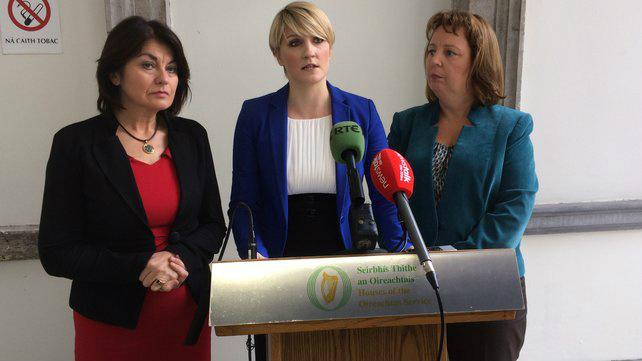

SENATORS FIDELMA HEALY EAMES, AVERIL POWER, AND JILLIAN VAN TURNHOUT LAUNCHED THE BILL
A number of Opposition senators have called on the Government to support a bill they are proposing that would give adopted people an automatic right to their birth certificate.
Senators Averil Power, Fidelma Healy Eames and Jillian Van Turnhout published the bill at Leinster House this morning.
It would give adopted persons an automatic right to their birth certificate and the name of their mother and the time of their birth.
It would give fathers’ names, if they are available.
It would also provide for natural birth mothers to be contacted in advance of birth certificates being issued to see if they were willing to have their contact details passed on.
If birth mothers declined to consent to the release of their contact details, they would not be passed on to the adoptee, although the adoptee would be told of the refusal.
Mothers could also choose to allow health details and other relevant information be passed on to the adopted person, even when they opt not to have direct contact.
Under the bill’s provisions, birth parents would also be able to access information concerning the process of adoption of their children.
They could request adoption certificates for their children, their adopted names and the names of their adoptive parents.
The adopted person may, however, decline the release of any information that may identify them or their adoptive parents.
The legislation would also requir all bodies or individuals that hold adoption records to
Caroline Simons of the Pro Life Campaign calls on stem cell research results to be promoted better


Amid calls by researchers at a conference in NUI, Galway for wider availability of embryonic stem cells for scientific research, Caroline Simons of the Pro Life Campaign has said that results-based stem cell research should be promoted instead.
IN A STATEMENT CAROLINE SIMONS SAID recently:
“For years now, those who push embryonic stem cell research (ESCR) have been trying to convince the public of the potential to cure a number of diseases but the reality is that ESCR has produced virtually no scientific or medical breakthroughs.”
“On the other hand, adult stem cells and induced pluripotent stem cells, which present no ethical dilemmas for scientists, continue to produce astounding clinical results.”
“Just last week it was reported that a 40 year old paralyzed man from Poland can now walk again with the aid of a frame after breakthrough surgery transplanted cells from his nose into his spinal cord, which had been severed in a knife attack.”*
“And we know that companies, like Geron, a US-based firm which was involved in carrying out the first US government-backed embryonic stem cell research ceased it’s operations in recent years because of a lack of progress in the area of embryonic stem cell research.”
Ms. Simons pointed out that adult stem cell science presents the best possible outcome in that it does not involve the destruction of human life and it is repeatedly demonstrating its worth in medical and scientific terms.
“Focussing on embryonic stem cell research distracts from the successes of adult stems cell research that is producing tangible results. The Government and our universities should be committed to promoting ethical research that deliver results for patients. That’s a win-win solution”, she concluded
Diabetes types & controlling the insulin condition in everyday life


MUIRIS HOUSTONS LOOKS AT the CAUSES, SIGNS, SYMPTOMS, PREVENTION, TREATMENT AND USEFUL RESOURCES available.
Diabetes Mellitus occurs when there is excessive sugar in the blood. The term ‘diabetes’ means excessive urination and the word ‘mellitus’ means honey.
There are two distinct types of diabetes. Both are caused by a lack of sufficient insulin, which is produced by the pancreas gland.
Type I diabetes is also known as insulin-dependent diabetes and happens when the body produces insufficient insulin. It mainly occurs in young people and children and it requires the depleted insulin to be replaced through regular injections.
Diabetes type 2 or non-insulin-dependent diabetes mainly affects older people and those who are overweight.
It occurs when more sugar is consumed than the insulin produced by the body can handle. It is treated with diet and oral medication although some people with this version of diabetes will eventually require insulin injections.
Untreated diabetes affects many body systems and is linked to the development of other conditions such as heart disease, kidney disease and eye disease.
NO CURE YET?
While diabetes cannot be cured, the condition can be controlled. A combination of sensible weight loss, avoidance of sugar and refined carbohydrates and increased exercise may be sufficient to control Type 2 diabetes. If you have type 1 disease, then carefully matching your blood sugar levels to the dose of injected insulin can produce good, tight control.
The International Diabetes Federation estimate there are over 91,000 people with diabetes in Ireland, with a prevalence of 6.1 per cent of the population.
According to Diabetes Ireland there are about 30,000 people here with the disease but who remain undiagnosed.
CAUSES, SIGNS AND SYMPTOMS AND DIAGNOSIS:
Type 1 diabetes is caused by the body’s own immune system destroying the insulin making cells in the pancreas. It tends to occur in childhood. Type 2 diabetes develops slowly in adults and is linked to lifestyle, especially being overweight and not exercising sufficiently.
The symptoms of diabetes include an excessive and frequent need to pass urine, excessive thirst, tiredness and lack of energy. Some people notice an increased tendency to develop infections especially those of the skin. Weight loss is common in Type I diabetes.
When your doctor examines you there may be no outward signs of diabetes, especially with type 2 disease. However if you have developed some complications they may find you have high blood pressure or there may be evidence of the disease when they examine your neurological system or look at the back of your eye. Spot testing your urine for sugar may also indicate the possibility of diabetes.
Ultimately the diagnosis is made by blood test. A fasting blood glucose above a certain level strongly suggests the diagnosis. In borderline cases you may be asked to undergo a glucose tolerance test where you drink the equivalent of a bottle of Lucozade after which your blood sugars are checked. A test called the Haemoglobin 1Ac, initially developed as a means of monitoring diabetes control is now also used as a diagnostic test.
Allergens on loose foods in Ireland have to be labelled properly
 V

Specific allergens, such as peanuts, milk and shellfish, will have to be clearly labelled on all loose foods from next month, the Department of Health has stated today.
New laws have been brought in by Health Minister, Leo Varadkar, as required under EU regulations. Similar measures are being signed into law throughout the EU and will come into effect on December 13.
The new regulations will cover loose food sold in shops, as well as food sold in a range of businesses, including takeaways, restaurants, pubs and food stalls.
“This is a significant measure for people who suffer from allergies to some of the most common food products. Although allergens already have to be declared on prepacked food, there is no such requirement for loose or non-prepacked products. The impact of allergens on sufferers can range from irritation, to a life-threatening reaction,” noted Minister Varadkar.
He said that while many commercial outlets already provide this important information, ‘consumers with allergies cannot afford to take chances’.
“I look forward to consumers of non-prepacked foods receiving the same information as is currently available to consumers of pre-packed foods, as it will allow them to make informed choices,” Minister Varadkar added.
According to the Food Safety Authority of Ireland (FSAI), 14 food allergens specified under EU law will now have to be detailed on all loose foods. This also extends to food sold on the internet. The allergens covered by the new laws include milk, eggs, shellfish, cereals containing gluten, nuts, mustard and soybean products.
“By extending the food allergen declaration requirement to include non-prepacked or loose food, consumers can now be confident they will be able to make more informed choices about all of the food they buy,” commented FSAI chief executive, Prof Alan Reilly.
Robotic baby penguin helps researchers get closer to the shy adults of the colony


Researchers used the robot in Adelie Land, Antarctica, where ‘March of the Penguins’ was filmed
A tiny grey robotic penguin as above with four, thick, snow-ready black wheels is helping scientists to understand the specie’s behaviour.
As emperor penguins are notoriously shy creatures, they retreat when researchers approach them – causing their heart rates to rise and interfering with data on their health.
To tackle this problem, a team of scientists and film-makers led by Yvon Le Maho of the University of Strasbourg in France created a remote control rover disguised as a chick. The cunningly designed robot can easily sidle up to penguins without scaring them away.
The robot has been deployed in Adelie Land, Antarctica, where the 2005 documentary March of the Penguins was filmed, and allowed researchers to study the animals from over 650 feet (200 meters) away.
But to create the successful bot, scientists endured a process of trial an error, with the first disguised version of the rover, made of fibreglass scaring the real birds, Le Maho said.
Researchers tried about five versions before they found their final design which is covered in grey fur, sports black arms, and has a black-and-white painted face and black beak.
 “The penguins did not scamper away and even sang to it with “a very special song like a trumpet,” Le Maho said.
Le Maho suggested that the adult penguins were trying to find a mate for their chicks and they were listening for a response, but researchers didn’t program the rover to make a sound.
“They were very disappointed when there was no answer,” Le Maho said. “Next time we will have a rover playing songs.”
At other times, the rover crowded in with a group of chicks, acting as “a spy in the huddle,” Le Maho said.
Le Maho also used a rover without any animal disguise to spy on king penguins and elephant seals because those animals do not flee from strangers.
Even though the king penguins attacked the small rover with their beaks when it moved, it allowed the device to get close enough to get readings. Meanwhile, the large lumbering elephant were not disturbed when the rover zipped by and around them.
In the future, the researchers plan to use a more autonomous robot to spy on the emperor penguins. The idea is to use devices on the rover to read signals from radio tags on the birds.
The study is published Sunday by the journal ‘Nature Methods’.


