Pages

Showing posts with label Michael Noonan. Show all posts

Wednesday, September 21, 2016

Donie's Ireland daily news BLOG update

Mortgage rules likely to curtail buying of new homes in Ireland,

ECONOMIC THINK TANK SAYS HOUSING SUPPLY WILL BE REDUCED BY 5% OVER FOUR YEARS

Image result for Mortgage rules likely to curtail buying of new homes in Ireland,   Image result for Mortgage rules likely to curtail buying of new homes in Ireland,  Image result for Mortgage rules likely to curtail buying of new homes in Ireland,

OVER THE NEXT THREE OR FOUR YEARS HOUSE PRICES ARE LIKELY TO BE ON AVERAGE 3.5% LOWER THAN WHERE THEY WOULD HAVE BEEN WITHOUT THE CENTRAL BANK MORTGAGE RULES, AN ESRI REPORT HAS FOUND.

The Central Bank’s mortgage lending rules are likely to curtail the supply of new homes by up to 5% over the next four years, the Economic and Social Research Institute (ESRI) has warned.
In a research paper published with its latest quarterly report, the institute found the impact of the restrictions had yet to fully play out because of the lag effect in construction, albeit there has been a sizeable dip in new mortgage lending.
However, it said this would change over the next three to four years with house prices likely to be on average 3.5% lower than where they would have been without the rules.
This decline will lead to reduced profitability in construction, which will lower the number of housing units completed in each quarter by about 5 per cent, and reduce the State’s overall housing stock by about 0.5%.
The finding comes as the Central Bank conducts its first review of the rules, which were introduced in February 2015 to prevent the housing market from overheating again.
They require first-time buyers to have a 10% deposit for the first €220,000 of a house price and 20% for the balance while all other buyers must have a 20% deposit in place.
In addition, the Central Bank requires that income limits of 3.5 times are applied by the banks before approving mortgages.
A recent consultation process, which will inform the bank’s review, yielded 50 submissions, several of which called for the threshold below which first-time buyers have to pay only a 10% deposit to be raised from the current level of €220,000.
Kieran McQuinn of the ESRI said the measures had had a contractionary impact on the housing market in terms of reducing prices, supply and mortgage lending below levels the would have otherwise pertained.
He said they had made it more difficult for potential buyers to raise downpayments and pushed more people into the rental market. This explained why rents were rising at an even greater rate than property prices.
Boom years
A recent report by property website Daft found that rents were now above what they were during the boom years, with annual inflation in Dublin, where the housing shortage is most acute, running at 11%.
Dr McQuinn said the ESRI fully supported the need for macroprudential measures but the rules needed to incorporate room for a “counter-cyclical dimension”to reflect the current supply shortages.
The institute does not expect housing completions to increase to 25,000, the level needed to meet demand, until after 2018. Property Industry Ireland, the Ibec group that represents the sector, predicts that completions this year will only amount to about 14,000.
In its latest quarterly commentary, the ESRI downgraded its growth forecasts amid concern over global demand linked to weakness in the Chinese economy and because of Brexit-related issues.
It predicted GDP, the standard measure of economic growth, would expand by 4.3% this year and by 3.8% in 2017.
On the 26% GDP growth recorded for last year, the think tank acknowledged nobody could take this rate seriously.

Michael Noonan agrees to now appear before the Public Accounts Committee

Image result for Michael Noonan agrees to now appear before the Public Accounts Committee  Image result for Nama's controversial sale of its Northern Ireland loan book

THE FINANCE MINISTER MICHAEL NOONAN HAS TONIGHT BOWED TO PRESSURE AND WILL NOW APPEAR BEFORE THE PUBLIC ACCOUNTS COMMITTEE (PAC) OVER NAMA’S CONTROVERSIAL SALE OF ITS NORTHERN IRELAND LOAN BOOK, 

Mr Noonan was told by Independent Ministers including Finian McGrath and Shane Ross at Cabinet today that it would be better if he attended the committee and try and “kill off” the controversy.
While ministers agreed that it was Mr Noonan’s decision to make, he was left in no doubt as to the feelings of his colleagues, sources have said.
“I have today decided to accept the invitation of the Committee of Public Accounts to assist the Committee in its examination of the C&AG’s Special Report on the National Asset Management Agency’s sale of Project Eagle,” Mr Noonan said in a statement.
“I intend to reply by letter to the Committee of Public Accounts to confirm this and to request assurances from the Committee that the proceedings of the Committee will be conducted in line with its terms of reference,” he added.
Members of the PAC welcomed Mr Noonan’s announcement.
Sinn Féin Deputy Leader Mary Lou McDonald TD said his decision to face questions is in the public interest.
“After a weekend of stalling, Minister Noonan has reversed his decision and has agreed to come before the Public Accounts Committee to address concerns regarding the sale of NAMA’s northern loan-book. I welcome his decision as it is, without question, in the public interest that he explain why he failed to suspend to sale when he became aware of the operation of fixer fees,” she said.
“He must explain why he, as Minister for Finance, failed to protect the interests of the citizens of this state. Minister Noonan now needs to open the books, assist the PAC inquiry, and not engage in further prevarication,” she added.
Last week, Nama rejected a report which says that it could have sold loans based in Northern Ireland for more than £1.32 billion.
The long-awaited Comptroller and Auditor General’s (C&AG) report into the sale of Project Eagle was published today, saying that the agency could have made more than that.
The report found that the State lost around £190 million (€220 million).
The C&AG report found that Nama had over-discounted the loans, giving 10-15% discounts where 5.5% would be more applicable. It added that NAMA did not keep an “adequate record of key decisions and events even though the sales process deviated from standard”.

Micheál Martin claims the elimination of water charges would not erode our tax base

Image result for Micheál Martin claims the elimination of water charges would not erode the tax base   Image result for water charges erosion

FIANNA FÁIL LEADER MICHEÁL MARTIN TD ADDRESSES THE MEDIA PRIOR TO THE ANNUAL PARLIAMENTARY PARTY THINK-IN AT THE SEVEN OAKS HOTEL, CARLOW.

Fianna Fáil leader Micheál Martin has rejected a European Commission report that said the elimination of water charges would erode the tax base.
The Commission’s remarks came in its latest post-bailout report in the Irish economy.
Mr Martin said scrapping water charges is “not an erosion of the tax base because it’s made a very negligible contribution to the widening of the tax base in the last three years.”
He was speaking after his party’s Co Carlow think-in where he also responded to a study by the Irish Tax Institute that outlined how workers are paying the top rate of income tax before their salaries reached the average industrial wage.
The Fianna Fáil TD was asked if the party should rethink its policy of pushing for spending measures over tax cuts as a result of the study.
Mr Martin said he was committed to its position that there should be a 2:1 break-down of spending to tax cuts in the upcoming Budget.
“There’s absolutely no question but that we do have to invest in health, in education and housing and give people some decent quality of life in terms of access to those services,” he added.
He said there “is a case” for tax cuts but that a balance has to be struck.
“We need to be mindful of the risks to the Irish economy not least the Brexit risks and proceed in a cautious manner,” he added.
Meanwhile he said he doesn’t think it will be achievable or the right policy to abolish the USC in five years as Finance Minister Michael Noonan today told an Oireachtas committee he’d like to do.
Mr Martin responded to this saying: “I don’t believe it’s achievable”.
“We don’t believe its the right policy or the right approach,” he said adding that there needs to be a balance between investing in services and infrastructure and giving people a break in their taxes.

Irish teens are smoking and drinking less according to a new European survey says

NEW SURVEY RAISES CONCERNS OVER YOUNG PEOPLE’S DRUG USE AND INTERNET BEHAVIOUR

Image result for Irish teens are smoking and drinking less according to a new European survey says   Image result for Irish teens are smoking and drinking less according to a new European survey says V Image result for Irish teens are smoking and drinking less according to a new European survey says

SMOKING AND DRINKING HAVE DECLINED AMONG IRISH SECONDARY SCHOOL STUDENTS, ACCORDING TO A NEW EUROPEAN SURVEY.

Smoking and drinking have declined among Irish secondary school students, but new concerns are emerging in relation to drugs and addictive behaviours associated with the internet, a new European survey has claimed.
Fewer Irish teenagers are drinking and smoking, according to the European School Survey Project on Alcohol and Other Drugs (ESPAD)’s 2015 report, which looked at the behaviour of 15- to 16-year-olds.
However, Irish respondents reported slightly higher than average rates in use of illicit drugs other than cannabis during their lifetime, lifetime use of inhalants and lifetime use of new psychoactive substances.
The ESPAD report also said more than one in 10 Irish teenagers gambled for money frequently.
Use of alcohol within the last 30 days and the rate of heavy episodic drinking were less common among Irish respondents, compared with the average in the survey.
Thirty-five per cent of Irish teenagers reported drinking alcohol during the past 30 days, compared with a European average of 48 per cent, while 28 per cent of Irish teenagers reported heavy episodic drinking during the past 30 days, compared with a 35 per cent average.
The same was true for cigarette use during the last 30 days, which stood at 13 per cent among Irish respondents, compared with the European average of 21 per cent.
The ESPAD’s findings are based on a survey undertaken in 2015 in 35 European countries, including 24 EU member states.
A total of 96,043 students, including 1,400 from Ireland, participated in the survey, responding in school to an anonymous questionnaire.
The ESPAD’s report highlighted overall “positive developments” in the area of cigarette-smoking.
“Today, the majority of adolescents have never smoked (54 per cent) and less than one-quarter (21 per cent) of the sample can be considered current smokers,” it said.
The survey identified “high rates of alcohol use” among European teenagers, but said trends over the past two decades point to positive developments.
It recorded a decrease in lifetime and last-30-day use of alcohol among teenagers between 1995 and 2015, from 89 per cent to 81 per cent and from 56 per cent to 47 per cent respectively
However, it said changes in heavy episodic drinking were less pronounced and only observed among boys, going from 36 per cent to 35 per cent in the past 20 years.
On internet use, survey respondents said they had used the internet an average of 5.8 days within the last seven days.
Welcomed reaction
Responding to the study, Alcohol Action Ireland said it welcomed some of the trends in alcohol consumption among Irish teenagers but said alcohol should not be a part of any 15- or 16-year-old’s life.
“One of the most disappointing aspects of this survey is that over three-quarters of Irish 15- and 16-year-olds still find it easy to obtain alcohol, which is reflective of both the massive increase of the availability of alcohol in outlets throughout Ireland in recent years and the ongoing failure of the current regulations.”
Ministers of State for Health Marcella Corcoran Kennedy and Catherine Byrne welcomed the survey results on alcohol and cigarettes.
Ms Byrne said a particular focus of the Government’s National Drugs Strategy consultation was “getting the views of young people on the measures required to tackle the issue into the future”.

The survival secret of the ‘earth’s hardiest animal’ is now revealed

Image result for The survival secret of the 'earth's hardiest animal' is now revealed  Image result for planet's hardiest animal it's the tardigrade

MEET THE PLANET’S HARDIEST ANIMAL IT’S THE TARDIGRADE AND IT HAS JUST REVEALED A GENETIC SECRET THAT COULD HELP PROTECT HUMAN CELLS.

Researchers have discovered a genetic survival secret of Earth’s “hardiest animal”.
A gene that scientists identified in these strange, aquatic creatures – called tardigrades – helps them survive boiling, freezing and radiation.
In future, it could be used to protect human cells, the researchers say.
It was already known that tardigrades, also known as water bears, were able to survive by shrivelling up into desiccated balls.
But the University of Tokyo-led team found a protein that protects its DNA – wrapping around it like a blanket.
The scientists, who published their findings in the journal Nature Communications, went on to grow human cells that produced that same protein, and found that it protected those cells too.
This, the scientists suggest, means that genes from these “extremophiles”, might one day be used to protect living things from radiation – from X-rays, or as a treatment to prevent damage from the Sun’s harmful rays.
Tardigrades are more commonly – and cutely – known as water bears. Scientists had thought that they survived radiation exposure by repairing the damage done to their DNA. But Prof Takekazu Kunieda, of the University of Tokyo, and his colleagues, carried out an eight-year study of a tardigrade genome to pinpoint the source of its remarkable resilience.

EXTREME GENETICS

To identify their secret weapon, researchers scrutinised the genome of one tardigrade species, looking for proteins that were attached to the DNA, and that therefore might have a protective mechanism. They found one that they have called “Dsup” (short for “damage suppressor”).
The team then inserted the Dsup gene into human cells’ DNA, and exposed those modified cells to X-rays; Dsup-treated cells suffered far less DNA damage.
Prof Mark Blaxter of the University of Edinburgh told BBC News that the study was “groundbreaking”.
“This is the first time an individual protein from a tardigrade has been shown to be active in radiation protection.
“[And] radiation is one of the things that’s guaranteed to kill you.”
By sequencing and examining the genome, this study also appears to resolve a strange genetic controversy about these creatures. Research published in 2015, involving a different tardigrade species, concluded that the creature had “acquired” a portion of its DNA from bacteria through a process called horizontal gene transfer.
That study suggested that some of these beasts’ notorious imperviousness had been snipped out of the bacterial genetic code.
This study found no evidence of this gene transfer.
The tardigrades themselves, though, were far more resistant to X-rays than the human cells that the researchers manipulated. “[So] tardigrades have other tricks up their sleeves, which we have yet to identify,” said Prof Matthew Cobb from the University of Manchester.
With further research, scientists think that genes like Dsup could make it safer and easier to store and transport human cells – protecting, for example, delicate human skin grafts from damage. Prof Kunieda and his co-author on the study, Takuma Hashimoto, applied to patent the Dsup gene in 2015.
Prof Cobb added that, in principle, “these genes could even help us bioengineer organisms to survive in extremely hostile environments, such as on the surface of Mars – [perhaps] as part of a terra-forming project to make the planet hospitable for humans”.
And scientists with a fascination for tardigrades think this discovery could be the tip of the iceberg.
Prof Blaxter said that tardigrade research could even explain how exactly “radiation damages DNA, and how we might prevent DNA damage from other sources”.
Prof Takekazu Kunieda told BBC News that he hoped more researchers would join the “tardigrade community”.
“We believe there [are] a lot of treasures there,”   

Friday, July 1, 2016

Donie's Ireland daily news BLOG update

Noonan says Brexit will not affect Budget as Irish shares rise

UK REFERENDUM MAY DELAY EU RULING ON APPLE’S IRISH TAX AFFAIRS, MINISTER NOW SAYS?


MINISTER FOR FINANCE MICHAEL NOONAN AT THE SELECT COMMITTEE ON FINANCE, PUBLIC EXPENDITURE AND REFORM

The Brexit vote will not affect Budget 2017 but its longer term effect on Ireland could be serious depending on what deal the UK agrees with the EU, Minister for Finance Michael Noonan has said.
The tax streams for 2017 are relatively fixed at this stage and contingencies for the initial impact of the Brexit result have already been worked out, Mr Noonan said. Beyond that it will depend on what sort of new arrangement the UK agrees with the EU.
If the UK remains in the single market “then the impact [on Ireland] will be quite low,” Mr Noonan told the Select Committee on Finance, Public Expenditure and Reform, and An Taoiseach on Thursday. But if a more distant relationship emerges involving tariffs and border posts, “the impact would be bigger… it would be serious.”

IRISH SHARES RISE.

The Minister’s comments came as Irish and other European shares rose for a third straight session as they continued to claw back some of the ground lost in the immediate aftermath of the UK referendum. The Iseq added 1%, while the FTSE 100 gained 2.3% in London. Meanwhile, the market interest rate, or yield, on the Government’s 10-year bonds fell to a record low of 0.509% as investors continued to speculate that the European Central Bank will add stimulus to limit the fallout from Brexit.
Mr Noonan said post-Brexit market movements have been bad for the UK in terms of exchange rates and stock exchange values, with the international expectation being that the UK will become a weaker economy. He said the UK quitting the EU presents potential economic and foreign direct investment (FDI) advantages for Ireland, though if the British government feels it is losing out “they’ll probably adjust policy to forestall that.”
Meanwhile, Mr Noonan said the UK vote may delay the EU’s decision on whether iPhone-maker Apple’s tax dealings in this country breached state-aid rules. While he said it had been rumoured that the EU would deliver its final ruling on its case against Ireland in July, the possibility of an adverse finding and large tax bill for “an American company operating in Europe” next month is now less likely, following the the referendum.
Enda Kenny
Also speaking to the committee, Taoiseach Enda Kenny insisted that the best thing for Ireland would be if the UK retains access to the single market. But he added that for this to happen the country must accept the key principles of the EU, including the free movement of people.
He said the new British prime minister, due to be in place by September 9th, will be given a short period of time to work out their strategy before they will be expected to initiate formal exit negotiations.
The process should last about two years, after which a short extension may be granted. However, if the UK and EU fail to reach an agreement, then World Trade Organisation rules will come into effect. Mr Kenny said he hoped this didn’t happen.
Mr Kenny also said he has made the EU aware that Ireland’s interest are in maintaining the common travel area between Ireland and the UK, protecting the peace process, maintaining the open border between the Republic and the North and maintaining trade links between Ireland and the UK.

Ireland’s Seanad to invite Nicola Sturgeon to address it on Brexit

GREAT AFFINITY BETWEEN IRELAND AND SCOTLAND, SAYS FINE GAEL SENATOR PADDY BURKE


SCOTLAND’S FIRST MINISTER NICOLA STURGEON (above) DELIVERS A SPEECH DURING A MEDIA CONFERENCE AT THE SCOTLAND HOUSE IN BRUSSELS.

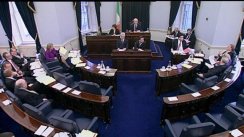
Scottish first minister Nicola Sturgeon is to be invited to address the Seanad on the UK’s exit from the EU before it adjourns for the summer recess later this month.
The proposal was made by Fine Gael Senator Paddy Burke, who said there was a great affinity between parts of Ireland and Scotland, with both having a lot in common.
“We heard a lot recently about countries that want to leave the EU, but Scotland wants to stay in it,’’ he added.
Sinn Féin Senator Rose Conway-Walsh said she agreed with the proposal.

SCOTTISH INDEPENDENCE

“People seem to be fighting the cause for Scottish independence and its right to have a say over its own destiny, but they need to show the same consideration and fight with the same vehemence for our comrades in the North,’’ she added.
“It cannot be done for one without the other.’’
She said she admired and respected Ms Sturgeon and would be very happy to hear from her in the House.
Later, during a debate on delivering sustainable full employment, Fine Gael Senator Neale Richmond said a week from the referendum some people had expressed frustration that Brexit was still being discussed.

EXTREMELY IMPORTANT

While he was sorry to disappoint them, the referendum result was extremely important in the context of delivering sustainable full employment.
Mr Richmond said it was important to emphasise Ireland would continue to be an EU member, with full access to the single market and retaining all of the advantages for inward investment.
A report produced in May suggested Brexit could push about €6 billion of investment into Ireland’s financial services sector, he said.
A bank already moving some operations to Ireland was Switzerland’s Credit Suisse, which had said in December it would make Dublin its primary hub for servicing hedge funds in Europe and move staff from London to here, said Mr Richmond.
“A report from Bloomberg earlier this week compared Dublin with Paris, Frankfurt, Luxembourg, Amsterdam and even Edinburgh as possible destinations for financial institutions now looking to relocate from London in a post-Brexit world,’’ he added.
“A glowing recommendation brought just two negative concerns to light: a relative lack of office space and high personal tax rates.’’

LOW PAY SCANDAL

Sinn Féin Senator Paul Gavan said there was a scandal of low pay in Ireland, particularly in the hospitality industry.
“It is an industry that for some time has enjoyed a generous tax break in terms of a reduced VAT rate of nine per cent, costing taxpayers €650 million a year,’’ he added.
“We know that the hotel industry is booming, with record levels of room occupancy, but that stands in stark contrast to the terms and conditions of workers in that sector.’’

Just 7% of Irish parents think their kids may be overweight?

DENIAL?  REALITY IS THAT 1 IN 4 IS OVERWEIGHT OR OBESE

Image result for Just 7% of parents think their kids may be overweight?    

LESS THAN HALF OF IRISH PARENTS KNOW WHAT WEIGHT THEIR CHILDREN ARE, WHILE JUST 7% FEEL THAT THEIR CHILDREN MAY BE OVERWEIGHT, NEW DATA HAS SHOWN.

According to the latest Pfizer Health Index, Only 47% of parents know what weight their children are and the vast majority do not think they are overweight, despite the fact that currently, one in four children in Ireland is overweight or obese.
When asked if their children were undertaking 60 minutes of physical activity per day – the recommended daily amount – just 20% of parents said that their children were achieving this. The average was 60 minutes per day four times a week.
“One in four of our children is currently overweight or obese, yet because the norm has changed we are not recognising this reality. Children’s social, emotional and physical health is being harmed. We as a society must partner with industry and the Government to turn the tide on childhood obesity in Ireland as a matter of priority,” commented Dr Cliodhna Foley-Nolan of Safefood.
Parents were also asked about the use of screens in their home. The average length of time children spend looking at various screens each day is two hours and 16 minutes according to these findings.
Some 15% of children bring a screen, such as a smartphone or tablet, to bed with them, and 24% of parents have no rule in relation to screens in bed.
“Modern technology is undoubtedly impacting on the health of our family unit and we can see that children are more sedentary than before. There has been exponential growth in the use of screens particularly with mobiles and tablets and in Ireland we currently have more mobile phones than we do people.
“While technology is a powerful tool, it is important that parents aim to be in charge of the use of that technology, rather than technology being in charge of you,” said family psychotherapist, Dr John Sharry.
The health index also looked at family health in general. It asked parents to rank health priorities for their children. The biggest priority for parents was that their children reached their developmental milestones (31%). The second most important priority was that their children would have access to GP care (29%).
Other areas that were seen as priorities by parents included the social development of their child, including developing friendships, educational performance and having their children vaccinated.
This is the 11th annual Pfizer Health Index to be carried out. This year’s index was based on a survey of over 1,200 people aged 16 and older. It was undertaken by Behaviour & Attitudes in April.

Marijuana shown to protect brain cells from Alzheimer’s


A NEW STUDY SUGGESTS THAT COMPOUNDS FOUND IN MARIJUANA CAN STAVE OFF THE BRAIN DAMAGING EFFECTS OF ALZHEIMER’S DISEASE. IT’S A PROMISING DISCOVERY, BUT CLAIMS THAT POT CAN PREVENT THIS AGE-RELATED BRAIN DISORDER ARE PREMATURE. PUT THE PIPE AWAY, MAN.

Researchers from the Salk Institute have shown that tetrahydrocannabinol (THC) and other compounds found in marijuana can contribute to the removal of toxic proteins, known as amyloid beta, which have been linked to Alzheimer’s disease. This research offers new insight into the role that inflammation plays in this neurological disorder, which could point the way to new drugs.
But this research should be taken with a grain of salt. The protective effects of marijuana were observed in neurons grown in the lab, so it’s not immediately clear if the same process is applicable to living human beings. What’s more, this study doesn’t speak to the potential negative effects of marijuana on the aging brain. It’s far too early to be making claims about pot being some kind of miracle cure for Alzheimer’s, or even as something that can be used as a protective measure. Only time—and further research—will truly tell.
Previous research has shown that compounds in marijuana, called cannabinoids, protect the brain from the symptoms of Alzheimer’s. This new study is unique in that it’s “the first to demonstrate that cannabinoids affect both inflammation and amyloid beta accumulation in nerve cells,” as the study’s lead author David Schubert put it in a statement.
Scientists are fairly certain that these toxins contribute to the growth of damaging plaque deposits in the brain, but they’re not entirely sure about the precise role that’s played by amyloid beta in the process. To learn more, Schubert’s team studied nerve cells that were modified to produce high levels of amyloid beta. Left untreated, these cells were subject to inflammation and higher rates of death. But when the researchers exposed these cells to cannabinoids, the levels of the amyloid beta proteins were reduced. The inflammation disappeared, and the neurons were able to survive. The compounds found within marijuana appeared to be protecting the cells from dying.
As noted, this research was conducted on neurons in a petri dish, so it’s not clear if an actual brain would respond to cannabinoids in the same way. Scientists will need to perform clinical trials to find out.
They’re also going to have to consider the potential tradeoffs of using marijuana as a drug to stave of neurodegeneration. Previous studies have shown that pot can screw around with our memories—which is clearly a bad thing in a disease that already ravages memories. Recent research also shows that marijuana alters the brain reward system, and that that long-term use makes it more difficult to recall memories during middle age.
Pot may very well help with Alzheimer’s, but we’re clearly going to have to be mindful of its negative effects as well.

Pollution has been causing springtime to come early 'Says researchers'


ARTIFICIAL LIGHTING HAS BEEN CAUSING SPRINGTIME TO COME EARLY, WITH TREES BURSTING INTO LEAF A WEEK EARLIER IN AREAS WITH MORE LIGHT POLLUTION, SCIENTISTS HAVE FOUND.

Researchers at the University of Exeter compared the amount of artificial night-time light across the country and the date at which new leaves first appeared on trees such as sycamore, oak, ash and beech.
The research drew on “citizen science” data from the Woodland Trust, which asks members of the public to record the signs of the changing seasons, such as bud-burst, in its Nature’s Calendar scheme.
Comparing 13 years of data about when the buds were bursting with satellite images of artificial lighting, the researchers found the key sign of spring was occurring up to 7.5 days earlier in brighter areas, with the effect larger in later-budding trees.
Excluding large urban areas from the analysis showed the advance of spring was even more pronounced, the research published in the journal Proceedings of the Royal Society B, found.
This showed the early bud bursting was not simply down to the “heat-island” effect in which cities are slightly warmer than the surrounding areas.
The way the effect was seen across all areas also suggests it is not down to temperature rises, according to the study, which was a collaboration between the university and independent environmental consultants Spalding Associates, in Truro, Cornwall.
The scientists raised concerns that the impact of artificial night-time lighting – such as street lights – on trees would have a knock-on effect on other wildlife.
Winter moths, which feed on emerging oak leaves, could be affected, which in turn could have an impact on birds which feed on them.
Dr Kate Lewthwaite, Woodland Trust citizen science manager, said: “Analysis of Nature’s Calendar data suggests that increased urbanisation is continuing to put pressure on the natural world, in ways that we could not have foreseen.
“As the seasons become less and less predictable, our native wildlife may struggle to keep up with fluctuations that affect habitats and food sources.
“Hopefully this research will lead to new thinking on how to tackle such issues, and will help influence future development decisions.”