Total Irish employment figures set to top 2 million after strong quarter of growth
LATEST FIGURES SHOW SIGNIFICANT DROP IN YOUTH UNEMPLOYMENT
 Down >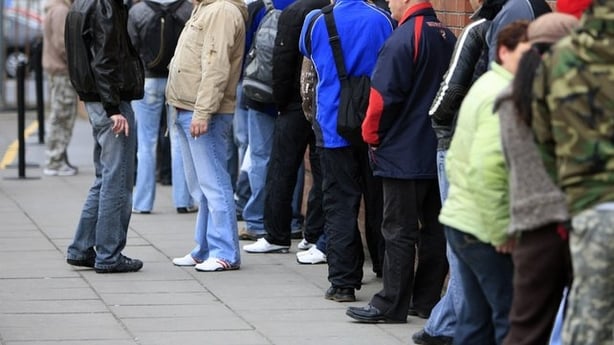
The total number of people in the labour force in the first quarter of 2016 was 2.16 million, an increase of 13,600 over the year. The number of people not in the labour force in the first quarter was 1.47 million, a rise of 5,300 in the year.
The number of people working in the State is on course to reach two million this year, analysts said, after the jobless rate dipped below 8% for the first time since the crash.
Female employment is rising at a faster rate than male employment, but new data also points to a strong rebound in construction employment. As recovery proceeds, the high rate of youth unemployment is also in decline.
The Central Statistics office said the official unemployment rate dropped to 8.3% in the first three months of the year from 9% in the final quarter of 2015.
In addition, a revision of monthly data in the lastest quarterly household survey showed the seasonally adjusted unemployment rate fell to 7.9% in April from 8.1% in March. The jobless rate in April 2015 was 9.8% and it was 11.8% in April 2014.
“The data released today show that the numbers at work continue to grow and that the level of employment is now just shy of the two million mark. We have now seen 14 consecutive quarters of employment growth,” said Minister for Finance Michael Noonan.
Alan McQuaid, chief economist at Merrion strockbrokers, said the labour market had improved dramatically. This was in keeping with the accelerating recovery, even though emigration had been a factor to some extent in keeping unemployment down.
“Consecutive gains in employment have been posted in the past three years and the Department of Finance is projecting that Ireland will pass the two million people in employment mark in 2016 and replace all of the jobs lost during the downturn by 2018. All in all, it is hard to disagree with this assumption,” said Mr McQuaid.
The decline in the jobless rate came as number of people working in the State rose by 46,900 or 2.4% in the year to end March, the CSO said.
Female workers accounted for the bulk of the increase, with the number of working rising by 27,900 in the year. The number of males at work rose by 19,000 in same period.
Youth unemployment fell to 16.9% in the year to the first quarter of 2016 from 21.5% 12 months previously.
Support services up 9.9%.
The largest rates of increased employment was in the administrative and support service activities, which rose by 6,100 or 9.9%, and in the construction sector, which rose by 9,500 or 7.8%.
The biggest decline in employment was in financial, insurance and real estate activities, which eased by 1,500.
On a seasonally adjusted basis, the number of people at work rose by 15,400 or 0.8% in the first quarter of 2016 over the final three months of 2015. This followed a seasonally adjusted quarterly increase in employment of 6,600 or 0.3% in the fourth quarter of 2015.
“Unemployment decreased by 33,300 or 15.7% in the year to the first quarter of 2016, bringing the total number of persons unemployed to 179,500.
“The long-term unemployment rate decreased from 6 per cent to 4.7% over the year to [the first quarter of] 2016,” said the CSO.
“Long-term unemployment accounted for 56.1% of total unemployment in [the first quarter of] 2016 compared with 59.7% a year earlier and 60.5% in the first quarter of 2014.”
In the year to the first quarter of 2016, the number of persons classified as long-term unemployed declined by 26,500 or 20.9%. This brought total long-term unemployment to 100,600.
Short-term unemployment decreased by 11,300 or 13.7% in the year, to 71,200.
The total number of people in the labour force in the first quarter of 2016 was 2.16 million, an increase of 13,600 over the year. The number of people not in the labour force in the first quarter was 1.47 million, a rise of 5,300 in the year.
Allied Irish Bank reports a 4% drop in number of Irish mortgages in arrears


AIB chief executive Bernard Byrne (right picture).
ALLIED IRISH BANK (AIB) HAS MAINTAINED ITS MOMENTUM FROM 2015 AND HAS REPORTED STRONG PROFITABILITY, INCREASED LENDING, AND REDUCTIONS IN IMPAIRED LOANS IN THE FIRST THREE MONTHS OF THE YEAR.
In a trading update released to shareholders this morning, AIB posted a net interest margin (NIM) of 2.09pc, an increase on the 1.97% for the full year of 2015.
New lending drawdowns increased by 17% in the period as the bank held on to leading market shares in both retail and business sectors.
AIB chief executive Bernard Byrne said the bank has continued the positive trend from 2015.
“Our focus on growth, a more efficient operating model and improved funding costs enabled us to pass on a 4 reduction of 25bps to variable rate mortgage customers and a €2,000 contribution to switching costs.
“We look forward to increasing our payments to the State to around €6.5bn when we pay a further €1.8bn in capital and interest in July on the maturity of the Contingent Capital Notes.”
Excluding currency costs performing loans increased by €500m, which AIB said was driven by increased new lending and restructures offset by redemptions.
Impaired loans were down by €1bn to €12bn due to ongoing case by case process of bringing in restructuring solutions.
Irish mortgages in arrears fell by 4% in the three months with similar declines visible in both early and late stage arrears. AIB said the number of accounts in arrears in both the owner-occupier and buy-to-let portfolios dropped by 29% and 27% respectively since December 2014.
Thousands of Ireland’s families paying over the odds for health insurance


THOUSANDS OF FAMILIES ARE OVERPAYING FOR HEALTH COVER.
Four out of five consumers who have health insurance are on the wrong plan, according to research by one of the country’s leading health insurance experts.
This means thousands of families are overpaying for health cover.
And employers who pay some or all of the health insurance costs of staff are not getting the best value in the market, according to Dermot Goode of TotalHealthCover.ie
Some 2.12 million people now have health insurance, up 4,000 since last December, according to recent research from the Health Insurance Authority.
Mr Goode said 80% of those with health cover are on a plan that is too expensive or does not give them the benefits they need.
This implies that up to 1.7 million people could be on unsuitable plans.
The health insurance expert said consumers make it too easy for insurers to keep them on plans that do not suit them and are too expensive.
“But we can’t lump all the blame on insurers – as consumers we need to be more proactive in terms of reviewing our cover properly to bag healthcare savings wherever possible.”
He said that both consumers purchasing individual plans and employers spending hundreds of thousands on employee cover need to do more to ensure they have the right plan.
There are some 420 health insurance plans from the four insurers, with companies changing the benefits on existing plans, increasing prices and bringing out new schemes at regular intervals.
Mr Goode, who is speaking at the Future Health Summit in the Citywest Convention Centre near Dublin, said too few people review their cover.
“If we do go to review, we generally leave it too late, and even when we phone the insurer we ask the wrong questions and are too accepting of the first answer as the final answer.”
He said that those who are on the same plan for two years or more are usually overpaying by the greatest extent. These people could make savings of 20% plus, he said.
Employer schemes stand to make the biggest savings, often up to 20%.
“To make these savings you need to put the health insurers ‘under pressure’ as too many consumers make it too easy for them to recommend the plans that suit them,” Mr Goode said.
Your profile picture could be telling people more about your personality than you had thought


THE SOCIAL MEDIA PROFILE PICTURE COULD BE THE WINDOW TO YOUR SOUL.
That’s according to a group of researchers who have investigated the link between people’s profile pictures and their personality traits.
According to the study, social media users can be grouped into one of the Big Five model personality traits – openness to experience, conscientiousness, extraversion, agreeableness and neuroticism – based on their profile picture alone.
For instance, extraverts are more likely to have a profile picture with several faces in it. They are also likely to portray a younger image either through the use of a picture from years ago or with them posing with younger people.
The study used the Twitter profiles of more than 66,000 people – making it larger than most psychological studies – while 429 users filled in a standard personality questionnaire and found “significant differences in profile picture choice between personality traits”.
So the question is, what category does your profile pic fall in and how much is it giving away to other social media users, not to mention future employers or advertisers?
Openness
The analysis revealed that these users are “likely to have profile pictures other than faces, which reveals non-conformance with what is expected”.
Photos are also likely to be more aesthetically pleasing and use an artistic quality such as grey scale. Users are often seen wearing glasses, but not sunglasses, show less emotion and the ratio of the face size is usually larger than others.
Conscientiousness
The study describes conscientiousness as the personality trait associated with orderliness, planned behaviour and self discipline and for that reason these users “prefer the expected behaviour”. A picture showing the users face only is therefore most expected and they are more likely to appear as happy, smiling or positive than any other trait.
They don’t tend to use grey scale images, they rarely wear glasses and the size of the face is usually smaller. The pictures also make users appear older than they actually are.
Extraversion
Extraversion is a trait marked by engagement with the outside world and “these type of users are correlated the highest out of all traits with colourful images”. An extravert’s picture tends to have many faces in it – which is different from all personalities – and they usually present as a younger age using a picture from when they were younger or surrounded by younger people.
The strongest correlation compares to other traits is that the ratio of their faces is smaller – although that might be because they tend to have more people in the picture.
Agreeableness
This trait is described as being “characterised by social harmony and co-operation”. These users like to have profile pictures with faces in them and the correlation to colour is opposite to openness. That means they usually present colourful profiles, but the pictures are usually low in sharpness, blurry, bright and tend to be cluttered and not that aesthetically pleasing.
Neuroticism
pictures for neurotic users are perhaps unsurprisingly anti-correlated with colourfulness and are opposite to the traits displayed by agreeableness and extraversion users. The study found that “overall, neurotic people display simple, uncolourful images with negative colour emotions”.
It also found that neurotic users tend not to use faces as a profile picture and when they do they have the strongest correlation to people who are displayed wearing reading glasses. When a face is present in the picture it is also “significantly larger” than other users’ pictures.
Blood-sucking fish on the rise in the most of our rivers


SWIMMERS ARE ON RED ALERT AFTER A HUGE RISE IN THE NUMBER OF A ONE METRE LONG BLOOD SUCKING FISH WITH ROWS OF RAZOR SHARP TEETH IN THE COUNTRY’S RIVERS, INCLUDING THE TRENT WHICH RUNS THROUGH
Once bitten says Jeremy Wade of the ITV show River Monsters, having his blood sucked by a hungry lamprey, The number of lampreys, which are known to attack humans when hungry, are soaring all around the UK, with record numbers found in some of the country’s water ways.
The rise in the ‘vampire fish’, which kill off other fish by latching onto them and sucking their blood out, has been flagged up on outdoor swimming websites where members swim in rivers and lakes. The Swimmer’s Daily website carried a report into the rise of the lampreys warning swimmers ‘Return of the lamprey – ancient, ugly and swimming up Britain’s rivers’.
Outdoor swimmers are now ‘keeping an eye out’ for the blood-sucking creatures during dips in rivers. As well as the Trent, they have been spotted in the Great Ouse, Trent, Derwent and Wear. Wild swimmer Matt Clarke, who swims all over the UK, but who normally swims in the River Great Ouse as it runs through the town of Olney, Bucks, said he was alerted by a pal last week who saw a warning on the Swimmer’s Daily website. Mr Clarke, 31, of Milton Keynes, Bucks, said his pal also alerted him to an episode of ITV show River Monsters aired in May 2013 about lampreys and called ‘Vampires of the Deep’.
The show, which stars biologist Jeremy Wade, shows him up to his shoulders in a lake with a lamprey attached firmly to his neck as it sucks out his blood. Speaking during the episode, Mr Wade says: “The parallels with vampires are striking – they both tap into that that same dark place, the primal fear they will drain the life force from us.”
The lamprey has a formidable mouth full of sharp teeth. As he stands in the shoulder-height river with the creature sucking out his blood, he says: “There’s suction, but there is something sharp going on as well. “If you get these things attached you’re going to want to get them off.” He warned swimmers: “If you’re swimming you’re needing your limbs to keep you afloat and to keep you moving, but what are you going to do (if) you’ve got these attached to you?
Do I carry on swimming with maybe more and more attaching (to me), or do I stop swimming and try and get these things off – these things are like aquatic vampires.” The TV host was investigating reports of lamprey attacks on swimmers at Lake Champlain in north America in 2007, with several swimmers reporting ‘being attacked’ by up to seven lampreys at a time.
The attacks on humans at Lake Champlain were made into a 2014 movie called Blood Lake: Attack of the Killer Lampreys, starring Back to the Future star Christopher Lloyd and Beverly Hills, 90210 star Shannon Doherty. Accounts worker Mr Clarke said: “My friend told me to watch out for lampreys as he’d seen the River Monsters episode and heard that lampreys were on the rise around where I normally swim.
“I’m not really worried, but after watching that episode online last week I will be keeping an eye out for them.”The numbers of lampreys – which have been around for 360m years and have a permanently open mouth armed with a powerful sucker and rows of razor-sharp teeth – in the UK have shot up in recent years.
Numbers had been dwindling after man-made barriers to alter the flow of the water, called weirs, prevented them from swimming upstream to their breeding grounds, where females lay around 170,000 eggs at a time. Mark Owen, head of freshwater at the Angling Trust, said last week that ‘fish passes’ allow lampreys to get through weirs had helped boost numbers. He said: “The fact they’re coming back indicates the water quality is improving, which is welcome for all fish species.”


