Irish exchequer tax receipts come in ahead of target
EXCHEQUER RETURNS SHOW THAT REVENUE COLLECTED €7.2BN BY THE END OF FEBRUARY
 Above projection figs.
Exchequer figures released on Wednesday afternoon by the Department of Finance show that Revenue collected €7.2 billion by the end of February, €478 million more than in the same period in 2015.
Tax collection rose by €478 million in the first two months of the year as the public finances took the benefit of increased employment and surging car sales.
Exchequer figures show that Revenue collected €7.2 billion by the end of February, 7.1% more than than in the same two months last year.
The rate of increase was higher than the 5.8% foreseen in the October budget for the entire year. However, the January-February data show the return was €34 million or 0.5% behind the Department of Finance target.
There was a blip in VAT returns. Data show that €310 million VAT collection in February – a non-VAT due month for traders – was €109 million lower than in the same period in 2015.
This has been attributed to higher VAT repayments by Revenue to traders as they increase stocks. VAT receipts in the year to date stand at €2.41 billion, €43 million more than in the first two months of 2015.
Expenditure control
At the same time, the figures reflect tight expenditure control. Although €6.56 billion net spending was €56 million lower than forecast, any spending overruns typically do not arise until the later months of the year.
The exchequer was in surplus to the tune of €310 million at the end of February, a figure which was in contrast to the €205 million deficit recorded in the opening two months of 2015.
- Exchequer returns: Revenue collects €4.5bn in January.
“This €515 million improvement in the exchequer balance is driven by increased tax receipts and reduced expenditure,” the department said.
“Overall, the release shows the Government broadly on track to hit its fiscal target this year,” said Davy economist David McNamara.
“An important point to remember is that the impact of any change in fiscal policy by the next government will not be felt in the numbers until 2017, while EU rules will limit any radical change in course.”
Peter Vale, tax partner at Grant Thornton, said the data would give comfort tothe next minister for finance that the public finances were in good shape. He argued, however, that the reliance on income tax as a percentage of all taxes was too high.
Income tax
Income tax receipts to end-February reached €3.14 billion, up €251 million or 8.7 per cent on the same period in 2015 .
“This performance is consistent with the recovering labour market, employment growth and increases in the average weekly earnings as evidenced by the latest quarterly national household survey and earnings releases,” the department said.
Excise duties reached €946 million in the first two months, a €168 million or 21.6 per cent increase on 2015. “A contributory factor is an increase in car sales which has boosted VRT receipts,” said the department.
Corporation tax receipts stood at €248 million for the first months, largely on target after a big rise in payments during 2015.
Total exchequer debt servicing costs to end-February 2016 were €422 million, down €169 million or 28.6 per cent on the same period last year .
“This decrease is primarily due to lower interest payments on International Monetary Fund loans following the completion of early repayments in March 2015,” the department said.
It also cited “timing factors” around interest payments on loans from the European Financial Stability Facility, the euro zone rescue fund from which Ireland drew big loans during the EU/IMF bailout.
Election result is not a victory for anti-abortion lobby? (Renua)
CANDIDATES WHO SPECIFICALLY POSITIONED THEMSELVES AS AGAINST CHOICE FAILED MISERABLY


The Renua party failed to elect one any candidates, including Lucinda Creighton, viewed as one of the most recognisable and vocal TDs against abortion.
It won’t go unnoticed amongst marriage equality campaigners that several candidates who were to the fore during last year’s referendum failed to get elected, most notably Averil Power, Aodhán Ó Riordáin,John Lyons, Alex White and Jerry Buttimer.
Did they lose their seats because people don’t care about marriage equality? No, they lost their seats because of a largely anti-government vote.
For those who want to see social justice issues and reproductive rights to the fore as the next Dáil takes shape (if it ever does), it is of course concerning that the Labour Party has been decimated to the extent that it has. There is a feeling that if Fianna Fáil and Fine Gael end up forming a coalition, that so-called “liberal” issues will take a backseat. But in case no one has noticed, they generally always have.
The marriage equality referendum was a people’s movement, pushed to the fore by a legal case, a protest movement, campaigning, lobbying, and a popular appetite for equality that grew in tandem with a global movement. Without disrespecting Labour’s involvement in marriage equality it was an issue that was fought for and won by citizens. Labour took up the baton when in government.
People choose who they’re going to vote for for a variety of reasons, and when a smaller coalition partner is punished, good people are always going to lose their seats because they have been perceived as guilty by association, no matter how glowing their achievements were. There has been a lot of chatter online in recent days about another burgeoning people’s movement, the campaign to repeal the Eighth amendment.
Marriage equality
While it can be tempting to tie the marriage equality movement and the pro-choice movement in Ireland together, they are very separate issues. Ireland was at the vanguard of change when it came to LGBT equality last year, yet on reproductive rights, we trail miserably behind most countries.
The prospect of Fianna Fáil and Fine Gael forming a coalition would obviously create a very conservative government, but in general, politicians have never been to the fore of championing women’s reproductive rights here. That drive has been, and will continue to be, a people’s movement, something that has to be fought for and demanded and dragged out of them.
If we are going to wait for politicians to spearhead it, we’d be waiting a long, long, time, and in fact, we have. What has changed about the movement to repeal the Eighth has very little to do with the political makeup of our governments, and everything to do with a change in perception of the public on the issue, a cracking open of conversations and a desire for progress.
Politicians have avoided talking about it, but outside of our political institutions, the public conversation has only grown louder. This movement will not stop, no matter who is in government. If anything, a conservative government will galvanise it further.
Dissecting where individual politicians and parties stand on reproductive rights does show progress, however. Despite Enda Kenny’s deflections when it came to making abortion an election issue, it was. Like marriage equality, it is a grassroots movement. But it has also been given a new lease of life by young people who are dissatisfied with waiting around for the system to anoint change, and are instead demanding it themselves.
The Life Institute, an anti-abortion group, accidentally provided a decent guide of where candidates were on a pro-choice spectrum, in an attempt to inform voters about which ones were against choice.
Repealing eight amendment.
By the Life Institute’s own count, 150 candidates who ran in this election had a declared anti-abortion position, contrasted with 356 candidates they listed who are in favour of repealing the Eighth, or whose voting patterns had declared a pro-choice stance on abortion.
Another indication of where candidates stood on supporting holding a referendum was a candidate’s pledge compiled by the Coalition to Repeal the Eighth Amendment, or Repeal Eight. 177 candidates signed the Repeal Eight’s pledge, a high number given that Fine Gael candidates do not sign such pledges, the exception on this occasion being Kate O’Connell who was elected in Dublin Bay South.
Candidates who specifically positioned themselves as anti-choice failed miserably. If maintaining the Eighth Amendment was a priority for the Irish public, then Renua, seen largely as an anti-abortion party, would have swept the boards. Instead, they failed to elect one any candidates, including Lucinda Creighton, viewed as one of the most recognisable and vocal TDs against abortion.
In Dublin Bay North, where Power and Ó Riordáin failed to get elected,Tommy Broughan listed repealing the Eighth as one of his election priorities. Finian McGrath signed the Repeal Eighth’s pledge to support a referendum, as did Sinn Féin’s Denise Mitchell.
In Dublin Bay South, which rejected Lucinda Creighton, Kate O’Connell of Fine Gael also signed the pledge, as did Eamon Ryan. When I asked Eoghan Murphy about the issue on Twitter, he replied with a screengrab of his newsletter, which stated “We must tackle Direct Provision and the housing crisis, repeal the 8th amendment, and protect our environment by addressing Climate Change.”
Fianna Fáil targets.
Fianna Fáil set out their stall well before the election campaign, with Micheál Martin saying that the party “would not initiate moves to repeal the 8th.” Fine Gael’s position on the issue attempted so many sidesteps that it merely tripped up, with a free vote promised, but not before Enda Kenny’s idea to have a constitutional convention take two.
At the time of writing, Fine Gael has 49 TDs, Fianna Fáil 44, Sinn Féin 23, Labour six, the Anti-Austerity Alliance – People Before Profit six, Social Democrats three, the Green Party two.
Outside of Fine Gael and Fianna Fáil, 40 members of other parties have policies to repeal the Eighth amendment. Of the independent groupings, Independents 4 Change (Mick Wallace, Clare Daly, Joan Collins, Tommy Broughan) are all in favour of repealing the eighth amendment. Seamus Healyalso signed Repeal Eight’s pledge.
Of the Independent Alliance six TDs, Finian McGrath and John Halligansigned Repeal Eight’s pledge.
Of the 12 remaining independents elected, amongst them are Katherine Zappone, who along with her wife Ann Louise Gilligan is perhaps the best known champion for marriage equality in Ireland, and who ran on a platform of equality and a strong feminist stance. That’s before you count those in Fine Gael who want at least a referendum on the issue.
While there might be smugness in some quarters that oppose reproductive rights for women in Ireland in the aftermath of this election, the campaign to repeal the eighth amendment is not going to go away. Ignited loudly in 2015, its voice will continue to roar in 2016 until it is listened to, and until the people are allowed to answer themselves.
Irish Water abolition ‘could cost Irish State up to €7bn’

Irish Water says abolition of the charges would put Ireland in breach of European rules on the water framework directive and Europe’s “polluter pays” principle.
The abolition of Irish Water by a new government would cost the State up to €7 billion over the next five years, according to internal estimates by the State-owned utility.
The estimates envisage the losses occurring under four categories: cash costs, sunk costs, benefits forgone and the lost possibility of getting its debts off the exchequer’s books.
With Ireland’s water and sewerage infrastructure in need of a multi-year investment programme costing well over €500 million a year, the issue will have a crucial impact on the incoming government’s ability to spend money on public services and/or tax cuts.
The cash costs have been estimated at about €100 million, and largely involve paying off staff who would not be transferred to local authorities. It would also include the cost of breaking leases and contracts, and the costs of transferring back the property already put into Irish Water ownership.
Sunk costs are categorised as expenditure the value of which would be lost if the company was abolished or water charges ended. Some €500 million has been spent on the metering system, and another €170 million on establishing the financial, procurement and customer processing systems that Irish Water uses.
- What’s going on with Irish Water?
The benefits forgone are the domestic water charges valued at €1.6 billion that would be collected in the period to 2021, and a further €1.6 billion in savings that are part of the utility’s business plan to 2021.
The State balance sheet
The final issue is whether Irish Water’s borrowings could be kept off the State’s balance sheet, something that is decided on in Europe.
At present the utility does not qualify, in large part because of the Government’s decision to give people water conservation grants.
Without water charges, the utility cannot pass the Eurostat test. The achievement of savings, and an increase in domestic customers paying their water charges, which stands at about 63%, will be key to passing the Eurostat test. Late-payment charges begin to apply from July.
Minister for Agriculture Simon Coveney told RTÉ’s Prime Time last night that Fine Gael will certainly be willing to talk about water during negotiations on the formation of a new government.
Fianna Fáil has said, if in government, it would abolish the controversial company and suspend water charges but the move could see hundreds of jobs being lost in party leader Micheál Martin’s constituency. About 400 people at Abtran’s Cork facility are involved in providing outsourced customer services to Irish Water. Direct employment losses at the utility would be about 500 but a shared services centre in Cork, used by Irish Water and Gas Networks Ireland, would also be likely to let some 100 staff go if the company closes.
Sinn Féin also campaigned on a policy of abolishing Irish Water and water charges. Its newly elected TD for Dublin Bay North, Denise Mitchell, on Tuesday said her party stood on a platform to abolish water charges and it would be a priority in the new Dáil. Newly elected TDs from smaller groups and parties have also supported abolition of the utility.
With Irish Water already taking central control for such issues as procurement, insurance, and an investment plan for a fully mapped water and sewerage system, some experts question if the abolition of the utility was possible. “It would be like putting the toothpaste back in the tube,” said one.
They also pointed out that abolition of the charges would put Ireland in breach of European rules on the water framework directive and Europe’s “polluter pays” principle. The potential fine for such a breach could be in the region of €120 million.
It’s Boeing 767 plane sailing for Sligo embalmer’s glamping dream


A SLIGO FUNERAL DIRECTOR AND EMBALMER HAS REVEALED HIS PLANS TO MOVE A GROUNDED BOEING 767 AIRCRAFT FROM SHANNON AIRPORT TO HIS ENNISCRONE SLIGO HOME TOWN TO USE IT FOR CAMPING ACCOMMODATION IN HIS FIELD.
David McGowan revealed his plans to start a “Quirky Glamping Village” in his field in Enniscrone, West Sligo — and how he hopes to host guests in converted vehicles of various types.
https://youtu.be/ROMHYAuk0Fc “I got the idea of turning old types of transportation into accommodation,” Mr McGowan told the Anton Savage Show on Today FM. “I rang around the three different airports, Dublin, Cork and Shannon and Shannon was the only one that got back to me and they said they had one but that it was no good to me.”
The plane in Shannon was an engineless 159-foot long, 70 tonne, Boeing 767 with a 140-metre wingspan. The airport told Mr McGowan they believed it would be too big for him.
“I went down and looked at it and said ‘Right, I’m thinking of putting this in my back garden,” he said. However the plane, left behind by a Russian company that went into liquidation, was firmly sealed with frozen bolts. Having bought it for €20,000, Mr McGowan then tried to figure a way of moving it by road.
“We put the whole process into place and engineered the whole thing and after eight months we found that there were two bridges in Clare that we just couldn’t get under,” he said.
“We were all about to do it but these bridges were giving us a problem, and the county councils wouldn’t allow me put a crane on the bridge to lift it over because they didn’t want me stopping traffic going into Limerick City.
“I had 136 ESB wires to lift, I had 23 traffic lights to lift, I had 97 Telecom Éireann wires to lift.
“I went down to a meeting and you couldn’t convince three local authorities to put 500 tonne cranes on these things, sure you could collapse the bridge.
“So there was no point in even bringing engineers in to try and convince them, you just walk away and come up with another plan. I wasn’t determined to be beat. So – the sea,” Mr McGowan said.
“The option of going by sea, instead of the road, means there is a possibility I can get this jet intact.”
Using a barge from Liverpool, Mr McGowan plans to bring the plane up the west coast to Enniscrone.
Having studied the tides, he hopes to make the move between March 21 and 26, during high tide.
Irish life expectancy in 1916 was just 53 years of age
‘LIFE IN 1916 IRELAND’ RESEARCH CRUNCHES THE NUMBERS ON CENTENARY OF EASTER RISING.


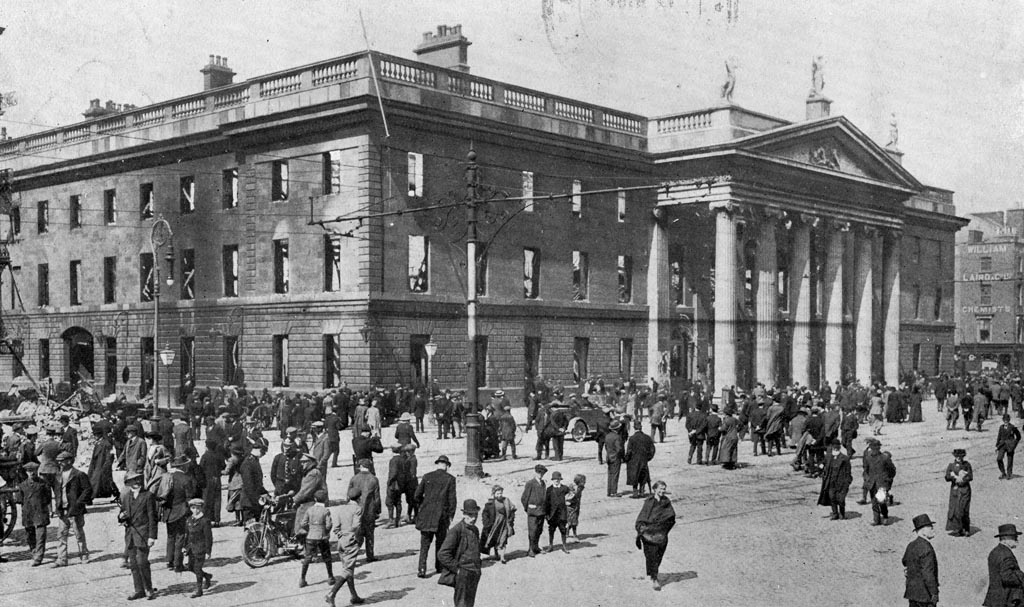
SOME 1916 PHOTOGRAPH’S: FROM DUBLIN SIX DAYS AFTER THE INSURRECTION? 2016.
A new statistical picture of life in Ireland in 1916 shows just how much can change in a century.
If you lived in the time of the Easter Rising, your name was far more likely to be John or Mary and if you managed to avoid the prospect of death in childhood, you would probably succumb by the age of 53 with a good chance of bronchitis or tuberculosis being the cause.
It was a world in which children as young as three were sent to industrial schools while families squeezed into almost 24,000 one-room tenements in Dublin alone.
Society was bereft of variety, in food, movement and places of birth; it was an unsurprisingly homogeneous world.
The statistical mirror of Ireland a century ago is the product of arduous research conducted by the Central Statistics Office (CSO) as its contribution to centenary celebrations.
Much of the data, published on Wednesday, is based on the 1911 census and other material as closely applicable to 1916 as possible.
The compendium of history, titled Life in 1916 Ireland: Stories from Statisticsis available on the CSO website for anyone wishing to step back in time.
“Things were very poor back then so poverty jumps out at you, the lack of variety. From some simple things like names, people felt they could only use certain names for their babies,” explained Helen Cahill, the lead statistician on the project.
“We have average prices of groceries that people bought. There was very little variety in food.”
Dublin was a “city of extremes in housing” with 22 per cent having more than 10 rooms and 36 per cent one-bedroom tenements (23,977).
Half of the workforce was in agriculture compared with a paltry 5 per cent in modern Ireland while 10 per cent of people were employed in domestic service.
Some popular names
If you were born 100 years ago the most popular names for boys were, in order, John, Patrick and James, compared with Jack, James and Daniel in 2014.
For girls, the trend was Mary, Bridget and Margaret compared with Emily, Sophie and Emma.
The same census material shows that in 1911, just 0.7 per cent of people here were born outside the UK and Ireland, compared with 11.2 per cent today.
In 1916, more than 8,000 children lived in industrial schools, and some reformatory schools, although the numbers admitted that year were the lowest in some time (1,001).
“The infant mortality rates were just phenomenally high and in Dublin in particular they were sky high,” explained Ms Cahill.
“The average rate in the State was 81. So for every 1,000 babies born in 1916, 81 were dead before their first birthday. The rate for Dublin city was 153.”
With the decline of church influence, marriage statistics have also changed. In 1916, 92 per cent of 15,207 unions were in Catholic churches, compared with a little under 60 per cent in 2014. Conversely, 28 per cent of marriages were civil ceremonies in 2014. That figure was less than 1 per cent a century ago.
About one in eight deaths in 1916 were due to bronchitis or pneumonia (6,708 fatalities) and the same rate for tuberculosis (6,471). Combined, those conditions killed 1,012 people in 2014.
In 1915, there were 359,700 farms of more than one acre compared with 139,860 of more than one hectare (2.5 acres) in 2010, a decline of more than 60 per cent.
And while car sales slumped in the recent recession, the 1.9 million registered in 2014 dwarfed the mere 9,850 of 1915.
Parts of Great Barrier Reef face permanent destruction due to El Nino


Parts of Australia’s Great Barrier Reef face permanent destruction if the current El Nino, one of the strongest in two decades, does not ease this month, scientists said on Wednesday.
The El Nino is a result of a warming of the ocean in the western Pacific — ideal conditions for coral bleaching, where coral expels living algae, causing it to calcify. Coral can only survive within a narrow band of ocean temperature.
The scientists said areas of the Great Barrier Reef, a world heritage site, are experiencing the worst bleaching in 15 years.
Coral around Lizard Island off the tropical city of Cairns has seen the most widespread bleaching, with 80 per cent of its coral bleached under unrelenting sunlight, Dr Anne Hoggett, director, Lizard Island Research Station told Reuters.
“Bleaching is a clear signal that living corals are under physiological stress. If that stress is bad enough for long enough, the corals can die,” said Dr Russell Reichelt, chairman of the Great Barrier Reef Marine Park Authority said.
“What happens now will be entirely dependent on local weather conditions,” said Reichelt.
Scientists said the Great Barrier Reef needs a break in El Nino conditions within weeks if some coral areas are to survive.
The Australian Bureau of Meteorology’s most recent forecast calls for a continuation of El Nino conditions.
This year will be the hottest on record and 2016 could be even hotter due to the El Nino weather pattern, the World Meteorological Organization
The Great Barrier Reef stretches 2,000 km along Australia’s northeast coast and is the world’s largest living ecosystem. It brings in billions of dollars a year in tourism revenue.
UNESCO’s World Heritage Committee last May stopped short of placing the Great Barrier Reef on an “in danger” list, but the ruling raised long-term concerns about its future due to climate change.
While the El Nino is set to ease by the middle of 2016, according to the BOM, the weather system – which brings hot, dry conditions to Australia’s east coast – is seen as foreshadowing the likely impact of future climate change.
“Coral is the canary in the mine,” said Hoggett of the looming threat from climate change.


