Irish Teens with self-esteem worries are smoking a lot to control their weight
More than one in 10 girls and one in eight boys are smoking to control their weight, according to a new survey on teenagers’ body image.
And some boys also resort to excessive body-building and the use of supplements to bulk up their physiques.
The findings show 43pc of of the 10- to 21-year-olds surveyed are not happy with how they look and this lack of self-confidence is worst among 15- year-olds.
The opinions of 2,156 teenagers from Comhairle na nOg — youth councils across the country — were canvassed as part of the report ‘How We See It: Report of a Survey on Young People’s Body Image’, which was overseen by the Department of Children and Youth Affairs.
Young people are most like to be self-critical about their appearance when they compare themselves with others, while 46pc of teens, particularly boys, say bullying affects their self-image.
More than four in 10 feel conscious of their weight, while the influence of media and celebrities can also lead to poor self-esteem.
Children’s Minister Frances Fitzgerald, who launched the survey, said: “It is clear that for many young people concerns over body image can be a source of much stress and pressure.”
The survey revealed:
- More than one in five 15-year-old girls exercised to control their weight. But 18-year-old boys were least likely to do this.
- Twice as many girls as boys said they did not take enough exercise to stay healthy.
- More boys (15pc) than girls said they took more exercise than was healthy.
- More than half of all the young people surveyed said their body image interfered with their participation in activities such as swimming, dating, and putting photographs on Facebook.
Girls are twice as likely as boys to take part in these activities. Some 85pc of the girls in the survey put time into their appearance compared with 54pc of boys.
Dissatisfaction with body image among Irish teens is high by international standards — it is 32pc in Australia. But satisfaction with body image among Irish young people improves again after the age of 15.
The report makes a number of recommendations, including the rollout of a body awareness campaign and the expansion of personal development programmes in education.
180 Voluntary redundancies sought at Abbotts Sligo manufacturing plant
A total of 180 voluntary redundancies are to be sought at the Abbott plant in Sligo. The news was announced to workers in Ballytivnan following a meeting earlier.
Management said that is is part of a scheme to streamline its global nutrition business.
The facility is part of the company’s nutrition division, manufacturing tubes and feeding devices.
Abbott is one of the major employers in the Sligo area – having been established there in 1974.
Workers leaving the plant this afternoon declined to comment.
Deputy Michael Colreavy, Sinn Féin TD for Sligo/North Leitrim has expressed disappointment at the announcement of 180 redundancies by Abbott, at its Nutrition Plant in Ballytivnan, Sligo today.
Deputy Michael Colreavy, Sinn Féin TD for Sligo/North Leitrim expressed disappointment at the announcement.
“The people of the Northwest were delighted when Abbott announced 175 new jobs at their pharmaceutical operations in Sligo earlier this year,” he said.
“Today’s announcement is a major blow to the community with news of the redundancy programme, for implementation by the end of 2013, with the loss of 180 jobs.
“Abbott is held in high regard in the Sligo area and I hope that the company will minimise the job losses with retraining and redeployment. I also hope that those who accept voluntary redundancies receive a fair deal.
“I call on the Minister for Enterprise, Jobs and Innovation, Richard Bruton TD, and junior minister, John Perry TD, to work closely with the company to identify areas for redeployment in the Sligo area and for development of the northwest in general.”
Anna Haslam a pioneer standing up for women politics in Ireland
Anna Haslam, with help from the writings of her husband, Thomas, was a pioneer in persuading women of all political hues to stand for election
A limestone seat in the centre of St Stephen’s Green in Dublin bears an inscription honouring Anna and Thomas Haslam for their “long years of public service chiefly devoted to the enfranchisement of women.”
Anna Haslam, a pioneer in every 19th-century Irish feminist campaign, fought for votes for women from 1866 when she was part of the first salvo as a signatory of John Stuart Mill’s petition to Parliament. In 1918, a woman of almost ninety, she went to the polls surrounded by flowers and flags, flanked by unionist, Irish Party and Sinn Féin women, united in her honour to celebrate the victory of the vote. This display of unity by activist women from all shades of political opinion acknowledged Anna’s pivotal role in the fight for the vote.
Anna and Thomas Haslam were founding members of the Dublin Women’s Suffrage Association (DWSA) in 1876. This marked the start of a sustained campaign in Dublin for votes for women. There had been sporadic suffrage activity prior to this, including the publication of a short-lived journal, The Woman’s Advocate, by Thomas Haslam in 1874. Membership of the DWSA was open to men and women and included many members of Parliament, unionist and nationalist.
Many members were Quakers. Although its leadership was unionist, it was non-party and attracted members of all political affiliation. It is difficult now to appreciate the radical nature of the early suffrage movement. Its activities – collecting signatures for petitions to Parliament, writing letters, holding meetings– appear tame when compared with the more flamboyant behaviour of the suffragettes who came after them. The early suffragists challenged the prevailing precepts that citizenship was possible only for male heads of households and that the subjection of women by men was natural.
They challenged the ideology that a woman’s place was in the home and that it was shocking for her to speak in public. When Millicent Fawcett, the English suffrage leader, addressed a suffrage meeting in 1869, her husband was criticised in parliament for allowing her to speak in such an “advanced” and “unsexing” a manner.
The minute book of the DWSA, held in the National Archives of Ireland, contains a record of 213 meetings, all of which Anna Haslam attended, between 1876 and 1913. Although it was a Dublin-centred association, great efforts were made to involve women all over Ireland. Emphasis was placed on the educational role of the DWSA. It held public and private meetings at which prominent English suffragists were invited to speak and worked to overcome the “prevailing ignorance” of Dubliners regarding votes for women; copies of the Women’s Suffrage Journal were deposited in reading-rooms and libraries all over the city.
Many members of Parliament who supported women’s suffrage brought bills to Parliament, none of which succeeded, despite considerable support. This was because suffrage bills never received government support and it was notoriously difficult for private members’ bills to succeed in parliament. There was huge disappointment when the 1884 Reform Act, which significantly extended the male franchise, did not include a clause giving the vote to women householders.
Anna Haslam, aided by the writings of her husband Thomas, continued the fight, and in 1896 women in Ireland won the right to be elected as Poor Law Guardians, members of the official bodies which administered the Poor Law. Anna then spearheaded a campaign to encourage qualified women to stand for election. In 1898 women won eligiblility to vote in local government elections, and to stand for election as rural and urban district councillors.
This was a significant breakthrough which made the case for parliamentary suffrage compelling, when one considers the absurdity of being voted onto bodies which administered the law while being precluded from a having a voice in the parliament which framed that law. By the end of 1898 there were 85 women Poor Law Guardians, 31 of whom were were also rural district councillors. In acknowledgement the DWSA changed its name to Irish Women’s Suffrage and Local Government Association (IWSLGA).
The 20th century saw the rise of the suffragette movement in England, followed in Ireland by the foundation of the Irish Women’s Franchise League (IWFL) by Hanna Sheehy Skeffington and Gretta Cousins, who had been recruited by Anna as members of the IWSLGA. Anna continued her constitutional efforts, although overshadowed by the militant, younger and more flamboyant campaign of the IWFL.
In February 1918, over 50 years after the Mill petition was presented to Parliament, the Representation of People Act enfranchised women over 30 in Great Britain and Ireland. In December 1918, she recorded her vote in the midst of “an admiring feminine throng”. In 1914 Francis Sheehy Skeffington wrote that the achievements of Thomas and Anna Haslam were too often forgotten by those “who have entered into the harvest of their labours.” They deserve to be remembered.
The Eyre Family of Galway City

A horse drawn tram fill up with passengers in Eyre Square, Galway City around 1900
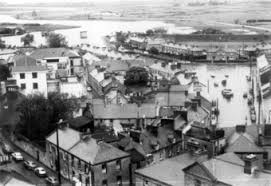 Galway recently celebrated the 300th anniversary of Eyre Square becoming a public park. On 12 May 1712, the Mayor of Galway, Edward Eyre, presented the open ground in front of his house to the corporation. The following is a brief account of the Eyres and some prominent members of this family.
Eyre is a surname of great antiquity in England. It is derived from the old French word for heir and was written ‘le Eir’ and ‘leEyer’. Legend has it that the first Eyre arrived in England with William the Conqueror and that he saved the life of the future king at the Battle of Hastings.
After freeing Prince William from a situation in which he could not breathe, William named his rescuer Eyre. Although mainly associated with Ireland after the Cromwellian invasion, there were, however, English officials of that name in the country during the sixteenth century. A number are listed in the ‘Irish Fiants of the Tudor Sovereigns’.
However, according to MacLysaght, one of the first of this family to arrive in Ireland was a Colonel John Eyre. Along with his younger brother, Edward, he arrived in Dublin as part of the invasion force under Oliver Cromwell in 1649. They were both officers in the Cromwellian army and were in the company of Lieutenant General Edmund Ludlow, under whom they saw much of their service during the Parliamentarian War of 1641-51.
The arrival of the Cromwellian forces in Galway is well documented. It was a terrible period, not just in Galway’s history, but also in the history of Ireland. On 8 July 1651, Sir Charles Coote, Lord President of Connacht and commander of the Cromwellian forces, arrived at the gates of Galway City. He demanded its immediate surrender.
The city authorities refused and the people of Galway braced themselves for the consequences of their decision. Outside the city walls, the Cromwellians were busy preparing for a strong siege. Coote had a substantial force under his command, consisting of 2,000 cavalry and 5,000 infantry. After a nine-month siege, the city surrendered and became the last town in England and Scotland or Ireland to fall to the Parliamentarian Armies.
Among the Cromwellians who had arrived in Galway was the aforementioned Colonel John Eyre. Following the siege, the Eyre family gained control of much property throughout the city and county. John Eyre obtained extensive grants of land also. He built Eyrecourt castle and village, which is named after him. Another area named after this family is Eyreville, also in County Galway.
The Eyres became one of the most influential Cromwellian families to settle in County Galway. Five of them held the office of sheriff between 1675 and 1809. Many others held the office of mayor.
The first member of this family to hold the mayoral office was Colonel John Eyre, who was elected Mayor of Galway in 1661. John Eyre was born in 1623, the son of Giles Eyre of Brickworth, Wiltshire, who, in 1640, sat with three of his sons in the Council of Oliver Cromwell. John Eyre’s mother was Jane. She was the daughter of Ambrose Snelgrove of Redlynch in Wiltshire.
In 1657, John Eyre was a member of the commission for settling the land and housing issues in counties Galway and Mayo for the Commonwealth. This was part of the Cromwellian Land Confiscations, when the Irish and, indeed, many of the Anglo Irish lost their property to the new settlers.
While serving on this commission, Eyre acquired land formally owned by the O’Maddens near Ballinasloe, which became the basis for the Eyrecourt estate. Eyre also disposed families such as O’Kelly, Horan, and Burke in southeast Galway. John was also the ancestor of the Eyreville families. He served two terms as Recorder for the corporation and, along with his brother, Edward, he served as a member of parliament in 1661.
In 1662, he married Mary, daughter of Philip Bygoe, who was High-Sheriff of King’s County. In 1681, John Eyre served as High-Sheriff of County Galway. He died on 22 April 1685 and was survived by two sons, John and Samuel. Both his sons entered the military service and both also served as Mayors of Galway, John in 1704, 1705 and 1706, and Samuel Eyre in 1712 and 1713.
His brother, Edward, was elected mayor in 1663. Edward was born in 1626, the sixth son of Giles Eyre. As mentioned already, Edward arrived in Ireland during the Cromwellian war and was also attached to the military. He was the Recorder for Galway in 1661 and 1662.
Over time, Edward Eyre also obtained a considerable amount of property, formally owned by the now dispossessed ancient families of the town. He also acquired leases on properties in Woodquay, Suckeen, Eyre Street, Forthill and Victoria Place. He also served as Mayor of the Staple and, in 1670, he obtained a number of other leases, among them the area now known as Eyre Square. He acquired this property on a ninety-nine lease at a yearly rent of £3.
Among the properties he acquired was the former home of Robert Martin Fitz-Jasper, which was located close to Eyre Square. It was situated approximately on the site of the present day Great Southern Hotel. It was here that Eyre set up his home in Galway.
Following the Restoration of Charles II, Robert Martin was issued with a King’s warrant, granting him re-ownership of the house. However, when Martin approached Eyre with the warrant, Eyre laughed in Martin’s face, telling him he placed no value on the King’s Order and would not vacate the property. Eyre was obviously a good politician, as Martin’s bid to have his property restored failed even before the Irish Lord Justices. Eyre was, in fact, praised for his integrity and in being a loyal servant of the King.
Edward Eyre married a lady named Jane and had three sons and two daughters, the first of whom was also named Edward. He was born in Galway in 1663 and became mayor in 1710 and 1711. Edward (Senior) was an alderman in 1771 and served on the town council in 1774. He continued to play an active role in corporation affairs, serving up to the time of his death in 1683.
Edward was the ancestor of the Hedges-Eyre family of Macroom Castle, County Cork. He was buried in St Nicholas’ Collegiate Churchyard and his memorial describes him as: ‘…a thorough honest Englishman which plain character be-speakes him eminently possessed of all good and virtuous qualities. He lived greatly beloved by all who knew him, and died much lamented’.
One of his descendents, William Hedges Eyre, bequeathed an annual sum out of the Galway salmon fishery to charity.
Richard Hedges Eyre of Macroom Castle married Frances Browne, the daughter of the Second Viscount Kenmare. In 1777, their daughter Helena married the Very Reverend George Maunsell, Dean of Leighlin. Their second son Robert Hedges Eyre Maunsell married his cousin Elizabeth, daughter of Thomas Maunsell of Plassey in County Limerick. It was possibly through this branch of the family that Fort Eyre in Shantalla and Maunsell Road takes their names.
Events of note: More Eyre family connections to follow. The St Bridget’s Terrace Residents Association are organising a Christmas party for 14 December 2012 in the Western Hotel, Prospect Hill. It is part of the 100 years anniversary celebrations. Tickets are available from Brian Kennedy.
Dolphins ‘stay awake for 15 days’
Dolphins can stay alert and active for 15 days or more by sleeping with one half of their brain at a time, scientists in the United States have learned.
The trick of keeping half the brain continuously awake is vital to the sea mammals’ survival, experts believe.
It allows them to come to the surface every so often to breath, and remain constantly vigilant for sharks.
Scientists in California tested the ability of two bottlenose dolphins to echolocate accurately over periods of time which would have left other animals sleep-deprived and exhausted. The dolphins, a male called Nay and female called Say, had to swim around a pen looking for phantom sonar targets.
Each of the eight targets consisted of a device that picked up dolphin sound pulses and sent back “phantom”echoes. When a dolphin detected an echo from an activated target, it responded by pressing a paddle. Correct detection triggered a tone, signalling success, and the dolphin was rewarded with a fish. False alarms led to no tone and no reward.
Over three sessions of five continuous days both dolphins did well, with success rates of up to 99%, but Say outperformed her male partner. The scientists then went on to test Say further by repeating the same experiment over a period of 30 days.
In the event, a storm cut the trial short after 15 days had elapsed. However, during this time Say’s performance hardly deteriorated at all. The findings were published in the online journal Public Library of Science ONE.
Lead researcher Dr Brian Branstetter, from the National Marine Mammal Foundation in San Diego, said: “These majestic beasts are true unwavering sentinels of the sea. The demands of ocean life on air breathing dolphins have led to incredible capabilities, one of which is the ability to continuously, perhaps indefinitely, maintain vigilant behaviour through echolocation.”
The scientists wrote: “From an anthropomorphic viewpoint, the ability of the dolphin to continuously monitor its environment for days without interruption seems extreme. However, the biological, sensory and cognitive ecology of these animals is relatively unique and demanding.
“If dolphins sleep like terrestrial animals, they might drown. If dolphins fail to maintain vigilance, they become susceptible to predation. As a result, the apparent ‘extreme’ capabilities these animals possess are likely to be quite normal, unspectacular, and necessary for survival from the dolphin’s perspective.”
