Pages

Wednesday, May 2, 2012

Wednesday's all Ireland nes Blog by Donie

Irish Government accused of 'scare-mongering tactics' 
to get the referendum passed

 No  
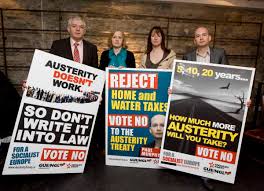
Clare Daly TD, MEP Paul Murphy, Cllr Ruth Coppinger and Joe Higgins TD at the Poster Launch of Socialist Party ‘No’ campaign against the Austerity Treaty in Dublin.

The Government has today been accused of using scare tactics in order to ensure the fiscal treaty referendum is passed.
Launching what it described as its biggest ever referendum campaign in Dublin earlier today, the Socialist Party criticised Minister for Finance Michael Noonan over his warning that he would have to introduce a tougher budget if a No vote is returned by the electorate.
Socialist Party MEP Paul Murphy described Mr Noonan’s comments(above picture left) as an “attempt to put a gun to the heads of the public and force them to vote Yes”.
He said the referendum was “the people’s opportunity to say no to austerity and to writing austerity into law”.
Citing the low number of householders who have signed up for the household charge, Mr Murphy said the Socialist Party would unashamedly make the link between the struggle against unfair taxes and the introduction of further austerity measures if the referendum is passed.
Mr Murphy’s colleague Joe Higgins TD accused the Government of using the “argument of fear” to scare voters. He said that instead of offering more stability, the fiscal treaty would bring about more instability both here and across the euro zone.
Mr Higgins said that many of the “lavish phrases” being used by the Government in the campaign echoed similar comments made during the second Lisbon Treaty referendum.
“Bitter experience has shown that those promises were absolutely worthless and false. Lisbon 2 did not provide the jobs that were promised and private investment has utterly collapsed. The new promises of stability are equally worthless,” he said.
“The Irish Government cannot promise stability. The financial markets, which operate virtually economic dictatorship over the economy will respond to events right across Europe to suit their agenda,” he added.
Cllr Ruth Coppinger rejected claims that Ireland would be isolated if it voted No in the referendum. She said that voting against the treaty would be an act of solidarity with citizens of other countries who don’t have the opportunity to vote.
“A No vote in Ireland would give a huge boost to all those around Europe who are fighting the effects of austerity and it would be the first continent-wide response to the bondholders’ agenda.”
The Socialist Party is to spend up to €55,000 on the campaign which will include sending out 1 million leaflets to householders. A total of €47,000 in funding is being provided by the European United Left while the rest will come from local fundraising events.
Mr Murphy said that while the Yes side will “massively overspend” compared to the No campaign during the referendum, the No side was optimistic that it would do well because of the increasing confidence of people “to fight back against austerity”.
Mr Higgins said the Yes side would be bolstered by the print media, which he claimed were “stridently promoting a Yes vote”.
He added that the bulk of the printed press had put similar pressure on members of the public to register for the household charge and would likely do so again now.

Ibec Group says that a Yes vote will secure Ireland’s future


 Ibec, the group that represents Irish business, yesterday launched a nationwide poster campaign in support of a Yes vote in the upcoming referendum.

Ibec insists Yes vote will secure future: THE BUSINESS lobby group Ibec insisted a Yes vote for the fiscal treaty will “secure Ireland’s future” when unveiling the organisation’s referendum poster in Dublin city centre yesterday.
Ibec director general Danny McCoy said he believed a No vote would increase the amount of time Ireland would spend in austerity and would hamper recovery, while a Yes vote would give confidence and certainty.
“What Ireland needs now is growth,” he said. Mr McCoy said people making decisions about investment in Ireland were “a little bit bemused, I suppose, that we would be risking our access to markets by even contemplating a No vote”.
He said there was no need for scaremongering, but he believed a Yes vote would send a very positive signal to potential investors.
The Ibec posters carry the slogan: “Secure Ireland’s Future”. The organisation intends erecting 5,000 posters across the country.
Ibec president Julie O’Neill said a Yes vote would drive growth and recovery in the economy, while a No vote would increase uncertainty and increase the cost of servicing the State’s debt.
“Driving Ireland’s recovery is very important, and Europe is a very important part of that,” Ms O’Neill said.
She said sensible and robust rules to avoid a future debt crisis were in the interest of both Ireland and Europe. “If Ireland and Irish business is to prosper and create jobs and generate growth we need to draw a line under the European debt crisis.”
Mr McCoy and Ms O’Neill were joined at the launch by Anne Hegarty, chief executive of recruitment firm CPL; Mary McKenna, managing director of Tour America; Regina Moran, chief executive of Fujitsu Ireland; and Sally Storey, general manager of GlaxoSmithKline Ireland.
Commission uses Facebook 
THE REFERENDUM Commission is using Facebook to encourage people to check the voting register and make sure they are eligible to participate in the fiscal treaty referendum on May 31st.
An advertising campaign on Facebook over the next fortnight will direct people to an app which aims to help them check the register. Referendum Commission chairman Mr Justice Kevin Feeney said he hoped younger people who did not always get information from “traditional media” would find it useful.
The Referendum Commission’s booklet will start arriving in homes from May 8th and is expected to be distributed around the State within 10 days. The 24-page booklet – with 12 pages in English and 12 in Irish – will contain a fairly short summary of what the treaty is about.
The Government is in the process of distributing a 40-page booklet containing the text of the fiscal treaty referendum and an explanatory section. Distribution started in Munster last Thursday and Friday. An additional pamphlet will be distributed closer to polling day, May 31st.
Fine Gael, Labour and Fianna Fail, who are advocating a Yes vote, will distribute separate leaflets and canvass cards.
Sinn Féin, which is calling for a No vote, will distribute around one million bilingual leaflets.

Civil marriages in Ireland to be conducted by non-religious groups  ‘In new legislation passed’ 


The Irish Government yesterday approved legislation allowing members of non-religious groups, such as the Humanist Association of Ireland, to perform civil marriages, writes Deaglán de Bréadún, Political Correspondent.

Minister for Social Protection Joan Burton said: “I am delighted to have obtained the support of my colleagues in Cabinet for the proposal.”
Originally brought in as a Private Members’ Bill by Labour Senator Ivana Bacik, the Civil Registration (Amendment) Bill is due to complete its progress in the Seanad today and Ms Burton will sponsor its progress through the Dáil. It proposes to give the right to conduct civil marriages to non-religious groups, which must be a “philosophical and non-confessional body”.

Huge China trade hub planned for the Midland’s of Ireland in 1.4 billion Euro development


The 1.4 billion euro development receives planning permission in phase one of he Government’s plan

Ireland gave phase one of a huge Chinese trading hub planning permission on Tuesday, paving the way for what would be one of the biggest developments in the struggling euro zone country.
China has expressed growing interest in Ireland’s economy in recent months, with leader-in-waiting Xi Jinping choosing Ireland as the only European stop in an international tour in February.
Beijing’s sovereign wealth fund has also signed a memorandum to explore investment opportunities in Ireland and Tuesday’s decision will allow building to start on a complex that could eventually see Chinese manufacturers and traders display goods to international buyers in 3,000 demonstration halls.
The 1.4 billion euro’s Europe China Trading Hub’, set on 140 hectares of mostly agricultural land in the midlands county of Westmeath, aims to become Europe’s largest source of Chinese branded goods, according to the site’s Irish developers.
They said Ireland was chosen as the preferred location due to its European Union membership, English speaking workforce, attractive corporate tax rate and stable industrial relations environment.
Ireland’s ultra low corporate tax rate, which it guards vigorously against pockets of opposition in Europe, has helped it attract large multinationals to the country from eight of the ten world’s biggest pharmaceutical companies to tech giants like Google and Facebook.
Acting as a gateway between China and buyers from Europe and the US, the development will provide space for Chinese traders to display their products with a view to generating bulk orders which will then be delivered from China.
The developers say the goods traded will range from electric cars to fabrics and machinery, with a particular focus on the high-end market and that the hub could ultimately provide direct and indirect employment for 9,000 people, as well as bringing 1.5 million visitors to Ireland every year.
The site would also include shops, restaurants, pubs, a theatre, cinemas and a library.
The first phase, which will see just under a quarter of the overall development initially built, could be open for business by 2015, according to the head of the nearby Athlone Business Park which proposed the development.
Asked if it would be able to finance the project, John Tiernan said the response from the private backers and promoters behind the project all pointed to a positive outcome.

Tuesday, May 1, 2012

Tuesday's news Ireland Blog by Donie


The Household tax: 60% of Phil and Enda’s constituents reject it


Over 60% of constituents in Minister Phil Hogan’s constituency have failed to pay the household charge, it has emerged. And in Enda Kenny’s Mayo homeland 60pc have so far not paid the €100 levy.

Eamon Gilmore’s affluent Dublin constituency of Dun Laoghaire has a compliance rate of 64pc – despite the anti payment campaign mounted by Independent Richard Bot Barrett who also hails from the borough.
The figures, produced in today’s Daily Mail, do not include the 235,000 applications yet to be processed.
Overall just one of 34 councils nationwide has a compliance rate in excess of 50pc and 22 have less than 40pc paid up.
In Environment Minister Hogan’s own constituency just 34pc have signed up in Carlow and 35pc in Kilkenny.
Many families who decided to bite the bullet and pay the household charge have been hit with late-payment fines and interest penalties of almost €300,000.
This is because they failed to pay the €100 charge by the March 31 deadline and were forced to stump up an additional €10 late-payment fee and €1 interest payment.
A total of 890,184 homeowners have registered to pay the charge, figures from the Local Government Management Agency showed earlier this month.
Some 648,739 have paid the tax in full, with just over 27,000 paying since March 31, meaning they were liable for late-payment fees.
Homeowners who pay no later than six months after the due date are hit with a 10pc late-payment fee. This rises to 20pc after six months and 30pc after a year. An additional interest penalty of 1pc is added per month it is unpaid.

Inquiry at school that bars 16 year old pregnant teenager from attending class


Children’s Ombudsman Emily Logan has requested a school apologise for excluding a girl because she was pregnant

The school that excluded a 16-year-old pregnant teenager is being investigated by the Department of Education and Skills following a complaint from Children’s Ombudsman Emily Logan.
Ms Logan has requested the Munster school apologise for excluding the girl because she was pregnant.
Ms Logan said she has been lobbying for years for a clear admissions policy for parents and children.
“The best way that I think I could handle this is to make it known to the members of the Oireachtas and to the Minister who has responsibility for legislating in this area,” she said. “It is important that the public is aware that there are still children who are being mistreated and this is not acceptable.”
Ms Logan said she never experienced such hostility as when investigating the decision by the school to exclude the teenager.
“It is very, very unusual. Generally people are respectful of the level of independence of my office,” she said. “By and large people co-operate in relation to the fact that we have a role to do.”
In a report published on the Children’s Ombudsman website, Ms Logan said the girl in question tried unsuccessfully twice to enrol in the school, once when she was pregnant and secondly after she had the baby in 2010.
According to the report, when her mother wrote to the school principal, he replied: “Your letter surprises me. A neighbour called at your request and stated that your daughter was pregnant. I was shocked and I told her that I did not take in such girls. She conveyed the message to you.”
Ms Logan wrote to the school in July last year following a complaint from the girl’s mother.
She requested the school furnish a copy of its admissions policies and complaints procedures along with outlining its board of management structure.
In response the school manager wrote to her: “Neither am I obliged to have any other frills that you mention. This school is NOT [manager's emphasis] a haven for young pregnant people or for young mothers who, in particular, have been in two other post primary schools. The school has an uncompromising ethos and will not become a dumping ground for those rejected elsewhere.”
Ms Logan said she could not see any evidence of an admissions policy publicly available to families and potential students nor did the school appear to have a complaints mechanism.
She concluded the school had treated the teenager unfavourably and had discriminated against her based on family status.
A statement from the Department of Education said they do not want to prejudice the outcome of the inspector’s report and so will not be commenting on the specific case.
However, the department pointed out Minister for Education Ruairí Quinn unveiled a discussion paper on school enrolment last year to make the process of enrolling schools more “open, equitable and consistent”.
The statement continued: “Education partners and interested parties were invited to submit their views and the Department is currently co-ordinating their submissions. The feedback from this consultation will help inform the nature and scope of a new regulatory framework for school enrolment.
The Minister plans to bring proposals to Government this year.” Attempts to contact the school by phone and email this afternoon were unsuccessful.

Irish property prices have over-corrected - Say’s the Central Bank


The Central Bank has said Irish property prices have overcorrected by between 12% to 26% compared with the fundamental value of properties.

The Central Bank has said that Irish property prices have overcorrected by between 12% to 26% compared with the fundamental value of properties.
The bank suggests that a lack of consumer confidence and expectations about further price falls is holding back purchases.
It also said that a lack of mortgage finance from banks is restricting market activity and price levels.
The bank warns that any immediate revival of the sector still appears to be some way off.
The bank’s researchers used four separate models to assess property prices for the research.
One model found that prices were 26% below what economic fundamentals in the economy would warrant. Two other models found that prices were 16-18% undervalued.
A fourth model suggested that they were under valued by 12%.
The Central Bank said that as it enters its fifth year, the severe downturn in the residential property market has already become one of the OECD’s largest and most protracted.
The CSO’s residential property price index showed that the decline in value since the peak of the market in 2007 was over 47%.
The research pointed out that Ireland’s housing prices have fallen for 16 quarters in row, but this compares to 82 quarters in Japan and 41 quarters in Switzerland.
It also noted that just 11,000 new mortgages were issued last year, down from 110,800 in 2006. It said that almost 10,500 housing units were built last year, down from 14,600 in 2010. At the height of the housing boom about 93,000 houses were built in 2006.
The Central Bank pointed out that a positive trend in the housing market is the fact that affordability has improved in recent years, but it adds that the imposition of tighter credit conditions by the banks could diminish much of this benefit.

Figures in Ireland show a rise in sexual crimes


New crime figures for the Republic show an alarming rise in number of sexual offences, kidnappings and drug-related crimes between 2006 and 2010.

New crime figures for the Republic show an alarming rise in number of sexual offences, kidnappings and drug-related crimes between 2006 and 2010.
Conversely, the figures show a decline in the murder rate as well as a fall-off in the number of offences linked to property damage.
The Central Statistics Office figures, published today, outline trends in recorded and detected offences across 16 different crime categories.
The volume of recorded sexual offences jumped by 66 per cent during the four-year period.
However, gardaí warned that part of the rise in sexual offences reflected a decision to review of all outstanding allegations, including historic child sex abuse cases.
The figures indicated sharp rises in kidnappings and related offences (up 59 per cent), in controlled drug offences (up 40 per cent), in the rate of gun and explosives-related crime (up 30 per cent) as well as robbery, extortion and hijacking offences (up 28 per cent).
On the other hand, the number of recorded homicide offences fell by 35 per cent and damage to property and to the environment offences fell by 10 per cent.
The figures, which also analysed detection rates, showed that three out of every four burglaries across the State were going undetected.
Barely a quarter of the 25,377 burglaries carried out in 2010 were detected, with only 38 per cent of 76,492 thefts solved.
However the detection rate for the 55 murders, five manslaughters and 30 deaths by dangerous driving was 83 per cent. Criminal charges were brought in 64 cases, while 15 remain undetected.
The highest number of killings were recorded in Dublin’s north inner city, with 4.7 deaths per 100,000 people.
The detection rate for drugs offences was also high, with more than 98 per cent of the 19,943 cases closed.
There were also 4,092 recorded incidents of weapons and explosives offences, with more than 90 per cent solved.

The cost of keeping a home in Ireland increases by €138 a week


Feeling like your wallet is getting increasingly more roomy? You’re probably right if figures released today about the cost of living are anything to go by.

Apparently the cost of just keeping a decent roof over your head have risen dramatically by €138. And what makes it much worse is that it’s €138 every week.
The figures have been collated with figures from data released by the CSO Central Statistics Office and it makes for pretty upsetting reading.
The average cost of keeping a home has gone from €275 to over €400. This means the average couple are now finding themselves having to pay over €21,000 a year before they even think about feeding or clothing themselves.
The increase is put down to higher cost of mortgage repayments, insurance and fuel.
The even worse news for many is that these increases don’t take into account the household charge, water charge or rubbish collection fees.
The data analysed comes from the period between January 2006 and March of this year.
There was a 20.5 per cent increase in the cost of gas and a 11.2 per cent in the cost of electricity last year alone.
So the only reasonable conclusion can be that Irish people are every year being asked to pay more just to get by.