Pages

Showing posts with label credit. Show all posts

Friday, August 19, 2016

Donie's Ireland daily news BLOG update

Irish household debt decreases by €1.1bn in first quarter of 2016

IRISH HOUSEHOLDS FALL TO FOURTH MOST INDEBTED IN THE EUROPEAN UNION


NEW FIGURES FROM THE CENTRAL BANK SHOW IRISH HOUSEHOLD DEBT STOOD AT €31,216 PER CAPITA IN THE FIRST THREE MONTHS OF THE YEAR, THE LOWEST LEVEL SINCE THE FIRST QUARTER OF 2006.

Irish households fell from being the third most indebted in the European Union to the fourth during the first quarter of this year, according to new figures from the Central Bank.
The figures show Irish household debt fell by €1.1 billion to €148.5 billion in the first three months of the year.
This represented a household debt per capita of €31,216, which is the lowest level since the first quarter of 2006.
Household net lending fell to a level of €2.4 billion during the first quarter.
The net worth of households increased by 0.3% to €628.7 billion, mainly driven by a rise in house values, and a decline in household liabilities.
Household net worth has regained two-thirds of the drop that followed the Celtic Tiger’s high-water mark of €718 billion in the second quarter of 2007.
The Central Bank said household debt as a proportion of disposable income now stands at 149.4%, its lowest level since the end of 2004.
Investec said the stock of household liabilities now stands at €148.5 billion, 27% below the all-time high of €203.7 billion reached in the third quarter of 2008. It noted household net worth has increased for 12 successive quarters.
“Notwithstanding external pressures, we expect the Irish economy to continue to turn in some of the strongest growth in the EU both this year and the next, facilitating further improvements in the aggregate balance sheet of Irish households,” said Investec chief economist Philip O’Sullivan.

Irish Parents spend some €450 a month ‘supporting’ students

IRISH LEAGUE OF CREDIT UNIONS DATA SHOWS 87% WILL BACK CHILDREN FINANCIALLY WHILE IN COLLEGE


JUST OVER TWO-THIRDS OF STUDENTS WORK THROUGHOUT THE ACADEMIC YEAR TO FUND THIRD-LEVEL EDUCATION, WORKING ON AVERAGE 17 HOURS WEEKLY FOR €12 AN HOUR.

The vast majority of students attending third level institutions will be financially supported by their parents over the next year with the average parent spending €447 each month, a survey has found.
According to a piece of research published by the Irish League of Credit Unions this morning 87 per cent of parents will financially support their children through the academic year with 60 per cent getting into debt to do so.
The research asked both parents and students about how they meet the costs of third level education and the financial challenges facing families. The results highlight the impact of sending children to college (in financial terms) has on spending and budgets as well as the challenges and concerns parents have in relation to finance, debt, accommodation, course choice and job prospects.
All told just under three quarters of parents polled said they would struggle to cover the cost of their child’s third level education. The average amount of debt parents will accrue is put at €4,300 down from €4,670 in 2015.
The piece of research also found that parents save for an average of eight years to cover third level costs for their children and manage to accumulate on average €8,150 over that period.

A WORRY?

The survey also asked parents what they worried about as their children headed off to college. Employment prospects after graduation was the biggest concern for parents with 32 per cent saying it was the thing which worried them the most. Passing exams was in second place with 17 per cent highlight that while concerns over the misuse of drink and drugs has jumped sharply to 17 per cent up from 10 per cent last year.
It is not only parents who have worries ahead of the new term. The poll suggests that just over two thirds of students who need to live away from their family home are “extremely worried” about finding suitable accommodation for the academic year.
Concerns about the availability and affordability of accommodation could be behind a slight increase in the number of students who say they will live at home over the course of the next academic year. The survey says that 65 per cent of students will be living at home compared to 62 per cent in 2015.
The cost of living away from home is laid bare in the study with students living outside the home saying they will spend €1,048 euro per month while those living at home will spend €530 per month
Just over two thirds of students work throughout the academic year to fund third level education working an average of 17 hours per week getting paid an average of €12 per hour.
The survey by iReach was carried out in July using 1,000 responses from over-18s across Ireland.

Nutrition business progress drives Glanbia earnings growth


EXCEPTIONALLY STRONG GROWTH IN GLANBIA’S PERFORMANCE NUTRITION BUSINESS HELPED THE IRISH COMPANY TO EARNINGS OF €176.5M IN THE OPENING HALF OF THE YEAR.

Glanbia’s H1 earnings increased by close to 11% compared with the same period last year in what company chief executive Siobhán Talbot described as a “strong set of results”.
That firm’s earnings growth was driven primarily by its performance nutrition (GPN) business which accounted for almost half the company’s earnings.
The performance nutrition business segment’s earnings before interest tax and amortisation (EBITA) totalled €81.7m a 35% increase on H1 2015 on a constant currency basis.
Ms Talbot said she was pleased with the progress of GPN which develops products aimed at the sport and fitness markets, including protein shakes.
Growth would moderate to more modest and sustainable levels over time, she accepted.
“Sales of performance nutrition brands and value-added nutritional ingredients showed good growth in the first half of 2016 delivering on our vision to be a leading nutrition business.
“Our overarching strategy is to continue to get growth across the group. Various dynamics in various periods of the year and indeed full years can accelerate that and we’re very pleased with the 35% that we had in the first half [of 2016].
“We very much look to that long-term sustainable growth rate and we’re obviously not saying that that level of growth will be sustainable but if you take our overall guidance for the year that we’ve reiterated of 8%-10%, growing performance nutrition is an important factor within that,” Ms Talbot said.
GPN’s growth will be increasingly driven by new product innovations rather than breaking into new markets.
Ms Talbot said she expected continued “pull” on pricing in its Irish dairy division after a 4.9% decline in prices in the first half of the year.
Glanbia described Dairy Ireland’s performance as “satisfactory” despite a 3.3% decline in revenue to €356.9m which reflected the continued price drop as well as a 1.1% increase in volumes.
Ms Talbot said conditions for “anybody in the dairy space are a bit challenging” but noted that Dairy Ireland delivered a modest profit increase in the first six months of the year.
The company is dealing with currency headwinds arising from both the relative strength of the dollar and the uncertainty created by the UK’s decision to leave the European Union.
Ms Talbot said the UK is not a particularly big market for Glanbia but like all other corporates, the Irish firm doesn’t like uncertainty and currency volatility caused by the Brexit vote would need to be monitored.
Similarly, Glanbia is “always watching” the dollar-euro exchange rate and is used to managing the associated risk.
The relative strength of the dollar against other currencies can have a marked effect on demand in other markets, such as Brazil, however.
Ms Talbot said the dollar’s strength was actually more of an issue last year than it has been in the opening half of 2016 though.
The company remains on the lookout for potential acquisitions and has a good pipeline of deals.
Ms Talbot said, however, that it is difficult to be prescriptive about how many deals would be completed or when.

Viruses are more dangerous in the morning and so maybe we should all sleep in


EARLY MORNING COMMUTERS ON PACKED TRAINS CAN FINALLY FEEL JUSTIFIED IN THEIR AVERSION TO THEIR FELLOW PASSENGERS, AFTER A NEW STUDY FOUND VIRUSES ARE MORE DANGEROUS IN THE MORNING.

A science paper (rivetingly) entitled “Cell autonomous regulation of herpes and influenza virus infection by the circadian clock” found viruses were 10 times more successful at breaking down their host if the infection began in the morning.
The study, by the University of Cambridge, involved infecting mice with either the influenza (the cause of flu) or the herpes virus. Tests showed mice infected in the morning had a viral level 10 times higher than those infected in the evening.
Professor Akhilesh Reddy told the BBC: “It’s a big difference. The virus needs all the apparatus available at the right time, otherwise it might not ever get off the ground, but a tiny infection in the morning might perpetuate faster and take over the body.”
Viruses hijack living cells in order to replicate and proliferate around the body. It is thought the body clock, or circadian clock as per the paper title, is what makes cells more susceptible to viruses at different times.
Bmal1 is the body clock gene scientists in this study identified as the key to this susceptibility and it peaks in the afternoon, increasing resistance to infection. Bmal1 activity is low in the morning however, so we have increased vulnerability.
So should we all be locking ourselves in quarantine in the mornings for fear of microscopic germ warfare? Well no, but the findings could be helpful in preventing the spread of disease during a viral pandemic.
“In a pandemic, staying in during the daytime could be quite important and save people’s lives – it could have a big impact if trials bear it out,” said Professor Reddy.
One thing is clear – we’ve all been given one more reason to hit that snooze button tomorrow…

Zebra finches sing to eggs to prepare babies for global warming ahead

THIS COULD BE ONE WAY BIRDS LEARN TO SURVIVE THE HEAT
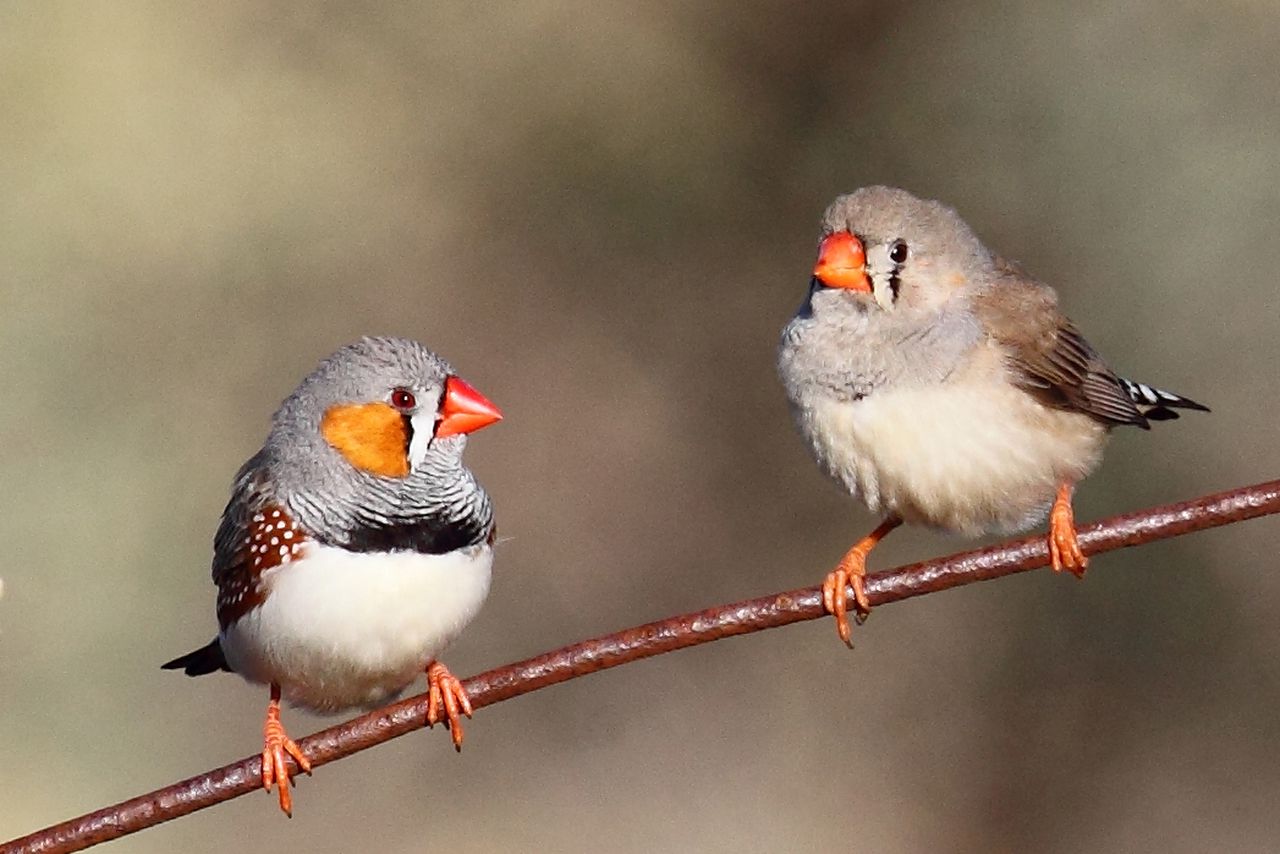
    
Zebra finches program their offspring to prepare for global warming by singing to eggs before they hatch. In especially hot areas, finch parents make a special call to incubating eggs, basically telling them it’s really hot outside and they better not grow too big. The hatchlings listen and this mechanism might explain how birds learn to adapt, and survive climate change.
Many bird species sing to their eggs. These calls have been shown to do everything from improving learning to synchronizing hatching times. When it comes to the Australian zebra finch, we already know that they make a specific call when it’s unusually hot outside, which in this case means over 79 degrees Fahrenheit no matter what season it is.
Finch parents start making these calls about five days before the eggs are supposed to hatch and the calls become more frequent the closer it gets to hatch time. This suggests the calls are a way to tell the soon-to-be-born finches about the world outside, and not just the parents complaining about the heat.
But how do we know if it’s just a coincidence? Mylene Mariette and Katherine Buchanan at Australia’s Deakin University figured out a way to test this. For a study published today in Science, they put a bunch of zebra finch eggs in an incubator that created a temperature around 100 degrees Fahrenheit. Mariette and Buchanan then played the “global warming” call for some of the eggs and not others.
Next, the scientists waited to see if there were significant differences between the two groups. If there were, it was probably because of the difference in the calls they heard.
After the eggs hatched, the baby finches were raised in an environment where the temperature varied naturally. By day 13 after hatching, nestlings that heard the “heat” calls were smaller than the ones who didn’t. This seems to confirm that the embryos in the eggs really do listen to the calls and then change how they grow.
All this makes sense because other research tells us that animals end up smaller when it gets hotter because the smaller size makes it easier to cope with high temperatures. Mariette and Buchanan also found that birds who were smaller in hot conditions produced more fledglings during their first breeding season, showing that this is a good evolutionary strategy after all.     

Friday, June 1, 2012

Donie's news Ireland Blog Friday


It’s a YES for: Ireland as voters approve the fiscal Treaty by 60 – 40 majority


With results from count centres completed, Ireland voters have chosen to say yes to the EU fiscal treaty and has now put it up to the Government to deliver on their promises.

The Yes side has officially won by 60.29% to 39.71%. 38 constituencies returned a Yes vote with just 5 – Dublin South Central, Dublin South West, Dublin North West, Donegal South West and Donegal North East – voting No. The turnout for the referendum was 50.6%.
HERE ARE THE results from your constituency counts as they were received at the Dublin Castle central count centre (in alphabetical order).
OVERALL NUMBER OF VOTES: 1,591, 385.
INVALID VOTES: 7,206.                  
TOTAL VALID VOTES: 1,584,179.
‘YES’   VOTES: 955,091. = 60.29%  
‘NO’     VOTES: 629,088. = 39.71%  
The ‘Yes’ vote won by 326,003 votes.
COMPLETED CONSITUENCY COUNTS: 43.
KEY TO MAP (via referendum.ie):
Green – Result in: Majority YES
Red – Result in: Majority NO
Blue – Count not yet completed
CARLOW-KILKENNY: Turnout 50.98%. Yes 63.29%; No 36.71%.
CAVAN-MONAGHAN: Turnout: 48.76%. Yes 57.58%; No 42.42%.
CLARE: Turnout 49.81%. Yes 65.73%; No 34.27%.
CORK EAST: Turnout 49.21%. Yes 60.52%; No 39.48%.
CORK NORTH-CENTRAL: Turnout 51.49%. Yes 52%; No: 48%.
CORK NORTH-WEST: Turnout 51.91%. Yes 65.59%; No 34.41%.
CORK SOUTH-CENTRAL: Turnout 53.46%. Yes 62.17%; No 37.83%.
CORK SOUTH-WEST: Turnout 51.55%. Yes 66.27%; No 33.73%.
DONEGAL NORTH-EAST: Turnout 42.59%. Yes 44.37%; No 55.63%.
DONEGAL SOUTH-WEST: Turnout 41.92%. Yes 45.05%; No 54.95%.
DUBLIN CENTRAL: Turnout 48.3%. Yes 53.53%; No 46.47%.
DUBLIN MID-WEST: Turnout 51.63%. Yes 50.01%; No 49.99%. 
(Just FIVE votes separated the sides in this one)
DUBLIN NORTH: Turnout 52.92%. Yes 60.43%; No 39.57%.
DUBLIN NORTH-CENTRAL: Turnout 58.76%. Yes 62.28%; No 37.72%.
DUBLIN NORTH-EAST: Turnout 57.17%. Yes 58%; No 42%.
DUBLIN NORTH-WEST: Turnout 51.85%. Yes 46.76%; No 53.24%.
DUBLIN SOUTH: Turnout 57.07%. Yes 75.84%; No 24.16%.
DUBLIN SOUTH-CENTRAL: Turnout 51.73%. Yes 49.1%; No 50.9%.
DUBLIN SOUTH-EAST: Turnout 48.84%. Yes 72.3%; No 27.7%.
DUBLIN SOUTH-WEST: Turnout 51.04%. Yes 49.30%; No 50.70%.
DUBLIN WEST: Turnout 51.65%. Yes 58.18%; No 41.82%.
DUN LAOGHAIRE: Turnout 57.17%. Yes 74.21%; No 25.79%.
GALWAY EAST: Turnout 46.77%. Yes 63.25%; No 36.45%
GALWAY WEST: Turnout 48.19%. Yes 57.91%; No 42.09%.
KERRY NORTH/WEST-LIMERICK: Turnout 47.16%. Yes 60.95%; No 39.05%.
KERRY SOUTH: Turnout 48.26%. Yes 64.67%; No 35.33%.
KILDARE NORTH: Turnout 51.23%. Yes 65.28%; No 35.27%.
KILDARE SOUTH: Turnout 49.61%. Yes 58.36%; No 41.64%.
LAOIS-OFFALY: Turnout 48.59%. Yes 59.64%; No 40.36%.
LIMERICK: Turnout 48.33%. Yes 66.1%; No 33.9%.
LIMERICK CITY: Turnout 48.79%. Yes 60.69%; No 39.31%.
LONGFORD-WESTMEATH: Turnout 46.74%. Yes 60.30%; No 39.70%.
LOUTH: Turnout 52.17%. Yes 52.75%; No 47.25%.
MAYO: Turnout 47.76%. Yes 67.24%; No 32.76%.
MEATH EAST: Turnout 48.98%. Yes 62.64%; No 37.36%.
MEATH WEST: Turnout 47.58%. Yes 56.58%; No 43.42%.
ROSCOMMON-SOUTH LEITRIM: Turnout 52%. Yes 60.75%; No 39.25%.
SLIGO-NORTH LEITRIM: Turnout 47.99%. Yes 60.32%; No 39.68%.
TIPPERARY NORTH: Turnout 53.97%; Yes 65.57%; No 34.42%.
TIPPERARY SOUTH: Turnout 52.96%. Yes 60.65%; No 39.35%.
WATERFORD: Turnout 51.11%. Yes 57.66%; No: 42.34%.
WEXFORD: Turnout 48.89%. Yes 57.81%; No 42.19%.
WICKLOW: Turnout 57.47%. Yes 60.88%; No 39.12%.

Europe must now repay Ireland’s trust, says No campaigner Declan Ganley

Libertas leader Declan Ganley in the Dublin count centre at Dublin Castle for the Fiscal Stability Referendum as the votes are counted across the country. Photo: PA  

EUROPE must now repay Ireland’s trust in political leaders to deliver the country from crippling bank debts, Libertas founder and No campaigner Declan Ganley said.

The businessman said a Yes vote in the referendum on the fiscal stability treaty was an expression of trust in government to deal with the chronic insolvency that is killing the economy.
“This was the only democratic exercise on this particular treaty to be carried out in Europe,” he added.
“The majority of the electorate here have expressed trust and faith in our partners in Europe to do the right thing by us with regard to this bank debt.”
Arriving at Dublin Castle national count centre, Mr Ganley said the Irish people can no longer be treated as “patsies” picking up the bills of private banks who refuse to pay their own debts.
Asked why the No campaign faltered, he simply responded: “Not enough votes.”
Mr Ganley said it was “way too early” to say if he would run again for elected office under his Libertas banner, which he recently rebranded as a think-tank.
“I wouldn’t rule it out either,” he added.
“It’s going to be a long hot summer in European markets, and a lot is going to happen.”
Damning Enda Kenny with faint praise, he congratulated the Taoiseach on a successful strategy of not debating opponents.
“If you can’t win a debate, don’t have it,” he said.

Ireland’s fiscal treaty referendum

Turnout figures could be as low as 38%

Enda Kenny arrives with his wife Fionnuala at St Patrick's De La Salle Boys National School, Castlebar, Co Mayo to vote  
Carmelite nuns could be asking where are all the voters? as they prepare to cast their vote in the European Fiscal Treaty Referendum at a polling station in north Dublin while Enda & Fionnuala smile after casting their votes in Mayo.

Voter turnout in Ireland’s referendum on the European fiscal treaty has been reported as low across the country maybe as low as 38%.

As polling stations closed at 10pm and counting starts, the percentage of those casting ballots was estimated overall to be in the high 30s. An electorate of 3.1 million were eligible to have their say.
Taoiseach Enda Kenny was among the first to cast his vote as to whether the country should ratify the controversial agreement to impose stricter budget controls.
Turnout in Dublin averaged at 38%, with averages in the north west counties around 20%, and the commuter belt in Leinster well into the 30s. In the Cork area in the south, turnout was also as described as slow through the day but picked up into the 30s in the evening.
Similar patterns were reported in the western counties and midlands with a few higher results in parts of Limerick. The earliest indication of the result is expected no sooner than mid-morning, when the political tally men start estimations from the 43 constituencies.
Turnout is crucial with low voter numbers in two previous European referendums giving the anti-treaty side a huge boost. Ireland’s record is unpredictable, having rejected the last two at the first vote only to accept the EU reforms in a re-run the following years.
Mr Kenny cast his ballot at St Patrick’s National School in Castlebar, Co Mayo, alongside his wife Fionnuala while Tanaiste Eamon Gilmore voted in Shankill, south Dublin.
Elsewhere, Sinn Fein president Gerry Adams, one of the key figures in the anti-treaty camp, was out early casting his ballot in the constituency of Louth where he moved to from Belfast to contest the Republic’s 2011 general election.
On Wednesday night both Mr Kenny and Mr Adams made their final appeal for support. The Taoiseach said a strong Yes would send a message that Ireland is on the road to the recovery and that it would help continue the strong flow of investment into businesses seen over the last few months. He said: “While there are still difficult challenges ahead, I hope people will vote Yes to continuing the progress we’ve made together.”
Mr Adams’ final message to voters warned that the treaty would not solve the eurozone crisis and would put into the Constitution the failed austerity policies. He said: “I ask Irish citizens not to be bullied, not to give their democratic rights away, not to give up their say over Irish economic policy and not to write austerity into the Constitution.”

New Euro report shows Irish teenagers now consuming less drink and drugs since 2007

  Irish students report less use of cigarettes and alcohol during the past 30 days compared with the average for all countries. Graph: ESPAD  

A new report by the European Monitoring Centre on alcohol and drug consumption by 15 and 16 year olds across Europe has indicated a drop in drink and drug use by Irish teenagers since 2007.

The survey was carried out last year for Drugs and Drug Addiction; full comparative figures were not supplied but changes from 2007 were shown. In no category was there any increase for Ireland.
The report showed 40 per cent of students of this age in Ireland reported “heavy episodic drinking” in the last 30 days. That was a “significant” drop from the last survey.
While the Irish result was just ahead of the EU average of 39 per cent, it was well behind the British result (52 per cent) and France (67 per cent).
Just six per cent of teenagers reported having tried any drug other than cannabis, exactly in line with the EU average but lower than Britain, where the result was nine per cent.
However Irish teens reported consuming more alcohol than the average in their last drinking occasion.
Irish smoking rates were below average, at 21 per cent in the last 30 days compared to the average of 28 per cent, and 38 per cent in France.
Looking at consumption of all addictive substances, the countries with the lowest rates of consumption were Iceland, Albania, Bosnia and Herzegovina, Moldova and Montenegro.
No single country was above average for all measures but the report mentioned notably high rates in the Czech Republic, Estonia and France.

Three of Ireland’s youngest universities rank in the 

World’s top 100


Ireland’s three youngest universities under 50 years old are ranked among the top 100 in the world for their age.

The three universities are–   NUI Maynooth, (NUIM), Dublin City University (DCU) and the University of Limerick (UL)

The new league table shines a light on colleges that struggle for recognition against institutions with reputations going back hundreds of years.
Global university rankings are usually dominated by iconic names such as Oxford (established 1096), Cambridge (established 1209) and Harvard (established 1636). Trinity College, which carries top billing for Ireland in such tables, was established in 1592.
The new UK-based Times Higher Education (THE) 100 Under 50 rankings puts NUIM in 64th place, DCU at 86th and UL at 97th.
Rankings editor Phil Baty said they served as a warning to the traditional elites that new powers were quickly emerging.
He commented on the “tough times” faced by Irish universities now because of the difficult funding situation.
“The fact that the Ireland’s older elite universities did not make the traditional THE World University Rankings top 100 list last autumn was a cause of great concern. However, this new list of the world’s best under 50s offers some hope.”
Higher Education Authority chief executive Tom Boland said that while there was often dispute as to what rankings measured, Ireland’s universities were always among the top 2pc-3pc.
There are about 15,000 universities in the world, but it is not known exactly how many fall into the under 50 category.
It measured colleges using 13 criteria, and adapted the methodology it uses for its annual World Top100 specially for this purpose.
Earlier this week, DCU was ranked 46th in another rankings of global universities under 50 years old, conducted by ratings agency QS.

Eating 100g dark chocolate a day could prevent heart problem


Eating about 100g of dark chocolate daily could help prevent heart problems in high risk people, Melbourne researchers say.

Dark chocolate is rich in components called polyphenols, especially flavonoids, which can have anti-imflammatory and blood pressure lowering effects.
Melbourne researchers surveyed data on 2000 people at risk of developing heart disease and estimated the benefits to their health of eating 100g of dark chocolate a day after a decade.
Using a best-case scenario of 100 per cent compliance, the researchers showed that daily dark chocolate consumption could avert about 85 fatal and non-fatal cardiovascular events, such as heart attacks and strokes, per 10,000 people treated over 10 years.
It also showed that spending $40 per person a year on prevention strategies using dark chocolate would be cost-effective.
Although the reduction in heart problems in the population was less than one per cent, Monash University researcher Prof Chris Reid said the strategy could save money considering the cost of heart attack and stroke on the community and the number of people with heart disease who died each year.
“Because of the high cost of treating those diseases, the potential savings of those number of fatal and non-fatal events, actually make this quite a cost-effective strategy,” Prof Reid told AAP.
Cardiovascular disease is the leading cause of death worldwide, causing about 17 million deaths in 2004, the study said.
An increasing number of people were at risk of developing heart disease, Prof Reid said.
The research noted that polyphenols were also found in fruit, vegetables, wholegrains, nuts and tea.
However, Prof Reid said the study had shown eating dark chocolate had a high compliance rate and made people feel full.
The study did not take into account weight gain but the potential benefits on blood pressure and cholesterol would outweigh weight gain, “but that is something you would need to consider,” he said.
Dr Paul Lewandowski, senior lecturer at Deakin University’s School of Medicine, said eating 100g of dark chocolate a day would do no harm but it had to be part of a healthier lifestyle.
He said if people had a balanced diet they would probably receive enough polyphenols from the food they were consuming.
The effects of dark chocolate on lowering blood pressure and cholesterol were not as profound as drugs, the study said.
The study, involving Monash University, University of Melbourne and Baker IDI Heart and Diabetes Institute researchers, was published in the British Medical Journal on Thursday.

Galway's Tesco stores introduce new Homegrown in Ireland products events


Galway shoppers are in for a treat as Tesco will showcase the best of Irish produce in Galway, Oranmore, and Ballinsaloe this week.

The events are part of Tesco’s new Homegrown in Ireland campaign which will see 70 suppliers across 52 Tesco stores display their products.
The initiative aims to highlight the best in seasonal, fresh, Irish produce and educate the consumer about Irish growing seasons and fresh produce. A new ‘Homegrown in Ireland’ label will be introduced to Tesco fresh own-lines to denote fresh, Irish, produce.
Shane Flaherty, Galway store manager, said the event is a great chance for Galway shoppers to sample excellent Irish produce.
“This is a great opportunity for Galway shoppers to come down to our stores to taste the best in fresh Irish foods. All Tesco fresh Irish produce, including our fresh beef, fresh pork, and fresh lamb, as well as Irish milk and eggs will now be branded under the ‘Homegrown in Ireland’ banner, which will mean they are guaranteed seasonal, fresh, Irish foods,” he said.
Suppliers that will feature at the Galway stores include O’Hara’s Bakery, Dawn Meats, Arrabawn Milk, Magnetti Foods, and Brogan’s Bakery.
Tesco recently announced that it will work in partnership with Bord Bia to help food and drinks companies to develop their skills. The supermarket chain is now worth €2.7bn a year to the Irish economy. Exports to Tesco outlets abroad now account for nine per cent of overall food and drink exports from Ireland, according to a recent report by Indecon.
The Homegrown in Ireland event will take place in Galway Tesco today, Thursday May 31, from 4pm to 8pm. The event at the Oranmore store takes place tomorrow, Friday June 1, between 4pm and 8pm, and on Saturday June 2 between 2pm and 6pm at the Ballinasloe branch.