Pages

Showing posts with label Bank inquiry. Show all posts

Saturday, June 13, 2015

Donie's Ireland daily news BLOG update

2015 on track to be Ireland’s best-ever year for tourism


2015 is set to be a record year for tourism, according to a new report from the CSO.

Figures show that more than 1.5 million trips were made to Ireland by overseas visitors in the first three months of 2015.
That represents a 13% rise on the same period last year.
The news comes as Fáilte Ireland is reminding towns that today is the closing date for entrants to apply to the 2015 Tourism Towns Award.
Alex Connolly from Fáilte Ireland said that that these figures are good news for tourism operators across the country.
“The American market is extremely strong – that’s been helped by the fact that the American economy is improving – but also by the fact that the currency is currently working in favour of American visitors,” he said.
“Also the UK market, the British market, is very strong at the moment.
“We’ve recently surveyed the tourism businesses in Ireland and eight of 10 tourism operators are telling us that they reckon their business will be up this year.
“We could be looking at the best tourism year on record.”

Drumm, Fitzpatrick, McAteer, Whelan (The notorious four) given inquiry date


Former Taoiseach Bertie Ahern asked to appear on July 16th, before former Anglo executives.

Former Anglo Irish Bank executives David Drumm, Sean Fitzpatrick, Willie McAteer and Pat Whelan have been directed to appear before the Oireachtas Banking Inquiry on July 29th.
Other high-profile Anglo executives John Bowe and Tom Browne have been directed to appear on July 24th. Mr Bowe was a former head of capital markets at the bank and featured prominently in the Anglo Tapes controversy.
Mr McAteer and Mr Whelan were found guilty last year of giving illegal loans to 10 developers to buy shares in the bank and ordered to do community service. This followed a 48-day trial.
In addition, former Irish Nationwide Building Society chairman Michael Walshhas been directed to attend on September 2nd, along with John Stanley Purcell, a former director with the institution.
Anglo and INBS received €34.7 billion in bailout cash from Irish taxpayers following the crash of the Irish financial sector in late 2008.
However, no date has yet been set for the appearance of INBS’s former chief executive Michael Fingleton, who was issued with a notice to attend the committee on May 21st.
Other high profile players in the financial sector before and after the crash who have yet to be given a date include, Alan Dukes, the former chairman of Irish Bank Resolution Corporation, Mike Aynsley, IBRC’s ex chief executive, Gillian Bowler, a former chair of Irish Life & Permanent, Gary McGann, a former director of Anglo, Fergus Murphy, a former head of EBS Building Society who is now an executive with AIB, and Matt Moran, an executive with Anglo.
These directions were issued late yesterday as part of the latest tranche of communications by the Inquiry to witnesses to appear before the committee, which is investigating the events that led up to the financial crash in 2008.
The 11-person committee is being chaired by the Labour Party’s Ciarán Lynch.
Former Taoiseach Bertie Ahern has been asked to appear on July 16th while the current holder of the office Enda Kenny will appear a week later, along with jobs ministerRichard Bruton.
Tánaiste Joan Burton will appear on the same date along with the former Labour Party leader Pat Rabbitte.
The Minister for Finance Michael Noonan is set to go in front of the committee on September 10th.
It now remains to be seen if all of those directed to appear will actually turn up at the committee, in particular Mr Drumm, who moved to the United States after his exit from Anglo and has shown little interest in returning to Ireland.

Rethink again how you eat your vegetables

    
We’re always being told to eat our greens, pack our diet full of fruit and vegetables and get much-needed nutrients into our bodies.
But while many of us think that pinging a steam fresh bag of veg in the microwave or popping a few florets of broccoli in a pan to go with our dinner will do the job, it turns out that a lot of our storing, preparation and cooking methods of vegetables are actually diminishing their nutritional value.
In her new book Eating on the Wild Side: The Missing Link to Optimum Health, journalist Jo Robinson has shared some top tips on how to make sure you are getting the most out of the veggies you eat.
Cook tomatoes for longer. The longer you cook tomatoes for, the more nutritious they become because the heat changes the lycopene within them into a form our bodies can process a lot easier. This means that canned tomatoes have more nutritional benefits than the fresh variety thanks to the cooking and canning process.
Boiling vegetables. Most of us will have heard before that boiling vegetables like spinach is wrong because water soluble vitamins like vitamin C seep out during the process. However Jo reveals that antioxidant levels also lower when boiled. Instead, try steaming, sautéing or roasting your veg to keep it nutritious.
Don’t cook chopped garlic straightaway. If you put chopped or minced garlic in a hot pan as soon as you’ve prepared it, you stand little chance of absorbing any allicin, the beneficial compound that makes garlic such a fundamental part of a healthy diet. This is because it hasn’t had chance to activate, so leave it for ten minutes after preparing before putting it on the heat as this will give the enzyme a chance to do its thing.
Cutting carrots before cooking. We’re all guilty of this mistake at some point: cutting carrots before cooking them. While it seems like the logical thing to do, cooking them whole, then chopping them into your desired shape helps keep more nutrients in the little orange numbers. Jo adds that cooked carrots are better for you than in their raw form, as it helps break down the cell walls, which means the nutrients are easier to get to.

Some 7,700+ patients on Irish Hospital trolleys during May


It’s the highest May figure since records began

Over 7,700 patients were left waiting on trolleys for an inpatient bed last month – a 31% increase on the same period last year, new figures have shown.
According to the latest ‘Trolley/Ward Watch’ figures from the Irish Nurses and Midwives Organisation (INMO), 7,713 patients were left waiting on trolleys during May of this year compared to 5,891 during May of last year.
These are the highest May trolley figures seen since records began in 2006. In May of that year, 4,214 people were left waiting on trolleys, therefore last month’s figure of 7,713 represents an 83% increase.
The hospitals with the highest number of patients on trolleys last month included Dublin’s Beaumont Hospital (782), Our Lady of Lourdes Hospital in Drogheda (718), University Hospital Limerick (538) and University Hospital Galway (524).
The INMO pointed out that in recent weeks, two patients who were over 100 years old, were left waiting on trolleys for more than 24 hours. However, it insisted that ‘every day is the same inside Emergency Departments (EDs), with elderly people on trolleys lined up, head to toe, along small narrow corridors’.
The organisation said that there are not enough nurses to care for these patients and at this point, many of its members are ‘embarrassed to have to face patients and their families who have to suffer this indignity’.
INMO general secretary, Liam Doran, described the treatment of these elderly patients as ‘a damning indictment of our society’.
“While some investment has been made recently, it is only the tip of the iceberg. The Government as a whole needs to take responsibility for this ongoing crisis as we continue to see a deterioration in the figures month on month,” he commented.
He added that the stated target of having a reduction in the level of daily overcrowding in EDs by October 1 ‘is merely a pipe dream’, unless there is major investment in acute beds, step-down beds, community services and recruitment initiatives for nursing and other staff.

Six care workers in court for alleged assault of Áras Attracta patients


Case put back until July 14th to allow disclosure of TV footage and various documents

Six people appeared in court on Friday for allegedly assaulting patients who are intellectually disabled at the HSE-run Áras Attracta centre in Swinford, Co Mayo
Six people appeared in court on Friday for allegedly assaulting patients who are intellectually disabled at the HSE-run Áras Attracta centre in Swinford, Co Mayo.
The cases against all six, five women and a man, were put back until July 14th for mention by Judge Mary Devins at a sitting of Ballina District Court.
The cases against the defendants were put back to allow for disclosure of TV footage and various documents and papers that the State is seeking to rely on.
The six accused, Joan Gill (62), Dublin Road, Swinford; Patrick McLoughlin (56), Lalibella, Mayfield, Claremorris;Christina Delaney (35), Seefin, Lissatava, Hollymount;Kathleen King (56), Knockshanbally, Straide, Foxford; Joan Walsh (42), Carrowilkeen, Curry, Co Sligo and Anna Ywunsong Botsimbo (34), Lowpark Avenue, Charlestown, were all present for this morning’s brief court hearing.
An intensive garda investigation into allegations of assault was mounted following a Prime Time TV investigation late last year.
Footage, which was secretly filmed by an undercover reporter, showed residents at the centre being forced fed, physically restrained, shouted at and slapped.
The assaults allegedly occurred in November at what is known as ‘Bungalow 3’ in the Áras Attracta complex.
One of the accused, Ms Gill, faces five assault charges, the others one each.
Judge Devins put back all the cases to July 14th for mention to allow disclosure be provided. A date for a full hearing will be decided thereafter.
Solicitors for five of the accused requested that an application for free legal aid be deferred until a later date.
On the instructions of the DPP charges against all six defendants have been brought under Section 2 of the Non Fatal Offences Against the Person Act.
The penalties for conviction are a fine of €1,905 or six months in prison.
The State was represented at the hearing by the State Solicitor for Mayo, Vincent Deane.

Polar bears develop a taste for dolphins as the Arctic warms up


Norwegian scientists have seen polar bears eating dolphins in the Arctic for the first time ever and blame global warming for the bears expanding their diet.

Polar bears feed mainly on seals but Jon Aars at the Norwegian Polar Institute has photographed dolphins being devoured by a bear and published his findings in the latest edition of Polar Research this month.
“It is likely that new species are appearing in the diet of polar bears due to climate change because new species are finding their way north,” he told AFP.
The first incident he documented was in April 2014 when his team came across a polar bear feeding on two white-beaked dolphins.
Although dolphins are regularly seen in the Norwegian Arctic in the summer when the ice has melted, they have never been observed during winter or spring when the sea is usually still covered in sheets of ice.
But Norwegian scientists have reported a strong retreat of ice and two nearly ice-free winters in recent years which they said could have attracted the dolphins further north, where they probably became trapped by the sudden arrival of dense ice blown into a fjord by strong northerly winds.
Aars said the bear he photographed had probably caught the two dolphins when they surfaced to breathe through a tiny hole in the ice.
“Even if they saw the bear, the dolphins did not necessarily have any other choice,” he said.
In the photos a skinny old male bear devours one of the dolphins and appeared to have stored a second one under snow for later – something which scientist had never seen before.
“We think that he tried to cover the dolphin in snow in the hope that other bears, foxes or birds would have less of a chance of finding it. Maybe to be able to eat it a day or two later, once he had digested the first one,” Aars said.
After the first incident in 2014, a further five cases of dolphins stranded or captured and then eaten by bears have been reported.
“I don’t think that this signifies a great upheaval” in the diet of the carnivores, Aars said. “It’s just that the polar bear is coming into contact with species they have not been used to meeting until now.”
Polar bears are opportunistic predators that are also known to feed on small whales if the opportunity arises.     

Friday, May 8, 2015

Donie's Ireland daily news BLOG

Bank of Ireland ‘did not need bail-out’

 Says CEO Richie Boucher


The Bank of Ireland chief executive Richie Boucher above who gave evidence to the Oireachtas Banking Inquiry.

Bank of Ireland did not need to be covered by a controversial bailout of the country’s six main lenders, which has already cost taxpayers 40 billion euro, the bank’s chief executive has said.
Richie Boucher said that on the night the state guarantee was brought in – on September 29 2008 – the bank had enough protection to withstand the crisis that was engulfing financial institutions.
Before the Oireachtas Banking Inquiry, Mr Boucher said he was annoyed at rumours around the finance world at the time that Bank of Ireland had asked the government for a guarantee.
“I was annoyed and also felt it was appropriate and necessary to make it clear in the market that Bank of Ireland did not go in and ask for a guarantee for itself,” he told the hearing.
“We didn’t feel that we needed a guarantee in terms of the pressures we were facing in the market.
“We felt subsequently that we had very significant collateral ourselves.”
Mr Boucher gave evidence to TDs and senators that Bank of Ireland had “quite a lot” of financial security through mortgages on properties in Ireland and the UK at the time.
But he said he could not say whether the lender would have needed help three or four weeks after the state guarantee if the international money markets had continued to hammer Ireland’s banks.
Mr Boucher said the bank held a top-level late-night credit committee meeting on September 29 to consider a request to give funding to Anglo Irish Bank.
But they learned after midnight it was no longer necessary when the lender’s then chief executive Brian Goggins told senior staff the coalition government had decided to effectively insure the country’s six main lenders, he said.
Two of the banks, including Anglo, later collapsed.
Mr Boucher said he was involved in talks with the Central Bank weeks before the guarantee about giving financial support to the other doomed lender, Irish Nationwide.
In the event they felt they could not offer the backing.
He said he was “shocked and shaken” at the time by the lack of information available to Irish Nationwide bosses and Central Bank chiefs about the state of the building society’s books.
Mr Boucher has been chief executive of Bank of Ireland since 2009.
He joined the lender as deputy chief executive of corporate banking in 2003 and was on the board of directors by 2006.
Before the inquiry, he said 100% mortgages given to borrowers in the run-up to the crash were wrong.
“I think we probably followed the market too much in relaxing our standards,” he said.
“Whether or not (the step) was taken prior to my arrival or after my arrival the decisions we took were wrong.”
Bank of Ireland was “uncomfortable” with the 100% mortgages and bosses met the financial regulator to see if anything could be done about them, Mr Boucher said.
But he admitted the bank could have refused to handle them if it had felt strongly enough about it.
The hearing was told Mr Boucher was on a salary of 242,000 euro in 2007 and was given a bonus of 615,000 euro the same year.
The following year he took a salary of 550,000 euro with a bonus for the same amount.
In 2009, while Irish taxpayers were pumping 3.5 billion euro into Bank of Ireland, he had a 690,000 euro salary.
Asked to justify the pay packages, Mr Boucher said they were approved by the Minister for Finance and the bank’s shareholders “who paid for it”.
  • “I don’t have anything further to say on that,” he said.
  • Mr Boucher said he spent his 2007 bonus on Bank of Ireland shares.
  • “So maybe there is some poetic justice in that,” he added.
Cormac McCarthy, former chief executive of Ulster Bank, admitted he made big mistakes during the boom, in an attempt to become a major competitor with Bank of Ireland and Allied Irish Banks.
“In aiming to become a genuine third force in Irish banking, Ulster Bank lent too much money to too many people on the basis of assumptions which turned out to be seriously flawed,” he said.
But Mr McCarthy denied the lender took a cavalier or reckless approach to banking,
All the economic indicators from 2003 to 2007 were positive, and the bank had forged an “ill-judged and mistaken strategy” based on the upbeat forecasts, he told the hearing.
“I deeply regret that this happened while I was chief executive of Ulster Bank,” he added.
Mr McCarthy said “hand on heart” he made all his decisions in good faith, based on the best information he had at the time.
“I never anticipated the circumstances that transpired in 2008 and beyond and I was mistaken not to have done so,” he said.
“I greatly regret the decisions I made while chief executive of Ulster Bank have had the impact they have had on so many lives.”

Irish nurses seek shorter working week and a pay rise

Concern about continuing trolley crisis expressed at start of INMO conference

   
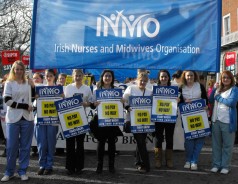
Liam Doran, general secretary at the INMO (Irish Nurses and Midwives Organisation) and Minister for Health Leo Varadkar: Mr Doran said the extra €74m from the Government to help the trolley crisis is welcome but is not enough to solve the problem.
Shorter working hours and the continuing trolley crisis in emergency departments top the agenda for the annual conference of the Irish Nurses and Midwives Organisation, which opens today.
The union is seeking a return to a 37½-hour working week, several years after nurses agreed to work an extra 90 minutes a week under cost-cutting measures agreed with the Government as part of the Haddington Road agreement. In line with other public sector unions, it also wants a significant first step towards the restoration of pay cuts.
It says the latest trolley figures, which a 26 per cent rise in the number of patients waiting for admission to hospital last month compared to the previous April, are very worrying. Of particular concern is a sharp increase in trolley numbers in hospitals outside Dublin – up from 12 to 806 between April 2014 and April 2015.
Today’s figures show there are 465 patients on trolleys or on wards today waiting for admission to a bed. Beaumont Hospital has the largest number with 47 patients waiting, followed by 41 at Our Lady of Lourdes Hospital in Drogheda and 39 at the Mater in Dublin.
The Government has provided an additional €74 million to implement the recommendations of the emergency department task force report, but the INMO says this will not be enough to solve the problem.
General secretary Liam Doran, who co-chaired the task force, described the extra funding was welcome but said much more was needed.
Minister for Health Leo Varadkar is due to address the meeting on Friday.

Dublin woman found she was bred by Nazis for ‘master’ race


Naomi Linehan, co-author of Irish No 1 bestseller Nowhere’s Child, on how Kari Rosvall survived Hitler’s breeding camps to find an Irish home. 

Kari revisits the Lebensborn home called Hohehorst, where she was kept for the first year of her life with other children chosen for Himmler’s scheme
Imagine you just appeared, as if from nowhere – a three-year-old orphan with no parents, no history, no idea of your nationality. Now imagine you had to live with that mystery for your whole life – not knowing where you came from or who you really were. This is what happened to Kari Rosvall.
She calls the first three years of her life the dark years, and that’s what they were until something happened recently in her home in south Co Dublin that changed everything – a clue from the past, about where she came from, a reality she could never have imagined possible.
A letter arrived at her house. Inside was a photograph of Kari as a baby, the first photograph she had ever seen of herself as an infant. At the time, she was 64 years old. The photograph was taken by the Nazis.
Kari discovered that she was born as part of a Nazi breeding programme during the second World War. Lebensborn, “the spring of life” programme, was a secret SS project designed to create a so-called Aryan race of blond-haired, blue-eyed children who would be the future leaders of the Third Reich. Kari Rosvall was one of those Lebensborn children. This is the secret that had been kept from her, for her entire life.
The Lebensborn programme was the brainchild of Heinrich Himmler. Himmler was obsessed with eugenics and the idea of a master race. He once said, “Should we succeed in establishing this Nordic race, and from this seedbed produce a race of 200 million, then the world will belong to us”.
This meant that at the same time that the Nazis were killing Jews as part of the Final Solution they were secretly breeding their own “Aryan race”. The Lebensborn extended beyond Germany, into countries like Norway, where Nazi soldiers impregnated Aryan looking women. Kari’s mother was one of these women.
As part of this plan, Kari was taken from her mother in Norway, when she was just 10 days old, packed in a crate and sent to Germany. There she was kept for the first year of her life with other children chosen for Himmler’s scheme in a Lebensborn home called Hohehorst.
When the war ended in 1945, everything changed. The children who were to be “the elite” suddenly became outcasts in every country. Nobody wanted this sinister reminder of Hitler’s regime. Manufactured by the Nazi war machine, Kari found herself homeless in the world, hidden in an attic with other Lebensborn children. Following a heroic rescue by the Red Cross and a period in an orphanage, she was adopted and grew up in Sweden and eventually found a home in Ireland. But questions from her past still haunted her and she decided to find the answers no matter how difficult this would be.
In her early twenties, Kari had tried to piece together her life story. Like many adopted children she longed for answers, and went looking for her birth parents. She discovered her biological mother in Norway and went to meet her. The meeting was difficult and shocking, and left her with more questions than answers.
Today Kari is an Irish citizen living an ordinary suburban life in Dublin’s Ballinteer. But she has travelled a long way to get there. This is the journey as told in the book, Nowhere’s Child. It is the story of a child abandoned in the world. But it is also a story of a mother and a daughter and of strong people who come to one another’s rescue. It is a story of hope. But it is also a horror story about the shocking reality of an evil regime.
Kari’s story spans the period from the Second World War up to modern-day Dublin. It is a firsthand account that will be gone after this generation. I was lucky enough to meet Kari just over a year ago – almost by accident.
I was reporting for the Pat Kenny Show on Newstalk radio. As a journalist you sometimes think you have to travel to war zones and battlefields to find interesting stories, but sometimes you find them where you least expect.
One day, Kari was at an Irish Countrywomen’s Association meeting, telling her story to some of the ladies who were gathered there. I heard about her from people who were at the meeting, so I went to Kari’s home in Ballinteer to try to find out more.
She told me about her life – about everything that had happened to her – and the interview went out on air. People texted the programme in huge numbers. They wanted to know where they could hear more, and if there was a book about her life.
Kari and I talked about it, and she decided that it was time to tell her story in full, for the first time, and the idea for Nowhere’s Child was born. We both cared deeply about this story and knew it was something that had to be told. And so, we made another decision that would change both our lives. For the next year we would put everything on hold. Kari cancelled travel plans, and I quit my job in Newstalk.
We knew it would be difficult. There were a lot of very painful memories that would have to be relived: Kari’s search for answers, the abandonment by her birth mother, being an orphan in the world and all the feelings that go with trying to come to terms with being part of a history you have not chosen. It would be hard; we knew that. But what we didn’t know was that it would also be healing and inspirational. There were tears along the way, long conversations into the night, gallons of tea, and glasses of wine. And lots of laughter, too.
Kari is one of the warmest people I have ever met. Everywhere we go she brings a warmth and love of life with her. Her optimism is contagious. I do not know how she has found it in her to forgive and put the past to rest. She told me she wants to tell this story to show other people that there is hope and light, even in the darkest places.
Kari has found a home here in Ireland. It is where she is at peace in the world. She is surrounded by loving friends and family, who all came out in great numbers for the launch of Nowhere’s Child just a few short weeks ago. It is a testament to the life she has built with her husband Sven and her son Roger.
Kari Rosvall was just an ordinary person, going about her day. We may have passed her in the street, or in the shops, not knowing the story she had to tell. If there is something we can learn from Nowhere’s Child, it is that history is all around us. It is not some dusty thing from the past. It is a living thing. History is in people. We just need to take the time to stop and ask people what they have experienced, and how they feel about it all. We might just be surprised at what they have to say.

Varadkar rejects claims of lack of action on obesity


Childhood obesity has plateaued, says Varadkar, but adds we must treat obesity as seriously as tobacco

Health Minister Leo Varadkar has hit back at suggestions the Government is not doing enough to combat obesity, after research from the World Health Organisation predicted that Ireland would be the most obese country in Europe by 2030.
The WHO said 89% of men and 85% of women in Ireland will be classed as obese or overweight within the next 15 years.
Mr Varadkar said the figures should be taken as projections, not as fact, and are based on figures that are “quite old”.
“Research and numbers that we do have indicate childhood obesity has probably plateaued and we’ll have figures on adult obesity later in the year when the Healthy Ireland survey is published, so I think it’s important to stick to the facts and not sensationalise what is a serious issue,” he said.
“But it’s absolutely the case that obesity is a major personal and public-health problem and we need, in the next couple of years and in the future, to treat it as seriously as we treated tobacco in the past.”
Mr Varadkar outlined a number of initiatives to combat obesity that are already under way.
“The National Physical Activity Plan is at draft stage and will be published in the next few months; the Cabinet has agreed that we’re going to legislate for calorie posting on menus; and as well as that the special action group on obesity will be advising us on our new obesity policy which will be published by the end of the year.”
He stopped short of advocating a tax on junk food. “I think the jury’s still out on the sugar tax; we need to see if it’s worked. We’ll have some results from Mexico, where they’ve introduced it, quite soon. But if it doesn’t work then it’s just another tax.”
Medical experts have criticised this standpoint and say the Government must do more if it is to avoid the predictions made by the WHO.
Francis Finucane, a consultant endocrinologist at University Hospital Galway, said on RTÉ radio that the Government “needs to take action to legislate”.
“And it’s going to be the legislators in this country who change the obesity epidemic.
“We could use the money we generate from a health-related food tax to fund things like hospital-based services for people who are worst affected by this problem. The fact of the matter is we haven’t done enough to develop those services nationally.”
Prof Donal O’Shea, head of weight management at St Columcille’s and St Vincent’s Hospitals, said obesity was driving a diabetes epidemic, a cancer epidemic, and a heart-disease epidemic that “the health service is currently not coping with”.
Meanwhile, the Irish Cancer Society is funding new research to decrease the risk of cancer by changing dietary habits. According to the WHO, there is a strong link between obesity and many types of cancer.

THE 5 DAY ABS CHALLENGE?

      
Who’s ready to work on those killer abs? Join me for the 5 day abs challenge from Daily Hiit. No matter if you are on a holiday or busy with work you can find 20-30 minutes to work on your tummy and get those abs ready for the summer season which is just around the corner.
For those who are all excited to join me on the challenge, but are not sure how to perform some of the abs exercises scroll down and find a detailed explanation of each exercise below.
Reverse Crunch: Lie on the floor and place hands on the floor or behind the head.
  1. Bring the knees in towards the chest until they’re bent to 90 degrees, with feet together or crossed.
  2. Contract the abs to curl the hips off the floor, reaching the legs up towards the ceiling.
  3. Lower and repeat for 1-3 sets of 12-16 reps.
  4. It’s a very small movement, so try to use your abs to lift your hips rather than swinging your legs and creating momentum.
V-Ups: Lie on a flat surface with your lower back curvature pressed against the surface. Hold on to a fixed and sturdy object behind you (such as one of the beams from a squat rack) or you can just have your arms by your side with the palms facing the floor. Your feet should be straight in front of you and the upper torso should be aligned with the arms behind you holding on to the fixed object.
  1. Raise your legs to where they are off the floor. This will be your starting position.
  2. Raise your legs until the torso makes a 90-degree angle with the legs. Exhale as you perform this movement and hold the contraction for a second or so.
  3. Go back slowly to the starting position as you breathe in.
Russian Twists: Sit on the ground with your knees bent and your heels about a foot from your butt.
  1. Lean slightly back without rounding your spine at all. It is really important, and difficult, to keep your back straight, but don’t let it curve.
  2. Place your arms straight out in front of you with your hands one on top of the other. Your hands should be level with the bottom of your ribcage.
  3. Pull your navel to your spine and twist slowly to the left. The movement is not large and comes from the ribs rotating, not from your arms swinging. Inhale through center and rotate to the right. This completes one rep.
Sit Ups: Lie down on the floor placing your feet either under something that will not move or by having a partner hold them. Your legs should be bent at the knees.
  1. Place your hands behind your head and lock them together by clasping your fingers. This is the starting position.
  2. Elevate your upper body so that it creates an imaginary V-shape with your thighs. Breathe out when performing this part of the exercise.
  3. Once you feel the contraction for a second, lower your upper body back down to the starting position while inhaling.
Side Jackknife: Lie on your left side on an exercise mat with your legs extended straight downward and the right leg on top of the left. Place your left hand on your abdominals. Place your right hand behind your head. This is your starting position.
  1. Raise your right let straight in the air while simultaneously raising your torso, bringing your right elbow toward your right leg.
  2. Hold for a moment and then return to the starting position.
  3. Repeat for a complete set and then switch sides.
Mountain Climbers: Start the exercise by lying face down on the floor.
  1. Straighten out your arms and then touch your knees down to the ground or floor.
  2. Now you are ready to lift yourself up into position. When doing this, be sure that your hands are directly under your chest at a width that is slightly more than your shoulder length distance.
  3. Once you have settled into position and checked the position of your hands you should be sure to keep your legs stretched out, ensuring that they are properly lined up with the rest of your body. Pay special attention to your knees as many people tend to create a gap here but that should be avoided. If the recommended position is uncomfortable for you, it is alright to modify it slightly as long as you maintain the correct posture.
  4. Now you should stretch out your left leg for stability. Bend your right knee and bring it up in the direction of your right hand. At this point, you should be in a similar position to the one you would be in if you were climbing a mountain or tree (hence the name) except horizontal instead of vertical.
  5. After bringing your right knee up, return it to the original position and do the previous step with your left leg. (Once again, bend the left knee and bring it up towards the left hand mimicking the actions of a mountain climber)
Scissors: Lie flat on your back. You can extend your arms so they’re against the sides of your body with your palms pressing into the floor, or you can bend your elbows and place your palms under the back of your head.
  1. Bend your knees and draw them into your ribs. This will make it easier to pull your navel in towards your spine and actively press your lower back flat on the ground.
  2. Lift both legs straight up toward the ceiling, continuing to engage your abs and press your lower back into the ground.
  3. Keeping your core strong, slowly lower your right leg down toward the ground, until it is a few inches above. Then scissor your legs, so you lift your right leg back up as you lower your left leg down towards the ground.
  4. Keep the movements slow and steady, moving with control, and keeping your core engaged the entire time, and your lower back pressing into the floor.
Side Plank: Lie on your left side with your knees straight.
  1. Prop your upper body up on your left elbow and forearm. Position your elbow under your shoulder.
  2. Brace your core by contracting your abs forcefully as if you were about to be punched in the gut.
  3. Raise your hips until your body forms a straight line from your ankles to your shoulders. Your head should stay in line with your body.
  4. Hold this position for the prescribed amount of time while breathing deeply. That’s one set.
  5. Turn around so that you’re lying on your right side and repeat.
Plank: Start off on a yoga mat in the pushup position. Starting with the pushup position is the easiest way to get into the plank.
  1. Lower both your forearms to the ground so that both your elbows and fists are flat to the ground. Your palms should be balled up, and directly underneath your shoulders.
  2. Curl your toes under and engage your abs by tilting your pelvis and pulling your belly button toward your spine.
  3. Straighten your body but keep your neck and spine neutral. Imagine that you’re a plank of wood, and that you’re straight as an arrow.
  4. Flex your abdominals and squeeze your glutes. These are the two major muscle groups you’ll be working out in this exercise.
  5. Hold this position, also known as the plank, until after the burning begins. Keep your eyes on the floor in front of you. Avoid raising your behind. Your body should make a straight line from your heels to the back of your head.
Bicycle Crunches: Lie flat on the floor with your lower back pressed to the ground and contract your core muscles.
  1. With your hands gently holding your head, lift your knees to about a 45-degree angle.
  2. Slowly, at first, go through a bicycle pedal motion.
  3. Alternately touching your elbows to the opposite knees as you twist back and forth.
Burpees:
  1. Begin in a standing position. Your feet should be shoulder-width apart. Now, lower your body into a squatting position, placing your hands on the floor in front of you.
  2. Kick your feet back so that you are in push-up position. Keep your hands firmly on the ground to support your body.
  3. Lower your chest to do a push-up. Bring your chest back up.
  4. Kick your feet back to their original position. Stand up, and then jump into the air while clapping your arms overhead.
  5. Repeat.

How muscles created from humble onion cells provide scientists to develop artificial muscles


The humble onion is proving its strength outside the culinary world, enabling scientists to develop artificial muscles by using gold-plated cells of the vegetable.

The humble onion is proving its strength outside the culinary world, enabling scientists to develop artificial muscles by using gold-plated cells of the vegetable.
Unlike previous artificial muscles, this one, created by a group of researchers from National Taiwan University, can either expand or contract to bend in different directions depending on the driving voltage applied.
“The initial goal was to develop an engineered micro-structure in artificial muscles for increasing the actuation deformation (the amount the muscle can bend or stretch when triggered),” said researcher Wen-Pin Shih.
“One day, we found that the onion’s cell structure and its dimensions were similar to what we had been making,” said Shih, who lead the study. The onion epidermis is a thin, translucent layer of blocky cells arranged in a tightly-packed lattice.
Shih and his colleagues thought that onion epidermal cells might be a viable candidate for the tricky task of creating a more versatile muscle that could expand or contract while bending.