Pages

Showing posts with label Cancer's. Show all posts

Monday, March 6, 2017

Donie's Ireland daily news BLOG update

Bus Éireann may sell company property and assets to pay for redundancy scheme?

AS PART OF REVISED SURVIVAL PLAN, MOVE CONSIDERED FOR VOLUNTARY REDUNDANCY SCHEME.

Image result for Bus Éireann may sell company property and assets to pay for redundancy scheme?  Image result for Bus Éireann may sell company property and assets to pay for redundancy scheme?

BUS ÉIREANN SUGGESTED IN A CONFIDENTIAL EMAIL TO THE WRC THAT FUNDING COULD BE SECURED TO MEET THE COST OF A VOLUNTARY REDUNDANCY SCHEME.

Bus Éireann may sell assets including property to part fund a voluntary redundancy scheme for staff as part of a revised survival plan for the company.
Bus Éireann believes the board of its overall parent holding group, CIÉ, will provide it with additional funding in the short term if it produces a viable plan to tackle potential insolvency and uncompetitiveness.
The company suggested in a confidential email on Friday to the Workplace Relations Commission (WRC) that funding could be secured to meet the cost of a voluntary redundancy scheme to be put in place over the next 12-18 months.
Sources suggested this money could be provided by both the CIÉ holding group and by Bus Éireann itself including by means of a sale of assets including property.
The company also indicated for the first time that the immediate threat of insolvency at the company could be overcome by staff co-operation with improved efficiency measures and the implementation of all existing national agreements across the company. Plans for cuts to terms and conditions and further cost-saving measures which were to be included in an all-embracing survival plan which was to have been completed by the end of March would appear to have been shelved.
Talks suspended?
A planned all-out indefinite strike at the State-owned transport company, which was scheduled to go ahead on Monday, was suspended on Friday after the intervention of the WRC, which invited the parties to talks on Monday.
Management at the company agreed to hold back on the planned unilateral introduction of work practice changes and new efficiency measures next Monday and in turn trade unions suspended their plans for strike action.
The planned closure of the Clonmel-Dublin route on March 12th and the scheduled reduction in frequency of Dublin-Limerick and Dublin-Galway services on the same date have also been deferred pending the outcome of the new talks.
In an email on Friday afternoon, Bus Éireann management told the WRC: “We all want Bus Éireann to survive and prosper. We are very conscious of the significant long-term damage that could be caused by a strike and are willing to engage with the unions and compromise to reach a sustainable agreement. With this in mind and in a final effort to avoid a dispute the company are putting forward the following position. We believe that if we can put forward a viable plan that demonstrates that we are addressing the insolvency and competitiveness issues that we can expect financial support in the short term. This proposal covers all items and there will not be a need for any additional plans such as those suggested for the end of March.”
Bus Éireann said that the issue of uncompetitiveness at the company would significantly be addressed by “restructuring and rationalisation”.
A staff reduction?
“The implementation of streamlining structures together with improved efficiencies will allow for a reduction in staff numbers. We are confident that if we reach agreement on improved efficiencies and show how this is addressing the imminent threat of insolvency that funds will be made available to provide for the costs of voluntary severance. Releasing staff through voluntary severance could then begin rolling out over the next 12 to 18 months. Redeployment will be a critical element of achieving the core manning numbers as will voluntary severance. The potential voluntary severance packages are likely to be available across all grades. “
Bus Éireann also said in the email it was willing to negotiate with the unions on the issue of a pay increase for staff “in the context of ensuring a plan for future survival without pre-conditions”.
It said any increase must be justified in its own right.
Siptu sector organiser Willie Noone said the union’s representatives would continue to play their part in trying to avert a national public transport dispute “but we rely on the management of Bus Éireann making genuine efforts to reach a resolution”.
NBRU general secretary Dermot O’Leary said his members remained on a “war footing” and would be prepared to engage in an immediate all-out strike “should the company plough ahead with any attack on members’ terms and conditions.

Parkinson’s treatment app founder named as “Ireland’s Best Young Entrepreneur”

THE APP HAS HELPED PEOPLE WITH PARKINSON’S DISEASE IN 40 COUNTRIES.

Image result for Parkinson’s treatment app founder named as "Ireland’s Best Young Entrepreneur"  Image result for Parkinson’s treatment app founder named as "Ireland’s Best Young Entrepreneur"

THE FOUNDER OF AN APP TO HELP PEOPLE WITH PARKINSON’S DISEASE HAS BEEN CROWNED IRELAND’S BEST YOUNG ENTREPRENEUR.

The 26 year old Physiotherapist Ciara Clancy, developed Beats Medical which emits a beat or soundwave from your smartphone to help control movement and speech.
She will now receive a €45,000 investment through the Local Enterprise Offices to help develop her company further.
Minister Mary Mitchell O’ Connor and Minister Pat Breen announced the winner of Ireland’s Best Young Entrepreneur (IBYE) competition at the Google European HQ in Dublin earlier today.
The competition, which is supported by the Department of Jobs, Enterprise and Innovation and Enterprise Ireland and run by the 31 Local Enterprise Offices, attracted entries from over 1,800 18-to-35-year-olds and showcased some of the country’s best and brightest business talent.
In addition to becoming Ireland’s Best Young Entrepreneur, Ciara Clancy also won the ‘Best Established Business’ category.
The Beats Medical app provides individually tailored physiotherapy, speech and language and occupational therapy exercises through mobile phones.
Ciara Clancy said that her aim is to continue supporting more and more people with Parkinson’s around the world, as an estimated 10 million people currently live with the disease.
She is also developing digital treatments for other neurological conditions such as MS, Stroke, Dyspraxia and Cerebral Palsy.
Speaking after winning the award she said “These success stories keep all of the team at Beats Medical motivated every day to do more for the people that use our service.”

U2 at the top of Irelands rich list chart

Image result for U2 at the top of Irelands rich list chart  Image result for Niall Horan, Colin Farrell, Graham Norton, Michael Flatley, Daniel O’Donnell, and Enya on Irelands rich list chart

U2 ARE THE RICHEST ENTERTAINERS IN IRELAND WITH A COMBINED WEALTH OF €645 MILLION, ACCORDING TO THE 2017 SUNDAY TIMES IRISH RICH LIST.

Irish entertainers Niall Horan, Colin Farrell, Graham Norton, Michael Flatley, Daniel O’Donnell, and Enya also feature on the new list, which examines the wealth of the 300 richest individuals and families in Ireland across entertainment, sport, business, technology and construction.
U2’s last world tour took in $133m but the band are still some way behind the world’s richest entertainer, Paul McCartney, who was estimated to have a fortune of £730m on 2015’s Sunday Times list.
One Direction star Horan is the only person under 40 on the Richest Entertainers List, and has securing a place among the top 10. Donegal star Daniel O’Donnell also makes the grade with an estimated wealth of €31m.
Alastair McCall, Editor of The Sunday Times Rich List, said: “U2’s status as one of Ireland’s most recognisable exports is confirmed by their position at the top of our Entertainers’ Rich List, accounting in their own right for more than 30% of the wealth measured. They are to Ireland what Abba were to Sweden in the 1970s – a global brand with instant recognition.”
Actors including Liam Neeson, Pierce Brosnan and Colin Farrell also appear on the Richest Entertainers List. Wicklow residents Daniel Day-Lewis and his wife Rebecca Miller are in at 8th place on the list with a fortune of €55m between them.

Threat to Sligo vet lab is against Irish rural policy says Marian Harkin

Image result for Threat to Sligo vet lab against rural policy says marian Harkin  Image result for Threat to Sligo vet lab is against Irish rural policy says Marian Harkin

THE INDEPENDENT MEP MARIAN HARKIN.

THE INDEPENDENT MEP MARIAN HARKIN HAS SAID THE POSSIBLE CLOSURE OF THE DEPARTMENT OF AGRICULTURE’S REGIONAL VETERINARY LABORATORY (RVL) IN SLIGO CONFLICTS WITH GOVERNMENT RURAL POLICY.

The proposal by the Department to close the lab in Sligo and others is flying in the face of good animal health practice and in contravention of recent Government policies to stimulate development in rural areas, according to Marian Harkin MEP.
She was speaking after it was revealed by the Irish Farmers Journal that RVLs are subject to a major internal review headed by Professor Alan Reilly, the former chief executive of the Food Safety Authority of Ireland.
One of the recommendations from the report is to, in time, close Limerick, Sligo and Kilkenny, with an upgrading of the facilities at the other three labs.
“The Sligo laboratory also plays a significant role in helping to protect Ireland’s animal health status, which is a major positive marketing tool in promoting the country’s food products on a worldwide basis,” Marian said.

A SIX-HUNDRED KILOMETRE ROUND-TRIP?

“We have seen successive lip service plans to supposedly bring long overdue balanced regional development and the latest Ireland 2040 plan’s strategy is to ensure that ‘the enormous potential of the rural parts of our country are maximised’”, she said.
If the closure goes ahead, it will leave farmers having to travel a 600km round-trip from the Inishowen Peninsula to the proposed centralised facility in Athlone.
Bringing a dead animal for the examination would have significance for both the farmer concerned and for the build-up of knowledge, which is vital to protecting the country’s animal disease status, the Independent MEP said.
She questioned how this aspiration for regional development could be taken seriously in the northwest when a service vital to the region’s most important economic sector was proposed to be removed.
Saving the lab petition.
In an effort to save the RVL, part-time suckler farmer Trevor Boland, who is from Dromard in Co Sligo, set up a petition.
He told the Irish Farmers Journal the RVL is of vital importance to farmers from Donegal to Sligo.
“If this RVL closes, the nearest one to us will be in Athlone and that will affect the speed of post-mortem tests and their results,” he said.

Obesity now linked to 11 types of cancer as our overweight population grows

Image result for Obesity now linked to 11 types of cancer as our overweight population grows  Image result for Obesity now linked to 11 types of cancer as our overweight population grows  Related image
A new research finds a link between obesity and 11 cancers as the worldwide obesity rate continues rising, according to the World Health Organization.
Obesity is strongly linked to the development of 11 types of cancers, including breast, kidney, rectum, colon, and pancreatic cancer, scientists warned in a new study.
The research on excess body fat and cancer, published in the British Medical Journal, reviewed more than 200 studies on cancer and obesity and found “strong evidence” of a connection between increased body fat and 11 cancers.
“Other associations could also be genuine, but there is still substantial uncertainty about them,” lead study author Dr. Maria Kyrgiou, of Imperial College London, said by email, according to reports from several news outlets.
Researchers specifically reviewed the data on body mass index (BMI), a ratio of weight to height, and discovered links between an increase in BMI and a higher risk for cancers of the pancreas, kidney, bone marrow, esophagus and biliary tract.
The strongest connection was discovered between obesity and cancer of the digestive organs, and excess fat and hormone-related cancers in women, according to the survey.
But, the study authors cautioned that more research is needed to better understand the connection between obesity and cancer.
Cancer is a leading cause of death globally, with almost 9 million people dying from a form of the disease in 2015, according to the World Health Organization, and the numbers are expected to continue increasing by about 70 percent over the next two decades, the WHO said on its website.
Almost 2 million adults are overweight or obese, the WHO reported. Obesity increases the risks for all kinds of health problems, including diabetes, heart disease and certain cancers.     

Friday, August 26, 2016

Donie's Ireland daily news BLOG update

With Universal Social Charge the best we can hope for is a very long goodbye

REPLACING UNIVERSAL SOCIAL CHARGE WOULD REQUIRE BIG TAX HIKES ELSEWHERE

Image result for Universal Social Charge the best we can hope for is a very long goodbye  Image result for universal social charge budget 2016

The MINISTER FOR FINANCE MICHAEL NOONAN HAS ACTED TO FREEZE PROPERTY TAX BILLS UNTIL 2019.

The Department of Finance quite likes the universal social charge – or so you might conclude from various communications from senior officials to the Minister. The latest, released in a freedom-of-information request to Sinn Fein’s Pearse Doherty, outlines what would be needed to replace the €4 billion revenue if the USC was abolished.
Needless to say, all the options are horrific. The USC accounts for not far off €1 in every €10 raised in tax each year (9.1%), to be precise). And so, were it to be abolished in one fell swoop, replacing it would require big tax hikes elsewhere – for example, a sixfold increase in the property tax combined with a range of other hikes in capital taxes, or a rise in the two main income tax rates by five points each to 25% and 45%.
Everyone knows that this is not going to happen. We are never going to be able to afford to abolish the USC in a year or two, even if the tone of the general election debate might have suggested otherwise. The documents, drawn up as briefing notes for a new Minister for Finance – in the event,Michael Noonan was reappointed – look designed to drive home the point that progress in cutting the USC was going to have to be slow.

GRADUAL PHASING OUT PROCESS? 

The department said the notes predate the programme for government and the plan was for the “gradual phasing out” of the USC to continue. The plan was never to abolish it in one go.
  • Property tax may need to be increased by 600% if USC scrapped
  • Department says USC advice predates Programme for Government
The statement added: “While scope is limited in this year’s budget there will be a further move to curb USC, especially for mid- to low-income earners”. The statement also noted that there was “absolutely no intention” to increase property tax in the forthcoming budget. In fact, Noonan has acted to freeze property tax bills until 2019, a move which will introduce so many anomalies that the tax could yet be wide open to legal challenge.
What we will see in the budget is some limited further relief for USC. It would be a surprise if the main rate – cut from 7% to 5.5% in the last budget – was not cut again. But the room for manoeuvre on budget day will be limited – about €330 million will be available to reduce taxes, compared with €750 million last year. A bit more may be available in subsequent years, but that depends on the ability of the economy to continue to grow at 3% plus a year, post-Brexit.
The plan of the Government – if it lasts – is to continue to use the spare resources in the budget to cut the USC year by year. This is because the alternative route to phasing out the USC – raising significant money elsewhere – is seen as unpalatable. Cash will be raised from a new tax on sugary drinks in the next few years. And it is likely that income tax credits and the standard-rate band will not be adjusted for wage inflation – effectively a sneaky tax increase on people getting wage rises, which will offset some of the gains of USC cuts. But there is no way the Government will take the potential political hit of raising a large sum elsewhere after the water charges debacle.
But there will be no big move to , say, hike property taxes or indirect taxes. And the scale of the revenue raised by the charge mean we will all be living with it for years yet. We are talking, at best, about a decade-long phase-out of the charge, if that is the route successive governments chose to take.

POLITICAL CAPITAL

Sinn Féin, whose plans were more modest in terms of USC reduction than those of Fianna Fáil and Fine Gael, will seek to make some political capital out of this in the run-up to the budget. Fine Gael, meanwhile, by refusing to give way on its plans to phase out the charge, will struggle to make the case that this is achievable in a reasonable time frame.
Calculations presented by the department in prebudget tax documents set out a programme which could see the USC roughtly halved by 2020. It would require all the estimated room for tax cuts to be allocated to USC reductions – and in fact for new revenue to come on stream to meet some of the cost after 2018. And remember that for the room to manoeuvre to emerge we need economic growth to continue.
So the painful USC charge on our payslips is here to stay for quite some time yet. The best we can hope for is a very long goodbye.

The number of complaints against doctors in Ireland has increased“with many blamed for poor communication”

Image result for complaints against doctors in Ireland has increased Image result for complaints against doctors in Ireland has increased Image result for complaints against doctors in Ireland has increased

THE NUMBER OF COMPLAINTS AGAINST DOCTORS ROSE LAST YEAR WITH MANY PATIENTS ACCUSING MEDICS OF POOR COMMUNICATION.

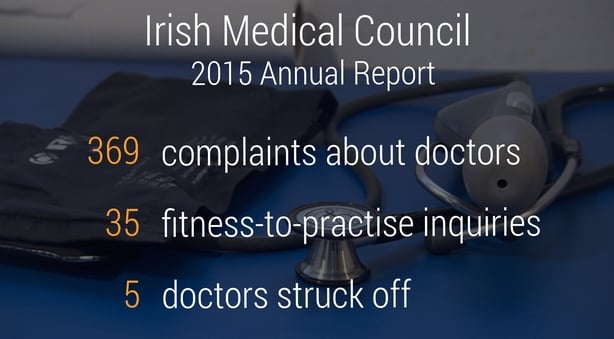
The annual report of the Medical Council, the regulatory body for doctors, said it received 369 complaints about the profession in 2015, compared to 308 in 2014.
The number of complaints about poor communication rose by 40%..
The majority of grievances came from the public, but 25 were lodged by other health professionals and two by the HSE.
Other causes of allegations related to misdiagnosis, clinical investigations and examinations, professional skills, lack of dignity when treating patients and poor follow-up care.
There were 35 fitness to practise inquiries into serious allegations against doctors during the year, half of which were held in public.
Chief executive Bill Prasifka said the number of doctors registered here topped a record 20,473.

THERE WERE 1,200 DOCTORS EXITING THE REGISTER DURING THE YEAR.

He said: ”I found it particularly interesting that although males continue to dominate the medical profession as a whole, since we began collating this data, there have been more Irish female graduates entering the medical profession than their male counterparts.
“The majority of those on the register between the ages of 30 – 44 are female; however from 44 years and on the number of females on the register begins to decrease.
“Data from our Your Training Counts report also found that 40% of female trainees – or tomorrow’s specialists – want to work less than full-time and this  definitely poses some questions for the health sector and all of those involved in the future planning of Ireland’s healthcare service.”
Medical Council President, Prof Freddie Wood said: “It is great to see that the number of specialists on the register has increased significantly this year as we are all too aware of the doctor shortages we have experienced in recent months and years and with this valuable data we have the power to share workforce intelligence with our stakeholders involved in healthcare planning in order to address these issues and deficiencies that have hindered our health system for too long”

THE FINDINGS SHOW:

• Exit rates of doctors have increased slightly on last year – from 5.6% in 2014 to 6.4% in 2015;
• The number of specialists on the register in 2015 increased by almost 7%;
• Reliance on international medical graduates is among the highest in the OECD with almost 38% of the workforce an international medical graduate

Excess body fat now linked to 13 different types of cancer

Excess body fat now linked to 13 different types of cancer      Image result for Excess body fat now linked to 13 different types of cancer   

EXCESS FAT INCREASES THE RISK OF CELL ABNORMALITIES.

“Experts have linked eight more cancers to being overweight or obese, nearly tripling the list from five to 13,
This is the latest finding of the International Agency for Research on Cancer (IARC), a group of cancer experts from around the world that look at risk factors for cancer.

WHAT IS THE BASIS FOR THESE REPORTS?

The headlines are based on a report published in the peer-reviewed New England Journal of Medicine.
The report is not exactly new research, but a review of previously published studies that looked at the link between weight and cancers.
It is the result of a working group of international cancer researchers who met to review the evidence in April this year.

WHAT’S THE LINK BETWEEN FAT AND CANCER?

The IARC looked at research into the reasons why being overweight may cause cancer.
They found strong evidence that sex hormones and inflammation – both of which are affected by weight – are involved in cancer formation.
They also reviewed evidence from experiments on rats, which found animals fed a calorie-restricted diet were less likely to develop a range of cancers, and obese animals were more likely to get cancer.
They reviewed studies in humans, animals and basic science to see whether the group’s previous conclusions, published in 2002, needed to be updated.
The group’s new report concludes that, “the absence of excess body fatness lowers the risk of most cancers”, also saying that losing weight intentionally may help prevent cancer.
They list 13 cancers where they say there is “sufficient” evidence to conclude that being a healthy weight reduces the risk of cancer, three where there is “limited” evidence, and eight where the evidence is “inadequate”.

THE CANCERS THEY IDENTIFY AS HAVING SUFFICIENT EVIDENCE TO LINK THEM TO WEIGHT ARE:

  • oesophageal cancer
  • gastric cardia – a type ofstomach cancer
  • bowel cancer
  • liver cancer
  • gallbladder cancer
  • pancreatic cancer
  • breast cancer in postmenopausal women
  • womb cancer
  • ovarian cancer
  • kidney cancer
  • meningioma – a type of brain tumour
  • thyroid cancer
  • multiple myeloma – cancer of the white blood cells
The degree of increased risk ranged from an almost fivefold increase for oesophageal cancer in the highest BMI category compared with people with a normal weight (relative risk [RR] 4.8; 95% confidence interval [CI] 3.0 to 7.7), to a 10% increased risk of postmenopausal breast cancer (RR 1.1, 95% CI 1.1 to 1.2).

WHAT IS THE LINK BETWEEN CANCER AND WEIGHT?

Scientists have known for some time that people who are overweight have an increased risk of certain cancers compared with people of a healthy weight.
A healthy weight is usually defined as having a body mass index (BMI) of 18.5 to 24.9. People are classed as overweight if their BMI is 25 to 29.9 and obese if their BMI is 30 or over. BMI is calculated from weight and height.
Almost all of the evidence linking being overweight and cancer is from epidemiological studies, which look at large groups of people and then calculate how likely people of different weights are to have been diagnosed with cancer, compared with people of a healthy weight.
Many of these studies also try to take account of other factors that can affect cancer risk, such as whether people smoke, whether they exercise, and how healthy their diet is.
But it’s hard to account for all other factors, so individual studies can’t really show whether being overweight causes cancer.
When reviewed together, however, and when studies show that the more overweight someone is, the more likely they are to get cancer, the chances are higher that the research is showing that weight has a causal effect.
A report by the IARC in 2002 said there was enough evidence to say being overweight increased the risk of eight cancers, all of which are included in the new list of 13.
Since then other studies have strengthened the evidence, so the IARC now feels it has enough evidence to list these 13 cancers.
How does weight and cancer affect you?
Carrying excess body weight has a number of health risks, including a greater chance of having a heart attack or stroke, as well as being linked to a raised risk of the cancers listed above.
The easiest way to keep to a healthy weight is to avoid putting weight on, but if you already weigh more than you like, diet and exercise can help you achieve a healthier weight.
Talk to your GP or see our 12-week plan to lose weight through healthy eating and physical activity.
Weight is not the only factor that affects the risk of cancer. Although there’s no proven way to avoid cancer altogether?
You can lower your risk of getting cancer if you:-
  • eat a healthy, balanced diet
  • maintain a healthy weight
  • stay physically active
  • drink less alcohol
  • stop smoking
  • protect your skin from sun damage

Your daily coffee habit could be part of your genetics?

A NEW STUDY NOW SUGGESTS

Image result for Your daily coffee habit could be part of your genetics?   Image result for Your daily coffee habit could be part of your genetics?  Image result for Your daily coffee habit could be part of your genetics?

SCIENTISTS HAVE FOUND A GENE THAT APPEARS TO HAVE AN INFLUENCE OVER THE AMOUNT OF COFFEE PEOPLE DRINK, AND HOW THE BODY PROCESSES CAFFEINE

The gene variant appears slowing the breakdown of caffeine in the body, meaning the stimulant lingers in the blood for longer and gives people a more enduring “hit” for every cup.
A gene that appears to wield influence over the amount of coffee people drink has been found by scientists who believe the section of DNA alters how caffeine is broken down in the body.
Italians villagers who carry a specific variant of the PDSS2 gene consume about one less cup of coffee per day compared with non-carriers, according to researchers at Edinburgh University.
The gene variant appears to affect people’s coffee intake by slowing the metabolism of caffeine in the body. When caffeine is broken down more slowly, the stimulant lingers in the blood for longer and gives people a more enduring “hit” for every cup.

WHY DRINKING COFFEE CAN GIVE YOU JET LAG – AND HELP YOU GET OVER IT.

Nicola Pirastu, a geneticist who led the study, said the discovery reinforces the idea that caffeine is one of the main drivers for drinking coffee. But he added that larger studies are needed to confirm the biological mechanism that links the PDSS2 gene to coffee drinking.
Previous searches for genes linked to coffee consumption have already thrown up more than half a dozen variants that hold sway over the metabolism and rewarding effects of caffeine. In teasing out the genetics of coffee drinking, scientists hope to learn more about the unexplained effects of the drink. “Coffee is protective against some types of cancers, cardiovascular diseases and Parkinson’s,” said Pirastu. “Understanding what is driving its consumption may help us understand what the effects on these diseases are, and so open new lines of research.”
In the study, researchers analysed the genetic makeup of 370 people living Puglia in southern Italy and a further 843 from six villages in the Friuli Venezia region in the north east. All were asked to complete a survey, which included a question about how many cups of coffee they drank each day.
The researchers found that people with a specific variant of the PDSS2 gene tended to drink fewer cups of coffee than those who carried other variations of the gene. To check the result, the researchers went to 1731 people in the Netherlands and found a similar effect, though the gene’s apparent influence over coffee consumption was weaker there.

CAN DRINKING TOO MUCH COFFEE KILL YOU?

 One explanation could be that national preferences for coffee differ in Italy and the Netherlands. While moka and espresso are popular in Italy, the Dutch favour more filter coffee. And even though the concentrations of caffeine in the drinks are much the same, the difference in cup sizes means the Dutch imbibe nearly three times as much caffeine per cup as the Italians.
Published in the journal Scientific Reports, the study drew on researchers from Edinburgh, Trieste and the Netherlands. The Italian coffee company Illy participated in the project, but did not fund the work.
Many of the genes that have a role in the breakdown of caffeine also metabolise certain medicines. So unravelling the genes could help scientists understand why some patients respond differently to their drugs than others, and so help doctors to personalise their treatments, Pirastu said.

Kitten size extinct ‘lion’ named after Sir David Attenborough

Image result for Kitten size extinct 'lion' named after Sir David Attenborough Sir David Attenborough Image result for Kitten size extinct 'lion' named after Sir David Attenborough

MICROLEO ATTENBOROUGHI WAS SMALL ENOUGH TO FIT INSIDE A HANDBAG, ACCORDING TO AUSTRALIAN SCIENTISTS

A miniature marsupial lion, extinct for at least 18 million year, has been named after Sir David Attenborough after its fossilised remains were found in a remote part of Australia.
Teeth and bone fragments from the kitten-sized predator, named Microleo attenboroughi, were found in limestone deposits at the Riversleigh World Heritage Fossil site in north-western Queensland.
The researchers named the new species after the British broadcasting legend because of his work promoting the famous fossil site, which provides a record of nearly 25 million years of Australia’s natural history.
When Microleo was still prowling around, in the early Miocene era (roughly 19 million years ago), the arid, outback ecosystem was a lush rainforest.
“It likely ran through the treetops, gobbling up birds, frogs, lizards and insects,” says Dr Anna Gillespie, a palaeontologist at the University of New South Wales (UNSW).
Ms Gillespie, who has been working at Riversleigh and preparing fossils for 20 years, helped recover fragments of the animal’s skull and several teeth.
The relatively tiny tooth row of Microleo attenboroughi (top), compared with the tooth row of its Pleistocene relative, the lion-sized Thylacoleo carnifex
It’s far from a complete skeleton, but it’s an important part of the puzzle.”Crucially, we have got the third premolar, which is an elongated tooth that looks like a blade,” she told the BBC.
The razor-sharp tooth, used to tear up prey, is a common feature found in all known members of the family.
“It immediately tells us it’s a marsupial lion,” she says.
A pocket-sized predator? But the tooth is by far the smallest of its kind ever recovered.
It’s about one-tenth the size of the 3cm-long “bolt-crunching” teeth belonging to the largest and last surviving marsupial lion, Thylacoleo carnifex, which went extinct about 100,000 years ago.
Thylacoleo weighed about 130kg (286lbs) and was Australia’s largest carnivorous mammal. It was a fearsome predator about the size of an African lion, with the bite strength to match, and hunted megafauna such as giant kangaroo and diprotodon.
In sharp contrast, Ms Gillespie and her team estimate that their “little guy” weighed only 600g, and was about the size of a kitten.
“We weren’t expecting to find a marsupial lion of this small size,” she says. “It might have been a bit too big to fit in your pocket, but it would have fit quite comfortably in a handbag. It would have been very cute.”
Image result for Kitten size extinct 'lion' named after Sir David Attenborough The Neville’s Garden site is renowned for the rich diversity of fossils that have been discovered there over many years
The team has ruled out the possibility that the fossils belonged to a juvenile, or a malformed member of a related species. This is due to their distinctive shape, the fact that all the molars have erupted and the presence of “very clear wear patterns”.
“This animal has been running around hunting things for quite a while. So it’s definitely an adult,” says Dr Gillespie.
The team from UNSW has described the new species in the journal Palaeontologia Electronica.

UNMATCHED DIVERSITY?

With this find, the researchers have determined that at least three different marsupial lions were co-existing in the ancient Riversleigh rainforest.
“This level of diversity is unmatched for the family at any other time in their evolutionary history,” the researchers note.
Sir David Attenborough has long promoted Australia’s Riversleigh World Heritage Fossil site
One marsupial lion (Priscileo) weighed about 1.8kg, and was about the size of a cat. Another yet-to-be described species (Wakaleo) weighed around 30kg, about the size of a small Labrador dog, says Ms Gillespie.
She says it indicates that they may have been co-operating, dividing up the food resources to reduce competition between themselves.
The fossil was found in a location at Riversleigh known as Neville’s Garden, which has become renowned for its rich diversity of animals.
Caption Microleo was tiny compared to other members of the marsupial lion family, which included the enormous and fierce Thylacoleo
It’s yielded bandicoots, possums, kangaroos, toothed platypuses, small koalas, thousands of bats, fish, turtles, lizards, pythons and a range of rainforest birds.
“My colleagues have been working at Riversleigh for 40 years,” says Ms Gillespie.
“In that time we have processed tonnes of limestone, and got thousands and thousands of fossils back, but this is the only specimen from this animal.
“So it’s rather enigmatic in this way,” she says. “It might have been a rare species in that ecosystem, but we still have to hunt for more.”
‘Freakishly productive’
Stephen Wroe, an associate professor of zoology and palaeontology at the University of New England in NSW, who was not involved in the study, says the discovery raises new questions about the origin of the marsupial lion family.
“Until quite recently there were only a few marsupial lion species known. Over the last decade or two evidence from Riversleigh has seen this jump to 11 subspecies,” he says.
“This most recent find doesn’t just increase the known diversity in terms of species numbers – it greatly expands the diversity of known morphologies.”
Mr Wroe says the team has done a good job estimating the body size: “No matter how you wash it, this little guy was tiny relative to other members of the family.”
He says its diminutive size may explain why only a single specimen has been found.
“In general Australia’s fossil record is very poor over this time period,” he says. “Riversleigh is a freakishly productive area in this respect.”