Pages

Showing posts with label Carbon. Show all posts

Friday, August 21, 2015

Donie's Ireland daily news BLOG

Irish household debt falls by 2.3% on 1stquarter & most in five years

Central Bank figures show total household debt fell to €154.6 billion or €33,530 per capita
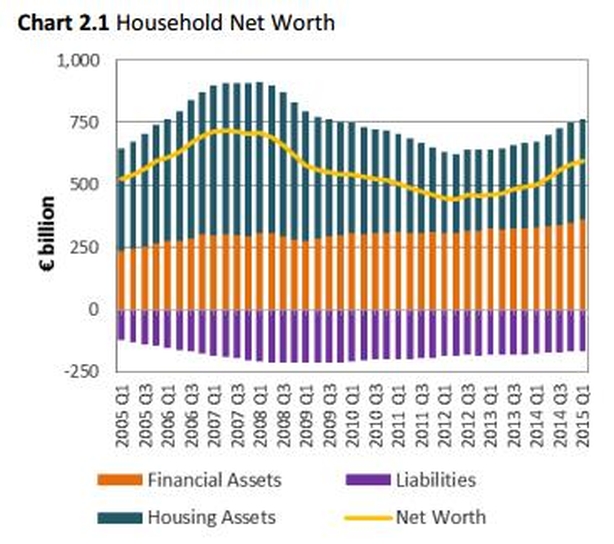
 

Irish household debt fell by the most in five years during the first quarter of 2015, according to the Central Bank.

Its latest Quarterly Financial Accounts show debt total household debt fell to €154.6 billion or €33,530 per capita during the period, representing a fall of €3.7 billion or 2.3% on the previous quarter.
This was the largest decline in debt since the second quarter of 2010.
Though Irish household debt has decreased significantly in recent years in tandem with recovery elsewhere in the economy, it still remains high relative to other countries, the Central Bank said.
It noted that only Denmark and the Netherlands had higher household debt relative to disposable income during the first quarter of 2015.
The figures also indicated that non-financial corporation debt as a percentage of gross domestic product (GDP) fell from 205 per cent in the final quarter of 2014 to 194 per cent in the first quarter of this year.
“However, the decline reflected both an increase in the value of annualised GDP, as well as, a €10.4 billion fall in the stock of debt.

New Irish mobile operator iD launches today


iD, Ireland’s newest mobile operator, goes live across Ireland today.

Irish customers will be able to build their own plans, picking and choosing elements that suit their needs. Customers can choose anywhere from 100 to 5,000 minutes, 100 to 5,000 texts, and a data cap of 125MB to 20GB. 4G is included in all plans by default.
There will be no roaming packages initially. iD says that its roaming prices will be competitive with the market.
Not only will customers be able to tailor a plan to suit themselves, but they’ll also be able to decide how much to pay for a new phone upfront and how long to pay the handset off for.
These costs are separate, so once a customer pays off the phone their monthly bill will be cheaper.
iD will offer 20 handsets initially, the majority of which will be 4G-enabled. Apple fans will have to wait to make the move to this new operator; the iPhone is not being offered at launch.
The average SIM-only plan will cost €20.81 per month. Analysts expect that iD’s launch will lead to price reductions across the board as other mobile operators react to lower prices.
iD is operated by Dixon’s Carphone and is piggybacking on Three Ireland’s network. The new mobile operator is aiming to secure around 6% of the Irish market within five years.

AIB’s credit card redress bill likely to be small


AIB yesterday launched a redress scheme for 110,000 credit card customers who paid for insurance they didn’t need.

However, it is likely the Government-owned bank will pay less than half of the estimated bill of up to €7m owing to affected users.
The Central Bank said it had been working with AIB for the lender to pay back insurance to credit card customers who had bought credit card protection insurance from Pinnacle Insurance because the card holders were already covered for parts of any losses.
AIB had been selling the insurance cover at an annual premium of €16 since August 2006, and repayments will therefore be calculated on the number of years customers have paid out for the insurance cover.
It believes the average payment per customer will be €66 and the total cost, if every customer were to apply, would reach over €6.6m.
AIB says it will be contacting affected customers and explaining to them how they can apply to get their money back under the redress scheme.
But experience of other redress schemes involving excessive credit card insurance payments show that at most 40% of affected customers will end up applying.
In recent months, the Central Bank had issued guidance to 161,000 customers affected by a separate redress scheme for credit card customers at Bank of Ireland, MBNA, and Ulster Bank.
Affected customers at these banks had been sold insurance cover through Homecare Insurance Ltd (HIL), but again parts of the insurance were already covered by the card providers.
Only €9m was claimed under the three banks’ redress scheme, meaning that around €10m was left unclaimed by card users.
It is believed that the Central Bank will continue to urge customers of the three banks to seek compensation even though the deadline for applying under the redress scheme has officially passed.
“We require all firms to make full disclosure to consumers of all relevant material information when selling any financial product,” said Bernard Sheridan, director of consumer protection at the Central Bank.
“It is important that consumers can have confidence that firms are acting in their best interests and that they are not sold any cover which they do not need,” he said.
“Where this has occurred it is our priority to ensure that consumers receive full redress. We encourage all affected consumers to make a claim.”
An AIB spokeswoman said that it was following procedures used in earlier schemes to compensate customers.

Study shows prolonged sitting as bad as smoking for health


Researchers find sitting for long periods linked to an increased risk of heart disease and early death

Sitting for long periods of time is just as dangerous for your health as smoking, according to researchers at Queen’s University Belfast.
Researchers from the university found prolonged sitting was linked to an increased risk of heart disease, obesity, diabetes and an early death.

THEY SAID IT WAS AS BIG A THREAT TO PUBLIC HEALTH AS SMOKING.

Dr Mark Tully, from the UKCRC Centre of Excellence for Public Health at Queen’s, said most people sit for an “inordinate” amount of time at work, driving or at home watching television.
“One of the biggest threats to health is the amount of time spent sitting. On average people spend over nine hours, or up to 80 per cent of their waking day, sitting down,” he said.
Dr Tully said levels of sedentary behaviour increased as peopled aged.
“Public health scientists have recognised the need to develop effective interventions to address the high levels of inactivity across ages, with sitting regarded as ‘the new smoking’,” he said.
The four-year-study, which is being carried out in conjunction with researchers in Scotland, Germany,France, Denmark and Spain, is looking at developing new ways to help older adults be more active and will test the new methods on 1,300 people in Europe.

Carbon nano-fibres made from CO2 in the air

  
Out of thin air we get carbon nanofibres
Scientists in the US have found a way to take carbon dioxide (CO2) from the air and make carbon nano-fibres, a valuable manufacturing material.
Their solar-powered system runs just a few volts of electricity through a vat full of a hot, molten salt; CO2 is absorbed and the nano-fibres gradually assemble at one of the electrodes.

IT CURRENTLY PRODUCES 10G IN AN HOUR.

The team suggests it could be scaled up and make an impact on CO2 emissions, but other researchers are unsure.
Nonetheless, it could offer a cheaper way of making carbon nano-fibres than existing methods.
“Until now, carbon nano-fibres have been too expensive for many applications,” said Prof Stuart Licht of George Washington University. He was speaking at the autumn meeting of the American Chemical Society in Boston.
Carbon nano-fibres are already used in high-end applications such as electronic components and batteries, and if costs came down they could be used more extensively – improving the strong, lightweight carbon composites used in aircraft and car components, for example.
The question is whether the “one-pot” reaction demonstrated by Prof Licht and his team could help to drop that cost.
At the moment 10g of nano-fibres – like this sample Dr Licht brought to the conference – can be made per hour
The idea of turning CO2 from the air into useful products is a popular one, and the field is strewn with many more unfulfilled promises than success stories.
But Prof Licht is confident his design can succeed. “It scales up very easily – the entire process is quite low energy.”
He also suggested that the system could provide “a reasonable path to bring down CO2 levels in the atmosphere”.
This would involve adopting the reactors on a colossal scale and the idea has raised some eyebrows.
Dr Katy Armstrong, a chemical engineer at the University of Sheffield, said the process was “promising and very interesting on a lab scale” but that Prof Licht’s bigger vision might be problematic.
“As they are capturing CO2 from the air, the process will need to deal with huge volumes of gas to collect the required amount of carbon, which could increase process costs when scaled up,” she told the BBC.
Dr Paul Fennell, a chemical engineer and clean energy researcher at Imperial College London, said: “If they can make carbon nano-fibres, that is a laudable aim and they’re a worthwhile product to have.
“But if your idea is to take CO2 out of the atmosphere and produce so many carbon nano-fibres that you make a difference to climate change – I’d be extremely surprised if you could do that.” Prof Licht insists it is worth trying.
“There aren’t any catches; there’s a necessity to work together, to test this on a larger scale, to apply some societal resources to do that.”
Meanwhile, other chemists were impressed by the simple fact that Prof Licht’s team had produced nano-fibres from atmospheric carbon.
The carbon nano-fibres gradually build up on one of the device’s electrodes
Dr Dario Corradini was also at the American Chemical Society meeting, presenting his theoretical work on absorbing CO2 with a similar type of electrochemical cell.
“These cells are relatively inexpensive in terms of energy consumption – it’s definitely a realistic approach to producing the nano-fibres,” he said.

Humans would have had chicken brains (literally) if it weren’t for one tiny molecular change

  
Scientists may have finally uncovered the reason why us humans aren’t birdbrains (literally!).
We kid you not, researchers believe the reason why the human brain is much more powerful than a chicken is all down to a single molecular event.
Losing a tiny fragment of protein is thought to have spurred the evolution of the complex mammalian central nervous system, and without that change we could all literally be birdbrains.
A tiny fragment of protein (a lack of it, to be precise) is the reason why our brains aren’t like those of chickens.
The reason why mammals are so brainy compared with other vertebrates such as birds, lizards and frogs is a mystery since all these groups share similar genes.
The answer could lie in a biological process called alternative splicing (AS), part of the assembly system that attaches together the building blocks of proteins from genetic instructions.
During AS in mammals, a small fragment of a protein found in all vertebrates called PTBP1 is left off – like a single brick omitted from a Lego model.
Scientists believe that a biological process called alternative splicing is the reason why the human brain evolved.
Scientists found that in mammalian cells, the new shorter version of PTBP1 unleashed a cascade of events leading to the generation of neurons.
When chicken cells were genetically engineered to produce the mammalian form of PTBP1, similar events were triggered.
When scientists genetically engineered chicken cells to produce the mammalian form of PTBP1, they noticed a more complex brain development.
“One interesting implication of our work is that this particular switch between the two versions of PTBP1 could have affected the timing of when neurons are made in the embryo in a way that creates differences in morphological complexity and brain size,” said Professor Benjamin Blencowe, lead scientist from the University of Toronto in Canada.    

Thursday, July 9, 2015

Donie's Ireland daily news BLOG update

A third of Irish parents expect to fall into debt over back-to-school costs


Parents of secondary school children are spending an average €258 on a new uniform for September.

Mothers and fathers of youngsters in national school are also feeling the financial stress, having to fork out an average of €166 for each child.
The figures were released by the Irish League of Credit Unions, which warned that almost a third of parents expect to get into debt when preparing their children for the new school year, with loans averaging €360.
Aine Lynch, chief executive of the National Parents Council, said while costs have come down and new book rental schemes are in place, concerns remain over the annual hit families have to take.
“I think ultimately the costs are too high,” she said.
“Children go to schools all over the country and they have no uniform and they have no difficulty getting a good education, so I think it is important that uniforms are not imposed.”
The credit union survey of 1,000 parents also revealed the pressure to make voluntary contributions to schools – seven out of 10 parents expect to make these payments, an average of €112 per child, down from €119 last year.
The survey showed the cost of books for secondary school pupils is €213 for this September, a huge jump from €166 last year, while for national school children it was €162, up from €140.
Ms Lynch hit out at the practice of parents being asked to make voluntary payments.
“Our concern is when the arrangement is defined as financial, when the first engagement is around asking for voluntary contributions, that can impact on the child-teacher relationship,” she said.
“The parents might resent it or it might be that the parents can’t afford it. There could be an embarrassment, pressure, stress.”
She added: “In some instances parents have been asked for this on enrolling. Therefore there’s an implication around enrolling.”
The ILCU said a quarter of parents will use savings and 12% will use credit cards to cover back-to-school costs.
Warning of the difficulties of running a household when extra bills hit home, the survey found 72% of parents admit the costs will hurt their ability to pay bills and keep family plans, and 70% – compared with 80% last year – sacrificed this year’s family holiday or children’s summer camps to cover the costs.
More shockingly, 16% of parents said they will sacrifice spending on food to meet the expense.
Some 2% reported they would use a moneylender to pay the back-to-school bills.
Founder of the Irish Financial Review Frank Conway said: “As the findings of this study reveal, many families across Ireland struggle to cover the cost of a child, or even several children, going back to school and college.
“Costs can run into thousands and for some families the only way of closing the financial gap is through debt, including the use of moneylenders. Where debt is used, the cost of items, including school uniforms can double when expensive interest charges are factored in.”

Irish GP’s will struggle with demands of the under 6’s scheme


A survey of pharmacists reveals that they think GPs will not be able to cope with the extra demands of free GP care for under 6s.

The survey shows 24% of pharmacists do not believe GPs can cope with the extra workload that will come about as a result of the introduction of the scheme, while 59% say GPs will only be able to cope with the demands with difficulty.
It comes as it emerges more than 100,000 children across the country have been registered for the scheme.
The pharmacy survey was undertaken by healthcare software provider, Helix Health ahead of the 2015 Helix Health Pharmacist Awards.
Dublin pharmacist and Chair of the Helix Health Pharmacist Awards Committee, Fintan Moore said: “GPs are already struggling to cope with their existing workloads and many will find it difficult to cope with the extra demands of the free GP care scheme. Pharmacists could be doing much more, which would both ease the workload on GPs and improve patient care and accessibility to services.
“We should be delivering a minor ailments scheme, a new medicines scheme, chronic illness management, further health screening initiatives and expanding the existing vaccination service to include travel vaccinations as is the case with pharmacists in other countries.
“We are ready and able to do more. It’s time for the Minister to work with us to expand our professional role for patient care in our communities.”
The survey also revealed that more than 90% of pharmacists believe they should get enhanced roles at primary care level.
Mr Moore said: “Pharmacists have demonstrated their abilities to take on enhanced roles, as seen with the roll-out of the flu vaccination service, and we would urge the Government to realise pharmacists’ potential and allow us to further improve the health and wellbeing of the Irish people.
“Last year pharmacists delivered more than 50,000 flu vaccinations, a figure that is rising every year. We are willing and able to expand this service and to deliver more vaccines.”

It is time we cut the pensions of our politicians who led Ireland to the brink


The revelations that the lavish pensions of ex-ministers and Taoiseach are to be boosted have caused widespread public anger and consternation.

Politicians like Bertie Ahern and Brian Cowen, who are already in receipt of inflated pensions, are to have them further enriched, some by €1,680 per year.
This is due to a provision in the Lansdowne Road Agreement on public sector pay.
When questioned on this Public Expenditure Minister Brendan Howlin pleaded that he had no option under the law but to allow the pension hike go ahead.
Nonetheless, ordinary people who are struggling under the pension levy will be dismayed by this turn of events. As will many workers whose taxes fund the retirement of Ahern, Cowen et al.
Enormous pensions?
These ex-politicians may have had their pensions reduced in recent years but let’s not forget that they are already in receipt of enormous pensions anyway.
Bertie Ahern and Brian Cowen the two men who led our country to the brink of ruin, headed governments whose actions caused huge financial suffering to citizens.
It is extraordinarily unfair then that, in a country where the fruits of recovery are still trickling down very slowly, a pension boost of this nature should take place.
Frankly, former politicians should have their pensions reduced across the board – a move which would bring them in line with ordinary citizens who lack the benefit of publicly-funded pensions.
Former ministers Mary Hanafin and Mary O’Rourke view the payments as being “wrong” at this time, it’s reported.
But “wrong” is not enough. These pensions must be reduced.

New genealogy resource will boost tourism, Taoiseach Kenny says


Kenny commends National Library’s website for parish records from 18th-19th centuries.

Ciara Kerrigan, project manager of the National Library’s digitisation of parish registers, showing the new website to Enda Kenny and Heather Humphreys.
An online resource for researching family history from the 18th and 19th centuries will prompt a wave of genealogical tourists to visit Ireland in the coming years, Taoiseach Enda Kenny has said.
Mr Kenny was speaking at the announcement of the National Library of Ireland’s parish records website, which contains digitised details of births, deaths and marriages in almost every Catholic parish during the 1700s and 1800s.
The three-year project saw researchers create 370,000 digital images from microfilms of parish records, which were initially collated in the 1950s and 1960s.
Previously, anyone seeking to find information on their Irish ancestry had to go to the National Library on Dublin’s Kildare Street and physically access the microfilms.
The website allows the free perusal of the records from anywhere in the world.
“What you’re doing here in the National Library, I absolutely applaud it because you are giving a facility to the Irish diaspora all over the world to connect, and in a world that is changing so rapidly isn’t it important to have a sense of place, a sense of who we are,” Mr Kenny said.
“It is about us, about our Irishness, and I think that’s so important.”
Tourism boost
Former Taoiseach Liam Cosgrave and US ambassador Kevin O’Malley were present for the event, as was Minister for Arts and Heritage Heather Humphreys, who spoke of a potential boost for genealogy tourism as a result of the website.
She said a concerted effort was being made to digitise as much historical material as possible ahead of the 1916 centenary.
Out of more than 1,000 parishes nationwide, 56 were omitted from the original microfilms.
People searching for information on relatives are advised to have prior knowledge of the parish and year in which their family member was born for optimum results.
Handwriting and Latin insertions can also make some of the records hard to decipher.
Project manager Ciara Kerrigan said the details available through the website provide an invaluable stepping stone for anyone attempting to complete a family tree, given the destruction of all census records predating 1901 during the Four Courts fire in 1922.
“If you’re looking for records of Irish people in the 18th and 19th centuries, no other records for them exist apart from these church records.
“It provides an absolutely critical step in the road because unless you can pinpoint when and where people were baptised, you’re not going to be able to build up a very comprehensive family tree.
“It can lead on to other records like valuations of property in Ireland from the 1840s to 1860s. You could look at estate records, records relating to how local communities lived, such as land and property records, which would give a flavour of the kind of lives people had.”
HOW IT WORKS
While very intuitive to navigate, prospective users should note that the search mechanism on the new registers.nli.ie website is subject to some legacy limitations.
Rather than look for their ancestors solely by name, family history enthusiasts must first identify the parish in which their relative was born/married/died in, along with the year of the event. Without this basic prior knowledge, it can be a bit of a ‘needle in a hay stack’ exercise.
If you do happen to isolate the place, year and month in question, inconsistent methods of data input – i.e. a priest’s unintelligible handwriting or sporadic insertions of Latin – can sometimes make the task more difficult.
Around 95 per cent of parishes submitted their registries for microfilming during the 1950s and 1960s, however, 56 parishes were either omitted from the process or did not come into existence until after the cut-off point for records in 1880. Where this is the case, users are advised to contact the parish in question directly for missing information.
Finally, while families with Dublin origins have the best of it with records extending back to the early 18th century, lists of events from counties including Waterford, Wexford and Kilkenny cover a shorter period from around the 1780s to the 1880s, while records from areas along the western seaboard generally don’t begin until the latter half of the 19th century.

Eight food businesses shut down in June for safety violations


Dublin cash and carry to pay almost €6,000 for breaching food hygiene regulation

Pearl River take away in Phibsborough, Dublin 7 which was issued a closure order last month.
Eight businesses were served with closure orders last month for violations of food safety regulations.
The Food Safety Authority of Ireland (FSAI) serves such orders when inspectors deem there to be a grave and immediate danger to public health at a premises.
Bimdoc Cash and Carry on Jamestown Road in Finglas, Dublin 11 was convicted on six counts and ordered to pay € 5,560. This included a fine of €1,000 and costs of € 4,560 awarded to the Health Service Executive (HSE) which prosecuted the case under hygiene of foodstuffs regulations.
Pearl River in Phibsborough, D Limit African & European Restaurant on Ballybough Road in Dublin and ShanghaiHouse in Cork were served closure orders.
Posh Nosh take away in Ardee, Co Louthwas closed twice during the month. The other closure orders related to food businesses in Cavan, Mayo and Wexford.
In addition, a prohibition order was issued to Cumiskey’s public house on Blackhorse Avenue in Dublin.
This order is issued if the activities, such as handling and preparation of food, or the condition of the premises could pose a risk to public health.
Six of the orders have since been lifted. May saw the highest monthly number of closures so far this year with a total of 14. In total, 45 closure orders have been issued this year.
Dr Pamela Byrne, chief executive of the FSAI, said the violations had “serious negative implications” for the premises and the wider food industry.
“There can be no justification for these breaches, which can endanger consumers’ health and undermine the confidence they should expect to have in the safety of the food they eat,” she said.

Full list of businesses that were served closure orders:

  1. Shanghai House restaurant, 13 Upper Cork Street,Mitchelstown, Co Cork
  2. Mr Wong take away, 81 Main Street, Co Cavan
  3. D Limit African & European restaurant, 61A Ballybough Road, Dublin 3
  4. Posh Nosh take away, 1 Millstream, Moorehall, Ardee, Co Louth (two closure orders)
  5. “Fish & Chips” catering trailer (chip van), Main Street, Roundfort, Hollymount, Co Mayo
  6. Pearl River take away, 62 Phibsborough Road, Phibsborough, Dublin 7
  7. Hotel Curracloe (activity closed: all food preparation and service activities in and from the kitchen and ancillary areas), Curracloe, Enniscorthy, Co Wexford

The burning question of global carbon reduction


The world’s last climate conference demonstrated in vivid terms the difficulty of agreeing binding emissions targets among countries at different stages of economic development.

The snowbound Copenhagen gathering six years ago foundered over how to share the burden between the developed and developing worlds of the cost of combating global warming. By the time it disbanded, it had generated lots of bad will between participants — but few commitments of substance.
As the world prepares for this year’s follow-up in Paris, many national governments seem commendably keen to avoid a re-run. Less happily, this determination is allied to a lack of ambition. The sense among leaders is that action remains too expensive to be politically viable. So to deliver a deal, they are paring back the commitments they will give or expect others to make.
Now a group of academics, businessmen and policy makers have stepped forward to challenge official defeatism. In their New Climate Economy report, they argue that halting global warming without denting economic growth can be done more easily than many realise. Volatile oil prices, falling renewable energy costs and other global trends have set the stage for economies to cut greenhouse gas emissions and keep growing, the study says.
The cost of solar power has fallen by 75% since 2000, and that of power storage systems by 60% over the past decade. According to a report from Deutsche Bank, solar is now competitive with retail electricity prices in 39 countries. Meanwhile volatile oil prices are encouraging more governments to withdraw fuel subsidies. This has lowered the cost of political interventions to drive the shift to cleaner power.
The report is right to note that in some areas the pace of clean energy adoption is accelerating. While there must be doubts about the causal link it implies, encouragement can be drawn from the fact that the global economy grew last year while emissions remained broadly flat. De-linkage is to be welcomed, even if only achieved by consumers switching from polluting sources to transitional, cleaner technologies. Even a short term environmental dividend is better than none.
In the end, however, the problem of achieving a binding global deal remains. The report’s authors rightly argue that cities and countries should work collaboratively on measures such as raising energy efficiency standards, cutting aircraft pollution and boosting investment in clean energy.
But such initiatives will avail the world little unless backed up by states setting tough emissions targets and giving hard commitments to meet them. While costs may be falling, that still means kick-starting huge investments in global urban infrastructure.
Governments also need to spend far more on research into new forms of renewable energy. Only 2% of the world’s public R&D goes into this area, according to the global Apollo programme. That is not enough.
Lastly they must back up binding targets by sticking a higher price tag on carbon. The practical and political obstacles to widespread carbon pricing are daunting. Nearly every tradeable good includes a carbon component. Make it more expensive to produce things in one place and activity simply leaks abroad.
The falling cost of renewables is something to celebrate. It lowers the price of political action. But it does not absolve the delegates to Paris from taking the hard political decisions necessary to de-carbonise. If they duck them, the conference will enjoy no more success than the last.