Pages

Showing posts with label Credit Unions. Show all posts

Monday, January 4, 2016

Donie's Ireland daily news BLOG

Credit union rules relaxed to allow investment in social housing

FINANCE MINISTER MICHAEL NOONAN HAS ORDERED A REVIEW INTO THE LIMITS ON THE SECTOR


MINISTER FOR FINANCE MICHAEL NOONAN TD SPEAKING TO MEDIA AT GOVERNMENT BUILDINGS FOLLOWING RENT CERTAINTY PROPOSALS AND INCREASED HOUSING SUPPORTS.

The Central Bank is scrapping a rule that prevents credit unions from investing in public projects, such as social housing.
The country’s credit unions have long campaigned to be allowed to invest in social housing. The Irish League of Credit Unions said in November that it had up to €8.5bn of members’ deposits available to help solve Ireland’s social housing crisis and that it could not understand why the Government was prohibiting this.
Department of Finance assistant secretary-general Ann Nolan confirmed to the country’s biggest credit unions that the prohibition is being scrapped last month.
“Following discussions with the Central Bank, I have been informed that regulations have been updated in relation to classes of investments for credit unions to specifically include investments in projects of a public nature, including investments in social housing,” Ms Nolan wrote on December 16.
Many other rules governing credit unions are also being reviewed, following the surprise move by Finance Minister Michael Noonan in December to order a statutory committee to probe the limits imposed on the sector, such as limitations on the nature and term of lending.
Many of these rules were originally introduced by the Central Bank, based on a 2012 report by the Commission on Credit Unions, another statutory group.
The Central Bank has been accused of implementing the Commission’s recommendations in a manner inconsistent with their spirit and intent. Some credit unions deem them onerous.
The new review, to be conducted by the Credit Union Advisory Committee, will begin this month and is expected to report by the end of June.
The Sunday Independent has seen its terms of reference and among the things the committee must take into account is “the need for credit unions to develop their business model and grow income in a prudent manner”.
The contentious €100,000 savings cap for credit unions has already been relaxed. Credit unions with more than €100m in assets may apply to the regulator to accept more than €100,000 from individual savers.
The Credit Union Development Association, which represents some of the country’s largest credit unions, wants the regulator to go further. Writing in the Sunday Independent today, CUDA chief executive Kevin Johnson called for the introduction of tiered regulation, whereby larger credit unions would be given more freedom than smaller credit unions.
“Tiered regulation, done properly, will allow some credit unions to continue to offer basic savings and loans, while allowing other credit unions to develop and offer a greater range of services, as long as they have what is necessary to manage the additional risks,” he writes.
“Credit unions need to be allowed to compete with banks… Fundamentally, credit unions offering a full range of services will drive great competition – something that is sorely lacking in Ireland at the moment.”

House prices outside Dublin up 13% as supply at decade low
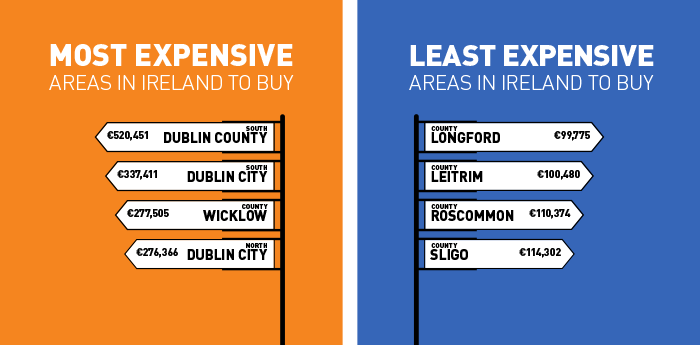
  

HOUSE PRICES OUTSIDE OF DUBLIN SOARED IN 2015, WHILE THE NATIONAL HOUSING SUPPLY NOW STANDS AT ITS LOWEST POINT IN ALMOST A DECADE.

According to the latest Daft.ie house price report, prices rose by an average of 8.5% in 2015.
However, the national average hides a significant difference between Dublin,  where prices rose by just 2.7% — and the rest of the country, where the average asking price jumped by 13.1%.
The report found the national average asking price in the final quarter of 2015 was €204,000, compared to €188,000 a year ago and €164,000 at its lowest point in early 2013.
The different trends in Dublin and elsewhere mark a turnaround from 2014, when prices rose by 21% in the capital and by 9% elsewhere.
The Daft.ie report highlights that the slowdown in Dublin inflation occurred at a time when inflation in Ireland’s other cities accelerated.
For example, house prices rose by an average of 20.7% in Cork in 2015 compared to 14.7% in 2014, and by 19.7% in Galway compared to 16.3% in 2014.
In Waterford City the rate of inflation increased significantly, with prices up 18.6%, compared to 4.1% a year ago.
However, the most dramatic change in house prices has occurred in Limerick City.
A year ago, prices in the city were falling by 1.3% year-on-year, but in the last 12 months they have risen by 22.3%.
Prices in the city are now back at mid-2012 levels.
Elsewhere in the country, inflation has accelerated from 8.8% in 2014 to 12.1% in 2015. The Daft.ie study also pointed out that the total stock of properties for sale is now at its lowest point in nearly nine years, with just over 25,000 properties for sale nationwide.
A year ago, there were nearly 30,000 properties on the market, with the bulk of the reduction coming from outside of the five main cities.
Ronan Lyons, economist at Trinity College Dublin and author of the report, said the dramatic slowdown in Dublin house prices in 2015 shows how effective the Central Bank deposit rules have been there, but that this had not been replicated elsewhere.
“This has not been the case elsewhere in the country as house prices are lower relative to incomes and thus the new rules have not been as binding.
“Some have criticised the new rules as hindering new housing supply, but the solution to a lack of supply is not stimulating demand even more.
“If supply is lacking, the solution to this must be found in reducing construction costs, not in giving borrowers access to potentially dangerous levels of mortgage credit,” he said.

Minister Frances Fitzgerald says miscarriage’s are one of Ireland’s main taboos

MINISTER RECALLS HER MISCARRIAGES, SAYS FAMILIES HAVING MISCARRIAGES AT OLDER AGE AS THEY WAIT TO HAVE CHILDREN


   

‘A LOT OF PEOPLE ARE HAVING MISCARRIAGES AT AN OLDER AGE BECAUSE THEY WANT TO HAVE BABIES AT AN OLDER AGE,’ MINISTER FOR JUSTICE FRANCES FITZGERALD SAID OF A SUBJECT THAT STILL REMAINS A TABOO IN IRELAND SHE SAYS.

Miscarriages are one of Irish society’s main taboos in an era where couples are choosing to have children later in life, Minister for Justice Frances Fitzgeraldhas said.
Ms Fitzgerald, who spoke about having had two miscarriages, said it has become an issue for an older demographic.
“A lot of people are having miscarriages at an older age because they want to have babies at an older age, so it is more stressful. Then they think: ‘Am I going to get pregnant again?’” she said in an interview with the Irish Examiner.
“Younger generations of men and women have gotten into the mindset, and that is obviously linked to the availability of contraception, there is a belief that you can plan a pregnancy.
“Of course, first of all, there are fertility issues as you get older. Secondly, the fact is a lot of pregnancies end in miscarriage, there is a shock and disbelief for people.”
More than one in five pregnancies result in miscarriage. Ms Fitzgerald said the availability of contraception had impacted on people’s perceptions around having children.
Of her own experience she recalled the shock of being told by doctors but that going on to have subsequent successful pregnancies had helped her.
“For me, I went on to have a second and a third pregnancy afterward, so you can recover from it.
“And you can kind of accept, well there was something wrong and there is a reason for it.”

First there was no shaving, then no booze and now meat and dairy face the chop

Veganuary campaign expects 50,000 people to join the likes of Vivienne Westwood, Romesh Ranganathan and Sara Pascoe for a month free of animal products

     
L-R Gwyneth Paltrow, Brad Pitt, Sara Pascoe, Romesh Ranganathan Composite: REX Shutterstock & Graeme Robertson
In the beginning, there was Movember. Then there was Stoptober. Now prepare yourself for Veganuary.
Those who have overindulged this festive period may be tempted to turn vegan for January. If so, they will not be alone. Organisers of Veganuary, now in its third year, predict that 50,000 people will take part this month, of whom around half will stay vegan.
About 3,000 people participated in the first Veganuary. Last year the figure rose to 12,800. But eschewing meat, fish and dairy products is now becoming increasingly fashionable thanks to a number of high-profile advocates.
Famous names who have tried vegan diets in the past include Bill Clinton and actor Anne Hathaway. Committed vegans include Brad Pitt, Ellie Goulding and Gwyneth Paltrow. Kat Von D, an American tattoo artist and model, crashed theVeganuary website earlier this year when she encouraged people to register.
Among the celebrities taking part this month are comedians Romesh Ranganathan and Sara Pascoe. Actor Peter Egan of Downton Abbey fame and designer Vivienne Westwood have also signed up.
Organisers of the event claim the surge in support for veganism reflects a growing awareness that it can help alleviate the world’s food crisis.
Rearing animals for consumption and dairy production produces significantly more carbon dioxide than plant-based food. In addition, animal farming is the leading producer of methane gas, a major contributor to global warming. However, organisers said that a concern for animals was still the primary motivation for people becoming vegan.
“We ask about motivation when people sign up to Veganuary and, for the past two years, animals are the primary reason by a large majority, with health coming second, and the environment third,” said Clea Grady, marketing manager of Veganuary.
“There is an increasing awareness and concern at how we treat, use and abuse animals, and this is growing year on year. Anecdotally, we know that, for whatever reason an individual approaches veganism, the lines begin to blur once education has taken place.”
The business world is now waking up to the growing vegan market. Companies such as VBites, Violife and Fry’s market products such as vegan cheese, ice-cream, “fish” fingers, burgers, sausages, schnitzels and “chicken” nuggets.
Pret a Manger has been expanding its range of vegan sandwiches; Caffè Nero labels its mince pies as vegan; and Pizza Express has a vegan pizza on its regular menu. Both Yo! Sushi and the Handmade Burger Company are doing special promotions in support of Veganuary.
“There has been a marked increase in enthusiasm in the UK over the past 12 to 18 months, and that’s extremely exciting to see,” Grady said.
“This has resulted in more media coverage, many more vegan products on our shelves, and ever-increasing numbers of Veganuary participants. We are starting to catch up with the States, but they continue to pave the way.”
Some nutritionists argue that humans cannot derive all the minerals and vitamins they need from a pure vegan diet. Both Clinton and Hathaway famously turned their backs on veganism. “I just didn’t feel good or healthy,” Hathaway once explained.
However, Grady said veganism could provide a balanced diet. “All it requires is a little knowledge and guidance, and that’s what Veganuary specialises in,” she said. “The Health and Nutrition sections of Veganuary.com were co-authored by a GP and a qualified nutritionist, so we are confident in the information we provide. We follow this up with practical guides on what to eat, and what to replace, demonstrating how easy getting the right nutrition can be.”

Which planets are habitable? Astrophysicists have a fresh insight

By looking at slight variations in the brightness of distant stars, scientists say they can determine their surface gravity, a technique that provides important clues to life-hosting properties of the planets that orbit them.
     
An international team of astrophysicists has devised a way to measure the surface gravity of distant stars to help determine if the planets in their orbit are hospitable to life.
Led by a researcher at the University of Vienna, the team calculated the surface gravity of stars that are too distant to study with conventional methods by looking at the slight variations in their brightness, which is caused by convection and surface turbulence, the same forces behind a pot of boiling soup, explains the Vancouver Sun.
Gravity is crucial to many aspects of astrophysics, say the researchers in a paper published on January 1 in the journal Science Advances, as it provides clues to the properties of stars, such as their mass and radius, and to the properties of planets in their orbits that might make them habitable.
“Our technique can tell you how big and bright is the star, and if a planet around it is the right size and temperature to have water oceans, and maybe life,” said study co-author Jaymie Matthews, a professor of astrophysics at the University of British Columbia, in a study announcement.
“If you don’t know the star, you don’t know the planet,” explained Prof. Matthews. “The size of an exoplanet is measured relative to the size of its parent star. If you find a planet around a star that you think is Sun-like but is actually a giant, you may have fooled yourself into thinking you’ve found a habitable Earth-sized world.”
To determine the gravitational pull of distant stars, the researchers used data of star brightness collected from Canada’s MOST and NASA’s Kepler satellites.
Since its launch in 2009, Kepler has already discovered more than 1,000 planets, a dozen of them less than twice the size of Earth and residing in the habitable zone of their host stars, which means these planets orbit their host stars at the right distance to make them neither too hot nor too cold to harbour liquid water. Astronomers believe the presence of water on planets is critical to life.
The team of astrophysicists behind the latest gravity-measuring technique believes that it will help future exoplanet surveys to correctly characterize the planets they find.
“I expect someone will announce the discovery of life on an exoplanet within about 20 years,” Matthews told the Vancouver Sun. 

Wednesday, September 24, 2014

Donie' Ireland daily news BLOG

Repaying most of Ireland’s IMF debt early will save the State €2.1bn Euros interest


Finance Minister Michael Noonan has previously said the deal would save taxpayers about €1.5bn over a five to seven year period.

Repaying the bulk of Ireland’s IMF debt early will save the state €2.1bn in interest payments, the troika has said.
Finance Minister Michael Noonan has previously said the deal would save taxpayers about €1.5bn over a five to seven year period.
But a document prepared by the troika said that if Ireland was to repay €18.3bn between the end of this year and next year in three equal tranches, the interest saving would equate to €2.1bn.
“IN light of currently very favourable market conditions, an early repayment of IMF credit can generate significant savings on government interest expenditure for the Irish sovereign,” the document states.
It also said that the early repayment of the IMF debt would measurably improve the sustainability of Ireland’s public finances.
The deal was approved by Europe’s other 27 Finance Ministers at a meeting in Milan earlier this month.
But it warned any improvement in the debt position would be diminished by using the savings to boost spending or cut taxes.

Credit union alliance with post offices gives hope to Ireland’s villages


A COMBINED LOANS TRIAL IS THE FIRST STEP IN A NEW FINANCIAL SERVICES ALLIANCE.

The plan has the potential to revitalise both organisations and could breathe new life into smaller towns and villages around the country.
The Credit unions and post offices are forging an alliance which will help secure their futures and present a viable alternative to banks in local communities.
The plan has the potential to revitalise both organisations and could breathe new life into smaller towns and villages around the country.
A trial in Limerick will see post offices and credit unions jointly offer small loans for the first time. The funds will be provided by credit unions with money available through post offices.
If the initiative gets rolled out nationally, it will be the first step towards a stronger alliance, with plans for a wider pooling of services nationwide.
The deal could lead to the possibility of credit unions taking over post offices in rural towns.
Such a third force would help offset the effect on communities of bank branch closures, emigration and the closure of hundreds of pubs and shops that were once the heart of village life.
An Post, the Irish League of Credit Unions and the Irish Postmasters’ Union all said they were in favour of the coming together of credit unions and the State post office network to offer financial services.
Such a move would counter the contraction of banks’ branch networks, and provide a boost to credit unions and post offices, as both bodies are under pressure in rural areas.
Banking expert Professor Ray Kinsella told an Irish Postmasters’ Union conference recently that an alliance between the post office network and the credit unions could provide a radical new model for delivering financial services.
“Together they could provide social and community-focused banking, greater competition and also strengthen a domestic banking sector that is still in crisis,” he said.
The Irish Independent has learned that six credit unions and 15 post offices in Limerick are seeking permission to launch a trial to offer loans of up to €1,000 to jobseekers.
The aim of this plan is to steer low-income groups away from moneylenders.
A spokesman for the Irish League of Credit Unions said the initiative was at an early stage. But he stressed other areas where the two bodies can pool their offerings are being explored.
“The participating credit unions in Limerick and An Post are also examining whether there may be common ground to explore other methods of cooperation, which would offer mutual benefit.”
The spokesman added that credit unions were now looking at a number of other areas where co-operation can be fostered nationwide. The proposals include:
Credit unions using An Post’s Post Point terminals to offer members a range of bill-paying services.
An Post accepting cash lodgements and loan repayments from credit unions members.
Seeing if post offices could be housed in credit unions, and vice versa, in certain circumstances.
Loans offered from cash-rich credit unions via post offices.
The proposals would be implemented on a phased basis over the next year, following pilot projects. There are 386 credit unions in the State but they are under pressure due to low demand for loans, despite being flush with cash, and strict new regulatory rules.
They are also grappling with loan arrears and they are under pressure to perform mass mergers across the sector in order to bulk them up.
There are 1,100 post offices, but they are overly-dependent on processing social welfare payments to make an income.
The planned link-up between six credit unions and 15 post offices in Limerick involves allowing people on social welfare access to loans worth up to €1,000 each.
The funds would be provided by the credit unions, but loans would be granted through the post offices.
To get a loan people would have to sign up to An Post’s household budget scheme, and make repayments weekly.
This scheme allows people to pay regular amounts towards household bills, deducted from social welfare payments.
The idea is to give families on low incomes cheap access to small amounts of credit for the likes of Christmas and communions.
The Department of Social Protection told the Irish Independent it was happy to consider any proposal that progresses financial inclusion.
“Such a proposal would also have to be examined for compatibility with the existing legislation that governs the household budgeting scheme and any implications for modification thereto considered.”

Irish property prices up 14.9% this year to August


NEW CSO FIGURES SHOW THAT IRISH RESIDENTIAL PROPERTY PRICES ARE NOW 14.9% HIGHER THIS YEAR THAN IN AUGUST 2013

Residential property prices increased again last month, according to new figures from the Central Statistics Office.
The CSO figures show that national prices were 14.9% higher in August compared to August 2013 – the 15th annual increase in a row.
Residential prices across the country rose by 2.3% in the month of August compared to July.
Dublin saw property price increases of 3.5% in the month, while they were 25.1% higher than a year ago.
In the rest of the country, prices rose by 0.8% in August on a monthly basis, while they were 5.6% higher than this time last year.
The CSO said that Dublin house prices rose by 3.5% in the month of August, and were 24.7% higher compared to the same month last year.
It also noted that Dublin apartment prices were 32.6% higher on an annual basis, but it added that apartment transactions are based on low volume levels and therefore suffer from greater volatility.
Today’s figures show that house prices in Dublin are more than 39% lower than at the peak of the market at the start of 2007. Dublin apartments are 45.8% lower than their 2007 peak.
The price of residential properties outside of Dublin are 44.6% lower than their highest level in September 2007.
Today’s CSO figures are based on mortgage draw-downs and do not include cash transactions.
But they show that the number of transactions increased markedly over the past year. Between January and July 2013, 11,800 houses and apartments changed hands. During the same time this year there were almost 20,000 transactions.
Alan McQuaid, chief economist with Merrion, said August’s numbers represented the 15th annual increase in a row.
He pointed out that the underlying housing market was a lot more robust than the official data would suggest as the figures are based solely on mortgage draw-downs.
“Although cash sales are not as high now compared with the start of the year, they are still significant, with three to four of every ten transactions a cash purchase,” he said.
“The generally improving economic backdrop should help to sustain the house price recovery in the short-term even with limited credit availability for potential buyers.”
“Longer-term, however, the flow of credit needs to be a lot higher than it is now. Following an average increase of 1.8% in house prices last year, we are now looking for an increase of around 13.5% in 2014.”
Conall Mac Coille, chief economist with Davy, said there appeared to be little evidence that the recovery in Irish house prices was abating.
He pointed out, however, that the market was exceptionally illiquid with just 15,688 residential property market transactions in the first half of 2014, comprising around 0.8% of the housing stock.
“This suggests that the average house is being sold once every 64 years at current transaction rates. That said, year-to-date transaction levels are up almost 50% on 2013,” he said.
“The pick-up in house price inflation increasingly reflects negative factors, preventing the Irish economy from achieving its potential. Specifically, activity and employment in housing construction remain at moribund levels, holding back the supply of fresh homes to satiate demand from first-time buyers,” Mr Mac Coille concluded.

“Good News” Sligo to host the 2015 All-Ireland Fleadh for another year


THE ALL IRELAND FLEADH CEOL NA EIREANN 2015 WILL BE COMING TO SLIGO AGAIN, IT WAS CONFIRMED YESTERDAY.

The dates will be from August 9th untill the 16th.
Martin Enright of the Fleadh committee, said that it is tremendous news for Sligo.
He said: “We are delighted that it is coming back, this has worldwide implications for the region.
“It is not just for the week, for the long-term.
“I have been getting messages from America, Russia, all over about how well Sligo did.
“It has been a real positive for Sligo.” He said that the Ard Comharlas, that grant who gets the Fleadh, met at the weekend and had a vote.
“In principle it is fully ratified, depending on whether the Fleadh committee can come up with the required funding by early December.”
He said that the pressure is on now to get these funds, through grants and various stakeholders, such as the vintners and hoteliers.
“We are delighted that it is coming back,” Martin added.

Typical children in Ireland are eating more than 16kgs of treat type foods each year


Foods such as biscuits, sweets and crisps are now an every-day staple of kids’ diets, making up a fifth of their daily calorie intake.
As part of its campaign to take on childhood obesity, Safefood is urging parents to tackle the amount of “treat foods” that their children are eating.
“At present 20% of children’s daily calorie intake is from these foods with little or no nutritional value,” it said.
The body estimated that on average a child typically consumes over 16kgs of treat foods per year – the equivalent of 140 small chocolate bars, 105 tubes of sweets, 36 packets of jam-filled biscuits and 118 bags of crisps. And this doesn’t include foods like ice-cream, cakes, pastries and buns and puddings that a child would typically eat.
Figures show that approximately one-in-four primary school children is overweight or obese. The prevalence of excess weight is also beginning earlier in childhood, with 6pc of three-year-olds currently being obese.
“We are giving our children treat foods every day and in many cases several times a day. These nutritionally poor foods, which are often referred to as ‘empty calories’, are given at the expense of nutritionally-rich foods in our children’s diets. Eating patterns developed in early childhood tend to last,” said Dr Cliodhna Foley-Nolan, director of human health and nutrition with Safefood.
“Parents need to be aware of the health risks associated with over-consumption of these types of foods. It’s simply a matter of cutting down on treat foods to a more sensible level, basically much smaller amounts and not every day.
“One of the big things we are trying to get across is the difference between a snack and an indulgence. The difference has become blurred.”
She suggested that fruit or a slice of toast, depending on the age of the child, is suitable if they are hungry.
In addition, quantities are another big issue for parents to cut down on, according to Dr Foley-Nolan.
“The other thing we are saying is in general not to have a ‘treats’ cupboard at home.
“If it is there, you are tempted, they are tempted,” she added. “Treats should be a luxury.”
Meanwhile, in relation to meal size and quantity, she said: “If you look at a plate of food, a good third should be vegetables, a third should be the starchy food, whether rice, pasta and potatoes, and a third should be the meat or fish.”
John Sharry, a senior lecturer in the School of Psychology at UCD, added: “Parents want what’s best for their children and no one wants to take the fun out of childhood. But we’ve reached a point where these so-called ‘treat’ foods are consumed far too frequently and just aren’t treats any more.
“As parents, we’ve lost the ability to say ‘no’ to our children and we need to re-learn that setting these clear boundaries is an important step in our children’s well-being and development.”
The Safefood campaign will feature on TV and poster advertisements.

Irish teenagers bag top prize at Google Science Fair 2014

  
The Google winners – Ciara Judge, Émer Hickey and Sophie Healy. 
The 18 finalists were selected from over 5,000 entries in 90 different countries.
It marks a remarkable 12 months for Ciara Judge, Sophie Healy-Thow and Emer Hickey who have literally conquered the world of science competitions.
The Cork trio won the BT Young Scientist title in January 2013 before heading to the Czech Republic last September and winning the €7,000 top prize in the EU Young Scientist competition.
As if that wasn’t impressive enough, last September Ciara scored a whopping 12As in her Junior Cert.
In a remarkable twist, Ciara’s older sister, Ashling, was the 2006 Young Scientist champion.
Ciara’s proud parents, Eamon and Maureen, admitted that it has been an astonishing 18 months for the girls and their school.
The girls’ project on seed germination has already received worldwide plaudits.
It revolves around their discovery that bacteria which occur naturally in the soil can help kick-start the germination of some crops by as much as 50%.
The Cork girls’ winning project examined how a particular bacteria, a diazotroph, can increase germination rates and crop yields.
Experts believe the commercial applications of their discovery are absolutely enormous.
“It has been an absolutely fantastic couple of months,” Ciara admitted.
Their top prize for winning the US title in California is a €30,000 scholarship from Google and an all-expenses paid field study trip to the Galapagos Islands where Charles Darwin formulated his theory of evolution.
They will also get the chance to sample astronaut training with NASA.
Ciara has already set her sights on studying veterinary science in university after her Leaving Cert.
Former EU Commissioner Geoghegan-Quinn said she was very impressed by the Kinsale girls and their project.
“The future is bright if this is the level of talent we are producing in Europe. It is particularly great to see the mix of curiosity-driven research and more applied projects,” she said.
The Kinsale Community School triumph continues a remarkable Irish success story in the EU Young Scientist competition with Irish entries having won the overall prize 15 times in 25 years.
Ciara’s parents, Eamon and Maureen, said their daughter, who is now in Fifth Year, is ultimately hoping to study veterinary in university.
KCS principal Fergal McCarthy said they were absolutely delighted by the girls’ latest triumph.
It was the third time in seven years that the Cork school won the overall national title.
The school proudly held the joint record this year for the greatest number of entries and had a remarkable total of 38 students participating.