Pages

Showing posts with label Death. Show all posts

Friday, July 15, 2016

Donie's Ireland daily news BLOG update

More than 259,000 vacant homes in Ireland census 2016

CSO FIGURES SHOW NUMBER OF EMPTY DUBLIN HOLIDAY PROPERTIES ‘UP 190% IN FIVE YEARS’


PRELIMINARY FIGURES PUBLISHED BY THE CENTRAL STATISTICS OFFICE ON JULY 14TH SHOW THE TOTAL POPULATION IS NOW 4,757,976.

The number of vacant holiday homes in Dublin city centre has nearly trebled in five years.
Publishing preliminary statistics from the April 24th census, the CSO said there had been a “noticeable increase”, up from 322 in 2011 to 937 this year – an increase of 190%.
The housing crisis in some parts of the State appears to have manifested itself in the census, with figures showing the number of vacant dwellings has fallen by 29,889 (13.8%).
In total, there are 259,562 vacant homes, including 61,204 vacant holiday homes, up 1,809 (3%) on the last census.
Vacancy rates for housing vary widely by county but the overall rate stands at 12.8%.
Carlow experienced the largest fall in the number of vacant dwellings from 3,202 in 2011 to 2,417 in this year’s census – a drop of 26.9%.
In Leitrim, the county with the highest vacancy rate in 2011, the number of vacant homes fell by just 3.7%.
Donegal, where the vacancy rate was 28.4% five years ago, has seen the number of vacant dwellings fall by just 97 units or less than 1%, the CSO said. This brings the vacancy rate to 28.2%.
The census provided information on the number of vacant dwellings for the first time in 2006 and the results showed there were 266,322 vacant dwellings (including holiday homes) in Ireland at that time, with a vacancy rate of 15%.
Vacancy rate
By 2011 the number of vacant dwellings had increased by 23,129 to 289,451, while the overall vacancy rate (14.4%) had fallen.
According to the 2016 preliminary census figures, household formation has fallen behind population growth and household sizes are also getting bigger in urban areas, bucking the trend of previous censuses. In rural areas, household sizes are getting smaller, the CSO’s statisticians said.
The number of occupied households increased between 2011 and 2016 by just over 49,000, or 3%.
Asked how the CSO identified housing as vacant, senior statistician Deirdre Cullen said the 4,663 enumerators were provided with very detailed notes. “It’s vitally important that we get it right,” she said.
Enumerators were instructed to call to every dwelling four, five, six and even seven times.
“They call several times; they talk to neighbours.”
If the house was vacant, neighbours might identify it as a holiday home or a property that was just visited at weekends. Overgrown gardens, for sale signs and an absence of post were also indicators a home was vacant.
“It’s really just on-the-ground knowledge by talking to people,” Ms Cullen said.
Airbnb, which allows people book short-term stays in homes of their choice around the world, insisted earlier this year that its services were not taking housing off the market.
Figures from the Airbnb website back in March showed the number of properties available to rent in Dublin for short-term holidays exceeded the number available for long-term letting.
At that point there were 1,748 apartments or houses available for holiday lettings on the site.

Ireland’s lobbyists call for investment after ‘vote of confidence’ in Republic population growth

GROUPS SAY MORE MONEY NEEDED TO COPE WITH GROWING POPULATION


IBEC CHIEF EXECUTIVE DANNY MCCOY SAID THE COMING YEARS WOULD SEE “SIGNIFICANTLY INCREASED PRESSURE” ON SERVICES, HOUSING AND INFRASTRUCTURE.

The growth in the population is “a vote of confidence” in the Republic’s future, but there is an “urgent need” for the Government to invest in services if the State is to be equipped to cope, according to lobbyists reacting to Census 2016.
Danny McCoy, chief executive of employers’ group Ibec, said the coming years would see “significantly increased pressure” on services, housing and infrastructure.
“We need a long-term approach to planning and development. The rapidly growing population is a vote of confidence in the country’s future.
“While many countries struggle to confront the problems of a declining population, Ireland must address those presented by a young, rapidly growing population.”
Mr McCoy said the shift in population from the western seaboard to the east was “a concern”. If economic activity was focused predominantly on the capital it would stretch resources, push up costs, and leave other parts of the State behind.
“It is creating a worrying economic and social imbalance. A new Atlantic-cities strategy is needed to ensure complementary growth between Dublin and other cities in terms of size, infrastructure, population and other resources.”
Crucial
Chambers Ireland director of policy Mark O’Mahoney said it was “crucial” that Government prioritises increased capital investment “in the short term”.
“We recognise that efforts have been made and that there are limited resources. However, it is only through sustained capital investment that Ireland can avoid future infrastructural bottlenecks that will hinder our economic growth.”
Simon Communities spokeswoman Niamh Randall said the figures were “unacceptable” when there are over 6,000 men, women and children in emergency accommodation “with no place to call home”.
“That there are 198,358 vacant units at a time when we are experiencing the worst housing and homeless crisis is scandalous. Clearly, having more effective housing stock management across the country must be addressed urgently.”

Irish exports slow in first four months

MAJOR CONCERNS HAVE BEEN FLAGGED OVER CURRENCY FLUCTUATIONS HITTING EXPORTS.


THE IRISH TRADE SURPLUS FELL BY OVER €4BN IN THE FIRST FOUR MONTHS OF THIS YEAR.

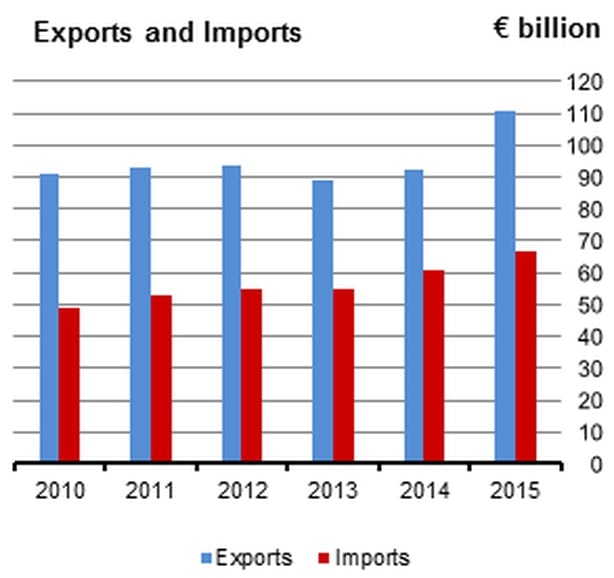
STATISTICS RELEASED BY THE CENTRAL STATISTICS OFFICE (CSO) REVEAL THAT THE NUMBER OF EXPORTS EXCEEDING IMPORTS DECLINED FROM €20.3BN IN 2015 TO €16BN THIS YEAR.

Exports to the UK declined by €162m in the year to April. Irish importation of UK products also slowed, down over €116 million compared to the January to April sequence for 2015.
Ireland’s trade surplus with the UK was €1.4bn for the first four months of the year. Germany imported €2.2bn worth of Irish goods, followed by France with €1.9bn.
Irish exports to the US were down by €480m, while Irish imports from the US fell by €771m. Exports to China were up €215m.

Obesity causes premature death, concludes a study of studies

EVEN OVERWEIGHT PEOPLE RISK EARLIER DEATH THAN THOSE OF NORMAL WEIGHT, RESEARCH SHOWS

  An overweight child and adult

MEN WHO ARE OBESE ARE AT MUCH HIGHER RISK OF PREMATURE DEATH THAN OBESE WOMEN, ACCORDING TO THE STUDY OF STUDIES PUBLISHED IN THE LANCET MEDICAL JOURNAL.

Obesity and excess weight do shorten lives, according to a major review across five continents which sought to find a definitive answer to a controversial question.
While obesity is a known risk for heart disease, stroke, cancer and type 2 diabetes, which can all be life-shortening, the impact of obesity alone has been much disputed. Overweight and obesity are measured by BMI – body mass index – which charts weight against height. Many argue that it is a seriously flawed measure because it does not allow for the muscle that replaces fat in very fit people, such as athletes.
A large group of international researchers has attempted to overcome the problems of previous studies by analysing a vast amount of data collected in smaller studies, on 3.9 million adults worldwide. They found that even overweight people risked an earlier death than those of normal weight.
“On average, overweight people lose about one year of life expectancy, and moderately obese people lose about three years of life expectancy,” said Dr Emanuele Di Angelantonio, the lead author, from the University of Cambridge.
“We also found that men who were obese were at much higher risk of premature death than obese women. This is consistent with previous observations that obese men have greater insulin resistance, liver fat levels and diabetes risk than women.”
The researchers in the Global BMI Mortality Collaboration looked at the risk of early death between the ages of 35 and 70. Men of normal weight (with a BMI of 18.5 to 25) have a 19% risk of an earlier death and women a 11% chance. For those who are moderately obese, with a BMI of 30 to 35, that rises to 29.5% for men and 14.6% for women.
If obesity does directly cause early deaths, they calculate that if all those who are overweight or obese were instead of normal weight, one in seven early deaths could be avoided in Europe and one in five in north America, where obesity rates are higher. “Obesity is second only to smoking as a cause of premature death in Europe and North America,” said co-author Prof Sir Richard Peto, from the University of Oxford.
“Smoking causes about a quarter of all premature deaths in Europe and in North America, and smokers can halve their risk of premature death by stopping. But [being] overweight and obesity now cause about one in seven of all premature deaths in Europe and one in five of all premature deaths in North America.”

New initiative launched to save threatened bee species in Ireland


Bumblebee (left) collecting pollen from a mullein and the Irish honey bee (right)

A new initiative has been launched to save Ireland’s declining bee population, following the news that one third of our 98 bee species are endangered.
The National Biodiversity Plan seeks to protect Ireland’s pollination services.
More than 68 governmental and non-governmental organisations across Europe have agreed to the shared plan, which notes 81 actions everyone can take part in to make our gardens pollinator friendly.
“If you’re a pollinator, finding enough food is the biggest challenge you have to face.” said Dr Úna FitzPatrick from the National Biodiversity Data Centre, who chaired the plan steering group.
She added “gardens can play a crucial role by acting as pit stops for busy bees as they try to move around the landscape”.
The plan includes a list of low-cost and practical actions to suit gardens of any size.
The most important thing people can do in their garden is to make sure there are bee-friendly flowers in bloom from March to October.
Dr Erin Jo Tiedeken, the project officer for the All-Ireland Plan, recommends lavender, heather, comfrey, lungwort and catmint as a great food source for bees.
The plan suggests cutting your garden lawn slightly less often to allow wildflowers such as dandelions and clovers to grow.
It also warns not to use pesticides that are harmful to pollinators.
The implementation of the All-Ireland Pollinator Plan is being coordinated by the National Biodiversity Data Centre with funding provided by the Heritage Council and Bord Bia.

New underwater microscope shows the beauty of coral turf on the ocean floor

Benthic Underwater Microscope   Benthic Underwater Microscope   Benthic Underwater Microscope
Left, Two polyps connect their gastrovascular openings at night this is dubbed ‘polyp kissing, (On right picture) Stylophora on the left of the picture and Pocillopora on the right were placed close together to induce competition. When corals compete for dominance, they emit mesenterial filaments, string-like structures,

RESEARCHERS USED THE INSTRUMENT TO CAPTURE IMAGES OF CORAL TURF WARS AND A PREVIOUSLY UNKNOWN PHENOMENON DUBBED “CORAL POLYP KISSING.”

Researchers from the Scripps Institution of Oceanography at UC San Diego have developed a diver-operated underwater microscope that can examine small-scale biological processes on the ocean floor. Referred to as the Benthic Underwater Microscope (BUM), this revolutionary tool is able to take photographs and videos of microorganisms in their native habitats without interfering with their natural settings.
Prior to the development of the BUM, scientists were forced to remove organisms from the ocean in order to analyze them with microscopes, preventing them from fully understanding the context of ecological processes.
Oceanographer Jules Jaffe led the team that developed the microscope, and he considers the instrument essential to conducting research in the ocean. “To understand the evolution of the dynamic processes taking place in the ocean, we need to observe them at the appropriate scale,” Jaffe explained.
Jaffe and his team brought the BUM to coral reefs off the coasts of Maui, Hawaii and in the Red Sea to test it in the field. While using the microscope in the Red Sea, the researchers observed corals of different species firing string-like filaments from their stomach cavities towards one another in a “coral turf war.” The filaments secreted enzymes that dissolved coral tissue in an effort to reduce competition from neighboring species. The researchers also observed individual coral polyps on a single colony embracing each other, a previously unknown phenomenon they dubbed “coral polyp kissing.”
Off the coast of Maui, the team used the BUM to observe coral bleaching, a phenomenon that occurs when waters are too warm. The change in water temperature puts stress on corals, causing them to expel algae that live in their tissue and turning them completely white. The microscope revealed a previously undiscovered honeycomb pattern formed by expelled algae as it grew on the surface of the bleached coral.
Jaffe and his team published their observations in the journal Nature Communications and also produced a video describing their research. Watch Andrew Mullen, one of the authors of the study, explain how the BUM works and see some of the beautiful footage below.     

Tuesday, May 10, 2016

Irish households continue to cut its debt by repaying loans 

LATEST FIGURES FROM CENTRAL BANK SHOW HOUSEHOLDS STILL THIRD MOST INDEBTED IN THE EU


HOUSEHOLD DEBT HAS DECLINED CONTINUOUSLY FOR THE LAST 29 QUARTERS AND HAS FALLEN BY 26.6% SINCE ITS PEAK. 

Irish household debt fell by 1.1% in the fourth quarter of last year as borrowers focused on repaying loans.
The latest figures from the Central Bank show household debt continued to decrease, falling by €1.6bn, or 1.1%, to €149.6bn.
This represented a household debt per capita of €32,269. Household debt is now at its lowest level since the first quarter of 2006.
The Central Bank said the decline over the quarter reflected net debt repayments (-€1.1bn) and debt write-downs (-€0.6bn), which were slightly offset by positive reclassifications (€0.1bn).
Household net worth increased by 1.4% to €626.1bn, or €135,078 per capita, during the same period. This increase was largely driven by a rise in housing asset values (€6.3bn), as well as a further decline in household liabilities (€1.6bn).
Compared to a post-crisis low of €444.0bn in the second quarter of 2012, household net worth has risen by 41%. However, it is still 12.8% lower than its pre-crisis peak of €718bn in the second quarter of 2007.
Household debt has declined continuously for the last 29 quarters and has fallen by 26.6% since its peak of €203.7bn in the third quarter of 2008.
Indicators of household debt sustainability continued to improve during the same period. Debt as a proportion of disposable income fell from 159.8% to 155.1%, reflecting both the decline in household debt, as well as strong growth in annualised disposable income.
Overall, the ratio of household debt to disposable income has fallen by 60.2% since its peak of 215.3% in the second quarter of 2011.
Debt as a proportion of total assets also decreased, falling to from 19.5% to 19.1% over the quarter.
Despite a “significant decline” in debt as a proportion of disposable income over the year to Q4, Irish households continued to be the third most indebted in the European Union. Irish household debt fell by 25.1 per points over the year.
The Central Bank noted this was “significantly more” than any other country examined.
Spanish and Portuguese household debt also fell considerably over the year declining by 6.1%% and 4.6% respectively.
Household investment in financial assets rose to €1.9bn. This represented the highest level of investment in financial assets by households since the third quarter of 2009.
The increase in financial assets over the quarter largely reflected transactions into deposits.

Investigation launched after death of a man in his (70s) in Garda custody

GSOC CONFIRM GARDAÍ ADMINISTERED CPR AFTER MAN ‘BECAME UNWELL WITH BREATHING DIFFICULTIES’ IN A GARDA CELL.


THE GARDA OMBUDSMAN HAS CONFIRMED THAT THEY ARE INVESTIGATING THE DEATH OF A MAN IN CUSTODY.

The man, who was in his 70s, was discovered dead in a cell at Westport Garda station in Co Mayo at 11am.
The man was detained earlier today and sources have indicated he may have suffered a heart attack.
A spokeswoman for the Garda Siochana Ombudsman Commission (GSOC) has confirmed that a team is on their way to the scene where an investigation will be carried out.
A referral was made to the body under section 102 of the Garda Síochána Act 2005.
This evening GSOC released a statement about the incident.
A statement?
A spokeswoman confirmed: “The Garda Ombudsman is examining the circumstances surrounding the death of a man in his 70s while in custody at Westport Garda Station, Co. Mayo.
“The incident was referred to GSOC by the Garda Síochána under section 102 of the Garda Síochána Act at about 12.30pm this afternoon.
“The man who was under arrest became unwell with breathing difficulties and CPR was administered by gardaí. A doctor and the emergency services were called and the man was pronounced dead at the scene.
“The State Pathologist has been informed and a post-mortem is scheduled to take place in Castlebar in the coming days.
“GSOC Investigators are at the scene and an independent examination is underway to establish the facts of the situation.”

The published Panama Papers reveals thousands of secret offshore companies

A SEARCHABLE DATABASE DISPLAYS MORE THAN 200,000 ENTITIES FROM THE PANAMA PAPERS


THE INTERNATIONAL CONSORTIUM OF INVESTIGATIVE JOURNALISTS (ICIJ) TONIGHT PUBLISHES A SEARCHABLE DATABASE (HTTPS://OFFSHORELEAKS.ICIJ.ORG) THAT STRIPS AWAY THE SECRECY OF NEARLY 214,000 OFFSHORE ENTITIES CREATED IN 21 JURISDICTIONS, FROM NEVADA TO HONG KONG AND THE BRITISH VIRGIN ISLANDS.

The data, part of the Panama Papers investigation, is the largest ever release of information about offshore companies and the people behind them. This includes, when available, the names of the real owners of those opaque structures.
The database also displays information about more than 100,000 additional offshore entities the ICIJ had already disclosed in its 2013 Offshore Leaks investigation.

THE PANAMA PAPERS DATABASE.  

(HTTPS://OFFSHORELEAKS.ICIJ.ORG)

THE ICIJ IS PUBLISHING THE INFORMATION IN THE INTEREST OF THE PUBLIC .

The data the ICIJ is now making public represents a fraction of the Panama Papers, a trove of more than 11.5 million leaked files from the Panama-based law firm Mossack Fonseca, one of the world’s top creators of hard-to-trace companies, trusts and foundations.
The consortium is not publishing the totality of the leak, and it is not disclosing raw documents or personal information en masse. The database contains a great deal of information about company owners, proxies and intermediaries in secrecy jurisdictions, but it does not disclose bank accounts, email exchanges and financial transactions contained in the documents.
In all, the database reveals more than 360,000 names of people and companies behind secret offshore structures. As the data are from leaked sources and not a standardised registry, there may be some duplication of names.
The data was originally obtained from an anonymous source by reporters at the German newspaper Süeddeustche Zeitung, who asked ICIJ to organise a global reporting collaboration to analyse the files.
More than 370 reporters (https://panamapapers.icij.org/about.html) in nearly 80 countries investigated the files for a year. Their investigations uncovered the secret offshore holdings of 12 world leaders, more than 128 other politicians and scores of fraudsters, drug traffickers and other criminals whose companies had been blacklisted in the US and elsewhere.
Their status as outlaws or public officials did not prevent them from obtaining shell companies in locales where secrecy laws often make it impossible for prosecutors and other investigators to trace their assets.
The files revealed, for example, that associates of Russian President Vladimir Putin secretly shuffled as much as $2 billion through banks and shadow companies.

THE GLOBAL REACTION? 

The reaction to the Panama Papers was immediate and viral.
Outraged citizens took to the streets in Reykjavik, Malta and London while the hashtag #panamapapers trended on Twitter for days after the story broke on April 3rd.
The prime minister of Iceland resigned over the British Virgin Islands company he co-owned with his wife, while other world leaders scrambled to explain their secret holdings.
It took UK’s prime minister David Cameron three days to publicly acknowledge he had profited from an investment fund, created by his father, that was incorporated in Panama and managed in the Bahamas.
In Spain a minister resigned after being caught in a series of lies about his connections to offshore, and in Uruguay police arrested five individuals suspected of laundering money for a powerful Mexican drug cartel.
The Panama Papers underscore the fundamental injustices and inequalities created by the offshore system, media commentators and political leaders say.
“When taxes are evaded, when state assets are taken and put into these havens, all of these things can have a tremendous negative effect on our mission to end poverty and boost prosperity,”
Jim Yong Kim, the president of the World Bank, said as he opened the spring meetings of the World Bank and IMF in Washington soon after ICIJ and more than 100 other news organisations, including The Irish Times, began revealing the results of the media collaboration’s investigation.
President Barack Obama, meanwhile, pointed out that the biggest problem was that many of the schemes revealed by the Panama Papers were legal. “It’s not that they’re breaking the laws, it’s that the laws are so poorly designed,” he said.
The revelations reignited the debate about the need for public registries in which information about who ultimately controls a company be accessible to all. The UK has made disclosure of beneficial owner data mandatory and public, but British Overseas Territories such the British Virgin Islands and the Cayman Islands, some the busiest offshore havens, have agreed to share that information by law enforcement.
Citing the Panama Papers, the US government also announced on Thursday that it has sent legislation to Congress to create a centralised federal registry of the actual owners of any newly created company.
The registry would help law enforcement authorities ferret out the real people behind anonymous companies used in money laundering and other wrongdoing.
The governments of Australia and Germany have said that they too intend to create public registries of company owners.
On Friday, the anonymous leaker of the Panama Papers, known only as “John Doe, ” spoke publicly for the first time in a written statement and called out for concrete steps to combat tax havens .
“In the European Union, every member state’s corporate register should be freely accessible, with detailed data plainly available on ultimate beneficial owners,” the source wrote. Doe added that the US “can clearly no longer trust its fifty states to make sound decisions about their own corporate data.”

EXPLORING THE DATABASE? 

(HTTPS://OFFSHORELEAKS.ICIJ.ORG)

The searchable database that ICIJ publishes today allows users to explore the networks of companies and people that used – and sometimes abused – the secrecy of offshore locales with the help of Mossack Fonseca and other intermediaries. The leaked data covers nearly 40 years, from 1977 through the end of 2015.
The data, which includes postal addresses, displays links to more than 200 countries and territories, from China to Chile.
Users can filter the information by country and by offshore jurisdiction. They can also explore the role of banks, law firms and other gatekeepers of the financial system in facilitating the creation of offshore companies for high net worth individuals.
For the first time, they can see details about shadowy Panamanian private foundations, including when available information about who controls them.
While the database opens up a world that has never been shown in this much detail, not every owner of a company that appears in the Panama Papers shows up in the public database.
This is because ownership information is often buried in emails, power-of-attorney letters and internal notes of Mossack Fonseca employees and cannot easily be extracted in a systematic manner.
In addition, Mossack Fonseca often failed to collect the necessary information about the ultimate owners of companies, relying instead on banks and other intermediaries to keep track of that essential data.
Still, it is expected that Panama Papers revelations will continue to surface as regulators and ordinary citizens from around the globe probe the newly available data and find new connections that may have escaped reporters. Concerned citizens are encouraged to share tips with ICIJ and the Panama Papers journalists who continue to investigate the documents. The full dataset is also available for download: https://offshoreleaks.icij.org/pages/database.
“Transparency is not going to move backward,” Kim said in his World Bank spring meetings remarks, warning that those trying to avoid taxes or steal money from public treasuries should be “very careful” because they will eventually be tracked down.
“The world is only going to become more and more transparent as we move forward.”

Aldi and Lidl prove incredibly astute at tapping into what Irish consumers want

IRISH CONSUMERS MOVING TO OWN-BRAND OFFERINGS IS NO SURPRISE


IRISH CONSUMERS ARE NOW DISCARDING BRAND NAMES MORE IN FAVOUR OF THE OWN-BRAND OFFERINGS ON THE SHELVES OF ALDI AND LIDL IN GREATER NUMBERS THAN EVER SHOULD COME AS NO SURPRISE.

The share of the Irish grocery market held by the German discounters Aldiand Lidl has just increased dramatically, with confirmation due on Monday that nearly one in four Irish consumers do their shopping in either one of the two stores.
Last month, figures from industry analysts Kantar Worldpanel painted a very different picture.

THOSE FIGURES PUT SUPERVALU ON 24.9% OF THE IRISH MARKET, WHILE TESCO HAD 23.9% -JUST 0.4% AHEAD OF DUNNES STORES.

Lidl and Aldi had 8.5% and 8.4% market share respectively – good certainly, but nowhere as near as good as the new figures suggest.
The change is due to a recalibration from Kantar rather than any shift in spending.
There is no change in the running order, with Supervalu still in the number one position and Aldi still in fifth – but the combined market share of Aldi and Lidl is 22.1%. Lidl now has 11.5% of the Irish market, while Aldi is just behind it on 11.2%.
Aldi is arguably the better performing of the pair, because it has an almost identical market share with significantly fewer stores.
Brand names:  That Irish consumers are eschewing brand names in favour of the own-brand offerings on the shelves of Aldi and Lidl in greater numbers than ever should come as no surprise.
In the mid-1990s, Lidl and Aldi were unfamiliar to most Irish shoppers. Then, in 1998, Lidl arrived and was joined the following year by Aldi.
In the early days growth was slow, with Irish people reluctant to swap branded products for unfamiliar labels, while Irish suppliers and producers were reluctant to do business with untested chains who were not highly regarded among shoppers.
People were amused by the pair’s eclectic weekly special offer – but the allure of delights such as jackhammers jostling for position with canoes, luridly coloured onesies and flat-pack gazebos was not enough to bring people through their doors in significant numbers.
Their Spartan shelves did Lidl and Aldi no favours either. A big Tesco outlet might have more than 20,000 different items on their shelves, while the discounters contented themselves with around 1,000.
Then the bubble burst – and everything changed. The growth of both retailers has been relentless ever since but it would be wrong to suggest that growth has been simply down to cash strapped times. Far from it.
Both Aldi and Lidl have proved themselves to be incredibly astute at tapping into what Irish consumers want. They tweaked their product lines to offer more Irish produce, their ranges improved dramatically and they established very good relationships with Irish suppliers.
Crucially, both Aldi and Lidl were also able to prove that people who did their shopping in their stores saved money, a lot of money.
Canny shoppers realised they could easily knock over a third off their annual grocery spend by shopping with the Germans, without sacrificing anything significant in terms of quality.
The perception of both companies is also very good. Both featured in the top 10 most respected companies in the Republic in a survey published last month by the Reputations Agency, while a separate survey from Amárach on consumers’ attitudes published late last year rated Aldi fourth most highly rated company in Ireland in a poll of more than 2,700 people.
“That really surprised me,” said Gerard O’Neill of Amárach when the survey was published.
“We lived through the recession and watched as the discounters changed the retail rules and relentlessly pushed down prices, but now they are changing the rules again. They are aiming for better prices, better experiences, and better service.”
Speaking yesterday, O’Neill elaborated. “The recession gave them [discounters] a foothold – but there is more to it than that. They have completely changed the conversation about value and made people realise it is not all about price.
“It is about affordability, but also about the sense of how a person feels shopping. Aldi and Lidl have made people who shop in their stores feel prudent, discerning, more astute – almost German.”
O’Neill said the two had been “very clever in how they have dealt with their competition. It has been like a bait and switch. They made the conversation about price and then switched it to Irishness and community.
“If a Martian was to arrive in Ireland they would be sure that both Aldi and Lidl were indigenous companies, so embedded in the local communities do they appear,” he suggested.
Customer experience
He pointed out that customer experience “is driven not by value for money – because we rationalise that after the fact – but by something more emotional. We like to come away from the shopping experience feeling smug – in the nice sense of the word – and safe in the knowledge that we have got a bargain. Aldi and Lidl understand that.”
It is not just by offering good value and toying with our emotions that Aldi and Lidl have grown so strongly. Both have opened stores at a phenomenal rate.
Last Thursday, the former opened its 124th – and largest – store in Sallynogginin Co Dublin, while Lidl has 147 stores.
Both have plans for more openings in the months ahead.
Damian O’Reilly, who lectures in retail management in the Dublin Institute of Management, described how effectively the discounters have been playing the retail game in recent years, capitalising on changing economic conditions, improving consumer knowledge and very effective store design and stock maintenance.
He pointed out that their modular units were very cheap to put up – a store can be opened for about €3 million – and their compact size means they can be squeezed into small spaces in rural towns which has allowed them to take on Supervalu in areas where that retailer used to be traditionally untouchable.
And, he said, Aldi and Lidl have been outspending their rivals on television and newspaper ads over the last two years, working relentlessly to promote their Irishness.
They also have some canny tricks they play. “They have longer conveyor belts leading to the cash registers, so shoppers think they are nearly there when they start putting their shopping out – even though there might still be three people ahead of them. The staff have to scan 30 items a minute – so the check-out process moves very quickly.”
But where to next? “In terms of market share I think they are nearly there,” O’Reilly says. “They might be able to grow another couple of per cent but the rate at which they are opening stores is slowing and that will put a limit on how much they will grow.”
O’Neill agreed, although he suggested the Germans could get to 30% of the market. “They will be constrained by the amount of real estate they can buy and the competition is not just going to sit there and watch as they grow bigger.”

Full moons influence less sleep in children


THE FULL MOON CAN SOMEHOW INFLUENCE CHILDREN’S BEHAVIOUR AND EVEN AFFECT THEIR SLEEP? ALTHOUGH IT IS NOT ENOUGH TO STRENGTHEN ANCIENT BELIEF ON THE LUNAR PHASES’ EFFECTS ON HUMAN BIOLOGY.

A recent study published in the journal Frontiers in Pediatrics showed that children are no more active during full moon than in any other phase of the moon. The full moon, on the other hand, may interfere with their sleeping time, potentially owing to its brightness particularly “if the window curtain is not sufficiently opaque.”
“[S]leep duration was 1 percent shorter at full moon compared to new moon, while activity behaviours were not significantly associated with the lunar cycle in this global sample of children,” wrote the researchers, with this specific finding translating to around five minutes less sleep.
According to researchers from the Children’s Hospital of Eastern Ontario Research Institute in Canada, the study offers “solid evidence” that the links between moon phases and children’s sleep duration and activity behaviors do not come across as meaningful from a public health perspective.
The team analyzed data from over 5,800 children, who were ages 9 to 11 and came from 12 countries. Unlike previous research relying on human judgment, subjects wore accelerometers, which are akin to fitness trackers recording body movements or monitoring sleep for 24 hours a day for at least seven days.
The kids got five minutes shorter sleep on nights with a full moon, deemed an effect “unlikely to be important.” And it remains unclear why children had less shuteye on full-moon nights.
 It could be that the full moon’s brightness was interfering with sleep, although the researchers considered this implausible given the abundance of artificial light – such as from smartphones and mobile devices – in modern societies.
The team urged future studies to see if the human body is somehow synchronized with the moon’s cycles, or if the full moon has a more pronounced effect on certain groups of people.
The belief that the moon affects people’s behavior dates back ancient times, although studies have seen little evidence to back up this idea. The moon mystery, suffice it to say, has fascinated many civilizations and generations.
For instance, no peer-reviewed study yet has seen any notable association between the full moon and epileptic seizures, psychiatric ward visits, or emergency room cases. Even when it comes to menstrual cycles, there is no research so far that makes a significant correlation between lunar phases and the condition across a huge swath of participants.
In addition, the effects of the moon on the ocean are notable not only during the full moon – the tides, too, are highest during the new moon.