Pages

Showing posts with label Population. Show all posts

Friday, July 15, 2016

Donie's Ireland daily news BLOG update

More than 259,000 vacant homes in Ireland census 2016

CSO FIGURES SHOW NUMBER OF EMPTY DUBLIN HOLIDAY PROPERTIES ‘UP 190% IN FIVE YEARS’


PRELIMINARY FIGURES PUBLISHED BY THE CENTRAL STATISTICS OFFICE ON JULY 14TH SHOW THE TOTAL POPULATION IS NOW 4,757,976.

The number of vacant holiday homes in Dublin city centre has nearly trebled in five years.
Publishing preliminary statistics from the April 24th census, the CSO said there had been a “noticeable increase”, up from 322 in 2011 to 937 this year – an increase of 190%.
The housing crisis in some parts of the State appears to have manifested itself in the census, with figures showing the number of vacant dwellings has fallen by 29,889 (13.8%).
In total, there are 259,562 vacant homes, including 61,204 vacant holiday homes, up 1,809 (3%) on the last census.
Vacancy rates for housing vary widely by county but the overall rate stands at 12.8%.
Carlow experienced the largest fall in the number of vacant dwellings from 3,202 in 2011 to 2,417 in this year’s census – a drop of 26.9%.
In Leitrim, the county with the highest vacancy rate in 2011, the number of vacant homes fell by just 3.7%.
Donegal, where the vacancy rate was 28.4% five years ago, has seen the number of vacant dwellings fall by just 97 units or less than 1%, the CSO said. This brings the vacancy rate to 28.2%.
The census provided information on the number of vacant dwellings for the first time in 2006 and the results showed there were 266,322 vacant dwellings (including holiday homes) in Ireland at that time, with a vacancy rate of 15%.
Vacancy rate
By 2011 the number of vacant dwellings had increased by 23,129 to 289,451, while the overall vacancy rate (14.4%) had fallen.
According to the 2016 preliminary census figures, household formation has fallen behind population growth and household sizes are also getting bigger in urban areas, bucking the trend of previous censuses. In rural areas, household sizes are getting smaller, the CSO’s statisticians said.
The number of occupied households increased between 2011 and 2016 by just over 49,000, or 3%.
Asked how the CSO identified housing as vacant, senior statistician Deirdre Cullen said the 4,663 enumerators were provided with very detailed notes. “It’s vitally important that we get it right,” she said.
Enumerators were instructed to call to every dwelling four, five, six and even seven times.
“They call several times; they talk to neighbours.”
If the house was vacant, neighbours might identify it as a holiday home or a property that was just visited at weekends. Overgrown gardens, for sale signs and an absence of post were also indicators a home was vacant.
“It’s really just on-the-ground knowledge by talking to people,” Ms Cullen said.
Airbnb, which allows people book short-term stays in homes of their choice around the world, insisted earlier this year that its services were not taking housing off the market.
Figures from the Airbnb website back in March showed the number of properties available to rent in Dublin for short-term holidays exceeded the number available for long-term letting.
At that point there were 1,748 apartments or houses available for holiday lettings on the site.

Ireland’s lobbyists call for investment after ‘vote of confidence’ in Republic population growth

GROUPS SAY MORE MONEY NEEDED TO COPE WITH GROWING POPULATION


IBEC CHIEF EXECUTIVE DANNY MCCOY SAID THE COMING YEARS WOULD SEE “SIGNIFICANTLY INCREASED PRESSURE” ON SERVICES, HOUSING AND INFRASTRUCTURE.

The growth in the population is “a vote of confidence” in the Republic’s future, but there is an “urgent need” for the Government to invest in services if the State is to be equipped to cope, according to lobbyists reacting to Census 2016.
Danny McCoy, chief executive of employers’ group Ibec, said the coming years would see “significantly increased pressure” on services, housing and infrastructure.
“We need a long-term approach to planning and development. The rapidly growing population is a vote of confidence in the country’s future.
“While many countries struggle to confront the problems of a declining population, Ireland must address those presented by a young, rapidly growing population.”
Mr McCoy said the shift in population from the western seaboard to the east was “a concern”. If economic activity was focused predominantly on the capital it would stretch resources, push up costs, and leave other parts of the State behind.
“It is creating a worrying economic and social imbalance. A new Atlantic-cities strategy is needed to ensure complementary growth between Dublin and other cities in terms of size, infrastructure, population and other resources.”
Crucial
Chambers Ireland director of policy Mark O’Mahoney said it was “crucial” that Government prioritises increased capital investment “in the short term”.
“We recognise that efforts have been made and that there are limited resources. However, it is only through sustained capital investment that Ireland can avoid future infrastructural bottlenecks that will hinder our economic growth.”
Simon Communities spokeswoman Niamh Randall said the figures were “unacceptable” when there are over 6,000 men, women and children in emergency accommodation “with no place to call home”.
“That there are 198,358 vacant units at a time when we are experiencing the worst housing and homeless crisis is scandalous. Clearly, having more effective housing stock management across the country must be addressed urgently.”

Irish exports slow in first four months

MAJOR CONCERNS HAVE BEEN FLAGGED OVER CURRENCY FLUCTUATIONS HITTING EXPORTS.


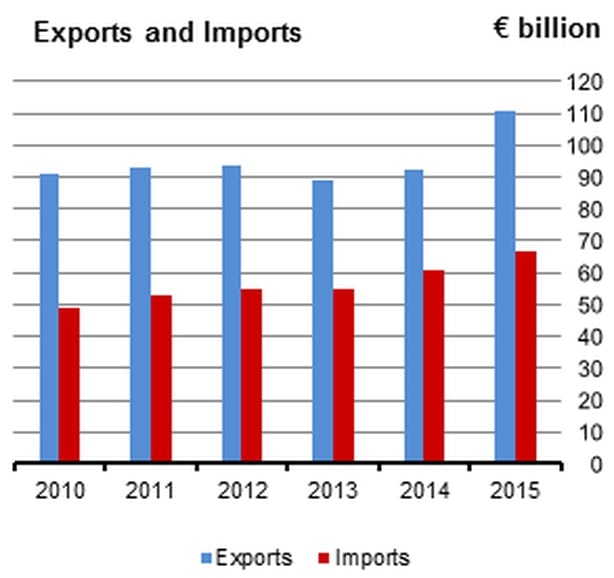
THE IRISH TRADE SURPLUS FELL BY OVER €4BN IN THE FIRST FOUR MONTHS OF THIS YEAR.

STATISTICS RELEASED BY THE CENTRAL STATISTICS OFFICE (CSO) REVEAL THAT THE NUMBER OF EXPORTS EXCEEDING IMPORTS DECLINED FROM €20.3BN IN 2015 TO €16BN THIS YEAR.

Exports to the UK declined by €162m in the year to April. Irish importation of UK products also slowed, down over €116 million compared to the January to April sequence for 2015.
Ireland’s trade surplus with the UK was €1.4bn for the first four months of the year. Germany imported €2.2bn worth of Irish goods, followed by France with €1.9bn.
Irish exports to the US were down by €480m, while Irish imports from the US fell by €771m. Exports to China were up €215m.

Obesity causes premature death, concludes a study of studies

EVEN OVERWEIGHT PEOPLE RISK EARLIER DEATH THAN THOSE OF NORMAL WEIGHT, RESEARCH SHOWS

  An overweight child and adult

MEN WHO ARE OBESE ARE AT MUCH HIGHER RISK OF PREMATURE DEATH THAN OBESE WOMEN, ACCORDING TO THE STUDY OF STUDIES PUBLISHED IN THE LANCET MEDICAL JOURNAL.

Obesity and excess weight do shorten lives, according to a major review across five continents which sought to find a definitive answer to a controversial question.
While obesity is a known risk for heart disease, stroke, cancer and type 2 diabetes, which can all be life-shortening, the impact of obesity alone has been much disputed. Overweight and obesity are measured by BMI – body mass index – which charts weight against height. Many argue that it is a seriously flawed measure because it does not allow for the muscle that replaces fat in very fit people, such as athletes.
A large group of international researchers has attempted to overcome the problems of previous studies by analysing a vast amount of data collected in smaller studies, on 3.9 million adults worldwide. They found that even overweight people risked an earlier death than those of normal weight.
“On average, overweight people lose about one year of life expectancy, and moderately obese people lose about three years of life expectancy,” said Dr Emanuele Di Angelantonio, the lead author, from the University of Cambridge.
“We also found that men who were obese were at much higher risk of premature death than obese women. This is consistent with previous observations that obese men have greater insulin resistance, liver fat levels and diabetes risk than women.”
The researchers in the Global BMI Mortality Collaboration looked at the risk of early death between the ages of 35 and 70. Men of normal weight (with a BMI of 18.5 to 25) have a 19% risk of an earlier death and women a 11% chance. For those who are moderately obese, with a BMI of 30 to 35, that rises to 29.5% for men and 14.6% for women.
If obesity does directly cause early deaths, they calculate that if all those who are overweight or obese were instead of normal weight, one in seven early deaths could be avoided in Europe and one in five in north America, where obesity rates are higher. “Obesity is second only to smoking as a cause of premature death in Europe and North America,” said co-author Prof Sir Richard Peto, from the University of Oxford.
“Smoking causes about a quarter of all premature deaths in Europe and in North America, and smokers can halve their risk of premature death by stopping. But [being] overweight and obesity now cause about one in seven of all premature deaths in Europe and one in five of all premature deaths in North America.”

New initiative launched to save threatened bee species in Ireland


Bumblebee (left) collecting pollen from a mullein and the Irish honey bee (right)

A new initiative has been launched to save Ireland’s declining bee population, following the news that one third of our 98 bee species are endangered.
The National Biodiversity Plan seeks to protect Ireland’s pollination services.
More than 68 governmental and non-governmental organisations across Europe have agreed to the shared plan, which notes 81 actions everyone can take part in to make our gardens pollinator friendly.
“If you’re a pollinator, finding enough food is the biggest challenge you have to face.” said Dr Úna FitzPatrick from the National Biodiversity Data Centre, who chaired the plan steering group.
She added “gardens can play a crucial role by acting as pit stops for busy bees as they try to move around the landscape”.
The plan includes a list of low-cost and practical actions to suit gardens of any size.
The most important thing people can do in their garden is to make sure there are bee-friendly flowers in bloom from March to October.
Dr Erin Jo Tiedeken, the project officer for the All-Ireland Plan, recommends lavender, heather, comfrey, lungwort and catmint as a great food source for bees.
The plan suggests cutting your garden lawn slightly less often to allow wildflowers such as dandelions and clovers to grow.
It also warns not to use pesticides that are harmful to pollinators.
The implementation of the All-Ireland Pollinator Plan is being coordinated by the National Biodiversity Data Centre with funding provided by the Heritage Council and Bord Bia.

New underwater microscope shows the beauty of coral turf on the ocean floor

Benthic Underwater Microscope   Benthic Underwater Microscope   Benthic Underwater Microscope
Left, Two polyps connect their gastrovascular openings at night this is dubbed ‘polyp kissing, (On right picture) Stylophora on the left of the picture and Pocillopora on the right were placed close together to induce competition. When corals compete for dominance, they emit mesenterial filaments, string-like structures,

RESEARCHERS USED THE INSTRUMENT TO CAPTURE IMAGES OF CORAL TURF WARS AND A PREVIOUSLY UNKNOWN PHENOMENON DUBBED “CORAL POLYP KISSING.”

Researchers from the Scripps Institution of Oceanography at UC San Diego have developed a diver-operated underwater microscope that can examine small-scale biological processes on the ocean floor. Referred to as the Benthic Underwater Microscope (BUM), this revolutionary tool is able to take photographs and videos of microorganisms in their native habitats without interfering with their natural settings.
Prior to the development of the BUM, scientists were forced to remove organisms from the ocean in order to analyze them with microscopes, preventing them from fully understanding the context of ecological processes.
Oceanographer Jules Jaffe led the team that developed the microscope, and he considers the instrument essential to conducting research in the ocean. “To understand the evolution of the dynamic processes taking place in the ocean, we need to observe them at the appropriate scale,” Jaffe explained.
Jaffe and his team brought the BUM to coral reefs off the coasts of Maui, Hawaii and in the Red Sea to test it in the field. While using the microscope in the Red Sea, the researchers observed corals of different species firing string-like filaments from their stomach cavities towards one another in a “coral turf war.” The filaments secreted enzymes that dissolved coral tissue in an effort to reduce competition from neighboring species. The researchers also observed individual coral polyps on a single colony embracing each other, a previously unknown phenomenon they dubbed “coral polyp kissing.”
Off the coast of Maui, the team used the BUM to observe coral bleaching, a phenomenon that occurs when waters are too warm. The change in water temperature puts stress on corals, causing them to expel algae that live in their tissue and turning them completely white. The microscope revealed a previously undiscovered honeycomb pattern formed by expelled algae as it grew on the surface of the bleached coral.
Jaffe and his team published their observations in the journal Nature Communications and also produced a video describing their research. Watch Andrew Mullen, one of the authors of the study, explain how the BUM works and see some of the beautiful footage below.     

Tuesday, February 3, 2015

Donie's Ireland daily news BLOG

No penalties for people who miss Irish Water deadline


Deadline of midnight to register with Irish Water to receive accurate bills

Saturday’s water charges demonstration has brought parts of Dublin to a standstill as protesters converge on the GPO.
There will be no penalties imposed on those who fail to meet this week’s “deadline” for registration with Irish Water although some who fail to sign up for the new regime may face higher charges at some future point.
Irish Water spokeswoman Elizabeth Arnett said there will be an assumption made that those who do not confirm their details with Irish Water are part of a two-adult household so will face the standard charge of €260.
She also said that households who do not register with the controversial utility will not be in a position to apply to the Department of Social Protection for the €100 Water Conservation Grant although the deadline for applying for that grant is still some way off.
“We will make an assumption that you are on a standard charge, in other words that you have more than two adults in the household and that you have both water and waste water services, and in that respect your bill would be €260,” she told RTE’s Sean O’Rourke.
“You may need to have a lower charge than that, we can’t determine that unless you’ve contacted us and similarly in terms of the €100 conservation grant unless your details have been confirmed with us you won’t be able to apply to the Department of Social Protection for that grant”.
All told 30,000 households registered with Irish Water over the weekend. Just over half of the households expected to pay bills to Irish Water have registered their details with the new utility as a deadline of midnight tonight looms for registration to ensure accurate water bills.
Almost 850,000 homes have provided their details to Irish Water out of the estimated 1.5 million customers who will receive their first water bills in April.
There is no penalty for not registering by this time, but the default rate of €260 will apply to households with no confirmed details.
A spokeswoman for Irish Water told The Irish Times the utility would continue to accept confirmation from people or changes in their details after the deadline.
“People can confirm or change their details with us anytime. We’ll continue to do that beyond February 2nd. The earlier you give it to us the better so you get the correct bill. If you get a bill that has any aspect of it not right, get onto to us.”
About 35,000 households returned their registration packages with no details, according to the water company. This figure includes 20,000 unopened packs.
An estimated 400,000 households will not be required to pay bills because they have private wells and septic tanks.
All households, including those who are not Irish Water customers, are eligible to apply for the water conservation grant of €100, but they need to register with the utility in order to qualify.
The Department of Social Protection has set aside a budget of €130 million to pay for the €100 water conservation grant – equivalent to paying the fee to 1.3 million households.
The Department of Environment has confirmed to The Irish Times that there is no deadline for households to apply for this grant, which will be paid from September.
A statement from Irish Water said 1.065 million households had registered their details with the utility, which includes about 200,000 responses from homes who are not Irish Water customers.
All households, including those who are not Irish Water customers, are eligible to apply for the water conservation grant of €100 but need to register with Irish Water before they can apply for the grant.
“Approximately 79 per cent of those are on the public water main and therefore customers of Irish Water. This represents over 56 per cent of the total customer base,” the statement said.
Sinn Féin deputy leader Mary Lou McDonald said her party will not stand over a situation where people are charged for their domestic water supply.
“One of the really frustrating things in all of this debate is the government has set out their stall… and the shambles that is Irish Water,” she told RTÉ radio.
“We in opposition have spent all our time trying to row them back from that very flawed approach. They haven’t listened to us and have carried on regardless. And we’ve wasted a whole pile of parliamentary time and the time of public servants who have all of the facts and figures and all the data at their disposal arguing a flawed proposal rather than putting our heads together as parliamentarians and coming up with a proposal that’s fair. And that works,” she said.
Pressed on where the party would find the money to finance Irish Water, Ms McDonald said half would come from exchequer funding, some from commercial rates and the party would be open to “looking at all forms of formula”
“You would tailor the level of investment and works you could carry out on the basis of that formula,” she said.

Aer Lingus Regional begins Dublin to Donegal service


Airline also announces new Donegal to Glasgow service, with up to four flights weekly

Aer Lingus Regional, operated by Stobart Air, has launched a new route between Dublin and Donegal.
Aer Lingus Regional, operated by Stobart Air, has launched a new route between Dublin and Donegal.
The airline today flew its first flight to Dublin Airport as the new operator of the PSO (Public Service Obligation) route from Donegal. The airline will fly twice daily return flights seven days a week year round.
Sean Brogan, interim chief executive officer of Stobart Air, said twice daily services between Donegal and Dublin will facilitate day return travel from Donegal for both business and leisure passengers.
“Equally, it will allow for easier connectivity to transatlantic services from Dublin for Donegal passengers and for US passengers to visit Donegal,” he said.
Aer Lingus Regional has also announced a new Donegal to Glasgow service, with up to four flights per week.
“Our services between Glasgow and Donegal will facilitate leisure and business passengers on both sides of the North Channel,” Mr Brogan said.
“We remain committed to offering Aer Lingus Regional customers reliable and efficient services to key regional areas across the United Kingdom and Ireland,” he added.

Cancer in Ireland to double by year 2040,

says a new report


Inevitable ‘boom’ expected because of relatively young population now growing.

Minister for Health Leo Varadkar speaking at the launch of the NCCP cancer report ‘A Strategy for Cancer Control in Ireland’.
Ireland will see a doubling in the incidence of cancer by 2040, according to a new report published today.
The National Cancer Control Programme (NCCP) said while considerable progress had been made in the implementation of the many recommendations of the 2006 national cancer strategy, a number of priorities remained a work in progress.
Because of Ireland’s relatively young population and inevitable “boom’’ in the number of ageing people, Ireland would have the highest growth of cancer incidence inEurope, according to the report.
The report on the 2006 national cancer strategy was launched in Dublin by Minister for Health Leo Varadkar. He said cancer services had shown a marked improvement since it was initiated.
Mr Varadkar said the third national cancer strategy for 2016 to 2025 was now being developed and he would set up a steering group. “Now, almost eight years on, it is timely to review implementation undertaken to date, celebrate the successes and identify the gaps that remain,’’ he said.
Another challenge, according to the report, would be the “current financial climate leading to capacity constraints in beds, theatre and ICU [/Intensive Care Unit/] and uncertainty regarding the availability of development funding at a time of rising incidence and prevalence of cancer’’.
Drug costs and related laboratory testing were predicted to rise sharply in the coming years, the report said.
The strategy provided a clear vision and focus for change, the report said. Strong political, policy and HSE (Health Service Executive) support, combined with effective clinical leadership across disciplines and tumour-site specific diseases were, and remained, essential, it said.
It said 2,870 men attended the eight NCCP rapid access prostate clinics in 2013. Of these, 1,591 were offered an appointment within 20 working days and, on average, 36 per cent of those who attended were subsequently diagnosed with cancer.
Access to clinics continued to be an issue, with just 55 per cent of patients who were referred seen within the target time, it said. The situation had deteriorated further in the first half of last year, it said.
The report said Galway, Limerick and Waterford hospitals had continuously struggled to reach their targets, with a contributory factor to the delays a lack of consultant urologist posts locally.
Since January last year targets were not being met in some Dublin centres because of cancellation of clinics over holiday periods and staffing challenges, the report said. There was a commitment to provide additional consultant urologist posts, the report said.

IVF treatment causing a huge increase in Ireland’s twin births


Ireland’s twin birth rate has increased dramatically due to an rise in IVF treatment.

Over 1,200 mums have delivered twins each year since 2009. Before 2000, the figure hadn’t topped 200.
Medics have attributed the increase to the rising interest in IVF treatment and to older mums.
In 2014, the average age of mothers in Ireland was 32.2 years – which is one of the oldest worldwide. Studies have shown that twin pregnancies increase significantly with maternal age.
Twins currently account for 10-20% of all babies born through IVF.
However, the Government will soon consider legislation which could include a ban on the use of multiple-embryo transfers in fertility treatment.
This could ultimately lead to a reductioin in the number of twins born in the future.
Health Minister Leo Varadkar will bring forward legislation governing a number of aspects of assisted human reproduction following the Supreme Court ruling last November in which a birth mother of twins born by surrogacy was deemed to be their legal mother.
The Minister is reportedly considering the aspects surrounding multiple embryo transfers.

Multiple

The Sims Clinic in Dublin, which carries out approximately 1,400 IVF and egg donation cycles each year, said that it would have concerns about any ban on multiple embryo transfers.
Clinical director David Walsh said that older women in particular would be affected by any rule change.
“For younger women it is very sensible to have a single embryo transfer policy as they have time to have more children,” he said.

“But it will penalise older women.”

Mr Walsh added that 3% of all births in Ireland arise out of fertility treatment.
He said that ultimately it will see the number of Irish women travelling overseas for fertility treatment.
Currently, an estimated 50% of the women receiving IVF treatment travel to clinics overseas. The Irish Multiple Births Association said they have noticed a rise in the number of enquiries for membership.
Rachael Joyce, of the association, said that she has noticed a jump in membership numbers from 800 to 1,800 in the space of just a few years.
“Most are seeking advice and support because of having two or more children at the same time,” she said recently.

Accelerated ice melt causing Iceland to rise


Parts of Iceland are rising, and the culprit may be climate change.

GPS measurements show that land in the central and southern parts of Iceland have been rising at a faster pace every year, beginning at about the same time as the onset of the ever-increasing melt of the island’s eponymous ice due to rising temperatures, a new study finds.
One of 62 GPS stations scattered around Iceland that have detected the land rising in response to glacier melt. Langjökull glacier is in the background.
“There have been a lot of studies that have shown that the uplift in Iceland is primarily due to ice loss,” study lead author Kathleen Compton, a PhD student at the University of Arizona, said. But this one, detailed in the journal Geophysical Research Letters, is the first to show that the acceleration of one speeds up the other.
That uplift could in turn affect Iceland’s notorious volcanoes and hasten eruptions, which can have impacts on air travel, so clearly seen in the 2010 eruption of Eyjafjallajökull, which disrupted air traffic for weeks.

When Ice Melts, Land Rises

Any big chunk of ice like a glacier or an ice sheet pushes down on the land below it, like a person laying on a tempurpedic mattress. (This is why parts of the bedrock of Antarctica are actually below sea level.) When that ice is removed, the land slowly rebounds, just as the mattress will slowly fill in when the person gets up.
Parts of North America are still rebounding after the retreat of the ice sheets that covered the region during the last major ice age thousands of years ago. But under Iceland, the mantle — the semi-solid layer of the Earth below the crust ¬— is a bit goopier, and so responds more quickly to changes in the weight pressing down on it.
What the new study shows is that parts of Iceland are rising much faster — as much as 30 millimeters, or 1.4 inches, a year — compared to prehistoric ice loss. This faster response is because recent ice loss, which is ultimately triggered by atmospheric warming due to the buildup of greenhouse gases, is happening at a faster pace.
“I’m not surprised at the amount of uplift, as the visible signs of ice loss are there for everyone to see,” David McGarvie, a volcanologist with The Open University in Scotland, who has studied Iceland, said.
And not only is the uplift faster, it’s accelerating 1 to 2 millimeters per year, Compton and her colleagues found.

GPS Signals

The researchers first noticed this unexpected increase in the uplift when they looked at the data coming from one of the GPS stations in a network of 62 such stations across the island. In looking at other stations in that network, they found the same trend, with the fastest accelerating uplifts closest to the biggest glaciers.
In analyzing the records, the team found that the area with the accelerated uplift coincided with the higher rates of glacier melt that has been separately documented by glaciologists since 1995.
“The upward velocity of the crust as measured by the researchers is almost certainly due to recent loss of ice mass due to melting,” McGarvie said.
As further corroboration, temperature records going back to the 1800s have showed steadily rising air temperatures since 1980. Both of these factors correspond to calculations Compton performed when Iceland’s recent uplift began.
“It’s always nice to see something come together this well,” she said.

Potential Side Effects

Compton also ran some calculations that showed that the only way to see the faster and faster uplift would be from sped up ice melt.
McGarvie isn’t completely convinced that the uplift is escalating as the data record is relatively short (only a few decades), but he says the idea is well worth continued study.
Whether or not similar uplift could be happening in other places with significant ice loss is difficult to assess because many of those spots have land that responds more slowly to pressure changes and have less extensive GPS stations than Iceland.
But, Compton said, “I think it’s certainly something that we should have on our radars.”
As for how the uplift will continue to play out in Iceland, she said that “this acceleration can’t go on forever,” but that it would be interesting to monitor over the next several years and see how it might change over time.
One thing scientists are concerned about are the potential effects the uplift could have on tectonic activity in an already active Iceland, as the changing stresses on the ground could impact volcanoes and earthquake faults. In fact,another recent study suggested that melting in the mantle caused by uplift could make eruptions of the size of Eyjafjallajökull in 2010 more common — an effect of climate change that wouldn’t be limited to Iceland itself, as that episode made clear.