Pages

Showing posts with label Men. Show all posts

Friday, July 15, 2016

Donie's Ireland daily news BLOG update

More than 259,000 vacant homes in Ireland census 2016

CSO FIGURES SHOW NUMBER OF EMPTY DUBLIN HOLIDAY PROPERTIES ‘UP 190% IN FIVE YEARS’


PRELIMINARY FIGURES PUBLISHED BY THE CENTRAL STATISTICS OFFICE ON JULY 14TH SHOW THE TOTAL POPULATION IS NOW 4,757,976.

The number of vacant holiday homes in Dublin city centre has nearly trebled in five years.
Publishing preliminary statistics from the April 24th census, the CSO said there had been a “noticeable increase”, up from 322 in 2011 to 937 this year – an increase of 190%.
The housing crisis in some parts of the State appears to have manifested itself in the census, with figures showing the number of vacant dwellings has fallen by 29,889 (13.8%).
In total, there are 259,562 vacant homes, including 61,204 vacant holiday homes, up 1,809 (3%) on the last census.
Vacancy rates for housing vary widely by county but the overall rate stands at 12.8%.
Carlow experienced the largest fall in the number of vacant dwellings from 3,202 in 2011 to 2,417 in this year’s census – a drop of 26.9%.
In Leitrim, the county with the highest vacancy rate in 2011, the number of vacant homes fell by just 3.7%.
Donegal, where the vacancy rate was 28.4% five years ago, has seen the number of vacant dwellings fall by just 97 units or less than 1%, the CSO said. This brings the vacancy rate to 28.2%.
The census provided information on the number of vacant dwellings for the first time in 2006 and the results showed there were 266,322 vacant dwellings (including holiday homes) in Ireland at that time, with a vacancy rate of 15%.
Vacancy rate
By 2011 the number of vacant dwellings had increased by 23,129 to 289,451, while the overall vacancy rate (14.4%) had fallen.
According to the 2016 preliminary census figures, household formation has fallen behind population growth and household sizes are also getting bigger in urban areas, bucking the trend of previous censuses. In rural areas, household sizes are getting smaller, the CSO’s statisticians said.
The number of occupied households increased between 2011 and 2016 by just over 49,000, or 3%.
Asked how the CSO identified housing as vacant, senior statistician Deirdre Cullen said the 4,663 enumerators were provided with very detailed notes. “It’s vitally important that we get it right,” she said.
Enumerators were instructed to call to every dwelling four, five, six and even seven times.
“They call several times; they talk to neighbours.”
If the house was vacant, neighbours might identify it as a holiday home or a property that was just visited at weekends. Overgrown gardens, for sale signs and an absence of post were also indicators a home was vacant.
“It’s really just on-the-ground knowledge by talking to people,” Ms Cullen said.
Airbnb, which allows people book short-term stays in homes of their choice around the world, insisted earlier this year that its services were not taking housing off the market.
Figures from the Airbnb website back in March showed the number of properties available to rent in Dublin for short-term holidays exceeded the number available for long-term letting.
At that point there were 1,748 apartments or houses available for holiday lettings on the site.

Ireland’s lobbyists call for investment after ‘vote of confidence’ in Republic population growth

GROUPS SAY MORE MONEY NEEDED TO COPE WITH GROWING POPULATION


IBEC CHIEF EXECUTIVE DANNY MCCOY SAID THE COMING YEARS WOULD SEE “SIGNIFICANTLY INCREASED PRESSURE” ON SERVICES, HOUSING AND INFRASTRUCTURE.

The growth in the population is “a vote of confidence” in the Republic’s future, but there is an “urgent need” for the Government to invest in services if the State is to be equipped to cope, according to lobbyists reacting to Census 2016.
Danny McCoy, chief executive of employers’ group Ibec, said the coming years would see “significantly increased pressure” on services, housing and infrastructure.
“We need a long-term approach to planning and development. The rapidly growing population is a vote of confidence in the country’s future.
“While many countries struggle to confront the problems of a declining population, Ireland must address those presented by a young, rapidly growing population.”
Mr McCoy said the shift in population from the western seaboard to the east was “a concern”. If economic activity was focused predominantly on the capital it would stretch resources, push up costs, and leave other parts of the State behind.
“It is creating a worrying economic and social imbalance. A new Atlantic-cities strategy is needed to ensure complementary growth between Dublin and other cities in terms of size, infrastructure, population and other resources.”
Crucial
Chambers Ireland director of policy Mark O’Mahoney said it was “crucial” that Government prioritises increased capital investment “in the short term”.
“We recognise that efforts have been made and that there are limited resources. However, it is only through sustained capital investment that Ireland can avoid future infrastructural bottlenecks that will hinder our economic growth.”
Simon Communities spokeswoman Niamh Randall said the figures were “unacceptable” when there are over 6,000 men, women and children in emergency accommodation “with no place to call home”.
“That there are 198,358 vacant units at a time when we are experiencing the worst housing and homeless crisis is scandalous. Clearly, having more effective housing stock management across the country must be addressed urgently.”

Irish exports slow in first four months

MAJOR CONCERNS HAVE BEEN FLAGGED OVER CURRENCY FLUCTUATIONS HITTING EXPORTS.


THE IRISH TRADE SURPLUS FELL BY OVER €4BN IN THE FIRST FOUR MONTHS OF THIS YEAR.

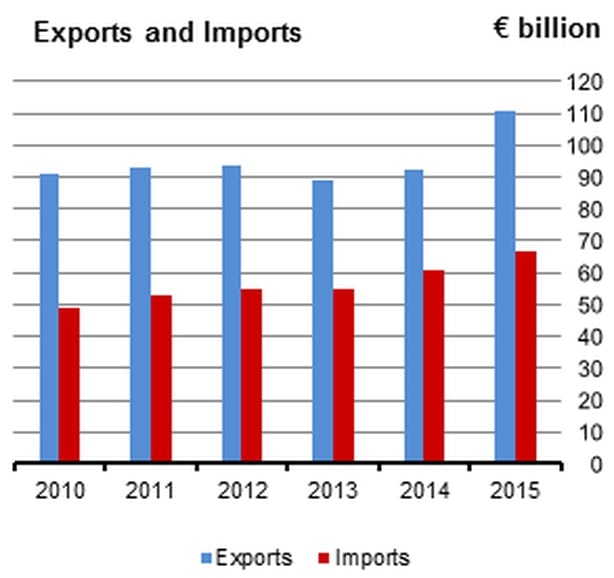
STATISTICS RELEASED BY THE CENTRAL STATISTICS OFFICE (CSO) REVEAL THAT THE NUMBER OF EXPORTS EXCEEDING IMPORTS DECLINED FROM €20.3BN IN 2015 TO €16BN THIS YEAR.

Exports to the UK declined by €162m in the year to April. Irish importation of UK products also slowed, down over €116 million compared to the January to April sequence for 2015.
Ireland’s trade surplus with the UK was €1.4bn for the first four months of the year. Germany imported €2.2bn worth of Irish goods, followed by France with €1.9bn.
Irish exports to the US were down by €480m, while Irish imports from the US fell by €771m. Exports to China were up €215m.

Obesity causes premature death, concludes a study of studies

EVEN OVERWEIGHT PEOPLE RISK EARLIER DEATH THAN THOSE OF NORMAL WEIGHT, RESEARCH SHOWS

  An overweight child and adult

MEN WHO ARE OBESE ARE AT MUCH HIGHER RISK OF PREMATURE DEATH THAN OBESE WOMEN, ACCORDING TO THE STUDY OF STUDIES PUBLISHED IN THE LANCET MEDICAL JOURNAL.

Obesity and excess weight do shorten lives, according to a major review across five continents which sought to find a definitive answer to a controversial question.
While obesity is a known risk for heart disease, stroke, cancer and type 2 diabetes, which can all be life-shortening, the impact of obesity alone has been much disputed. Overweight and obesity are measured by BMI – body mass index – which charts weight against height. Many argue that it is a seriously flawed measure because it does not allow for the muscle that replaces fat in very fit people, such as athletes.
A large group of international researchers has attempted to overcome the problems of previous studies by analysing a vast amount of data collected in smaller studies, on 3.9 million adults worldwide. They found that even overweight people risked an earlier death than those of normal weight.
“On average, overweight people lose about one year of life expectancy, and moderately obese people lose about three years of life expectancy,” said Dr Emanuele Di Angelantonio, the lead author, from the University of Cambridge.
“We also found that men who were obese were at much higher risk of premature death than obese women. This is consistent with previous observations that obese men have greater insulin resistance, liver fat levels and diabetes risk than women.”
The researchers in the Global BMI Mortality Collaboration looked at the risk of early death between the ages of 35 and 70. Men of normal weight (with a BMI of 18.5 to 25) have a 19% risk of an earlier death and women a 11% chance. For those who are moderately obese, with a BMI of 30 to 35, that rises to 29.5% for men and 14.6% for women.
If obesity does directly cause early deaths, they calculate that if all those who are overweight or obese were instead of normal weight, one in seven early deaths could be avoided in Europe and one in five in north America, where obesity rates are higher. “Obesity is second only to smoking as a cause of premature death in Europe and North America,” said co-author Prof Sir Richard Peto, from the University of Oxford.
“Smoking causes about a quarter of all premature deaths in Europe and in North America, and smokers can halve their risk of premature death by stopping. But [being] overweight and obesity now cause about one in seven of all premature deaths in Europe and one in five of all premature deaths in North America.”

New initiative launched to save threatened bee species in Ireland


Bumblebee (left) collecting pollen from a mullein and the Irish honey bee (right)

A new initiative has been launched to save Ireland’s declining bee population, following the news that one third of our 98 bee species are endangered.
The National Biodiversity Plan seeks to protect Ireland’s pollination services.
More than 68 governmental and non-governmental organisations across Europe have agreed to the shared plan, which notes 81 actions everyone can take part in to make our gardens pollinator friendly.
“If you’re a pollinator, finding enough food is the biggest challenge you have to face.” said Dr Úna FitzPatrick from the National Biodiversity Data Centre, who chaired the plan steering group.
She added “gardens can play a crucial role by acting as pit stops for busy bees as they try to move around the landscape”.
The plan includes a list of low-cost and practical actions to suit gardens of any size.
The most important thing people can do in their garden is to make sure there are bee-friendly flowers in bloom from March to October.
Dr Erin Jo Tiedeken, the project officer for the All-Ireland Plan, recommends lavender, heather, comfrey, lungwort and catmint as a great food source for bees.
The plan suggests cutting your garden lawn slightly less often to allow wildflowers such as dandelions and clovers to grow.
It also warns not to use pesticides that are harmful to pollinators.
The implementation of the All-Ireland Pollinator Plan is being coordinated by the National Biodiversity Data Centre with funding provided by the Heritage Council and Bord Bia.

New underwater microscope shows the beauty of coral turf on the ocean floor

Benthic Underwater Microscope   Benthic Underwater Microscope   Benthic Underwater Microscope
Left, Two polyps connect their gastrovascular openings at night this is dubbed ‘polyp kissing, (On right picture) Stylophora on the left of the picture and Pocillopora on the right were placed close together to induce competition. When corals compete for dominance, they emit mesenterial filaments, string-like structures,

RESEARCHERS USED THE INSTRUMENT TO CAPTURE IMAGES OF CORAL TURF WARS AND A PREVIOUSLY UNKNOWN PHENOMENON DUBBED “CORAL POLYP KISSING.”

Researchers from the Scripps Institution of Oceanography at UC San Diego have developed a diver-operated underwater microscope that can examine small-scale biological processes on the ocean floor. Referred to as the Benthic Underwater Microscope (BUM), this revolutionary tool is able to take photographs and videos of microorganisms in their native habitats without interfering with their natural settings.
Prior to the development of the BUM, scientists were forced to remove organisms from the ocean in order to analyze them with microscopes, preventing them from fully understanding the context of ecological processes.
Oceanographer Jules Jaffe led the team that developed the microscope, and he considers the instrument essential to conducting research in the ocean. “To understand the evolution of the dynamic processes taking place in the ocean, we need to observe them at the appropriate scale,” Jaffe explained.
Jaffe and his team brought the BUM to coral reefs off the coasts of Maui, Hawaii and in the Red Sea to test it in the field. While using the microscope in the Red Sea, the researchers observed corals of different species firing string-like filaments from their stomach cavities towards one another in a “coral turf war.” The filaments secreted enzymes that dissolved coral tissue in an effort to reduce competition from neighboring species. The researchers also observed individual coral polyps on a single colony embracing each other, a previously unknown phenomenon they dubbed “coral polyp kissing.”
Off the coast of Maui, the team used the BUM to observe coral bleaching, a phenomenon that occurs when waters are too warm. The change in water temperature puts stress on corals, causing them to expel algae that live in their tissue and turning them completely white. The microscope revealed a previously undiscovered honeycomb pattern formed by expelled algae as it grew on the surface of the bleached coral.
Jaffe and his team published their observations in the journal Nature Communications and also produced a video describing their research. Watch Andrew Mullen, one of the authors of the study, explain how the BUM works and see some of the beautiful footage below.     

Saturday, June 4, 2016

Donie's Ireland daily news BLOG update

Ireland's broadband users face price hikes of 18% from next September?

TELCOS SAY THEY INTEND TO PASS ON EIR’S INCREASE IN WHOLESALE RATES TO CONSUMERS


EIR DEFENDS PRICE CHANGES, SAYING THEY WERE LINKED TO THE COMPANY’S INCREASED INVESTMENT IN HIGH-SPEED FIBRE BROADBAND.

Consumers can expect an 18% hike in broadband prices from next September as a result of changes to Eir’s wholesale rates.
The State’s largest telco rents space on its network to rival operators such as Vodafone, BT, Magnet and Sky, as well as its own retail arm.
From September, it plans to raise fibre broadband prices for wholesale customers from €19.50 to €23 a month. Non-Eir operators have signalled the hike, which has been approved by regulator Comreg, would be passed on in full to consumers.
Eir, however, said the rate increase, when combined with a €2.11 reduction in its traditional fixed-line rental rates due in July, was broadly price neutral, and therefore did not necessitate a price rise at the retail end.
The assertion was disputed by rivals, which claimed the two price changes related to different product sets and could not be used to offset each other.
Alto, the umbrella group for non-Eir companies, described Eir’s move as “cynical”, claiming it bore no relation to the costs associated with providing the service. “With improved efficiencies and economies of scale, the costs should actually be decreasing,” Alto spokesman Ronan Lupton said
He said Eir was imposing such charges with impunity and without any regard to the impact it would have on wholesale customers and ultimately the consumer.
In the context of the National Broadband Plan, Mr Lupton said Eir’s move emphasised the importance of having “very strict price controls on the winning tenderer”.
However, Eir defended the price changes, saying they were linked to the company’s increased investment in high-speed fibre broadband.
“We believe it is fair that we can make a reasonable return on investment that delivers much improved services,” the company said in a statement.
The likely price hike comes in the wake of an analysis by the European Commission, which suggested Irish consumers already face the second highest prices in the EU.

Priest claims Irish Catholic Church 

‘is beyond the point of redemption’

Fr Tony Flannery says female clergy would make a dramatic change amid serious crisis.
      

REDEMPTORIST FR TONY FLANNERY PIC ABOVE LEFT: ‘THE CATHOLIC PRIESTHOOD AS WE HAVE KNOWN IT, THIS MALE CELIBATE THING, IS GONE.’

Dissident Irish priest Fr Tony Flannery has said the Catholic Church inIreland is in such “serious crisis” that it may well have gone beyond the point of redemption.
Fr Flannery, a Redemptorist priest who was suspended from duties in 2012 by the Holy See, was speaking in Rome on Wednesday at a meeting of WOW (Women’s Ordination Worldwide) in the celebrated House of Women, just down the banks of the Tiber from the Vatican.
Fr Flannery’s support for the concept of women priests in the Catholic Church was one of many issues which led to disciplinary sanctions against him.
Despite that, he repeated his support for women priests , saying: “We all know that the Church in Ireland is in serious crisis, indeed a lot of people would say at this stage that it has gone beyond the point of redemption.
“If you could release the energy of women, it would make a dramatic change.
“I’d say for example that a fair number of Redemptorist priests agree with what I say about women priests but they just think that I made the mistake of saying it publicly,” he said. “A lot of them keep their heads down because they don’t want to lose their ministry.
“The argument that a woman cannot be a minister of the Eucharist because she cannot be a persona Christi (someone who acts as Jesus and as God), that is such a ridiculous argument.
“That argument belongs to the time of the flat earth, when Galileo was persecuted.
“It is depressing and sad and disturbing that Pope Francis, a man for whom we have so much hope, seems to have that dreadful attitude (towards women priests)”.
Fr Flannery said parishoners “have moved light years ahead of the bishops in attitude”, which makes it difficult to maintain a dialogue with an ecclesiastical authority that is out of touch.
He said that within the church reform movement, people were warned “not to talk about the ordination of women”, because that was too “radical”.
Even though he conceded Pope Francis remains doctrinally conservative, he said he is “still quite hopeful” about the reform movement.
“The Catholic priesthood as we have known it, this male celibate thing, is gone,” he said. “So while all of that is happening, it gives me hope for real, real change. I certainly won’t live to see it…if it bears fruit in one hundred years’ time, it will have been worth doing.
“As for Ireland, it is no longer a Catholic country. A lot of people now say I don’t see what the issue is anymore, people just take it (sexual equality) for granted. Young Irish people will tell you that this Church is mediaeval in its thinking, they simply don’t care.”

Men can underestimate how much sex their wives and girlfriends want?

      
Men in long-term relationships tend to underestimate their female partners’ sex drive, new data from two Canadian universities show. A study published last month in the Journal of Personality and Social Psychology indicates that the conventional wisdom eternally exploited in sitcom riffs and stand-up routines and that wives are incapable of satisfying their husbands’ gargantuan libidos which may be a figment of the male imagination.
Psychologists from the University of Toronto and the University of Western Ontario studied 229 North American couples, most of which were heterosexual partnerships. (A few same-gender couples participated, but not enough to produce any statistically significant data.) Research subjects were aged 18 to 68 and had been in their current relationships for an average of six years; they reported having sex about one to two times per week.
The members of the couples either visited the lab once to report on their general sexual desire, their perception of their partner’s sexual desire, and their satisfaction with their relationship, or kept a daily three-week diary on those same three factors. Some also reported on their daily level of motivation to evade sexual rejection.
The researchers found that, on a regular basis, men significantly underperceived the degree of their female partners’ sexual desire, while women consistently made accurate judgments about how much their male partners wanted sex. Among diary-keeping couples, on days when men underestimated their female partners’ libido, the women showed higher levels of relationship satisfaction.
This suggests that, whether consciously or not, men might be better partners when they think they have to work for it—in other words, a man will try harder to please his female partner if he thinks she’s not responding to his advances, which keeps him from taking the relationship for granted and getting lazy. Another likely explanation for male sexual underperception: fear of rejection. On days when men reported in their diaries a high level of motivation to avoid sexual rejection, they were more likely to underestimate their partners’ desire for sex, perhaps as a precaution against making advances that could go unreturned.
Socialized beliefs and behaviors could contribute to the perception gap, too. Women may make fewer or subtler sexual overtures that their partners, or, Elizabeth Bernstein suggests at the Wall Street Journal, if a woman knows she has a higher sex drive than her husband in general or on a particular occasion, she may refrain from making a move to avoid embarrassing or emasculating him if he wants to say no.
But there’s a larger, more amorphous barrier to accurate male sex predictions out there: The prevailing notion that women just aren’t that concerned with sex. As Taryn Hillin writes at Fusion:
Consider this—when this study started making news this week, the most common headlines were some variation of “Women are more interested in sex than you think” or “Hey guys, women want sex more often than you think.” These headlines assume that we, the readers, believe women are not interested in sex to begin with, and so this news is somehow shocking.
These framings ignore the fact that women also read news reports and probably already know that all those sitcom gags about sexually uninterested wives don’t match up with the reality of their experiences. As a lump demographic, men report higher sex drives than women, but women’s reports cover a much larger range that varies based on geography and other environmental factors, suggesting that the concept of sex drive is molded by sociocultural forces. Kristen Mark’s June 2015 paper in Current Sexual Health Reports analyzed 31 studies on sexual desire and sex-drive discrepancy in relationships; she found that, in long-term heterosexual partnerships, women and men are equally likely to be the lower-libido member of their couple.
Still, the findings of this new Canadian study were somewhat surprising, because the only previous research on men’s sex-drive perception focused on the situation of a man meeting a woman for the first time or evaluating the sexual interest of a fictional or unknown woman. These studies have reliably shown that men tend to overestimate the sexual interest demonstrated by these women’s behaviors.
That explains the circumstances of most overaggressive late-night bar encounters. Taken together, these contradicting trends suggest that when many men try to gauge a partner or potential partner’s desire, they perceive what they want to believe.

Now you can obtain a Wild Atlantic passport!

     Pictured at the launch of a new passport for the Wild Atlantic Way are Minister of State for Tourism and Sport Patrick O'Donovan with Fiona Monaghan, Head of Wild Atlantic Way, Failte Ireland

PICTURED (RIGHT) AT THE LAUNCH OF A NEW PASSPORT FOR THE WILD ATLANTIC WAY ARE MINISTER OF STATE FOR TOURISM AND SPORT PATRICK O’DONOVAN WITH FIONA MONAGHAN, HEAD OF WILD ATLANTIC WAY, FAILTE IRELAND

Minister of State for Tourism and Sport, Patrick O’Donovan has launched the official Wild Atlantic Way Passport.
The joint Fáilte Ireland and An Post initiative provides visitors to the west with a recorded souvenir of their journey along some or all of the 188 Discovery Points on the world’s longest coastal touring route.
Minister O’Donovan said: “The Wild Atlantic Way is already proving popular with visitors – both from overseas and from Ireland. We want to deepen visitor engagement and encourage those who travel along the route to slow down, dwell longer and immerse themselves in the local towns and villages of Sligo along the west coast. The local Post Office is at the heart of these communities and the passport is a clever means to build such interaction into the Wild Atlantic Way experience.”
The new passport contains a section for each of the various zones along the route and visitors to Discovery Points can call in to the local Post office to have their passport stamped with a unique motif for each one. The Wild Atlantic Way Passport may be purchased (for €10) at over 130 selected An Post Offices, along the Wild Atlantic Way route as well as at Dublin’s GPO and St Andrew’s Street Post Offices.
Fiona Monaghan, Fáilte Ireland’s Head of the Wild Atlantic Way, today emphasised: “This passport is a wonderful way for visitors to record their experiences along the Wild Atlantic Way. However, by encouraging visitors to visit local towns to get their passport stamped in the Post Office, we also hope the passport will help increase tourist activity and engagement with people and places of Sligo.
“The passport is also neatly placed to encourage a return trip for those that have part-completed their passport – and we will be urging visitors to think about completing their collection of Wild Atlantic Way stamps over a number of years.”
Visitors will be rewarded for buying a passport with free entry into a draw for a holiday of a lifetime along the Wild Atlantic Way. Additionally, every time a visitor reaches 20 new stamps in their passport, they are encouraged to call into the nearest Tourist Information Office to receive a Wild Atlantic Way gift.
An Post Director of Innovation and Quality, John McConnell said that visitors are assured of a warm welcome at Post Offices along the Wild Atlantic Way.
“Ensuring the best possible customer experience is what An Post does on a daily basis throughout our retail network. This colourful, keepsake Passport is a great addition to our range of products and services and will help to drive footfall into rural Post Offices along the route. We’re delighted to be working so closely with Fáilte Ireland and here’s to a busy summer season ahead.”
Promotional material will be visible in all participating Post Offices and 16 Tourist Information Offices advertising the Passports to both domestic and overseas visitors. Training for all the Post Office staff involved has been provided to ensure they are knowledgeable about the Wild Atlantic Way initiative and its objectives.
The Wild Atlantic Way Passport is also being promoted across all Wild Atlantic Way digital platforms – the website, the dedicated App and social media channels.

Fungie the bottlenose dolphin injured by a ‘propellor blade’


THE BELOVED DINGLE DOLPHIN, FUNGIE, HAS BEEN INJURED, MOST LIKELY DUE TO A PROPELLER OF A BOAT.

Spotted yesterday, photos show the bottlenose dolphin has a deep wound on his side while a scratch goes over the side of the dorsal fin.
A Facebook page devoted to the dolphin and his welfare, Fungie Forever, posted the images of the injury saying that “while it looks deep, wide and red but we have seen deeper wounds on other dolphins that healed quite well”.
In a post on Facebook, they said they will continue to keep an eye on him:
“At first Fungie seemed to be quiet and stayed under water but after as while he started to play spontaneous and jump over and over and over… We tried to leave him in peace, give him some rest but he started to jump again and again.”
They also say that while they are “gutted”, they expect him to make a full recovery – last year, he sustained an injury to his chin which has healed within weeks.
It is unknown how exactly the injury was sustained – Fungie is said to be well used to the local boats, he is sometimes attracted to visitors to the harbour.

Our Universe is expanding way faster than we had thought, Researchers now say

I WRITE ABOUT THE UNIVERSE AS WE UNDERSTAND IT.  


LEFT PICTURE IS A DIAGRAM OF THE COSMIC DISTANCE LADDER.  THE BRIGHT SPOT IN THE LOWER LEFT OF THE MIDDLE PICTURE IS A SUPERNOVA IN THE NGC 4526 GALAXY.

The Universe is expanding. In the standard model of cosmology the rate of that expansion is given by the Hubble parameter, which is a measure of the dark energy that drives cosmic expansion. New observations of distant galaxies yield a higher than expected Hubble value. That may mean the Universe is expanding faster than we thought, but there’s no need to start rewriting textbooks just yet.
Since the Hubble parameter measures the rate of cosmic expansion, one way to determine it is to compare the redshift of light from distant galaxies with their distance. The cosmological redshift of a galaxy is easy to measure, and is due to the fact that cosmic expansion stretches the wavelength of light as it travels across millions or billions of light years, making it appear more red. By comparing the redshifts for galaxies of different distances we can determine just how fast the Universe is expanding.
Unfortunately distance is difficult to determine. It relies upon a range of methods that vary depending on distance, known as the cosmic distance ladder. For close stars we can use parallax, which is an apparent shift of stars relative to more distant objects due to the Earth’s motion around the Sun. The greater a star’s distance the smaller its parallax, so the method is only good to about 1,600 light years. For larger distances we can look at variable stars such as Cepheid variables.
We know the distance to some Cepheid variables from their parallax, so we can determine their actual brightness (absolute magnitude). From this we’ve found that the rate at which a Cepheid variable changes in brightness correlates with its overall brightness. This relation means we can determine the absolute brightness of Cepheid variables greater than 1,600 light years away. If we compare that to their apparent brightness we can calculate their distance. By observing Cepheids in various galaxies we can determine galactic distances. We can observe Cepheids out to about 50 million light years, at which point they’re simply too faint to currently observe.
Enter the supernova. In a single burst of light a supernova can outshine an entire galaxy, so they can be detected across billions of light years. While there are several types of supernovae, one type (Type Ia) has a fairly consistent maximum brightness. We know this by observing several in galaxies where Cepheids have been used to determine their distance. Just like Cepheids, we can compare the actual brightness of a Type Ia supernova with its apparent brightness and determine the distance of a galaxy.