Pages

Showing posts with label Dinosaurs. Show all posts

Thursday, February 16, 2017

Donie's Ireland daily news BLOG

Another Garda whistle-blower demands inclusion of their case in public inquiry

KEITH HARRISON CLAIMS HE AND HIS GIRLFRIEND ENDURED SURVEILLANCE AND REFERRALS TO TUSLA?

Image result for Another Garda whistle-blower demands inclusion of their case in public inquiry  Image result for Another Garda whistle-blower demands inclusion of their case in public inquiry  Image result for Another Garda whistle-blower demands inclusion of their case in public inquiry

A SECOND GARDA WHISTLE-BLOWER HAS DEMANDED THAT HIS CASE IS INCLUDED IN A PUBLIC INQUIRY INTO AN ALLEGED SMEAR CAMPAIGN AGAINST SGT MAURICE MCCABE.

Another Garda whistle-blower has demanded that his case is included in a public inquiry into an alleged smear campaign against Sgt Maurice McCabe.
Keith Harrison claims he and his girlfriend endured covert and overt surveillance, referrals to Tusla – the Child and Family Agency, and that they were the victim of rumour, innuendo and malicious falsehoods.
Garda Harrison issued a lengthy statement through his solicitor after Taoiseach Enda Kenny confirmed a tribunal was being set up into the scandal of unfounded and false sex abuse claims being peddled against Sgt McCabe.
Mr Harrison claimed there is an “orchestrated system and culture” among senior management of the force that dictates the treatment of whistleblowers.
Mr Harrison said: “The efforts of this Government to restrict the inquiry/commission of investigation to the very traumatic story of Sgt McCabe absolutely ensures we will not get to the bottom of the culture of management failures and ill-treatment of whistleblowers within An Garda Síochána. ”
Effectively forced
The Government was effectively forced into ordering the tribunal with hearings to be public.
The decision was taken after Mr McCabe and his wife Lorraine said they would not accept any investigation into the controversy being held behind closed doors.
“There’s nothing worse in this country than to be called a sex abuser, nothing worse,” the Taoiseach told the Dáil.
The terms of reference of the tribunal are expected to be finalised in the next 48 hours, with the Government now under deepening pressure to extend it to include other whistle-blowers.
Who is Sgt Maurice McCabe?
In 2008, Sgt Maurice McCabe raised concerns about quashing of penalty points. In 2012, he was banned from using Pulse, the Garda system through which he identified questionable quashing. Controversy over his treatment led to resignations of Garda commissioner Martin Callinan and minister for justice Alan Shatter. In due course, Sgt McCabe was vindicated over his main complaint.
The Garda whistle-blowers: We found this helpful a Yes No
Garda Harrison, who was previously nominated for a Scott Medal for bravery but has been on extended sick leave, was stationed in Athlone when he stopped a colleague on suspicion of drink-driving in 2009.
He also raised concerns about drug-dealing investigations.
In the statement issued on behalf of Mr Harrison and his partner Marisa Simms, their solicitor claimed that since then both he and his family suffered victimisation, bullying, and intimidation.
Disciplinary action?
He has also faced disciplinary action and threatened criminal prosecution.
The officer was prosecuted for having no insurance on his car and he was reported to Tusla.
Garda Harrison has spoken out before and some of his claims have been put on the record in the Dáil.
“It is our belief that senior management within An Garda Síochána set out to attack and destroy our family because I sought to speak out about malpractice within the force,” Mr Harrison said.
“In doing so they tried to discredit me, and also reported ‘concerns’ regarding the wellbeing of my partner’s children, leading to a Tusla investigation, which revealed no risk whatsoever.”
Garda Harrison said his treatment bears similarities to the experience of Sgt McCabe and his family.
“It is clear to us the incidents contained in the disclosures of Supt (David) Taylor and Sgt McCabe are not isolated but rather, along with our experience, identifies a common approach within the senior management of An Garda Síochána to whistleblowers,” Mr Harrison said.
Under pressure
Amid the second whistle-blower going public, the Government is under pressure for Ministers, including the Taoiseach, Tánaiste and Minister for Justice Frances Fitzgerald and Minister for Children Katherine Zappone, to formally explain what they knew and when they knew it, regarding the McCabe affair.
The sergeant was at the centre of an unfounded and false report on a Tusla file of an allegation of sex abuse against a colleague’s daughter.
A counsellor working on behalf of the agency has claimed the error was made when details from a different case were cut and pasted on to a file.
Sgt McCabe has rejected an apology issued by the Health Service Executive at the weekend.
A horrific ordeal?
And in a four-page statement issued on Monday, Sgt McCabe accused Garda Commissioner Noirin O’Sullivan of privately discrediting him while publicly declaring her support over his horrific ordeal.
The officer claimed the Garda chief’s lawyers set out to discredit him at the O’Higgins Commission which investigated and vindicated a series of allegations by Sgt McCabe of negligence in policing in the Cavan-Monaghan district.

Irish Cabinet approves new Irish drink-driving laws

Image result for Irish Cabinet approves new Irish drink-driving laws  Image result for Irish Cabinet approves new Irish drink-driving laws  Image result for Irish Cabinet approves new Irish drink-driving laws

THE CABINET HAS APPROVED NEW LAWS THAT WILL AUTOMATICALLY BAN ALL THOSE CAUGHT DRINK DRIVING FROM THE ROADS.

Currently, first-time offenders are not necessarily disqualified and can pay a fine and get three penalty points.

TRANSPORT MINISTER SHANE ROSS SAID THAT THIS SENDS OUT THE WRONG ROAD SAFETY MESSAGE.

Welcoming the decision to approve the General Scheme of a Road Traffic (Fixed Penalty – Drink Driving) Bill 2017, Minister Ross said: “The evidence shows that despite a perception to the contrary, drink driving continues to be a very serious issue in this country.
“We can no longer be ambivalent in our attitude toward this destructive practice.”
“What I am now proposing is that the existing provision allowing people to get penalty points rather than a disqualification for drink driving sends the wrong message and should go.
“Instead of three penalty points, such drivers will get a three-month disqualification. This is quite proportionate.
“Drink driving is serious, and potentially fatal. Even a small amount of alcohol can impair people’s reactions, and that cannot be tolerated when people are behind the wheel of a car.”
The Minister expressed his hope that this Bill can be passed quickly and without amendment.
Minister Ross added: “It is important to get it out there and working, and with it the message that drink driving will no longer be without serious consequences.
“This is an important step on the road to enacting what will be a focused, timely and urgently needed piece of legislation which will ultimately save lives.”
The General Scheme will now be submitted to the Office of the Parliamentary Counsel for formal drafting, with a view to its publication as soon as possible.
In line with Government policy, the Minister will also refer the General Scheme to the Joint Oireachtas Committee on Transport, Tourism and Sport for its consideration.

New Irish tenancy laws confuse both the tenants and landlords

Related image  Image result for New Irish tenancy laws confuse both the tenants and landlords   Image result for New Irish tenancy laws confuse both the tenants and landlords
The Planning and Development (Housing) and Residential Tenancies Act 2016, announced before Christmas, aimed to bring a greater level of predictability to the rental market. However, confusion remains for both tenants and landlords.
Housing Minister Simon Coveney last month announced an extension of the existing list of rent pressure zones (RPZs). The list now includes most of Galway City as well as 23 smaller commuter towns, including Cork City suburbs such as Douglas and Ballincollig.
While tenants will welcome the new measures in a climate of rapidly rising rents, many landlords see them as curtailing their potential rental income and their ability to manage their properties.
What does it mean if I live in a RPZ?
For those properties now located within a RPZ, rent rises are capped at 4% per year for three years. There is also a set formula which landlords must use when calculating the reviewed rent. This cap doesn’t apply if the property was vacant (before the current new letting), and was not let at any time in the 24 months before the area became an RPZ. The cap also won’t apply where there has been a substantial change in the nature of the accommodation since the rent was last set. For example, if major refurbishment works have been undertaken which would change the market rent applicable for that property.
How often will landlords be able to review rents?
The Residential Tenancies Amendment Act 2015 had restricted a landlord’s ability to review rents to once every two years, so many tenants may now be confused as to when their rent can next be reviewed. The new legislation means that, in the case of existing tenancies within RPZs, the cap on rent rises will apply when the next rent review falls. So, if you are currently within a rent review freeze, the RPZ designation will become relevant once those two years are up. When that next review occurs, rent reviews will then be allowed annually, rather than every two years.
What happens when I have rented a property for six months or more?
Once you have lived in a property for more than six months, a part 4 tenancy occurs, entitling you to remain for a further three-and-a-half years. This right is separate to any lease agreement with the landlord, so even if you have a one-year lease, after six months, you also have part 4 tenancy rights. After four years, if you remain in the property, a further part 4 tenancy begins.
The landlord can only terminate a part 4 tenancy on certain specific grounds, for example, if they require the property for their own use, for that of a family member, or if they plan to substantially refurbish the property.

TWO MAIN CHANGES HAVE BEEN INTRODUCED TO GIVE TENANTS GREATER SECURITY OF TENURE.

The first is the extension of the cycle from four to six years, for tenancies that began after December 24, 2016. For any part 4 tenancy beginning before that date, a four-year cycle remains but, as soon as that ends, the further part 4 tenancy will be a six-year cycle.
The second change relates to how a part 4 tenancy can be terminated. Previously, once the first cycle was up, a landlord was entitled to terminate the tenancy at any time in the first six months of the further part 4 tenancy, without needing to fall within one of the above termination grounds.
That six-month window has now been removed. For all tenancies, which began after December 24, 2016, once the further part 4 tenancy commences, the stated reason for termination must also be one as set out in the legislation. This is expected to be extended shortly, to tenancies which commenced on or before that date.
Landlords who wish to avoid having to give specific grounds will need to time the termination correctly so that it falls before a further part 4 tenancy begins.
To achieve this, they will have to serve notice before the current part 4 tenancy ends, with the notice period expiring on, or after, the tenancy’s end-date. This ensures that a further part 4 tenancy does not occur.
Anything else that we should know?
A further provision, which has not yet commenced, is a restriction on landlords seeking to terminate tenancies on the grounds of “intention to sell”. This is where they propose to sell ten or more units within the same development, either at the same time or within a six-month period. This will be of interest given recent media attention around “vulture funds” buying up loans from banks. As they now wish to sell off properties they hold as security, these vulture funds are serving notices on multiple tenants within the same development of “intention to sell”.
Landlords will soon only be able to rely on these grounds if they can prove that selling the property with the tenant still remaining will reduce the market value by 20% below what it would be, if sold with vacant possession. They also need to prove it would cause undue hardship on the landlord.

Irish Water reveals households wasting less than it was previously thought

MANAGING DIRECTOR JERRY GRANT: 765M LITRES A DAY STILL BEING LOST IN PUBLIC PIPE NETWORK

Image result for Irish Water reveals households wasting less than it was previously thought  Image result for Irish Water reveals households wasting less than it was previously thought  Image result for Irish Water reveals households wasting less than it was previously thought

METERING IS SAID TO HAVE IDENTIFIED THAT “BY FAR THE MOST BENEFICIAL GAIN” IN IRISH WATER’S ACTIVITIES WAS IN FIXING LEAKS “ON THE PUBLIC SIDE” OF THE PIPE NETWORK.

Information gathered from the State’s water-metering programme has led Irish Water to conclude households waste less water than previously thought.
Jerry Grant, managing director of Irish Water, told the Oireachtas Committee on the future of water charges the utility was “forced to rethink” its calculations on water usage, after the metering programme revealed individual water use was about 110 litres per day, at the lower end of international comparisons.
It had previously been estimated that individuals used in excess of 140 litres per day, but metering had identified that “by far the most beneficial gain” in Irish Water’s activities was in fixing leaks “on the public side” of the pipe network.
Mr Grant told the committee on Tuesday that domestic meters measured “flow” to households “for a variety of uses”, but he said “it was a government decision to charge” for that water.
Drinking water supply?
He said Irish Water provided about 1.7 billion litres of drinking water to homes and businesses a day. Of this, 600 million litres were consumed by households and 300 million litres went to “non-domestic” premises.
He said these figures were dwarfed by the 765 million litres a day which were still being lost in the public pipe network – about 45% of overall water production.
The use of domestic meters had already identified leaks of 77 million litres per day on the householder’s property, which had been fixed under the utility’s free “first fix scheme”.
Already conserving water?
The data the company had got from 800,000 water meters had shown most households were already conserving water – but one per cent of households used over 20% of all domestic water. Five% of households accounted for use of one third of domestic water supplies.
Mr Grant said metering had helped the utility establish that some households had “continuous night flows”, which indicated leaks.
Some 28,000 homes had availed of the utility’s free “first fix” scheme, resulting in savings of 70 million litres of water per day.
He said about a half a billion euro had been spent on domestic water meters when the scheme was suspended, and the remaining fund of about €150 million had been redirected to invest in the network, largely in new connections.
One domestic leak under a driveway could typically see consumption rise to that of 20 households, he said.
“The information is telling us the fundamental gain is about fixing leaks,” Mr Grant said.
He added the greatest gains in water conservation over the next 15 to 20 years will not be from individual household conservation measures, but in fixing leaks and installing district meters.
Mr Grant was asked by Anti Austerity Alliance TD Paul Murphy why water meters were used to gather information on households, while district networks used other tools, from “listening sticks” to technology, to establish water flow.
Mr Grant said Irish Water could gather data from 80,000 meters in two months, collecting by the use of technology-equipped vans, whereas to send out individuals to seek access to individual properties and stopcocks would take a multiple of that time.

A lust for life and why sex is better in your 80’s

Sexually active older people are considered a curiosity, but a new survey suggests that lovemaking is often more fulfilling for ‘sexual survivors’ than those in middle age
Image result for A lust for life and why sex is better in your 80's   Image result for A lust for life and why sex is better in your 80's  Related image

DR DAVID LEE SAYS ‘SEXUAL SURVIVORS’ ARE PROBABLY ‘THE HEALTHIEST PEOPLE IN OLDER AGE’.

Dr David Lee, a research fellow at Manchester University’s School of Social Sciences, calls them “sexual survivors” – people over the age of 80 who still enjoy an active sex life. In a report written with Professor Josie Tetley, using data from the English Longitudinal Study of Ageing, he notes that while physical challenges (erectile difficulties, for instance) occured more frequently with age, the emotional side of sex appeared more fulfilling for people over 80. Men and women in this age bracket reported more shared sexual compatibility and emotional closeness than those in their 50s, 60s and 70s – which sounds like good news for anyone going through a drought in middle age.
Sex isn’t defined by penetration, says Lee – some older people find more imaginative ways to keep their sex lives active. “We saw quite a lot of adaptation in the older people, saying they no longer had penetrative sexual intercourse and were more content with kissing and cuddling and general intimacy. We kept a very broad definition of sex. We saw what appeared to be adaptive behaviour in the older members of our sample.”
Don’t bank on hitting your sexual peak so late, though. The problem is, having a sex life at all in your 80s is far from guaranteed. Only about one in 10 women aged 85 or older, and nearly one-quarter of men of that age, enjoy one. “They’re a minority, clearly, but they’re an interesting minority,” says Lee. “Among those who were [sexually active], it was quite interesting that they seemed happy with their sexual lives.”
Lee is studying what it takes to become a sexual survivor. There is likely to be a range of factors, he says. Having a partner is important, of course, and many people in their 80s have been widowed. “I would envisage that these [sexual survivors] are the healthiest people in older age,” he adds. Medication, for instance, can interfere with sex drive and ability.
Sexually active octogenarians are still considered such a curiosity that documentaries are made about them (such as Channel 5’s Party Pensioners, which featured an octogenarian burlesque dancer, and Sex and the Silver Gays, a film about older gay men who go to sex parties). Sites aimed at millennials run interviews with them, too – in 2015, Vice published an interview with an 82-year-old called Chris Wilson about his exploits on Grindr (he said he found the hook-up app “especially helpful when travelling. When I was in London, England, I got hit on by about 40 guys. I had sex eight times in seven days!”).
Lee says we need to get used to the idea that some older people may want a fulfilling sex life – and take seriously the means to allow them to achieve this. “We’re simply trying to broaden the discussion around sex and saying, irrespective of age, there is a need for joined-up healthcare services that people can access if they wish. We’re seeing from the comments in our survey [that] when older people try to access healthcare [for] sexual problems they have come across dismissal: ‘You should expect it at your age.’” But Lee has also seen how it becomes internalised in older people: “They think: ‘It’s not relevant to me anymore.’” Better, instead, to know you could enjoy a later-life sexual peak.

First live birth evidence in a group of dinosaur relatives found

Related image  Image result for First live birth evidence in a group of dinosaur relatives found

IT WAS ADAPTED FOR A FULLY AQUATIC LIFESTYLE

SCIENTISTS HAVE UNCOVERED THE FIRST EVIDENCE OF LIVE BIRTHS IN THE GROUP OF ANIMALS THAT INCLUDES DINOSAURS, CROCODILES AND BIRDS.

ALL EXAMPLES OF THIS GROUP, KNOWN AS THE ARCHOSAUROMORPHA, LAY EGGS.

This led some scientists to wonder whether there was something in their biology that prevented live births.
But examination of the fossil remains of a very long-necked, 245 million-year-old marine reptile from China revealed it was carrying an embryo.
Jun Liu, first author of the new study in Nature Communications, said that the animal would have measured between three and four metres long, with a neck that was about 1.7m long.
The embryo may have been around half a metre long and is positioned inside the rib cage of the adult Dinocephalosaurus fossil, which was discovered in 2008 in Luoping County, Yunnan Province in southern China.
Researchers had to consider whether the smaller animal might have been part of the adult’s last meal. But it’s facing forward, whereas swallowed prey generally face backwards because predators consume the animal head first to help it go down the throat.fossil embryo appears to be facing forwards; ingested prey often end up facing backwards
Another line of evidence in favour of the live birth idea is that the small reptile inside the mother is clearly an example of the same species.
Co-author Prof Mike Benton, from the University of Bristol, told BBC News that the fossil was important because the Archosauromorpha form one of three large groupings of land-based vertebrates (backboned animals), each including about 10,000 species.
Since we now know that no fundamental biological barrier to live births exists in this group, palaeontologists would be “looking very closely” at other fossils. He suggested one target would be a group of aquatic crocodile relatives – whose mode of reproduction was not well known.
Prof Liu, from Hefei University of Technology in China, said the discovery pushes back evidence of reproductive biology in the archosauromorphs by 50 million years.
The mode of reproduction in Dinocephalosaurus also points to how the sex of its offspring was determined.
Co-author Prof Chris Organ, from Montana State University, added: “Some reptiles today, such as crocodiles, determine the sex of their offspring by the temperature inside the nest.
“We identified that Dinocephalosaurus, a distant ancestor of crocodiles, determined the sex of its babies genetically, like mammals and birds.”
Prof Benton explained: “This combination of live birth and genotypic sex determination seems to have been necessary for animals such as Dinocephalosaurus to become aquatic.
“It’s great to see such an important step forward in our understanding of the evolution of a major group coming from a chance fossil find in a Chinese field.”
The possibility that an eggshell once surrounded the embryo but was not preserved in fossilisation could not be ruled out, said Prof Benton. But living Archosauromorphs all lay eggs very early in embryonic development, whereas this embryo is very advanced, with well developed bones.
Furthermore, the team says Dinocephalosaurus’s long neck and other features of its anatomy suggest it could not have manoeuvred easily out of the water, meaning a reproductive strategy like that of turtles – which lay eggs on land before returning to the water – was probably not an option.     

Sunday, October 30, 2016

Donie's Ireland daily news BLOG.

Some 170 Garda stations not connected on to the Pulse system

BEST PRACTICE SHOWS THERE ARE TOO MANY STATIONS FOR EFFECTIVE SERVICE, SAYS SINN FÉIN TD

Image result for Some 170 Garda stations not connected to the Pulse system  Image result for the Garda Pulse system  Image result for Some 170 Garda stations not connected to the Pulse system

THE MINISTER FOR JUSTICE FRANCES FITZGERALD: SAYS ENHANCING RURAL ACCESS TO THE GARDA NETWORK BY CONNECTING NON-NETWORKED SITES TO THE NETWORK IS BEING EXAMINED.

Many Garda stations are not connected to the Garda Pulse network, according to Department of Justice figures.
Minister for Justice Frances Fitzgerald said 167 stations were not connected to the Garda computer network, but that Gardaí can “contact the Garda Information Services Centre to provide relevant details to trained civilian call-takers who enter the details on the Pulse system”.
Enhancing rural access to the Garda network by connecting non-networked sites to the network was being examined, she said.
Sinn Féin justice spokesman Jonathan O’Brien, who sought the information in a parliamentary question, said Garda management “want to close as many stations as possible”.
Gardaí in non-Pulse connected stations report into a centralised centre in Connacht. The Garda Inspectorate and the Garda Commissioner favoured a regional model, he said.
Mr O’Brien, who was appointed justice spokesman after this year’s general election, said “it’s not politically popular but international best practice has shown and the Garda Inspectorate has said that we have too many Garda stations for an effective policing service”.
The 2016 election manifesto?
This conflicts with Sinn Féin’s 2016 election manifesto, which says “we will reverse the closure of Garda stations – these closures have provided minimal savings to the State of €556,000 per annum and are a shameful legacy of this government”.
However, the Cork North-Central TD said the Garda Inspectorate view was that “to have an effective police service in the 21st century, you’re going to have some stations that are going to have to close”.
Referring to the Garda Inspectorate’s report on the service, he said: “You don’t need an actual police station to have a police presence.”
Mr O’Brien pointed to the inspectorate’s call for a civilianisation programme of elements of the service, which he said “could release 1,500 Gardaí for active duty in a matter of months”, while the force would be recruiting 600 to 700.
Gardaí should not be at the front desk in a station to deal with passport applications, he said. That was a job for civilians.
He said Gardaí on duty reporting and investigating crimes should not actually be designating what category of crime is involved, in part because of excessive paperwork and also for improving crime classification.
Mr O’Brien said a “Garda in Cork might designate a crime as burglary while another garda elsewhere might report it as trespassing even though it’s the same type of offence”.
The Minister pointed to the launch in June of the Garda Síochána Modernisation and Renewal Programme 2016-2021 which aimed to “professionalise, modernise and renew An Garda Síochána” to meet current and future challenges.

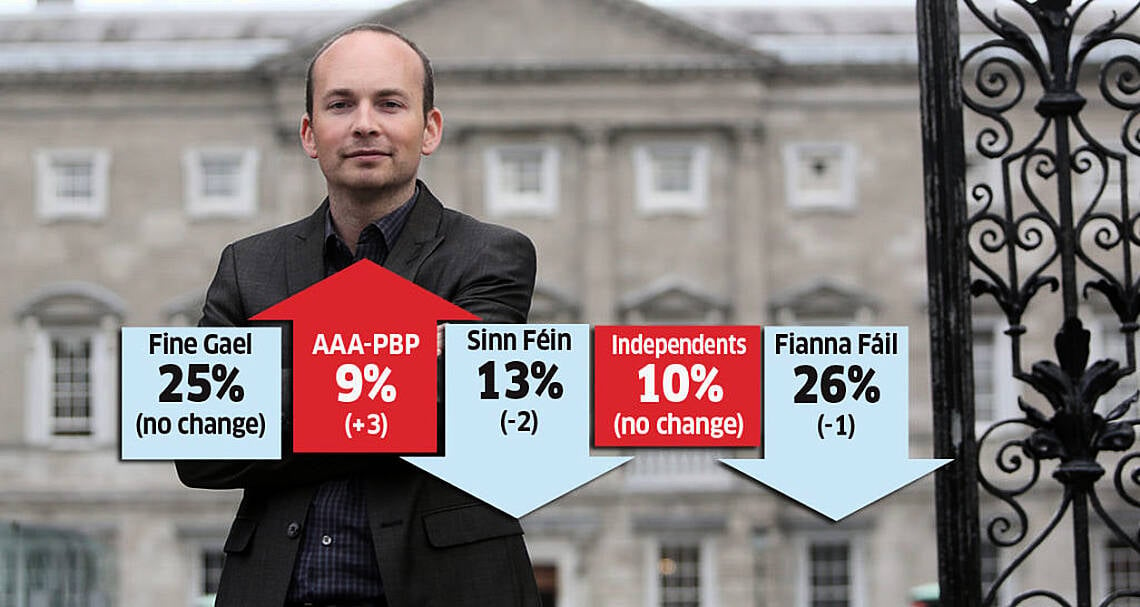
The AAA-PBP surges to record high of 9% acording to Red C Poll

PARTY IS UP 3 POINTS TO 9% FOLLOWING ATTEMPTS TO PASS ABORTION REFERENDUM BILL

Image result for The AAA-PBP surges to record high according to Red C Poll   Image result for The AAA-PBP surges to record high according to Red C Poll

THE ANTI-AUSTERITY ALLIANCE AND PEOPLE BEFORE PROFIT PARTY HAS SEEN ITS SUPPORT SURGE TO ITS HIGHEST LEVEL IN THE LATEST SUNDAY BUSINESS POST/RED C POLL.

It is up by three points to a record 9% after extensive coverage of its attempt to pass an abortion referendum bill in the Dáil this week. The bill was defeated but party TDs such as Brid Smith, Ruth Coppinger, Paul Murphy and Richard Boyd Barrett all featured prominently in the debate.
The poll of 1,000 voters, which was carried out between Monday and Thursday last week, is also the first to show the impact of the Budget on party support.
Fianna Fáil, which played a key role in budget negotiations, has actually dropped in support by one point to 26%. It has now lost support in the last four Red C polls in a row. However, it still remains the most popular party among those polled.
Fine Gael did not make any gains from the budget two weeks ago with its support unchanged at 25%. But the Independent Alliance is up by two points to 6%. Support for other Independents, which includes the likes of Children’s Minister Katherine Zappone, Communications Minister Denis Naughten and Independent TDs in opposition, is unchanged at 10%.
While the AAA-PBP party has made gains, they appear to be at the expense of Sinn Féin, which is down by two points to 13%, and Labour, which drops by two points to 5%. The Green Party is up by one point to 3%, while the Social Democrats are down by one to 3%.

FOR A FULL BREAKDOWN AND ANALYSIS SEE BELOW.

How they stand:

Fianna Fáil 26 (-1)
Fine Gael 25 (no change)
Sinn Féin 13 (-2)
Independents 10 (no change)
AAA-PBP 9 (+3)
Independent Alliance 6 (+2)
Labour 5 (-2)
Social Democrats 3 (-1)
Green Party 3 (+1)  Totals 100. 

What do families who have already scattered the ashes of loved ones do now?

Image result for What do families who have already scattered ashes of loved ones do now?  Image result for What do families who have already scattered ashes of loved ones do now?

I REMEMBER CALLING TO GLASNEVIN TO PICK UP THE URN CONTAINING MY BELOVED FATHER’S ASHES AND WONDERING WHAT TO DO WITH IT; I COULDN’T PUT HIM IN THE BOOT, SO I STRAPPED HIM INTO THE BACK SEAT AS WE DROVE TO KERRY,

What are we going to do now? the families of the faithful who have already scattered our loved ones’ ashes? Can we assume that the new Vatican ban on the practice won’t be applied retrospectively?
Can we also ask if the Catholic Church is bent on alienating us, the relatives of the 1,300 people cremated in Ireland annually?
About 50% of all people who die in Ireland are cremated and, of those, about a quarter choose to bring the ashes home, or to scatter them.
Not all of those people are practising Catholics and many may simply choose to ignore the new guidelines issued by the Congregation for the Doctrine of the Faith and approved by Pope Francis. But for the observant, it is now against Church regulations to scatter the ashes of our departed relatives in the air, on land, at sea, or in some other way.
The measure is designed to counter so-called New Age ideas that death is a “fusion” with Mother Nature, or the “definitive liberation” from the prison of the body.
The new rules also consider it non-Christian to preserve ashes or bone fragments “in mementos, pieces of jewellery or other objects”.
That last instruction is, let’s say, interesting when you consider the bone fragments of saints that have, for centuries, been preserved “in mementos, pieces of jewellery or other objects” in lavishly made Church- approved reliquaries. You can visit them in the treasury houses of the bigger Catholic churches and cathedrals all around the world.
I love visiting those wonderful repositories, packed, as they are, with rings, chasubles, copes, beautifully illuminated books, crosses, crucifixes and breath-taking reliquaries. They offer a tantalising peep into the past.
They also show the deep human need for ritual in life but, more importantly, in death.
Of course, the key difference between the Church’s collection of mementos and those held by its grieving faithful is that the former are held in a sacred place. That is one of the central concerns behind the latest Vatican document — it insists that ashes should be kept only in sacred places, such as cemeteries.
In truth, the Catholic Church never fully endorsed cremation. It reluctantly allowed it as recently as 1963, so it is not entirely surprising to hear the Church say now that burial is the most “fitting way to express faith”.
I won’t be alone in feeling a deep sense of betrayal in that understandable U-turn. I say “understandable” because this measure is all about exercising more control and we have come to expect that from the Catholic hierarchy.
Though, it has to be said the softening of the rules on eulogies at funerals some years ago was a heartening step. In fact, only last week, at the funeral of a dear friend’s mother it struck me that Catholic funerals were one of the few truly inclusive Church occasions.
There is something genuinely comforting about allowing family members stand on the altar to recall their loved ones in those moving self-penned prayers and eulogies that are often delivered in quavering voices.
It is to the credit of Irish clergy that they allow a little of the profane to be included at the edges of their sacred rites. Allowing those family tributes has neither diluted the funeral liturgy, as was feared, nor turned religious ceremonies into some sort of a This is Your Life show. If anything, it has heightened the integrity of the sacrament and made it more meaningful to relatives and friends.
Thanks, too, to those understanding priests who bend the rules on hymns and music. My wonderful Auntie Mary went out to the strains of the Preservation Hall Jazz Band, a nod to her love of jazz and her visit to New Orleans.
But now? What about those committed Catholics who have passed on believing that the ashes of their living spouses would be scattered as theirs were, in some favoured beauty spot?
Or those deeply Christian people, now departed, who would be rocked to their core to discover that they had contravened some Church regulation?
Of course, they could not possibly know that the Church would move the goal posts, yet it is still not clear if the guidelines are retroactive or not. Worse, there is no explicit instruction on what Catholics should do if they scattered their loved ones’ ashes in a practice now deemed improper.
In the ten years since we, as a family, scattered my father’s ashes, it comforts me to think that he got the dignified funeral that he had wished for. He was a committed Catholic but more than that, he was a truly Christian man in the broadest possible sense. One of the balms during his illness were the regular visits from local priests. They, too, were Christian in the broadest sense — those kind, generous, men helped us navigate some sort of a path through those final bewildering months.
There were lots of bewildering moments in death, too. I remember calling to Glasnevin Cemetery to pick up the urn containing my beloved father’s ashes and wondering what to do with it; I couldn’t, in all conscience, put him in the boot, so I strapped him into the back seat as we drove to our native Kerry. I am almost afraid now to say exactly how we dispensed with those ashes, but I can say that, to us, it was sacred and fitting and solemn.
The Catholic hierarchy has already alienated so many with its indifference to the child abuse scandals and its continuing refusal to include women, to mention the most damaging examples. Many, however, are still happy to dance around the fringes and join in during those important times in a Catholic’s life — baptism, Communion, Confirmation, marriage and death. But for how long?
The Catholic Church is not a democracy, of course. Still, I can’t help feeling these new guidelines will prompt even more people to vote with their feet.

Irish among the biggest consumers of calories per day

Image result for Irish among the biggest consumers of calories per day  Image result for Irish among the biggest consumers of calories per day  Image result for Irish among the biggest consumers of calories per day

PEOPLE IN IRELAND CONSUME THREE TIMES MORE CALORIES PER DAY THAN THOSE LIVING IN INDIA AND WE ARE AMONG THE BIGGEST CONSUMERS OF CALORIES IN THE WORLD, ACCORDING TO A REPORT.

The average daily consumption of calories in the world is 1,398, with the lowest seen in India at 761 calories per capita per day. The highest is Belgium with 2,580 per capita per day.

THE IRISH NATIONAL AVERAGE IS AT NO 12 ON A TABLE OF 54 COUNTRIES WITH 2,307 DAILY CALORIES PER DAY.

Data analysts, Euromonitor International, reveal that Ireland’s love affair with red meat and baked goods has bumped up calorie intake.
Nutrition analyst at Euromonitor International, Sara Petersson, said the nation’s carbohydrate-heavy diet accounts for Ireland’s high calorie score.
“Most of Ireland’s calories derive from meat, followed by baked goods, with bread being the primary source within that category.
“In third place is dairy, and confectionery in fourth. This pattern is similar to what we see in other Western Countries such as the UK, the US or Canada.
“It differs from Asian Pacific Countries, where rice, noodles or nuts, play a more significant role in the diet.”
The Irish are the biggest carnivores in Europe with the nation tucking into nearly three times as many red meat dinners as our counterparts in Britain.
Irish people ate the equivalent of more than 70 steaks or 140 quarter pounders per head of population last year to become the top beef and veal eaters in Europe just ahead of the Netherlands and Denmark.
Ms Petersson said the passport nutrition data relating to Ireland also shows the country consumes a high number of liquid calories.
“Soft drinks are the seventh highest source of calories in Ireland, providing over 100 calories per capita per day, followed by alcoholic drinks in eighth place, delivering a very similar number, also over 100 calories a day.”
Our overweight and obesity prevalence has risen steadily over the past couple of decades from around 43% of the population in 1996 to 51% of the population in 2015, according to Euromonitor Data.
In terms of just obesity, according to Euromonitor, Ireland was number 53 among 80 researched countries in 1996 and is currently ranked 59 in 2015.
America had the highest rate of obesity followed by Kuwait and Venezuela.
While 43% of the US population is classed as obese, the figures showed that 14.5% of the Irish population was obese in 2015.

TOP OF THE TABLE

Euromonitor Table of Calories Per Capita for last year 2015.
  1. Belgium 2,580
  2. Austria 2,558
  3. Germany 2,519
  4. Chile 2,518
  5. Bulgaria 2,517
  6. Netherlands 2,447
  7. Hungary 2,418
  8. Sweden 2,348
  9. Finland 2,343
  10. Romania 2,334
  11. Czech Republic 2,321
  12. Ireland 2,307

Now revealed the 32 best pubs in Ireland for a drink and a bite

Image result for Moran's Oyster Cottage in Kilcolgan  Image result for Sligo's top gastropub is Hargadon in Sligo town  Image result for Oarsman in Carrick-on-Shannon

SOME QUALITY PUB EATING HOUSES WEST OF THE SHANNON ABOVE.

IF YOU HAVE BUILT UP AN APPETITE AS WELL AS A THIRST, 32 IRISH PUBS ACROSS 15 COUNTIES CAN PROVIDE THE SOLUTION.

The hostelries north and south of the Border have been named in the prestigious 2017 ‘Michelin Eating Out In Pubs Guide’.
Of the 32 establishments listed, 25 are in the Republic and seven are in the North.
And if you’re in Dublin, the two winners are only about 100 metres apart.
Down dominates the winners with six listings, followed closely by Cork with five, Clare with four and Kildare with three.
Galway, Dublin and Mayo each received two listings, while Antrim, Kerry, Leitrim, Louth, Sligo, Tipperary, Wexford and Wicklow all have one.
The capital’s listings are the Old Spot and the Chop House, both located in Ballsbridge, Dublin 4.
General manager of the Old Spot, Conor Kavanagh, spoke about what it takes to be listed in the guide for the second year in a row.
“We opened at the end of 2014, so we’re really delighted about this,” he said. “We have a real dedication to quality and because we declared ourselves as a gastropub when we opened. I think people wanted to come and see us to check us out.

OFFERING QUALITY.

“We offer fantastic food in a pub environment, very high quality produce, great wine and a great cocktail list. We’re in a great part of Dublin, right beside the Aviva Stadium.”
Antrim’s listing is Billy Andy’s in Mounthill, near Larne. Clare’s pubs are Morrissey’s in Doonbeg, Vaughan’s Anchor Inn in Liscannor, the Wild Honey Inn in Lisdoonvarna and Linnane’s Lobster Bar in New Quay.
Cork’s listed pubs are Mary Ann’s in Castletownshend, the Poacher’s Inn in Bandon, Deasy’s in Clonakilty, Cronin’s in Crosshaven and Toddies at The Bulman in Kinsale.
Down’s winning pubs were the Pheasant in Annahilt, the Poacher’s Pocket in Comber, the Parson’s Nose and the Plough Inn, both in Hillsborough, Pier 36 in Donaghadee and Balloo House in Killinchy.
Galway’s listings were Moran’s Oyster Cottage in Kilcolgan and O’Dowd’s in Roundstone.
Kerry’s listed pub is the O’Neill’s Seafood Bar in Caherciveen. Kildare impressed with Hartes in Kildare town, the Ballymore Inn in Ballymore Eustace and Fallons in Kilcullen.
Leitrim’s stand-out pub is the Oarsman in Carrick-on-Shannon, while Co Louth’s is Fitzpatrick’s in Jenkinstown.
Mayo’s listings are The Tavern in Murrisk and the Sheebeen in Westport.
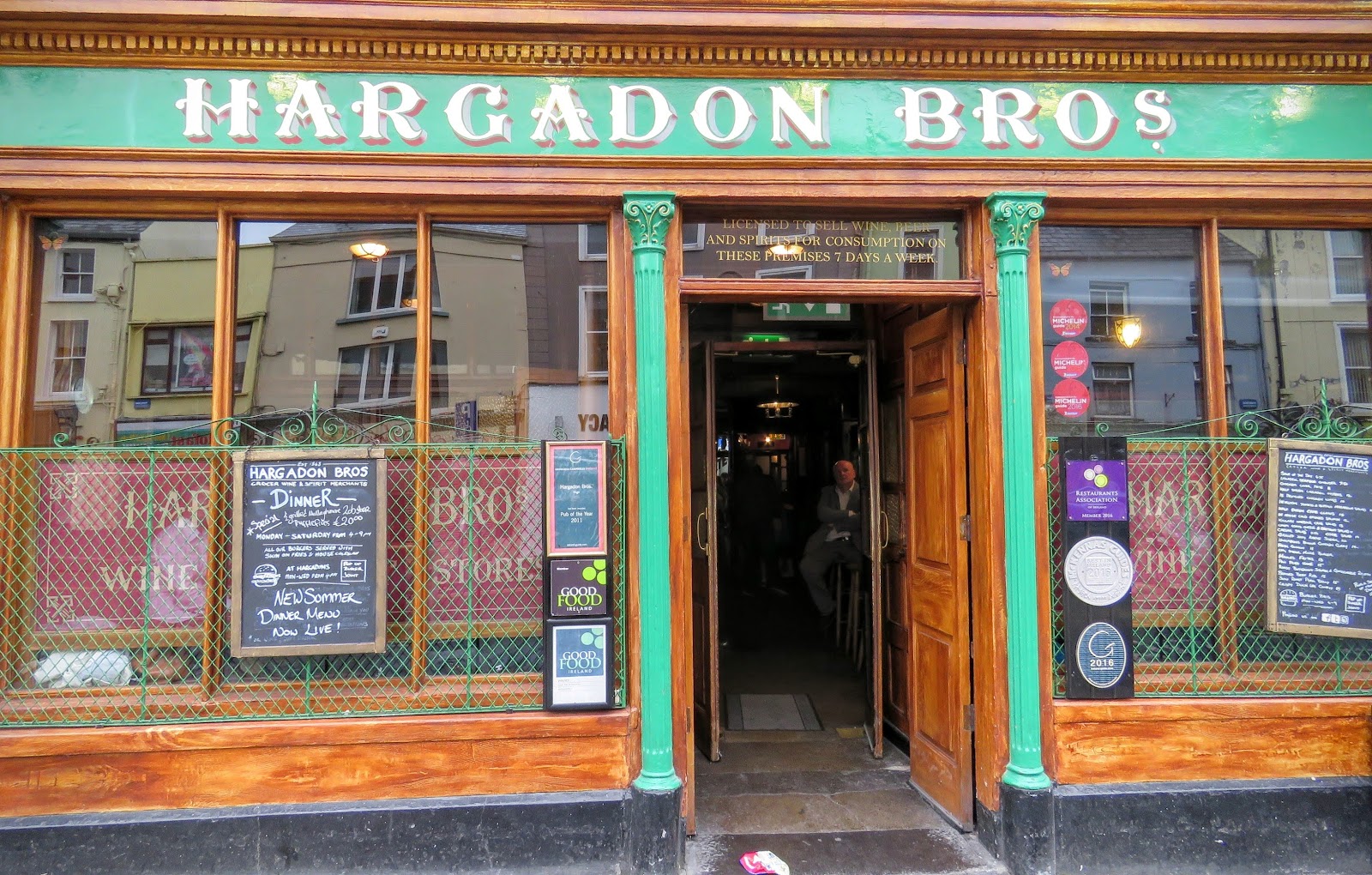
Sligo’s top gastropub is Hargadon in Sligo town, while Larkins in Garrykennedy is the premier pub in Tipperary.
Wexford’s listing is the Lobster Pot in Carne, while Wicklow won with Byrne & Woods in Roundwood.
Wild Honey Inn and Toddies at The Bulman both retained an ‘Inspectors’ Favourites’ commendation, described as “establishments found to be particularly charming and which offer something extra special”.

Fossilised dinosaur brain discovered for the first time same as Crocodiles and Birds

Image result for Fossilized dinosaur brain discovered for the first time same as Crocodiles and Birds Image result for Fossilized dinosaur brain discovered for the first time same as Crocodiles and Birds  Scanning the fossil (pictured) revealed the brain tissue had distinct similarities to those of modern-day crocodiles and birds
Scans from the fossil (pictured above right) revealed the brain tissue had distinct similarities to those of modern-day crocodiles and birds.

WE’VE LONG KNOWN THAT DINOSAURS EXISTED, MAINLY BECAUSE OF THEIR FOSSILIZED SKELETONS. HOWEVER, WE’VE NEVER SEEN A BRAIN UNTIL JUST RECENTLY.

Scientists have come across several dinosaur fossils in the past, but never have they seen a fossilized dinosaur brain. Well, this is no longer the case for the first fossilized brain tissue has been found in southeast England.
The small clump of the rock-looking object most likely comes from a dinosaur that lived 133 million years ago. According to scientists, what they have found is a small brain tissue of a leaf-eating dinosaur, a large one at that. Researchers are not 100 percent confident of the type, but it could be similar to an Iguanodon.
According to a report released by the Geological Society of London, the specimen is the first brain tissue found for a dinosaur, so there is a chance of finding more, but those chances are rather slim. Furthermore, scientists say the fossilized brain tissue has similar characteristics to that of crocodiles and birds.
“What we think happened is that this particular dinosaur died in or near a body of water, and its head ended up partially buried in the sediment at the bottom,” said David Norman from the University of Cambridge. “Since the water had little oxygen and was very acidic, the soft tissues of the brain were likely preserved and cast before the rest of its body was buried in the sediment.”
Here’s the thing, these findings could potentially shed light on how dinosaur brains and the brains of other ancient creatures have evolved over millions of years. This has always been a problem for researchers, but things could change for the better.
One of the reasons why scientists haven’t come across dinosaur brain tissue in the past is the fact that brains are the first part of a body to decay. It’s quite surprising this clump of brain tissue has been found, considering the circumstances.
More Findings On The Horizon?
This finding should allow scientists to have an idea of what to look for when seeking out fossilized dinosaur brains. They know where to look now, so it’s only a matter of time, no matter how long, before another clump of brain is located.
How Smart Were The Dinosaurs?
Where the brain fossil was located in the skull should give scientists an idea of how intelligent the ancient creatures were. However, they are hesitant at coming to any conclusion based on a single fossil. We’re guessing if more fossils are found in the future, researchers will make an announcement. Don’t be too surprised if these creatures were as smart as a crocodile. That would be scary, right?
A New Dinosaur Species
Recently, we reported the discovery of a new species of plant-eating dinosaur in Australia. This is the first to ever be discovered in the country, and we’re sure it won’t be the last. We understand the creature is a long-neck Sauropod, and spans nearly half the length of a basketball court.