Pages

Showing posts with label calories. Show all posts

Sunday, October 30, 2016

Donie's Ireland daily news BLOG.

Some 170 Garda stations not connected on to the Pulse system

BEST PRACTICE SHOWS THERE ARE TOO MANY STATIONS FOR EFFECTIVE SERVICE, SAYS SINN FÉIN TD

Image result for Some 170 Garda stations not connected to the Pulse system  Image result for the Garda Pulse system  Image result for Some 170 Garda stations not connected to the Pulse system

THE MINISTER FOR JUSTICE FRANCES FITZGERALD: SAYS ENHANCING RURAL ACCESS TO THE GARDA NETWORK BY CONNECTING NON-NETWORKED SITES TO THE NETWORK IS BEING EXAMINED.

Many Garda stations are not connected to the Garda Pulse network, according to Department of Justice figures.
Minister for Justice Frances Fitzgerald said 167 stations were not connected to the Garda computer network, but that Gardaí can “contact the Garda Information Services Centre to provide relevant details to trained civilian call-takers who enter the details on the Pulse system”.
Enhancing rural access to the Garda network by connecting non-networked sites to the network was being examined, she said.
Sinn Féin justice spokesman Jonathan O’Brien, who sought the information in a parliamentary question, said Garda management “want to close as many stations as possible”.
Gardaí in non-Pulse connected stations report into a centralised centre in Connacht. The Garda Inspectorate and the Garda Commissioner favoured a regional model, he said.
Mr O’Brien, who was appointed justice spokesman after this year’s general election, said “it’s not politically popular but international best practice has shown and the Garda Inspectorate has said that we have too many Garda stations for an effective policing service”.
The 2016 election manifesto?
This conflicts with Sinn Féin’s 2016 election manifesto, which says “we will reverse the closure of Garda stations – these closures have provided minimal savings to the State of €556,000 per annum and are a shameful legacy of this government”.
However, the Cork North-Central TD said the Garda Inspectorate view was that “to have an effective police service in the 21st century, you’re going to have some stations that are going to have to close”.
Referring to the Garda Inspectorate’s report on the service, he said: “You don’t need an actual police station to have a police presence.”
Mr O’Brien pointed to the inspectorate’s call for a civilianisation programme of elements of the service, which he said “could release 1,500 Gardaí for active duty in a matter of months”, while the force would be recruiting 600 to 700.
Gardaí should not be at the front desk in a station to deal with passport applications, he said. That was a job for civilians.
He said Gardaí on duty reporting and investigating crimes should not actually be designating what category of crime is involved, in part because of excessive paperwork and also for improving crime classification.
Mr O’Brien said a “Garda in Cork might designate a crime as burglary while another garda elsewhere might report it as trespassing even though it’s the same type of offence”.
The Minister pointed to the launch in June of the Garda Síochána Modernisation and Renewal Programme 2016-2021 which aimed to “professionalise, modernise and renew An Garda Síochána” to meet current and future challenges.

The AAA-PBP surges to record high of 9% acording to Red C Poll

PARTY IS UP 3 POINTS TO 9% FOLLOWING ATTEMPTS TO PASS ABORTION REFERENDUM BILL
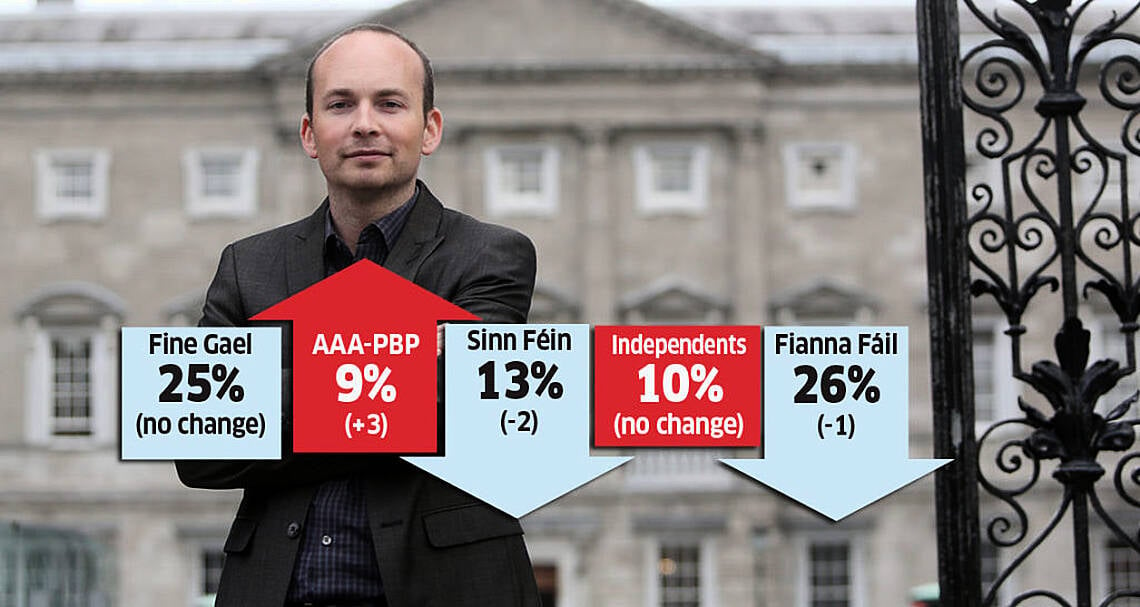
Image result for The AAA-PBP surges to record high according to Red C Poll   Image result for The AAA-PBP surges to record high according to Red C Poll

THE ANTI-AUSTERITY ALLIANCE AND PEOPLE BEFORE PROFIT PARTY HAS SEEN ITS SUPPORT SURGE TO ITS HIGHEST LEVEL IN THE LATEST SUNDAY BUSINESS POST/RED C POLL.

It is up by three points to a record 9% after extensive coverage of its attempt to pass an abortion referendum bill in the Dáil this week. The bill was defeated but party TDs such as Brid Smith, Ruth Coppinger, Paul Murphy and Richard Boyd Barrett all featured prominently in the debate.
The poll of 1,000 voters, which was carried out between Monday and Thursday last week, is also the first to show the impact of the Budget on party support.
Fianna Fáil, which played a key role in budget negotiations, has actually dropped in support by one point to 26%. It has now lost support in the last four Red C polls in a row. However, it still remains the most popular party among those polled.
Fine Gael did not make any gains from the budget two weeks ago with its support unchanged at 25%. But the Independent Alliance is up by two points to 6%. Support for other Independents, which includes the likes of Children’s Minister Katherine Zappone, Communications Minister Denis Naughten and Independent TDs in opposition, is unchanged at 10%.
While the AAA-PBP party has made gains, they appear to be at the expense of Sinn Féin, which is down by two points to 13%, and Labour, which drops by two points to 5%. The Green Party is up by one point to 3%, while the Social Democrats are down by one to 3%.

FOR A FULL BREAKDOWN AND ANALYSIS SEE BELOW.

How they stand:

Fianna Fáil 26 (-1)
Fine Gael 25 (no change)
Sinn Féin 13 (-2)
Independents 10 (no change)
AAA-PBP 9 (+3)
Independent Alliance 6 (+2)
Labour 5 (-2)
Social Democrats 3 (-1)
Green Party 3 (+1)  Totals 100. 

What do families who have already scattered the ashes of loved ones do now?

Image result for What do families who have already scattered ashes of loved ones do now?  Image result for What do families who have already scattered ashes of loved ones do now?

I REMEMBER CALLING TO GLASNEVIN TO PICK UP THE URN CONTAINING MY BELOVED FATHER’S ASHES AND WONDERING WHAT TO DO WITH IT; I COULDN’T PUT HIM IN THE BOOT, SO I STRAPPED HIM INTO THE BACK SEAT AS WE DROVE TO KERRY,

What are we going to do now? the families of the faithful who have already scattered our loved ones’ ashes? Can we assume that the new Vatican ban on the practice won’t be applied retrospectively?
Can we also ask if the Catholic Church is bent on alienating us, the relatives of the 1,300 people cremated in Ireland annually?
About 50% of all people who die in Ireland are cremated and, of those, about a quarter choose to bring the ashes home, or to scatter them.
Not all of those people are practising Catholics and many may simply choose to ignore the new guidelines issued by the Congregation for the Doctrine of the Faith and approved by Pope Francis. But for the observant, it is now against Church regulations to scatter the ashes of our departed relatives in the air, on land, at sea, or in some other way.
The measure is designed to counter so-called New Age ideas that death is a “fusion” with Mother Nature, or the “definitive liberation” from the prison of the body.
The new rules also consider it non-Christian to preserve ashes or bone fragments “in mementos, pieces of jewellery or other objects”.
That last instruction is, let’s say, interesting when you consider the bone fragments of saints that have, for centuries, been preserved “in mementos, pieces of jewellery or other objects” in lavishly made Church- approved reliquaries. You can visit them in the treasury houses of the bigger Catholic churches and cathedrals all around the world.
I love visiting those wonderful repositories, packed, as they are, with rings, chasubles, copes, beautifully illuminated books, crosses, crucifixes and breath-taking reliquaries. They offer a tantalising peep into the past.
They also show the deep human need for ritual in life but, more importantly, in death.
Of course, the key difference between the Church’s collection of mementos and those held by its grieving faithful is that the former are held in a sacred place. That is one of the central concerns behind the latest Vatican document — it insists that ashes should be kept only in sacred places, such as cemeteries.
In truth, the Catholic Church never fully endorsed cremation. It reluctantly allowed it as recently as 1963, so it is not entirely surprising to hear the Church say now that burial is the most “fitting way to express faith”.
I won’t be alone in feeling a deep sense of betrayal in that understandable U-turn. I say “understandable” because this measure is all about exercising more control and we have come to expect that from the Catholic hierarchy.
Though, it has to be said the softening of the rules on eulogies at funerals some years ago was a heartening step. In fact, only last week, at the funeral of a dear friend’s mother it struck me that Catholic funerals were one of the few truly inclusive Church occasions.
There is something genuinely comforting about allowing family members stand on the altar to recall their loved ones in those moving self-penned prayers and eulogies that are often delivered in quavering voices.
It is to the credit of Irish clergy that they allow a little of the profane to be included at the edges of their sacred rites. Allowing those family tributes has neither diluted the funeral liturgy, as was feared, nor turned religious ceremonies into some sort of a This is Your Life show. If anything, it has heightened the integrity of the sacrament and made it more meaningful to relatives and friends.
Thanks, too, to those understanding priests who bend the rules on hymns and music. My wonderful Auntie Mary went out to the strains of the Preservation Hall Jazz Band, a nod to her love of jazz and her visit to New Orleans.
But now? What about those committed Catholics who have passed on believing that the ashes of their living spouses would be scattered as theirs were, in some favoured beauty spot?
Or those deeply Christian people, now departed, who would be rocked to their core to discover that they had contravened some Church regulation?
Of course, they could not possibly know that the Church would move the goal posts, yet it is still not clear if the guidelines are retroactive or not. Worse, there is no explicit instruction on what Catholics should do if they scattered their loved ones’ ashes in a practice now deemed improper.
In the ten years since we, as a family, scattered my father’s ashes, it comforts me to think that he got the dignified funeral that he had wished for. He was a committed Catholic but more than that, he was a truly Christian man in the broadest possible sense. One of the balms during his illness were the regular visits from local priests. They, too, were Christian in the broadest sense — those kind, generous, men helped us navigate some sort of a path through those final bewildering months.
There were lots of bewildering moments in death, too. I remember calling to Glasnevin Cemetery to pick up the urn containing my beloved father’s ashes and wondering what to do with it; I couldn’t, in all conscience, put him in the boot, so I strapped him into the back seat as we drove to our native Kerry. I am almost afraid now to say exactly how we dispensed with those ashes, but I can say that, to us, it was sacred and fitting and solemn.
The Catholic hierarchy has already alienated so many with its indifference to the child abuse scandals and its continuing refusal to include women, to mention the most damaging examples. Many, however, are still happy to dance around the fringes and join in during those important times in a Catholic’s life — baptism, Communion, Confirmation, marriage and death. But for how long?
The Catholic Church is not a democracy, of course. Still, I can’t help feeling these new guidelines will prompt even more people to vote with their feet.

Irish among the biggest consumers of calories per day

Image result for Irish among the biggest consumers of calories per day  Image result for Irish among the biggest consumers of calories per day  Image result for Irish among the biggest consumers of calories per day

PEOPLE IN IRELAND CONSUME THREE TIMES MORE CALORIES PER DAY THAN THOSE LIVING IN INDIA AND WE ARE AMONG THE BIGGEST CONSUMERS OF CALORIES IN THE WORLD, ACCORDING TO A REPORT.

The average daily consumption of calories in the world is 1,398, with the lowest seen in India at 761 calories per capita per day. The highest is Belgium with 2,580 per capita per day.

THE IRISH NATIONAL AVERAGE IS AT NO 12 ON A TABLE OF 54 COUNTRIES WITH 2,307 DAILY CALORIES PER DAY.

Data analysts, Euromonitor International, reveal that Ireland’s love affair with red meat and baked goods has bumped up calorie intake.
Nutrition analyst at Euromonitor International, Sara Petersson, said the nation’s carbohydrate-heavy diet accounts for Ireland’s high calorie score.
“Most of Ireland’s calories derive from meat, followed by baked goods, with bread being the primary source within that category.
“In third place is dairy, and confectionery in fourth. This pattern is similar to what we see in other Western Countries such as the UK, the US or Canada.
“It differs from Asian Pacific Countries, where rice, noodles or nuts, play a more significant role in the diet.”
The Irish are the biggest carnivores in Europe with the nation tucking into nearly three times as many red meat dinners as our counterparts in Britain.
Irish people ate the equivalent of more than 70 steaks or 140 quarter pounders per head of population last year to become the top beef and veal eaters in Europe just ahead of the Netherlands and Denmark.
Ms Petersson said the passport nutrition data relating to Ireland also shows the country consumes a high number of liquid calories.
“Soft drinks are the seventh highest source of calories in Ireland, providing over 100 calories per capita per day, followed by alcoholic drinks in eighth place, delivering a very similar number, also over 100 calories a day.”
Our overweight and obesity prevalence has risen steadily over the past couple of decades from around 43% of the population in 1996 to 51% of the population in 2015, according to Euromonitor Data.
In terms of just obesity, according to Euromonitor, Ireland was number 53 among 80 researched countries in 1996 and is currently ranked 59 in 2015.
America had the highest rate of obesity followed by Kuwait and Venezuela.
While 43% of the US population is classed as obese, the figures showed that 14.5% of the Irish population was obese in 2015.

TOP OF THE TABLE

Euromonitor Table of Calories Per Capita for last year 2015.
  1. Belgium 2,580
  2. Austria 2,558
  3. Germany 2,519
  4. Chile 2,518
  5. Bulgaria 2,517
  6. Netherlands 2,447
  7. Hungary 2,418
  8. Sweden 2,348
  9. Finland 2,343
  10. Romania 2,334
  11. Czech Republic 2,321
  12. Ireland 2,307

Now revealed the 32 best pubs in Ireland for a drink and a bite

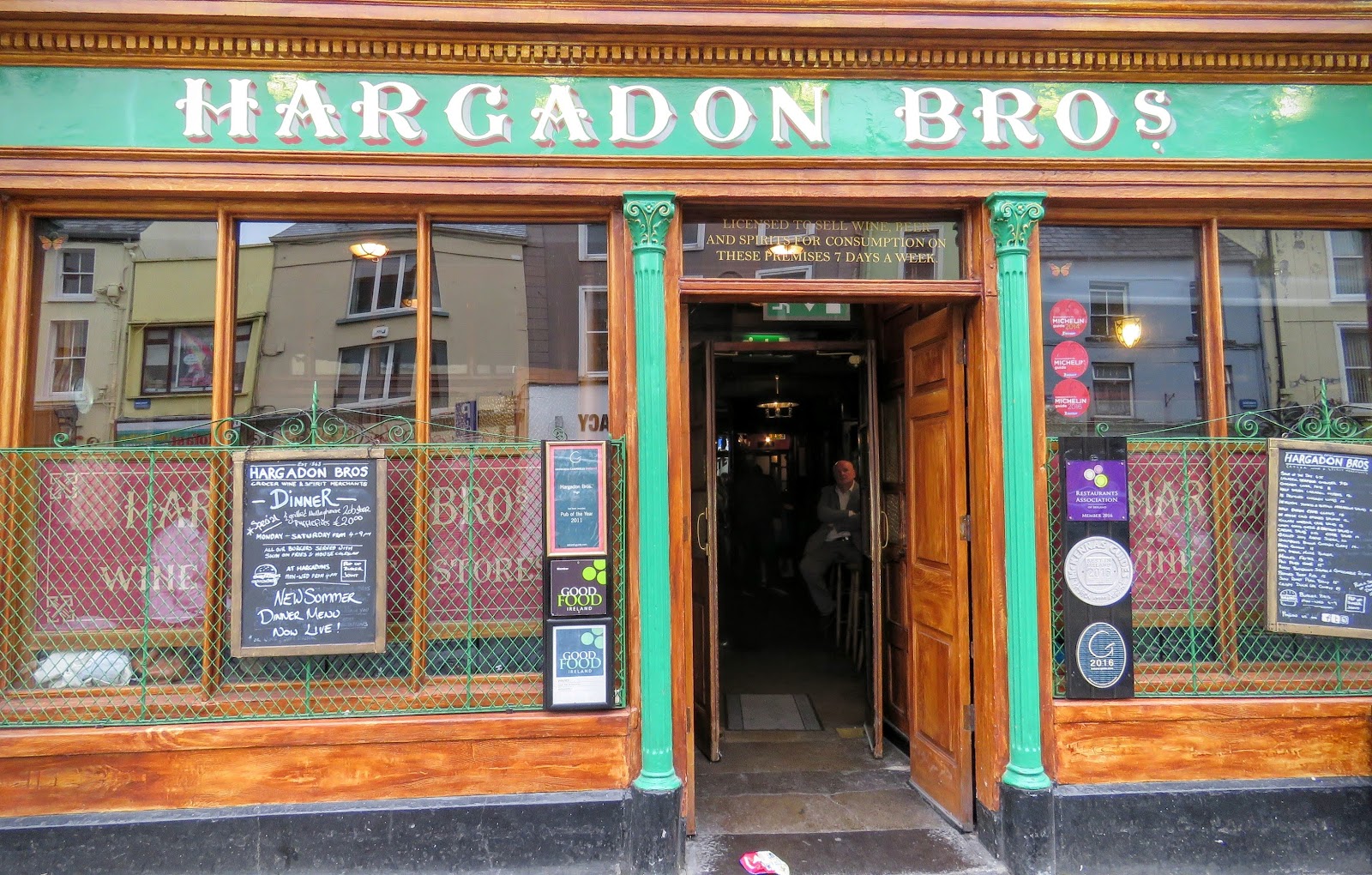
Image result for Moran's Oyster Cottage in Kilcolgan  Image result for Sligo's top gastropub is Hargadon in Sligo town  Image result for Oarsman in Carrick-on-Shannon

SOME QUALITY PUB EATING HOUSES WEST OF THE SHANNON ABOVE.

IF YOU HAVE BUILT UP AN APPETITE AS WELL AS A THIRST, 32 IRISH PUBS ACROSS 15 COUNTIES CAN PROVIDE THE SOLUTION.

The hostelries north and south of the Border have been named in the prestigious 2017 ‘Michelin Eating Out In Pubs Guide’.
Of the 32 establishments listed, 25 are in the Republic and seven are in the North.
And if you’re in Dublin, the two winners are only about 100 metres apart.
Down dominates the winners with six listings, followed closely by Cork with five, Clare with four and Kildare with three.
Galway, Dublin and Mayo each received two listings, while Antrim, Kerry, Leitrim, Louth, Sligo, Tipperary, Wexford and Wicklow all have one.
The capital’s listings are the Old Spot and the Chop House, both located in Ballsbridge, Dublin 4.
General manager of the Old Spot, Conor Kavanagh, spoke about what it takes to be listed in the guide for the second year in a row.
“We opened at the end of 2014, so we’re really delighted about this,” he said. “We have a real dedication to quality and because we declared ourselves as a gastropub when we opened. I think people wanted to come and see us to check us out.

OFFERING QUALITY.

“We offer fantastic food in a pub environment, very high quality produce, great wine and a great cocktail list. We’re in a great part of Dublin, right beside the Aviva Stadium.”
Antrim’s listing is Billy Andy’s in Mounthill, near Larne. Clare’s pubs are Morrissey’s in Doonbeg, Vaughan’s Anchor Inn in Liscannor, the Wild Honey Inn in Lisdoonvarna and Linnane’s Lobster Bar in New Quay.
Cork’s listed pubs are Mary Ann’s in Castletownshend, the Poacher’s Inn in Bandon, Deasy’s in Clonakilty, Cronin’s in Crosshaven and Toddies at The Bulman in Kinsale.
Down’s winning pubs were the Pheasant in Annahilt, the Poacher’s Pocket in Comber, the Parson’s Nose and the Plough Inn, both in Hillsborough, Pier 36 in Donaghadee and Balloo House in Killinchy.
Galway’s listings were Moran’s Oyster Cottage in Kilcolgan and O’Dowd’s in Roundstone.
Kerry’s listed pub is the O’Neill’s Seafood Bar in Caherciveen. Kildare impressed with Hartes in Kildare town, the Ballymore Inn in Ballymore Eustace and Fallons in Kilcullen.
Leitrim’s stand-out pub is the Oarsman in Carrick-on-Shannon, while Co Louth’s is Fitzpatrick’s in Jenkinstown.
Mayo’s listings are The Tavern in Murrisk and the Sheebeen in Westport.
Sligo’s top gastropub is Hargadon in Sligo town, while Larkins in Garrykennedy is the premier pub in Tipperary.
Wexford’s listing is the Lobster Pot in Carne, while Wicklow won with Byrne & Woods in Roundwood.
Wild Honey Inn and Toddies at The Bulman both retained an ‘Inspectors’ Favourites’ commendation, described as “establishments found to be particularly charming and which offer something extra special”.

Fossilised dinosaur brain discovered for the first time same as Crocodiles and Birds

Image result for Fossilized dinosaur brain discovered for the first time same as Crocodiles and Birds Image result for Fossilized dinosaur brain discovered for the first time same as Crocodiles and Birds  Scanning the fossil (pictured) revealed the brain tissue had distinct similarities to those of modern-day crocodiles and birds
Scans from the fossil (pictured above right) revealed the brain tissue had distinct similarities to those of modern-day crocodiles and birds.

WE’VE LONG KNOWN THAT DINOSAURS EXISTED, MAINLY BECAUSE OF THEIR FOSSILIZED SKELETONS. HOWEVER, WE’VE NEVER SEEN A BRAIN UNTIL JUST RECENTLY.

Scientists have come across several dinosaur fossils in the past, but never have they seen a fossilized dinosaur brain. Well, this is no longer the case for the first fossilized brain tissue has been found in southeast England.
The small clump of the rock-looking object most likely comes from a dinosaur that lived 133 million years ago. According to scientists, what they have found is a small brain tissue of a leaf-eating dinosaur, a large one at that. Researchers are not 100 percent confident of the type, but it could be similar to an Iguanodon.
According to a report released by the Geological Society of London, the specimen is the first brain tissue found for a dinosaur, so there is a chance of finding more, but those chances are rather slim. Furthermore, scientists say the fossilized brain tissue has similar characteristics to that of crocodiles and birds.
“What we think happened is that this particular dinosaur died in or near a body of water, and its head ended up partially buried in the sediment at the bottom,” said David Norman from the University of Cambridge. “Since the water had little oxygen and was very acidic, the soft tissues of the brain were likely preserved and cast before the rest of its body was buried in the sediment.”
Here’s the thing, these findings could potentially shed light on how dinosaur brains and the brains of other ancient creatures have evolved over millions of years. This has always been a problem for researchers, but things could change for the better.
One of the reasons why scientists haven’t come across dinosaur brain tissue in the past is the fact that brains are the first part of a body to decay. It’s quite surprising this clump of brain tissue has been found, considering the circumstances.
More Findings On The Horizon?
This finding should allow scientists to have an idea of what to look for when seeking out fossilized dinosaur brains. They know where to look now, so it’s only a matter of time, no matter how long, before another clump of brain is located.
How Smart Were The Dinosaurs?
Where the brain fossil was located in the skull should give scientists an idea of how intelligent the ancient creatures were. However, they are hesitant at coming to any conclusion based on a single fossil. We’re guessing if more fossils are found in the future, researchers will make an announcement. Don’t be too surprised if these creatures were as smart as a crocodile. That would be scary, right?
A New Dinosaur Species
Recently, we reported the discovery of a new species of plant-eating dinosaur in Australia. This is the first to ever be discovered in the country, and we’re sure it won’t be the last. We understand the creature is a long-neck Sauropod, and spans nearly half the length of a basketball court.   

Thursday, August 25, 2016

Donie's Ireland daily news BLOG update

The numbers of emigrants returning home to Ireland soars

ARE YOU ONE OF THE THOUSANDS OF IRISH PEOPLE THAT HAVE RETURNED HOME IN THE LAST TWO YEARS?

Image result for Number of emigrants returning home to Ireland soars   Image result for Number of emigrants returning home to Ireland soars

MORE PEOPLE ARE NOW COMING INTO IRELAND TO LIVE THAN ARE LEAVING, WHILE THE NUMBER OF RETURNING IRISH EMIGRANTS HAS SURGED, LATEST FIGURES SHOW.

It is the first time since 2009 that Ireland has recorded net inward migration.
The number of returning Irish emigrants has surged in the year to the end of April.
At least 21,100 people with Irish nationality came into the country in this period – up 74pc on last year, when 12,100 arrived. Overall, 79,300 people came to live in Ireland over the year to the end of April – up 15pc – while 76,200 left.
Business groups welcomed the migration data, but warned that a growing workforce and population means extra pressure on state resources, and the need to improve infrastructure.
“Net inward migration along with an increasing population will place further demand on State resources in the future, highlighting further the need for government to prioritise investment in infrastructure as a matter of urgency,” said Ian Talbot, Chambers Ireland chief executive.
With housing and high rents an issue at present, business groups have also repeatedly stressed Ireland’s high marginal rate of income tax needs to be addressed. And the Small Firms Association this week again noted the level the rate kicks in also needs to be increased.
The CSO data shows the bulk of the people who came into Ireland in the year to April have done so for work. That has consistently been the case since 2012. Students were the next biggest category.
Work was the main reason for individuals leaving the country, but studying was a close second. The majority of those emigrating were either at work or a student in the period prior to departing, with one in 10 listed as unemployed.
A breakdown of immigration by education attainment shows more than half of those aged 15 and over who were emigrating had a third level degree or above. In April, the CSO said there was net inward migration of 3,100, compared with net outward migration of 11,600 in the previous year. Of the 76,200 people who left Ireland over the period, almost 42pc were estimated to be Irish.
This is down 3,500 on the year to April 2015, when 35,300 Irish nationals left. Non-Irish nationals from outside the EU accounted for around 40pc of total immigrants into Ireland.
The National Youth Council of Ireland (NYCI), however, said the number of young people aged between 15 and 24 leaving the country was still rising.
It noted that within this age group, 31,700 left in the year to the end of April, compared with 30,400 the previous year. There were about 12,000 more young people who left the country over the period than came in.
Marie-Claire McAleer, head of research and policy at NYCI, said there remain many impediments to returning to Ireland.
“We are encouraged by the steps that have been taken by the Government to address some of these barriers but substantial work remains to be done to stem the tide of young people having to leave Ireland at present and to provide the opportunities for them to return in the future,” she said.
The source of data for the migration statistics is the Quarterly National Household Survey, which gives details on employment and unemployment, and also provides a basis for the classification of flows by sex, age group, origin/destination, and nationality.
The CSO said the migration data is also compiled with reference to movements in other migration indicators, such as the number of PPS numbers allocated to foreigners, and the number of visas issued to Irish people travelling to destinations including Australia, the US and Canada.

Maynooth seminary to review social media policies

COLLEGE’S BOARD ACKNOWLEDGES ‘UNHEALTHY ATMOSPHERE’ AFTER DATING APP ALLEGATIONS

Image result for Maynooth seminary to review social media policies   Image result for Maynooth seminary to review social media policies
The Archbishop of Dublin Dr Diarmuid Martin has said he intends to send seminarians from his archdiocese to the Pontifical Irish College in Rome instead of the national seminary at Maynooth because of concerns about ‘strange goings-on’ in St Patrick’s.
There will be a review of social media policies and procedures for handling whistleblowers at St Patrick’s seminary in Maynooth following allegations of trainee priests using dating apps, the college’s board of trustees has announced.
During a meeting in Maynooth on Tuesday, the board also asked the Irish Bishops’ Conference which is based in St Patrick’s College to commission an independent audit and report into the governance of Irish seminaries.
Those who oversee the management of St Patrick’s came in for criticism earlier this month when media reports surfaced of trainee priests using the Tinder dating app as well as its gay equivalent, Grindr.
Following those reports, a number of ex-seminarians came forward with accounts of alleged bullying and sexual harassment they had suffered during their time at the Maynooth college, and in a statement released on Wednesday the trustees say they “share the concerns about the unhealthy atmosphere” there.
Archbishop of Dublin Dr Diarmuid Martin has said he intends to send seminarians from his archdiocese to the Pontifical Irish College in Rome instead of the national seminary at Maynooth because of concerns about “strange goings-on” in St Patrick’s.
In subsequent interviews he described a “poisonous” atmosphere at the Maynooth seminary and urged its board of trustees, which comprises Ireland’s four archbishops and 13 other senior bishops, to meet as soon as possible to address the issues which had arisen.
As part of the suite of measures, the Irish Bishops’ Conference has been asked to conduct a triennial review of St Patrick’s College and the Irish Pontifical College in Rome next spring.
The St Patrick’s board of trustees has also requested that the conference “progress urgently a uniform national policy for admissions to Irish seminaries” and to establish a subcommittee to examine “the pastoral needs of priestly training in Ireland”.
A statement issued by the Irish Bishops’ Conference read: “There is no place in a seminary community for any sort of behaviour or attitude which contradicts the teaching and example of Jesus Christ.
“The trustees share the concerns about the unhealthy atmosphere created by anonymous accusations together with some social media comments which can be speculative or even malicious. Persons with specific concerns are encouraged to report them appropriately as soon as possible.”
The announcement of a series of reviews and audits coincides with 14 new seminarians beginning their training at St Patrick’s this week, which will swell the number of resident seminarians to 41 for the coming academic year.
Archbishop of Dublin Diarmuid Martin acknowledged the need for institutional reform in a homily Wednesday at the final Mass in the Mater Dei Institute chapel as it becomes part of DCU’s new multi-denominational teacher training college.
He said most of the institutions set up to train priests and faith-based teachers “are slowly vanishing from or are being transformed” in Dublin. Catholicshould not be alarmed but see rather new opportunities, citing “possible new forms of the preparation of future priests”

Drink driving in Ireland creeping up as alcohol is involved in a third of fatal accidents

Image result for Drink driving in Ireland creeping up as alcohol is involved in a third of fatal accidents   Image result for Drink driving in Ireland creeping up as alcohol is involved in a third of fatal accidents   Image result for Drink driving cause a third of fatal accidents in Ireland

THE ROAD SAFETY AUTHORITY CHIEF EXECUTIVE, MOYAGH MURDOCK, HAS SAID THERE IS EVIDENCE THAT DRINK DRIVING IS “CREEPING UP” AGAIN AS LATEST FIGURES SHOW ALCOHOL WAS INVOLVED IN A THIRD OF FATAL COLLISIONS.

A report published by the Road Safety Authority in June for 2008-2012 shows a record of alcohol consumption before the collision in 29% of cases analysed.
Ms Murdock said that latest vehicle collision figures for 2013 showed alcohol was involved in 33% of cases.
“That is very worrying,” she said.
One in 10 fatal collisions happened the day after a night spent consuming alcohol so it was still in the person’s system, even if it was not over the legal limit.
Research showed that 30% of the people killed in collisions where alcohol was involved were under the legal limit.
“So people are fatigued after a big night out, even though the alcohol may have cleared from their system 24 hours later.
“They are tired because they have not had a proper night’s sleep, and that is where driver fatigue can be a factor.”
The RSA wants to push the message that even one drink can impact a person’s ability but there were people killed on Irish road who were four or five times over the legal limit.
Ms Murtagh said drink driving was a bigger problem in younger drivers — those under 24 years.
In a bid to get the drink driving message to younger drivers the learner driver theory test is being changed this autumn to include a new module.
The questions have been drafted, and the updated examination, together with an explanatory booklet, will be launched in in October or November.
“We will have between 20 and 25 new possible questions on drink driving. The test itself will have an additional three questions.”
Ms Murtagh said the questions would be about the impact of alcohol on a person’s ability to control a vehicle.
While older people had got the message about drink driving, younger people never really tuned into it.
“We have to target the younger generation on drink driving. We will start with the updated theory test but there will be a number of other interventions and they will be introduced shortly.”
The RSA’s Back to School campaign, sponsored by ESB Networks, will distribute free high visibility vests to every child starting school next month. Four children aged 14 and under died on Irish roads during the first eight months of the year.

The average commuter adds 800 calories a week to their diet, a new report has found

Research from the Royal Society for Public Health (RSPH) suggests that people who commute for long periods of time are potentially “shortening their lives”.

Image result for The average commuter adds 800 calories a week to their diet, a new report has found  Image result for average calorie-intake was 767 kcal  Image result for average calorie-intake was 767 kcal

THE AVERAGE COMMUTER ADDS EXTRA 800 CALORIES TO THEIR DIETS EVERY WEEK AS A RESULT OF THEIR JOURNEY TO AND FROM WORK, A NEW REPORT HAS FOUND.

Research from the Royal Society for Public Health (RSPH) suggests that people who commute for long periods of time are potentially “shortening their lives”.
The median average calorie-intake was 767 kcal, based on self-reporting of additional food consumption by a sample of 1,547 commuters in the UK.
The report links long commutes with increased stress, higher blood pressure and BMI, and reduced time available for health-promoting activities such as cooking, exercising and sleeping.
The average commute in the UK stands at roughly an almost an hour a day, while Celtic Tiger-era commutes are on the way back here, too.
According to the RSPH survey, people who commute in London have an average journey of 79 minutes – compared to just under 45 minutes for people living in Wales.
The report also found:
  • More than half (55%) reported increased stress levels.
  • Around two in five (41%) said they didn’t exercise as much as they used to.
  • More than a third said they slept less.
  • Two in five (38%) said they spent less time preparing healthy meals.
  • A third of people reported increased snacking (33%) while over a quarter reported fast food consumption (29%).
  • Almost half (44%) said their commute meant they spent less time with family and friends.
To combat the health issues associated with long commutes, the RSPH has called for employers to increase flexible and home working.
“Not only does it add to our stress levels, but travelling by bus, car, and train eats into the time we could be using to incorporate physical activity into our daily routine,” said Dr Justin Varney of Public Health England.
Employers can support staff wellbeing by offering facilities which promote cycling and walking to work, such as showers and bike spaces, and taking up opportunities like the Cycle2Work scheme.
“For some of us the daily commute can be a pleasurable experience, giving time for reflection or an opportunity to relax,” Shirley Cramer CBE, the head of the RSPH added.
“But for an increasing number of us it is having a damaging effect on our health and wellbeing.”

Closest potentially habitable planet to our solar system now found called Proxima b

Image result for Closest potentially habitable planet to our solar system now found called Proxima b   Image result for Closest potentially habitable planet to our solar system now found called Proxima b   Image result for Closest potentially habitable planet to our solar system now found called Proxima b
  • SCIENTISTS HAVE FOUND THE CLOSEST EXOPLANET TO EARTH

  • LIQUID WATER COULD EXIST ON THE SURFACE OF PROXIMA B

In a discovery that has been years in the making, researchers have now confirmed the existence of a rocky planet named Proxima b orbiting Proxima Centauri, the closest star to our sun, according to a new study. It is the closest exoplanet to us in the universe.
Given the fact that Proxima b is within the habitable zone of its star, meaning liquid water could exist on the surface, it may also be the closest possible home for life outside of our solar system, the researchers said.
Because of its location, the researchers hope it provides an opportunity for possible “robotic exploration in the coming centuries.”
“The good news is that it is so close,” study author Ansgar Reiners said. “It is not only nice for having it in our neighborhood, but it’s a dream come true for astronomers if we think about follow-up observation.”
Proxima Centauri coexists with a binary star in Alpha Centauri, a well-studied star system that serves as a neighbor to our sun.
Proxima b is a mere 4.2 light-years away from our solar system, or 266,000 times the distance between the Earth and the sun, which are 92.96 million miles apart. Previous rocky exoplanet discoveries, like those orbiting ultracool red dwarf star TRAPPIST-1, were previously described as “close” at 40 light-years away.
“It’s not only the closest terrestrial planet found, it’s probably the closest planet outside our solar system that will ever be found because there is no star closer to the solar system than this one,” said lead study author Guillem Anglada-Escudé.
“The only thing you can hope to find between that is Planet Nine, but that would a solar system object or a brown dwarf that hasn’t been discovered,” researcher Pedro Amado added.
Here is what we know about the planet, as well as the questions that researchers hope to be able to answer.
This Jupiter-like planet in the HD-188753 system, 149 light-years from Earth, has three suns. The main star is similar in mass to our own Sun. The system has been compared to Luke Skywalker’s home planet Tatooine in “Star Wars.”
Kepler-421b is a Uranus-sized transiting exoplanet with the longest known year, as it circles its star once every 704 days. The planet orbits an orange, K-type star that is cooler and dimmer than our Sun and is located about 1,000 light-years from Earth in the constellation Lyra.
Astronomers discovered two planets less than three times the size of Earth orbiting sun-like stars in a crowded stellar cluster approximately 3,000 light-years from Earth in the constellation Cygnus.
This artist’s conception shows a hypothetical planet with two moons orbiting in the habitable zone of a red dwarf star. The majority of the sun’s closest stellar neighbors are red dwarfs.
Kepler-186f was the first validated Earth-sized planet to be found orbiting a distant star in the habitable zone. This zone a range of distance from a star where liquid water might pool on the planet’s surface.
Kepler-69c is a super-Earth-size planet similar to Venus. The planet is found in the habitable zone of a star like our sun, approximately 2,700 light years from Earth in the constellation Cygnus.
The Kepler-444 system formed when the Milky Way was just 2 billion years old. The tightly packed system is home to five planets that range in size, the smallest is comparable to the size of Mercury and the largest to Venus, orbiting their sun in less than 10 days.
This artistic concept image compares Earth, left, with Kepler-452b, which is about 60% larger. Both planets orbit a G2-type star of about the same temperature; however, the star hosting Kepler-452b is 6 billion years old — 1.5 billion years older than our sun.
This artist’s impression shows the planet Proxima b orbiting the red dwarf star Proxima Centauri, the closest star to our solar system.
 Image result for This artist's impression shows a view of the surface of the planet Proxima b.  This artist’s impression shows a view of the surface of the planet Proxima b.
An artist’s rendering shows Earth-sized exoplanets TRAPPIST-1b and 1c in a rare double transit event as they pass in front of their ultracool red dwarf star, which allowed Hubble to take a peek at at their atmospheres.
Out of a new discovery of 104 exoplanets, astronomers found four similar in size to Earth that are orbiting a dwarf star. Two of them have the potential to support life. The craft depicted in this illustration is the NASA Kepler Space Telescope, which has helped confirm the existence of thousands of exoplanets.
This artist’s impression shows a view of the triple-star system HD 131399 from close to the giant planet orbiting in the system. Located about 320 light-years from Earth, the planet is about 16 million years old, making it also one of the youngest exoplanets discovered to date.
An artistic impression of the planet Kepler-1647b, which is nearly identical to Jupiter in both size and mass. The planet is expected to be roughly similar in appearance. But it is much warmer: Kepler-1647b is in the habitable zone.
HD-106906b is a gaseous planet 11 times more massive than Jupiter. The planet is believed to have formed in the center of its solar system, before being sent flying out to the edges of the region by a violent gravitational event.
Kepler-10b orbits at a distance more than 20 times closer to its star than Mercury is to our own sun. Daytime temperatures exceed 1,300 degrees Celsius (2,500 degrees Fahrenheit), which is hotter than lava flows on Earth.
This Jupiter-like planet in the HD-188753 system, 149 light-years from Earth, has three suns. The main star is similar in mass to our own Sun. The system has been compared to Luke Skywalker’s home planet Tatooine in “Star Wars.”
Kepler-421b is a Uranus-sized transiting exoplanet with the longest known year, as it circles its star once every 704 days. The planet orbits an orange, K-type star that is cooler and dimmer than our Sun and is located about 1,000 light-years from Earth in the constellation Lyra.
Astronomers discovered two planets less than three times the size of Earth orbiting sun-like stars in a crowded stellar cluster approximately 3,000 light-years from Earth in the constellation Cygnus.
This artist’s conception shows a hypothetical planet with two moons orbiting in the habitable zone of a red dwarf star. The majority of the sun’s closest stellar neighbors are red dwarfs.
Kepler-186f was the first validated Earth-sized planet to be found orbiting a distant star in the habitable zone. This zone a range of distance from a star where liquid water might pool on the planet’s surface.
Kepler-69c is a super-Earth-size planet similar to Venus. The planet is found in the habitable zone of a star like our sun, approximately 2,700 light years from Earth in the constellation Cygnus.
The Kepler-444 system formed when the Milky Way was just 2 billion years old. The tightly packed system is home to five planets that range in size, the smallest is comparable to the size of Mercury and the largest to Venus, orbiting their sun in less than 10 days.
This artistic concept image compares Earth, left, with Kepler-452b, which is about 60% larger. Both planets orbit a G2-type star of about the same temperature; however, the star hosting Kepler-452b is 6 billion years old — 1.5 billion years older than our sun.
This artist’s impression shows the planet Proxima b orbiting the red dwarf star Proxima Centauri, the closest star to our solar system.
 MEET PROXIMA B
Proxima b is a rocky, terrestrial planet with a surface — unlike a gas giant, such as Jupiter — that is 1.3 times the size of Earth and orbits its star every 11.2 days. It is in a close orbit of Proxima Centauri: only 5% of the distance between the Earth and the sun. They are even closer together than Mercury and the sun. But because its star is much cooler and fainter than our sun, Proxima b has a temperature that is suitable for liquid water to exist on the surface without evaporating.
Researchers estimate that if the planet has an atmosphere, which could be assumed but isn’t known, it may be between 86 to 104 degrees Fahrenheit on the surface. Without an atmosphere, it could be -22 to -40 degrees Fahrenheit. To put that in perspective, Earth would be -4 degrees if it didn’t have an atmosphere, Reiners said.
Given the proximity to its star, Proxima b is also subject to less pleasant factors like ultraviolet and X-ray flares that are 100 times the intensity of what Earth receives from the sun. In the paper, researchers estimated it to be 400 times the intensity, but recent research has caused them to create a new estimate, they said. If there is life on the planet, it would be affected by this radiation, but it is pure speculation as to what kind of effect.
This infographic compares the orbit of the planet around Proxima Centauri (Proxima b) with the same region of the Solar System.
What took so long?
If the Alpha Centauri system is well-studied and Proxima Centauri is our sun’s cozy star neighbor in the universe, why did it take so long to find Proxima b?
It comes down to an understanding of the star this planet orbits, as well as how data collection has evolved during the last 16 years.
Proxima Centauri is a low-mass red dwarf star, known as an M-class dwarf, that happens to be close to the bright binary star Alpha Centauri AB, which outshines its cool stepbrother, so to speak. All of these stars are within the faint Centaurus constellation, which can’t be seen with the unaided eye.
Taking a closer look at new Earth-like planets for the first time
M-class dwarves are not well understood in comparison with other types of stars, Reiners said. Because of that, researchers don’t know much about the history of these stars or their radiation in the early days.
“But within the field of exoplants, [researchers] have recently realized that looking for planets around M dwarves is what is going to be the most spectacular, because you can find these plants in the liquid water zone more easily than other stars,” Reiners said.
NASA’s K2 mission finds more than 100 new planets
Because it’s an active star, Proxima Centauri can behave in varied ways that mimic the presence of a planet, according to the study. Researchers wanted to observe it for a long period of time, so for the first half of this year, telescopes around the world were pointed at Proxima Centauri. The researchers looked for a “Doppler wobble,” or back and forth wobble of Proxima Centauri that would be caused by the gravitational pull of a planet in orbit.
This was combined with research, data and published studies of Proxima Centauri dating to 2000.
“The significance of the detection went sky high,” Anglada-Escudé said. “Statistically, there was no doubt. We have found a planet around Proxima Centauri.”
The research around Proxima b will continue, and the researchers have more questions they want to answer. They don’t know whether there is water on the surface or if the planet has an atmosphere, although both are likely. They also don’t know whether, like Earth, the planet has a protective magnetic field to help with some of the radiation it receives.
Perhaps one of the biggest questions includes the history of the star and the planet. How did they form?
“What happened during the formation?” Reiners asked. “Was the star more active than the sun is today, and where during that phase was Proxima b located?”
This would indicate whether the plant was rich with water in its early days or started out dry, as well as whether there was any high-energy radiation that could have blasted away an atmosphere during formation of the planet.
A view of the southern skies over the ESO 3.6-meter telescope at La Silla Observatory in Chile with images of the stars Proxima Centauri (lower right) and the double star Alpha Centauri AB (lower left).
There is also some debate over whether this planet is Earth-like, which comes with some connotations. Depending on its formation, perhaps it could be like Venus.
Learning the answers to these questions about formation are possible with research. The habitability of a planet like Proxima b is also “a matter of intense debate,” according to the study, due to arguments against it: tidal locking, strong stellar magnetic fields, strong flares, and high ultraviolet and X-ray fluxes. But, as they point out, none of those has been proved definitive, either.

A GROWING EXCITEMENT?

Researchers have long looked to Alpha Centauri for study. Now, they want us to go there.
Programs like Mission Centaur intend to design and build a space mission with a small telescope to point at the star system. It would look for exoplanets by imaging or other techniques that could find more of them around these three stars. Given how long it took us to confirm Proxima b and the fact that the researchers encountered a puzzling extra signal in some of their data and models, it’s entirely possible that there are more planets to be found.
It is also the target of the Starshot project, which aims to create and send ultra-fast light-driven nanocraft that would reach the system 20 years after launch and beam home images. This is on the list of Breakthrough initiatives, an effort whose board includes Stephen Hawking and Mark Zuckerberg.

JOIN IN THE CONVERSATION?

See the latest news and share your comments with CNN Health on Facebook andTwitter.
Because Proxima b exists outside our solar system, it doesn’t change our well-known roster of planets (and we know some of you are still rather upset over Pluto). But it does add to the field of exoplanet research that’s underway, some of which hopes to identify Earth-like planets that future telescopes, such as the James Webb Space Telescope and the European Extremely Large Telescope, can use for observation.
Many researchers hope that we can actually image these planets in the future, getting an idea of their atmospheric makeup and surface composition, and strive to answer the question of “Are we alone in the universe?”
“We know that there are terrestrial planets around stars. The excitement is because it’s the nearest one, and we expect to characterize it and maybe visit in a couple of centuries,” Anglada-Escudé said.