Pages

Showing posts with label Dublin. Show all posts

Wednesday, August 10, 2016

Donie's ireland daily news BLOG update

New €10m investment plan for rural Irish towns ‘is not enough & needs to be much bigger’


A NEW GOVERNMENT PLAN TO INVEST €10M IN RURAL IRISH TOWNS NEEDS TO BE AT LEAST 20 TIMES BIGGER TO MAKE ANY REAL DIFFERENCE FOR RECESSION-HIT SMALLER COMMUNITIES, AN OPPOSITION TD HAS WARNED, 

Independent TD for Roscommon-Galway East, Michael Fitzmaurice, made the claim after the badly needed ring-fenced funding was announced by Arts, Heritage, Regional, Rural and Gaeltacht Affairs Minister Heather Humphreys (above pic left).
Under a long-awaited initiative to help rural Ireland recover from a near decade of an economic crash, Ms Humphreys has published plans to invest at least €10m in small towns and villages this year.
The money, which will be provided through the relevant local authorities, will be focussed on 200 specific communities where less than 10,000 people live – with the majority of funding going to villages with populations of less than 5,000 people.
Announcing the plans in Clones, Co Monaghan, yesterday, Ms Humphreys said the renewal scheme is needed “to begin breathing life back into our rural towns and villages”.
While accepting one funding initiative is not “the silver bullet” for tackling longer term economic problems in rural Ireland, the Fine Gael TD said the money available has been “more than doubled” from €4m last year and that up to 200 locations are set to benefit from the Government action.
However, despite the positive comments, Independent TD Mr Fitzmaurice heavily criticised the level of funding, saying it needs to be at least 20 times bigger in order to make any real difference to hard-hit communities.
The Roscommon-Galway East TD said the €10m fund in reality works out at just €380,000 per county, and that the money being made available is “not significant”.
“It’s ticking a box, basically saying, that look it, we have done this trying to get the rural regeneration off. To be quite frank about it you would want 20 times that if you were to make an effort in regenerating parts of rural Ireland,” he said.
While the economic crisis caused havoc to all parts of Ireland, rural communities were among the worst affected due to the linked issues of joblessness and emigration.
Addressing the issue was among the key points raised during the post-election Government negotiations

Dublin Airport now named as one of the fastest growing airports in Europe in 2016


TRAFFIC AT THE TRAVEL HUB GREW FASTER THAN AT BARCELONA’S EL-PRAT AIRPORT, ISTANBUL’S SABIHA GOKCEN INTERNATIONAL AIRPORT AND SCHIPHOL AIRPORT IN AMSTERDAM

Dublin Airport is one of the fastest growing airports in Europe over the last six months, new research has revealed.
And the booming business led to the Dublin Chamber of Commerce to urge the Government to move forward the construction of a second runway at the popular travel hub.
Passenger numbers climbed by 13.4% in the first half of the year, according to data from the trade associate for European airports (ACI), reports Dublin Live .
In the first six months of this year, traffic at the airport grew faster than at Barcelona’s El-Prat Airport, Istanbul’s Sabiha Gokcen International Airport, Copenhagen Airport and Schiphol Airport in Amsterdam.
Aebhric McGibney, Director of Public and International Affairs at Dublin Chamber said: “Growth levels at Dublin Airport continue to surprise on the upside.
“The challenge now is to ensure that Dublin Airport is equipped for further growth in the coming years.
“Dublin Airport’s reaction to faster-than-expected growth has been to prioritise the construction of a much-needed new second runway.
“The Minister for Transport must now show the same sense of ambition to ensure that the Metro North link between Dublin City Centre, Dublin Airport and the rapidly-expanding north County Dublin area is built much quicker than the previously-mooted target of 2027.”
He added: “Dublin Airport is a vital piece of national infrastructure, with four out of every five visitors who arrive to Ireland by air coming through it.
“A new rail link is needed not only to serve Dublin Airport, but also to cater for the additional 40,000+ people who will be commuting into Dublin city centre from north county Dublin by 2023.”
Dublin Airport Managing Director Vincent Harrison said: “Dublin Airport had a very strong performance in the first half of this year, welcoming just over 13 million passengers.
“The growth in passenger numbers at Dublin Airport is having a significant impact on the Irish economy,”
Traffic growth across European airports was 4.9% in the first half of that year, with traffic at non-EU airports within Europe growing by just 0.5%

Why Volunteering is good for your mental health


Older people get the most benefit from helping others.

Volunteering is good for your mental health, especially in middle age and beyond, according to a new study.
The report, published in the journal BMJ Open, surveyed people living in 5,000 households in Great Britain over several years. About 20% of the people surveyed said they volunteered.
On a questionnaire that measured mental health and wellbeing—where lower scores were considered healthier—people who volunteered scored about 10.7, compared to the average score of 11.4 among people who didn’t volunteer. Volunteering may “provide a sense of purpose,” the researchers write in the study, while helping maintain social networks that are critical as people age.
Interestingly, people in the 40 and older groups appeared to have the greatest health benefit from the practice. The effect increased as people got older, and it was more robust among people who said they volunteered frequently compared to people who volunteered less often. “One explanation might be that during younger ages, volunteering may be perceived of as yet another obligatory task to fulfill in order to be a good student, parent, worker and so forth, so it does not have beneficial effects on health,” the researchers suggest.
The study is not the first to link volunteering to better health. Otherresearch has suggested that people over age 50 who volunteer regularly are less likely to develop high blood pressure than non-volunteers.

All that foot tapping and fidgeting could be good for your circulation 


FOR PEOPLE WHO FIDGET AND THAT NERVOUS HABIT OF TAPPING YOUR FEET MAY ANNOY YOUR FRIENDS, BUT IT COULD BE GOOD FOR YOUR HEALTH.

For people who fidget and have that nervous habit of tapping your feet that may annoy your friends, but it could be good for your health.
It can keep the blood flow in your legs going when you sit for a long time.
Researchers at the University of Missouri tested young men and women before and after 3 hours of sitting.
They were surprised to find that fidgeting increased blood flow enough to prevent a decline in the function in leg arteries that’s tied to long periods of sitting.
“What we found on an average, people performed 250 taps per minutes that resulted in an increase in blood flow during the actual fidgeting,” says Dr. Jaume Padilla, leader of the study.
“We believe that any type of leg movement will be beneficial to the arteries of the lower limbs,” continued Dr. Padilla.
It’s not a substitute for exercise, but…
“Perhaps in situations where we are stuck in the office or on an airplane, in these situations fidgeting or leg movement may be a good alternative,” said Dr. Padilla.
The study was good news for M-U student Nathan Winn, a confessed “constant fidgeter.”
“So as long as you are not annoying your friends or bothering other people and you can get potential health benefits out of it, then why not do it?” says Winn.
Previous studies found another benefit to fidgeting – is that it helped young people with ADHD learn easier.
So there’s two good excuses if you are someone who fidgets.

Medieval skeletons found under disused Kilkenny car park

FEMALE REMAINS BELIEVED TO BE OF POOR ANGLO-NORMAN COLONISTS WHO DIED YOUNG


THE SKELETONS WERE DISCOVERED JUST A FOOT UNDERGROUND DURING THE DIGGING OF SERVICE TRENCHES FOR ELECTRICITY WIRES.

Four medieval skeletons have been discovered under a disused car park in Kilkenny city.
The female skeletons have been dated to between 1250 and 1350 meaning they were likely among the first Anglo-Norman colonists in Co Kilkenny.
They were discovered just a foot underground during the digging of service trenches for electricity wires.
The service trenches were for the €6 million St Mary’s Medieval Mile Museumin Kilkenny which is due to open in the next 12 months.
The area was formerly a car park which had been concreted over in the 1950s before the church and its grounds were bought by the council in 2009.
Archaeologists have determined that the women, aged between eight and 25, were the poor of the town.
They had been buried in the southwest corner of the city’s main graveyard around St Mary’s Parish Church. This area was reserved for the poor.
Tell-tale green stains on the bones of the skeletons suggest they were buried in shrouds rather than in coffins as the better off were at the time. The stains came from copper-alloy pins used to hold the burial shrouds together.
One of the skeletons, that of a teenage girl, showed evidence of hardship. Her spine was damaged from the prolonged lifting of heavy weights and one of her legs appeared to be shorter than the other, meaning she would have walked with a pronounced limp.
Their premature deaths showed how hard life was for the poor at that time. For these unfortunate girls, life was truly nasty, brutish and short.
The skeletons are being carefully recorded and analysed in the ground by the archaeological team and their osteoarchaeologist. Once exhumed they will be brought to a laboratory for further detailed analysis.
They may be reburied in St Mary’s, following consultation with the National Museum of Ireland.

Meteor shower set to light up Irish skies on next Thursday with dazzling display

‘THREE TIMES STRONGER THAN NORMAL’


HUNDREDS OF SHOOTING STARS WILL BE VISIBLE FROM ACROSS IRELAND ON THURSDAY EVENING AS THE ANNUAL PERSEID METEOR SHOWER PEAKS

Irish skies are set to sparkle later this week as a spectacular meteor shower is expected to peak this week.
The annual Perseid meteor shower is the strongest of the year, according to David Moore, chairman of Astronomy Ireland.
“This year is expected to be two to three times stronger than normal, because we’re passing through a particularly dense swarm of dust particles,” Mr Moore told RTE Radio One’s Morning Ireland.
He explained that although they look like stars shooting across a sky, they are actually debris from a comet.
“They’re just bits that have fallen off a comet goes around the sun every 120 years. It’s been around so many times that there’s now a huge swarm of particles all throughout its orbit, and we pass closest to that, a particularly dense strand, on Thursday night.
“We hit them at 100,000 miles an hour and they burn up as a fiery streak,” he said.
Stargazers hoping to take in the dazzling view are advised that the meteor shower will be visible from 10pm on Thursday until 4am on Friday morning, but that the spectacle should continue for several nights afterwards.
“Normally you’d expect to see a shooting star every ten minutes in a dark rural sky and less in towns and cities, but we could be seeing two or three if we’re lucky,” Mr Moore said.
He added that although there will be a moon until 12.30am, it won’t make much of a difference to the view, and that conditions are otherwise “perfect” for the shimmering display.     

Sunday, March 13, 2016

Donie's Ireland daily news BLOG update

Recent poll suggests futility of a second general Irish election,

THE RESULT WOULD BE THE SAME?


A NEW MEDIA POLL HAS SHOWN THAT A SECOND GENERAL ELECTION WOULD SHOW NO MAJOR CHANGES IN PUBLIC OPINION, WITH A GRAND COALITION THE MOST LIKELY OUTCOME.

The Red C poll for the Sunday Business Post shows there are no major gains to be made for any of the three larger parties, but a continued slide for Labour.
Each of Fine Gael, Fianna Fáil and Sinn Féin score 1% higher in this poll than they did in the election two weeks ago.
The major losers are Labour and the Independents – Independents are down 4% to 9%, and Labour go down 3% to 4%, giving it the same popularity as the Anti-Austerity Alliance/People Before Profit.
The biggest gains would, in theory, be made by the Social Democrats, up 2% to 5%, the same level as the Independent Alliance.
The Greens would remain on 3%, with Renua on 2%.
It all means that while another election may seem possible, at present it would not produce a very different Dáil.

JD Wetherspoon Irish bars performing above average

GROUP REVENUES UP 6.2% TO £790.3M AS PRE-TAX PROFITS DECLINE 3.9% TO £36M

    
JD Wetherspoon chairman Tim Martin (above) photographed in the Three Tun Tavern in Blackrock.
JD Wetherspoon founder and chairman Tim Martin has said its five bars in Ireland are performing above average, as the group announced lower first-half pre-tax profits.
Mr Martin, who established the pub chain in 1979, also repeated calls for the UK to leave the European Union. He said a “Brexit” would restore power to the national parliament and thereby increase the level of democracy and accountability.
His call came as the group reported pre-tax profits of £36 million (€46.1m) for the 26 weeks till January 24th, down 3.9% on the £37.5 million recorded for the same period a year earlier.
Revenues were 6.2% higher at £790.3 million, versus £744.4 million for the preceding year with operating profits down 10.8% to £49.4 million, as against £55.4 million last year.
Irish operations
Speaking recently, Mr Martin said plans to open up to 30 pubs in the Republic are continuing, although he added that rising property prices meant the pace of expansion had slowed down.
“We’ve got five pubs going and another four that are awaiting planning permission. There are also a few other irons in the fire but the thing that’s working against us is the property market. I can see us having a dozen or so pubs within the next two years but rising property prices might affect this,” he said.
JD Wetherspoon currently operates five bars in Ireland: The Three Tun Tavern in Blackrock; The Forty Foot in Dun Laoghaire; The Great Wood in Blanchardstown; The Old Borough in Swords; and the Linen Weaver in Cork city.
Mr Martin said the group was very happy with the success of the bars it currently has in the Republic.
“The Irish bars are trading well with higher average sales compared to in the UK. We’ve built up a good team in Ireland and have received a great reception,” he said.
Like-for-like sales at JD Wetherspoon rose 2.9% in the 26 weeks till January 24th, with total sales up 6.2% to £790.3 million, compared to £744.4 million. Operating profit decreased by 10.8% to £49.4million with the group reporting an operating margin of 6.3%. The group said in the six weeks to 6th March, like-for-like sales increased by 3.7%, with total sales up 5.7%.
During the period under review, JD Wetherspoon opened five new pubs and sold two , bringing the number of pubs open to 954. It said it expected to open 15 new pubs overall in its new financial year.
Tax disparity
Mr Martin was highly critical of the tax disparity between pubs and supermarkets in the UK, which he said was unfairly impacting on business.
The main disparity relates to value added tax, with pubs having to pay 20 per cent on all food sales. Mr Martin said this allowed supermarkets to subsidise their alcoholic drinks prices.
“The tax disparity with supermarkets is unfair. Pubs create significantly more jobs and more taxes per pint or per meal than do supermarkets and it does not make social or economic sense for the UK tax regime to favour supermarkets,” said Mr Martin.

A woman shares photo of her breast to show what cancer symptoms look like


A WOMAN SHARES PHOTO OF HER BREAST TO SHOW WHAT CANCER SYMPTOMS LOOK LIKE

An Australian woman has shared a photo of her breast online to warn people about the subtle symptoms of breast cancer.
Kylie Armstrong from Melbourne asked others to share her Facebook post to highlight the need for women to remain vigilant of the illness.
The photo shows three small dimples on the underside of her left breast, which are the only discernable signs of the disease.
Neither M/s Armstrong nor her GP were able to feel a lump as the cancer was deep in her breast, “close to the muscle”
Ms Armstrong wrote alongside the picture: “Please take a good look at this photo. These 3 very, very subtle DIMPLES on the bottom of this breast are a sign of breast cancer! This is what my breast cancer looks like
“I felt no lump. The GP felt no lump.”
She also wrote about the effect her diagnosis had had on herself and her family.
“We are shocked, we are numb, we are emotional, we are sometimes OK, we are pretending it’s not happening, we are trying to absorb information, we are dealing with tests,” he said.
“We are crying, we are trying to continue as normal.”
Her message to other women was simple: “I am sharing this because I hope I can make people aware that breast cancer is not always a detectable lump.
“Please go straight to your GP if you notice ANY change in your breast. It could save your life.

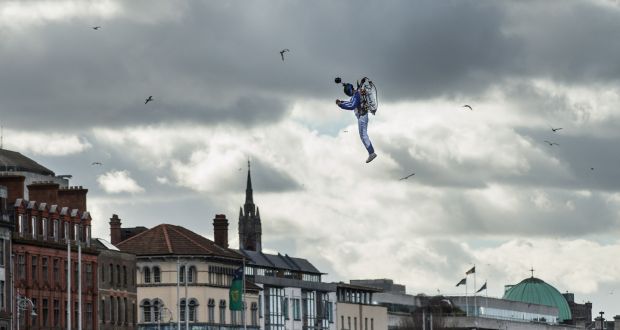
Jetpack pilot flies over Dublin’s iconic Ha’penny Bridge

THE FOOTAGE SHOWS A JETPACK PILOT FLYING OVER DUBLIN’S HA’PENNY BRIDGE AND LANDING ON A PONTOON IN THE RIVER LIFFEY.

  
A man wearing a jetpack stopped traffic in Dublin, Ireland, on Wednesday when he flew over the city’s iconic Ha’penny Bridge.The footage shows the pilot soaring over the bridge and landing on a pontoon in the middle of the River Liffey.
Pilot flies like a bird over Ha’Penny Bridge (Twitter / Quentin Doran O’Reilly)
The jetpack pilot had clear skies for the short flight, which was met with applause and whistles by onlookers when he landed safely.
The event was part of a promotion by Samsung for the launch of a new model smartphone.

Expert’s say women need more sleep than Men

     
If you have a strong bond with your bed and have to peel yourself out of it in mornings (I for one am guilty), this could be of interest.
Professor Jim Horne, who holds the position of Director at Loughborough University’s Sleep Research Centre, said that women can experience increased levels of psychological distress due to lack of sleep but this isn’t as likely for men.
Horne noted that in general, these feelings “were not associated with the same degree of sleep disruption” for males.
Speaking to Mail Online, Horne said that because women tend to “multi-task” their brains are used more during the day and, as a result, they need more time to recover.
“The more of your brain you use during the day, the more of it that needs to recover and, consequently, the more sleep you need.
“Women tend to multi-task — they do lots at once and are flexible — and so they use more of their actual brain than men do. Because of that, their sleep need is greater” explained the professor.
Horne said that on average, females need twenty minutes more sleep but this can vary from woman to woman.
The sleep expert also pointed out that men whose jobs involve “decision-making and lateral thinking” are also likely to need more sleep.
Horne’s research, which focused on 210 middle-aged men and women, was originally released in 2010 but it’s a source of discussion again this week.
The world’s thinnest lens now a reality
A team of researchers has developed the world’s thinnest lens, which is one two-thousandth the thickness of a human hair, paving way for flexible computer displays and a revolution in miniature cameras.
Lead researcher Dr Yuerui (Larry) Lu from The Australian National University (ANU) said the discovery hinged on the remarkable potential of the molybdenum disulphide crystal, adding that this type of material is the perfect candidate for future flexible displays.
Lu noted, “We will also be able to use arrays of micro lenses to mimic the compound eyes of insects.”
The 6.3-nanometre lens outshines previous ultra-thin flat lenses, made from 50-nanometre thick gold nano-bar arrays, known as a metamaterial.
Dr. Lu said that Molybdenum disulphide, which is an “amazing crystal,” survives at high temperatures, is a lubricant, a good semiconductor and can emit photons too. The capability of manipulating the flow of light in atomic scale opens an exciting avenue towards unprecedented miniaturisation of optical components and the integration of advanced optical functionalities.
The team created their lens from a crystal 6.3-nanometre thick – 9 atomic layers – which they had peeled off a larger piece of molybdenum disulphide with sticky tape. They then created a 10-micron radius lens, using a focussed ion beam to shave off the layers atom by atom, until they had the dome shape of the lens.
The team discovered that single layers of molybdenum disulphide, 0.7 nanometres thick, had remarkable optical properties, appearing to a light beam to be 50 times thicker, at 38 nanometres. This property, known as optical path length, determines the phase of the light and governs interference and diffraction of light as it propagates. 

Wednesday, November 11, 2015

Donie's Ireland daily news BLOG

Restoration work starts on Easter Rising headquarters for 2016 celebrations

The Moore Street site where 1916 rebels surrendered will become a commemorative centre.


The site of Easter Rising headquarters on Moore Street in Dublin.

Restoration work has begun on the site of the final headquarters of the Easter Risingrebels on Moore Street in Dublin ahead of next year’s centenary celebrations.
The Government purchased14-17 Moore Street for €4 million earlier this year.
The site is to be turned into a commemorative centre, which Minister for Arts, Heritage and the Gaeltacht Heather Humphreys expects to be completed next year.
Number 16 is recognised as the site where the Rising leaders agreed to surrender.
All four of the buildings will be restored to their 1916 condition following structural stabilisation work and the reinstatement of contemporary interiors.
It was announced that the company behind the recent restoration of Kilmainham Courthouse, Dublin-based conservation and heritage specialists Lissadell Construction Ltd, will undertake the Moore Street project.

A National monument?

The buildings in question date back to the 18th-century, and were declared a national monument in 2007.
“I am delighted to see this project moving ahead. The national monument at numbers 14-17 Moore Street has such special historical significance in the context of the Easter Rising,” Ms Humphreys said.
“This project is a very important element of the Government’s plans for the 1916 centenary commemorations.
“The conservation work will reveal the period architectural detail, the living conditions and, above all, the imprint of the insurgency.
“The primary focus of the work is to reveal the buildings as they were during the Rising, allowing them to illuminate that period in our history.”
Preservation campaigners have praised the Government for its actions in securing the future of numbers 14 to 17, but some have voiced concerns about development proposals for adjoining houses.
Planning permission still stands for a stalled retail development in the neighbouring area, which may be resurrected after Nama sold its stake in the premises to UK-based property group Hammerson last month.

As much as 38,519 killed on roads across the island of Ireland


More than 38,500 people have been killed on roads throughout the island of Ireland since records began.

Just over 38,500 people have been killed on roads throughout the island of Ireland since records began.
A total of 38,519 people have died on the roads on both sides of the border, including 23,752 in the Republic of Ireland and 14,767 in Northern Ireland.
The records of road deaths in Northern Ireland go back as far as 1931, while fatalities in the Republic of Ireland were only counted from 1959 onwards.
The statistics were released as events are being planned around the island for Sunday to mark World Day of Remembrance for Road Traffic Victims.
NI Environment Minister Mark H Durkan, who lost his sister in a car crash in 2000, said: “Many generations and thousands of families in the North, including my own, have been devastated by the grief of loss and the heartache of road tragedy.
“Almost 15,000 people, just like you and me, have lost their lives. And this is why I am working along with my road safety partners – the PSNI, the NI Fire and Rescue Service and the NI Ambulance Service amongst others – towards reducing the carnage on our roads. We must do everything possible to prevent this loss and suffering touching any more lives.
The Minister added: “The certainty of the unexpected means that it is crucial to reduce speed, wear seatbelts and eliminate high risk behaviours.
“I am fully committed to improving safety for all road users. I firmly believe that by working together, we can rise to the challenge of making our roads safer for everyone.”
So far this year 61 people have been killed on Northern Ireland’s roads.
PSNI Assistant Chief Constable Alan Todd commented: “Behind each of these statistics are family and friends who have been affected and we must remember them.
“This Sunday provides us with an opportunity to remember all those people who have lost their lives on our roads. Our thoughts are with all their family members and friends not just today, but throughout the year.”
Irish Transport Minister Paschal Donohoe, welcomed the fact that people across the island were coming together to remember all the lives lost on the roads.
He said: “Many lives have been saved and injuries prevented as a result of the collaborative work by road safety agencies on both sides of the border in recent years so it is fitting that we should come together on World Day of Remembrance for Road Traffic Victims to remember those who have tragically died on the road and to also think of their families.”
The Day of Remembrance for Road Traffic Victims, was first held in 1993 in the United Kingdom and organised since then by non-governmental organisations in a number of countries.
The RSA, along with members of An Garda Síochána, Road Safety Officers in Local Authorities, the Emergency Services and road safety support groups have organised masses, services and commemorative events around the country this Sunday to remember the lives that have been lost and changed forever on our roads.

Undiagnosed diabetes more common among older people outside Dublin

Access to health services may be reason for result of Tilda study

Undiagnosed Type 2 diabetes is more common among older people living outside Dublin. Photograph: Thinkstock    

Undiagnosed Type 2 diabetes is more common among older people living outside Dublin.

Undiagnosed Type 2 diabetes is more common among older people living outside Dublin.
A new report from Trinity College Dublin’s longitudinal study on ageing (Tilda) shows one in 10 people over 50 in Ireland (120,000) has diabetes.
Led by Prof Rose Anne Kenny at Trinity, Tilda has completed three waves of data collection from its nationally representative cohort of more than 8,000 people living in Ireland, aged 50 and over.
The study found those with private health insurance were less likely to have undiagnosed diabetes.
Distance from GP
Dr Siobhán Leahy said the study covered three areas: Dublin city or county, urban areas outside Dublin and rural areas.
“People in Dublin are less likely to have undiagnosed diabetes. One of reasons potentially for this is access to health services,” Dr Leahy said.
“We haven’t drilled down our research in the rural areas yet . . . two rural areas aren’t comparable so we don’t know the finer detail. However, things like distance from your GP may affect how often you visit them or how early it is diagnosed,” she said.
Dr Leahy said the incidence of diabetes is in line with other European countries. “While it’s not a particularly high prevalence . . . it is a modifiable disease and highly affected byphysical activity and lifestyle. Ten per cent of people with diabetes are undiagnosed.”

70% of Irish population now owns a smartphone


Some 70% of the population of Ireland now carries a smartphone device, according to an Eir survey.

This means 2.37m Irish people use smartphones, which is up from 39% of the population using smartphones in 2012.
The study found that there is also growing use of digital technologies among older generations, with 45% of those over the age of 50 going online every day.
The survey found that 75% of the population of Ireland uses the internet at least once a day, up 6% year-on-year. Out of this, 18% claim to be connected during every waking hour, rising to 41pc among 16-to-24-year-olds.
Some 21% of Irish households now use smart TVs, up from 14% last year. The Eir study reveals that with people planning to buy new smart TVs, the number of households with smart TVs will exceed 500,000 by the end of the year.
In terms of what people do online, 66% use the internet to manage email followed by 59% who view YouTube, while on-demand services like Netflix account for 30% of users’ time online.
Older generations are now hopping online more frequently and while laptop usage among over-50s remains static at 53pc, smartphone usage has shown a surprising jump from 6% to 39pc in just a year.
Most parents’ attitudes towards broadband are favourable, according to Eir, with four-out-of-five parents of five-to-17-year-olds saying broadband helps their kids with their homework.

The social nation of Ireland

Unsurprisingly, 94% of 16-to-24-year-olds are power users of social media, with Facebook being used by 92pc of people in this age group.
Snapchat is used by 67% of users, Instagram by 58% of users, Spotify by 39% of users and Pinterest by 23% of users.
“The findings really highlight how, as a society, we have an insatiable desire to be connected,” commented Lisa Comerford, director of brand and communications at Eir’s consumer division.
“Whether it’s keeping on top of work emails in the evening, helping children with their homework, looking up the best recipes, or planning a night out, access to the internet and a love of devices play an increasingly central role in our lives. The trends over the past couple of years only point to one thing: demand for greater and better connectivity is only going to increase.”

E-commerce

Despite recent evidence that over 90pc of Irish businesses can’t transact online, with Christmas looming the propensity of Irish consumers to shop online should be a cause for concern as it means money will leave the economy to go overseas.
Clothes (69pc) are now vying with flights (70pc) and hotels (66pc) to be the top online shopping category, with those in Dublin more active compared with rural areas.
Some 57pc of the population say they shop online, equally divided between men and women.
This rises to 77pc for those between 25 and 34.

Ireland is becoming a nation of DIY online doctors

The big finding of the year is people’s attitudes towards lifestyle and health. It points to the rise of the ‘noodie’, individuals who happen to be nutrition foodies and use the internet to find healthy food and recipes.
The study also found that there is an appetite for remote monitoring of health of relatives and family members.
Some 25pc of those surveyed agreed that the internet has become their first port of call when seeking medical advice.
However, one in five agreed that they had worried unnecessarily about their health after reading something online.
Only 7pc would be willing to order pharmaceuticals online.

But do we need to power down?

A need to power down is becoming evident, with 59pc of the working population revealing they do some form of work from home, either checking email or bringing work home.
One in four said that they often catch up with work in the evening or at the weekend.
The survey also showed that 15pc of the working population now run a business from home.

Search for meteor that flashed across the Irish skies last Sunday.

   Jim Ramsay, 44, spotted the bright light while taking pictures of the night sky near Squinty Bridge in Glasgow city centre
A bright flash illuminated Irish skies on Sunday evening as a meteorite disintegrated hundreds of miles above the Earth. Parts of a meteorite that collided with Earth last weekend may have landed in Ireland, according to Astronomy Ireland.
Last Sunday evening at around 8.13 pm, reports of a flash so bright that it lit up the sky for a few seconds flooded into Astronomy Ireland from all over Ireland. Confirmed sightings came from counties as far apart as Clare, Dublin, Meath and Monaghan.
Astronomy Ireland believe the flash was caused by a rock from space colliding with Earth and breaking up as it hurtled towards the ground hundreds of miles above Irish soil.
“No man-made explosion (except for a nuclear weapon being detonated) could have caused a flash this bright. So Astronomy Ireland reckons it was a rock in space colliding with Earth and burning up in the sky hundreds of miles above Ireland,” said David Moore, editor of Astronomy Ireland magazine.
One amateur astronomer even managed to catch the explosive occurrence on camera. Michael O’Connell captured the video below of the incredible burst of light in the sky from Kildare at 20:12:47 on Sunday November 8. O’Connell writes that it was most likely a northern Taurid [annual meteor shower associated with the comet Encke] and that he believes it occurred over the Irish Sea near Wales.
Astronomy Ireland also believe that such was the force of the flash and the “colossal explosion” in Irish skies that fragments of the meteorite may have made it to ground. They have issued an appeal for further reports from the public to locate any such remnants of the meteor’s collision.
“From a flash this bright it is possible that part of the rock survived the reentry process and landed on Earth,” Moore added.
“From all the sightings we can predict where any meteorite fell and then people can search that area for the highly valuable meteorites. Astronomy Ireland will add anyone who sends in a report to its email list and when the analysis is completed in a few days a message will be emailed to everyone on that list so everyone can search for the meteorite at the same time.”
And as if discovering a bit of outer space wasn’t incentive enough to report a sighting, meteorites can also fetch an astronomical sum, according to Moore.
“A fireball in November 1999 that dropped a meteorite on Ireland was found in Co. Carlow after a similar analysis by Astronomy Ireland,” he said. “Collectors were later selling bits of this meteorite for 50 times the price of gold at the time, so meteorites can be very valuable.”
If you think you may have seen something of interest to Astronomy Ireland you can report the sighting to astronomy.ie.