Pages

Showing posts with label Losers. Show all posts

Sunday, March 13, 2016

Donie's Ireland daily news BLOG update

Recent poll suggests futility of a second general Irish election,

THE RESULT WOULD BE THE SAME?


A NEW MEDIA POLL HAS SHOWN THAT A SECOND GENERAL ELECTION WOULD SHOW NO MAJOR CHANGES IN PUBLIC OPINION, WITH A GRAND COALITION THE MOST LIKELY OUTCOME.

The Red C poll for the Sunday Business Post shows there are no major gains to be made for any of the three larger parties, but a continued slide for Labour.
Each of Fine Gael, Fianna Fáil and Sinn Féin score 1% higher in this poll than they did in the election two weeks ago.
The major losers are Labour and the Independents – Independents are down 4% to 9%, and Labour go down 3% to 4%, giving it the same popularity as the Anti-Austerity Alliance/People Before Profit.
The biggest gains would, in theory, be made by the Social Democrats, up 2% to 5%, the same level as the Independent Alliance.
The Greens would remain on 3%, with Renua on 2%.
It all means that while another election may seem possible, at present it would not produce a very different Dáil.

JD Wetherspoon Irish bars performing above average

GROUP REVENUES UP 6.2% TO £790.3M AS PRE-TAX PROFITS DECLINE 3.9% TO £36M

    
JD Wetherspoon chairman Tim Martin (above) photographed in the Three Tun Tavern in Blackrock.
JD Wetherspoon founder and chairman Tim Martin has said its five bars in Ireland are performing above average, as the group announced lower first-half pre-tax profits.
Mr Martin, who established the pub chain in 1979, also repeated calls for the UK to leave the European Union. He said a “Brexit” would restore power to the national parliament and thereby increase the level of democracy and accountability.
His call came as the group reported pre-tax profits of £36 million (€46.1m) for the 26 weeks till January 24th, down 3.9% on the £37.5 million recorded for the same period a year earlier.
Revenues were 6.2% higher at £790.3 million, versus £744.4 million for the preceding year with operating profits down 10.8% to £49.4 million, as against £55.4 million last year.
Irish operations
Speaking recently, Mr Martin said plans to open up to 30 pubs in the Republic are continuing, although he added that rising property prices meant the pace of expansion had slowed down.
“We’ve got five pubs going and another four that are awaiting planning permission. There are also a few other irons in the fire but the thing that’s working against us is the property market. I can see us having a dozen or so pubs within the next two years but rising property prices might affect this,” he said.
JD Wetherspoon currently operates five bars in Ireland: The Three Tun Tavern in Blackrock; The Forty Foot in Dun Laoghaire; The Great Wood in Blanchardstown; The Old Borough in Swords; and the Linen Weaver in Cork city.
Mr Martin said the group was very happy with the success of the bars it currently has in the Republic.
“The Irish bars are trading well with higher average sales compared to in the UK. We’ve built up a good team in Ireland and have received a great reception,” he said.
Like-for-like sales at JD Wetherspoon rose 2.9% in the 26 weeks till January 24th, with total sales up 6.2% to £790.3 million, compared to £744.4 million. Operating profit decreased by 10.8% to £49.4million with the group reporting an operating margin of 6.3%. The group said in the six weeks to 6th March, like-for-like sales increased by 3.7%, with total sales up 5.7%.
During the period under review, JD Wetherspoon opened five new pubs and sold two , bringing the number of pubs open to 954. It said it expected to open 15 new pubs overall in its new financial year.
Tax disparity
Mr Martin was highly critical of the tax disparity between pubs and supermarkets in the UK, which he said was unfairly impacting on business.
The main disparity relates to value added tax, with pubs having to pay 20 per cent on all food sales. Mr Martin said this allowed supermarkets to subsidise their alcoholic drinks prices.
“The tax disparity with supermarkets is unfair. Pubs create significantly more jobs and more taxes per pint or per meal than do supermarkets and it does not make social or economic sense for the UK tax regime to favour supermarkets,” said Mr Martin.

A woman shares photo of her breast to show what cancer symptoms look like


A WOMAN SHARES PHOTO OF HER BREAST TO SHOW WHAT CANCER SYMPTOMS LOOK LIKE

An Australian woman has shared a photo of her breast online to warn people about the subtle symptoms of breast cancer.
Kylie Armstrong from Melbourne asked others to share her Facebook post to highlight the need for women to remain vigilant of the illness.
The photo shows three small dimples on the underside of her left breast, which are the only discernable signs of the disease.
Neither M/s Armstrong nor her GP were able to feel a lump as the cancer was deep in her breast, “close to the muscle”
Ms Armstrong wrote alongside the picture: “Please take a good look at this photo. These 3 very, very subtle DIMPLES on the bottom of this breast are a sign of breast cancer! This is what my breast cancer looks like
“I felt no lump. The GP felt no lump.”
She also wrote about the effect her diagnosis had had on herself and her family.
“We are shocked, we are numb, we are emotional, we are sometimes OK, we are pretending it’s not happening, we are trying to absorb information, we are dealing with tests,” he said.
“We are crying, we are trying to continue as normal.”
Her message to other women was simple: “I am sharing this because I hope I can make people aware that breast cancer is not always a detectable lump.
“Please go straight to your GP if you notice ANY change in your breast. It could save your life.

Jetpack pilot flies over Dublin’s iconic Ha’penny Bridge

THE FOOTAGE SHOWS A JETPACK PILOT FLYING OVER DUBLIN’S HA’PENNY BRIDGE AND LANDING ON A PONTOON IN THE RIVER LIFFEY.

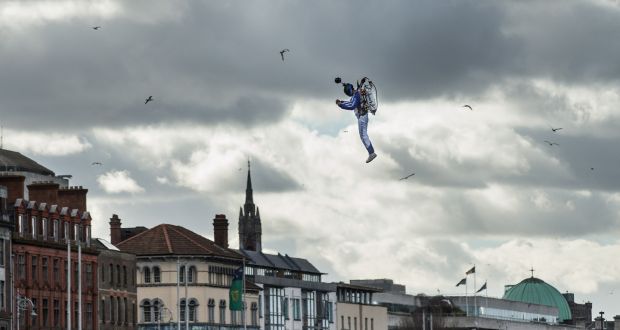
  
A man wearing a jetpack stopped traffic in Dublin, Ireland, on Wednesday when he flew over the city’s iconic Ha’penny Bridge.The footage shows the pilot soaring over the bridge and landing on a pontoon in the middle of the River Liffey.
Pilot flies like a bird over Ha’Penny Bridge (Twitter / Quentin Doran O’Reilly)
The jetpack pilot had clear skies for the short flight, which was met with applause and whistles by onlookers when he landed safely.
The event was part of a promotion by Samsung for the launch of a new model smartphone.

Expert’s say women need more sleep than Men

     
If you have a strong bond with your bed and have to peel yourself out of it in mornings (I for one am guilty), this could be of interest.
Professor Jim Horne, who holds the position of Director at Loughborough University’s Sleep Research Centre, said that women can experience increased levels of psychological distress due to lack of sleep but this isn’t as likely for men.
Horne noted that in general, these feelings “were not associated with the same degree of sleep disruption” for males.
Speaking to Mail Online, Horne said that because women tend to “multi-task” their brains are used more during the day and, as a result, they need more time to recover.
“The more of your brain you use during the day, the more of it that needs to recover and, consequently, the more sleep you need.
“Women tend to multi-task — they do lots at once and are flexible — and so they use more of their actual brain than men do. Because of that, their sleep need is greater” explained the professor.
Horne said that on average, females need twenty minutes more sleep but this can vary from woman to woman.
The sleep expert also pointed out that men whose jobs involve “decision-making and lateral thinking” are also likely to need more sleep.
Horne’s research, which focused on 210 middle-aged men and women, was originally released in 2010 but it’s a source of discussion again this week.
The world’s thinnest lens now a reality
A team of researchers has developed the world’s thinnest lens, which is one two-thousandth the thickness of a human hair, paving way for flexible computer displays and a revolution in miniature cameras.
Lead researcher Dr Yuerui (Larry) Lu from The Australian National University (ANU) said the discovery hinged on the remarkable potential of the molybdenum disulphide crystal, adding that this type of material is the perfect candidate for future flexible displays.
Lu noted, “We will also be able to use arrays of micro lenses to mimic the compound eyes of insects.”
The 6.3-nanometre lens outshines previous ultra-thin flat lenses, made from 50-nanometre thick gold nano-bar arrays, known as a metamaterial.
Dr. Lu said that Molybdenum disulphide, which is an “amazing crystal,” survives at high temperatures, is a lubricant, a good semiconductor and can emit photons too. The capability of manipulating the flow of light in atomic scale opens an exciting avenue towards unprecedented miniaturisation of optical components and the integration of advanced optical functionalities.
The team created their lens from a crystal 6.3-nanometre thick – 9 atomic layers – which they had peeled off a larger piece of molybdenum disulphide with sticky tape. They then created a 10-micron radius lens, using a focussed ion beam to shave off the layers atom by atom, until they had the dome shape of the lens.
The team discovered that single layers of molybdenum disulphide, 0.7 nanometres thick, had remarkable optical properties, appearing to a light beam to be 50 times thicker, at 38 nanometres. This property, known as optical path length, determines the phase of the light and governs interference and diffraction of light as it propagates. 

Wednesday, October 21, 2015

Donie's Ireland daily news BLOG

Irish the biggest losers from financial crash  “Says the ECB”

Typical Irish person lost €18k between 2009 -2013 figures show, more than in Greece and Spain


In an analysis of the years between 2009 and 2013, ECB experts discovered that Ireland lost more than €18,000 per person, while Spaniards saw wealth dwindle by almost €13,000 as property in both nations plummeted.

The Irish lost more of their personal wealth than any other euro zone country in the aftermath of the financial crash while Germany and the Netherlands gained the most, fresh data from the European Central Bank shows.
In an analysis of the years between 2009 and 2013, ECB experts discovered that Ireland lost more than €18,000 per person, while Spaniards saw wealth dwindle by almost €13,000 as property in both nations plummeted.
Greeks saw their notional wealth decline by almost €17,000 for the same reason.
In the Netherlands and Germany, by contrast, the wealth per capita grew by roughly €33,000 and €19,000 respectively, due in part to a boost to financial investments over that time.
The data, which takes a snapshot before the recent economic upswing in Spain and Ireland, illustrates the stark differences between countries in the 19-country euro zone that extends from cities such as Helsinki in the north to Athens in the south.
By presenting the data in this manner, the ECB acknowledges the divergence, although there is little the central bank can do to remedy it.
Its money-printing scheme known as quantitative easing is spread out according to euro zone member countries’ relative size and not determined by their economic needs.
To fix imbalances between strong industrial nations such as Germany and countries such as Spain, experts have long pushed for a system of financial transfers or payments from rich to poor states.
Germany, which fears that this would lumber it with unmanageable costs and believes that handouts would discourage spendthrift countries from reforming, has flatly rejected the suggestion.
A separate chart published by the ECB, with data up until the start of this year, shows, however, that the situation of weaker nations may be gradually improving.
Data shows an improvement in income almost across the board in the euro zone, barring a small number of stragglers including Cyprus.

Pensioner woman (90) will not have to pay costs in satellite dish case

Anne Rudd says ‘justice done’ after court rules she need not pay €1,500 legal bill


Anne Rudd, a great grandmother from St Enda’s Road, Terenure, was summoned by Dublin City Council which had sought an order for legal costs. Following pleas from her lawyers that it would be unfair if Ms Rudd had to pay the expenses, which the council had reduced from €2,100 to €1,500, Judge John O’Neill dismissed the case.

TOM TUITE

A judge has thrown out a case against a Dublin woman (90) who faced a €1,500 legal bill for having an unauthorised satellite dish on the front of her house.
Anne Rudd, a great grandmother from St Enda’s Road, Terenure, was summonsed by Dublin City Council which had sought an order for legal costs.
Mrs Rudd’s lawyers argued it would be unfair if she had to pay the expenses, which were reduced from €2,100 to €1,500 by the council.
Judge John O’Neill dismissed the case, saying it was a substantial bill and he was not going to order her to pay costs due to exceptional circumstances.
Following the verdict, Mrs Rudd stood outside the courthouse with her daughters Anne Claxton and Teresa Davey and her son Peter Rudd and told reporters “justice has been done”.
“I have had my family around me, there are women and men who have nobody. It was an oversight,” she said.
Mrs Rudd said she was shocked by the attention she had received following the initial hearing. “I could not believe it, me, little me, Australia, England, Wales, San Diego in California, people offered things. Bunches of flowers, money was sent and I gave it to charity. In Wales a man wanted to start up a fund.”
Ms Claxton thanked the public for their good wishes as well as Judge O’Neill, the legal team and the news media.
Mrs Rudd was accused at Dublin District Court of failing to comply with an enforcement notice issued on May 28th last telling her she had to remove “the unauthorised satellite dish” along with all associated fixtures and fittings from the facade of her house under Section 154 of the Planning and Developments Acts.
James Cosgrave, a planning enforcement officer with the council, had told the court he spoke to Mrs Rudd in March and told her the dish could not be fixed to the front of her home. She was given until the end of June to move the dish.
Mr Cosgrave gave her more time to remove it but that had not been done by the time of his next inspection, on July 21st, after which proceedings commenced
Solicitor Michael Quinlan, prosecuting, said Mrs Rudd had been told then that something had to be done. The proceedings were a result of non-compliance.
Her family told the court last month that their mother would not have known what the letter pertained to but they later learned it was official and arranged to have the dish taken down.
Court proceedings had been initiated by then. Her daughters told the council last month that €1,500 could be paid.
The case resumed yesterday and this time Mrs Rudd was represented by barrister Peter Maguire (instructed by Thomas Loomes and Company solicitors). They had wanted to help, free of charge, and Ms Rudd did not seek legal aid.
Mr Maguire argued that it was unfair to ask the pensioner in receipt of €230 a week to pay a legal bill she could not afford.
He said regulations stated that in exceptional circumstances such as these, the judge has discretion in relation to making an order for costs and is not solely a “mouthpiece of the law”.

Recession’s always damages the mental health of our families,

A study shows

A report says falling incomes and unemployment place heavy strain on relationships

    
Prof Richard Layte (r), author of a new report on childhood in Ireland. 
The financial strain on families as a result of the recession has “hugely damaged” many parents’ and children’s mental health, a new study shows.
The findings are based on analysis of the Growing Up in Irelandstudy, which tracked the lives of almost 20,000 children between 2008 and 2011.
The latest analysis of the study shows that falling incomes and unemployment have placed a heavy strain on family relationships.
Among families under economic pressure, the risk of mothers showing clinical levels of depression jumped by 84 per cent compared with families unaffected by the downturn.
The equivalent increased risk for fathers was 61 per cent.
Parents experiencing financial distress reported more arguments and were more likely to report that they were unhappy with their relationship.
The study also provides stark evidence of how this parental stress had a much wider impact on children’s wellbeing.
Parents under stress were found to use harsher parenting styles with less warmth, the study found.
This change was true for parents across the levels of education and social class.
These worsened relationships between parents and children were linked to higher anxiety and worse conduct, as well as lower child happiness.
This, in turn, led to deterioration in conduct among children at home and poorer test results at school.
Unhappy children
One of the report’s authors, Prof Richard Layte of Trinity College Dublin, said the findings had long-term implications for young people.
“Anxious, unhappy children do worse in school, often with long-term consequences for both wealth and health,” said Prof Layte.
“By investing in children and young people, we will be developing healthier, happier and more productive adults for all our tomorrows – and saving money in the process.”
The results also show the extent to which personal income fell during the recession.
Cutting back on basics?
The proportion reporting some degree of difficulty in making ends meet doubled, rising from 31 per cent in 2008 to 61 per cent.
Almost 30 per cent of mothers reported cutting back on basics, while 8 per cent said they fell behind with their rent or mortgage.
Overall, household income fell by 16 per cent between 2008 and 2011 for families who participated in the study.
Unemployment among fathers rose from 6 per cent to almost 14 per cent.
The report also found a number of key gender differences.
For example, the effect of economic strain on a relationship was perceived to be higher among mothers.
It also recorded a relatively low level of separation or divorce among parents – at 2 per cent of parents – but Prof Layte said it was too early to draw any definitive conclusions from this.

The Irish kings of online ‘mystery shoppers’ now with $20m in their coffers


Clavis Insight was founded in 2008. Soon it will employ 300 people worldwide.

A DUBLIN COMPANY that takes the ‘mystery shopper’ concept online for the world’s biggest grocery producers has announced a major cash injection as it ramps up its international expansion.
Clavis Insight has received a $20 million (€17.6 million) investment from US venture capital firm Accel-KKR to fuel its growth in the US, Europe and China.
Garry Moroney started Clavis in 2008 and it has since expanded to almost 150 staff across offices in Dublin, Boston, London and Shanghai.
The majority are employed in its Dublin headquarters, where the company handles its main software development and data analysis.
Moroney sold his previous business, software firm Similarity Systems, to US-based Informatica in a cash deal worth nearly $55 million in 2006.
Clavis is expected to double its headcount to around 200 staff in Ireland over the next two years as part of the global push.
Online sales
The company checks how products from its clients are being sold over the internet – from their availability to how the goods are advertised on e-commerce sites like Amazon and Tesco’s virtual store.
That information can then be used to tweak the online selling process to help suppliers offload more of their products. In return, it charges up to $20,000 (€17,600) per retailer it analyses as part of its service.
Clavis’s software is already used by the world’s 10 largest manufacturers of consumer packaged goods, including Unilever, Nestlé and Mondelēz.
The company, previously known as Clavis Technology, has previously raised money from investors including Dublin venture-capital firm Delta Partners, Enterprise Ireland and millionaire Irish software entrepreneur Jim Mountjoy.

European greenhouse gas emissions drop


Greenhouse gas emissions in the European Union are down 23 percent since 1990, but the reductions are expected to slow before the EU can hit a self-imposed carbon goal. 

In a report published Tuesday, the European Environment Agency (EEA) said the EU has cut its emissions faster than previously predicted and most member states are on pace to hit their individual reduction targets.
The EU has already met its goal of cutting emissions by one-fifth by 2020, all while seeing its economy grow by 46 percent since 1990.
But its greenhouse gas reduction rate is expected to slow: By 2030, when officials have hoped to reduce emissions by 40 percent over 1990 levels, the bloc will only cut emissions by between 27 and 30 percent, according to the report.
“To achieve our longer-term goals for 2030 and 2050, a fundamental change is needed in the way we produce and use energy in Europe,” EEA Director Hans Bruyninckx said.
The report tracked country-by-country progress on greenhouse gas reductions, renewable energy goals and energy efficiency targets.
Twenty-four countries are expected to hit their carbon targets, but only 13 of the 28 EU members states are expected to meet all three goals. The report says the countries “will have to increase considerably their efforts” in order to meet longer-term environmental goals.
The EU’s emissions target is an important component of an international climate change accord the United Nations hopes to reach later this year. The EU member states, taken as a bloc, are one of the world’s largest polluters, behind only China and the United States.