Pages

Showing posts with label Healthy sleeping. Show all posts

Sunday, March 13, 2016

Donie's Ireland daily news BLOG update

Recent poll suggests futility of a second general Irish election,

THE RESULT WOULD BE THE SAME?


A NEW MEDIA POLL HAS SHOWN THAT A SECOND GENERAL ELECTION WOULD SHOW NO MAJOR CHANGES IN PUBLIC OPINION, WITH A GRAND COALITION THE MOST LIKELY OUTCOME.

The Red C poll for the Sunday Business Post shows there are no major gains to be made for any of the three larger parties, but a continued slide for Labour.
Each of Fine Gael, Fianna Fáil and Sinn Féin score 1% higher in this poll than they did in the election two weeks ago.
The major losers are Labour and the Independents – Independents are down 4% to 9%, and Labour go down 3% to 4%, giving it the same popularity as the Anti-Austerity Alliance/People Before Profit.
The biggest gains would, in theory, be made by the Social Democrats, up 2% to 5%, the same level as the Independent Alliance.
The Greens would remain on 3%, with Renua on 2%.
It all means that while another election may seem possible, at present it would not produce a very different Dáil.

JD Wetherspoon Irish bars performing above average

GROUP REVENUES UP 6.2% TO £790.3M AS PRE-TAX PROFITS DECLINE 3.9% TO £36M

    
JD Wetherspoon chairman Tim Martin (above) photographed in the Three Tun Tavern in Blackrock.
JD Wetherspoon founder and chairman Tim Martin has said its five bars in Ireland are performing above average, as the group announced lower first-half pre-tax profits.
Mr Martin, who established the pub chain in 1979, also repeated calls for the UK to leave the European Union. He said a “Brexit” would restore power to the national parliament and thereby increase the level of democracy and accountability.
His call came as the group reported pre-tax profits of £36 million (€46.1m) for the 26 weeks till January 24th, down 3.9% on the £37.5 million recorded for the same period a year earlier.
Revenues were 6.2% higher at £790.3 million, versus £744.4 million for the preceding year with operating profits down 10.8% to £49.4 million, as against £55.4 million last year.
Irish operations
Speaking recently, Mr Martin said plans to open up to 30 pubs in the Republic are continuing, although he added that rising property prices meant the pace of expansion had slowed down.
“We’ve got five pubs going and another four that are awaiting planning permission. There are also a few other irons in the fire but the thing that’s working against us is the property market. I can see us having a dozen or so pubs within the next two years but rising property prices might affect this,” he said.
JD Wetherspoon currently operates five bars in Ireland: The Three Tun Tavern in Blackrock; The Forty Foot in Dun Laoghaire; The Great Wood in Blanchardstown; The Old Borough in Swords; and the Linen Weaver in Cork city.
Mr Martin said the group was very happy with the success of the bars it currently has in the Republic.
“The Irish bars are trading well with higher average sales compared to in the UK. We’ve built up a good team in Ireland and have received a great reception,” he said.
Like-for-like sales at JD Wetherspoon rose 2.9% in the 26 weeks till January 24th, with total sales up 6.2% to £790.3 million, compared to £744.4 million. Operating profit decreased by 10.8% to £49.4million with the group reporting an operating margin of 6.3%. The group said in the six weeks to 6th March, like-for-like sales increased by 3.7%, with total sales up 5.7%.
During the period under review, JD Wetherspoon opened five new pubs and sold two , bringing the number of pubs open to 954. It said it expected to open 15 new pubs overall in its new financial year.
Tax disparity
Mr Martin was highly critical of the tax disparity between pubs and supermarkets in the UK, which he said was unfairly impacting on business.
The main disparity relates to value added tax, with pubs having to pay 20 per cent on all food sales. Mr Martin said this allowed supermarkets to subsidise their alcoholic drinks prices.
“The tax disparity with supermarkets is unfair. Pubs create significantly more jobs and more taxes per pint or per meal than do supermarkets and it does not make social or economic sense for the UK tax regime to favour supermarkets,” said Mr Martin.

A woman shares photo of her breast to show what cancer symptoms look like


A WOMAN SHARES PHOTO OF HER BREAST TO SHOW WHAT CANCER SYMPTOMS LOOK LIKE

An Australian woman has shared a photo of her breast online to warn people about the subtle symptoms of breast cancer.
Kylie Armstrong from Melbourne asked others to share her Facebook post to highlight the need for women to remain vigilant of the illness.
The photo shows three small dimples on the underside of her left breast, which are the only discernable signs of the disease.
Neither M/s Armstrong nor her GP were able to feel a lump as the cancer was deep in her breast, “close to the muscle”
Ms Armstrong wrote alongside the picture: “Please take a good look at this photo. These 3 very, very subtle DIMPLES on the bottom of this breast are a sign of breast cancer! This is what my breast cancer looks like
“I felt no lump. The GP felt no lump.”
She also wrote about the effect her diagnosis had had on herself and her family.
“We are shocked, we are numb, we are emotional, we are sometimes OK, we are pretending it’s not happening, we are trying to absorb information, we are dealing with tests,” he said.
“We are crying, we are trying to continue as normal.”
Her message to other women was simple: “I am sharing this because I hope I can make people aware that breast cancer is not always a detectable lump.
“Please go straight to your GP if you notice ANY change in your breast. It could save your life.

Jetpack pilot flies over Dublin’s iconic Ha’penny Bridge

THE FOOTAGE SHOWS A JETPACK PILOT FLYING OVER DUBLIN’S HA’PENNY BRIDGE AND LANDING ON A PONTOON IN THE RIVER LIFFEY.

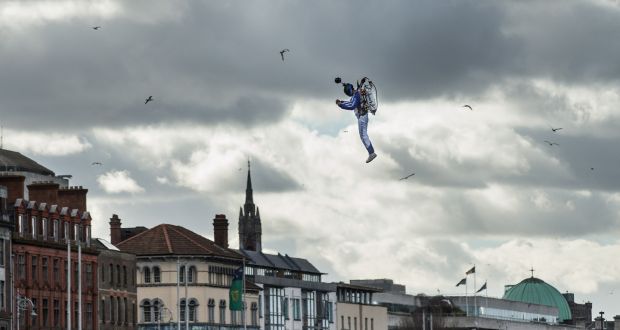
  
A man wearing a jetpack stopped traffic in Dublin, Ireland, on Wednesday when he flew over the city’s iconic Ha’penny Bridge.The footage shows the pilot soaring over the bridge and landing on a pontoon in the middle of the River Liffey.
Pilot flies like a bird over Ha’Penny Bridge (Twitter / Quentin Doran O’Reilly)
The jetpack pilot had clear skies for the short flight, which was met with applause and whistles by onlookers when he landed safely.
The event was part of a promotion by Samsung for the launch of a new model smartphone.

Expert’s say women need more sleep than Men

     
If you have a strong bond with your bed and have to peel yourself out of it in mornings (I for one am guilty), this could be of interest.
Professor Jim Horne, who holds the position of Director at Loughborough University’s Sleep Research Centre, said that women can experience increased levels of psychological distress due to lack of sleep but this isn’t as likely for men.
Horne noted that in general, these feelings “were not associated with the same degree of sleep disruption” for males.
Speaking to Mail Online, Horne said that because women tend to “multi-task” their brains are used more during the day and, as a result, they need more time to recover.
“The more of your brain you use during the day, the more of it that needs to recover and, consequently, the more sleep you need.
“Women tend to multi-task — they do lots at once and are flexible — and so they use more of their actual brain than men do. Because of that, their sleep need is greater” explained the professor.
Horne said that on average, females need twenty minutes more sleep but this can vary from woman to woman.
The sleep expert also pointed out that men whose jobs involve “decision-making and lateral thinking” are also likely to need more sleep.
Horne’s research, which focused on 210 middle-aged men and women, was originally released in 2010 but it’s a source of discussion again this week.
The world’s thinnest lens now a reality
A team of researchers has developed the world’s thinnest lens, which is one two-thousandth the thickness of a human hair, paving way for flexible computer displays and a revolution in miniature cameras.
Lead researcher Dr Yuerui (Larry) Lu from The Australian National University (ANU) said the discovery hinged on the remarkable potential of the molybdenum disulphide crystal, adding that this type of material is the perfect candidate for future flexible displays.
Lu noted, “We will also be able to use arrays of micro lenses to mimic the compound eyes of insects.”
The 6.3-nanometre lens outshines previous ultra-thin flat lenses, made from 50-nanometre thick gold nano-bar arrays, known as a metamaterial.
Dr. Lu said that Molybdenum disulphide, which is an “amazing crystal,” survives at high temperatures, is a lubricant, a good semiconductor and can emit photons too. The capability of manipulating the flow of light in atomic scale opens an exciting avenue towards unprecedented miniaturisation of optical components and the integration of advanced optical functionalities.
The team created their lens from a crystal 6.3-nanometre thick – 9 atomic layers – which they had peeled off a larger piece of molybdenum disulphide with sticky tape. They then created a 10-micron radius lens, using a focussed ion beam to shave off the layers atom by atom, until they had the dome shape of the lens.
The team discovered that single layers of molybdenum disulphide, 0.7 nanometres thick, had remarkable optical properties, appearing to a light beam to be 50 times thicker, at 38 nanometres. This property, known as optical path length, determines the phase of the light and governs interference and diffraction of light as it propagates. 

Wednesday, July 2, 2014

Donie's Ireland daily news BLOG update

Ireland has fewer doctors & hospital beds

BUT HAS MORE NURSES THAN OECD AVERAGE

  
The OECD report details doctor, nurse and hospital bed numbers as well as average salaries in health. 
New figures show that Ireland has fewer doctors, fewer beds and more nurses than the average across the 34 member countries of the Organisation for Economic Co-operation and Development.
On average hospital consultant here earned €170,784 last year in public work alone, according to the OECD report.
The figures for consultants exclude emergency call-out and on-call fees, which range between €2,430 and €22,303 a year, as well as any private practice income a consultant may have.
The average income for GPs is put at €118,677 for last year.
GP income is based on self-assessed income tax declared to the Revenue Commissioners.
The average income for a nurse is €51,202.
The figures for consultants, GPs and nurses are gross annual income.
The OECD Health Statistics 2014 report says that in 2012 total health spending in Ireland was slightly less than the OECD average.
It says that most reductions in public spending have been achieved through cuts in wages and fees paid to health professionals and drug companies.
The OECD suggests that health spending in Ireland has started to rise again in real terms but at a very modest rate.
The OECD takes this view despite the fact that €4bn in cuts have been applied to the health service since 2008.

14% more company start-ups in Ireland for first half of 2014

  
14% more company start-ups in first half of 2014 says Vision-net.ie.
The number of company start-ups formed in the first half of this year is up 14pc to 8,684 compared with the same period in 2013, according to risk analyst Vision-net.ie.
This figure contributed to the total of 21,834 company and business start-ups formed since 1 January, an average of 124 start-ups a day and a 2.6pc increase on the same period in 2013.
Company start-ups refer to those requiring two company directors while business start-ups are usually sole traders.
The professional services sector accounted for a quarter of all new company start-ups, followed by wholesale and retail at 10pc and social and personal services at 9pc.
Both the construction and real estate sectors experienced a significant rise of 39pc and 32pc respectively in company start-ups.
The construction industry has experienced the highest growth this year, with as many as three new start-ups formed each day.
Coupled to this rise in start-ups was the overall decline in company insolvencies, a figure that dropped by 10.5pc in the first half of 2014 compared to the same period in 2013. Nearly half (43pc) of these insolvencies were Dublin-based companies.
Christine Cullen, managing director of Vision-net.ie, said that the increase in company start-ups combined with the decrease in insolvencies indicated “the hallmarks of an economic recovery”.
“Most positive are the strong increases in start-ups in the construction and real estate sectors.”

Sleeping positions “the pros and cons”

   
Anyone who’s ever woken up with a stiff neck will know the resulting pain is enough to make you feel like you got up on the wrong side of the bed for the rest of the day. But which sleeping position is best for you?
We’ve picked out the pros and cons of every kind of position so you can work out which one will give you the best night’s slumber.
Sleeping on your side

 the PROS: THE RISK OF BACK AND NECK PAIN IS MINIMISED, YOU’RE LIKELY TO SNORE LESS AND AVOID ACID REFLUX.

Cons: It’s not the best position for your breasts or your skin.
Overall: Side sleepers are almost getting it right. It’s great for people who suffer from snoring and acid reflux and is overall pretty healthy. It also keeps your spine elongated, which is good for preventing back pain. The downside is that it can cause wrinkles, as your face is pressed up against the pillow. Larger breasted women should also consider that their boobs will be hanging down, which could cause sagging.
Sleeping on your back

 the PROS: NECK AND BACK PAIN IS LESS OF A RISK, AS IS ACID REFLUX. UNLIKE THE SIDE POSITION, YOU’LL ALSO AVOID WRINKLES AND BE MORE LIKELY TO KEEP YOUR BREASTS PERKY.

Cons: You might get nudged by your bed partner, as you’re more likely to snore.
Overall: Ultimately, this is the healthiest sleeping position. Your head, back and spine remain neutral and you’re not forcing your back to curve. Keep your head a little elevated and you’ll also avoid acid reflux.
Sleeping in the foetal position

 the PROS: SNORING IS MINIMISED AND IT’S COMFORTABLE FOR PREGNANT WOMEN.

Cons: There are no beauty benefits and it could cause back and neck pain.
Overall: To get into the foetal position you’re basically curling up into a ball, which puts strain on your spine and knees. This means you might have aching joins in the mornings. It also restricts diaphragmatic breathing and is bad for anyone looking to prevent wrinkles and sagging breasts. Instead, you could just try straightening out a little bit to ease the pressure on your joints and also invest in a nice plump pillow to support your head and neck.
Sleeping on your front

 the PROS: YOU’RE LESS LIKELY TO SNORE.

Cons: You might feel it in your neck and back and yet again it’s not great for your skin or breasts either.
Overall: If you sleep stomach down, it’s pretty hard for your spine to remain neutral, which means you could wake up with a stiff back. It also puts pressure on your joints and nerves, which means you might have pins and needles in the morning. If you suffer from bad snoring and don’t find sleeping on your front is affecting your back, it could actually be a good position for you, as it opens up your airways. Make sure you just use a thin pillow so there’s not too much pressure on your neck, which will constantly be twisted to one side.

Magnet Telecom experiments with 1-Gbps speed broadband in Dublin

  
Telecoms firm Magnet has fitted out a South Dublin apartment block with 1Gbps broadband as part of a wider experiment to see what residents would do with such speeds.
The 1Gbps fibre service is being deployed at the Jade apartments at The Grange, off the Stillorgan Road, and will service 120 apartments.
A spokesman for Magnet told Siliconrepublic.com that a similar development is planned for the Beacon apartments in Sandyford.
The service will cost €50 per month, to encourage people to sign up.
The fibre is being installed in the Jade apartments in collaboration with construction company JJ Rhatigan & Co.
Magnet will provide the 1Gbps service in a synchronous fashion, meaning users will be able to receive 1,000Mbps upstream and downstream.
The 1Gbps service is being deployed under the auspices of Magnet Project Leap to determine the impact of ultra-fast speeds on consumers’ use of devices and applications.
According to Magnet, 1Gbps will allow potentially 200 Netflix movies to be streamed simultaneously, 100 songs to be downloaded in three seconds, and 200 family photos to be uploaded to Facebook in just one second.
While companies such as Apple and Google prepare apps and services for the connected home, Magnet predicts the data demands of ‘smart living’ could require this speed of broadband within five years, as 4K video content, video chatting, cloud storage access and streaming, in particular, become part and parcel of everyday family life.
“This project is the latest in Magnet’s history of ‘firsts’ in Ireland, as we transfer our leading-edge capability and corporate fibre horsepower in the business sector to the residential environment,” said Magnet chief executive Mark Kellett.
“This capability puts us in a unique position, being more agile and able to go anywhere in a market where other providers are limited to 100Mb, and allows us to provide a competitive advantage to companies locating here, to the direct benefit of Ireland Inc.”

Fish reveal a long-term memory span


SOME FISH MAY NOT HAVE A TINY MEMORY, RESEARCHERS BELIEVE

The famously minuscule memory span of fish may be a myth, new research suggests.
At least one fish species is able to remember where it was given food for at least 12 days, scientists discovered.
The research on African cichlids was inspired by anecdotal reports of their intelligence from aquarium owners.
“Some people even believe that their cichlids watch television with them,” said study leader Dr Trevor Hamilton, from MacEwan University in Canada.
For the research, cichlids were trained to enter a particular zone of an aquarium to receive a food reward.
After a 12 day rest period, they were re-introduced to the aquarium and their movements were tracked.
The fish showed a distinct preference for the area previously associated with the food reward, suggesting they remembered being fed there.
They were also able to stop making the association after further training when the food was linked to a different stimulus.
“Fish that remember where food is located have an evolutionary advantage over those that do not,” said Dr Hamilton, who presented the findings at the Society for Experimental Biology’s annual meeting in Manchester.
“If they are able to remember that a certain area contains food without the threat of a predator, they will be able to go back to that area. Decreases in the availability of food would promote the survival of species that can remember the location of food sources.”
Wild cichlids have a varied diet that includes snails, small fish, insects and plants and are thought to associate locations with preferred sources of food.
The scientists are now investigating whether the strength of fish memories are affected by environmental conditions or drugs.    

Wednesday, January 1, 2014

Donie's Ireland daily news BLOG Tuesday

Make Meatless Mondays a weekly practice for 2014?

and IT WILL BE GOOD FOR THE CLIMATE AS WELL

       
This year has seen much heated debate over climate change – on the campaign trail, in Washington and in newspaper headlines. But a conclusion shared by a growing number of climate experts underscores the fact that Americans can do more than just debate climate change; each and every one of us can take action to fix the problem.
In fact, every time we sit down to eat we can choose to help stop global warning, and it’s as easy as eating our fruits and vegetables.
Let’s look at the big picture. Raising enormous numbers of animals for food—tens of billions globally—causes significant emissions of three of the most important climate-changing gases — methane, carbon dioxide, and nitrous oxide – which disrupts weather, temperature and ecosystem health.
This is one reason the Food and Agriculture Organization of the United Nations calls animal agriculture one of the top causes of climate change, contributing nearly 20 percent of all human-induced greenhouse gas emissions.
Additionally, the mass production of farm animals is a main cause of deforestation, clearing land for grazing as well as to grow corn and soy to feed to billions of farm animals. I don’t think we could create a less efficient and more environmentally troublesome model to feed the world if we tried.
And, of course, the industrial scale production methods inherent to factory farming are the source of inhumane practices and large amounts of animal suffering.
With the mounting evidence of animal agriculture’s damaging toll, leading climate experts, environmental organizations and animal welfare advocates are urging people to take one simple action to yield big results for the planet: eat less meat.
Rajendra Pachauri, Ph.D., the chairman of the United Nations Intergovernmental Panel on Climate Change, which won the Nobel Peace Prize in 2007 with Vice President Gore, makes no bones about his stance, stating “Give up meat for one day [a week] initially, and decrease it from there…”
The European Union has come to the same conclusion. This year, a study for European Commission found that among the behavioral options studied, the continent’s greatest potential for reduction in greenhouse gas emissions by 2020 was to simply reduce its meat intake.
As we start out this New Year and plan how to better ourselves and the world around us, we can start by cutting back on meat for a more sustainable  and more compassionate planet.
Eating less meat is a simple solution to a big problem, which is why the Meatless Mondays campaign has gained such widespread support among climate scientists, environmental nonprofits, celebrities like Oprah and Paul McCartney,  more than 2,400 hospitals, schools and restaurants  and millions of Americans.
An increasing numbers of family farmers also are voicing their support for Meatless Monday as a means to achieve a more sustainable agricultural system. With the rise of industrial-style consolidation, more and more animals are being raised on fewer farms with the result being that factory farming has harmed animals, farmers, and the environment alike.
Eating less meat might be the most simple – and delicious – way to help combat global warming and factory farming in 2013. At The Humane Society of the United States, we call it implementing the Three R’s: reducing the consumption of meat and other animal-based foods; refining the diet by avoiding products from the worst production systems, like gestation crates for breeding pigs and barren battery cages for egg-laying hens; and replacing meat and other animal-based foods in the diet with plant-based foods.
While we don’t know what steps will be taken in 2014 to combat climate change by the world’s politicians and businesses, we can take action for a more sustainable planet every time we eat, and January 1 is as good a day as any to get started.

Small Firms Association warning that tax rates in Ireland are an impediment


The Small Firms Association (SFA) has warned that Ireland’s tax rates are an impediment to entrepreneurship and business start-ups.

SFA chairman AJ Noonan said that despite the impact on the sector in the years since 2008, there are still 200,000 small firms in Ireland, employing 655,000 people and 13,000 new businesses being set up each year.

BUT HE WARNED THAT TAX RATES WERE TOO HIGH.

“The marginal tax rate of 55pc for self-employed at average earnings is well above the OECD average of 36pc. These levels of tax rates are unusual across OECD countries and it is an obstacle for entrepreneurs and business start-ups,” said Mr Noonan.
“Ireland’s small business sector is deeply embedded in the Irish economy; it is now time to put jobs and small business at the centre of everything. With the right environment small businesses in Ireland will generate 20,000 jobs in 2014.”

Eight Sleeping Positions and their effects on your Health

 8 

Getting enough sleep is the most important thing – but did you know that how you sleep can also impact your health? Let’s take a look at eight common sleeping positions and what they do to your body.

1. ON YOUR BACK, ARMS AT SIDES

  Sleeping on your back with your arms at your side is generally considered to be the best sleeping position for spine health and it’s good for your neck, too, as long as you don’t use too many pillows. That said, back sleepers tend to snore more than those in any other position and sleep apnea is strongly associated with sleeping on the back.

2. ON YOUR BACK, ARMS UP

 This so-called “starfish” position is also good for the back. Whether you have your arms up around your pillow or not, sleeping on your back may also help to prevent facial wrinkles and skin breakouts. However, like the arms-down back sleeping position, this one can also result in snoring and problems with acid reflux. Plus, having your arms up can put pressure on nerves in your shoulders, leading to pain.

3. FACE DOWN

  Sleeping on your stomach can improve digestion but unless you’ve developed a way to breathe through your pillow, it most likely leads to you tilting your face in one direction or the other. This can put a lot of strain on the neck. Sleeping face down can also cause back pain, as the curve of the spine is not supported.

4. FETAL POSITION

  Sleeping all curled up into a ball with your knees drawn up and your chin tilted down might be comfortable but it can do a number on your back and neck.
The extreme curl of the fetal position can also restrict deep breathing. That considered, sleeping like a fetus can have you sleeping like a baby if you typically have problems with snoring or if you’re pregnant.

5. ON SIDE, ARMS AT SIDES

  When you’re sleeping on your side with both arms down, the spine is best supported in its natural curve. This can definitely help reduce back and neck pain while also reducing sleep apnea. The downside? Sleeping on the side can contribute to skin aging due to gravity, meaning facial wrinkles and sagging breasts.

6. ON SIDE, ARMS OUT

This position has many of the same benefits of sleeping on your side with your arms straight down. However, any side sleeping can cause shoulder and arm pain due to restricted blood flow and pressure on the nerves, which may be exacerbated by having your arms out in front of you.

7. ON THE RIGHT SIDE

  If you’re a side-sleeper, which side you sleep on also makes a difference. Sleeping on the right side can worsen heartburn while sleeping on the left side can put strain on internal organs like the liver, lungs, and stomach (while minimizing acid reflux). For pregnant sleepers, doctors typically advise sleeping on the left side, since this can improve circulation to the fetus.

8. PILLOW-SUPPLEMENTED

Regardless of which sleeping position you prefer, it’s highly likely that you can get a better night’s rest with less pain in the morning by supplementing your body with a pillow.
Back sleepers can put a small pillow under the arch of their spine, side sleepers can place a pillow between their knees, and stomach sleepers can place a pillow under their hips to support the joints and allow for full, pain-free relaxation.

Social welfare fraud claim tip-offs rocket to 21,000


More than 21,000 cases of suspected welfare fraud have been reported to the Department of Social Protection in anonymous tip-offs by members of the public this year.

The massive increase in reports of people abusing the social welfare system, up 2,500pc in just five years, shows that public acceptance of such practices has dropped since the economic collapse.
People allegedly working while claiming benefits make up the majority of the reports, while others related to allegations that lone parents were living with their partners and that people living outside the jurisdiction were claiming benefits.
TRIGGER: Social Protection Minister Joan Burton said that each report made by a member of the public is followed up but social welfare payment is not suspended or stopped solely on the basis of an anonymous report.
The tip-offs, however, may trigger a review of a person’s entitlements.
Minister Burton is expected to soon announce record savings of more than €700m through targeting fraud and clerical errors during 2013.
While the number of anonymous tip-offs from the public has grown rapidly, only 16pc resulted in welfare payments being reduced of stopped, according to a recent survey.

2013 a record year for organ transplants in Ireland

SAYS KIDNEY ASSOCIATION


THE NUMBER OF LUNG TRANSPLANTS AT THE MATER DOUBLES TO 32

This year was a “record” one for organ transplants in the State which reached 293 , the Irish Kidney Association said today.
There were 18 more transplants this year than in the previous record year of 2011, according to end-of-year figures released by the association.
It said the highlight achievement for the year was the more than doubling in the number of lung transplants at theMater Hospital from 14 in 2012 to 32 in 2013. This figure is more than the total number of transplants from 2009 to 2012.
There was also a record 38 living donors taking part in the kidney transplants atBeaumont Hospital, the association said. It also noted that 86 deceased donors saved the lives of 245 people, ten of whom received two organs.
Beaumont Hospital’s transplant team had record activity with 195 transplant operations and 38 living donor operations, the association said. There were 185 kidney operations at the hospital in 2013.
In addition there were 55 liver transplants at St. Vincent’s Hospital and 11 heart transplants at the Mater Hospital.
“Transplantation is a national team effort. The public are an essential element of the team with their generosity to donate organs,” Mark Murphy, chief executive of the Irish Kidney Association said in a statement.
He said transplant teams from St Vincent’s Hospital, the Mater Hospital and Beaumont Hospital had achieved “outstanding results in very difficult times for the health service”.
The HSE’s service plan for 2014 planned more investment in management of organ donation giving “encouragement to the 550 people on transplant waiting lists (of which 480 are waiting for kidneys)”, he said.
For organ donor cards freetext DONOR to 50050 or visitika.ie

€1.75m paid to Irish Farmers to protect 344 rare Hen Harrier birds


Forget about the millions of euro spent on turkeys this Christmas, Ireland’s most expensive bird is the rare and protected Hen Harrier.

New figures show that the Government spend on the bird of prey in the 10 months to the end of October this year amounted to €1.75m — or an average spend of over €5,000 per recorded adult bird.
The most recent national survey recorded between 128 and 172 breeding pairs across the country, giving an estimated total of 344 adult birds.
In response to a Freedom of Information request, the Department of Arts and Heritage confirmed that €1.75m was spent on conservation measures for the bird between January and October 20.
The largest proportion of the monies goes to farmers whose land is located in Special Protection Areas for the Hen Harrier. In the first 10 months of this year, farmers received €1.64m.
The highest amount was received by a Co Clare-based farmer who received €16,054 — with two other farmers from that county receiving in excess of €14,000. Two farmers from Co Galway received the second and third highest amounts at €15,097 and €14,884.
The vast proportion of the remainder — €97,342 — went on farmer planner fees.
SUPPORTED: In a statement yesterday, the Department of Arts and Heritage said it believed that the overall spend on the Hen Harrier represented value for money for the taxpayer.
A spokesman said: “Without the traditional type of hill farming in Hen Harrier areas being supported, it would be expected that the Hen Harrier population would decline and possibly become extinct. The Hen Harrier is a magnificent bird of prey and a beautiful part of Ireland’s natural heritage.”
The spokesman also claimed that the scheme supported farmers to remain on the land.
“The general trend in the absence of such a scheme has been land abandonment and rural depopulation, and without this scheme it is likely that much more high nature value farmland and habitat would have been lost,” he said.

Climate change worse than Scientists thought?

‘CATASTROPHIC RATHER THAN SIMPLY DANGEROUS’

      
Climate change may be far worse than scientists thought, causing global temperatures to rise by at least 4 degrees Celsius by 2100, or about 7.2 degrees Fahrenheit, according to a new study.
The study, published in the journal Nature, takes a fresh look at clouds’ effect on the planet, according to a report by The Guardian. The research found that as the planet heats, fewer sunlight-reflecting clouds form, causing temperatures to rise further in an upward spiral.
That number is double what many governments agree is the threshold for dangerous warming. Aside from dramatic environmental shifts like melting sea ice, many of the ills of the modern world — starvation, poverty, war and disease — are likely to get worse as the planet warms.
“4C would likely be catastrophic rather than simply dangerous,” lead researcherSteven Sherwood told the Guardian. “For example, it would make life difficult, if not impossible, in much of the tropics, and would guarantee the eventual melting of the Greenland ice sheet and some of the Antarctic ice sheet.”
Another report released earlier this month said the abrupt changes caused by rapid warming should be cause for concern, as many of climate change’s biggest threats are those we aren’t ready for.
In September, the Intergovernmental Panel on Climate Change said it was “extremely likely” that human activity was the dominant cause of global warming, or about 95 percent certain — often the gold standard in scientific accuracy.
“If this isn’t an alarm bell, then I don’t know what one is. If ever there were an issue that demanded greater cooperation, partnership, and committed diplomacy, this is it,” U.S. Secretary of State John Kerry said after the IPCC report was released.