Pages

Showing posts with label EMPEROR PENGUINS. Show all posts

Saturday, February 27, 2016

Donie's Ireland daily news BLOG

An Irish Times exit poll shows Coalition are well short of overall majority

SIGNIFICANT RECOVERY FOR FIANNA FÁIL AND GAINS FOR SINN FÉIN AND SMALLER PARTIES, IPSOS MRBI SURVEY FINDS


THE COALITION PARTIES HAVE FALLEN FAR SHORT OF AN OVERALL MAJORITY IN THE NEXT DÁIL, ACCORDING TO AN EXIT POLL CONDUCTED FOR THE IRISH TIMES BY IPSOS, MRBI.

Fine Gael support has slumped from 36.1% in the last general election to only 26.1% a far worse result than the party anticipated at any stage of the campaign.
The poll indicates the Labour Party received just under 8% support, far behind the 19.5% it achieved at the 2011 general election.
The Coalition parties did not benefit from a swing in the final days of the campaign, according to the poll..
Fianna Fáil appears to have made a significant recovery since the last election and is could almost double its number of Dáil seats.
Support for Sinn Féin has increased since 2011. There are also big gains for Independents and smaller parties.
The poll indicates the parties’ vote shares to be: Fine Gael 26.1%; Labour 7.8%; Fianna Fáil 22.9%; Sinn Féin 14.9%; AAA-PBP 3.6%; Greens 3.5%; Social Democrats 2.8%; Renua 2.6%; and Independents 16.1%.
At the last general election in 2011, Fianna Fáil took 17% of the first preference vote and Sinn Féin 10%.
In Dublin, Fine Gael has emerged as the largest party with 25.7% of the vote, followed by Sinn Féin with 15.4%, according to the poll. Fianna Fáil is on 14.6%, Labour 9.4% and others received 34.9%.
The 2016 General Election Exit Poll was conducted exclusively on behalf of The Irish Times by Ipsos MRBI, among a national sample of 5,260 voters at 200 polling stations throughout all constituencies in the Republic of Ireland.
Voters were randomly selected to self-complete a mock ballot paper on exiting the polling station. The accuracy level is estimated to be approximately plus or minus 1.2%.
If the final result is close to the exit poll predictions, the Fine Gael/-Labour Coalition will be far short of the numbers required to form a majority government.
Prediction
The complexity of the single transferrable vote system makes it difficult to provide an accurate prediction of the number of seats which will be won by the various parties .
At the last election Fine Gael got a seat bonus of 10%. In the unlikely event of a similar seat bonus this time, it would end up with 56 seats. But a more likely seat bonus of 5% would give the party 50 seats. The new Dáil has 158 seats, eight fewer than in the last one.
It is even more difficult to predict the number of seats the Labour Party will win if it takes just under 8% of the vote. It is likely to be in the range of eight to 12.
One thing that could benefit the party is that the poll indicates very strong transfers from Fine Gael to Labour.
Fianna Fáil, on 23%, should come close to, or even surpass, its target of 40 seats, which would represent a remarkable achievement for party leader Micheál Martin.
Sinn Féin on 14.9% also looks like it could make reasonable gains. Even with no seat bonus, the party should be able to break into the 20s range.
At the dissolution of the last Dáil, Fine Gael had 67 seats, Labour 33, Fianna Fáil 21 and Sinn Féin 14.
Disappointment
The strong performance of smaller parties and Independents confirms the trend evidenced in The Irish Times polls going back over the past 18 months.
The poll results will come as a severe disappointment for both Government parties even though they are very close to the figures they have been getting inIrish Times polls for the past year or so.
The expectation in the Coalition parties was that they would gain support as the election got closer and voters weighed up the merits of stability versus change.
That message did not resonate with the voters and the outcome will generate uncertainty about who can form the next government.
The turnout in the election appears to be down on the 70% figure achieved in 2011. Party sources estimated it might be about 65%.
Turnout was described as “uneven” in the run-up to the polls closing, with politicians claiming many people were still undecided up to the last moment.
The counting of votes begins at 9am today, with the first counts expected to be announced in the late afternoon.

Property tax take should rise with house prices

THE EU SAYS

Bailout reforms deemed not enough to remedy all problems resulting from crash
    
The European Commission report said potential new entrants into the mortgage market were probably deterred by the still-high level of non-performing loans and issues with access to property collateral underlying home loans.
The European Commission has strongly criticised the Government’s decision to suspend property tax revaluations, as it underlines a litany of vulnerabilities in the recovering Irish economy.
In an 85-page report published at 10pm yesterday – just as polling closed in the general election – the EU executive also suggested the property tax could be extended to non-agricultural land.
After an election campaign dominated by debate on promised cuts on taxes on income, the commission’s report said the tax wedge on labour in Ireland – the amount taken in taxation – was second-lowest in the EU. Revenue from VAT was also low compared to other member states, it added.
Non-performing loans
Turning to high variable-rate mortgage charges, the report said potential new entrants into the mortgage market were probably deterred by the still-high level of non-performing loans and issues with access to property collateral underlying home loans.
The report on Ireland, which is a regular assessment published each February, said reforms undertaken in the bailout programme had not been sufficient to tackle all the legacy issues from the crash.
“These issues continue to represent vulnerabilities and imbalances that affect the economy, hinder Ireland’s investment potential and pose challenges to macroeconomic policymaking,” it said.
These observations were made even as the commission said Ireland’s “remarkable” economic rebound had broadened and gained momentum in the last two years.
In relation to the property tax, the commission said the yield remained below the EU average.
“A revaluation of self-assessed property values used to calculate local property tax liabilities was initially planned for 2016, but has been delayed by three years to November 2019,” it said.
“This decision represents a lost opportunity to broaden the tax base as residential property prices have increased substantially since the first self-assessment in 2013.”
An increase in the share of revenue from the property tax would reduce the cyclical sensitivity of government revenues and encourage more efficient allocation of land resources, the commission said.
Housing supply
“Extending the coverage to adjacent non-agricultural land would broaden the tax base and improve the efficiency of land use. The latter point may pertinent given current housing supply constraints,” it added.
On housing, the report said demand exceeds supply by a wide margin in major urban areas.
Vulnerabilities persist as Ireland’s debt-to-GDP ratio remained high, it said. While financial sector vulnerabilities were in decline, profitability remained weak. Capital positions were sound but challenges remain as banks adapt to new prudential rules.
“Non-performing loans fell further with the recovery but the ratio remains among the highest in the euro area.”
Unemployment had fallen below the EU average but long-term unemployment and the low work intensity of households remained a matter of concern, the commission said.
“Overall, the welfare system has worked well to contain the effects of the crisis on poverty and inequality, but barriers to inclusive growth remain.
“In particular, concerns persist about inactivity traps for certain households, the high proportion of people living in households with very low work intensity, child poverty and the lack of access to affordable, full time and quality childcare.”

Dunne’s Stores acquisition of meat businesses cleared by competition authority


TIPPERARY BUTCHER PAT WHLEAN (CENTRE PHOTO), OF JAMES WHELAN BUTCHERS IN CLONMEL.

The deal first notified to the Consumer & Competition authority in January has been cleared to go ahead.
Dunnes Stores acquisition of two meat wholesale businesses, Whelan Food & Meat Processors Ltd and Tipperary Sustainable Food Company Ltd, has been cleared by the Competition & Consumer Authority. The proposed deal was first notified to the competition authority just over a month ago.
The meat wholesale businesses that Dunnes has acquired are owned by well-known Tipperary butcher Pat Whelan. The transaction is only for the two wholesale businesses and not the chain of well-known butcher stores operated by Whelan.
Both businesses are located in Co Tipperary and described as operating in the retail sale of meat and related products. The deal is private, with no figures disclosed.
Fifth generation
Whelan Food & Meat Processors was established in 2001 with an address at Clonmel, Co Tipperary. The second business, Tipperary Sustainable Food Company Ltd, was set up in 2008 and also has an address in Clonmel.
The latest accounts filed for Tipperary Sustainable Food Company show the business made profits of more than €280,000 in 2014.
Pat Whelan, a director of both businesses, is a fifth-generation butcher who also operates a chain of high-end butcher stores in Rathcoole and Monkstown in Dublin, Kilmacanogue near Bray in Wicklow, and Clonmel in Co Tipperary. This chain of butcher stores is not part of the deal.
Whelan Butchers and its beef dripping product were winners of the supreme award for the best food product in the UK and Ireland at the 2015 Guild of Fine Food Awards in London.
Dunnes Stores primary supplier of meat is Martin Jennings Wholesale in Co Mayo.

Penguins on a treadmill: what can we learn from the study?

STUDY FINDS FAT PENGUINS FALL OVER MORE THAN SLIMMER PENGUINS. AND THEY CHEAT
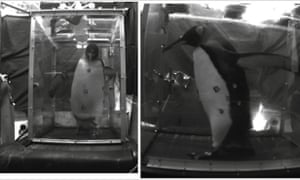
    
A University of London study using a treadmill shows that fat King penguins fall over more often than slim ones but carrying a bit of extra weight comes with an important advantage when it comes to reproduction, the biomechanics researchers say.
Fat king penguins are unsteady on their feet while waddling compared to their slimmer counterparts, making them an easier catch for predators (or pesky scientists).
A UK research team discovered this by simply travelling to the subantarctic region of Antarctica, catching 10 male king penguins and putting them on a treadmill. Okay, it wasn’t quite as simple as that but it does mean we can watch penguins on a treadmill.
The team, led by Astrid Willener from the University of Roehampton, was studying the biomechanics of the waddle of the king penguin, which can grow up to 1m tall and up to 16kg, making it the second largest species of penguin behind the emperor.
They captured 10 males who were in courtship and weighed more than 12kg near the shoreline at the edge of a colony. The penguins, serial monogamists, have the longest breeding cycle of all the penguin species – 14 to 16 months – and produce just one chick per cycle. Anyone who has seen March of the Penguins knows that caring for a penguin egg requires enduring an intensely long fast, so it’s crucial that parents have enough fat to keep them going.
The captured penguins, who were kept beside the colony for two weeks, received two training sessions of 10 minutes to get used to walking on the treadmill. Then they were filmed at a speed of 1.4km/hr before and after a 14-day fast (fasting for periods of up to one month is normal for king penguins and researchers checked the critical body mass of the birds to be sure that they were not losing body mass too fast during the study).
The posture – leaning and waddling – of the penguins while walking was then determined by the researchers. To quantify the waddling, the amplitude of peak left and right leaning was calculated.
It wasn’t all simple though. Some of the penguins – the larger individuals – found ways to cheat the system.
“ Sometimes the penguins were lazy and ‘water-skied’ on the treadmill by leaning their back on the back wall of the treadmill. That is obviously not good for the data collection,” Willener told the Guardian.
In the end the researchers found that although the penguins waddled with more agility at a lower weight, they had nonetheless adapted well to be able to handle waddling while heavier, even if they were not as efficient and less stable.
And packing on the pounds did give the big guys an important advantage when it comes to reproduction, the study, which was in the online journal PLoS One, found.
“The weight gain is an adaptive mechanism for them to survive their fast while reproducing and taking care of the egg,” said Willener. “But it is a trade-off between putting on weight to fast longer, in case there is a delay in finding a penguin partner to mate with, and still being able to walk, because if they can’t walk steady, they fall and will be spotted and eaten alive by predators.” Luckily walking isn’t their primary travel mode.
Willener hopes the findings will help in efforts to better understand, and protect the species.
The scientists were careful to point out that the video of its chubby penguin has been sped up, so it appears to be running faster than it did in reality. And, they clarify, no penguins were pushed over during the process.
So, you get to watch penguins on a treadmill and relax in the knowledge that it’s not only humans who put on weight when they have got a new girlfriend.

A view of the Milky Way like you have never seen before

  
Here’s a view of the Milky Way galaxy like you’ve never seen before.
https://youtu.be/Ip3YHk0gu0I   This video takes a close look at a new image of the Milky Way released to mark the completion of the APEX Telescope Large Area Survey of the Galaxy.
The Atacama Pathfinder Experiment telescope in Chile (APEX for short) captured this super-panoramic image of our home galaxy, mapping the full view of the galactic plane as seen from the Southern Hemisphere in unprecedented detail.
The 40-foot telescope views the sky in sub-millimeter wavelengths, which are between infrared light and radio waves and are invisible to the eye. That allows astronomers to observe the coldest regions of the universe, where gas and dust are only a few tens of degrees above absolute zero, as well as the regions where stars are born.
In the image, the APEX telescope’s observations appear in red, with some data from theEuropean Space Agency’s Planck satellite in fainter red. The blue parts of the image show shorter infrared light captured by NASA’s Spitzer Space Telescope.
The European Southern Observatory released the map to celebrate the completion of the APEX Telescope Large Area Survey of the Galaxy project. The image spans an area of sky 140 degrees long by 3 degrees wide — four times larger than the project’s first map.  

Monday, June 23, 2014

Donie's Ireland daily news BLOG Sunday

Alex White says it’s time to tell the IMF that ‘enough is enough’


Alex White says if he is elected the next leader of the Labour party there will be no more “adjustment” of €2 billion or anything close to it.

“ENOUGH IS ENOUGH”. That is the message Labour leader hopeful Alex White was conveying today at the Labour Party leadership hustings in Portlaoise.
The hustings:
The Minister for State at the Department of Health was scathing in his speech about the IMF saying that earlier this week “we were treated to another lecture in fiscal orthodoxy by our friends at the IMF in Washington”.
He added:
“We were told once again that we should take 2 billion out of our economy in the 2015 budget. In the rarified world of the IMF this counts as a ‘fiscal adjustment’. Those of us who live in this country know the reality behind those anodyne words.”
White said that a €2 billion “adjustment” means more cuts in public services, more taxes and charges for Irish people and more suffering and distress.
He told the crowd in no uncertain terms that if he is to be elected the next leader of the Labour Party, they will take no more “sanctimonious lectures” from the IMF.
“Let me be clear about this once again. If I am elected as leader of this Party there will be no more “adjustment” of €2 billion or anything close to it,” he said, adding:
Enough is enough.
“It would be better – much better – if the IMF were to give us some real assistance rather than sanctimonious lectures. And they could start with the excessive interest rates they are currently charging,” said White.
Speaking about the beating that Labour got in the local elections, White said the party suffered a “bruising” a few weeks ago.
He said the party should not assume that the numbers they lost in the local elections will return to them, stating that the “stark truth” is that they will only come back to Labour if they respond appropriately to the message the electorate gave them in May.
The message was stark, very stark. Quite simply they told us to: Change, or move off the stage.
He goes on to say that we need to change our message; we need to change the way we do things; we need to change the image we present to the electorate.That process of change will take time. It will not happen overnight.
But we have the opportunity to start that process of change when we elect a new leader on 4 July next.

Bank of Ireland returns to property development lending


BANK OF IRELAND’S RICHIE BOUCHER HAD SOME FARM TIME IN CORRIN MART LAST WEEK.

BANK of Ireland has plunged back into real estate development and construction lending, bulking up its property finance team and signing up to fund another multi-million build in Dublin city centre.
The Richie Boucher-led bank has agreed to partly fund US private equity firm Kennedy Wilson’s development of 164 homes at Clancy Quay in Dublin 8. Kennedy Wilson recently submitted planning proposals for the site, which sits on 5.2 acres on the south bank of the Liffey in an area where rents have rocketed over the past year. Approval is being sought for a mix of apartments and houses. The scheme already has 420 units but its completion was stalled by the credit crisis.
The bank lost billions on property lending when the global financial crisis hit in 2008, but has been persuaded back to the market after years of eschewing deals by spiralling demand for homes and commercial offices evident in Dublin, Galway and Cork.
Bank of Ireland has now funded at least six major property projects in the last 12 months, including the recent refinancing of €150m worth of short-term debt for the development of offices at Central Park. This is the first ever bank loan received by Green Reit, UK property guru Stephen Vernon’s real estate trust which owns 50pc of the Central Park site.
Other projects financed or part-financed by Bank of Ireland include the €22.5m construction of 192 student dorms at the former Montrose Hotel opposite UCD’s campus, the €16m redevelopment of the Burlington Hotel into a Hilton, and Kennedy Wilson’s acquisition of the 200-year-old Shelbourne Hotel through the acquisition of €111m loans connected to a consortium of developers led by Bernard McNamara.
The lender has also diverted staff from other activities to its property finance team in recent weeks, a spokesperson confirmed. The division is led by Paul McDonnell, who having held that role since 2006, has overseen lending to construction projects through both boom and bust.
Bank of Ireland is distinct from its peers in returning wholeheartedly to property lending. Permanent TSB and AIB have been far more cautious, sources said.
“Bank of Ireland is that little bit more aggressive, they got out of the traps first,” said Marie Hunt, head of research at CBRE. Barclays is also lending for construction purposes, she said.
But the norms for bank lending to property projects have changed, she added.
“They’re much more cautious than they were. The terms that were offered in the days of the Celtic Tiger are long gone. It’s now the norm to ask developers to provide 40pc of the money required.”
Bank of Ireland chief Richie Boucher confirmed that the high stake of equity it expects developers to contribute was an issue to construction lending when he appeared before the Oireachtas Joint Committee on Jobs, Enterprise and Innovation in April.
An influx of international banks and private equity fianciers also poses a challenge, Ms Hunt added.
“Domestic banks face more competition on property finance deals than ever before,” she said. “The likes of Deutsche Bank and Morgan Stanley are very keen to get involved in Irish property at the moment. But this also presents opportunities for Irish banks – we are seeing lots of consortiums coming together to lend. The overseas guys have the equity and the money but not the local expertise, so they’re looking for Irish partners.”

Thousands prosecuted over scrap metal theft in Ireland last year


Over 5,000 people have been prosecuted in 2013 over the theft of scrap metal – including from railway tracks and telecom masts – the government has claimed.

The Dail heard yesterday that lives are being put at risk by a spate of thefts from businesses.
Junior Minister Paschal Donohoe said it is important to recognise that gardai have brought charges against over 5,000 people involved in scrap metal theft in 2014.
He was speaking during a debate on a bill to regulate the scrap metal industry,
Labour TD for Dublin South East Kevin Humphreys said that the theft of scrap metal in Dublin had damaged the city’s reputation. He said the thefts had also done damage to peoples’ homes and had created the “possible loss of life”.
Independent TD Mattie McGrath, who proposed the bill, said thefts are causing havoc in rural communities.
Mr McGrath’s bill, a similar version of which was rejected in 2012, proposes stricter controls on the sale of precious metals but Mr McGrath’s bill was defeated following a vote in the Dail.

Football reduces women’s blood pressure

  
Despite Ireland’s failure to reach this year’s World Cup in Brazil, the tournament is still attracting a large TV audience. However, a new study has found that actually getting out and playing football may help lower blood pressure in women aged between 35 and 50.
According to the findings, women in this age group with mild high blood pressure who played recreational football over a 15-week period recorded a significant reduction in their blood pressure readings and their levels of body fat.
The women, none of whom had received training in football prior to this, played one hour sessions, three times a week, for 15 weeks.
“After 15 weeks of participation in recreational football, systolic and diastolic blood pressure had fallen by 12 and 6 millimetres of mercury (mmHg) and the women had lost 2.3 kg (5lbs) of fat on average. The football training produced an impressive reduction in blood pressure that was more than twice as big as with swimming performed over the same period as the football,” the researchers said.
The study also noted that the women enjoyed playing the game even if they had never played before.
“The players faithfully attended training, with an attendance rate of over 90%. In fact, through the project period they came to enjoy playing so much that they have now started up their own football club,” the researchers noted.
They pointed out that previous studies they have undertaken have found that football training reduces blood pressure in women aged between 20 and 45 with normal blood pressure, ‘but this is the first study that has looked at the effects of recreational football in women with high blood pressure’.
“As well as the impressive effects on blood pressure and body composition, we also saw a drop in cholesterol and a big improvement in physical fitness as a result of the 15 weeks of football training. In fact, the women were able to run more than twice as far in an endurance test and their heart rate was 14 beats per minute lower when working at moderate intensity,” the researchers said.
They concluded that recreational football ‘is an effective therapy for poor fitness and high blood pressure in 35‒50-year-old women’.

Emperor Penguin now adapting to the climate change

A STUDY SUGGESTS

  
Emperor penguins have shown to be not as attached to their nesting locations as previously thought, meaning that they could adapt much easier to their changing environment, which is being affected by rising global temperatures.
A new study by the University of Minnesota has observed penguins’ movements over the nesting period and found a new colony on the Antarctic Peninsula, which is believed to have relocated.
Researchers involved in the new study found six instances in just three years in which emperor penguins did not return to the same location to breed. They also report on one newly discovered colony on the Antarctic Peninsula that may represent the relocation of penguins.
University of Minnesota College of Science and Engineering researcher and the study’s lead author Michelle LaRue shared her findings at the IDEACITY conference in Toronto on June 20. The study will also be published in an upcoming issue of Ecography, a professional journal publishing research in spatial ecology, macroecology and biogeography.
“Our research showing that colonies seem to appear and disappear throughout the years challenges behaviors we thought we understood about emperor penguins,” said LaRue. “If we assume that these birds come back to the same locations every year, without fail, these new colonies we see on satellite images wouldn’t make any sense.
These birds didn’t just appear out of thin air—they had to have come from somewhere else. This suggests that emperor penguins move among colonies. That means we need to revisit how we interpret population changes and the causes of those changes.”
Emperor penguins are a well-studied species and have recently been elevated to celebrity status with movies like “Happy Feet” and the documentary “March of the Penguins.”
The “March of the Penguins” colony is called Pointe Géologie and it’s been studied for more than 60 years. Researchers observe the colony every year and look, in particular, for birds that have been banded by researchers to return to the colony. In recent decades researchers have been concerned about how receding sea ice may affect the emperor penguins that breed on it.
Over five years in the late 1970s, the Southern Ocean warmed and at the same time the penguin colony at Pointe Géologie, declined by half (6,000 breeding pairs to 3,000 breeding pairs). The decline was thought to be due to decreased survival rates. In other words, researchers thought that the warming temperatures were negatively impacting the survival of the species.
High-resolution satellite imagery has changed all that because now researchers can see the entire coastline and all the sea ice. Because emperor penguins are the only species out on the sea ice, they can look at images and identify their presence through the telltale sign—their guano stain. Before satellite images, researchers thought Pointe Géologie was isolated and there was nowhere else for the penguins to go. The satellite images show that Pointe Géologie is not isolated at all. Plenty of colonies are within easy travel distance for an emperor penguin.
“It’s possible that birds have moved away from Pointe Géologie to these other spots and that means that maybe those banded birds didn’t die,” LaRue said. “If we want to accurately conserve the species, we really need to know the basics. We’ve just learned something unexpected, and we should rethink how we interpret colony fluctuations.” 

Sunday, January 12, 2014

Donie's Ireland daily news BLOG Saturday

Bank documents now missing ahead of Irish Banking inquiry????  Whats next??


Material relates to communication between Bank of Ireland governor and a tax adviser?

Sinn Féin has said “key” documents relating to the bank guarantee have gone missing from the Department of Finance in the build-up to a banking inquiry.
Party finance spokesperson Pearse Doherty TD said he became aware of the absence of the records following a request under the Freedom of Information Act.
The material in question relates to two letters from 2009 between the Bank of Ireland governor and a named tax adviser which had been copied to late minister for finance Brian Lenihan.
Their exact significance was not clear last night.
However Mr Doherty said: “These are some of the only documents between the governor of the Bank of Ireland and the minister for finance during a period when the government decided to pump €3.5 billion of taxpayers’ money into that bank.
“I have now been informed that these letters have gone missing from the Department of Finance.”
Mr Doherty also said the development lent further weight to previous comments made in the Dáil by Taoiseach Enda Kenny with regard to documents having gone missing. “He said they have either been shredded disposed or dispatched of,” Mr Doherty said.
“This new revelation compounds that criticism. Once again, key documents in relation to the bank guarantee cannot be found after Fianna Fáil have left office.
‘Sensitive documents’“The only reason we know that these documents are missing is because two separate FoIs were made on the same document over a four-year period. The question has to be asked about what other sensitive documents have gone missing. The reality is that we may never know. If the upcoming banking inquiry is to be successful, it is important that all relevant documents are found or returned.”
In a statement to RTE last night, the Department of Finance said it had conducted a widespread search for the documents and it was not clear why they could not be located.

A €126m plan for Galway harbour should create some 800 jobs  

BUT EUROPE MUST GIVE GREEN LIGHT

 
A computer-generated image above left of the Galway harbour plan, which would give a boost to trade and tourism in the West.

A major €126m redevelopment of Galway Harbour, which would open up trade and tourism routes to the West, will create up to 800 new jobs, according to developers.

The planning application for the venture, which is the first in the country to use the ‘IROPI’ route, must be green-lighted by Europe because it is being built into a designated European habitat.
The IROPI clause in contained in the EU Habitats Directive and states that projects which may have a negative environmental impact may still proceed for reasons of ‘Imperative Reasons of Overriding Public Interest’.
Eamon Bradshaw, CEO of Galway Harbour Company, said they were confident the project would be given the green light because it had been open about the impact it will have.
“We are putting up our hands and saying at the very beginning yes we will have an impact on the habitat and we’re acknowledging that. And that’s what is different from other planning applications,” he said.
Mr Bradshaw said the group had liaised closely with European Commissionofficials on the plans and also brought people from Hull Port, which has previously gone through the process, to Galway to examine the site.
If the plans are green-lighted the Galway Harbour Company must put forward a compensatory habitat. A number of alternative sites and separate compensatory measures are now being looked at.
The plans for a 27-hectare extension include a 216-berth marina, a 12-metre deep commercial quay, deep sea berthing suitable for cruise liners and a nautical centre.
A cruise and coach terminal will also be included.
If given the green light, the expansion project will be carried out in four stages, with construction on the first stage due to begin next year at a cost of €52m.
The planning application will go live on January 20, with a final decision expected in around six months.

Working mothers are the real heroes of this world says Kate Winslet


Working mothers are “real heroes”, the actress Kate Winslet has said, as she discloses she spurns outside help with her children because it would make her unhappy.

Winslet, who has recently had her third child, said she chooses not to have “lots of people who do the cooking, the driving, all that jazz”.
She told Glamour magazine she would not want her children “raised that way”, as she praises mothers who work full time as “heroes”.
Winslet, who recently played single mother Adele in film Labor Day, said the character had a lot of strength to be able to function despite her sadness.
She told the magazine the role had showed her that women from all walks of life are able to “just pull it together because you have to”.
“Mothers who work full time – they’re the real heroes,” she said.
When asked about her life, which she described as “little” when away from the cameras, she added she “trundles along”, having friends over and making dinner.
“It’s weird because the two worlds are so different: from fishmongers to tea to film sets. But that’s the case for any actress who’s a mother.
“Sure, I could have lots of people who do the cooking, the driving, all that jazz – but I would be unhappy.
“I wouldn’t want my children raised that way.”

Console London based Charity says 600 Irish people at risk of suicide in UK 

An Irish suicide charity’s helpline in Britain last month received 600 calls from Irish immigrants who it deemed to be of “immediate risk” of taking their own lives.

Of the further 1,600 calls that Console’s newly formed London centre received last month, 1,100 were from people deemed to be at “low or moderate risk” of suicide and 500 from family members still in Ireland who were concerned about the welfare of their loved one living in Britain.

Paul Kelly, who founded Console here 11 years ago, said the majority of those deemed to be of immediate risk of taking their own lives and who contacted the Westminster centre from across Britain, were young adults aged 18 to their early 30s, particularly young men.
Mr Kelly said a number of factors had lead to the people reaching such a low ebb. He said many had travelled to Britain full of hope for a future where they could secure work and build a new life.
However, he said many, particularly from rural backgrounds, had found themselves unprepared for numerous factors including a lack of work there and the high cost of accommodation. That had led some to suffer from mental health problems such as depression but they did not know where to turn for help.
“They said things like they felt disconnected, suffering from loneliness and isolation. That led some to enter into a state of despair. They felt they had let themselves and their families down,” he said.
Mr Kelly also made reference to the large number of calls which came from Ireland to the Westminster centre from family members of people living in Britain.
He said many were from mothers and girlfriends of people about their sons and boyfriends who were struggling but who had great difficulty in expressing what they were going through.
As is the case in Ireland, the people receiving the calls in the year-old Westminster centre are trained mental health professionals.
Mr Kelly said there was a good news story to come out of the Irish charity’s operation in Britain as, in only the last 12 months, it has even managed to attract the attention of the NHS which has sought its advice on training programmes for those dealing with suicide and bereavement.
Meanwhile, St Patrick’s Mental Health Support Service says it had 2,510 calls for support in 2013 — 29% more than in 2012. Email contacts rose 46% to 1,450.
Its figures for 2013 showed a significant rise in calls relating to depression: 572 in 2013 compared to 382 in 2012. It also said the number of female callers (1,846) almost tripled that of their male counterparts (664) in 2013.
Tom Maher, director of Clinical Services at St Patrick’s said: “It’s encouraging to see the substantial increase in mental health queries to the St Patrick’s Support Service during 2013. It’s a sign that we are getting better at talking about our mental health”
* St Patrick’s Mental Health Support Service: 9am to 5pm Monday to Friday with an answering and call-back facility outside hours. 01 249 3333, or email info@stpatsmail.com
* Console: 1800 201 890

Cork student develops new software that adds to what search engines can do


Caelen Feller's code modifies what the engine is doing to deliver an enhanced service. 

15-year-old Caelen Feller developed software that looks to improve search engines
We all use search engines when surfing the internet, but few of us know what these engines do. Caelen Feller knows, and also knows how to improve them.
The 15-year-old transition-year student from Coláiste Choilm, Cork, developed software that adds to what search engines do, and he presented his research at RDS.
It took him a month and a half to produce the software code to achieve it but his code convinced 158 people that they had an improved experience with better searches.
“I investigated ways to improve web searches with a focus on news,” Caelen said.
He wanted to be able to tailor the browsing experience for the user with changes that would give more power to the user.
The primary search engine remains functioning behind, but Caelen’s code modifies what the engine is doing to deliver an enhanced service.
Rory Flynn, a 17-year-old fifth year from Newbridge College, Kildare, also wanted to improve a service for users.
“Data compression is used every day on websites to speed up movement of pages,” he says.
It is based on using mathematical algorithms to crunch down the data to speed up transmission and then un-crunching it when it arrives on screen.
Most of the algorithms used today were written in the 1980s and 1990s however, and Rory wanted to develop a new one.
While he achieved his aim, he found his compression algorithm did not perform as well as competitor systems.
It achieved less compression and was slower, but it is “lossless” and can reconstitute data without loss of quality or clarity, he says.

Penguins climbing walls of Ice as Antarctic ice layers becomes very thin


EMPEROR PENGUINS ENDURE FORCED MARCHES, AWKWARD MATING RITUALS, BLISTERING COLD AND THE POSSIBILITY THAT ALL THESE INDIGNITIES WILL BE EXPOSED BY DAVID ATTENBOROUGH.

Yet life for at least some of these birds has become even harder. Satellite and aerial reconnaissance by the British Antarctic Survey shows that four colonies of emperors have been forced to forgo the usual sea-ice breeding grounds and repair to firmer ice shelves that jut from the continent.
The shift, apparently caused by a lack of sea ice in warmer promontories of Antarctica, appears to be forcing thousands of birds to surmount walls of ice up to 30m high. The scientists are not clear on how they manage this.
They speculate that a colony of birds spotted near the edge of an ice shelf on Barrier Bay may have ascended through a gully a few kilometres from their breeding ground.
A colony of breeding birds on the Shackleton Ice Shelf also appeared to have made the uphill journey via a shallower route along ice creeks, although it was not clear how they managed to get down afterwards.
 “On the way out, they negotiate a large ice cliff,” the scientists write in the journal PLOS ONE. “The drop may be considerable, although there is evidence of large snow drifts abutting the cliff … How the emperor penguins get down the ice cliff is … unclear.”
Peter Fretwell, a geographer at the British Antarctic Survey, said it was possible they were sliding down the cliff, their fall cushioned by the drifts. “We usually imagine emperor penguins to be quite clumsy,” he said. “We don’t think they can climb up the shelves.”
The birds’ predicament – and potential agility – carried uncanny echoes of the 2011 animated film Happy Feet Two, a work of fiction not hitherto thought to contain particularly accurate observations on the lives of emperor penguins.
Dr Fretwell said he had not seen the movie, and thus could not comment on whether it would now be regarded as prophetic in the annals of Antarctic research.
The study concludes that in at least two cases, colonies of emperors may be choosing to forsake the sea ice in years when it becomes too thin – adaptive behaviour that could stand them in good stead if the Antarctic begins to warm, as predicted by scientists. “The Arctic has warmed, the Antarctic hasn’t yet,” Dr Fretwell said.
Emperor penguins were akin to the canary in the coalmine of Antarctic warming – the disappearance of sea ice was expected to endanger the species. If the birds were able to climb on to ice shelves, they might have a stronger chance of surviving in greater numbers.
“It’s not going to be a silver bullet for the emperor penguins,” said Dr Fretwell. “Ice shelves are more exposed in winter, they are farther from their feeding grounds. There are disadvantages as well.”
He said that none of the sites had been visited, not even by Sir David – although a plane had flown over two of them to take more photographs of the habitat.
Dr Fretwell and his three co-authors are uncertain how long the four colonies have been breeding on these loftier spots, formed by the ice of glaciers flowing off the continent. “It is unclear at present whether this behaviour of breeding on ice shelves is a new phenomenon associated with recent climate change or one that has always existed but has not yet been documented,