Pages

Showing posts with label property tax. Show all posts

Saturday, February 27, 2016

Donie's Ireland daily news BLOG

An Irish Times exit poll shows Coalition are well short of overall majority

SIGNIFICANT RECOVERY FOR FIANNA FÁIL AND GAINS FOR SINN FÉIN AND SMALLER PARTIES, IPSOS MRBI SURVEY FINDS


THE COALITION PARTIES HAVE FALLEN FAR SHORT OF AN OVERALL MAJORITY IN THE NEXT DÁIL, ACCORDING TO AN EXIT POLL CONDUCTED FOR THE IRISH TIMES BY IPSOS, MRBI.

Fine Gael support has slumped from 36.1% in the last general election to only 26.1% a far worse result than the party anticipated at any stage of the campaign.
The poll indicates the Labour Party received just under 8% support, far behind the 19.5% it achieved at the 2011 general election.
The Coalition parties did not benefit from a swing in the final days of the campaign, according to the poll..
Fianna Fáil appears to have made a significant recovery since the last election and is could almost double its number of Dáil seats.
Support for Sinn Féin has increased since 2011. There are also big gains for Independents and smaller parties.
The poll indicates the parties’ vote shares to be: Fine Gael 26.1%; Labour 7.8%; Fianna Fáil 22.9%; Sinn Féin 14.9%; AAA-PBP 3.6%; Greens 3.5%; Social Democrats 2.8%; Renua 2.6%; and Independents 16.1%.
At the last general election in 2011, Fianna Fáil took 17% of the first preference vote and Sinn Féin 10%.
In Dublin, Fine Gael has emerged as the largest party with 25.7% of the vote, followed by Sinn Féin with 15.4%, according to the poll. Fianna Fáil is on 14.6%, Labour 9.4% and others received 34.9%.
The 2016 General Election Exit Poll was conducted exclusively on behalf of The Irish Times by Ipsos MRBI, among a national sample of 5,260 voters at 200 polling stations throughout all constituencies in the Republic of Ireland.
Voters were randomly selected to self-complete a mock ballot paper on exiting the polling station. The accuracy level is estimated to be approximately plus or minus 1.2%.
If the final result is close to the exit poll predictions, the Fine Gael/-Labour Coalition will be far short of the numbers required to form a majority government.
Prediction
The complexity of the single transferrable vote system makes it difficult to provide an accurate prediction of the number of seats which will be won by the various parties .
At the last election Fine Gael got a seat bonus of 10%. In the unlikely event of a similar seat bonus this time, it would end up with 56 seats. But a more likely seat bonus of 5% would give the party 50 seats. The new Dáil has 158 seats, eight fewer than in the last one.
It is even more difficult to predict the number of seats the Labour Party will win if it takes just under 8% of the vote. It is likely to be in the range of eight to 12.
One thing that could benefit the party is that the poll indicates very strong transfers from Fine Gael to Labour.
Fianna Fáil, on 23%, should come close to, or even surpass, its target of 40 seats, which would represent a remarkable achievement for party leader Micheál Martin.
Sinn Féin on 14.9% also looks like it could make reasonable gains. Even with no seat bonus, the party should be able to break into the 20s range.
At the dissolution of the last Dáil, Fine Gael had 67 seats, Labour 33, Fianna Fáil 21 and Sinn Féin 14.
Disappointment
The strong performance of smaller parties and Independents confirms the trend evidenced in The Irish Times polls going back over the past 18 months.
The poll results will come as a severe disappointment for both Government parties even though they are very close to the figures they have been getting inIrish Times polls for the past year or so.
The expectation in the Coalition parties was that they would gain support as the election got closer and voters weighed up the merits of stability versus change.
That message did not resonate with the voters and the outcome will generate uncertainty about who can form the next government.
The turnout in the election appears to be down on the 70% figure achieved in 2011. Party sources estimated it might be about 65%.
Turnout was described as “uneven” in the run-up to the polls closing, with politicians claiming many people were still undecided up to the last moment.
The counting of votes begins at 9am today, with the first counts expected to be announced in the late afternoon.

Property tax take should rise with house prices

THE EU SAYS

Bailout reforms deemed not enough to remedy all problems resulting from crash
    
The European Commission report said potential new entrants into the mortgage market were probably deterred by the still-high level of non-performing loans and issues with access to property collateral underlying home loans.
The European Commission has strongly criticised the Government’s decision to suspend property tax revaluations, as it underlines a litany of vulnerabilities in the recovering Irish economy.
In an 85-page report published at 10pm yesterday – just as polling closed in the general election – the EU executive also suggested the property tax could be extended to non-agricultural land.
After an election campaign dominated by debate on promised cuts on taxes on income, the commission’s report said the tax wedge on labour in Ireland – the amount taken in taxation – was second-lowest in the EU. Revenue from VAT was also low compared to other member states, it added.
Non-performing loans
Turning to high variable-rate mortgage charges, the report said potential new entrants into the mortgage market were probably deterred by the still-high level of non-performing loans and issues with access to property collateral underlying home loans.
The report on Ireland, which is a regular assessment published each February, said reforms undertaken in the bailout programme had not been sufficient to tackle all the legacy issues from the crash.
“These issues continue to represent vulnerabilities and imbalances that affect the economy, hinder Ireland’s investment potential and pose challenges to macroeconomic policymaking,” it said.
These observations were made even as the commission said Ireland’s “remarkable” economic rebound had broadened and gained momentum in the last two years.
In relation to the property tax, the commission said the yield remained below the EU average.
“A revaluation of self-assessed property values used to calculate local property tax liabilities was initially planned for 2016, but has been delayed by three years to November 2019,” it said.
“This decision represents a lost opportunity to broaden the tax base as residential property prices have increased substantially since the first self-assessment in 2013.”
An increase in the share of revenue from the property tax would reduce the cyclical sensitivity of government revenues and encourage more efficient allocation of land resources, the commission said.
Housing supply
“Extending the coverage to adjacent non-agricultural land would broaden the tax base and improve the efficiency of land use. The latter point may pertinent given current housing supply constraints,” it added.
On housing, the report said demand exceeds supply by a wide margin in major urban areas.
Vulnerabilities persist as Ireland’s debt-to-GDP ratio remained high, it said. While financial sector vulnerabilities were in decline, profitability remained weak. Capital positions were sound but challenges remain as banks adapt to new prudential rules.
“Non-performing loans fell further with the recovery but the ratio remains among the highest in the euro area.”
Unemployment had fallen below the EU average but long-term unemployment and the low work intensity of households remained a matter of concern, the commission said.
“Overall, the welfare system has worked well to contain the effects of the crisis on poverty and inequality, but barriers to inclusive growth remain.
“In particular, concerns persist about inactivity traps for certain households, the high proportion of people living in households with very low work intensity, child poverty and the lack of access to affordable, full time and quality childcare.”

Dunne’s Stores acquisition of meat businesses cleared by competition authority


TIPPERARY BUTCHER PAT WHLEAN (CENTRE PHOTO), OF JAMES WHELAN BUTCHERS IN CLONMEL.

The deal first notified to the Consumer & Competition authority in January has been cleared to go ahead.
Dunnes Stores acquisition of two meat wholesale businesses, Whelan Food & Meat Processors Ltd and Tipperary Sustainable Food Company Ltd, has been cleared by the Competition & Consumer Authority. The proposed deal was first notified to the competition authority just over a month ago.
The meat wholesale businesses that Dunnes has acquired are owned by well-known Tipperary butcher Pat Whelan. The transaction is only for the two wholesale businesses and not the chain of well-known butcher stores operated by Whelan.
Both businesses are located in Co Tipperary and described as operating in the retail sale of meat and related products. The deal is private, with no figures disclosed.
Fifth generation
Whelan Food & Meat Processors was established in 2001 with an address at Clonmel, Co Tipperary. The second business, Tipperary Sustainable Food Company Ltd, was set up in 2008 and also has an address in Clonmel.
The latest accounts filed for Tipperary Sustainable Food Company show the business made profits of more than €280,000 in 2014.
Pat Whelan, a director of both businesses, is a fifth-generation butcher who also operates a chain of high-end butcher stores in Rathcoole and Monkstown in Dublin, Kilmacanogue near Bray in Wicklow, and Clonmel in Co Tipperary. This chain of butcher stores is not part of the deal.
Whelan Butchers and its beef dripping product were winners of the supreme award for the best food product in the UK and Ireland at the 2015 Guild of Fine Food Awards in London.
Dunnes Stores primary supplier of meat is Martin Jennings Wholesale in Co Mayo.

Penguins on a treadmill: what can we learn from the study?

STUDY FINDS FAT PENGUINS FALL OVER MORE THAN SLIMMER PENGUINS. AND THEY CHEAT
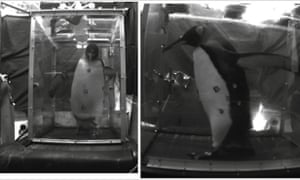
    
A University of London study using a treadmill shows that fat King penguins fall over more often than slim ones but carrying a bit of extra weight comes with an important advantage when it comes to reproduction, the biomechanics researchers say.
Fat king penguins are unsteady on their feet while waddling compared to their slimmer counterparts, making them an easier catch for predators (or pesky scientists).
A UK research team discovered this by simply travelling to the subantarctic region of Antarctica, catching 10 male king penguins and putting them on a treadmill. Okay, it wasn’t quite as simple as that but it does mean we can watch penguins on a treadmill.
The team, led by Astrid Willener from the University of Roehampton, was studying the biomechanics of the waddle of the king penguin, which can grow up to 1m tall and up to 16kg, making it the second largest species of penguin behind the emperor.
They captured 10 males who were in courtship and weighed more than 12kg near the shoreline at the edge of a colony. The penguins, serial monogamists, have the longest breeding cycle of all the penguin species – 14 to 16 months – and produce just one chick per cycle. Anyone who has seen March of the Penguins knows that caring for a penguin egg requires enduring an intensely long fast, so it’s crucial that parents have enough fat to keep them going.
The captured penguins, who were kept beside the colony for two weeks, received two training sessions of 10 minutes to get used to walking on the treadmill. Then they were filmed at a speed of 1.4km/hr before and after a 14-day fast (fasting for periods of up to one month is normal for king penguins and researchers checked the critical body mass of the birds to be sure that they were not losing body mass too fast during the study).
The posture – leaning and waddling – of the penguins while walking was then determined by the researchers. To quantify the waddling, the amplitude of peak left and right leaning was calculated.
It wasn’t all simple though. Some of the penguins – the larger individuals – found ways to cheat the system.
“ Sometimes the penguins were lazy and ‘water-skied’ on the treadmill by leaning their back on the back wall of the treadmill. That is obviously not good for the data collection,” Willener told the Guardian.
In the end the researchers found that although the penguins waddled with more agility at a lower weight, they had nonetheless adapted well to be able to handle waddling while heavier, even if they were not as efficient and less stable.
And packing on the pounds did give the big guys an important advantage when it comes to reproduction, the study, which was in the online journal PLoS One, found.
“The weight gain is an adaptive mechanism for them to survive their fast while reproducing and taking care of the egg,” said Willener. “But it is a trade-off between putting on weight to fast longer, in case there is a delay in finding a penguin partner to mate with, and still being able to walk, because if they can’t walk steady, they fall and will be spotted and eaten alive by predators.” Luckily walking isn’t their primary travel mode.
Willener hopes the findings will help in efforts to better understand, and protect the species.
The scientists were careful to point out that the video of its chubby penguin has been sped up, so it appears to be running faster than it did in reality. And, they clarify, no penguins were pushed over during the process.
So, you get to watch penguins on a treadmill and relax in the knowledge that it’s not only humans who put on weight when they have got a new girlfriend.

A view of the Milky Way like you have never seen before

  
Here’s a view of the Milky Way galaxy like you’ve never seen before.
https://youtu.be/Ip3YHk0gu0I   This video takes a close look at a new image of the Milky Way released to mark the completion of the APEX Telescope Large Area Survey of the Galaxy.
The Atacama Pathfinder Experiment telescope in Chile (APEX for short) captured this super-panoramic image of our home galaxy, mapping the full view of the galactic plane as seen from the Southern Hemisphere in unprecedented detail.
The 40-foot telescope views the sky in sub-millimeter wavelengths, which are between infrared light and radio waves and are invisible to the eye. That allows astronomers to observe the coldest regions of the universe, where gas and dust are only a few tens of degrees above absolute zero, as well as the regions where stars are born.
In the image, the APEX telescope’s observations appear in red, with some data from theEuropean Space Agency’s Planck satellite in fainter red. The blue parts of the image show shorter infrared light captured by NASA’s Spitzer Space Telescope.
The European Southern Observatory released the map to celebrate the completion of the APEX Telescope Large Area Survey of the Galaxy project. The image spans an area of sky 140 degrees long by 3 degrees wide — four times larger than the project’s first map.  

Wednesday, November 25, 2015

Donie's Ireland daily news BLOG

Ireland’s economic issues have brought a huge social cost says M.D. Higgins

President criticises “arrogant assumption” that growth can be perpetual and sustainable


President Michael D Higgins next to UN Conference on Trade and Development Secretary-General Mukhisa Kituyi in Geneva.

President Michael D Higgins has criticised the “arrogant assumption” that economic expansion can be perpetual and sustainable, and called instead for fresh thinking and new institutions that reflect the growing global challenges on climate and economics.
Mr Higgins told the 10th debt management meeting of the UN Conference on Trade and Development (UNCTAD) that Ireland’s recent experiences, while largely specific to our system, had come with a “huge social cost” and had triggered a “welcome debate” on such issues.
Drawing a line from Geneva to the climate talks in Paris and back to the recent New York agreement on sustainable development goals, Mr Higgins said our “vulnerable planet” was at a “crucial juncture” in 2015.
Tackling these disparate, yet interlinked challenges required addressing their common failing, he said: that the old model – of extracting and consuming resources, or prioritising debt repayments over basic social needs – posed a threat to the environment and social cohesion and was no longer fit for purpose.
“That such a version of our lives together could, or should, be made available across all spaces and cultures was an assumption that was in its origin, arrogant, and is today unsustainable,” he said in his keynote address to delegations from more than 80 countries, in Geneva to discuss debt management and sustainable development matters.
In a wide-ranging address, Mr Higgins said the single globalisation model, with its “uncontested assumptions” had encouraged a blindness that historians will later highlight as the foundation of failure.
Mr Higgins asked rhetorically whether globalisation had given due attention to moral and social issues or merely cleared the way for an “unregulated free march of an expanding and increasing speculative, and not necessarily productive, capital?”
Global problems required a different universal agreement based on solutions that were not weighted to favour “vulture funds over social impact arguments”. This was a debate to which Ireland was interested in contributing, following its recent crisis experiences.
Ireland had learned of the need for sustainable public finances and Mr Higgins expressed hope that, having addressed structural deficiencies in the Irish economy, Ireland would now “put in place a sustainable recovery and repair the damage to our public services and institutions”.
Fundamental questions
As Ireland and the EU emerged from crisis, however, they faced fundamental democratic questions over the competence of member states to control their own finances.
“What we can see across Europe is a fundamental questioning of what the role of the State now is in such circumstances,” he said, witnessed by the socialisation of debt and widening social inequality.
“What were the old characteristics of the south [developing world] are now visible as inequality and poverty in ‘the south within the north’,” he said, “and elite accumulation in the south might be called ‘the north within the south’”.
Growing public awareness that these issues are interlinked, he said, was driving debate over a “social floor”: a collection of non-negotiable core social goods including adequate levels of food, health education, participation.
Only after all of these had been provided for could the “debt discourse” be allowed to begin, he said, and the market allowed in.
The debate over global economic development – in particular global debt – is an issue that affects us all, Mr Higgins said, and thus must move beyond the corridors of the IMF and World Bank.
Dr Mukhisa Kituyi, secretary general of the UN conference, thanked Mr Higgins for his “intellectual leadership over many years” and his “consistency of thinking outside the box”.
Eight years since the global financial crisis, Mr Kituyi warned, global debt had continued to balloon and unsustainable debt had once again become a threat to development gains.
“Unsustainable private debt has a habit of ending up on public sector balance sheets, a link not limited to developing country alone, as the example of Ireland shows,” he said.
Mr Higgins reiterated Ireland’s commitment to helping developing countries restructure their debt. Despite Ireland’s difficult domestic economic circumstances it had worked to ensure additional funds from debt relief were used on programmes that benefit the poor.
Refugees
Looking to France and Belgium, Mr Higgins urged for the careful use of words and images, a clear distinction between refugees fleeing terror and those causing the terror and a clear refusal to allow them to “dislodge” western achievements, such as universal human rights.
Mr Higgins warned against the long-term consequences of widespread intelligence collection and sharing, warning it risked “becoming something far more dangerous and destabilising” than intended at first.
“It is a time for care,” he said in Geneva. “We must co-operate with wisdom and we must be careful that the language we use gives us assurance rather than succour to those who want to engender destabilisation.”

Irish property tax to be frozen until 2019

The government hopes to pass new legislation by this Christmas.


The rate of local property tax (LPT) being paid by Ireland’s home owners is to be frozen until 2019 under legislation that the government hopes to pass by this Christmas.

It means that people whose properties have increased in price or have been improved will still pay the same rate of tax that they have since the original LPT valuations in 2013.
The freeze on property tax, which was confirmed in last month’s Budget by Finance Minister Michael Noonan, follows the recommendations of a report by former civil servant Dr Don Thornhill.
It had originally been envisaged that the May 2013 valuation of properties would be valid until 31 October 2016 when another round of valuations would take place to account for property price increases and home improvements.
“The postponement means that home owners will not be faced with increases in their LPT in 2017 as a result of increased property values,” a government spokesperson said.
The new legislation will also give effect to two other recommendations in the Thornhill report, including exempting homes damaged by pyrite and offering LPT reliefs on properties occupied by persons with disabilities.
The government said the other recommendations of the Thornhill report would be considered by the next administration.

Irish D-Day hero in tribute to Paris victims as France awards him highest honour


War veteran Henry John Alfred Place is bestowed with France’s highest honour by the French Ambassador to Ireland Jean-Pierre Thebault in Dublin.

An Irish D-Day hero has paid tribute to the Paris terror victims as he was awarded France’s highest honour for helping liberate the country during the Second World War.
Henry John Alfred Place, from Limerick, was seriously injured and had his leg amputated after coming under enemy fire at Caen on August 14, 1944.
His troop commander Lieutenant Edwin Crewe was killed in the attack.
Seventy years on, the 91-year-old veteran has been awarded the Legion d’Honneur – France’s top military medal – for his part in the action.
At a ceremony in the residence of the French Ambassador to Dublin Jean-Pierre Thebault, Mr Place used the occasion to pay an emotional homage to his former commander and the victims of the recent Paris atrocity.
“I want to acknowledge all the soldiers who fought for the freedom of France and Europe in World War II, in particular, my armoured car commander, Lieutenant Edwin Crewe, who unfortunately didn’t make it home,” he said.
“I offer my condolences to the people of France, especially those who lost relatives and friends, following the recent terror attacks in Paris.”
Mr Place was studying engineering at Trinity College Dublin when war broke out.
At the age of 18, in May 1942, he enlisted in the Royal Armoured Corps and was part of the landings in Normandy in July 1944 with the 53rd Reconnaissance Regiment.
On advance patrol in the south of Caen, one of Normandy’s largest cities and a key military target during the Allied advance, his armoured car was hit by German fire.
During the ensuing gunfight he was badly injured, leaving him in hospital for some time before being discharged from the army in December 1945.
After the war, Mr Place worked for a while in London before moving back to Limerick, where he worked in Cement Roadstone until his retirement in the early 80s.
He has travelled several times to Normandy to attend the commemoration ceremonies and pay tribute to his fallen comrades.
The French ambassador M Thebault said: “By decorating Henry Place, France wants to thank all the Irish who took part in the liberation of France in 1944.”

Christmas bonus due to be paid to 1.2m Irish claimants next week


The Christmas bonus, which was restored in October’s Budget, is due to be paid to 1.2m social welfare claimants and pensioners from next week.

The Tanaiste Joan Burton and Public Expenditure Minister Brendan Howlin today signed the regulations required for the payments to be made from the State coffers.
The decision to increase the Christmas bonus by 50pc in the budget will see a dole claimant receive €141 in the coming weeks, while a pensioner will receive a bonus of €173.
A long-term jobseeker with a dependent partner and two dependent children will receive a bonus of €279.30.
Speaking in Government Buildings today, Ms Burton said:
“As Tánaiste and Labour Party leader, my focus is on trying to ensure we can improve things for every person, not just a few – and the Bonus will play an important role in that.”

Scientists now know the reason why you feel so full (and tired) after a meal

FEELING TIRED AFTER THAT LUNCH? GUT BACTERIA MAY HAVE SOMETHING TO DO WITH IT, RESEARCH SUGGESTS.


Scientists believe microbes in your gut may be taking over our appetites and dictating how much we eat. Their research suggests the bugs decide when they have had enough nutrients and send chemical signals to the brain that cause us to feel full.

The findings, from a study of rats and mice, highlight the close relationships animals – including humans – have with the microbes living in their digestive tracts.
Researchers say appetite-affecting gut bacteria may dictate how much we eat.
Lead researcher Dr Serguei Fetissov, from Rouen University in France, said: “We now think bacteria physiologically participate in appetite regulation immediately after nutrient provision by multiplying and stimulating the release of satiety hormones from the gut.
“In addition, we believe gut microbiota produce proteins that can be present in the blood longer term and modulate pathways in the brain.”
The study, published in the journal Cell Metabolism, focused on Escherichia coli (E.coli) which normally live harmlessly in the guts of mammals and birds.
Researchers found E.coli in the gut started producing different kinds of proteins after food consumption
Although some strains of E.coli can cause food poisoning, the bugs usually benefit their hosts by keeping out other kinds of harmful bacteria.
Dr Fetissov’s team found that 20 minutes after consuming nutrients and multiplying, E.coli in the gut start producing different kinds of proteins.
It takes about the same amount of time for a person to start feeling full or tired after a meal – and this is no coincidence, the researchers discovered.
Scientists studied microbes living in human and mammal guts.
Analysis of the “full” proteins released by the bacteria showed that they stimulated the release of the YY peptide, a hormone associated with satiety.
They also boosted the firing of neurons in the brain that reduced appetite. The “hungry” proteins produced by the bugs before a meal did not have this effect.
“Our study shows that bacterial proteins from E.coli can be involved in the same molecular pathways that are used by the body to signal satiety, and now we need to know how an altered gut microbiome can affect this physiology,” said Dr Fetissov.

Butterflies could also be affected by pesticide’s

SAYS A STUDY


THE CONTROVERSIAL PESTICIDE HAS ALSO BEEN BLAMED FOR DECLINING BIRD AND BEE POPULATIONS.

Butterflies that were widespread across Britain had fallen by 58% in England in 10 years, according to the study.
Controversial nerve agent pesticides have frequently been blamed for declining bird and bee populations. Now butterflies can be added to the list of species thought to be getting poisoned by neonicotinoids.
A new study by Stirling and Sussex universities has found the first scientific evidence the pesticides could be harming butterflies. Neonicotinoids remain in the environment and can be absorbed by wildflowers growing at the edge of fields, which provide a source of nectar for butterflies and leaves for their caterpillars to eat.
Fifteen of the 17 species, which lived on farmland observed by the researchers, showed declines associated with rising nerve-agent pesticide use. They included the small tortoiseshell, small skipper and wall butterfly, claims a paper in the PeerJ journal.
“Our study not only identifies a worrying link between the use of neonicotinoids and declines in butterflies but also suggests the strength of their impact on many species could be huge,” said Dr Andre Gilburn, an ecologist at Stirling University.
Dr Tom Brereton, head of monitoring at Butterfly Conservation, said: “We are extremely concerned with the findings of this study and are calling for urgent research to see whether the correlations we found are caused by neonicotinoid use or some other aspect of intensive farming.”
He added butterflies that were widespread across Britain had fallen by 58% in England in 10 years, despite conservation spending in Britain more than doubling over the same period. It raised huge concern about the general health of the countryside, he said. The small skipper fell by 62% between 2000 and 2009, while the small tortoiseshell declined by 64%.
Dave Goulson, professor of biology at Sussex University, said: “Many of us can remember a time when our meadows and hedgerows had far more butterflies, bees and other insects than today. This study adds to the growing mountain of evidence that neonicotinoids are one of the causes of these declines.”
Neonicotinoids are absorbed into every cell in a plant. They were banned for use on flowering crops by the EU for three years in 2013, although the UK government partially lifted the ban this year for use on oilseed rape in some regions.