Pages

Showing posts with label Survival. Show all posts

Thursday, November 17, 2016

Donie's Ireland daily news BLOG

Martin McGuinness says he was ‘in the dark’ over Project Eagle

SINN FÉIN MINISTER TO TELL PAC THAT THE NAMA SALE RAISES ‘SERIOUS’ QUESTIONS

Image result for Martin McGuinness says he was ‘in the dark’ over Project Eagle   Image result for Martin McGuinness says he was ‘in the dark’ over Project Eagle
Northern Ireland’s Deputy First Minister Martin McGuinness.

NORTHERN IRELAND’S DEPUTY FIRST MINISTER MARTIN MCGUINNESS WILL TELL THE DÁIL’S INQUIRY INTO NAMA ON WEDNESDAY THAT HE WAS EFFECTIVELY KEPT IN THE DARK ABOUT THE SALE OF THE PROJECT EAGLE PROPERTIES AND THAT THERE ARE “VERY SERIOUS” QUESTIONS ABOUT THE SALE WHICH NEED TO BE ANSWERED.

Mr McGuinness, who is also Sinn Féin’s leader at Stormont, has said he had no knowledge of, and did not approve, contacts between the Stormont administration, Nama and US company, Cerberus – the purchasers of Nama’s Northern loans, known as Project Eagle.
Nama sold the loans to Cerberus in April 2014 for €1.6 billion.
Claims that Belfast business and political figures were to benefit from the deal have led to investigations by the Dáil’s Public Accounts Committee (PAC) and the UK’s National Crime Agency.
A statement?
According to a statement that Mr McGuinness will make to the PAC on Wednesday, he was concerned when he learned of the extent of the contacts between potential purchasers of the portfolio and the office of the First Minister, then occupied by Peter Robinson.
Mr McGuinness will say that a meeting between Mr Robinson and the Minister for Finance Michael Noonan, in September 2013, took place without his knowledge.
Nama had decided that month to sell the loans through an open auction, following an approach from another US company, Pimco.
Similarly, Mr McGuinness will say that a meeting involving Pimco, Mr Robinson and then Northern finance minister Sammy Wilson, earlier in 2013, “happened without my knowledge or approval”.
Former Nama advisor Frank Cushnahan and Belfast solicitor Ian Coulter also attended that meeting.
Pimco chief legal officer Tom Rice wrote to the PAC last week confirming that the company left the Project Eagle auction in March 2014, after US lawyers, Brown Rudnick, sought a £15 million fee.
That money was to be split equally with Mr Cushnahan and Mr Coulter, it was claimed.
Personal guarantees
Mr McGuinness will also tell the inquiry that a memorandum of understanding which was sent to Nama by Mr Robinson’s office, in January 2014, “did not have my consent or approval”.
The memo included a commitment by Pimco to cancel personal guarantees given by property developers in the North that they would repay the loans and write-off some debts – in return for the borrowers’ co-operation.
It did not represent the Northern Ireland Executive’s position, Mr McGuinness will say.
“It has no status and is, frankly, not worth the paper it was written on. It is my view that all of these contacts certainly raise legitimate questions about how Michael Noonan, Nama and others were handling the situation,” Mr McGuinness will tell TDs.
Mr McGuinness was present at a phone call between Mr Robinson and Mr Noonan in January 2014, during which Pimco’s commitments were discussed.
The then first minister stressed at the time that he was not aligned to any buyer of Nama’s Northern Ireland loans.
Cerberus made similar commitments in a letter written to Mr Robinson on March 24th, shortly before its bid for Project Eagle succeeded.

Not enough being spent’ on Ireland’s €30bn motorway network

TRANSPORT INFRASTRUCTURE IRELAND: PLANNED CORK-LIMERICK ROAD AT LEAST 10 YEARS AWAY

Image result for Not enough being spent’ on State’s €30bn motorway network   Image result for Not enough being spent’ on State’s €30bn motorway network

THE STATE’S MOTORWAYS ARE NOT RECEIVING ENOUGH INVESTMENT TO MAINTAIN THEM, ACCORDING TO THE TII.

The State’s new motorway network, worth an estimated €30 billion, is on a deteriorating spiral with not enough money being spent to keep it on “steady state” maintenance, according to Transport Infrastructure Ireland (TII).
In addition, the authority said the proposed M20 Cork to Limerick motorway – which has been identified as crucial to achieving a government target of 300,000 jobs for the southern region, is at least 10 years away – and that is if money is allocated under the Governments mid-term review of capital spending.
In Northern Ireland, where the State is committed to spending on cross-border routes, neither TII nor Monaghan County Council is actively engaged with Transport Northern Ireland on the A5 /N3 link up.
The gloomy outlook for the State’s roads was delivered by TII chief executive Michael Nolan and Department of Transport assistant secretary general Ray O’Leary on Wednesday.
Mr Nolan was the second chief executive of a major State transport operator this week to tell the Government it had insufficient money to fulfil its objectives.
He followed David Franks of Iarnród Éireann who said some railway routes may have to close unless there is major investment.
Mr Nolan and Mr O’Leary told the Oireachtas Committee on Transport future costs for bringing the road network back up to standard could be well in excess of the cost of maintenance.
Mr Nolan told the committee the damage being done to the roads by lack of adequate spending in the longer term would see the costs remediation being “double” the cost of maintenance.
He said current levels of investment in “pavement” renewals was less than a third of that required.
‘Shovel ready’
In relation to minor works on national roads, Mr Nolan said “the current construction programme of realignments will end shortly. While there are some 50 other such schemes at various stages of planning, none of these schemes can proceed to construction in the short term”, as they are not “shovel ready”.
The Government’s current capital investment plan provides for the construction of eight major national road projects.
The plan identifies five other projects to be progressed to construction, subject to planning. The total investment is €730m with 90 per cent of this spread over the last three years of a seven-year plan.
Most are due start construction after 2019, with the exception of the widening of the M7 at Naas, which is expected to be sooner.
Under the State’s public private partnership programme, three new roads are being delivered. These are the M17/18 Gort to Tuam motorway, the N25 New Ross bypass and the M11 Gorey to Enniscorthy motorway.
Mr Nolan said should additional funding be allocated following the mid-term review of the capital expenditure plan, TII would look at the potential to accelerate some projects, the construction of additional projects and the planning of others, including the upgrade of a strategic M20 connection between Cork and Limerick.
However he said it could take up to 10 years for the M20 to be realised, divided between design, planning and construction, and that was not counting the possibility of a court challenge.
But he said failure to respond to future needs would lead to increased congestion, longer and less reliable journey times, less safe roads, higher costs and suppressed economic activity.
In relation to the Government’s commitments to contributing to cross-Border road schemes, Mr Nolan said the only cross-Border national route planned at the moment is the link crossing the River Foyle between Lifford and Strabane. The construction of this link is conditional on the construction of the A5.
At the southern end of the A5, he said there would be a need to agree details where the new A5 meets the N2.
“As that section of the A5 will not be built for some years, neither Monaghan County Council nor TII are actively engaged with Transport NI on the crossing” he said.
Mr O’Leary told the committee the Department of Transport had made a submission to Government for additional funding in the mid-term review of capital expenditure.

33% of Garda cars now have a licence plate recognition facility

TOMMY BROUGHAN HIGHLIGHTS RISE IN ROAD DEATHS, DECLINE IN GARDA TRAFFIC PERSONNEL

Image result for a third of Garda cars now have a licence plate recognition facility  Image result for licence plate recognition facility

ONE THIRD OF GARDA CARS ARE FITTED WITH AUTOMATIC NUMBER PLATE RECOGNITION TECHNOLOGY.

Just under one third of Garda traffic corps vehicles are fitted with automatic licence plate recognition technology, it has emerged.
There are 289 vehicles “assigned for use” by the traffic corps, according to Tánaiste and Minister for Justice Frances Fitzgerald. There are 103 official Garda vehicles fitted with the technology of which 91 are in the Traffic Corps.
The technology can automatically identify vehicle owners from their licence plates and allows gardaí to do this directly.
Ms Fitzgerald told Independent TD Tommy Broughan in a written reply to a parliamentary question that she had been informed that the technology “is in use in all Garda divisions and districts nationwide and that the use of this technology is kept under constant review by Garda management”.
Mr Broughan said that in comparison with the North, the Police Service of Northern Ireland (PSNI) “seems to have that technology available across the service for a long time and we don’t seem to have the same invigilation”.
The Dublin Bay North TD said the Traffic Corps was now down to under 700 gardaí and figures for those killed in road collisions was already higher than last year.
A total of 162 people died on Irish roads last year and this year there have already been 163 fatalities, Mr Broughan said, 33 more than at the same time last year.
The Tánaiste stressed that decisions on the provision and allocation of resources was a matter for the Garda Commission and she had no direct role in the matter.
But she pointed to the five-year Garda strategy that runs until 2021 – the Garda Síochána Modernisation and Renewal Programme – which aims to make greater use of licence plate recognition technology.
Ms Fitzgerald said the programme aimed to expand the number of units with the technology and “all units being 3G-enabled to give gardaí real-time information on suspect vehicles”.
The strategy also “envisages that An Garda Síochána will examine the introduction of fixed ANPR (Automatic Name Plate Recognition) sites at strategic locations across the road network” as well as the patrolling units.

The HSE has been offered an additional 1,000 beds this winter by (NHI)

THE OFFER HAS BEEN MADE BY NURSING HOMES IRELAND (NHI).

Image result for chief executive of Nursing Homes Ireland Tadhg Daly.   Image result for The HSE offered an additional 1,000 beds this winter   Image result for The HSE offered an additional 1,000 beds this winter
The HSE has been offered an additional 1,000 beds in Irish nursing homes this winter to alleviate overcrowding in state hospitals. The suggestion has been put forward by chief executive of Nursing Homes Ireland Tadhg Daly (above left).
In a statement the organisation said it has today “offered partnership to the Department of Health, HSE and Emergency Department Taskforce in planning for the winter pressures… in acute hospitals”.
It’s understood that the NHI beds have not been included in the HSE’s planning for the winter months to come.
The NHI is today holding its annual conference at the City-west Hotel in west Dublin.
Kelly this morning expressed his “disappointment” that Minister for Health Simon Harris will not be appearing at that conference having cited “government business”.
“Back in July, the Department of Health and Minister Harris’s office committed to engage with the NHI ‘in a timely manner’ as part of its winter planning process. We are now in November, winter is upon us and there is no sign of the engagement committed to,” Daly said.
A survey we undertook at the start of the month has informed nursing homes have capacity this winter of up to 1,000 vacant beds. This is the equivalent of creating capacity of four good-sized hospitals and could play a lead role in facilitating Government’s stated objective of providing care in the community.
Nursing homes have the capacity and expertise to provide convalescent, rehabilitative and respite care removed from hospitals and in our communities. Yet here we are approaching into the winter period of high numbers of persons lying on trolleys within our hospital corridors and wards and engagement with the majority providers of long-term nursing care is absent.
Daly added that he finds it “disappointing” that a “parochial attitude” has been taken by stakeholders with regard to the issue.

Health survey depicts Ireland as a nation of overweight drinkers

Image result for Health survey depicts Ireland as a nation of overweight drinkers   Image result for Health survey depicts Ireland as a nation of overweight drinkers   Image result for Health survey depicts Ireland as a nation of overweight drinkers

THE IRISH HEALTH SURVEY LOOKED AT THE STATE OF THE NATION’S WELLBEING

Ireland is a nation of overweight drinkers with back problems, high blood pressure and allergies, suggests the first survey of its kind.
Almost a 10th of the population is depressed while one in 10 youngsters has seen a psychiatrist, psychologist or psychotherapist over the past year.
The stark findings are revealed in the Irish Health Survey, a state-of-the-nation study under a wider European project which polled more than 10,000 households across the country.
It found more than half (53%) of Irish people are overweight or obese.
More than a fifth (22%) smoke, with people living in poorer areas more likely to have a tobacco habit.
Eight in 10 (81%) people regularly drink alcohol – with a sixth (16%) of the population saying they “binge drink” more than once a week.
The survey found:
:: Almost a 10th (8%) of the population said they are at least moderately depressed.
:: One in 10 of those aged 15 to 24 said they have visited a psychiatrist, psychologist or psychotherapist over the past year.
:: Chronic back pain is the most common condition, affecting almost a fifth (19%) of the population; followed by high blood pressure (16%); and allergies such as rhinitis, eye inflammation, dermatitis and food allergies (14%).
Despite this, the vast majority of people questioned (83%) said they believe their health to be good or very good.
But almost a third (32%) said they have a long standing illness or health condition.
Damien Lenihan, of the Central Statistics Office which released the report, said the findings give a good overview of the state of the nation’s health.
“This first release of the Irish Health Survey provides a comprehensive picture of self-reported health in Ireland,” he said.
“This is due to the breadth of the survey, examining aspects of health such as health status, health care usage, and health determinants.”
The average Irish person visits the GP six times a year, the poll found.
A quarter of the population reported taking at least one day off work over the past year because of a health-related problem.
The survey also revealed one in 10 looks after someone with a chronic health condition or infirmity due to old age.
In most cases the person being cared for is a family member.
The average number of hours spent providing care is almost 45 hours every week.
Rachel Clark, health promotion manager at the World Cancer Research Fund, said the report is incredibly worrying as being overweight or obese and drinking too much alcohol significantly increases the risk of many common cancers.
“After not smoking, being a healthy weight and avoiding alcohol are the most important things you can do to reduce your cancer risk,” she said.
“We urgently need to increase awareness across Ireland of the dangers of drinking alcohol and being overweight.”

Cockatoo filmed making tools from twigs, wood and cardboard to reach a nut

Image result for Cockatoo filmed making tools from twigs, wood and cardboard to reach nut Image result for Cockatoo filmed making tools from twigs, wood and cardboard to reach nut  Image result for Cockatoo filmed making tools from twigs, wood and cardboard to reach nut

THE COCKATOO PERFORATED THE CARDBOARD WITH BITES THEN TORE OFF THE STRIP TO BE USED AS A TOOL TO KNOCK THE NUT OFF THE PERCH. A NUT WAS PLACED OUT OF REACH AND THE BIRDS HAD TO SOLVE THE PROBLEM OF HOW TO REACH IT (AS ABOVE PICTURES SHOW)

COCKATOOS CLEARLY HAVE A DESIGN IN MIND WHEN THEY BEGIN FASHIONING TOOLS?

Cockatoos have been filmed making the same tool from three different kinds of material, proving for the first time that they have a design in mind and are anticipating how it can be used.
Tool manufacture was once thought to be unique to humans, but in recent years many animals such as chimps, crows, finches and vultures have been seen to make their own tools.
The Goffin’s cockatoo, which his native to Indonesia, is not known to use tools in the wild, but have learned in captivity.
One bird, called Figaro, who lives at the Messerli Research Institute at the University of Veterinary Medicine, Vienna, previously displayed the ability to spontaneously make tools by biting long splinters out of the wooden beams of its cage, which he then used to rake pieces of food that were otherwise out of reach.
Three others have since followed, showing that making such tools is within the capacity of the species.
However scientists could not tell if the birds intended to make the shape, because the wood would naturally splinter into a long shape anyway.
To test if the birds were aiming to make elongated tools that could bridge a particular distance, the researchers in Vienna and Oxford University gave them the problem of reaching a piece of food placed a few centimetres beyond a circular hole in the transparent wall of a box.
They were given four different materials that required different manipulations to produce suitable tools: larch wood, leafy beech twigs , cardboard and beeswax.
“While none of the birds succeeded in making tools out of beeswax, we found that at least some of them could make suitable tools from the three remaining materials,” said Dr Alice Auersperg, who heads the Goffin Laboratory at the University of Veterinary Medicine.
The successful parrots made well-shaped tools, even though each material required different manipulation techniques.
To make tools out of larch wood, they bit the material once or twice and tore off the resulting splinter. To use the leafy twigs, they snapped off redundant leaves and side branches until what was left was usable. Finally, to make cardboard tools, they simply cut what was necessary from the edge of the sheet provided.
‘To us, the tools made from cardboard were the most interesting ones, as this material was not pre-structured and required the birds to shape their tools more actively,” added Dr Auersperg.
” They succeeded by placing a large number of parallel bite marks along the edge of the material like a hole punch, using their curved upper beak to cut the elongated piece out of the cardboard block after reaching a certain length.
“Interestingly, this length was usually just above or very close to the minimum length required to reach the food reward placed behind the barrier.”
Co-author Professor Alex Kacelnik, from the University of Oxford’s Department of Zoology, said: ‘Ultimately, we want to understand how animals think – namely, to produce the equivalent of explicit computer programs capable of doing what the birds do.
“We really don’t know if the birds can picture in their minds an object that doesn’t yet exist and follow this image as a template to build something new, or how their brains elicit the appropriate set of movements to organise their response to novel problems, but this is what we are trying to find out.”
The research was published in the journal Biology Letters.     

Friday, August 19, 2016

Donie's Ireland daily news BLOG update

Irish household debt decreases by €1.1bn in first quarter of 2016

IRISH HOUSEHOLDS FALL TO FOURTH MOST INDEBTED IN THE EUROPEAN UNION


NEW FIGURES FROM THE CENTRAL BANK SHOW IRISH HOUSEHOLD DEBT STOOD AT €31,216 PER CAPITA IN THE FIRST THREE MONTHS OF THE YEAR, THE LOWEST LEVEL SINCE THE FIRST QUARTER OF 2006.

Irish households fell from being the third most indebted in the European Union to the fourth during the first quarter of this year, according to new figures from the Central Bank.
The figures show Irish household debt fell by €1.1 billion to €148.5 billion in the first three months of the year.
This represented a household debt per capita of €31,216, which is the lowest level since the first quarter of 2006.
Household net lending fell to a level of €2.4 billion during the first quarter.
The net worth of households increased by 0.3% to €628.7 billion, mainly driven by a rise in house values, and a decline in household liabilities.
Household net worth has regained two-thirds of the drop that followed the Celtic Tiger’s high-water mark of €718 billion in the second quarter of 2007.
The Central Bank said household debt as a proportion of disposable income now stands at 149.4%, its lowest level since the end of 2004.
Investec said the stock of household liabilities now stands at €148.5 billion, 27% below the all-time high of €203.7 billion reached in the third quarter of 2008. It noted household net worth has increased for 12 successive quarters.
“Notwithstanding external pressures, we expect the Irish economy to continue to turn in some of the strongest growth in the EU both this year and the next, facilitating further improvements in the aggregate balance sheet of Irish households,” said Investec chief economist Philip O’Sullivan.

Irish Parents spend some €450 a month ‘supporting’ students

IRISH LEAGUE OF CREDIT UNIONS DATA SHOWS 87% WILL BACK CHILDREN FINANCIALLY WHILE IN COLLEGE


JUST OVER TWO-THIRDS OF STUDENTS WORK THROUGHOUT THE ACADEMIC YEAR TO FUND THIRD-LEVEL EDUCATION, WORKING ON AVERAGE 17 HOURS WEEKLY FOR €12 AN HOUR.

The vast majority of students attending third level institutions will be financially supported by their parents over the next year with the average parent spending €447 each month, a survey has found.
According to a piece of research published by the Irish League of Credit Unions this morning 87 per cent of parents will financially support their children through the academic year with 60 per cent getting into debt to do so.
The research asked both parents and students about how they meet the costs of third level education and the financial challenges facing families. The results highlight the impact of sending children to college (in financial terms) has on spending and budgets as well as the challenges and concerns parents have in relation to finance, debt, accommodation, course choice and job prospects.
All told just under three quarters of parents polled said they would struggle to cover the cost of their child’s third level education. The average amount of debt parents will accrue is put at €4,300 down from €4,670 in 2015.
The piece of research also found that parents save for an average of eight years to cover third level costs for their children and manage to accumulate on average €8,150 over that period.

A WORRY?

The survey also asked parents what they worried about as their children headed off to college. Employment prospects after graduation was the biggest concern for parents with 32 per cent saying it was the thing which worried them the most. Passing exams was in second place with 17 per cent highlight that while concerns over the misuse of drink and drugs has jumped sharply to 17 per cent up from 10 per cent last year.
It is not only parents who have worries ahead of the new term. The poll suggests that just over two thirds of students who need to live away from their family home are “extremely worried” about finding suitable accommodation for the academic year.
Concerns about the availability and affordability of accommodation could be behind a slight increase in the number of students who say they will live at home over the course of the next academic year. The survey says that 65 per cent of students will be living at home compared to 62 per cent in 2015.
The cost of living away from home is laid bare in the study with students living outside the home saying they will spend €1,048 euro per month while those living at home will spend €530 per month
Just over two thirds of students work throughout the academic year to fund third level education working an average of 17 hours per week getting paid an average of €12 per hour.
The survey by iReach was carried out in July using 1,000 responses from over-18s across Ireland.

Nutrition business progress drives Glanbia earnings growth


EXCEPTIONALLY STRONG GROWTH IN GLANBIA’S PERFORMANCE NUTRITION BUSINESS HELPED THE IRISH COMPANY TO EARNINGS OF €176.5M IN THE OPENING HALF OF THE YEAR.

Glanbia’s H1 earnings increased by close to 11% compared with the same period last year in what company chief executive Siobhán Talbot described as a “strong set of results”.
That firm’s earnings growth was driven primarily by its performance nutrition (GPN) business which accounted for almost half the company’s earnings.
The performance nutrition business segment’s earnings before interest tax and amortisation (EBITA) totalled €81.7m a 35% increase on H1 2015 on a constant currency basis.
Ms Talbot said she was pleased with the progress of GPN which develops products aimed at the sport and fitness markets, including protein shakes.
Growth would moderate to more modest and sustainable levels over time, she accepted.
“Sales of performance nutrition brands and value-added nutritional ingredients showed good growth in the first half of 2016 delivering on our vision to be a leading nutrition business.
“Our overarching strategy is to continue to get growth across the group. Various dynamics in various periods of the year and indeed full years can accelerate that and we’re very pleased with the 35% that we had in the first half [of 2016].
“We very much look to that long-term sustainable growth rate and we’re obviously not saying that that level of growth will be sustainable but if you take our overall guidance for the year that we’ve reiterated of 8%-10%, growing performance nutrition is an important factor within that,” Ms Talbot said.
GPN’s growth will be increasingly driven by new product innovations rather than breaking into new markets.
Ms Talbot said she expected continued “pull” on pricing in its Irish dairy division after a 4.9% decline in prices in the first half of the year.
Glanbia described Dairy Ireland’s performance as “satisfactory” despite a 3.3% decline in revenue to €356.9m which reflected the continued price drop as well as a 1.1% increase in volumes.
Ms Talbot said conditions for “anybody in the dairy space are a bit challenging” but noted that Dairy Ireland delivered a modest profit increase in the first six months of the year.
The company is dealing with currency headwinds arising from both the relative strength of the dollar and the uncertainty created by the UK’s decision to leave the European Union.
Ms Talbot said the UK is not a particularly big market for Glanbia but like all other corporates, the Irish firm doesn’t like uncertainty and currency volatility caused by the Brexit vote would need to be monitored.
Similarly, Glanbia is “always watching” the dollar-euro exchange rate and is used to managing the associated risk.
The relative strength of the dollar against other currencies can have a marked effect on demand in other markets, such as Brazil, however.
Ms Talbot said the dollar’s strength was actually more of an issue last year than it has been in the opening half of 2016 though.
The company remains on the lookout for potential acquisitions and has a good pipeline of deals.
Ms Talbot said, however, that it is difficult to be prescriptive about how many deals would be completed or when.

Viruses are more dangerous in the morning and so maybe we should all sleep in


EARLY MORNING COMMUTERS ON PACKED TRAINS CAN FINALLY FEEL JUSTIFIED IN THEIR AVERSION TO THEIR FELLOW PASSENGERS, AFTER A NEW STUDY FOUND VIRUSES ARE MORE DANGEROUS IN THE MORNING.

A science paper (rivetingly) entitled “Cell autonomous regulation of herpes and influenza virus infection by the circadian clock” found viruses were 10 times more successful at breaking down their host if the infection began in the morning.
The study, by the University of Cambridge, involved infecting mice with either the influenza (the cause of flu) or the herpes virus. Tests showed mice infected in the morning had a viral level 10 times higher than those infected in the evening.
Professor Akhilesh Reddy told the BBC: “It’s a big difference. The virus needs all the apparatus available at the right time, otherwise it might not ever get off the ground, but a tiny infection in the morning might perpetuate faster and take over the body.”
Viruses hijack living cells in order to replicate and proliferate around the body. It is thought the body clock, or circadian clock as per the paper title, is what makes cells more susceptible to viruses at different times.
Bmal1 is the body clock gene scientists in this study identified as the key to this susceptibility and it peaks in the afternoon, increasing resistance to infection. Bmal1 activity is low in the morning however, so we have increased vulnerability.
So should we all be locking ourselves in quarantine in the mornings for fear of microscopic germ warfare? Well no, but the findings could be helpful in preventing the spread of disease during a viral pandemic.
“In a pandemic, staying in during the daytime could be quite important and save people’s lives – it could have a big impact if trials bear it out,” said Professor Reddy.
One thing is clear – we’ve all been given one more reason to hit that snooze button tomorrow…

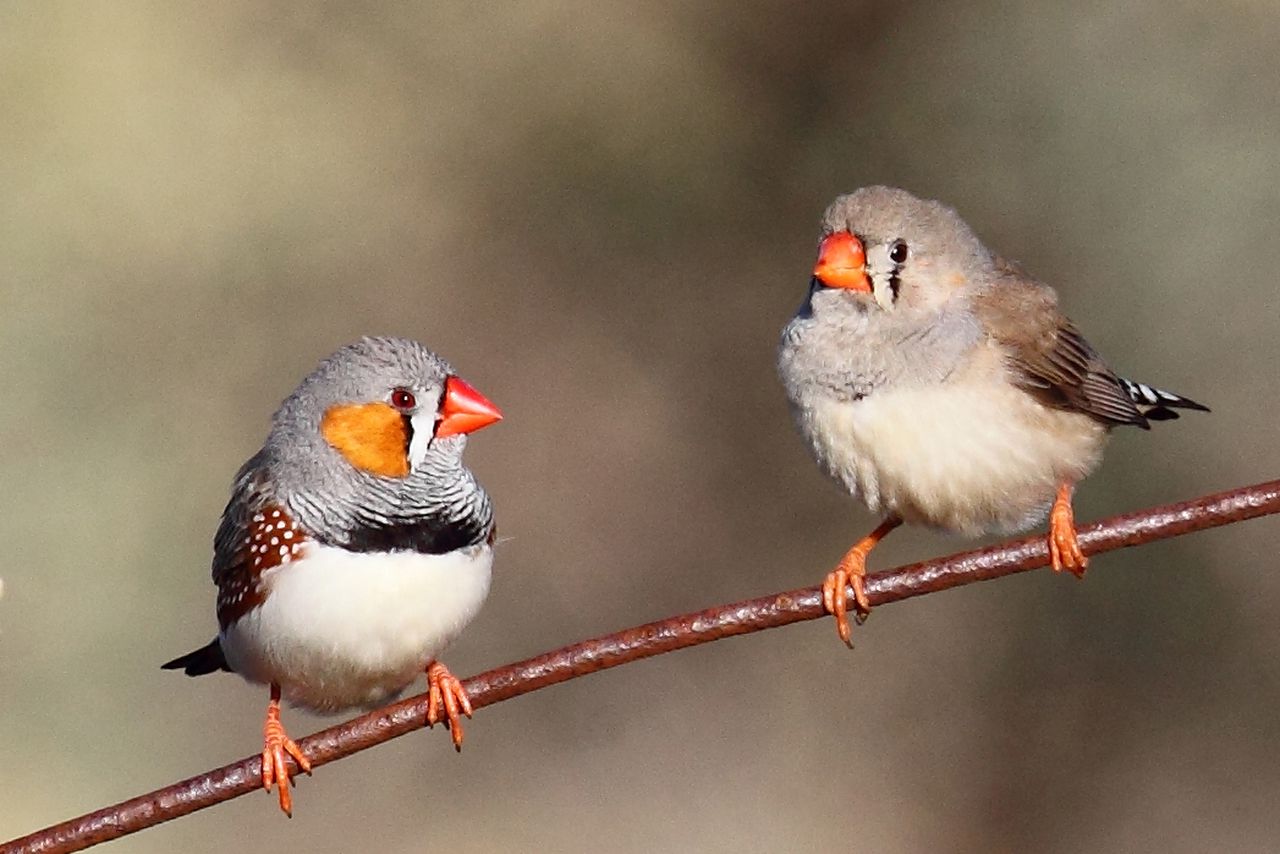
Zebra finches sing to eggs to prepare babies for global warming ahead

THIS COULD BE ONE WAY BIRDS LEARN TO SURVIVE THE HEAT

    
Zebra finches program their offspring to prepare for global warming by singing to eggs before they hatch. In especially hot areas, finch parents make a special call to incubating eggs, basically telling them it’s really hot outside and they better not grow too big. The hatchlings listen and this mechanism might explain how birds learn to adapt, and survive climate change.
Many bird species sing to their eggs. These calls have been shown to do everything from improving learning to synchronizing hatching times. When it comes to the Australian zebra finch, we already know that they make a specific call when it’s unusually hot outside, which in this case means over 79 degrees Fahrenheit no matter what season it is.
Finch parents start making these calls about five days before the eggs are supposed to hatch and the calls become more frequent the closer it gets to hatch time. This suggests the calls are a way to tell the soon-to-be-born finches about the world outside, and not just the parents complaining about the heat.
But how do we know if it’s just a coincidence? Mylene Mariette and Katherine Buchanan at Australia’s Deakin University figured out a way to test this. For a study published today in Science, they put a bunch of zebra finch eggs in an incubator that created a temperature around 100 degrees Fahrenheit. Mariette and Buchanan then played the “global warming” call for some of the eggs and not others.
Next, the scientists waited to see if there were significant differences between the two groups. If there were, it was probably because of the difference in the calls they heard.
After the eggs hatched, the baby finches were raised in an environment where the temperature varied naturally. By day 13 after hatching, nestlings that heard the “heat” calls were smaller than the ones who didn’t. This seems to confirm that the embryos in the eggs really do listen to the calls and then change how they grow.
All this makes sense because other research tells us that animals end up smaller when it gets hotter because the smaller size makes it easier to cope with high temperatures. Mariette and Buchanan also found that birds who were smaller in hot conditions produced more fledglings during their first breeding season, showing that this is a good evolutionary strategy after all.     

Monday, April 6, 2015

Donie's Ireland daily news BLOG

Austerity and the Verdict of the Squeezed Middle people of Ireland

Angry voters want their money back and tell Noonan to slash taxes USC now toxic as hated water charges.


Angry voters are demanding their money back after eight years of hard austerity,

The recent Sunday Independent/Millward Brown opinion poll has found.

The economic recovery has so far failed to clearly boost the Government’s standing with the electorate, according to the poll.
Dissatisfaction with the Coalition has actually increased a little at a time of higher than expected economic growth.
Exchequer returns for the last three months show €545m more tax than anticipated has been collected.
Now voters are demanding a financial dividend after almost a decade of increased taxes and charges.
With the economic recovery taking hold, a clear message in the poll is that people want more money in their pockets.
The Government’s performance has satisfied one-in-four, a three-point increase drawn from the undecided, but the level of dissatisfaction has also increased a point to 69%.
The poll was conducted in 971 interviews between March 24 and April 2. Among the key findings are that the Universal Social Charge (USC) is hated as much as water charges.
Voters want austerity taxes and charges, such as the USC and water charges, to be cut first ahead of the Coalition’s preferred option to reduce income tax. The poll has also found demand for pay hikes has increased, with a reversal of wage cuts in the private sector being favoured over the public sector.
After undecided voters (20%) are excluded, the state of the parties is: Fine Gael (25%) unchanged; Sinn Fein (24%) down two points; Fianna Fail (19%) unchanged; Labour (8%) up two points; Greens (3%) up two points; Independents/others (20%) down three points. Sinn Fein’s fall in support confirms findings in other polls and shows the party has been damaged by recent scandals related to child sex abuse.
The level of public disillusionment in general is illustrated by an increased level of dissatisfaction with all party leaders.
Although satisfaction with the Government (26%) has improved somewhat, the level of dissatisfaction has also increased, up a point to 69%, the same level as a year ago and within the margin of error from two years.
Today’s poll will add to the pressure on Finance Minister Michael Noonan after a week which saw a surge in anger at the banks’ imposition of high mortgage variable interest rates and industrial action on zero-hour contracts.
The average variable mortgage rate for new customers in Ireland is 4.2%, compared with a rate of 2.09% in the rest of the Eurozone.
This means the holder of a €200,000 mortgage here is paying €350 a month more than mortgage holders in Europe. The Coalition’s economic Spring Statement was initially scheduled for April 21, but is to be delivered on April 28 instead at the insistence of Labour, which wants to concentrate on the mortgage arrears crisis first.
The Coalition intends to use the statement to outline a five-year tax reform plan to secure a second term after the Budget in October.
However, today’s poll illustrates the level of voter expectation with which the Coalition must now contend.
The poll finds support for wage hikes has increased for both the private and public sectors but that voters still believe the public sector may have to wait.
Asked if there had been sufficient economic improvement to merit wage increases in the private sector, 45% said no (up one point) but 43% said yes (up five points) while 12% did not know (down six points).
Half of voters (50%), down one point, did not believe there should be public sector pay increases, while 37% (up six points) believed there should and 12% (down six points) did not know.
If exchequer money is to be given back, 61% said water charges should be reduced; 60pc said USC should be cut; 54% said reduce income tax; 47% want a cut to property tax; and 38% wanted PRSI reduced.
Dissatisfaction with all the party leaders has also increased: Enda Kenny (67%) up three points; Joan Burton (65%) up four points; Micheal Martin (57%) up eight points; Gerry Adams (56%) up six points.
Renua Ireland leader Lucinda Creighton has recorded a satisfaction rating of 20% and dissatisfaction of 44%; while 36% said they did not know.

The Irish government might cap the Property Tax?


The Tánaiste says that there has to be a reaction to rising property prices.

The Irish Government could consider capping the amount payable in Property Tax.
Speaking at a 1916 commemoration today, Tánaiste Joan Burton said that the government was “aware that house valuations are rising steeply” in parts of the country.
She said that the government is awaiting a new report and will act on it.
The tax is currently based on property valuations as of 1 May 2013, but that will be recalculated next May, with some householders potentially hit for €180 or €270 more from 2017 on.
Today’s Sunday Times reports that Finance Minister Michael Noonan told the Fine Gael party that it would be “absolute madness” to allow those whose property prices were inflating to be hit for bigger bills.
Already, over 7,000 properties have had their tax revised upwards.

It’s now time for a new Proclamation?


As the Centenary of the 1916 Rising draws near, we invite six people – a journalist, an artist, activists and economists – to write a new Proclamation for today’s Ireland

The Proclamation of 1916 is among Ireland’s best known historical documents. Almost 100 years after its publication, it continues to exercise a profound effect on the Irish imagination. In some ways it has not dated but, 99 years on, does it work for 21st-century Ireland?
The Irish Times has asked six people – journalist Fintan O’Toole; disability activist Joanne O’Riordan;  theatre maker Grace Dyas, environmentalist Oisin Coghlan; economist Constantin Gurdgiev; and author Gerard O’Neill – to compose new proclamations for today’s Ireland.
We’ve borrowed the idea from the official State Centenary Programme for 2016, launched this week. Its “Proclamation for a New Generation” project begins in schools in the next academic year, and will invite primary and secondary students to write a new proclamation that reflects the “values and aspirations of the generation of 2016”.

Seriously ill man traveled on an icebreaker, through rough seas for help

  
The Aurora Australis at anchor at Davis station
A seriously ill man reached an Australian hospital more than two weeks after he suffered a medical emergency at a remote Antarctic base.
The patient was admitted to hospital in Hobart, Australia’s mostly southerly city.
He had travelled aboard an icebreaker 3,000 miles through rough and ice-jammed seas from Australia’s Davis Station on the coast of Princess Elizabeth Land.
The Australian Antarctic Division’s chief medical officer Jeff Ayton said the patient was transferred by ambulance from the icebreaker, Aurora Australis, to the Royal Hobart Hospital where he remained in serious but stable condition.
“He will require ongoing medical treatment, but we are very pleased he has travelled well over the past couple of weeks and his condition has not deteriorated,” Mr Ayton said.
The authorities have released no personal details about the man, who is a tradesman. They have not revealed the nature of his medical emergency, other than to say it was not the result of an accident.
The man arrived at the Australian base in November and was supposed to spend the approaching southern winter there.
He became ill on March 18 only days after the Aurora Australis had resupplied the station and begun its voyage back to Hobart.
When the icebreaker returned to the station, officials had to wait for a break in snow showers so that the patient could be flown across sea ice on March 22.
The icebreaker rolled heavily in swells up to 23ft and winds gusting at 70mph while navigating the treacherous Antarctic Ocean toward Hobart.
The patient was cared for by the ship’s doctor with the help of distant specialists using telecommunications equipment designed for remote medical examinations.

Small farmers under threat from falling food prices & Euro red tape

   
Traditional British farming will soon be replaced by international investors and creation of mega farms to feed China. 
Centuries of traditional small family farming in Britain is under threat from a collapse in the price of food and European red tape, industry leaders have warned.
David Handley, chairman of the lobby group Farmers for Action said: “If you look at the exodus now from the industry, the small British tenant farmer is under threat. Tenant dairy farmers like ourselves are being crucified at the moment.”
Dairy prices in the UK have hit multi-year lows as China’s softening demand for milk and a Russian embargo on European imports sends shock waves through the British farming industry.
According to Mr Handley, the collapse in prices has left many farmers who were already operating on tight margins in financial difficulty.
He claims that for many farmers, a litre of milk is now costing more to produce than it is to sell to a commercial buyer. International milk prices as measured by the GlobalDairyTrade index fell by 48% and the market has shown little sign of recovery since.
Milk is now cheaper to buy than bottled water due to a fierce supermarket price war, recent figures showed.
When bought in a four-pint bottle, the price per litre of milk has dipped to 43p, compared with 44p for bottled still water.
In January, Asda cut the price of four pints of own- Label milk from £1 to 89p.
A collapse in profits could see many small farmers giving up the occupation altogether, either selling their farms or handing the keys back to landowners in a shift that could end centuries of tradition in the countryside.
There are around 10,000 dairy farmers left in England and Wales, half the number they were in 2002. That could fall to 5,000 in the next 10 years, the National Farmers Union (NFU) has warned.
Many experts expect traditional, small family-run British farms to be replaced by bigger operations owned and managed by large investors. “It’s part of a process of continuing evolution in the agricultural industry,” said Phil Bicknell, head of food and farming at the NFU.
“The trend is for farms to get bigger. If you want to make more you have got to farm a bigger area.”
Last month, the NFU warned that Britain’s food security was in danger and that just 53pc of the nation’s food needs will be produced from domestic farms by 2040.
Farming continues to make an important contribution to the UK economy, bringing in more than £8bn last year. Although George Osborne, the Chancellor, offered British farmers some relief in the Budget, Mr Bicknell said that the UK lacks a clear “vision for agriculture”.
Farmers will now be able to average profits for tax purposes over five years, up from the current two years, to counter volatile commodity markets.
Allan Wilkinson, HSBC Bank’s head of agriculture, has also warned that average farm incomes in the UK will drop this year amid a global oversupply of food and softer demand in Asia. British farmers have been hit by falling international food prices and the ban on dairy, meat and fish exports to Russia, which came into force last year.
“Incomes will fall this year,” said Mr Wilkinson. “The impact of the struggling pound is a bigger challenge than Russia because so much of UK farming revenues are from Europe.”
Last week, the European Milk Board (EMB) warned that dairy farmers can expect a severe loss in market power, plus chronic milk price slumps as the European milk quota system came to an end last Tuesday.
The EMB said that dairy farmers across the EU will step up production, driving down prices as producers look to offload their supplies.
Farm gate food prices have fallen to the lowest level recorded in the past five years according to the United Nations (UN), while the pound has appreciated by more than 12% against the euro over the past year.

HAVE SCIENTISTS FINALLY FOUND PROOF OF BIGFOOT?

  
A leading genetecist claims a towering woman named Zana (artist’s representation) who lived in 19th Century Russia – and appeared to be ‘half human, half ape’ – could have been the fabled yeti
Over the centuries the legend of North America’s Bigfoot and the Hemolayan Yeti have continued to crop up.
Here in Canada, there are still many Bigfoot sightings each year. Now, scientists may finally be able to say that the giant creature was not a myth.
Bryan Sykes, emeritus ¬professor of human genetics at the University of Oxford, has identified a strain of west African DNA on the Georgian-Russian border that he believes could ¬belong to a sub-species of modern humans.
Sykes claims to have found the best evidence that a woman who lived in 19th century Russia could have been a yeti.
According to accounts, she was described as resembling a wild beast, and “the most frightening feature of which was her expression which was pure animal”, one zoologist wrote.
Analysis of her DNA showed that while she was “100% African”, she bore little physical or genetic resemblance to any modern African group.
Experts believe the wandering ‘Wild Woman’ was found lurking in the remote region of Ochamchir in the Republic of Abkhazia.
According to Yahoo News, her resemblance has been described as that of a wild beast, and “‘the most frightening feature of which was her expression which was pure animal”, one Russian zoologist wrote in 1996 according to a report in the Times.
The man who organised various eyewitness accounts of Zana wrote: “Her athletic power was enormous.
“She would outrun a horse and swim across the Moskva river, even when it rose in violent high tide.’”
Zana was eventually “tamed” by the nobleman who bought her as a servant and kept her on his estate in Tkhina in the Republic of Abkhazia, according to local accounts.
Some of the professor’s colleagues remain doubtful given his previous findings – which include a claim that an unknown species of bear might account for yeti sightings in Bhutan.
Sykes has been involved in a number of high-profile cases dealing with ancient DNA, including those of Ötzi the Iceman and Cheddar Man, and others concerning people claiming to be members of the Romanovs, the Russian royal family. His work also suggested a Florida accountant by the name of Tom Robinson was a direct descendant of Genghis Khan, a claim that was subsequently disproved