Pages

Showing posts with label Irish Tax. Show all posts

Wednesday, September 21, 2016

Donie's Ireland daily news BLOG update

Mortgage rules likely to curtail buying of new homes in Ireland,

ECONOMIC THINK TANK SAYS HOUSING SUPPLY WILL BE REDUCED BY 5% OVER FOUR YEARS

Image result for Mortgage rules likely to curtail buying of new homes in Ireland,   Image result for Mortgage rules likely to curtail buying of new homes in Ireland,  Image result for Mortgage rules likely to curtail buying of new homes in Ireland,

OVER THE NEXT THREE OR FOUR YEARS HOUSE PRICES ARE LIKELY TO BE ON AVERAGE 3.5% LOWER THAN WHERE THEY WOULD HAVE BEEN WITHOUT THE CENTRAL BANK MORTGAGE RULES, AN ESRI REPORT HAS FOUND.

The Central Bank’s mortgage lending rules are likely to curtail the supply of new homes by up to 5% over the next four years, the Economic and Social Research Institute (ESRI) has warned.
In a research paper published with its latest quarterly report, the institute found the impact of the restrictions had yet to fully play out because of the lag effect in construction, albeit there has been a sizeable dip in new mortgage lending.
However, it said this would change over the next three to four years with house prices likely to be on average 3.5% lower than where they would have been without the rules.
This decline will lead to reduced profitability in construction, which will lower the number of housing units completed in each quarter by about 5 per cent, and reduce the State’s overall housing stock by about 0.5%.
The finding comes as the Central Bank conducts its first review of the rules, which were introduced in February 2015 to prevent the housing market from overheating again.
They require first-time buyers to have a 10% deposit for the first €220,000 of a house price and 20% for the balance while all other buyers must have a 20% deposit in place.
In addition, the Central Bank requires that income limits of 3.5 times are applied by the banks before approving mortgages.
A recent consultation process, which will inform the bank’s review, yielded 50 submissions, several of which called for the threshold below which first-time buyers have to pay only a 10% deposit to be raised from the current level of €220,000.
Kieran McQuinn of the ESRI said the measures had had a contractionary impact on the housing market in terms of reducing prices, supply and mortgage lending below levels the would have otherwise pertained.
He said they had made it more difficult for potential buyers to raise downpayments and pushed more people into the rental market. This explained why rents were rising at an even greater rate than property prices.
Boom years
A recent report by property website Daft found that rents were now above what they were during the boom years, with annual inflation in Dublin, where the housing shortage is most acute, running at 11%.
Dr McQuinn said the ESRI fully supported the need for macroprudential measures but the rules needed to incorporate room for a “counter-cyclical dimension”to reflect the current supply shortages.
The institute does not expect housing completions to increase to 25,000, the level needed to meet demand, until after 2018. Property Industry Ireland, the Ibec group that represents the sector, predicts that completions this year will only amount to about 14,000.
In its latest quarterly commentary, the ESRI downgraded its growth forecasts amid concern over global demand linked to weakness in the Chinese economy and because of Brexit-related issues.
It predicted GDP, the standard measure of economic growth, would expand by 4.3% this year and by 3.8% in 2017.
On the 26% GDP growth recorded for last year, the think tank acknowledged nobody could take this rate seriously.

Michael Noonan agrees to now appear before the Public Accounts Committee

Image result for Michael Noonan agrees to now appear before the Public Accounts Committee  Image result for Nama's controversial sale of its Northern Ireland loan book

THE FINANCE MINISTER MICHAEL NOONAN HAS TONIGHT BOWED TO PRESSURE AND WILL NOW APPEAR BEFORE THE PUBLIC ACCOUNTS COMMITTEE (PAC) OVER NAMA’S CONTROVERSIAL SALE OF ITS NORTHERN IRELAND LOAN BOOK, 

Mr Noonan was told by Independent Ministers including Finian McGrath and Shane Ross at Cabinet today that it would be better if he attended the committee and try and “kill off” the controversy.
While ministers agreed that it was Mr Noonan’s decision to make, he was left in no doubt as to the feelings of his colleagues, sources have said.
“I have today decided to accept the invitation of the Committee of Public Accounts to assist the Committee in its examination of the C&AG’s Special Report on the National Asset Management Agency’s sale of Project Eagle,” Mr Noonan said in a statement.
“I intend to reply by letter to the Committee of Public Accounts to confirm this and to request assurances from the Committee that the proceedings of the Committee will be conducted in line with its terms of reference,” he added.
Members of the PAC welcomed Mr Noonan’s announcement.
Sinn Féin Deputy Leader Mary Lou McDonald TD said his decision to face questions is in the public interest.
“After a weekend of stalling, Minister Noonan has reversed his decision and has agreed to come before the Public Accounts Committee to address concerns regarding the sale of NAMA’s northern loan-book. I welcome his decision as it is, without question, in the public interest that he explain why he failed to suspend to sale when he became aware of the operation of fixer fees,” she said.
“He must explain why he, as Minister for Finance, failed to protect the interests of the citizens of this state. Minister Noonan now needs to open the books, assist the PAC inquiry, and not engage in further prevarication,” she added.
Last week, Nama rejected a report which says that it could have sold loans based in Northern Ireland for more than £1.32 billion.
The long-awaited Comptroller and Auditor General’s (C&AG) report into the sale of Project Eagle was published today, saying that the agency could have made more than that.
The report found that the State lost around £190 million (€220 million).
The C&AG report found that Nama had over-discounted the loans, giving 10-15% discounts where 5.5% would be more applicable. It added that NAMA did not keep an “adequate record of key decisions and events even though the sales process deviated from standard”.

Micheál Martin claims the elimination of water charges would not erode our tax base

Image result for Micheál Martin claims the elimination of water charges would not erode the tax base   Image result for water charges erosion

FIANNA FÁIL LEADER MICHEÁL MARTIN TD ADDRESSES THE MEDIA PRIOR TO THE ANNUAL PARLIAMENTARY PARTY THINK-IN AT THE SEVEN OAKS HOTEL, CARLOW.

Fianna Fáil leader Micheál Martin has rejected a European Commission report that said the elimination of water charges would erode the tax base.
The Commission’s remarks came in its latest post-bailout report in the Irish economy.
Mr Martin said scrapping water charges is “not an erosion of the tax base because it’s made a very negligible contribution to the widening of the tax base in the last three years.”
He was speaking after his party’s Co Carlow think-in where he also responded to a study by the Irish Tax Institute that outlined how workers are paying the top rate of income tax before their salaries reached the average industrial wage.
The Fianna Fáil TD was asked if the party should rethink its policy of pushing for spending measures over tax cuts as a result of the study.
Mr Martin said he was committed to its position that there should be a 2:1 break-down of spending to tax cuts in the upcoming Budget.
“There’s absolutely no question but that we do have to invest in health, in education and housing and give people some decent quality of life in terms of access to those services,” he added.
He said there “is a case” for tax cuts but that a balance has to be struck.
“We need to be mindful of the risks to the Irish economy not least the Brexit risks and proceed in a cautious manner,” he added.
Meanwhile he said he doesn’t think it will be achievable or the right policy to abolish the USC in five years as Finance Minister Michael Noonan today told an Oireachtas committee he’d like to do.
Mr Martin responded to this saying: “I don’t believe it’s achievable”.
“We don’t believe its the right policy or the right approach,” he said adding that there needs to be a balance between investing in services and infrastructure and giving people a break in their taxes.

Irish teens are smoking and drinking less according to a new European survey says

NEW SURVEY RAISES CONCERNS OVER YOUNG PEOPLE’S DRUG USE AND INTERNET BEHAVIOUR

Image result for Irish teens are smoking and drinking less according to a new European survey says   Image result for Irish teens are smoking and drinking less according to a new European survey says V Image result for Irish teens are smoking and drinking less according to a new European survey says

SMOKING AND DRINKING HAVE DECLINED AMONG IRISH SECONDARY SCHOOL STUDENTS, ACCORDING TO A NEW EUROPEAN SURVEY.

Smoking and drinking have declined among Irish secondary school students, but new concerns are emerging in relation to drugs and addictive behaviours associated with the internet, a new European survey has claimed.
Fewer Irish teenagers are drinking and smoking, according to the European School Survey Project on Alcohol and Other Drugs (ESPAD)’s 2015 report, which looked at the behaviour of 15- to 16-year-olds.
However, Irish respondents reported slightly higher than average rates in use of illicit drugs other than cannabis during their lifetime, lifetime use of inhalants and lifetime use of new psychoactive substances.
The ESPAD report also said more than one in 10 Irish teenagers gambled for money frequently.
Use of alcohol within the last 30 days and the rate of heavy episodic drinking were less common among Irish respondents, compared with the average in the survey.
Thirty-five per cent of Irish teenagers reported drinking alcohol during the past 30 days, compared with a European average of 48 per cent, while 28 per cent of Irish teenagers reported heavy episodic drinking during the past 30 days, compared with a 35 per cent average.
The same was true for cigarette use during the last 30 days, which stood at 13 per cent among Irish respondents, compared with the European average of 21 per cent.
The ESPAD’s findings are based on a survey undertaken in 2015 in 35 European countries, including 24 EU member states.
A total of 96,043 students, including 1,400 from Ireland, participated in the survey, responding in school to an anonymous questionnaire.
The ESPAD’s report highlighted overall “positive developments” in the area of cigarette-smoking.
“Today, the majority of adolescents have never smoked (54 per cent) and less than one-quarter (21 per cent) of the sample can be considered current smokers,” it said.
The survey identified “high rates of alcohol use” among European teenagers, but said trends over the past two decades point to positive developments.
It recorded a decrease in lifetime and last-30-day use of alcohol among teenagers between 1995 and 2015, from 89 per cent to 81 per cent and from 56 per cent to 47 per cent respectively
However, it said changes in heavy episodic drinking were less pronounced and only observed among boys, going from 36 per cent to 35 per cent in the past 20 years.
On internet use, survey respondents said they had used the internet an average of 5.8 days within the last seven days.
Welcomed reaction
Responding to the study, Alcohol Action Ireland said it welcomed some of the trends in alcohol consumption among Irish teenagers but said alcohol should not be a part of any 15- or 16-year-old’s life.
“One of the most disappointing aspects of this survey is that over three-quarters of Irish 15- and 16-year-olds still find it easy to obtain alcohol, which is reflective of both the massive increase of the availability of alcohol in outlets throughout Ireland in recent years and the ongoing failure of the current regulations.”
Ministers of State for Health Marcella Corcoran Kennedy and Catherine Byrne welcomed the survey results on alcohol and cigarettes.
Ms Byrne said a particular focus of the Government’s National Drugs Strategy consultation was “getting the views of young people on the measures required to tackle the issue into the future”.

The survival secret of the ‘earth’s hardiest animal’ is now revealed

Image result for The survival secret of the 'earth's hardiest animal' is now revealed  Image result for planet's hardiest animal it's the tardigrade

MEET THE PLANET’S HARDIEST ANIMAL IT’S THE TARDIGRADE AND IT HAS JUST REVEALED A GENETIC SECRET THAT COULD HELP PROTECT HUMAN CELLS.

Researchers have discovered a genetic survival secret of Earth’s “hardiest animal”.
A gene that scientists identified in these strange, aquatic creatures – called tardigrades – helps them survive boiling, freezing and radiation.
In future, it could be used to protect human cells, the researchers say.
It was already known that tardigrades, also known as water bears, were able to survive by shrivelling up into desiccated balls.
But the University of Tokyo-led team found a protein that protects its DNA – wrapping around it like a blanket.
The scientists, who published their findings in the journal Nature Communications, went on to grow human cells that produced that same protein, and found that it protected those cells too.
This, the scientists suggest, means that genes from these “extremophiles”, might one day be used to protect living things from radiation – from X-rays, or as a treatment to prevent damage from the Sun’s harmful rays.
Tardigrades are more commonly – and cutely – known as water bears. Scientists had thought that they survived radiation exposure by repairing the damage done to their DNA. But Prof Takekazu Kunieda, of the University of Tokyo, and his colleagues, carried out an eight-year study of a tardigrade genome to pinpoint the source of its remarkable resilience.

EXTREME GENETICS

To identify their secret weapon, researchers scrutinised the genome of one tardigrade species, looking for proteins that were attached to the DNA, and that therefore might have a protective mechanism. They found one that they have called “Dsup” (short for “damage suppressor”).
The team then inserted the Dsup gene into human cells’ DNA, and exposed those modified cells to X-rays; Dsup-treated cells suffered far less DNA damage.
Prof Mark Blaxter of the University of Edinburgh told BBC News that the study was “groundbreaking”.
“This is the first time an individual protein from a tardigrade has been shown to be active in radiation protection.
“[And] radiation is one of the things that’s guaranteed to kill you.”
By sequencing and examining the genome, this study also appears to resolve a strange genetic controversy about these creatures. Research published in 2015, involving a different tardigrade species, concluded that the creature had “acquired” a portion of its DNA from bacteria through a process called horizontal gene transfer.
That study suggested that some of these beasts’ notorious imperviousness had been snipped out of the bacterial genetic code.
This study found no evidence of this gene transfer.
The tardigrades themselves, though, were far more resistant to X-rays than the human cells that the researchers manipulated. “[So] tardigrades have other tricks up their sleeves, which we have yet to identify,” said Prof Matthew Cobb from the University of Manchester.
With further research, scientists think that genes like Dsup could make it safer and easier to store and transport human cells – protecting, for example, delicate human skin grafts from damage. Prof Kunieda and his co-author on the study, Takuma Hashimoto, applied to patent the Dsup gene in 2015.
Prof Cobb added that, in principle, “these genes could even help us bioengineer organisms to survive in extremely hostile environments, such as on the surface of Mars – [perhaps] as part of a terra-forming project to make the planet hospitable for humans”.
And scientists with a fascination for tardigrades think this discovery could be the tip of the iceberg.
Prof Blaxter said that tardigrade research could even explain how exactly “radiation damages DNA, and how we might prevent DNA damage from other sources”.
Prof Takekazu Kunieda told BBC News that he hoped more researchers would join the “tardigrade community”.
“We believe there [are] a lot of treasures there,”   

Tuesday, September 20, 2016

Donie's Ireland daily news BLOG update

The EU Commissioner Margrethe Vestager has no specific concern’s about the Irish tax system

COMMISSIONER ALSO SAYS EU HAS NO PLANS AFOOT TO HARMONISE CORPORATION TAX

Image result for The EU Commissioner Margrethe Vestager has no specific concerns about the Irish tax system   Image result for The EU Commissioner Margrethe Vestager has no specific concerns about the Irish tax system

THE EU COMMISSIONER MARGRETHE VESTAGER.

The European Commission has “no specific concern” about the Irish tax system and is not planning to harmonise corporate tax system, according to competition commissioner Margrethe Vestager.
The competition commissioner, who has ordered Apple to pay €13 billion in back taxes to the Republic, was speaking as she began a three-day visit to the United States.

“WE DON’T HAVE A SPECIFIC CONCERN ABOUT IRELAND,” SHE SAID.

“We do very specific case work. If there are reasons for concern, well then we may open investigations. But there can be obvious reasons why you want to place your business in Ireland [in particular because it] has an attractive corporate tax rate of 12.5 per cent.”
The European Union has no intention of trying to harmonise corporate tax rates, she said.
With many large US multinationals having European bases in Ireland, there have been fears that the Apple decision, which both Ireland and Apple are appealing, is a foretaste of things to come for the Irish economy.
However, Ms Vestager seemed keen to dispel the notion that she is on the cusp of launching a slew of similar investigations.
‘Very, very thorough’
“We are very, very thorough. We don’t just open a case in the spur of the moment. Because we need to write an opening decision where we state our concerns, and in order to do that of course we have been asking questions beforehand.”
The commission has been given some 1,000 examples of tax rulings by EU member state governments, she said.
Having reviewed these rulings, she said most of them were “very well done” with “no selective advantages” given to companies.
The Government has stressed that Ireland has not been fined in the Apple case, which involved a ruling that the company should repay tax. But the commissioner pointed out that enforcement of EU state rules does not work with punishments or fines.
“Where I was raised in the western part of Denmark, the most awkward thing you could ever do was to take back a gift” and this was effectively what was being requested here, she said. “You rely on the uncomfortable inconvenience of a member state having to take back a selective benefit or advantage that they wanted to give.”
The Government denies that its arrangement with Apple, which has had a base in the country since 1980 and employs nearly 6,000 in its Cork offices, constituted illegal state aid.
Ms Vestager is meeting officials in the US administration and Congress and speaking at academic conferences in Washington and New York. Asked if the Apple decision had created transatlantic tensions, she said: “Even though we may disagree on this decision, when it comes to global tax issues, we are very very much on the same page.”
OECD
This is especially the case in light of OECD and G20 initiatives to create rules which make it more difficult for companies to legally avoid tax, she added.
Ms Vestager said it was hearings on Apple’s tax arrangements held by the US Senate that led the commission to open its investigation.
“We do not have a national bias,” she said, adding that of the 150 EU decisions taken between 2000 and 2015 where member states were required to recover illegal state aid, only 2 per cent involved US companies.
She was equally adamant that the case did not represent an attempt by the EU to assume tax-raising powers. “We are not trying to become, and we are not now, a tax authority. We enforce competition rules.”
Ireland and Apple intend to appeal the commission’s decision at the EU Court of Justice.

Irish property study reveals an appetite to buy

BUT POTENTIAL PURCHASERS SAY THERE’S A LACK OF SUITABLE PROPERTIES ON THE MARKET…


Image result for Irish property study reveals an appetite to buy  Image result for Irish property study reveals an appetite to buy  Image result for Irish property study reveals an appetite to buy

ALMOST ONE-THIRD OF IRELAND’S ADULT POPULATION HAVE SAID THAT THEY ARE AT LEAST CONTEMPLATING BUYING A RESIDENTIAL PROPERTY DURING THE NEXT YEAR, ACCORDING TO THE KBC BANK IRELAND’S HOME BUYER SURVEY.

49% of respondents believe that it is a good time to buy a house, with 14% thinking that it’s a bad time, and 37% remaining undecided.
When asked if the Central Bank’s mortgage lending measures had affected their plans 44% said that they will not have an impact – while the remaining 56% said that it had either affected the kind of property that they would consider buying, prolonged the period that they will wait before they buy, or meant that they will need to rely on family supports or other loans to support a purchase.
The average period of time added to raise this money is between one and two years.
Of those looking for a home, 29% said that they had seen no properties which suited their needs. 60% saw between one to five properties on the markets which they considered suited to their needs – while the remaining 11% had seen a greater number.
Interestingly, 48% of respondents plan to buy a property on their own – while 52% want to find a property with someone else.
One-third stated that the Brexit result has affected their plans.

Diet is vital for the prevention of Alzheimer’s

Image result for Diet is vital for the prevention of Alzheimer’s   Image result for An estimated 55,000 Irish people currently have dementia, with about 60% of them having Alzheimer’s  Image result for broccoli slows the degeneration of acetylcholine while egg yolks help to make it; avocado boosts blood flow to the brain, and the antioxidants in kale make your brain ‘younger’

EACH YEAR, SEPTEMBER 21ST MARKS WORLD ALZHEIMER’S DAY. AN ESTIMATED 55,000 IRISH PEOPLE CURRENTLY HAVE DEMENTIA, WITH ABOUT 60% OF THEM HAVING ALZHEIMER’S DISEASE (AD). AND DUE TO OUR AGEING POPULATION, FIGURES ARE EXPECTED TO RISE EXPONENTIALLY.

AD is characterised by the formation of amyloid ‘tangles’ and ‘plaques’ in the shrinking brain. These clumps destroy brain cells and interfere with its chemical messaging functions, particularly of acetylcholine, which deals especially with memory. Age is of course the primary risk factor, but others are equally important – diabetes, cardiovascular issues, genetics, infections, stress and nutritional deficiencies. An overview of more than 300 studies last August found that the number one protective factor was a healthy diet.
One consideration is that cognitive health is directly linked to heart health, and that both are strongly determined by blood levels of a toxic compound called homocysteine. Reducing those levels, by taking high strength B vitamins, would therefore be the first plan of action. Research has shown between 30% and 90% less brain shrinkage in people with early signs of AD when given B6, B12 and folic acid, which boost the conversion of homocysteine into that vital acetylcholine in the same way as the drugs given to people with AD do.
Inflammation (partly as a result of poor gut bacterial balance) is a central feature, as is oxidative damage to the cells, so taking a good probiotic and eating plenty of antioxidants in brightly coloured plant foods is the second prong of attack, along with exercising regularly (in the sunshine for important vitamin D). Inactivity raises the risk of AD by 70%, while sex has been shown to light up the relevant areas of the brain. And be sure to visit your dentist regularly – a strong connection has been established between gum disease and amyloid clumping.
Eating plenty of anti-inflammatory omega 3 and vitamin D-rich oily fish, and the healthy oils in olive oil, avocadoes, nuts and seeds is of proven benefit to those most at risk, but avoid trans/hydrogenated fats altogether, as they markedly accelerate cognitive decline. While research shows that a diet high in healthy fats reduces risk by 44%, a diet high in sugar and refined (white) grains increases the risk by a staggering 89%. Another study showed accelerated shrinkage in the part of the brain involved in memory in those on a Western diet of processed and fried meats, crisps and soft drinks.
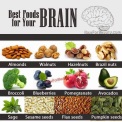
The latest research on diet includes: a moderate coffee intake can reduce risk by 18%, broccoli slows the degeneration of acetylcholine while egg yolks help to make it; avocado boosts blood flow to the brain, and the antioxidants in kale make your brain ‘younger’. A chemical called resveratrol, in red wine, raspberries and dark chocolate, can strengthen the barrier that blocks harmful molecules from accessing the brain.
An anti-inflammatory and antioxidant Indo/ Mediterranean diet, based on colourful vegetables and fruit, greens, oily fish, beans and lentils, nuts and seeds, olive oil, green tea and a little red wine, is widely accepted by as the very best model for the prevention and control of AD (figures are lower in Mediterranean countries). Olive oil contains compounds that can halt the build up of those plaques.
A connection has long been made between AD and exposure to aluminium. This is disputed, but it might be wise to eat foods rich in silicon, which counteracts aluminium. More recent research has pointed to high levels of copper in the blood of AD sufferers, and we know that copper makes it harder for the brain to get rid of amyloid proteins. It is, however, in a great variety of foods and necessary for health, so the answer is to take a supplement of zinc, which is antagonistic: the higher your zinc levels, the lower those of copper.
This January it was suggested that BMAA, a toxic compound produced by algae in Irish lakes and reservoirs and so present in some seafood and plants, is contributing to our Alzheimer’s ‘epidemic’, so this will doubtless be the focus of further research. As will the revelation that the brains of sufferers contain unusual yeasts and fungi. In more practical terms: while some studies show that being slightly overweight is far more protective than being underweight, it’s just been shown that the inflammation associated with obesity causes the brain to age ten years faster, so it really is a balancing act. Also in January, Canadian scientists found that chronic exposure to anxiety and stress hormones—also inflammatory–damage and shrink the relevant parts of the brain. And finally, a study out this April involving 5,000 people with insomnia found them to be 43% more likely to develop dementia in later life; there’s no doubt that lifestyle issues are key.

The future of Sex, Dating, and finding a Mate

Image result for Dating in the Internet Age.   Image result for The future of Sex, Dating, and finding a Mate  

SEX IS ONE OF THE MOST POWERFUL, FUNDAMENTAL HUMAN DRIVES.

IT’S CAUSED WARS… BUILT AND DESTROYED KINGDOMS AND IT OCCUPIES A SIGNIFICANT PERCENTAGE OF MOST PEOPLE’S THOUGHTS.

As such, it’s worth a conversation about how exponential technologies will change our relationship with sex.
Dating in the Internet Age.
Dating in past generations was local and linear. You had access to a small number of potential mates based on where you lived, where you went to school and your social status.
In the 1960s, over 50% of marriages globally and 95% of marriages in India were arranged.
Today that number has dropped to less than 15% (globally).
In 1960, the median age at first marriage for the bride was 20 and the groom was 23 years old.
Today, the median age is closer to 29 for women and 30 for men.
A cultural shift is happening, and it’s changing the game.
Dating has gone digital. As such, it has gone from local and linear to global and exponential.
Today, 40 million Americans use online dating services (that’s about 40% of the single population in the U.S.), driving the creation of a $2.4 billion online dating industry. (Go here for a great online dating infographic.)
These services transcend geography and social strata. People are matched from around the world.
Between 1995 and 2005, there was exponential growth among heterosexual couples meeting online. (See the green line in the first chart here.) For same-sex couples, the online dating trend has been even more dramatic, with more than 60% of same-sex couples meeting online in 2008 and 2009. (See the green line in the second chart here).
The implications of this are staggering — besides moving the marriage age back, there are a number of sociological effects such as decision fatigue, gamification of dating, and the commoditization of people that will start to have population-level effects as mating behaviors change.

AND THIS IS JUST THE BEGINNING.

Dating and Exponential Tech
In the very near future, we will see machine learning / artificial intelligence-based matchmakers that will find the perfect match for you based upon everything from your genomics to your psychographics.
Once you’re on a date, your augmented reality glasses will give you real-time dating info, calling up any info you want to know, as you need to know it.
Perhaps you want to understand how she/he is feeling about you, and your AR camera is watching her pupillary dilation and capillary flushing.
Like all technology, these applications are double-edged swords. My hope is that this tech actually increases the number of successful, meaningful relationships in the world and, in turn, has a net positive impact.
But while dating is one side of the coin, sex is another… and the implications of exponential technology on sex can be shocking.
Sex and Exponential Tech
Today, sex has been digitized; as such, it has been dematerialized, demonetized and democratized.
Sex, in the form of pornography, is free, available to anyone with an Internet connection and pervasive across many platforms.
In 2015, just one pornography website reported that their users watched over 4.3 billion hours of porn (87 billion videos) that year.
The proliferation of Internet connectivity, online video players and streaming, mobile phones, and advertisement delivery networks have propelled pornography into a $97 billion industry.
This is causing a number of negative social phenomena.
More than half of boys and nearly a third of girls see their first pornographic images before they turn 13. In a survey of hundreds of college students, 93% of boys and 62% of girls said they were exposed to pornography before they turned 18.
“Pornography is influencing everything from how teens language and frame sexuality to how and why they pierce certain body parts to what they expect to give and receive in intimate relationships,” says Jill Manning, Ph.D, Witherspoon Institute.
In Japan, a growing population of men report that they *prefer* having “virtual girlfriends” over real ones (i.e., they believe they are “dating” virtual avatars that they largely control).
Forty-five percent of Japanese single women and 25 percent of Japanese single men aged 16 to 24 claim they aren’t even interested in sexual contact.
Given these trends, unless something happens to boost Japan’s birth rate, its population will shrink by a third between now and 2060. In other words, there is serious concern of significant UNDER population.
But again, this is only the beginning… as virtual reality (VR) becomes more widespread, one major application will inevitably be VR porn.
It will be much more intense, vivid, and addictive — and as AI comes online, I believe there will be a proliferation in AI-powered avatar and robotic relationships, similar to those characters depicted in the movies Her and Ex Machina.
Implications
VR porn promises to offer a virtual world filled with more sex, better sex, endless sex, and new varieties of sex.
The dark secret, however, is that the further a user goes into that fantasy world, the more likely their reality is to become just the opposite.
Many psychologists believe that VR porn may numb us to sexual desire and pleasure in the real world, leading to less and less satisfying sex.
For many, VR (as well as other exponential technologies such as robotics, sensors and AI) will act as a complete replacement for intimacy and human relationships, as it is more easily accessible, cheaper, on-demand, and, well, controllable.
As the father of two five-year-old boys, this is really concerning to me…That said, are there upsides too?
Perhaps a bit of intimacy (if even technological) for those who are infirmed, aged, crippled and thereby alone.
We shall see. One thing is for sure: as with every technology in history, from the printing press to VHS and the Internet, pornography will be on the front line funding the advance of technology.

Pigeons can now distinguish real words from gibberish????

Image result for Pigeons can distinguish real words from gibberish   A pigeon scrutinizes a word (gibberish) during training. (Credit:   Image result for A pigeon scrutinizes a word (gibberish) during training.
(Centre picture) A pigeon scrutinizes a word (gibberish) during training.

BIRDS ARE RAPIDLY BUILDING THEIR REPUTATION AS A BRAINY BUNCH, AND THE LATEST CREDIT GOES TO FOUR PIGEONS WHO CAN VISUALLY RECOGNIZE WRITTEN WORDS.

These pigeons were living in a lab in New Zealand where, over a span of two years, they learned to distinguish four-letter English words from nonsense words. For their training, a computer screen would flash words like “DOWN” or “GAME”, and non-words like “TWOR” or “NELD”, along with a star symbol. Each time the pigeons made a correct identification — pecking the word if it was a real one, or pecking the star symbol beneath a non-word — they were rewarded with a portion of wheat.
Building ‘Vocabulary’
After the pigeons built up decent vocabularies (the star pupil acquired 58 words), the screen began flashing new words that they had never seen before. And even when faced with these novel words, the pigeons continued to pick out the real words from the non-words with impressive accuracy, according to a study published in Proceedings of the National Academy of Sciences.
So how did they do it? How does a pigeon distinguish words from gibberish, based solely on how the strings of letters look on a screen?
“It appears that the pigeons are paying attention to pairs of letters in the words,” explains study lead author Damian Scarf, a lecturer in psychology at the University of Otoga, New Zealand. Letters that appear side-by-side are known as bigrams, and some bigrams occur more frequently than others. For example, “TH” is a high-frequency bigram, whereas the “CB” combination is far less common.
Over time, the pigeons came to pick up on these statistical properties of words.
“We looked at whether the pigeons’ performances were related to how frequent the letter pairs were in their vocab,” says Scarf. “Basically we found what you find with people, which is that the more common the letter pairs, the better they do at recognizing the word.”
They Weren’t Reading
Now, before we raise our hopes of seeing a pigeon sitting on a park bench, poring over a newspaper, it’s important to note that these trainees could not read. Reading requires not only the ability to visually recognize words, but also to decode the letter-sound relationships. The pigeons were missing that second half of the equation.
But what these birds did manage to learn is remarkable, and it might even explain why humans have an entire brain region devoted to recognizing written words, despite the fact that writing was only invented around 5,400 years ago. As Scarf and his colleagues note, that’s far too short a period for a new specialized brain area to have evolved from scratch, but more than enough time for an old neural mechanism to get repurposed.
Reduce, Reuse, Recycle
This process of “neuronal recycling” involves brain cells that were once devoted to spotting everyday objects, like rocks or trees, gradually learning to key in to new visuals, like the written word. Some scientists believe this is precisely how ancient people first developed reading skills, and a recent studyrevealed that monkey brains can be trained to visually process written words in much the same way.
But according to this latest study, visual word recognition is not limited to the realm of the primate brain. Indeed, bird brains, which are “neither genetically nor organizationally similar to [those of] humans,” are quite capable of taking an existing neural circuit and recycling it to process a visual word — or, as Scarf describes it, a “two-dimensional stimulus that’s not relevant in the real world.”
Though the capacity to recognize a series of printed strokes may be of little consequence to a pigeon, the research shows that a visual system separated from ours by more than 300 million years of evolution can be co-opted to perform a very human function.
So whether or not they care, for four pigeons in New Zealand, words are now jumping off the page.