Pages

Showing posts with label Irish homeless. Show all posts

Tuesday, May 3, 2016

Donie's Ireland daily news BLOG

Richmond Barracks Dublin becomes the permanent reminder of the Irish Rising 100 years on

COURTS MARTIAL OF REBELS TOOK PLACE AT THE INCHICORE SITE

    
Sarah Morris and Robbie O’Connor performing for Sabina Higgins, Dublin Lord Mayor Críona Ní Dhálaigh and Joan Burton at the opening of Richmond Barracks.
One hundred years to the day that 1916 rebel leaders were court martialled at Richmond Barracks in Dublin, their relatives attended the reopening of the site as a tourist attraction.
The barracks in Inchicore has been designated one of the nine so-called permanent reminders” of the Rising and has been redeveloped by Dublin City Council as part of the Ireland 2016 centenary programme.
It will open next month as an interactive multimedia centre which will trace the story of the site from military barracks, to housing estate, to school. It also has a tea room and landscaped garden area.
Tours will incorporate the adjacent Goldenbridge cemetery, which will be open to the public for the first time.
More than 3,000 people, including the leaders, were rounded up and taken to the barracks for processing in the days following the Rising. Pádraig Pearse, Thomas McDonagh, and Thomas Clarke were among those court martialled on Tuesday, May 2nd, 1916, in the gymnasium.
Those in attendance at Monday’s reopening included the family of former taoiseach Liam Cosgrave.
Sabina Higgins, wife of President Michael D Higgins, was guest of honour and the event was also attended by Tánaiste Joan Burton and British ambassadorDominick Chilcott.
Relatives of the 77 women who were held at the barracks were also in attendance and their names were recited as part of the Flames Not Flowers performance art project.
Christina McLoughlin, from Dublin, said her uncle Sean McLoughlin and aunt Mary McLoughlin, then aged just 15, had been in the GPO during the Rising.
Their brother Paddy was in the Four Courts although it had proven harder to get information about him.
Deirdre Ní Enruigh, also from Dublin, said both her grandfathers had fought in 1916. Her mother’s father, John “Blimey” O’Connor, had come over from London in January 1916. Her paternal grandfather, Frank Henderson, captain of the F Company, came to the GPO from Fairview on the morning of the Rising.
The executive chair of Richmond Barracks, Eadaoin Ní Chléirigh, said the site had been part of the community in Inchicore for more than 200 years and had “a huge significance in Ireland’s national history”. The redevelopment by the city council, Purcell Construction and conservation architects Blackwood Associates with Margaret Quinlan Architects had been a “labour of love”.

Calls for increase in rent supplement to address the Irish homelessness issues


 AN IMMEDIATE INCREASE OF 28% IN RENT SUPPLEMENT IS REQUIRED IN ORDER TO PREVENT MORE FAMILIES FROM BECOMING HOMELESS, CAMPAIGNER FR PETER MCVERRY (ABOVE MIDDLE PIC.) SAID.

He was addressing the annual May Day parade, organised by the Dublin Council of Trade Unions, in the city centre yesterday.
Several hundred trade unionists and activists marched under their banners from the Garden of Remembrance on Parnell Square to Liberty Hall, where they were addressed by a number of speakers urging changes to employment legislation to protect workers’ rights.
Fr McVerry told the crowd that when the figures became available, they would show that while the political parties had been trying to form a government, some 200 families and about 300 individuals would have become homeless. “There is no sense of urgency, no sense of priority about dealing with this hugely critical problem at the moment.”
Over the next two weeks another 150 emergency beds would be taken out of the system, he said. “And they don’t know where they are going to go. They may very well end up, many of them, back sleeping on the streets.”
Emergency legislation was also required to prevent banks and financial institutions evicting people from their homes until they had found alternative suitable accommodation.
Fr McVerry said compulsory purchase orders were required for empty buildings to allow them to be used for family accommodation. He urged the incoming government to discuss the barriers to any such policy.
Marching with former employees of Clerys department store, which closed suddenly last year after its sale to a consortium, Siptu organiser Teresa Hannick said their campaign for changes to employment legislation was continuing.
“They are here to make sure no other worker has to go through what they went through,” she said. Chanting ‘justice for the Clerys workers’, the group stopped briefly outside the shuttered store on O’Connell Street.
Gerry Markey, speaking on behalf of the workers at the rally outside Liberty Hall, welcomed reports that the government had opened an investigation into the closure and sale last year which led to the immediate sacking of 460 staff.
Pat Bolger, of the DCTU, spoke about injustices in the healthcare system. He said the Impact union had warned the Government that its proposals for universal healthcare were unworkable. “When will anybody in power listen to the real experts – the staff, the workers, their unions and the patients?”
Former Ictu president John Douglas, speaking on behalf of Tesco workers, said their recent ballot for strike action over planned changes to their pay and conditions, was the answer to any employer who thought it could “roll over” workers without any regard to trade unions.
Activists and trade unionists marched under banners for Mandate, Siptu, the CPSU, Labour Youth, Unite, Anti-Austerity Alliance, People Before Profit, Irish Housing Network, Labour Youth, DCTU, Limerick Soviet, Ireland-Palestine Solidarity Campaign.

Please do not link Irish wage demand rises to housing inflation?

SAY’S IBEC
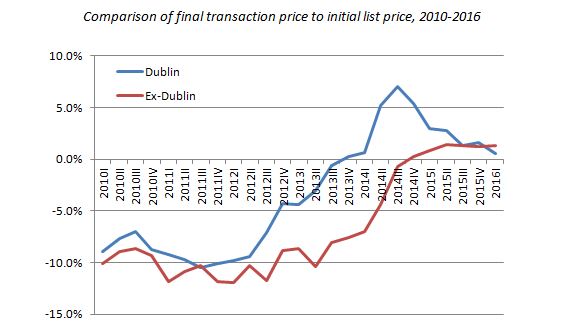
    Comparison of final transaction price to initial list price, 2010-2016  
                                                IBEC boss Danny McCoy

BUSINESS EMPLOYERS’ GROUP IBEC HAS INSISTED IT DOES NOT WANT WAGE DEMANDS LINKED IN ANY WAY TO HOUSE PRICE INCREASES EVEN AS UNIONS EYE A RETURN TO A SOCIAL PARTNERSHIP PAY MODEL.

An IBEC spokesman also told the Irish Independent that the group does not envisage a return to centralised wage agreements, and that for the “foreseeable future” wage agreements will continue to be thrashed out at an enterprise level.
IBEC boss Danny McCoy and the head of the Irish Congress of Trade Unions, Patricia King, have held meetings in recent weeks amid increasing unrest as workers from companies including Luas operator Transdev, Irish Rail and Tesco push for pay increases.
But while weekend reports suggested that the talks might pre-empt a wider shift towards returning to social partnership, an IBEC spokesman said that the business group has always held talks with unions.
“We don’t always see eye to eye, but it’s never the case that we don’t talk to each other,” he said.
He added that while IBEC is cognisant of the pressure being put on employees as a result of the housing shortage, he said the issue is equally of concern to employers.
He said that any attempt to link wage increases to rising home prices would be a step towards “repeating mistakes of the past”.
“One of the big mistakes of the boom years was the awarding of significant pay increases that did not accurately reflect the underlying health of individual businesses or the economy as a whole,” Mr McCoy told the IBEC CEO conference less than two weeks ago.
Housing starts have remained near record low levels, with the pace of construction significantly short of demand. Builders have had to fund more of construction projects themselves, while the new mortgage rules are also impacting the market.
By the middle of 2014, house prices in Dublin had risen by 40pc since the beginning of 2013. But property group Daft said that house price inflation slowed to 0.9pc in the first quarter of this year as the new mortgage rules bit. However, it said that in Dublin there are just 27 homes for sale for every 10,000 people, compared to 62 for every 10,000 elsewhere in the country.
Siptu and the National Bus and Rail Union have threatened possible strike action at Irish Rail if the company refuses to “meaningfully” engage on wage demands.

A new drug called Hsp90 inhibitor could treat resistant prostate cancers

New Drugs May Treat Lethal Resistant Prostate Cancers: Study  

MEN WITH LETHAL PROSTATE CANCER THAT HAS STOPPED RESPONDING TO CONVENTIONAL TREATMENT COULD POTENTIALLY BENEFIT FROM A NEW CLASS OF MEDICINES DESIGNED TO OVERCOME DRUG RESISTANCE, A NEW STUDY SUGGESTS.

The drugs, called Hsp90 inhibitors, which are already in clinical trials for several types of cancer, specifically target and inactivate a mechanism commonly used by prostate cancer cells to evade the effects of standard treatment, the findings showed.
The research team found that the drugs countered the effect of malfunctions in the androgen receptor, which often occur in resistance to hormone treatments.
Prostate tumours rely on male hormones called androgens to grow and spread, and blocking androgen receptors can be an effective treatment.
“We have demonstrated for the first time that Hsp90 inhibitors can block the production of the most common abnormal androgen receptors that cause many prostate cancers to stop responding to current treatments,” said study co-leader Johann de Bono, professor at The Institute of Cancer Research, London.
“These drugs are already in clinical trials for several types of cancer, and I am excited that our work suggests they could also benefit men with prostate cancer who have otherwise run out of treatment options,” he noted.
The study was published in the journal Cancer Research. The researchers investigated the effect of the drugs on human cancer cells.
Hsp90 inhibitors are among several innovative new types of treatment designed to attack cancer indirectly, by destabilising multiple different proteins required for the growth and survival of cancer cells.
By destroying several cancer signals at once, they are designed to make it hard for cancers to escape the effects of treatment, giving them promise as potential ‘resistance-busting’ drugs.
“These drugs can hit cancer harder than those targeting only one protein, and look promising for preventing or overcoming drug resistance,” study co-leader Paul Workman, chief executive of The Institute of Cancer Research, London, said.

New opportunities have to be seized in the context of changing our climate.

HUMANS HAVE MANAGED TO CHANGE THE ATMOSPHERE ON A GLOBAL SCALE, AND AS A RESULT THE PLANET IS WARMING UP


PROTESTERS AGAINST CLIMATE CHANGE PRETENDING TO BE DEAD OUTSIDE A PARIS HOTEL LAST WEEK WHERE THE INTERNATIONAL PETROL SUMMIT WAS TAKING PLACE.

It is hard to imagine there is anyone left who still questions climate change or that the altered weather patterns and global warming we are experiencing are not a consequence of human activity.
Surprisingly the doubters are out there and in considerable numbers unfortunately. They are happy to believe that humans have nothing to do with the changes we see in the seasons and in the shrinking Arctic Sea ice cover or the melting of the Antarctic peninsula.
So how do the climate-change deniers persist in the face of an overwhelming volume of scientific research that shows we are causing climate change?
A study by Trinity College Dublin and University of Exeter of 16,000 publications about climate change by 19 major think tanks over the 15-year period to 2013 showed a marked increase in attacks on research findings.
“Our data suggest that the era of climate-chance denial is not over,” says Trinity’s Prof Constantine Boussalis, who with colleagues published their findings last February in Global Environmental Change.
A recent study from the University of Queensland’s Global Change Instituteand other international colleagues writing in Environmental Research Lettersdescribes assessing tens of thousands of research papers on climate change. This is one of a number of studies that comes to the same conclusion. There is no room left for confusion about this issue; collectively humans have managed to change the atmosphere on a global scale, and as a result the planet is warming up.
The researchers found that 97% of climate scientists agree with this view. There is no uncertainty. There is no doubt. One wonders how the doubters come to their conclusions in the face of such certainty. The Queensland study was conducted to provide yet another proof – as if any more were needed – that scientists have reached a very high level of consensus on this issue.
And it isn’t just the scientists. The UN climate conference in Paris last December got 195 nations to agree to act in the face of global warming, to take action on controlling carbon release into the atmosphere, and to sign a treaty as a binding agreement to respond to the threat.
Why was the study needed given it just repeated what other studies had found?
Because the deniers who would seek to cause confusion over human-induced climate change are doing a better job at getting their message out to the people than the science lobby. They have stirred up enough doubt to make the public believe that disagreement persists amongst scientists.
The deniers claim there are valid, natural reasons for warming other than human activity so there is no need to change anything we are doing.
Theirs is a more comforting message – you don’t have to change anything, you can continue to drive your 5-litre SUV the half kilometre to the supermarket.
The result is widespread scepticism in the US and Australia, the authors say. Only 12% of people in the US are aware of the high level of scientific consensus, and the figure in Australia is 15%.
The door has already closed on this one but only a fraction of people heard the catch click on doubts over climate change.
The shadowy groups determined to keep doubts in place continue their nefarious work so who cares? Irish business innovators should.
It may be a bit of that silver lining in a deeply grey cloud, but companies here will have to adjust to an altered climate reality. This will open up newopportunities for those involved in a wide range of businesses, for example engineering companies, construction, consultants, and agriculture.
People will be looking for help and services that can provide answers for problems that arise, for example dealing with flooding risks, finding ways to guarantee water supplies, being able to cope with a wetter, hotter, stormier or drier climate or all of these depending on how it emerges in Ireland.
Now is the time to be developing ways to respond. Climate change will throw up problems but also advantages. It will come down to research and the work of scientists, technologists, engineers and not to mention meteorologists.
And stop laughing if someone jokes about the notion of Irish wineries. They already exist. We are officially listed as a wine-producing country by theEuropean Commission. We have three vineries in Co Cork, two in Mallow and one in Kinsale. There is a winery in Cappoquin, Co Waterford, and in Lusk, Co Dublin.
With our evolving climate innovation will be needed in many disciplines, with its delivery only a matter of research away.  

Sunday, May 11, 2014

Donie's Ireland daily news BLOG Saturday

Calm Frances Fitzgerald the woman who gets things done has already led major breakthroughs


At the launch of Fine Gael’s local election campaign, Frances Fitzgerald sent the candidates out to do battle on the doorsteps with a speech beginning with the declaration that most people get into politics in order to change things.

One week later, the newly appointed justice minister is being required to show she can not only make change but manage change as she takes over a portfolio in bumpy transition.
But if she had to sit herself down, self-administer smelling salts, or breathe deeply into a paper bag before saying yes to the appointment, it wasn’t showing yesterday.
Characteristically cool and unruffled, she kept a scheduled appointment, joining the Taoiseach visiting a community college for the start of the Youth2Work initiative, and returning directly to the front benches of the Dáil announcement of her promotion with a focused Fitzgerald Work demeanour.
M/s Fitzgerald, who will be 64 in August, was born Frances Ryan in Croom, Co Limerick, but her family moved to Kildare with their father who served in the army. Frances was educated at the Dominican College, Sion Hill, Blackrock, Dublin.
Leaving school, she knew what she wanted to do and went for it, graduating from University College Dublin with a degree in social science and taking a job as social worker at the now closed St Ultan’s Children’s Hospital on Dublin’s Charlemont St, which cared mainly for deprived inner city children.
It was during her early years in social work that she met her husband, the child and adolescent psychiatrist Professor Michael Fitzgerald, an expert in autism and Asperger’s.
They moved for a time to Britain, where Fitzgerald obtained a master’s degree in social work from the London School of Economics.
The couple now live in Castleknock, in the Dublin Mid-West constituency, in a suburb to which the overused description “leafy” truly applies. They have three sons, student Owen, accountant Robert, and stage actor Mark.
Back in Ireland, Fitzgerald worked in a number of hospital and social care settings and at the time of her first election to the Dáil, had most recently worked at the Mater Child and Family Centre in Ballymun.
She first got involved in politics through the Women’s Political Association, which she chaired from 1987 to 1989. But she really came to public prominence during her four-year stint as chair of the Council for the Status of Women — now the National Women’s Council of Ireland — from 1988 to 1992.
The final year of her term put her under the spotlight as she spoke out strongly on the need for reform of the laws on rape and treatment of victims following the Lavinia Kerwick case.
She was also vociferous on the right of women to make choices for themselves in the run-up to that year’s three-pronged abortion referendum, held on the same day as the general election.
Weeks before the election, Ms Fitzgerald was declared a candidate for Fine Gael in Dublin South East at the invitation of Garret FitzGerald, having also been approached by Fianna Fáil.
It was a breakthrough year for women in politics, with 20 female TDs elected, a massive leap on the previous record of 14; but with just 25 currently, the momentum has been slow since.
Ms Fitzgerald held the seat for 10 years, serving in opposition under John Bruton and Michael Noonan, firstly as party spokesperson on arts and then defence before putting her background to use in social, community, and family affairs, equality, and social welfare.
During this time, she was also elected to Dublin City Council, having lost her Dáil seat after Fine Gael’s slump in the 2002 general election.
She stood in the 2007 general election without success but returned to Leinster House via the Seanad and was made leader of the opposition as well as Fine Gael spokesperson on health and children.
It surprised nobody that when Fine Gael returned to power in 2011, Ms Fitzgerald not only got back into the Dáil but into Cabinet, being appointed the country’s first full children’s and youth affairs minister.
She has since scored notable successes, getting the children’s rights referendum passed, and establishing the Child and Family Agency to tidy up the baffling array of often overlapping and uncoordinated statutory agencies involved in child welfare.
She was also responsible for making creche inspection reports public, has action plans on childhood bullying and obesity, and generally speaks a lot of sense about youth drinking, crime, and pressure from social media.
She was a calm voice through last year’s abortion controversies and although she has attracted the ire and despair of many adopted people by moving slowly on releasing adoption papers, she rarely attracts criticism in either the public or political arenas.
But that could all change with her promotion to justice.

The Irish poor cut back on medicines because of drug levies


CHRONICALLY ILL PATIENTS ARE GOING WITHOUT NECESSARY MEDICINES BECAUSE OF THE €1 HIKE IN THE PRESCRIPTION LEVY.

Pharmacists have found that 38% of medical card holders say the increase makes them “think twice” before seeking prescriptions.
The issue will be discussed this weekend at the National Conference of the Irish Pharmacy Union in Ballyconnell, Co Cavan, which is being attended by hundreds of pharmacists from across the country.
EXEMPTION: Incoming president Kathy Maher has called on the Government to introduce an exemption from the charge for vulnerable patients including the homeless, people with intellectual difficulties and those in palliative care and residential care.
The cost would not be huge, but the benefits to these patients would be, she said.
“As pharmacists, we are very concerned that the hike in the levy is having a significant impact on medicine usage,” she said.
“We need to make sure that vulnerable patients are encouraged to take prescribed medicines, not discouraged.
An independent behaviour and attitude survey of medical card holders found 38pc were reluctant to get all the medications on their prescription list because of the dispensing cost per item of €2.50. The fee was raised in the last budget.
M/s Maher said the main issue this weekend will be the expanded role of the pharmacist in health care.
“International evidence suggests that there is huge scope for pharmacists to expand their services and to help alleviate pressures elsewhere in the healthcare system with considerable benefits for patient welfare,” she said.
An expanded role, she added, could alleviate pressure on hard-pressed family doctors.
Patients with minor conditions or with chronic conditions could have their medications or their conditions reviewed by the pharmacist.
“Our members want to engage with the Government to see their role expanded,” added M/s Maher.
The prescription levy was introduced in 2010 and caused outrage.
When he took office in March 2011, Health Minister James Reilly promised to scrap the levy. Instead, it has increased from 50c to €2.50.
BUDGET: In the 2013 Budget alone, the fee underwent a three-fold increase to €1.50.
Patients with a medical card have to pay the fee for each item under prescription, though the cost is capped at €25 a month.
The total charge was originally capped at €10 a month, which increased to €19.50 when the fee was at €1.50.
It was expected the fee would raise €2m a month when it was introduced.

Plight of the Irish homeless people highlighted


Homeless families held a protest about Ireland’s housing crisis on last Friday.

With the backing of Paul Murphy MEP and the Anti-Austerity Alliance, who helped organise the Dublin-based protest, they called for rent controls, the building of new homes and an end to discrimination against people on rent allowance.
The protest was the brainchild of Gwen Connell and Tamara Kearns who have both had personal experience of homelessness.
Ms Connell, who was forced out of her home due to a 400 euro rent hike, said: “There is a massive housing crisis in the country at the moment, which is particularly severe in Dublin. Anyone who is trying to find rental accommodation will know that rents have increased massively over the last year or so. This and the lack of housing is resulting in families becoming homeless.
“It’s time for the Government to act. They are allowing landlords to abuse the system and are wasting huge amounts of money putting homeless families up in hotels. There are 90,000 people on the housing waiting list, we need the immediate building of social and affordable housing, release the Nama houses and to introduce rent controls.”
Ms Kearns, who was forced along with her family into a homeless unit after they were unable to keep up with their rent, said: “My family and I have been homeless since October last year. We could no longer afford to keep up the price of rent. We do not receive rent supplement and we are not entitled to help from the social welfare. Our lives have been turned upside down. Our children are finding it hard to settle and have nowhere to play. Our daughter has had to change school, we don’t know for how long.
“I contacted all the so called ‘right people’ and was left stunned by the lack of a decent response.”
Councillor Ruth Coppinger of the Anti-Austerity Alliance called on the Government to “act immediately” to solve the housing crisis while Mr Murphy claimed that cuts to housing budgets would not help families who are on the housing waiting list for years. He suggested that massive state investment is needed to provide homes.

‘When mothers think there not perfect' they feel lots of guilt


An Irish counselling charity has said there is no national policy on screening for post-natal depression in Ireland, and is holding a conference today to highlight this issue and others.

Nurture claims the Irish health system does not cater well for those with mental health issues around conception, pregnancy, childbirth or loss of a baby.
The group is holding an ‘Emotional Wellbeing Education Conference’ conference in Dublin today Friday to raise greater awareness of mental health issues.
  Some 42,000 women are diagnosed each year with mental illness and emotional trauma surrounding childbirth. An estimated 13% of Irish women suffer with post-natal depression, with women from all socio-economic backgrounds affected.
Senior lecturer at the School of Nursing and Midwifery at UCC Dr Patricia Leahy Warren carried out a study on social support for first-time mothers, which revealed tremendous pressure to be the “perfect mother”.
“Every mother wants to be the best mother, so they feel they have to put up this front,” she said.
“There’s a society pressure to get into size zero jeans, that you have to be breastfeeding, that you have to love your baby… When mothers don’t have these feelgood factors, they feel guilty and they feel they can’t tell anybody about it, because they feel so bad about it.”

Tangible Leadership Series a charter for a New & excellent Ireland

   
The Tangible Leadership Series is a speaker series that was established by Raymond Sexton in early 2009. The purpose and aim of the organization is to assemble a diverse collection of intellects and advocates to create an excellent Ireland.
Founded by Raymond Sexton (above right picture) the participants debate issues in a positive and pragmatic way. Tangible Leadership Series has now taken place from Crossmaglen in Northern Ireland to Sydney and yesterday Tangible New York took place in Rockefeller Plaza hosted by Irish American lawyer John C. O’Reilly of Squire Saunders.
In attendance were an eclectic mix of Irish diaspora. The main topic under discussion was the notion of the global Irish nation and what can be done to engage positively with Irish diaspora all over the world. The group heard presentations from Neil O’Hagan, Atlantic Youth Trust, Noreen Bowden, Global Irish, Eve Earley Empowering Change, Paul Finnegan CEO of New York Irish Center and Ann Murtagh of Fitzpatrick’s Hotel Group.
The Irish are a courageously global people. Ireland is both the earth wire for this people and the source of great pride as it took its place among the free nations of the earth, but one small island in the Atlantic can no longer limit our dreams and aspirations. In an era of serial crises, Ireland, beset with institutional and leadership problems, seeks a new way of moving
Combining the Irish in Ireland and the Irish Diaspora to create the Global Irish will unleash the power of a people of great art, creativity and energy. Moving beyond one small island frees us from parochialism and allows us to enhance our contribution to the world. To ignore the Irish outside Ireland is an act of wanton neglect.
To create the structures that guarantee the inclusion and participation of all the Irish in the life of the nation is to create the global Irish Republic. Once created, Irish emigration ceases; from that day, Irish people are always at home and Irish nationalism is replaced by Irish internationalism.
All Irish-born people are entitled to citizenship. The descendants of our emigrants together with immigrants to Ireland and others with a strong affinity to Ireland should be entitled to apply for citizenship of a global Irish Republic. All citizens should have appropriate representation in the houses of Irish government and the opportunity to contribute to developing Ireland’s role in the world. This global Irish Republic should be a non-ethnic, true republic in which we can all participate and take pride; it should not tolerate domination, segregation or sectarianism.
It is now time to find and work with the willing to develop the policies, projects and structures that will breathe life into Global Irish-ness. Through collaborative leadership we can create a culture of shared excellence throughout the Irish world. We can build a truly dynamic and sustainable economy that benefits all our people and powers the social services necessary for a humane society.
No longer content with mediocrity or with the worst of the ways of the past, with passivity, deference and dependence, we will apply the full range of skills, qualities and abilities of all our people to the challenges we face.

Honeybee population collapse is due to use of insecticides

SCIENTIST’S CLAIM


Another mystery has been solved: recent honeybee population collapses are due to insecticides, according to a team of Harvard researchers.

The mysterious decline of honeybees over the past several years has been blamed on everything from cell phone radiation to global warming, but the scientists now believe they have evidence that the collapse can be blamed primarily on two widely used insecticides. The study, out of Harvard’s School of Public Health, was published in the Bulletin of Insectology this week.
The recent dramatic decline of honeybee populations is largely due to a phenomenon known as colony collapse disorder, in which bees abandon their hives in the winter and eventually die. The researchers followed 18 colonies in Massachusetts, monitoring them for population levels and exposure to insecticides.
What they found is an indictment of modern agricultural practices: the populations with the worst outcomes were exposed to two kinds of neonicotinoid, a kind of insecticide, during an especially harsh winter. According to the paper, this is because the cold weather triggers a neurological response in bees exposed to the insecticide:
It is striking and perplexing to observe the empty neonicotinoid-treated colonies because honey bees normally do not abandon their hives during the winter. This observation may suggest the impairment of honey bee neurological functions, specifically memory, cognition, or behaviour, as the results from the chronic sub-lethal neonicotinoid exposure.
The findings could have big implications for industry: the European Union last year banned three kinds of neonicotinoid for a two-year trial, and the Harvard scientists’ findings may lead to more of the same. With increasing weather extremes and more need than ever to grow and pollinate healthy crops, the study spreads much further than just the honey industry. “Hopefully,” the study’s authors say of the findings, “we can reverse the continuing trend of honey bee loss.”