Pages

Showing posts with label Irish Rising. Show all posts

Tuesday, May 3, 2016

Donie's Ireland daily news BLOG

Richmond Barracks Dublin becomes the permanent reminder of the Irish Rising 100 years on

COURTS MARTIAL OF REBELS TOOK PLACE AT THE INCHICORE SITE

    
Sarah Morris and Robbie O’Connor performing for Sabina Higgins, Dublin Lord Mayor Críona Ní Dhálaigh and Joan Burton at the opening of Richmond Barracks.
One hundred years to the day that 1916 rebel leaders were court martialled at Richmond Barracks in Dublin, their relatives attended the reopening of the site as a tourist attraction.
The barracks in Inchicore has been designated one of the nine so-called permanent reminders” of the Rising and has been redeveloped by Dublin City Council as part of the Ireland 2016 centenary programme.
It will open next month as an interactive multimedia centre which will trace the story of the site from military barracks, to housing estate, to school. It also has a tea room and landscaped garden area.
Tours will incorporate the adjacent Goldenbridge cemetery, which will be open to the public for the first time.
More than 3,000 people, including the leaders, were rounded up and taken to the barracks for processing in the days following the Rising. Pádraig Pearse, Thomas McDonagh, and Thomas Clarke were among those court martialled on Tuesday, May 2nd, 1916, in the gymnasium.
Those in attendance at Monday’s reopening included the family of former taoiseach Liam Cosgrave.
Sabina Higgins, wife of President Michael D Higgins, was guest of honour and the event was also attended by Tánaiste Joan Burton and British ambassadorDominick Chilcott.
Relatives of the 77 women who were held at the barracks were also in attendance and their names were recited as part of the Flames Not Flowers performance art project.
Christina McLoughlin, from Dublin, said her uncle Sean McLoughlin and aunt Mary McLoughlin, then aged just 15, had been in the GPO during the Rising.
Their brother Paddy was in the Four Courts although it had proven harder to get information about him.
Deirdre Ní Enruigh, also from Dublin, said both her grandfathers had fought in 1916. Her mother’s father, John “Blimey” O’Connor, had come over from London in January 1916. Her paternal grandfather, Frank Henderson, captain of the F Company, came to the GPO from Fairview on the morning of the Rising.
The executive chair of Richmond Barracks, Eadaoin Ní Chléirigh, said the site had been part of the community in Inchicore for more than 200 years and had “a huge significance in Ireland’s national history”. The redevelopment by the city council, Purcell Construction and conservation architects Blackwood Associates with Margaret Quinlan Architects had been a “labour of love”.

Calls for increase in rent supplement to address the Irish homelessness issues


 AN IMMEDIATE INCREASE OF 28% IN RENT SUPPLEMENT IS REQUIRED IN ORDER TO PREVENT MORE FAMILIES FROM BECOMING HOMELESS, CAMPAIGNER FR PETER MCVERRY (ABOVE MIDDLE PIC.) SAID.

He was addressing the annual May Day parade, organised by the Dublin Council of Trade Unions, in the city centre yesterday.
Several hundred trade unionists and activists marched under their banners from the Garden of Remembrance on Parnell Square to Liberty Hall, where they were addressed by a number of speakers urging changes to employment legislation to protect workers’ rights.
Fr McVerry told the crowd that when the figures became available, they would show that while the political parties had been trying to form a government, some 200 families and about 300 individuals would have become homeless. “There is no sense of urgency, no sense of priority about dealing with this hugely critical problem at the moment.”
Over the next two weeks another 150 emergency beds would be taken out of the system, he said. “And they don’t know where they are going to go. They may very well end up, many of them, back sleeping on the streets.”
Emergency legislation was also required to prevent banks and financial institutions evicting people from their homes until they had found alternative suitable accommodation.
Fr McVerry said compulsory purchase orders were required for empty buildings to allow them to be used for family accommodation. He urged the incoming government to discuss the barriers to any such policy.
Marching with former employees of Clerys department store, which closed suddenly last year after its sale to a consortium, Siptu organiser Teresa Hannick said their campaign for changes to employment legislation was continuing.
“They are here to make sure no other worker has to go through what they went through,” she said. Chanting ‘justice for the Clerys workers’, the group stopped briefly outside the shuttered store on O’Connell Street.
Gerry Markey, speaking on behalf of the workers at the rally outside Liberty Hall, welcomed reports that the government had opened an investigation into the closure and sale last year which led to the immediate sacking of 460 staff.
Pat Bolger, of the DCTU, spoke about injustices in the healthcare system. He said the Impact union had warned the Government that its proposals for universal healthcare were unworkable. “When will anybody in power listen to the real experts – the staff, the workers, their unions and the patients?”
Former Ictu president John Douglas, speaking on behalf of Tesco workers, said their recent ballot for strike action over planned changes to their pay and conditions, was the answer to any employer who thought it could “roll over” workers without any regard to trade unions.
Activists and trade unionists marched under banners for Mandate, Siptu, the CPSU, Labour Youth, Unite, Anti-Austerity Alliance, People Before Profit, Irish Housing Network, Labour Youth, DCTU, Limerick Soviet, Ireland-Palestine Solidarity Campaign.

Please do not link Irish wage demand rises to housing inflation?

SAY’S IBEC
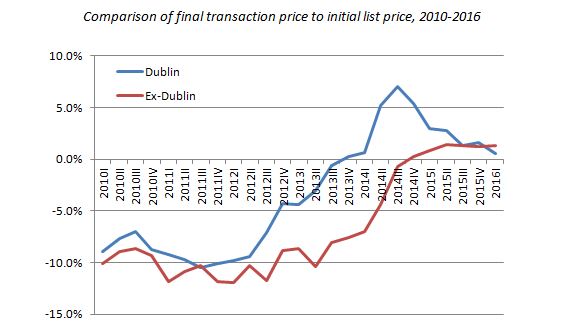
    Comparison of final transaction price to initial list price, 2010-2016  
                                                IBEC boss Danny McCoy

BUSINESS EMPLOYERS’ GROUP IBEC HAS INSISTED IT DOES NOT WANT WAGE DEMANDS LINKED IN ANY WAY TO HOUSE PRICE INCREASES EVEN AS UNIONS EYE A RETURN TO A SOCIAL PARTNERSHIP PAY MODEL.

An IBEC spokesman also told the Irish Independent that the group does not envisage a return to centralised wage agreements, and that for the “foreseeable future” wage agreements will continue to be thrashed out at an enterprise level.
IBEC boss Danny McCoy and the head of the Irish Congress of Trade Unions, Patricia King, have held meetings in recent weeks amid increasing unrest as workers from companies including Luas operator Transdev, Irish Rail and Tesco push for pay increases.
But while weekend reports suggested that the talks might pre-empt a wider shift towards returning to social partnership, an IBEC spokesman said that the business group has always held talks with unions.
“We don’t always see eye to eye, but it’s never the case that we don’t talk to each other,” he said.
He added that while IBEC is cognisant of the pressure being put on employees as a result of the housing shortage, he said the issue is equally of concern to employers.
He said that any attempt to link wage increases to rising home prices would be a step towards “repeating mistakes of the past”.
“One of the big mistakes of the boom years was the awarding of significant pay increases that did not accurately reflect the underlying health of individual businesses or the economy as a whole,” Mr McCoy told the IBEC CEO conference less than two weeks ago.
Housing starts have remained near record low levels, with the pace of construction significantly short of demand. Builders have had to fund more of construction projects themselves, while the new mortgage rules are also impacting the market.
By the middle of 2014, house prices in Dublin had risen by 40pc since the beginning of 2013. But property group Daft said that house price inflation slowed to 0.9pc in the first quarter of this year as the new mortgage rules bit. However, it said that in Dublin there are just 27 homes for sale for every 10,000 people, compared to 62 for every 10,000 elsewhere in the country.
Siptu and the National Bus and Rail Union have threatened possible strike action at Irish Rail if the company refuses to “meaningfully” engage on wage demands.

A new drug called Hsp90 inhibitor could treat resistant prostate cancers

New Drugs May Treat Lethal Resistant Prostate Cancers: Study  

MEN WITH LETHAL PROSTATE CANCER THAT HAS STOPPED RESPONDING TO CONVENTIONAL TREATMENT COULD POTENTIALLY BENEFIT FROM A NEW CLASS OF MEDICINES DESIGNED TO OVERCOME DRUG RESISTANCE, A NEW STUDY SUGGESTS.

The drugs, called Hsp90 inhibitors, which are already in clinical trials for several types of cancer, specifically target and inactivate a mechanism commonly used by prostate cancer cells to evade the effects of standard treatment, the findings showed.
The research team found that the drugs countered the effect of malfunctions in the androgen receptor, which often occur in resistance to hormone treatments.
Prostate tumours rely on male hormones called androgens to grow and spread, and blocking androgen receptors can be an effective treatment.
“We have demonstrated for the first time that Hsp90 inhibitors can block the production of the most common abnormal androgen receptors that cause many prostate cancers to stop responding to current treatments,” said study co-leader Johann de Bono, professor at The Institute of Cancer Research, London.
“These drugs are already in clinical trials for several types of cancer, and I am excited that our work suggests they could also benefit men with prostate cancer who have otherwise run out of treatment options,” he noted.
The study was published in the journal Cancer Research. The researchers investigated the effect of the drugs on human cancer cells.
Hsp90 inhibitors are among several innovative new types of treatment designed to attack cancer indirectly, by destabilising multiple different proteins required for the growth and survival of cancer cells.
By destroying several cancer signals at once, they are designed to make it hard for cancers to escape the effects of treatment, giving them promise as potential ‘resistance-busting’ drugs.
“These drugs can hit cancer harder than those targeting only one protein, and look promising for preventing or overcoming drug resistance,” study co-leader Paul Workman, chief executive of The Institute of Cancer Research, London, said.

New opportunities have to be seized in the context of changing our climate.

HUMANS HAVE MANAGED TO CHANGE THE ATMOSPHERE ON A GLOBAL SCALE, AND AS A RESULT THE PLANET IS WARMING UP


PROTESTERS AGAINST CLIMATE CHANGE PRETENDING TO BE DEAD OUTSIDE A PARIS HOTEL LAST WEEK WHERE THE INTERNATIONAL PETROL SUMMIT WAS TAKING PLACE.

It is hard to imagine there is anyone left who still questions climate change or that the altered weather patterns and global warming we are experiencing are not a consequence of human activity.
Surprisingly the doubters are out there and in considerable numbers unfortunately. They are happy to believe that humans have nothing to do with the changes we see in the seasons and in the shrinking Arctic Sea ice cover or the melting of the Antarctic peninsula.
So how do the climate-change deniers persist in the face of an overwhelming volume of scientific research that shows we are causing climate change?
A study by Trinity College Dublin and University of Exeter of 16,000 publications about climate change by 19 major think tanks over the 15-year period to 2013 showed a marked increase in attacks on research findings.
“Our data suggest that the era of climate-chance denial is not over,” says Trinity’s Prof Constantine Boussalis, who with colleagues published their findings last February in Global Environmental Change.
A recent study from the University of Queensland’s Global Change Instituteand other international colleagues writing in Environmental Research Lettersdescribes assessing tens of thousands of research papers on climate change. This is one of a number of studies that comes to the same conclusion. There is no room left for confusion about this issue; collectively humans have managed to change the atmosphere on a global scale, and as a result the planet is warming up.
The researchers found that 97% of climate scientists agree with this view. There is no uncertainty. There is no doubt. One wonders how the doubters come to their conclusions in the face of such certainty. The Queensland study was conducted to provide yet another proof – as if any more were needed – that scientists have reached a very high level of consensus on this issue.
And it isn’t just the scientists. The UN climate conference in Paris last December got 195 nations to agree to act in the face of global warming, to take action on controlling carbon release into the atmosphere, and to sign a treaty as a binding agreement to respond to the threat.
Why was the study needed given it just repeated what other studies had found?
Because the deniers who would seek to cause confusion over human-induced climate change are doing a better job at getting their message out to the people than the science lobby. They have stirred up enough doubt to make the public believe that disagreement persists amongst scientists.
The deniers claim there are valid, natural reasons for warming other than human activity so there is no need to change anything we are doing.
Theirs is a more comforting message – you don’t have to change anything, you can continue to drive your 5-litre SUV the half kilometre to the supermarket.
The result is widespread scepticism in the US and Australia, the authors say. Only 12% of people in the US are aware of the high level of scientific consensus, and the figure in Australia is 15%.
The door has already closed on this one but only a fraction of people heard the catch click on doubts over climate change.
The shadowy groups determined to keep doubts in place continue their nefarious work so who cares? Irish business innovators should.
It may be a bit of that silver lining in a deeply grey cloud, but companies here will have to adjust to an altered climate reality. This will open up newopportunities for those involved in a wide range of businesses, for example engineering companies, construction, consultants, and agriculture.
People will be looking for help and services that can provide answers for problems that arise, for example dealing with flooding risks, finding ways to guarantee water supplies, being able to cope with a wetter, hotter, stormier or drier climate or all of these depending on how it emerges in Ireland.
Now is the time to be developing ways to respond. Climate change will throw up problems but also advantages. It will come down to research and the work of scientists, technologists, engineers and not to mention meteorologists.
And stop laughing if someone jokes about the notion of Irish wineries. They already exist. We are officially listed as a wine-producing country by theEuropean Commission. We have three vineries in Co Cork, two in Mallow and one in Kinsale. There is a winery in Cappoquin, Co Waterford, and in Lusk, Co Dublin.
With our evolving climate innovation will be needed in many disciplines, with its delivery only a matter of research away.  

Monday, November 17, 2014

Donie's Ireland daily news BLOG update

The 1916 Irish Rising commemoration generates lots of interest


The SIGNED PHOTO OF MICHAEL COLLINS AND the COUNTESS MARKIEVICZ LETTERS SOLD AT AUCTION

  A log from 1916 kept by Dublin Fire Brigade’s ambulance service which recorded the first fatalities and injuries of the Rising was bought by an unnamed ‘institutional archive’
Collectors of Irish historical memorabilia were out in force – in person and online – at Whyte’s auction last Saturday, where 84% of the 500 lots sold realising €230,000. Some 20% of lots were bought by internet bidders who had registered from various locations in Ireland and overseas including the US, the UK, France, Belgium, Australia, Canada, South Africa, Italy, Israel, Germany and Qatar.
Auctioneer Ian Whyte said there were “many new collectors at the sale – particularly young collectors – which reflects the great interest in Irish history generated by the decade of centenaries”. Although he could not disclose the identity of buyers, Whyte was pleased that “the institutions – the National Museum and National Library among them – were able to acquire what they needed for public collections without invoking the wrath of our EU masters”.
One of the most notable items was a log kept by the Dublin Fire Brigade’s ambulance service during the Easter Rising in 1916. It recorded the first fatalities and injuries – both military and civilian – and sold for €3,800 (€3,000-€5,000) to an unnamed Irish “institutional archive”.
Two uniforms which belonged to General Sir John Maxwell, the British Army leader who suppressed the Rising, sold as a single lot for €6,600, well below the estimate of €15,000-€20,000.
The top lot in the sale, an Irish tricolour reputedly flown over Dublin during the Rising and painted with the slogan “Sinn Féin go deo” (Sinn Féin forever), had an estimate of €30,000-€50,000, but failed to sell.
A very different flag, a large-fringed tricolour embroidered with the words “Garda Siochana. Presented to the Hon Robert E Enright, Commissioner of Police, New York City, from the Irish Police as a Token of Esteem. International Police Conference 1925’’ sold for €1,700 (€1,500-€2,000).
Two previously unpublished letters, dated 1918 and written by Countess Markievicz deploring all things English, including the introduction of Greenwich Mean Time in Ireland, made €1,900 (€2,000-€3,000).
Two letters written in May 1916 by Lady Wimborne, wife of the viceroy and effectively Ireland’s “first lady” during the Easter Rising on notepaper headed “Vice Regal Lodge”, made €1,400 (€1,000-€1,500).
A photograph of women workers in a first World War munitions factory – the National Shell Factory on Dublin’s Parkgate Street – sold for €220 (€150-€200).
A signed photograph of Michael Collins in a Free State army uniform made €900 (€300-€500). However a souvenir programme signed in pencil on the cover by Michael Collins (in Irish as “Micheál Ó Coileáin”) and a ticket for a 1921 concert in his honour at London’s Royal Albert Hall, estimated at €5,000-€7,000, failed to sell.

Farmers of today are Europe’s new Renaissance men


“Today’s farmers are new Renaissance men: they must possess the right mix of science, economics, entrepreneurialism, and environmental awareness to meet the challenges of the future.”

That’s according to European Parliament President Martin Schulz who made the comment in a recent speech entitled Feeding the Planet: Energy for Life.
He said we need innovative solutions to meet the double challenge of increasing scarcity and growing demand and stressed that the European Union’s Common Agricultural Policy must help farmers to advance in exactly this direction.
In a wide ranging speech on food, Schulz said Europe needs to show its capability to foster a change of culture in the consumption of food.
He cited that the Commission estimates the annual food waste generation in the 28 Member States is over 100 million tonnes, or 179 kilograms per capita.
He said this requires a leap change in our education and habits. The European Parliament set out its position on this in a resolution in January 2012 on how to avoid food waste.
This year the Commission came with a proposal to amend the Waste Framework Directive, aiming at the development of a comprehensive strategy to combat unnecessary food waste.
According to Schulz the sustainability of our food chain in Europe does not mean closing out to the world as some suggest.
He said an open Europe is a Europe that helps lifting millions of people out of poverty and it is one that is advantageous to consumers and helps the competitiveness of our farmers.
“Yet, food is not just another additional tradable commodity like any other,” he said.
Schulz said while investments in agriculture to increase yields and profitability are welcome. Rampant speculation which can have devastating consequences on the lives of millions,

Some 12 ways this winter to slash your heating bills and reduce your future chills & bills


As the beautiful warmth of the summer sun fades away temperatures start to drop, one of our biggest financial worries rears it’s ugly head the HEATING BILLS.

Here are a few things you can do to keep you cosy before it starts to get colder.

1. CHECK YOUR BOILER

It might feel like you are spending a lot of money, but servicing your home boiler once a year could actually become a money saver and save you the hassle of unplanned breakdowns.
And if you can afford it, replace your old boiler with a new one as it will improve your central heating system and save you money in the long run. That’s because a boiler that’s 15 years old or more is only around 60-70% efficient, which means 30p of every pound spent on heating and hot water is pretty much wasted.

2. TAKE A LOOK AT YOUR CYLINDERS

 If you have cash to spare, look for a new cylinder for your boiler – because they generally come with a thick layer of built-in insulation.
Alternately, if you are tight on cash, try fitting your old cylinder with new insulation jacket that’s at least 75mm thick.
According to the UK’s Energy Saving Trust, fitting a jacket to an uninsulated cylinder could save you anything from £85-£130 a year (based on a typical gas-heated home in England, Scotland and Wales).

3. INSULATE YOUR PIPES

  A quick and helpful way to conserve your heating would be to insulate your heating and hot water pipes. By doing this, you will prevent unnecessary heat loss and stop them from freezing in the winter.
The easiest way to insulate pipes is to use pre-scored foam tubes, which snap over and around the pipes and come in different diameters for a snug fit.

4. HAVE CONTROL OVER YOUR RADIATORS

To make sure your radiators are working at full capacity, bleed them with a radiator key (only when the heating is off and the radiators are cold). Many older radiators don’t have adjustable valves (they only have on and off modes) so fitting new valves will enable you to control the heating.

5. GET SMART WITH TEMPERATURE CONTROL

There are an array of smart systems in the market which allow you to control your heating and hot water with the touch of a smartphone. So instead of leaving the heating on when you go out on a cold day, you can turn it on remotely with your smartphone when you’re on your way home.
One of the newest gizmos is therM, which is compatible with any heating system with a thermostat – if you can do basic wiring, you can fit therM yourself.

6. PUT A LOG ON

While there’s nothing more cosy than snuggling in front of a cosy open fire, the sad thing is, they’re not very energy efficient. On the other hand, majority of wood-burning stoves boast 70% to 90% efficiency, so you get all the benefits of a real fire without your money going up in smoke.
The good news is, wood burners are not as expensive as you think and start at less than £200. Also, as long as it’s sustainably sourced, wood is a more environmentally-friendly fuel than oil or gas and subject to fewer price rises.

7. MIND THOSE GAPS

Did you know around a third of the heat lost from uninsulated houses disappears through the walls? That’s because most homes have cavity walls – the gap in the middle of exterior walls. Filling them with insulation can make your home more energy efficient.
This not only means reduced heating costs, you’ll be making your house “greener” in the process. Cavity wall insulation typically costs £450 to £500 – which sounds steep now but they will last a long time and you will recoup the costs through energy savings.
According to the Energy Saving Trust, installing cavity wall insulation in a three-bed semi (with gas central heating) could save you up to €180 a year.

8. SWAP YOUR FURNITURE

  Does your room feel cold despite having your radiators on full blast? One of the reasons could be that you have a piece of furniture in front of it – say a sofa?
In this case, your best option would be to either move the radiator or swap a horizontal radiator for a vertical one, which will take up less space at sofa level. If you can’t afford to do this, move or replace your furniture to get more out of the existing radiator.

9. CHECK YOUR WINDOWS

Old, especially single-glazed, windows are a major source of heat loss. Replacing windows is obviously expensive, but you can work with what you have by fitting secondary glazing units (clear film you fix in place across the windows) or buying thermal curtains.
You can also fit weatherstripping, which is draught-proofing tape that helps to fill the gap between the frame and the window’s moving parts.

10. GET FABRIC DRAFT EXCLUDERS

They come in all colours, shapes and sizes, and can cold-proof your home immediately, with that added benefit of looking nice.

11. INSPECT YOUR LOFT

  One of the best ways to make your home more energy efficient is to insulate the loft.
According to the Energy Saving Trust, a quarter of the heat in an uninsulated home is lost through the roof. They say that laying 27cm of insulation, which is the recommended depth for mineral wool (other materials may vary), in an uninsulated loft will save you up to £180 a year (based on a three-bed semi with gas central heating).
Even if your loft has insulation, it may not be thick enough. The Trust calculates that if everyone in the UK fitted 27cm of loft insulation, the saving would be almost whopping £500 million a year!

12. AND FINALLY, PILE ON THE JUMPER

While this is no replacement for central heating, you can keep your rising bills in check by layering up with cosy cardis and give the heating a break for a few hours.

Eating disorders most common in women of their 30s


WEIGHT-LOSS FADS ARE PUTTING WOMEN’S LIVES IN DANGER, ACCORDING TO BODY-IMAGE EXPERTS

Weight-loss fads are putting women’s lives in danger, according to body-image experts
CALLS to a helpline for people suffering from eating disorders have soared by 92pc in the first six months of the year, disturbing new figures obtained by the Sunday Independent reveal.
And for the first time, the majority of people reaching out for help are women aged between 25 and 35 years – and not image-conscious teenagers.
The latest figures from Bodywhys – the Eating Disorder Association of Ireland – have revealed anorexia, bulimia, binge eating and unhealthy relationships with food are becoming more prevalent in older women and men, largely due to our increasingly hectic lifestyles.
In an interview with the Sunday Independent, Harriet Parsons, psychotherapist and services co-ordinator at Bodywhys, said “life stresses” have shifted the impact age from 19-24 to 25-35 years.
“Although an anti-stigma message is taking effect, people are still reaching out in their late 20s and early 30s where they really thought their life would have been sorted but they find they are still struggling a bit,” she said.
“Among that age group, you would have people with eating disorders since their teens.”
Last year more than 70pc of those attending Bodywhys support groups were over the age of 25, and some have been battling eating disorders for over 10 years.
“There can be a number of triggers at any age,” said Ms Parsons. “It’s usually something happens in a person’s life that causes them conflict, stress and that’s difficult, and they find themselves in a situation where they might not feel strong enough to deal with it.”
From finishing college and starting a new job, to going through a break-up or deciding to go on a diet – all these situations could potentially spark a problem with food.
“If you think of the life changes that might be happening within that age group, lots of people are probably having a significant relationship, marriage or having children and it can unsettle you or destabilise your world.
“It’s a bit like a comfort blanket. It turns into a way of coping- it actually helps them for a while and makes them feel better and stronger and more capable,” Ms Parsons added.
Dr Sarah Prasad, consultant psychiatrist on the eating disorder programme at St Patrick’s University Hospital, Dublin, agreed that eating disorders are “not a teenage problem”. She said the hospital has also experienced more referrals of older individuals battling the illness.
She told the Sunday Independent: “A lot of people associate the disorder with young girls but we’ve had people in their 20s, 30s, 40s and 50s who’ve had long-standing eating disorders and now are completely overwhelmed and can’t cope. “There is huge pressure on shape and body image on top of other stresses of life and that certainly could be a predisposing factor for the development of eating disorders at an older age. Looking a certain way and fitting a stereotypical thin ideal or image is something people are dealing with at every age.”
Developing an eating disorder in your 30s can also bring further problems for recovery.
“Putting your body under stress at any age is always detrimental. There is some evidence to suggest that the later the onset, sometimes the poorer the prognosis,” Dr Prasad said.
Dr Prasad, who deals specifically with adult patients, said she has often discussed fitness blogs, social media sites and all the latest apps during consultations.
“The message is, everything in moderation but some vulnerable individuals who are perfectionist or with low self-esteem might take these blogs to the extreme, thinking it will make them more acceptable or more valued.”
And she is particularly concerned with the most recent weight-loss trend called “thigh gap” where women and girls want their legs to be so slim that their thighs don’t touch when their feet are together.
“A lot of my patients are under that pressure and we constantly have conversations about this ‘thigh gap’ business and they tell me about the pressure they feel in their 20s, when impression is so huge and they think they have to have this gap between their thighs to fit in, and we have overcome this.”
Eating disorders manifest in different ways, including the restriction of food, skipping meals, over exercising, a focus on not eating, resulting in the person becoming very underweight.
According to Ms Parsons, the behaviour can then become more and more extreme and, depending on the type of eating disorder, be “very destructive to quality of life”.
“It becomes unmanageable, and they can’t do it anymore, and everything just feels like it’s falling down around them so they seek out help,” she added.
Although an eating disorder is always a subjective experience, Ms Parsons warns “living in a culture where there is a diet industry” makes it more difficult to avoid.
“There is always a focus on the ideal image of that very simple message that if you eat less and exercise more you will be a better person and you’ll be happy. It is a very distorted message.”
Ms Parsons said those affected are “very clear” this is not about media and culture, and they would “not want that idea to be associated with them”.
But it’s also more difficult to identify. “They can be quite high achievers and are living their lives, but really they are not well physically and psychologically.”
And for men in their later 20s and 30s, eating disorders manifest in the same way. “There is a growing pressure on the physicality and physique, so it can be identified by extreme over-exercising, but men also express anorexia, bulimia and eating disorders in exactly the same way as women and girls,” Ms Parsons added.

Scientists are divided over the ethics of attempting to cloning & revive an extinct mammal the Woolly mammoth

AN EXCEPTIONALLY WELL PRESERVED ADULT FEMALE WAS DISCOVERED IN SIBERIA IN MAY 2013

Will woolly mammoths stride the Siberian plains once again? DNA samples from an exceptionally well preserved extinct Mammuthus, found in the snowy wastes of Siberia, have raised the prospect of cloning.
But scientists are divided about raising the species from the dead, 10,000 years after becoming extinct.
Russian scientists were amazed at the condition of the mammoth, found embedded in a chunk of ice on a remote Siberian island. The samples were so well preserved that fresh blood was found within muscle tissue.
The team used carbon dating techniques to reveal the animal had walked the Earth around 40,000 years ago and raised hopes that it could be cloned.
Nicknamed Buttercup, the adult female was discovered in May 2013. At 2.5 metres tall, she is not much larger than an Asian elephant. Incredibly, three legs, most of her body, some of her head and her trunk had survived. She was in her fifties when she became trapped in a peat bog and was eaten by predators, scientists believe.
A Channel 4 film, to be shown next weekend, follows Buttercup’s autopsy in Siberia, and the extraction of high-quality DNA and cells for future use by Sooam, a South Korean biotech company.
The Korean researchers hope to find a cell with a complete nucleus, containing an intact genome.
“We’re getting an unprecedented amount of access to mammoth samples through this collaboration,” said Insung Hwang, a geneticist at Sooam.
“DNA has been distributed to multiple institutes for scientific purposes,” he added.
Dr Tori Herridge, a palaeobiologist based at the Natural History Museum in London said: “The guys from South Korea, who are collecting tissue for cloning, were excited because the better preserved the tissue, the greater their hopes were that there would be some intact DNA.”
However she warned that the dream of bringing the woolly mammoth back to life would be a cruel nightmare for their modern- day descendant, the elephant.
Dr Herridge, an expert in mammoth anatomy, said: “The most fundamental step and ethical concern with this kind of procedure is that you need to have an Asian elephant surrogate mum at some point; cloning a mammoth will require you to experiment on probably many, many Asian elephants.” She added: “The most important thing is how much we can learn without having to go down the route of cloning.”
Dr Herridge questioned “whether or not the justifications for cloning a mammoth are worth the suffering, the concerns of keeping an elephant in captivity, experimenting on her, making her go through a 22-month pregnancy, to potentially give birth to something which won’t live, or to carry something which could be damaging to her. And all of those aspects… I don’t think that they are worth it; the reasons just aren’t there.”
The autopsy has already provided crucial information. The growth rings on the mammoth’s tusks, which grew at a slower rate during pregnancy, revealed she had given birth at least eight times. And examination of her teeth revealed dental abnormalities, indicating she wasn’t able to chew her food properly, which may explain the small stones which were found in her gut.
Mr Hwang accepted that “there are inherent ethical questions that we have to address”.
“That’s why we have to start discussing the implications now,” he said. “Some of our colleagues are still working on analysing the genome from Buttercup’s specimen. This is a long and complicated process that is unlikely to be finished anytime in the near future.
“Bringing back the mammoth either through cloning or genetic engineering would be an extremely long process as well. We’re trying hard to make this possible within our generation.”