Pages

Showing posts with label Parenting. Show all posts

Wednesday, November 30, 2016

Donie's Ireland daily news BLOG update

Dáil expected to pass Bill legalising medicinal cannabis

UP TO 90 TDS SUPPORT NEW LEGISLATION PROPOSED BY PEOPLE BEFORE PROFIT’S GINO KENNY

Image result for Dáil expected to pass Bill legalising medicinal cannabis   Image result for Dáil expected to pass Bill legalising medicinal cannabis

GINO KENNY TD, WHOSE BILL FOR THE LEGALISATION OF MEDICINAL CANNABIS HAS RECEIVED WIDESPREAD SUPPORT IN THE DÁIL.

Legislation allowing for the use of cannabis for medicinal purposes is expected to pass through the Dáil.
A Bill proposed by People Before Profit TD Gino Kenny has secured the support of Fianna Fáil, Sinn Féin, Labour, the Social Democrats, the Green Party and his colleagues in the Anti-Austerity Alliance.
A number of other Independent TDs including Dr Michael Harty and the Independents4Change are also expected to back it.
The Independent Alliance, which includes Minister for Transport Shane Ross, Minister of State at the Department of Health Finian McGrath and Minister of State John Halligan, has also secured a free vote on the legislation.
This means the Bill will have the support of up to 90 TDs in the Dáil ensuring its passage through the House.
Minister for Health Simon Harris is likely to propose a reasoned amendment to the legislation.
Mr Harris is eager to see change on the issue of medicinal cannabis but is awaiting a report from the Health Products Regulatory Authority (HPRA) on the subject. It is due to report back by the end of January.
The Minister has met Mr Kenny and People Before Profit TD Richard Boyd Barrett to discuss the legislation.
Mr Harris has asked the deputies to consider adjourning the debate or suspending the vote until the report is concluded.
The Bill, which is to be debated on Thursday, provides for the regulation of cannabis for medicinal use so that patients can receive a legally protected, secure supply that is safe and effective.
Regulatory authority?
However, it also proposes the establishment of a cannabis regulatory authority, which would be tasked with regulating the sale, labelling, advertising and marketing of cannabis and related products.
A Cannabis Research Institute, which would conduct or commission and publish cannabis-related research, has also been proposed.
Once the Bill is passed it will go to the Oireachtas health committee for examination.
While a number of parties have agreed in principle to support the Bill, it is likely they will seek a number of changes at committee stage.
Sinn Féin is to request the HPRA oversee the regulation of cannabis rather than establishing two new bodies. Fianna Fáil, the Independent Alliance and Labour are likely to seek safeguards to ensure this does not lead to abuse of the law or the decriminalisation of cannabis.
Under the Misuse of Drugs Acts 1977 to 2016, cannabis is subject to stringent controls. A doctor can prescribe cannabis products in limited circumstances if granted a licence by the Minister for Health. One cannabis-based medicine, Sativex, is authorised for the treatment of multiple sclerosis in limited circumstances. Legislation could be amended to allow for its prescription on a wider basis.
Cannabis for medicinal use is permitted in the Netherlands, Croatia, Malta, the Czech Republic, Australia, Canada and a number of US states.
Minister of State with responsibility for the National Drugs Strategy Catherine Byrne said there should be an option for people to access cannabis for medical use.
“I have had a lot of calls on the issue with people making very good cases in favour of legalising cannabis for medical use, and against. In my own position, as Minister of State, I would be concerned that there would have to be very tight controls on it,” she said.
“I wouldn’t want people to think we are legalising cannabis, which is something I’d be totally against. We don’t want to see cannabis available on prescription and then being dealt on the streets.”

Doctor allegedly admitted cutting C-section patient in the wrong place

OBSTETRICIAN ACCUSED OF PROFESSIONAL MISCONDUCT IN SLIGO IS BEFORE MEDICAL COUNCIL

Dr Andrea Hermann  Image result for Consultant gynaecologist at Sligo Regional Hospital

DR ANDREA HERMANN WAS ALSO THE SUBJECT OF A PREVIOUS FITNESS TO PRACTICE INQUIRY AT THE MEDICAL COUNCIL, IN 2009 AND 2010.

A doctor who allegedly admitted cutting a patient undergoing a Caesarean section “in the wrong place” is before a medical council fitness to practice inquiry.
Dr Andrea Hermann faces allegations of professional misconduct and poor professional performance arising from her care of six patients at Sligo Univerity Hospital where she worked as an obstetric and gynaecological registrar in 2013 and 2014.
Patient A told the inquiry that she suspected something was not right when she was still in hospital four days after giving birth. She asked her husband to take a look at her scar and, when he did so, she said he told her, “It’s an awful big scar. It goes down one side.”
She was allowed go home on the Sunday but just as she was leaving a woman at reception “roared” at her to stay. She said Dr Hermann then came up to her. The doctor brought Patient A into a room and, according to Patient A, said, “I cut you in the wrong place.”
Patient A said Dr Hermann admitted she had made a mistake, apologised and said she was sorry this had happened to her.
Patient A said Dr Hermann said by way of explanation that they were using new drapes – a large piece of fabric placed over the patient with a slit for the incision – during the surgery.
“At this point I didn’t know what to think,” Patient A told the inquiry. “I was very shocked. I was quite upset leaving the hospital.”
“I was devastated,” she said. “I couldn’t get my head around how she had made a mistake doing a planned section.”
She said she still experiences a twinge of pain on her side.
Serious consequences.
In relation to another patient, it is alleged that Dr Hermann failed to establish whether a Mirena coil was still in place during a follow-up appointment. This patient later conceived and miscarried, the inquiry heard.
It is also alleged that Dr Hermann failed to display any surgical skill when closing a uterotomy during a procedure undergone by a woman referred to as Patient F. The inquiry heard that during this procedure, in January 2014, Dr Hermann was attempting to suture Patient F’s uterus to her abdominal wall. If it had not been for the intervention of one of her colleagues, there could have been very serious consequences for the patient, the inquiry heard.
It is also alleged Dr Hermann failed to tell the Sligo hospital of previous conditions imposed on her by the Medical Council following an earlier fitness to practice inquiry in 2010.
Her legal representative, Gerard O’Donnell, of O’Donnell Waters solicitors in Galway, read out a statement on behalf of Dr Hermann, before going off record. In the statement, Dr Hermann said that as a result of events following the previous inquiry in 2009 and 2010, she suffered from severe depression and was “traumatised”. She said her privacy was of huge importance and asked that her name did not appear in the media again.
Senior counsel Patrick Leonard, for the Medical Council, said Dr Hermann was also the subject of a previous fitness to practice inquiry at the Medical Council, in 2009 and 2010. Before this time, Dr Hermann worked in the Galway Clinic.
On foot of this, the Medical Council recommended that Dr Hermann be suspended for one year and that certain conditions be attached to her registration, such as agreeing to certain supervision, once she began work again. These conditions were confirmed by the High Court in March 2011.
Dr Hermann was suspended from June 2010 to June 2011. During this time, she practiced as a doctor in Germany, where she is from originally, and she continued to work there until the summer of 2013.
Restrictions disclosure?
It is alleged that she did not disclose the restrictions attached to her registration at a job interview at Sligo University Hospital when she returned to Ireland, although Dr Hermann disputes this.
Her application for re-registration was accepted and on July 24th, 2013, the Medical Council emailed Sligo hospital to confirm that Dr Hermann was registered, with certain conditions attached.
However, it appears that the hospital “did not appreciate” that Dr Hermann’s registration was subject to conditions, according to Mr Leonard.
By January 2014, concerns had been raised within Sligo hospital about Dr Hermann’s clinical competencies. The hospital removed her from the on-call rota, and they increased levels of supervision for her. In May 2014, Dr Hermann resigned from her post.
The inquiry heard that Dr Hermann, who is not present at the inquiry, admits to a number of the clinical allegations, and that they amount to poor professional performance. However, she has not made any admissions regarding the allegations concerning the conditions attached to her registration.
At the start of the inquiry Dr Hermann applied for a privacy application, so that her name would be anonymised, but this was denied.

Ireland’s unemployment rate falls to 7.3% for this November 2016

YOUTH UNEMPLOYMENT ALSO SLIPS TO 15.5%, ACCORDING TO NEW CSO FIGURES FOR NOVEMBER

  Image result for Ireland's unemployment rate falls to 7.3%

THE UNEMPLOYMENT RATE FOR WOMEN IN NOVEMBER WAS 6.1% NOW DOWN FROM 6.2% IN OCTOBER.

The Republic’s unemployment rate fell to a new post-crash low of 7.3% during November, according to the latest figures from the Central Statistics Office.
The seasonally adjusted unemployment rate for November 2016 was 7.3% – down from 7.5% in October 2016 and down from 9.1% in November 2015.
The number of people unemployed was 160,700 in November 2016, down from 164,100 in October 2016.
The 160,700 figure also represents a decrease of 36,200 when compared to November 2015.
In November 2016, the unemployment rate was 8.3% for men – down from 8.6% in October 2016 and down from 10.7% in November 2015.
Youth unemployment
The unemployment rate for women in November 2016 was 6.1% – down from 6.2% in October 2016 and down from 7.1% in November 2015.
The number of men unemployed in November 2016 was 99,600. This is a decrease of 3,400 when compared to the October 2016 figure of 103,000.
In November 2016, the number of women unemployed was 61,100 – an increase of 100 when compared to October 2016.
The unemployment rate for people aged 15-24 years (youth unemployment rate) was 15.5% in November 2016, a decrease from 16.4% cent in October 2016.
Merrion Stockbrokers economist Alan McQuaid said the fall in the figrues may “to some degree” be down to people returning to education or taking up training schemes.
“Although emigration has been a factor to some degree in keeping unemployment down since the financial crisis, the labour market has improved dramatically in recent years, reflecting the strengthening of the economic recovery,” he said.
“Meanwhile, in the third quarter of 2016, employment rose in twelve of the fourteen economic sectors on an annual basis and fell in the other two in the quarter.”
The greatest rates of increase were in the accommodation and food service activities sector, which rose 9.6% or 13,400, and in construction, which rose 7.3% or 9,300.
“The pick-up in the latter is particularly encouraging given that it was the building industry that suffered the worst in the downturn,” said Mr McQuaid.
The outlook?
The outlook from next year on however, is “more uncertain” in light of Britain’s impending exit from the European Union.
“Increased labour market participation will also impact on the numbers,” he said. “Still, we expect the downward trend in unemployment to continue over the next twelve months, albeit at a slower pace than before.”
ISME chief executive Neil McDonnell said living costs were impacting job creation.
“Government policies strongly influence almost 48% of the costs in the Consumer Price Index,” he said. “They must act now to reduce these costs, in health, education, housing, rent, insurance and travel”.
Mr McDonnell called on Government to reduce business costs to below the EU average, target capital investment in job rich infrastructure, outsource more state sector services to SMEs, and to reform the social welfare system to make it more profitable to work.
“If Government-controlled costs are reduced, workers would have more money in their pockets,” he said. “This would reduce the calls for pay increases, and would allow employers take on more staff.”

A Fathers’ embrace as role leader is tied to less behavioural problems in pre-teens

Image result for A Fathers’ embrace is tied to less behavioural problems in pre-teens   Image result for A Fathers’ embrace as role leader is tied to less behavioural problems in pre-teens
A new U.K. study suggests a new father’s adjustment to being a parent and his confidence in this role, rather than the amount of direct childcare they give, seems to be important during a child’s early years.
Investigators discovered pre-teens whose dads embrace parenthood may be less prone to behavioral issues.
The nature of parenting in a child’s early years is thought to influence their short- and long-term well-being and mental health, which are in turn linked to development and educational attainment.
But it’s not entirely clear what impact the father’s role might have, as much of the research to date has tended to characterize paternal involvement in a child’s upbringing as one-dimensional.
The researchers therefore drew on data from the Avon Longitudinal Study of Parents and Children (ALSPAC) study, which has been tracking the health of nearly 15,000 children since birth, to assess several aspects of paternal involvement. The study is published in the online journal BMJ Open.
The parents of 10,440 children living with both their mother and dad at the age of 8 months were asked to complete a comprehensive questionnaire about their and their child’s mental health. The questionnaire explored attitudes to parenting; time spent on childcare; their child’s behavior and development; as well as details of household income/education.
When the children were aged nine and 11, their behavior was assessed using the strength and difficulties questionnaire (SDQ). This covers emotional symptoms, behavior (conduct) problems, hyperactivity, peer relationship issues, and helpfulness (pro-social behavior).
Fathers’ parental involvement was measured by asking them to rate their level of agreement with 58 statements, reflecting the amount of direct childcare they engaged in, including household chores; their attitudes to parenting; the relationship with their child; and how they felt about the birth eight weeks and eight months afterwards.
The final analysis was based on almost 7,000 nine year-olds and nearly 6,500 of the same children at the age of 11.

THREE KEY FACTORS EMERGED IN RELATION TO THE CHILDREN’S SDQ SCORES:

1. fathers’ emotional response to the baby and their parenting role;
2. how much time the dads spent on direct childcare;
3. and how well they adjusted to their new role, including how confident they felt in their abilities as a parent and partner.
Investigators discovered a father’s emotional response and confidence in their new role were most strongly associated with lower odds of behavioural problems when their children reached nine and 11 years of age.
A high paternal factor one score was associated with 21 percent and 19 percent lower odds of a higher SDQ score at the ages of nine and 11, respectively. Similarly, a high paternal factor three score was associated with 28 percent lower odds of a higher SDQ score at both time points.
When researchers adjust for potentially influential factors, such as age at fatherhood, educational attainment and household income, hours worked and sex of the child, the results remained consistent.
Researchers noted, however, that the study is observational and no firm conclusions can be drawn about cause and effect. Moreover, researchers note the study dates back 25 years, and parenting styles may have changed, so the findings may therefore not be widely generalizable.
But they write, “The findings of this research study suggest that it is psychological and emotional aspects of paternal involvement in a child’s infancy that are most powerful in influencing later child behavior, and not the amount of time that fathers are engaged in childcare or domestic tasks in the household.”

A flying camera will now take your selfies from mid-air!

IT’S A DRONE, AND ALSO, A FLYING CAMERA.

Image result for A flying camera will now take your selfies from mid-air!     Image result for A flying camera will now take your selfies from mid-air!
Selfie sticks are so passé. Millennials now have something new to look forward to: a pocket-sized flying camera or perhaps the only portable flying camera that integrates with smartphones has now set a completely new aspiration for the selfie brigade.
It is simply called AirSelfie the device generates its own WiFi that a smartphone can pair with, and comes equipped with a rechargeable battery through a cell phone case. Additionally, a vibration-absorber system and a host of in-flight stability systems claim to offer fluid flight and sharp images. Compatible with most popular smartphones such as iPhone (6, 6s, 7 and 7 Plus), Huawei P9, Google Pixel and Samsung Galaxy S7 Edge, it is comprised of four propellers and a 5MP video camera with which you can take both photographs and video recordings.
With the built-in 260 mAh 7.4 V battery and a 4GB microSD card, the mini-drone can fly for up to three minutes on a single charge, and is controlled by its own app (available for iOS and Android.) For obvious reasons, the AirSelfie will work well for those personal selfies, and will also prove beneficial while taking group shots and family photos from up to 66 feet away. Users can take indoor and outdoor aerial photos of subjects and locations that would otherwise be unreachable.
“Our team of 60 seasoned technology professionals and enthusiasts researched, designed and created a flying camera that exceeds all current standards,” said Edoardo Stroppiana, co-founder of AirSelfie. “We saw an increasing need for a device that goes beyond a selfie stick, allowing users to take pictures from all angles, and we’re excited to introduce AirSelfie to millennials and consumers around the world. It sets a completely new bar for the market.”

HOW IT WORKS?

To activate AirSelfie, users need to remove it from its case, turn it on, then pair it with a smartphones via its self-generated WiFi access point. After use, simply pressing the ‘slide to land’ label on the app causes the device to descend and power off. Using the ‘selfie delay timer’ function, users can also take timed photos, giving them up to 10 seconds to get into position for the picture.
AirSelfie is available for pre-order via Kickstarter beginning November 17, and is slated to commence deliveries by March next year.

The Great Barrier Reef has suffered the worst coral devastation  on record

Image result for The Great Barrier Reef has suffered the worst coral devastation on record V Image result for The Great Barrier Reef has suffered the worst coral devastation on record

EARLIER THIS YEAR, THE GREAT BARRIER REEF WAS DEVASTATED BY THE LARGEST MASS BLEACHING EVENT EVER SEEN AS RECORD-WARM OCEAN TEMPERATURES TURNED LARGE SWATHS OF THIS VIBRANT 1,400 MILE HABITAT INTO A GHASTLY WHITE BONEYARD.

Now scientists have finally tallied up the damage. Data released Monday by Australian researchers shows that an unprecedented fraction of the coral in the more pristine northern part of the reef has died, with average mortality rates of 67 percent.
The good news is that the southern sections fared much better, with just 6 percent of coral dead in the central section and 1% dead in the south. “The [sea] corals have now regained their vibrant colour, and these reefs are in good condition,” said Professor Andrew Baird of the Australian Research Council Centre of Excellence for Coral Reef Studies in a release. Here’s a map showing the damage:
The map, detailing coral loss on Great Barrier Reef, shows how mortality varies enormously from north to south.
The scientists note that it could take 10 to 15 years for the worst-hit sections of the reef recover — but the real fear is that, thanks to global warming, another mass bleaching event will come along very soon and make the situation even worse.
How mass bleaching ravaged the Great Barrier Reef this year
Coral reefs are often dubbed the rain forests of the ocean. Anchored by millions of coral polyps — tiny, soft-bodied animals that create elaborate calcium carbonate skeletons that shelter fish — these reefs cover just 0.1 percent of the sea floor but are home to 25 percent of marine fish species.
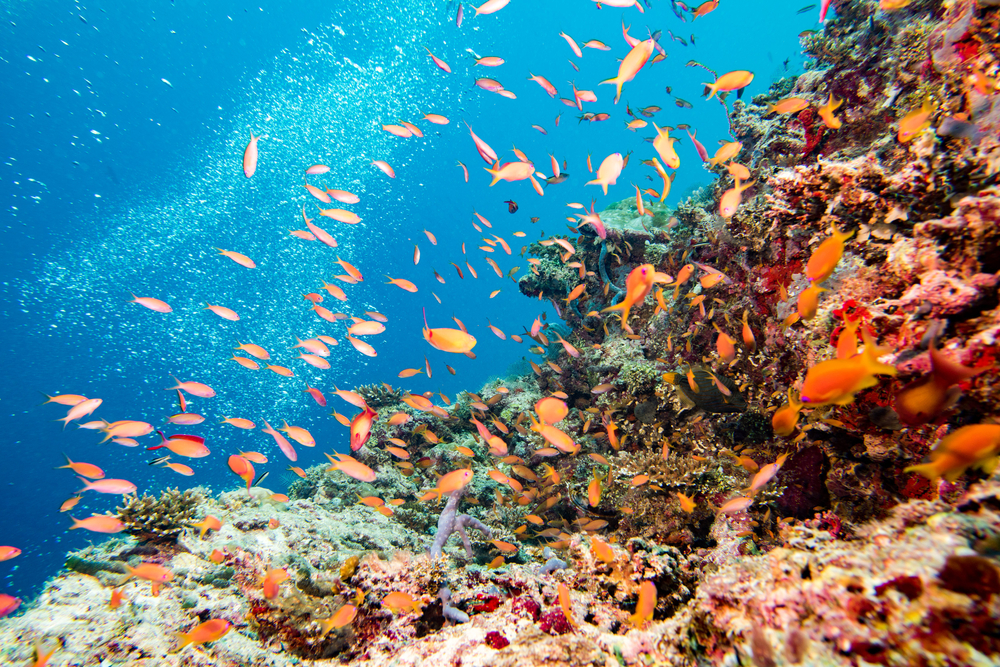
They’re popular spots for divers and tourists. They protect coasts from storms. They sustain food for half a billion people. And they’re just plain lovely. Here’s what a healthy reef looks like:
Coral reefs are, however, extremely vulnerable to soaring temperatures. In normal times, the living coral polyps form a symbiotic relationship with zooxanthellae, a colorful type of algae that synthesizes sunlight and carbon dioxide to create nutrients for the reef. This algae gives the coral its purple/gold color.
But this symbiosis only thrives within a fairly narrow temperature band. If the water in the reef gets too warm, the zooxanthellae’s metabolism goes into overdrive and starts producing toxins. The polyps recoil and expel the algae from their tissue, leaving the coral with a ghastly “bleached” appearance. At that point, the coral loses a key source of food and becomes more susceptible to deadly diseases.
That’s what happened in January through March of this year. Record high temperatures in the Pacific Ocean, fueled by global warming and a powerful El Niño, caused mass bleaching throughout the Great Barrier Reef. Here’s a shot of bleached staghorn coral at Lizard Island, taken February 2016:
Bleaching doesn’t kill the coral right away; if ocean temperatures drop again, the zooxanthellae will come back. But if temperatures stay high for a long period and the bleaching gets really severe, as was the case in the Great Barrier Reef, then a lot of coral will start to die of malnutrition or disease.
Here’s another picture of Lizard Island taken two months later, in April 2016 — the staghorn coral is completely dead and smothered in algae:
Dead staghorn coral overrun by algae in April 2016 at Lizard Island, Great Barrier Reef.
Once the coral dies off, it can adversely affect the fish that rely on the reefs. The entire ecosystem suffers.
Bleached coral reefs can recover — but only if they’re given a chance
Now, the good news is that coral reefs can recover from these mass die-offs. Now that El Niño is gone, ocean temperatures have fallen around Australia. New polyps are returning and starting to build new skeletal structures to replace the dead coral.
The hitch is that recovery takes time. Lots of time. In places like the Seychelles, where reefs are mostly sheltered from pollution, tourism, and heavy fishing, it has taken at least 15 years for damaged reefs to come back. In areas stressed by human activity, the process can take much longer.
What’s more, recovery is often uneven. The fast-growing “branching” corals bounce back first. But there are also older, massive corals that are centuries old and provide valuable shelter for bigger fish. When those die off, they don’t return overnight.
And here’s the catch: The current pace of global warming may not give these damaged reefs sufficient time to bounce back fully. Before the 1980s, mass bleaching events were virtually unheard of. Now they’re becoming more and more frequent, particularly every time there’s an El Niño, as ocean temperatures spike. In April, a paper in Science warned that the Great Barrier Reef may lose its ability to bounce back as global warming continues.
“This year is the third time in 18 years that the Great Barrier Reef has experienced mass bleaching due to global warming, and the current event is much more extreme than we’ve measured before,” Terry Hughes of the ARC Centre said back in May.
Another complication: As we pump more carbon dioxide into the atmosphere, the oceans are becoming more acidic. In some cases, acidification can make corals more sensitive to bleaching at lower temperatures. It can also make it harder for the corals to build their protective skeletons and recover from events like this.
Now, there are some things that Australia (and other countries) can do to help make reefs more resilient to bleaching. Humans can limit fertilizer and sewage runoff that further damage the coral. We can avoid overfishing key herbivores like the rabbitfish that nurture the reefs by clearing away excessive algae.
Chomp, chomp. The white-spotted rabbit-fish has been spotted clearing away harmful coral in the Great Barrier Reef.
Humans can also avoid wreaking havoc on reefs by rerouting boats around them and restricting construction in the coastal areas near them. Australia is on the wrong track here: In 2015, the government approved plans to expand coal exports via ship in the southern part of the Great Barrier Reef.
But ultimately, reducing our CO2 emissions is the crucial step. Mark Eakin, who runs who runs NOAA’s Coral Reef Watch program, told me back in March that we’d likely need to keep total global warming to below 1.5 degrees Celsius for coral reefs to continue thriving. Right now we’re on course to blow past 2 degrees Celsius, which could doom recovery efforts.
“At 2 degrees Celsius,” Eakin says bluntly, “we are likely to lose numerous species of coral and well over half of the world’s coral reefs.”  

Wednesday, June 17, 2015

Donie's Ireland daily news BLOG

Hunger is the world’s ‘greatest ethical challenge’

Says Irish President M.D. Higgins


The President of Ireland discusses the ‘moral outrage’ of global hunger at Expo 2015 in Milan.

President Michael D Higgins said Ireland has “innate understanding” of world hunger given its Famine history.
It is not often that you will hear a legendary singer such as Seán O’Sé light up a dull, overcast Milan morning with a live rendition of The Foggy Dew, but it happened on Tuesday when Ireland came to visit the Expo 2015 exhibition in Milan.
Accompanied by the Brú Ború band of Comhaltas Ceoltóirí fame, O’Sé was one of a number of Irish artists who welcomed President Michael D Higgins and his wife Sabina when they came to visit Expo on Tuesday on Irish National Day, time to coincide with Bloomsday.
In an age when hardly anyone knows what Expo is actually about, this Milan version may have hit on an irresistibly winning note. Entitled “Feeding the Planet, Energy for Life”, it has set out to investigate, illustrate and analyse just about every aspect of arguably the most urgent problem facing the world today.
The point was not lost on the President who said: “Global hunger in the 21st century represents the grossest of human rights violations, and the greatest ethical challenge facing the global community.
“According to the Food and Agricultural Organisation, while the world at the present time produces enough food to potentially feed its entire population, more than 1 billion people are undernourished, over 2 billion suffer from nutritional deficiencies, and almost 6 million children die every year from malnutrition or related diseases.”
‘A powerful infrastructure’
The President also said that the fact that more than 140 countries are participating in this Expo means that the exhibition provides a “powerful infrastructure” which brings together the key issues of food provision, upscaling nutrition and sustainability.
Calling world hunger not only a “great ethical challenge” but also a “great moral outrage”, he added:
“Ireland knows about this, Ireland has an innate understanding of this [world hunger] . . . given that 1 million Irish people died of starvation and over 1 million emigrated during, ‘An Gort Mór’, the Great Hunger in the 1840s and [thus] food security is given the highest priority by our development aid programme . . .”
The President was formally received at Expo by Ivan Scalfarotto, Italian junior minister for constitutional reform. Mr Scalfarotto, Italy’s first openly gay government minister, took the opportunity to congratulate Ireland on its progressive “recent legislation”, in an obvious reference to the success of the same-sex marriage referendum last month in Ireland.
During his six-hour stay, the President also took time to visit the Irish pavilion, created around Bord Bia’s “Origin Green” programme which aims at promoting Ireland as “a world-leading producer of independently verified, sustainably produced food and drink while protecting a landscape rich in natural resources”.
And Bloomsday? Do not worry, it was not forgotten with actor Garvan McGrath at one point offering a spirited rendering of some excerpts from Ulysses, excerpts which he also offered in even more spirited Italian much to the bemusement of some of his audience.

‘Our condolences go to the Irish people’ involved in the Berkeley disaster


Kittredge Street apartment materials taken away for more analysis.

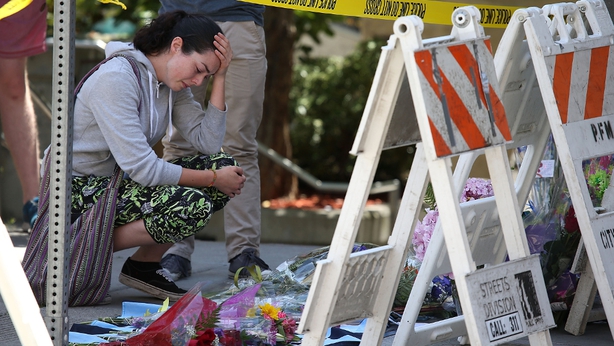
Two women embrace while watching sheriff’s deputies on duty at the scene in Berkeley where six Irish students were killed. They said hthey knew the victims.
It was around midnight in California’s best-known college town when Berkeley police got the first call from Kittredge Street tenants and neighbours.
According to their police log, it was just a noise complaint about a student party at the 2110 Berkeley Library Gardens Apartments – not the first or last from the eight-year-old complex, where short-term renters pay up to $3,000 per month for one-bedroom apartments.
“But cops didn’t arrive till 12.40am, just after the balcony collapsed,” said local witness Bob Brown, who lives opposite the apartment. “The police were late this time.”
The six victims have been named as Niccolai Schuster (21), Eoghan Culligan (21), Eimear Walsh (21), Olivia Burke (21), Ashley Donohoe (22) and Lorcan Miller (21). They and others seriously injured, fell on to pavement concrete, not the asphalt of Kittredge Road.
lrish Consul in San Francisco Philip Grantwent to Berkeley early in the day, talking to the building’s owners and establishing names of victims. His staff was already undergoing the usual summertime melee of lost passports and minor infractions. Now they’re facing the colossal bureaucratic and emotional toll.
Local people were dumbfounded at how so many managed to exit narrow French windows onto the cantilevered balcony. It doesn’t seem possible, they repeated.
From the ground, it looked small, and was immediately above another balcony. The pieces of the fourth floor balcony are now gone, leaving a ragged looking slash of wood and tarpaper being inspected by police detectives earlier yesterday morning.
“Statewide, we’re going to be examining balconies more closely from now on,” said a tenant from the opposite complex waiting outside the yellow police tape.
A second neighbour, David Daniels, said they’d “never known anything like this to happen in Berkeley”.
“Our condolences go out to the Irish people,” said Daniels, a 50-year-old Berkeleyian. Like his neighbour Bob Brown, he had watched at 5am as the ambulances and paramedics were moving the last of the injured and dead to local hospitals.
It’s just horrible, he went on, adding that it would make the city look twice at balconies ever after, and should prompt many inquiries into structural issues of number 2110 Kittredge.
Materials have been taken away for more analysis, and serious doubts have been cast on the integrity of building materials.
Daniels recounted how when he first moved to Kittredge Street a few years ago, a severe windstorm combined with a leak inside the roofing to result in an upper story window frame becoming loose and a casement dangling over the side.
He alerted the fire station and it was treated promptly. But the timbers under the stucco cladding are required by code to be kiln-dried and treated. It remains to be seen if they were. The City of Berkeley, the local authority here, said it had been taking “all necessary steps to safely secure the area” and investigate the incident.
It sent building inspectors to examine the scene early in the morning and have taken precautions.
“The balcony for the affected unit, as well as the three other similar balconies in the building, have each been red-tagged, prohibiting access to those areas,” it said.
“The City has ordered the property owner to immediately remove the failed balcony and to perform a structural assessment of the remaining balconies within 48 hours.”
Greystar, the property management company for the Library Gardens Apartments, said its heart went out to the families and friends of the deceased and those injured in the “tragic accident”.
“The safety of our residents is our highest priority and we will be working with an independent structural engineer and local authorities to determine the cause of the accident. We will share more details as we have them,” it said.
Throughout the day a host of friends and J-1ers came to the sidewalk of 2020 Kittredge to leave wreaths, messages and bouquets for the deceased and injured.
A block with the words City of Berkeley etched in it was draped in the bright blue flag of Dublin.

The Euro falls amid a Greek standoff,


The euro fell on Tuesday as it appeared more likely that debt-stricken Greece would default or have to leave the single currency, while the U.S. dollar rose at the start of a two-day meeting by the Federal Reserve.

Stocks mostly rose on the day, with shares in both Europe and the United States rebounding after a two-day decline, though investors continued to closely monitor the situation with Greece. Wall Street stocks were also supported by potential deal activity in the healthcare space.
Prime Minister Alexis Tsipras lashed out at Greece’s creditors on Tuesday, accusing them of trying to “humiliate” Greeks, and he defied a drum beat of warnings that Europe is preparing for his country to leave the euro. The address was seen as a sign that Tsipras was unlikely to accept austerity cuts needed to unlock frozen aid and avoid a debt default within two weeks.
“The market is still anxious about Greece and would like the situation to be dealt with one way or another. The week-after-week uncertainty isn’t good for the market,” said Scott Brown, chief economist at Raymond James in St. Petersburg, Florida.
The euro EUR= fell 0.35% to $1.1243 while the U.S. dollar index .DXY, which measures the greenback against a basket of currencies, rose 0.2 percent. The yen JPY= was flat against the dollar.
The all-country MSCI International ACWI Price Index .MIWD00000PUS rose 0.3 percent, while the pan-European FTS Eurofirst 300 .FTEU3 ended 0.6% higher, rebounding after a decline of 2.4 percent over the previous two sessions. Shares in Hong Kong .HSI fell 1.1%.
The Dow Jones industrial average .DJI rose 113.31 points, or 0.64%, to 17,904.48, the S&P 500 .SPX gained 11.86 points, or 0.57%, to 2,096.29 and the Nasdaq Composite.IXIC added 25.58 points, or 0.51%, to 5,055.55. The S&P 500 is coming off a two-day decline of 1.2%.
Wall Street was also lifted after the Wall Street Journal reported that UnitedHealth (UNH.N) was considering buying Cigna (CI.N) and Aetna (AET.N). UnitedHealth, a Dow component, rose 2.2% to $121.55.
U.S. investors were also looking for clues regarding the timing of a rate hike after a two-day Federal Reserve meeting.
The central bank is unlikely to raise rates in this meeting but traders will watch for any hints from Fed Chair Janet Yellen at a news conference after the meeting on Wednesday.
The Fed has said it remains data-dependent and will raise rates only when it sees an improvement in the economy. Second-quarter data pointed to a recovery after a halt in growth earlier in the year.
The benchmark 10-year U.S. Treasury note US10YT=RR rose 12/32 in price, pushing the yield down to 2.3111%.
In the commodity market, U.S. crude futures CLc1 rose 0.8% to $60.01 per barrel, lifted as a tropical storm moved ashore in the oil-producing state of Texas. [O/R] Brent crude for August delivery LCOc1 was down 0.5% at $63.65 per barrel.
Gold prices XAU= fell 0.4% while silver XAU= lost 0.5%. Copper CMCU3 lost 1.1% in its second straight daily decline of more than 1%.

The future of Irish post offices has very little to do with posting a letter?


Around 48% of post offices in Ireland account for just 12% of total business.

Irish Post Offices are being told to move into a number areas but it has nothing to do with posting a letter?
Entrepreneur Bobby Kerr has led a group which has authored a report for the Department of Communications which says that post offices can thrive if they move into financial services, social enterprise, public service delivery and white labelling.
The report found that a disproportionate amount of business is conducted in relatively few of the country’s 1,140 post offices. Two thirds of all transactions are conducted in just 300 post offices, while another 48% of post offices account for just 12% of total business.
The report says that An Post should fill the hole left in rural Ireland by the withdrawal of banks and should deliver services like motor tax, the electoral register, HSE payments, local authority payments and CAO and exam fees.
It also suggests post offices are better used for social enterprise and that they cross-sell goods from other suppliers.
Kerr says that An Post’s reach across the country means it is well-placed to deliver customer services.
I believe that An Post is best placed to provide a customer-led solution for a host of financial and government-related services right across the country.
There has been a slowdown in post office closures in the last five years, with a net closure rate of 24 between 2011 and 2014.

Gold that could be worth €150 million to Irish economy discovered by miners in Ireland


The valuable mineral was discovered this morning in soil three-feet deep near the border

Miners have unearthed gold believed to be worth more than €150 million in the border region.
The valuable mineral was discovered this morning in soil three-feet deep near Rockcorry, Co Monaghan.
Any gold found in the region is owned by the State and extracted under licence.
Irish gold exploration company Conroy Gold and Natural Resources confirmed that 700 metres by 300 metres gold-in-soil patch was tapped by explorers.
The company is proposing to develop a gold mine in Monaghan, around 14km away from the latest discovery and has been carrying out a number of searches in the area.
Professor Richard Conroy told the Irish Mirror: “When we hopefully get to develop it, which will be years down the line, it will be worth several million but there is an awful lot of work to be done.
“You have to do all the technical work first to see how much is actually down there.”
The discovery, which the company said revealed four gold-in-soil samples above 20ppb gold and a further five above 10ppb gold, is situated within the 50 km gold trend that Conroy outlined.
Professor Conroy explained: “This discovery confirms the gold potential of the company’s licenses in the area lying between the company’s existing gold targets to the Northwest at Clay Lake, Clontibret, where a mine is being developed, and Glenish, as well as those to the South at Slieve Glah.”
The gold lies along a major geological structure, known as the Orlock Bridge Fault.
The company has been working on the regions for years drilling, trenching and sampling.
Just last week, a gold nugget worth a staggering £10,000 (€14,000) was found in Scotland.
The precious metal – thought to be the largest found in Scotland in seven decades – was discovered by a Canadian gold panning enthusiast in a river near Wanlockhead, in Dumfries and Galloway.
It is believed the 20-carat nugget, which weighs around 18 grams, will spark a gold rush in the area.
While in April this year the Connemara Mining Company bought prospecting licences on the Inishowen peninsula

Building and moulding a child that can cope with life is a mighty task

   
There’s so much advice around parenting these days that it feels like you need a Phd. Ailin Quinlan cut to the chase and got tips from one of the country’s foremost experts in children and mental health.
Every parent yearns for an emotionally healthy child. Clinical psychologist Paul Gilligan has written a book for parents on how to raise one.
But what is an emotionally healthy child? “An emotionally healthy child is a child who’s generally content and confident, has a positive belief in themselves and can handle adversity in an appropriate manner,” says Gilligan, who is CEO of At Patrick’s Mental Health Services and chair of the Children’s Rights Alliance.
“They experience positive emotions in an appropriate way, at the appropriate time, and behave in a positive manner,” says the former CEO of the Irish Society for the Prevention of Cruelty to Children.
Children aged under 13 reflect their emotions in behaviour — for example, a depressed child may not do their homework, may not want to get up in the morning or may be the subject of complaints from the class teacher.
Gilligan says that parents have a built-in ability: “We are born with a deep capacity to love our children and to do the best we can for them,” he says. The goal is for the parent to connect with both of these qualities.
It is normal for parents to make mistakes, he says. Three things factors decide a child’s emotional and mental health — the child’s personality, his/her experiences, and the support he/she receives from parents and other important people in their lives. If these factors are not healthy, they can cause problems.
“Emotionally healthy children are able to navigate the difficulties of life — even if they develop an issue about something, if they are emotionally healthy they are better able to cope with it,” Gilligan says.

His tips on raising an emotionally healthy child:

  1. Connect with your deep love for your child
“We are in an era where parents are reluctant to talk about loving their child. Consciously acknowledge that love, and remind yourself that your actions spring from that,” he says.
  1. Believe in yourself as a parent
Don’t be overly confident, but believe in your ability to parent your child. Recognise that this may involve asking for help or advice. Don’t beat yourself up about what you’re not doing. “Research tells us that parents spend more time with their children nowadays than they did in the 1960s, but are more prone to questioning themselves around their ability to parent and provide for their child,” Gilligan says.
  1. Teach your child self-confidence
Encourage self-respect and self-care, and their development of realistic expectations of themselves.
“Help them map out their day,” he says. Encourage your child to understand that while they must do their homework, they should also relax afterwards, with a game of football, for example.
Develop realistic expectations by encouraging self-awareness and insight, and support them in doing their best in their hobbies and activities.
“Help them reflect on their achievements,” he says.
  1. Teach your child how to deal with difficulties
Protect them from unnecessary difficulties by identifying problems, such as bullying — but recognise that they will have to deal with the death of a beloved relative, for example, or a poor performance in an examination.
  1. Teach your child to be happy
First, recognise that your child cannot be happy all the time, but when there is the opportunity, encourage them to be happy.
“Let them be themselves, and allow them to realise their own individuality,” he says.
Remember, says Gilligan, life is full of things to be sad or happy about — but that also it often depends on how we interpret them. A child can be happy or disappointed with a B-plus grade in a test, depending on how they look at it, for example.
  1. Ensure the child’s environment is healthy and safe
Take a balanced approach, he says, because these days there is a major focus on “risks” and parents can become overly concerned.
“Be reasonable about assessing risk. Don’t swaddle a child in cotton wool and don’t expose a child to serious hazards. It’s all about balance,” he says. “We can overplay the risks to children.”
  1. Listen to, and communicate with, your child
It’s important to listen to what they are saying, and to communicate as clearly as possible. Integrate communication into family life, he says, by, for example, sitting down to an evening meal together.
  1. Look after yourself as a person
Reinforce yourself. Don’t be afraid to acknowledge what you do for your child, so that they see that you do your best. Try to maintain a balance between work, family and social life.
Raising Emotionally Healthy Children, by Paul Gilligan, published by Veritas, €14.95, will be launched by RTÉ broadcaster, Áine Lawlor, today at St. Patrick’s Mental Health Services, James St, Dublin 8.

‘Life outside of Earth is probably going to be really hard to find’

Say Scientists


In previewing missions in the search for life and discussing its challenges, the scientists confess they ‘can’t even agree on a definition of what life detection is’

This guy is smiling, but the search for life is not easy, says Nasa.
NASA scientists previewed several missions in the search for life off Earth on Tuesday, including a plan to scoop up minerals from an asteroid and one to drill into the surface of Mars.
The missions described by researchers included satellites, spacecraft, landers and work concentrated on Mars, Jupiter moons, an asteroid and on Earth itself.
“Sciences are being unified by the search for life in the universe,” said Dr John Grunsfeld, associate administrator for science at Nasa, before conceding that “life outside of earth is probably going to be really hard to find”.
“We can’t even agree on a definition of what life detection is.”
Grunsfeld said missions to Mars in the next few years will have greater capabilities than the Curiosity rover, which continues to explore Mars and in April discovered water on below the surface of the red planet. The European Space Agency’s ExoMars mission, for instance, aims to specifically search for signs of life.
The lander will have a “deeper drill than any lander”, Grunsfeld said, able to reach down into the Martian crust “a couple of meters” where the deadly radiation that bombards the planet would not be as able to affect life.
“The surface of Mars is bathed in ultraviolet light, bathed in radiation,” Grunsfeld said. “Mars’s magnetic field is essentially gone, so the surface of Mars is essentially sterilized.”
Places where the frozen water exists, as in the planet’s polar glaciers and below the surface, might be able to harbor life, but “these are challenging places to get to”, he said.
Last year the Curiosity rover detected “spikes” of methane, stoking speculation of life on the planet, but Grunsfeld noted that those signals could be abiotic as well as from a biotic organism.
“On future missions we’re going to look more toward what kind of instruments could detect life,” he said. “A DNA sequencer for instance might fail miserably even if it were surrounded by extant Martian life.”
The ExoMars mission is planned for 2018 and receive assistance from Nasa.
Grunsfeld also described a mission named Osiris Rex, which aims to send a satellite to an asteroid called Bennu in order to study its composition. The satellite will “do a quick touch-and-go and grab samples, up to 2kg (5lb)”, he said, which researchers will then be able to study.
In part, the Osiris Rex team will try to determine whether the organic materials that started life on Earth were “seeded” on the planet by collisions with carbonaceous asteroids like Bennu.
Dr Britney Schmidt, the principal investigator for the Nasa-funded Sub-Ice Marine and Planetary Analog Ecosystems (Simple) mission, spoke about the possibilities for life on Jupiter’s moon Europa.
“There’s a whole host of ice-rich worlds which potentially harbor subsurface oceans,” Schmidt said. “These are important places to think about in the search for life even within our own solar system.”
In February, Nasa won approval from the White House to proceed with a mission to fly by Europa, which is covered in a sheet of ice that has intrigued scientists for the likelihood that it coats a subsurface ocean.
The mission will feature an ice-penetrating radar that has been used to explore similar surfaces on Earth, Schmidt said, and try to determine whether the moon harbors “enough energy to power biology in these very distant and seemingly so alien worlds”.
Dr Alexis Templeton showcased some of her research on alien environments here on earth, where scientists have discovered life in what were until recently considered utterly inhospitable regions.
In particular, Templeton studies how rocks may have helped create life in these extreme environments. “Rocks have within them, depending on their chemistry, the ability to release electrons,” she said, which “can fuel certain systems, essentially a lot like fuel cells do”.
Citing the discovery of life in the high-pH waters of remote deserts and the ways that water can release chemicals and energy when it interacts with certain rocks, Templeton said that the research could help colleagues determine what exactly they should look for on celestial bodies. On a moon of Saturn, for instance, plumes of particles ejected from the south pole could “represent potential for liquid water that’s stored underneath the ice shell”, she said.
Dr Vikki Meadows, a professor of astronomy at the University of Washington’s Virtual Planetary Laboratory, said that she was studying hunting for oceans on planets by looking for the “glint effect”.
Meadows described the phenomenon as “something that should be very familiar to you if you’ve ever sat on a beach after sunrise or sunset” – the reflected light of the sun off the surface of the water at a particular angle.
With the help of a blurry photo of a crescent Earth, from a satellite that later crashed into the moon, researchers were able to calculate the glint effect for other planets – a prediction that could help detect oceans on solar systems outside our own.