Vulture funds now shifting assets after Irish tax clampdown
GOVERNMENT TO ADD MORE ANTI-AVOIDANCE MEASURES AS FINANCE BILL GOES THROUGH OIREACHTAS


OVERSEAS INVESTORS ARE LIKELY TO MOVE BILLIONS OF EURO OF IRISH PROPERTY ASSETS OUT OF FUNDS TARGETED BY A MAJOR STATE TAX CLAMPDOWN INTO ORDINARY COMPANIES AND REAL-ESTATE INVESTMENT TRUSTS TO EASE THE PAIN.
Meanwhile, the Irish Government is preparing to add further anti-avoidance measures as the Finance Bill goes through the Oireachtas. This will minimise how the strict rules in the proposed laws, unveiled on Thursday, can be circumvented by creative manoeuvrings, according to sources.
“The proposed changes will materially alter the tax treatment of Irish property funds,” William Fogarty and Andrew Quinn, tax lawyers with Maples and Calder in Dublin, said in a note to clients on Friday.
“Investors may wish to restructure their Irish real estate holdings in order to utilise standard corporate structures, or alternatively, to develop a real estate investment trust (Reit).”
As much as €12 billion of Irish property assets are held in Qualifying Investor Alternative Investment Funds and Irish Collective Asset-management Vehicles, which are targeted by the new rules.
Those with at least 25% of assets in Irish property face a 20% withholding tax from January on distributions to overseas investors, unless the recipients are pension or life assurance companies or other “collective investment vehicles”.
Funds that hold on to property for at least five years will be exempt from withholding tax being applied to distributions from capital gains. The remainder, including funds that are involved in developing property at a time when the country is facing a housing shortage, are likely to consider restructuring as a trading company, where a 12.5% tax rate would apply or, a tax-efficient rate structure, according to tax industry sources.
While some industry observers have welcomed that the Government introduced its plans this week, rather than waiting for a second Finance Bill as had been mooted at one stage, they say laws will have a broader impact than on the targeted funds.
“It will be a challenge for Ireland after this to convince foreign investors that the regime won’t change in future, particularly if existing transactions are not grandfathered,” said Jim Clery, a partner and head of real estate team with KPMG in Ireland.
“Each transaction I’ve been involved with recently involving major foreign direct investment has resulted in the overseas buyer saying they’ll come back and look at it later.”
Mr Clery warned that the property market may be hit by “a year or two of little activity” as long-term investors stick to the sidelines.
“The funds that brought assets from Nama and the Irish [State-controlled] banks paid prices on the basis of being able to put these assets in tax exempt fund structures,” he said. “In effect, they paid the State up front for the tax treatment that was clearly on the books at the time.”
Colm Lauder, an analyst with Goodbody Stockbrokers, said: “The changes will affect the price that certain funds will be willing to pay for assets, potentially dampening capital values and liquidity, if the pool of investors reduce – though [it] could present opportunities for unaffected investors.”
Ireland’s house price market up 7.2% for year to August
 UP 7.2%
IRISH HOUSE PRICES ROSE BY 7.2% OVER THE LAST YEAR AND ECONOMISTS NOW HAVE TO REVISE THEIR PROJECTIONS FOR PRICE INFLATION IN 2017 THANKS TO THE GOVERNMENT’S NEW HELP-TO-BUY SCHEME.
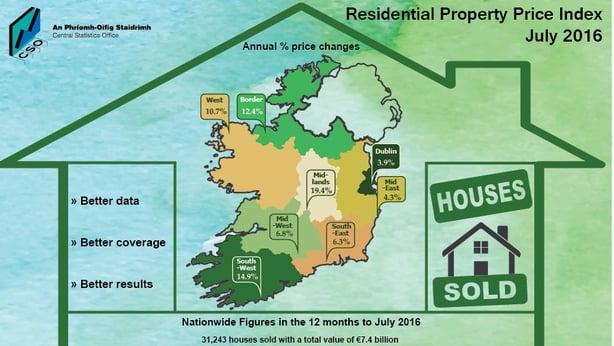
The residential property price index published yesterday by the Central Statistics Office shows that, while the national index is 33.7% lower than its highest level in 2007, prices nationally have risen by 45.6% since the “trough” in early 2013.
In Dublin, all residential property prices increased by 4.5% in the year to August. The index for all residential property prices in the rest of Ireland — excluding Dublin — increased by 11.4% in the year to August.
“The south-west region showed the greatest price growth, with house prices increasing 14.8%,” the CSO pointed out. “Conversely, the mid-east region showed the least price growth, with house prices increasing 5%.”
Conall Mac Coille of Davy Research said a geographical pattern remains with “more muted price gains in Dublin and its commuter belt”.
“The price gains are strongest in areas that have seen the slowest recovery so far,” he said. :In the Midlands, prices fell on the month by 0.5% but are still up 14.1% on the year. In the southwest, prices rose by 1.2% and up to 14.8% on the year.
“As we had expected, Irish house prices have risen briskly through the summer months after a slow start to 2016. The RPPI index has now increased for five consecutive months, up by 5% in the three months to August.”
Mr Mac Coille said his organisation had expected Irish house price inflation to remain close to 5% through 2017 and 2018.
“However, the new help-to-buy scheme will now provide a tax rebate for first-time buyers of newly-built homes worth up to €20,000, or 5% of the purchase price, and should push up prices on newly-built homes,” said MR Mac Coille. “So we will now have to revise up our forecasts for Irish RPPI inflation to above 5% in 2017.”
Property Industry Ireland said the Residential Property Price Index showed that only 6.8% of transactions in August were for new dwellings.
“The help-to-buy scheme, available only for new homes, will help bring a new supply of homes onto the market,” it said.
Galway tourism trade targets Canadian markets ‘with Canadian Expo workshop’


A SELECT NUMBER OF TOURISM OPERATORS FROM GALWAY, WILL MEET 20 TOP TOUR OPERATORS FROM CANADA AT A WORKSHOP IN THE MEYRICK HOTEL THIS MONDAY.
Canadian tourists visiting here injected an estimated €133 million into the Irish market last year the Galway workshop titled, ‘Canadian Expo’, is organised by Fáilte Ireland, in conjunction with Tourism Ireland.
It is focusing on attracting more overseas visitors to Galway and other Irish destinations from key markets such as Canada.
The workshop provides a cost and time effective business opportunity for the Irish tourism businesses to meet buyers and engage in one-to-one sales meetings to either make initial contact or maintain already established business relationships.
While here the Canadian tour operators will enjoy a cruise on the Corrib Princess, have a tour around Galway’s foodie destinations with Galway Food Tours, have a site visit at Glenlo Abbey Hotel, and take in a trip to Kylemore Abbey.
‘Most men have a fear of prostate cancer & some ignore it for years’
“IT IS SIMPLE GET A PSA BLOOD TEST DONE NOW”


KILLENARD FARMER CHRISTY SLEVIN (above with his wife) SHARES HIS EXPERIENCE OF PROSTATE CANCER AND IS URGING ALL MEN TO GET CHECKED.
Co. Laois farmer Christy Slevin is urging every man over 50 to get a simple blood test called a PSA done to check for prostate cancer, after his own was diagnosed early and successfully treated.
Christy’s cancer was detected from a PSA blood test carried out by his GP, three years ago when he was 53.
“I was getting routine blood tests anyway because I was on depression medication. My doctor said to get it looked at so I went off to James’ in Dublin for a biopsy. I wasn’t even that worried. My mother was sick with lung cancer and my dad was possibly facing a leg amputation at the time, so to me the prostate was like getting a bad tooth out,” he said.
“Most people have a fear of prostate cancer, some ignore it for years, but I had it the other way, I didn’t treat it with enough respect,” he said.
The first step after finding early prostate cancer is to ‘watch as wait’ becuase it grows very slowly and its removal can have lasting side effects.
Christy was even advised by doctors to go and enjoy a planned family holiday, but decided not to because of his parents being unwell.
A few months later, he had the operation to remove his prostate, a walnut size gland which is part of the male reproductive system.
It was keyhole surgery, and a second operation followed to remove a further dozen small clips.
The costs were covered 90 percent by his health insurance, and he drove a bargain for the rest.
“I got them to knock off the 10 percent. Farmers are divils for a bargain,” he said with a laugh.
Usually radiotherapy follows but as he has Crohn’s disease, it could not be used.
Christy’s cancer is gone, but he did not realise the full after effects of the operation.
Tiredness hit like a wall Christy said.
“I went home and did a bit of tilling but I fell asleep on the tractor. I woke up at the far end of the field,” he said.
His chronic tiredness affected his family, with support needed from his wife Mary, his sons and daughter.
“I had cancer but Mary had to cope with everything. She always does a lot but she had to do a lot more.
“I didn’t do much lambing that year. I didn’t realise the effect it has on your children. We talked to our kids but other people don’t. If they find out from friends, they worry more about what else you haven’t told them,” he said.
Christy has also found support in The Cuisle Centre in Portlaoise.
“I knew of it, but I thought it was for terminally ill people, and more for women. My brother brought my mother to it, and got me a leaflet so I rang them,” he said.
Last autumn he took part in their annual six support week Prostate Cancer course, where he finally met other men also experiencing sife effects.
“They were nearly all the same with the tiredness. To find out you’re not the only one was a relief, I felt I was being lazy so I was pushing myself too hard, but now I can take a nap in the day and sleep well because I don’t feel guilty. I feel 80 percent better since I came in here, it helps you to cope,” he said.
He is even spreading the word to fellow farmers about getting checked, and even loaning them relaxation tapes from Cuisle, which help with many stress related problems.
It is easier for men to talk in the group, says director Stella Moran .
“Some men said they never talked about it at home, and it was the first time they were able to express their feelings. On the last night they can bring their partners and by then they are more able to talk,” she said.
Prostate is one of the most curable cancers, if treated in the early stage.
“The test only costs about €15. If you were told you had cancer and where would you prefer it, you would go for the prostate, because it’s the most curable,” Christy said.
For him, life is now ploughing ahead.
“Nearly all the negatives can be got over. My son is getting married in Japan next year and we are looking forward to that. If I hadn’t looked after myself, I wouldn’t be here, now I have a full life ahead,” he said.
He urges any man facing or finished treatment, to go to the next Prostate Cancer Support Group course at the Cuisle Centre, starting on Tuesday October 25 at 7pm.
The centre also offers pelvic floor exercise classes for before and after prostate cancer treatments, to minimise the side effects.
“I just want to say to people, don’t be afraid to come into the Cuisle Centre, everybody here is very approachable,” Christy said.
Single men could now get the right to start family under radical new ‘infertile definition’
SERVICES COULD FACE PRESSURE AS WORLD HEALTH ORGANISATION CHANGES GLOBAL LEGAL STANDARD

THE AUTHORS OF THE NEW GLOBAL STANDARDS SAID THE REVISED DEFINITION GAVE EVERY INDIVIDUAL “THE RIGHT TO REPRODUCE”
Single men and women without medical issues will be classed as ‘infertile’ if they do not have children but want to become a parent, the World Health Organisation is to announce.
In a move, which dramatically changes the definition of in- fertility, the WHO will declare that it should no longer be regarded as simply a medical condition.
The authors of the new global standards said the revised definition gave every individual “the right to reproduce”.
Until now, the WHO’s definition of infertility – which it classes as a disability – has been the failure to achieve pregnancy after 12 months or more of regular unprotected sex.
The World Health Organisation sets global health standards and its ruling is likely to place pressure on individual health services.
Dr David Adamson, one of the authors of the new standards, said: “The definition of infertility is now written in such a way that it includes the rights of all individuals to have a family, and that includes single men, single women, gay men, gay women.
“It puts a stake in the ground and says an individual has got a right to reproduce whether or not they have a partner. It’s a big change.
“It fundamentally alters who should be included in this group and who should have access to healthcare.
“It sets an international legal standard. Countries are bound by it.”
Infertility affects one in five couples in Ireland. This radical new departure will see infertility redefined from a medical condition to the “right to reproduce” and could have public policy health implications, according to experts.
Speaking about the change in the definition, Dr Bart Kuczera, consultant with Beacon Health Fertility, said: “As surrogacy is illegal in this country it’s unlikely that this new WHO definition will be adopted in the short term.
“However, the Department of Health is currently charged with drafting legislation dealing with assisted human reproduction (AHR) which will regulate a range of practices for the first time.”
These include gamete (sperm or egg) and embryo donation, posthumous assisted reproduction and stem cell research, among other areas.
“Furthermore, the adoption of this WHO new definition could impact on potential new government plans to fund fertility treatment for couples struggling to conceive,” added Dr Kuczera.
The new definitions drawn up by WHO’s international committee monitoring assisted reproductive technology will be sent to every health minister for consideration next year.
The controversy broke as the American Society for Reproductive Medicine annual congress heard that the 10 millionth IVF baby would be born by the end of 2020.
Official figures estimate that by 2013, 6.5 million people had been born using the technique since the first IVF birth took place in 1978.
The world’s longest pub crawl has been calculated & it features 25,000 boozers across the UK


THE WORLD’S LONGEST PUB CRAWL HAS BEEN MAPPED OUT, AFTER A TEAM OF MATHEMATICIANS IN CANADA WORKED OUT THE SHORTEST ROUTE BETWEEN NEARLY 25,000 PUBS IN THE UK.
The international team spent two years on the project, which covers 24,727 pubs from every corner of the UK – from Land’s End to the northernmost islands of Shetland.
The blue line on this map of the UK marks the shortest route possible between each pub, returning eventually to the first pub again (math.uwaterloo.ca/screenshot)The project, from the University of Waterloo in Canada, was used as an example of the “travelling salesman problem” or TSP.
This ancient problem is one of the most studied in computational mathematics and aims to find the shortest route between a series of points on a map, usually landmarks, before bringing you back to where you started.
In this project, the team chose to map such a route from every pub from the website Pubs Galore, amounting to more than 100 times more stops than any road distance TSP to date.
The shortest route they found between the thousands of pubs was 45,495,239 metres, which equates to about 28,269 miles.
This close up of the pubs visited in Cambridge shows how efficient the route is (math.uwaterloo.ca/screenshot)Due to the fact the route returns to the beginning, it is actually endless. This means anyone in the UK could go to the nearest point on the map and start the tour if they wanted to.
Looking at how efficient it is you could walk much of it too, but there are a few ferry trips needed to get to the more remote areas.
Have no fear though, two of these ferry rides do serve beer.
“We, of course, did not have in mind to bring everything mathematics has to bear in order to improve the lot of a wandering pub aficionado,” wrote research lead Professor William Cook.
“The world has limited resources and the aim of the applied mathematics fields of mathematical optimisation and operations research is to create tools to help us to use these resources as efficiently as possible.”
The team say their next TSP goal is even bigger – a walking tour through 50,000 stops from the US National Register of Historic places.
Fancy giving the crawl a go? Then good luck trying to finish it, but you can take a look at the University’s work, including maps,
The beautiful Snow Leopard population is quickly declining due to human threat but
“ALL IS NOT LOST YET”


A SNOW LEOPARD WALKS IN THE SNOW AT BANHAM ZOO IN NORFOLK, UNITED KINGDOM. ACCORDING TO A NEW REPORT, SNOW LEOPARDS’ NUMBERS ARE DECLINING FAST BECAUSE OF RAMPANT POACHING IN SOME ASIAN COUNTRIES.
Alarm bells are ringing about the rapid decline of snow leopards in the high mountain ranges of many Asian countries.
According to a new report, nearly 90% of the poaching is happening in countries such as China, India, Mongolia, Pakistan, and Tajikistan.
The report from wildlife trade monitoring network TRAFFIC said only 4,000 snow leopards are left now. It also voiced concerns over the illegal trade in snow leopard skins going online, evading the eyes of law enforcing agencies. In addition to skins, the teeth, claws and bones of snow leopards are in high demand.
Found in 12 countries around the Himalayan plateaus at altitudes between 1,000 and 5,400 meters above sea level, the leopards survive in the cold because of hairy coats and furry feet.
Yet another study published in the journal Biological Conservation cautioned that two-thirds of the snow leopards’ alpine habitat will become extinct by 2070 because of global warming.
According to the new study, poaching has intensified since 2008 with an average 450 snow leopards getting killed annually.
Noting that half of the leopards are killed by herders as revenge for preying on their livestock, the report said, only 21% of snow leopards are targeted for claws, pelts, teeth, and bones, which are then sold through illegal channels.
“We think that what most observations, seizure records, and expert opinion shows are that the majority is still happening because of retaliatory killing,” said James Compton from TRAFFIC.
One report also talked about snow leopards hunting linked to their use in traditional Chinese medicines.
There is, however, hope. Conservation efforts of the Kyrgyzstan government are a case in point. They have saved several snow leopards from destruction by turning the hunting ground, Shamshy, near capital Bishkek, into a sanctuary. It is going to be co-managed by the Snow Leopard Trust and the Snow Leopard Foundation. Such a transformation of hunting ground into wildlife refuge has been rare.
According to Kuban Jumabai Uulu, director of the Snow Leopard Foundation, the conservation efforts in Shamshy are showing good results with a clear spurt in the numbers of snow leopards.
Conservation apart, the need for local communities to protect the depleting animal stock has been underscored in the TRAFFIC report.
With the need for killing to stop, Rishi Sharma, co-author of the report, said there is the requirement to work together in reducing the conflict between farmers and wildlife so that mountain communities can co-exist with snow leopards.


