Pages

Showing posts with label Tax avoidance. Show all posts

Wednesday, December 7, 2016

Donie's Ireland daily news BLOG update

Ireland does not engage in “harmful tax competition” says European Commission

OFFICIALS FACE TOUGH QUESTIONING ON CORPORATION TAX PLAN AT OIREACHTAS INQUIRY

Image result for Ireland does not engage in “harmful tax competition” says European Commission ? Image result for harmful tax competition in ireland does not happen says European Commissioner

IRELAND DOES NOT ENGAGE IN “HARMFUL TAX COMPETITION” IN THE EUROPEAN UNION, THE EUROPEAN COMMISSION HAS TOLD AN OIREACHTAS INQUIRY, IN A MARKED CHANGE OF TONE FROM PREVIOUS CRITICISMS.

Defending plans for changes to the EU’s corporate tax rules, the Commission officials rejected charges that they would lead, if implemented, to the harmonisation of rates across the Union.
Asked if the plan for a Common Consolidated Tax Base (CCCTB )was a “Trojan horse” for tax harmonisation, a leading Commission tax expert, Mr Bert Zuijdendorp was unequivocal. “No is the short answer,” he said.
Such an attempt, if it was made, would be “an insult to the intelligence of the member states,” he told the Oireachtas Finance, Public Expenditure and Reform committee in Leinster House.

OIREACHTAS QUESTIONS?

The Commission officials were questioned by TDs and senators, including the Anti-Austerity Alliance and People Before Profit TD Paul Murphy, who asked if Ireland had engaged in harmful tax competition.
Mr Zuijdendorp said: “Do we consider Ireland today is engaged in harmful tax competition? I don’t think the answer to that is yes. No. I don’t think that is the case. We are in a better place now that we were ten or 15 years ago.”.
The CCCTB plan, previously opposed by Ireland, was re-launched recently by the European Commission and Brussels insiders say there is more momentum behind the plan that when it was first proposed in 2011.
Even previously sceptical countries are now more open to the idea, though TDs and senators strongly expressed opposition. Officials from the Department of Finance and Revenue said that the Government had not yet taken a position.
The CCCTB would first introduce a common tax base across Europe with agreement on exactly what was taxable in corporate profits and what deductions and expenses could be allowed.
The second stage of the plan, if it is eventually accepted by EU states, would divide the tax paid by corporations amongst the member states by reference to labour, assets and sales.
Ireland has long feared that such an arrangement would lead to a substantial erosion of corporation tax receipts paid in Ireland – and suspect this is precisely why other European countries and the Commission want to progress the plan.
Multinational companies.
The Commission and several member states, including France and Germany, have always been irked at the relatively low rate of Ireland’s corporation tax, and at the activities of multinational companies which channel their profits through Ireland to minimise tax bills.
TDs and Senators were hostile to the plan on Tuesday, with Fianna Fáil finance spokesman Michael McGrath td accusing the Commission officials of “seeking to rewrite our entire corporation tax code”.
“This is a serious encroachment on the core competence of a member state,” Mr McGrath said.
Sinn Féin finance spokesman Pearse Doherty TD said that the Commission was engaging in “a blatant attempt to pull the wool over politicians’ eyes”.
Fine Gael TD Peter Burke said the CCCTB would be “an unmitigated disaster for Ireland”, while the committee’s acting chairman, Fianna Fáil senator Gerry Horkan said that there were “serious reservations from an Irish perspective”.
The Commission officials reminded the committee that unanimity was needed for the proposal to be adopted.

Nearly €13 million in Irish tax settlements in latest defaulters list

Image result for Nearly €13 million in Irish tax settlements in latest defaulters list   Image result for Nearly €13 million in Irish tax settlements in latest defaulters list

IN TOTAL THERE WERE EIGHT SETTLEMENTS IN EXCESS OF €500,000 DURING THE THIRD QUARTER, WHILE 32 WERE FOR MORE THAN €100,000

Settlements amounting to nearly €13 million were agreed with Revenue between July and September of this year, according to the latest tax defaulters’ list.
The largest single settlement of €895,931 for underdeclaration of VAT was agreed with the property developers O’Keefe Developments, which was based in Keady, Co Armagh. The company is now in liquidation.
Two other property development firms also made settlements of more than €500,000.
E L McGettigan & Sons from Kilmacrennan, Co Donegal – which is also now in liquidation – settled for €733,639 for underdeclaration of both corporation tax and VAT, while the now dissolved Highball – which was based in Ballsbridge in Dublin – settled for €669,315 in relation to underdeclaration of VAT.
Meanwhile, medical consultant Michael Geary, with an address at Torquay Rd, Foxrock, Dublin, settled with Revenue for €894,470 in relation to underdeclaration of income tax.
According to the list of tax defaulters, Crossan Hennessy Newsagents on the Naas Rd, Dublin 12 reached a settlement of €507,936 after underdeclaring VAT and PAYE/PRSI.
In total there were eight settlements in excess of €500,000 during the third quarter, while 32 were for more than €100,000.
Three of the 64 settlements published, yielding €630,000, relate to Revenue’s investigation into offshore assets and funds.

Big cuts needed to save Bus Éireann jobs & routes, says Minister Ross

ROUTES AND JOBS BOTH UNDER THREAT AS LOSSES EXPECTED TO RISE TO €6M NEXT YEAR

Image result for Cuts needed to save Bus Éireann, says Minister Ross  Image result for Cuts needed to save Bus Éireann, says Minister Ross

BUS ÉIREANN COULD BE INSOLVENT WITHIN TWO YEARS, ACCORDING TO TRANSPORT MINISTER SHANE ROSS. THE MINISTER FOR TRANSPORT SHANE ROSS HAS WARNED THAT BUS ÉIREANN IS FACING INSOLVENCY WITHIN TWO YEARS UNLESS DIFFICULT DECISIONS ARE MADE.

Mr Ross told his Cabinet colleagues between six and eight of the least profitable routes may have to be axed to bridge the funding gap at the company.
The Minister said the firm has reached a critical state in its financial situation and a number of unpopular decisions may have to be made.
Bus Éireann reported losses of up to €5.6 million last year and has projected a €6 million loss this year.
The semi-state company faults the Expressway services for the significant losses and is seeking to separate it from the rest of the firm.

IN CRISIS?

It is also proposing a reduction in staff and the introduction of pay cuts for remaining employees.
Mr Ross told his Cabinet colleagues the losses were unsustainable and the semi-state company was now in crisis.
The bleak financial picture was outlined to the Minister recently when he met the chief executive of Bus Éireann, Martin Nolan. He also met the chair of the company, Aidan Murphy, on Monday.
  • BUS ÉIREANN SAYS THERE ARE TOO MANY BUSES ON KEY ROUTES

  • BUS ÉIREANN SEEKS EXTERNAL REVIEW OF EXPRESSWAY PLANS

  • BUS ÉIREANN DRIVERS WARN OF INDUSTRIAL ACTION ON REFORM PLAN

Mr Ross said: “What they are looking at now is to find a solution to a critical situation in their finances.”
The announcement was made as management and unions met at the Labour Court to discuss union requests for pay increases of up to 21 per cent for drivers.
Management did not engage on pay insisting they could not assess the claims outside of examining the other cost-cutting measures.
In a statement the company said: “Bus Éireann incurred a €5.6 million loss in 2015 and is forecasting a similar deficit for 2016, mainly due to losses on our commercial Expressway services.
“The company must advance our cost reduction plan.
“The company attended the Labour Court with employee unions today December 6th, to address a pay claim.
“Bus Éireann has previously stated that we cannot afford a pay increase, given the immediate cost savings required to address ongoing losses.”
Mr Ross has backed the company and insisted it cannot afford the increases being sought by drivers.
The Minister and Bus Éireann will face stiff opposition to any proposals to cut staff or the company’s operations.

SOME OPPOSITION?

The Programme for Government commits to a full review of public transport policy and to investing in services including an updated bus fleet.
Fianna Fáil spokesman on transport Robert Troy said his party were totally opposed to any reduction in bus services or compulsory job losses. He said Bus Éireann is losing business to the private sector and the company is not responding adequately enough.
“It is unbelievable that despite this being highlighted by Bus Éireann for months, Minister Ross is only bringing it to Cabinet now,” he said.
“You could question whether he is taking this seriously at all. We cannot have a situation develop here where connectivity is at risk. Rural services have already been decimated. Mr Ross now needs to examine the subsidies available to the company and how they can be better used,” he added.
A recent report also warned Iarnród Éireann faces insolvency unless it gets more State money. And even with some additional Government funding, the routes from Limerick to Ballybrophy and Limerick Junction to Waterford could close. The National Transport Authority and Iarnród Éireann’s review also said part of the Limerick-Galway route from Ennis to Athenry, which only came back into service in 2010 at a cost of €100 million, and the Wexford line south of Gorey could be shut, leaving Wexford town and Rosslare without a rail service.
The report found the semi-State needs an extra €103 million a year over the next five years to ensure its survival.
The chief executive of Bus Éireann, meanwhile, has made a number of appointments to its management team to assist with their financial difficulties. Mr Nolan confirmed Ray Hernon would be appointed as the new chief financial officer. Joe Kenny, who operated as the chief Human Resources Officer, left the company after over 30 years of service with the CIÉ group.

New RTE footage shows insurance scammers staging road crashes for fraudulent claims
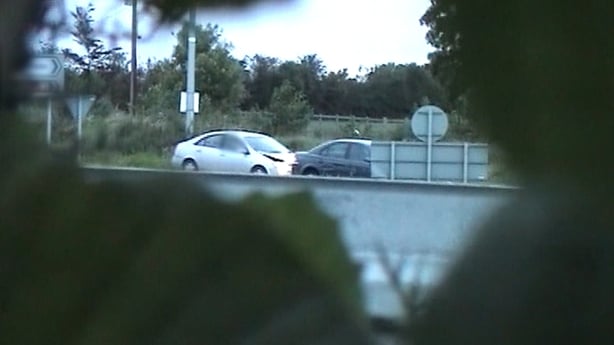
Image result for New RTE footage shows insurance scammers staging road crashes for fraudulent claims  Image result for New RTE footage shows insurance scammers staging road crashes for fraudulent claims

NEW FOOTAGE OF INSURANCE SCAMMERS STAGING ROAD CRASHES IN ORDER TO LODGE FRAUDULENT CLAIMS HAS BEEN BROADCAST FOR THE FIRST TIME.

Gardai filmed the footage, broadcast on RTE’s Prime Time, that shows two crashes which were found to have been faked for insurance purposes.
Speaking to a former Garda Drug Trafficking and organised crime officer, reporter Fran McNulty hears that organised criminals are using insurance fraud to finance their criminal network.
In one of the clips, broadcast on Tuesday night, the aftermath of a crash between a van and a car is shown.
Footage shown on @RTE_PrimeTime shows people staging a car crash in order to make a fraudulent insurance claim
A car can be seen arriving on scene and two men exit this car and get into the crashed car.
It is only then that the emergency services are called to the late night incident.
In a separate piece of footage, the driver of a van that was rear ended by a car, instructs the man who crashed into him, to “move back and do it one more time”.
Fraud Manager with Aviva Insurance Rob Smyth told RTÉ Prime Time that he is “quite satisfied that criminals are using insurance fraud as a way of funding their lifestyle”.
“Unfortunately when police officers are stopping these people with cash, most of them have had an insurance claim in the past and it justifies having possession of that ten thousand euro of cash or that twenty thousand euro of cash, but the fact of the matter is, it is covering up their criminal activities,” he said.
People are flying into Ireland as a result of the high levels of payouts for whiplash and soft tissue injuries here, the programme also reports.
According to Prime Time, these fraudsters are then hiring cars and crashing them.
Hertz’s Michael Brennan tells RTÉ Prime Time that 20pc of its insurance reserve is set aside for suspected fraudulent claims.
“We have seen accidents staged within as little as thirty minutes from the time of the rental, in some instances with rentals as short as 24 hours,” he said.
“But, within that period a road traffic accident is taking place resulting in multiple injuries but when examined at a closer level the circumstances of the accident, the circumstances of the rental and the testimony of our renter appears highly incredible”.
Insurance Ireland tells RTÉ Prime Time that the payouts here are so out of kilter with other countries that fraud tourism and fraudulent claims are leading to what they term a “propensity” of people engaging in the illegal behaviour.
Every person that features in the footage, except for one, have been charged and convicted of offences.

Movember awareness exercise shows that men’s health is in crisis in Ireland?

Image result for Movember awareness exercise shows that men’s health is in crisis in Ireland?  Image result for Movember awareness exercise shows that men’s health is in crisis in Ireland?

THE PHIBSBORO FIREFIGHTERS (ABOVE LEFT) WHO GREW BEARDS/MOUSTACHES FOR MOVEMBER 2016.

THE PEOPLE BEHIND MOVEMBER, AN ANNUAL EVENT TO RAISE AWARENESS OF MEN’S HEALTH PROBLEMS, HAVE SUGGESTED THAT MEN’S HEALTH IS IN CRISIS.

Last month, the Movember foundation created a space where men could discuss their health and get what was, for many, their first check-up.
The Movember & Co initiative used a free barber shop as a Trojan Horse to discover how well men were looking after themselves. It found that 41% of men did not check their testicles, even though testicular cancer is the most commonly diagnosed cancer among young Irish men aged 15 to 34.
More than half of the men (55%) did not take regular exercise, while 14% did not exercise at all.
Also, 61% of men had high cholesterol and, for 5%, it was very high. It is typical of what doctors usually find.
The campaign also highlighted men’s mental health, with Movember on a mission to combat this crisis, too.
There were 380 pairs of men’s shoes laid on the street outside Leinster House to symbolise the number of Irishmen who die by suicide each year.
The shoes were a powerful reminder that mental health does not discriminate by job, age, or income, but it does by gender, with men accounting for eight out of 10 suicides each week.
Movember has grown into the largest men’s health foundation in the world and works year round to encourage men to take control of their health.
On average, globally, men die six years before women. Men also suffer from diseases that are often preventable with minor lifestyle changes.
Money raised during Movember is used to fund the Irish Cancer Society’s Action Prostate Cancer programme.

Earth’s day lengthens by two milliseconds a century,

ASTRONOMERS TELL US?

Image result for Earth's day lengthens by two milliseconds a century  day chart 2   Image result for Earth's day lengthens by two milliseconds a century

THE GRADUAL SLOWING OF THE PLANET’S ROTATION IS CAUSING OUR DAY TO LENGTHEN, A COMPARISON OF NEARLY 3,000 YEARS OF CELESTIAL RECORDS HAS REVEALED.

Changes in the world’s sea levels and electromagnetic forces between Earth’s core and its rocky mantle also have effects on Earth’s spin.
There may never be enough hours in the day to get everything done, but at least the forces of nature are conspiring to help out.
Astronomers who compiled nearly 3,000 years of celestial records have found that with every passing century, the day on Earth lengthens by two milliseconds as the planet’s rotation gradually winds down.
The split second gained since the first world war may not seem much, but the time it takes for a sunbeam to travel 600km towards Earth can cost an Olympic gold medal, as the American Tim McKee found out when he lost to Sweden’s Gunnar Larsson in 1972.
For those holding out for a whole extra hour a day, be prepared for a long wait. Barring any change in the rate of slowing down, an Earth day will not last 25 hours for about two million centuries more.
Researchers at Durham University and the UK’s Nautical Almanac Office gathered historical accounts of eclipses and other celestial events from 720BC to 2015. The oldest records came from Babylonian clay tablets written in cuneiform, with more added from ancient Greek texts, such as Ptolemy’s 2nd century Almagest, and scripts from China, medieval Europe and the Arab dominions.
The ancient records captured the times and places that people witnessed various stages of solar and lunar eclipses, while documents from 1600AD onwards described lunar occultations, when the moon passed in front of particular stars and blocked them from view.
To find out how the Earth’s rotation has varied over the 2,735-year-long period, the researchers compared the historical records with a computer model that calculated where and when people would have seen past events if Earth’s spin had remained constant.
“Even though the observations are crude, we can see a consistent discrepancy between the calculations and where and when the eclipses were actually seen,” said Leslie Morrison, an astronomer on the team. “It means the Earth has been varying in its state of rotation.”
The Earth formed from a spinning cloud of dust and gas 4.5bn years ago, but it is thought to have received an extra rotational kick when a Mars-sized object crashed into the young planet and knocked off the material that became the moon. In that cataclysmic event, a day on Earth may have leapt from six hours to 24 hours.
But astronomers have long known that Earth’s spin is slowing down. The main braking effect comes from tides caused by the moon’s gravity. “The heaping up of water drags on the Earth as it spins underneath,” said Morrison. As Earth’s rotation slows, the moon’s orbit grows by about 4cm a year.
Tidal braking is not the only force at work though. The astronomers found that Earth’s spin would have slowed down even more had it not been for a counteracting process. Since the end of the most recent ice age, land masses that were once buried under slabs of frozen water have been unloaded and sprung back into place. The shift caused the Earth to be less oblate – or squished – on its axis. And just as a spinning ice skater speeds up when she pulls in her arms, so the Earth spins faster when its poles are less compressed.
Changes in the world’s sea levels and electromagnetic forces between Earth’s core and its rocky mantle had effects on Earth’s spin too, according to the scientists’ report in Proceedings of the Royal Society. The different forces seem to drive cycles in the Earth’s rotation spanning decades to centuries, with one cycle repeating every 1500 years.
“Geological processes occur on long time scales which makes direct observation of their evolution extremely difficult on human timescales,” said Jon Mound, a geophysicist at Leeds University who was not involved in the research. “This is a particular problem for phenomena such as the Earth’s rotation which don’t leave direct evidence in the geological record.”
“In many ways this is an amazing result that ties together a wide range of investigations at opposite ends of the scale of technological sophistication to determine to high precision an extremely small effect,” he said.    

Sunday, October 23, 2016

Donie's Ireland daily news BLOG update

Vulture funds now shifting assets after Irish tax clampdown

GOVERNMENT TO ADD MORE ANTI-AVOIDANCE MEASURES AS FINANCE BILL GOES THROUGH OIREACHTAS

Image result for Vulture funds now shifting assets after Irish tax clampdown   Image result for Vulture funds now shifting assets after Irish tax clampdown  Image result for Vulture funds now shifting assets after Irish tax clampdown

OVERSEAS INVESTORS ARE LIKELY TO MOVE BILLIONS OF EURO OF IRISH PROPERTY ASSETS OUT OF FUNDS TARGETED BY A MAJOR STATE TAX CLAMPDOWN INTO ORDINARY COMPANIES AND REAL-ESTATE INVESTMENT TRUSTS TO EASE THE PAIN.

Meanwhile, the Irish Government is preparing to add further anti-avoidance measures as the Finance Bill goes through the Oireachtas. This will minimise how the strict rules in the proposed laws, unveiled on Thursday, can be circumvented by creative manoeuvrings, according to sources.
“The proposed changes will materially alter the tax treatment of Irish property funds,” William Fogarty and Andrew Quinn, tax lawyers with Maples and Calder in Dublin, said in a note to clients on Friday.
“Investors may wish to restructure their Irish real estate holdings in order to utilise standard corporate structures, or alternatively, to develop a real estate investment trust (Reit).”
As much as €12 billion of Irish property assets are held in Qualifying Investor Alternative Investment Funds and Irish Collective Asset-management Vehicles, which are targeted by the new rules.
Those with at least 25% of assets in Irish property face a 20% withholding tax from January on distributions to overseas investors, unless the recipients are pension or life assurance companies or other “collective investment vehicles”.
Funds that hold on to property for at least five years will be exempt from withholding tax being applied to distributions from capital gains. The remainder, including funds that are involved in developing property at a time when the country is facing a housing shortage, are likely to consider restructuring as a trading company, where a 12.5% tax rate would apply or, a tax-efficient rate structure, according to tax industry sources.
While some industry observers have welcomed that the Government introduced its plans this week, rather than waiting for a second Finance Bill as had been mooted at one stage, they say laws will have a broader impact than on the targeted funds.
“It will be a challenge for Ireland after this to convince foreign investors that the regime won’t change in future, particularly if existing transactions are not grandfathered,” said Jim Clery, a partner and head of real estate team with KPMG in Ireland.
“Each transaction I’ve been involved with recently involving major foreign direct investment has resulted in the overseas buyer saying they’ll come back and look at it later.”
Mr Clery warned that the property market may be hit by “a year or two of little activity” as long-term investors stick to the sidelines.
“The funds that brought assets from Nama and the Irish [State-controlled] banks paid prices on the basis of being able to put these assets in tax exempt fund structures,” he said. “In effect, they paid the State up front for the tax treatment that was clearly on the books at the time.”
Colm Lauder, an analyst with Goodbody Stockbrokers, said: “The changes will affect the price that certain funds will be willing to pay for assets, potentially dampening capital values and liquidity, if the pool of investors reduce – though [it] could present opportunities for unaffected investors.”

Ireland’s house price market up 7.2% for year to August

Image result for Ireland's house price market up 7.2% for this year 2016 to August  Image result for Ireland's house price market up 7.2% for this year 2016 to August UP 7.2%

IRISH HOUSE PRICES ROSE BY 7.2% OVER THE LAST YEAR AND ECONOMISTS NOW HAVE TO REVISE THEIR PROJECTIONS FOR PRICE INFLATION IN 2017 THANKS TO THE GOVERNMENT’S NEW HELP-TO-BUY SCHEME.

The residential property price index published yesterday by the Central Statistics Office shows that, while the national index is 33.7% lower than its highest level in 2007, prices nationally have risen by 45.6% since the “trough” in early 2013.
In Dublin, all residential property prices increased by 4.5% in the year to August. The index for all residential property prices in the rest of Ireland — excluding Dublin — increased by 11.4% in the year to August.
“The south-west region showed the greatest price growth, with house prices increasing 14.8%,” the CSO pointed out. “Conversely, the mid-east region showed the least price growth, with house prices increasing 5%.”
Conall Mac Coille of Davy Research said a geographical pattern remains with “more muted price gains in Dublin and its commuter belt”.
“The price gains are strongest in areas that have seen the slowest recovery so far,” he said. :In the Midlands, prices fell on the month by 0.5% but are still up 14.1% on the year. In the southwest, prices rose by 1.2% and up to 14.8% on the year.
“As we had expected, Irish house prices have risen briskly through the summer months after a slow start to 2016. The RPPI index has now increased for five consecutive months, up by 5% in the three months to August.”
Mr Mac Coille said his organisation had expected Irish house price inflation to remain close to 5% through 2017 and 2018.
“However, the new help-to-buy scheme will now provide a tax rebate for first-time buyers of newly-built homes worth up to €20,000, or 5% of the purchase price, and should push up prices on newly-built homes,” said MR Mac Coille. “So we will now have to revise up our forecasts for Irish RPPI inflation to above 5% in 2017.”
Property Industry Ireland said the Residential Property Price Index showed that only 6.8% of transactions in August were for new dwellings.
“The help-to-buy scheme, available only for new homes, will help bring a new supply of homes onto the market,” it said.

Galway tourism trade targets Canadian markets  ‘with Canadian Expo workshop’

Image result for Galway tourism trade targets Canadian markets  'with Canadian Expo workshop'  Image result for tour operators in Canada

A SELECT NUMBER OF TOURISM OPERATORS FROM GALWAY, WILL MEET 20 TOP TOUR OPERATORS FROM CANADA AT A WORKSHOP IN THE MEYRICK HOTEL THIS MONDAY.

Canadian tourists visiting here injected an estimated €133 million into the Irish market last year the Galway workshop titled, ‘Canadian Expo’, is organised by Fáilte Ireland, in conjunction with Tourism Ireland.
It is focusing on attracting more overseas visitors to Galway and other Irish destinations from key markets such as Canada.
The workshop provides a cost and time effective business opportunity for the Irish tourism businesses to meet buyers and engage in one-to-one sales meetings to either make initial contact or maintain already established business relationships.
While here the Canadian tour operators will enjoy a cruise on the Corrib Princess, have a tour around Galway’s foodie destinations with Galway Food Tours, have a site visit at Glenlo Abbey Hotel, and take in a trip to Kylemore Abbey.

‘Most men have a fear of prostate cancer & some ignore it for years’

“IT IS SIMPLE GET A PSA BLOOD TEST DONE NOW”

Image result for 'Most men have a fear of prostate cancer & some ignore it for years'  Image result for 'Most men have a fear of prostate cancer & some ignore it for years'  Image result for 'Most men have a fear of prostate cancer & some ignore it for years'

KILLENARD FARMER CHRISTY SLEVIN (above with his wife) SHARES HIS EXPERIENCE OF PROSTATE CANCER AND IS URGING ALL MEN TO GET CHECKED.

Co. Laois farmer Christy Slevin is urging every man over 50 to get a simple blood test called a PSA done to check for prostate cancer, after his own was diagnosed early and successfully treated.
Christy’s cancer was detected from a PSA blood test carried out by his GP, three years ago when he was 53.
“I was getting routine blood tests anyway because I was on depression medication. My doctor said to get it looked at so I went off to James’ in Dublin for a biopsy. I wasn’t even that worried. My mother was sick with lung cancer and my dad was possibly facing a leg amputation at the time, so to me the prostate was like getting a bad tooth out,” he said.
“Most people have a fear of prostate cancer, some ignore it for years, but I had it the other way, I didn’t treat it with enough respect,” he said.
The first step after finding early prostate cancer is to ‘watch as wait’ becuase it grows very slowly and its removal can have lasting side effects.
Christy was even advised by doctors to go and enjoy a planned family holiday, but decided not to because of his parents being unwell.
A few months later, he had the operation to remove his prostate, a walnut size gland which is part of the male reproductive system.
It was keyhole surgery, and a second operation followed to remove a further dozen small clips.
The costs were covered 90 percent by his health insurance, and he drove a bargain for the rest.
“I got them to knock off the 10 percent. Farmers are divils for a bargain,” he said with a laugh.
Usually radiotherapy follows but as he has Crohn’s disease, it could not be used.
Christy’s cancer is gone, but he did not realise the full after effects of the operation.
Tiredness hit like a wall Christy said.
“I went home and did a bit of tilling but I fell asleep on the tractor. I woke up at the far end of the field,” he said.
His chronic tiredness affected his family, with support needed from his wife Mary, his sons and daughter.
“I had cancer but Mary had to cope with everything. She always does a lot but she had to do a lot more.
“I didn’t do much lambing that year. I didn’t realise the effect it has on your children. We talked to our kids but other people don’t. If they find out from friends, they worry more about what else you haven’t told them,” he said.
Christy has also found support in The Cuisle Centre in Portlaoise.
“I knew of it, but I thought it was for terminally ill people, and more for women. My brother brought my mother to it, and got me a leaflet so I rang them,” he said.
Last autumn he took part in their annual six support week Prostate Cancer course, where he finally met other men also experiencing sife effects.
“They were nearly all the same with the tiredness. To find out you’re not the only one was a relief, I felt I was being lazy so I was pushing myself too hard, but now I can take a nap in the day and sleep well because I don’t feel guilty. I feel 80 percent better since I came in here, it helps you to cope,” he said.
He is even spreading the word to fellow farmers about getting checked, and even loaning them relaxation tapes from Cuisle, which help with many stress related problems.
It is easier for men to talk in the group, says director Stella Moran .
“Some men said they never talked about it at home, and it was the first time they were able to express their feelings. On the last night they can bring their partners and by then they are more able to talk,” she said.
Prostate is one of the most curable cancers, if treated in the early stage.
“The test only costs about €15. If you were told you had cancer and where would you prefer it, you would go for the prostate, because it’s the most curable,” Christy said.
For him, life is now ploughing ahead.
“Nearly all the negatives can be got over. My son is getting married in Japan next year and we are looking forward to that. If I hadn’t looked after myself, I wouldn’t be here, now I have a full life ahead,” he said.
He urges any man facing or finished treatment, to go to the next Prostate Cancer Support Group course at the Cuisle Centre, starting on Tuesday October 25 at 7pm.
The centre also offers pelvic floor exercise classes for before and after prostate cancer treatments, to minimise the side effects.
“I just want to say to people, don’t be afraid to come into the Cuisle Centre, everybody here is very approachable,” Christy said.

Single men could now get the right to start family under radical new ‘infertile definition’

SERVICES COULD FACE PRESSURE AS WORLD HEALTH ORGANISATION CHANGES GLOBAL LEGAL STANDARD

Image result for Single men could now get the right to start family under radical new 'infertile definition'  Image result for Single men could now get the right to start family under radical new 'infertile definition'  Image result for Single men could now get the right to start family under radical new 'infertile definition'   

THE AUTHORS OF THE NEW GLOBAL STANDARDS SAID THE REVISED DEFINITION GAVE EVERY INDIVIDUAL “THE RIGHT TO REPRODUCE”

Single men and women without medical issues will be classed as ‘infertile’ if they do not have children but want to become a parent, the World Health Organisation is to announce.
In a move, which dramatically changes the definition of in- fertility, the WHO will declare that it should no longer be regarded as simply a medical condition.
The authors of the new global standards said the revised definition gave every individual “the right to reproduce”.
Until now, the WHO’s definition of infertility – which it classes as a disability – has been the failure to achieve pregnancy after 12 months or more of regular unprotected sex.
The World Health Organisation sets global health standards and its ruling is likely to place pressure on individual health services.
Dr David Adamson, one of the authors of the new standards, said: “The definition of infertility is now written in such a way that it includes the rights of all individuals to have a family, and that includes single men, single women, gay men, gay women.
“It puts a stake in the ground and says an individual has got a right to reproduce whether or not they have a partner. It’s a big change.
“It fundamentally alters who should be included in this group and who should have access to healthcare.
“It sets an international legal standard. Countries are bound by it.”
Infertility affects one in five couples in Ireland. This radical new departure will see infertility redefined from a medical condition to the “right to reproduce” and could have public policy health implications, according to experts.
Speaking about the change in the definition, Dr Bart Kuczera, consultant with Beacon Health Fertility, said: “As surrogacy is illegal in this country it’s unlikely that this new WHO definition will be adopted in the short term.
“However, the Department of Health is currently charged with drafting legislation dealing with assisted human reproduction (AHR) which will regulate a range of practices for the first time.”
These include gamete (sperm or egg) and embryo donation, posthumous assisted reproduction and stem cell research, among other areas.
“Furthermore, the adoption of this WHO new definition could impact on potential new government plans to fund fertility treatment for couples struggling to conceive,” added Dr Kuczera.
The new definitions drawn up by WHO’s international committee monitoring assisted reproductive technology will be sent to every health minister for consideration next year.
The controversy broke as the American Society for Reproductive Medicine annual congress heard that the 10 millionth IVF baby would be born by the end of 2020.
Official figures estimate that by 2013, 6.5 million people had been born using the technique since the first IVF birth took place in 1978.

The world’s longest pub crawl has been calculated & it features 25,000 boozers across the UK

Image result for pubs crawl in the UK    Image result for pub crawls across the UK

THE WORLD’S LONGEST PUB CRAWL HAS BEEN MAPPED OUT, AFTER A TEAM OF MATHEMATICIANS IN CANADA WORKED OUT THE SHORTEST ROUTE BETWEEN NEARLY 25,000 PUBS IN THE UK.

The international team spent two years on the project, which covers 24,727 pubs from every corner of the UK – from Land’s End to the northernmost islands of Shetland.
The blue line on this map of the UK marks the shortest route possible between each pub, returning eventually to the first pub again (math.uwaterloo.ca/screenshot)The project, from the University of Waterloo in Canada, was used as an example of the “travelling salesman problem” or TSP.
This ancient problem is one of the most studied in computational mathematics and aims to find the shortest route between a series of points on a map, usually landmarks, before bringing you back to where you started.
In this project, the team chose to map such a route from every pub from the website Pubs Galore, amounting to more than 100 times more stops than any road distance TSP to date.
The shortest route they found between the thousands of pubs was 45,495,239 metres, which equates to about 28,269 miles.
This close up of the pubs visited in Cambridge shows how efficient the route is (math.uwaterloo.ca/screenshot)Due to the fact the route returns to the beginning, it is actually endless. This means anyone in the UK could go to the nearest point on the map and start the tour if they wanted to.
Looking at how efficient it is you could walk much of it too, but there are a few ferry trips needed to get to the more remote areas.
Have no fear though, two of these ferry rides do serve beer.
“We, of course, did not have in mind to bring everything mathematics has to bear in order to improve the lot of a wandering pub aficionado,” wrote research lead Professor William Cook.
“The world has limited resources and the aim of the applied mathematics fields of mathematical optimisation and operations research is to create tools to help us to use these resources as efficiently as possible.”
The team say their next TSP goal is even bigger – a walking tour through 50,000 stops from the US National Register of Historic places.
Fancy giving the crawl a go? Then good luck trying to finish it, but you can take a look at the University’s work, including maps,

The beautiful Snow Leopard population is quickly declining due to human threat but

“ALL IS NOT LOST YET”

Image result for The beautiful Snow Leopard population is quickly declining due to human threat but  Image result for The beautiful Snow Leopard population is quickly declining due to human threat but   Image result for The beautiful Snow Leopard population is quickly declining due to human threat but

A SNOW LEOPARD WALKS IN THE SNOW AT BANHAM ZOO IN NORFOLK, UNITED KINGDOM. ACCORDING TO A NEW REPORT, SNOW LEOPARDS’ NUMBERS ARE DECLINING FAST BECAUSE OF RAMPANT POACHING IN SOME ASIAN COUNTRIES.

Alarm bells are ringing about the rapid decline of snow leopards in the high mountain ranges of many Asian countries.
According to a new report, nearly 90% of the poaching is happening in countries such as China, India, Mongolia, Pakistan, and Tajikistan.
The report from wildlife trade monitoring network TRAFFIC said only 4,000 snow leopards are left now. It also voiced concerns over the illegal trade in snow leopard skins going online, evading the eyes of law enforcing agencies. In addition to skins, the teeth, claws and bones of snow leopards are in high demand.
Found in 12 countries around the Himalayan plateaus at altitudes between 1,000 and 5,400 meters above sea level, the leopards survive in the cold because of hairy coats and furry feet.
Yet another study published in the journal Biological Conservation cautioned that two-thirds of the snow leopards’ alpine habitat will become extinct by 2070 because of global warming.
According to the new study, poaching has intensified since 2008 with an average 450 snow leopards getting killed annually.
Noting that half of the leopards are killed by herders as revenge for preying on their livestock, the report said, only 21% of snow leopards are targeted for claws, pelts, teeth, and bones, which are then sold through illegal channels.
“We think that what most observations, seizure records, and expert opinion shows are that the majority is still happening because of retaliatory killing,” said James Compton from TRAFFIC.
One report also talked about snow leopards hunting linked to their use in traditional Chinese medicines.
There is, however, hope. Conservation efforts of the Kyrgyzstan government are a case in point. They have saved several snow leopards from destruction by turning the hunting ground, Shamshy, near capital Bishkek, into a sanctuary. It is going to be co-managed by the Snow Leopard Trust and the Snow Leopard Foundation. Such a transformation of hunting ground into wildlife refuge has been rare.
According to Kuban Jumabai Uulu, director of the Snow Leopard Foundation, the conservation efforts in Shamshy are showing good results with a clear spurt in the numbers of snow leopards.
Conservation apart, the need for local communities to protect the depleting animal stock has been underscored in the TRAFFIC report.
With the need for killing to stop, Rishi Sharma, co-author of the report, said there is the requirement to work together in reducing the conflict between farmers and wildlife so that mountain communities can co-exist with snow leopards.