Pages

Showing posts with label Tourists. Show all posts

Thursday, August 11, 2016

Donie's Ireland daily news BLOG update

The cost of borrowing continues to fall for Ireland
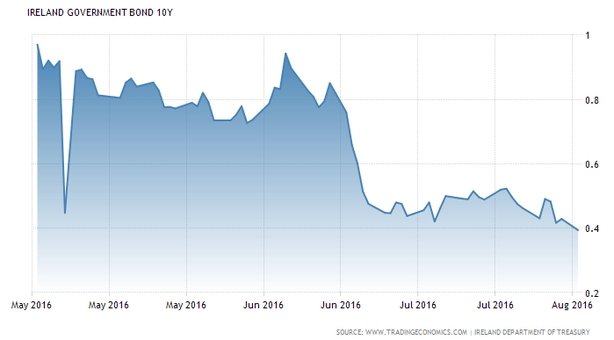
   

IRELAND’S COST OF BORROWING HAS CONTINUED TO FALL, AFTER THE YIELD ON IRISH 10-YEAR BONDS HIT RECORD LOW LEVELS YESTERDAY.

Peripheral euro zone bonds have become popular recently as economic uncertainty has led to an easing of monetary policy globally
A scarcity of bonds – highlighted by the Bank of England’s (BoE) inability to meet its bond-purchase target – has driven interest rates on government debt to record lows across the board.
In the week prior to the Brexit vote on 23 June, the interest rate on Irish 10-year bonds stood at 0.84%.
Yesterday that yield on Irish debt fell to a record low 0.37%, and today it is lower again at 0.34%.
Peripheral euro zone bonds have become popular recently as economic uncertainty has led to an easing of monetary policy globally.
Now further demand has been placed on euro zone bonds after the BoE failed to find enough willing sellers to meet its bond purchase target for the first time since it started buying government bonds in 2009.
German 10-year yields have fallen further into negative territory at -0.1%, while the Netherlands bond yield rate is also negative at -0.01%.
This has seen investors move towards peripheral euro zone bonds, such as Ireland, which would have a relatively higher rate of return.
Investors seeking alternatives
Spooked by the end of a 30-year bond bull run and bouts of money printing which have pushed stock values out of kilter with economic reality, high-profile investors are turning to fine wines, classic cars and jewels, research and index data show.
Even legendary bond investor and ex-Pimco boss Bill Gross said last week that he now favoured real assets like land and gold over more traditional investment classes.
This growing interest saw rare coins, collectable jewellery and classic cars join fine wine among the top performers in the year to end-March, the latest Knight Frank Luxury Investment Index showed.

A record breaking six months for Irish tourism with half a million extra visitors to Irish shores

MORE THAN HALF A MILLION EXTRA VISITORS TO IRISH SHORES FOR FIRST HALF OF THE YEAR…


PLAYING HOST TO THE LIKES OF GAME OF THRONES AND STAR WARS HELPED IRELAND ACHIEVE MASSIVE TOURISM GROWTH IN THE FIRST HALF OF THE YEAR, WITH 507,400 EXTRA VISITORS DESCENDING ON THE EMERALD ISLE THAN THE SAME PERIOD IN 2015.

Irish tourism’s best ever first-half performance saw the island welcome 4.4 million tourists, marking a mammoth 13% increase year-on-year.
Aside from the lure of screen tourism, air access, positive publicity and a global marketing campaigning were cited as contributing to the boom.
Tourism Ireland confirmed that revenue was also up 18% for the first quarter. The majority of tourists came from Britain and North America, while trips from mainland Europe were also on the rise.
Ireland now accounts for one in 10 of all American visitors to Europe.
There are 40,000 additional people employed in the tourism sector compared with five years ago.
Niall Gibbons, CEO of Tourism Ireland, said that hotels and other service providers have to continue to do their part to attract people here:
“The industry have to offer excellent value for money. Not be as good as our competitors; we have to be better.
“The good news is that if you look back at the actual statistics, in 1999… 3% of[British visitors] said Ireland was poor value for money. By 2009 that was 43%, and by 2015 that was back to single digits.
“I think we have to sustain and maintain those very positive value for money numbers.”
There were 16% more visitors from the UK in the first half, and Tourism Ireland is set to target that market with an extensive programme of promotions this autumn to boost off-peak business and mitigate for a weakened sterling following the Brexit vote.
Currency movements mean that Eurozone trips are now roughly 10% more expensive for British holiday makers.

Data protection chief Dixon must not distance herself from complainants

DISENGAGING FROM INDIVIDUALS COULD OPEN IRELAND TO A SANCTION BY EUROPEAN COURTS


IN A RECENT SPEECH, THE DATA PROTECTION COMMISSIONER HELEN DIXON REFERRED TO SOME SOLICITORS AS “DIGITAL AMBULANCE CHASERS”.

In a recent speech, Irish Data Protection Commissioner Helen Dixon set out her perspectives on data protection supervision – putting her on a collision course with the European Commission and the Court of Justice of the European Union.
At the Irish Centre for European Law annual Data Protection Conference, Commissioner Dixon expressed frustration at the lack of clear objectives for data protection and a failure to detail the harms it is designed to mitigate.
The commissioner went on to criticise the large number of complaints received by her office which, she said, were really proxies for disputes between different parties and had only a marginal connection with data protection issues.
Solicitors were singled out as “digital ambulance chasers” for bringing volumes of complaints of little apparent merit and using subject access requests for fishing expeditions in litigation.
Ms Dixon made it clear that she doesn’t think she should be obliged to consider every complaint received by her office and that she thinks the resources currently committed to investigating individual complaints would be better used examining systemic data protection issues.
So, should – or indeed can – the commissioner distance herself from individual complainants?
In my view, she cannot and should not.
Missed opportunity
To do so would not only require an amendment to European law, which guarantees such a right, it would also be a missed opportunity to engage with individuals in order to close the apparent gap between the general nature of data protection rules and the public’s understanding of the protections that it offers.
In disengaging from individuals, the commissioner would miss an essential aspect of data protection supervision, inevitably resulting in a standard of data protection supervision in Ireland below that set by European law.
Consequently, such a move could open Ireland to a sanction by the European courts.
To see why, it must be understood that data protection touches on every aspect of our lives – as consumers buying goods and services, citizens participating in a democratic society and as neighbours in our communities.
Data protection owes a lot to the experience of many millions of Europeans who lived in authoritarian communist regimes.
It values individual protection over pure self-interest, by setting moral boundaries to how our personal data may be used.
However, these boundaries are always specific to individual circumstances and can change over time. Crucially, data protection law doesn’t lend itself to absolute rules or codified, measurable objectives.
As such, the progressive nature of data protection law brings it into conflict with the conservative free market view that personal data is just another commodity that can be traded for profit.
There are similar conflicts with state bureaucracies looking for easy ways to exert control or deliver privatised public services.
The obligations on data protection supervisors, when hearing individual complaints, were spelled out by the Court of Justice of the European Union in the well-known Google Spain case, which concerned the so-called right to be forgotten, (i.e. the right of individuals to have certain links removed from internet searches on their names).
The court first noted that everyone has a right to make a complaint to an independent supervisor, such as our Data Protection Commissioner.
It then went on to find that interference with data protection rights, if sufficiently serious, cannot be justified on purely economic grounds but only with reference to other fundamental rights such as the right to freedom of expression.
The law is very vague?
Critically, in making a complaint, an individual is not required to demonstrate that they have been prejudiced.
Finally, the court stressed the importance of context. It noted publication by a search engine of personal data already legally published on the internet may nevertheless interfere with an individual’s rights.
Similarly, publication of personal data may cease to be justified with the passage of time.
So, if the law is vague and context dependent, how can the use of personal data be regulated and why are individual complaints so important?
Data protection places a high value on individual protection balanced only against other fundamental rights.
To regulate at the standards demanded of European law, a data protection supervisor must embrace the progressive ideals of this moral framework and engage in empathic dialogue with individuals to build a common shared understanding of data protection norms.
It is only through stepping into the shoes of individual data subjects that data protection supervisors can really give effect to the individual balancing of interests that is demanded.
Trivialising complainants and attacking their advisors is not the way forward.
If resources are truly an issue then Ms Dixon needs to press the State to fullfil its obligation to provide them.
Dialogue with individuals rather than distance is what is required.
It would be a serious mistake to remove the individual right to complain to the commissioner’s office.

This is the amount of exercise you should be doing every day


REDUCE THE RISK OF BREAST AND BOWEL CANCER, DIABETES, HEART DISEASE AND STROKE WITH MORE EXERCISE, 

The minimum recommended amount of exercise should be increased, researchers have said after a new study found that more exercise can drastically lower a person’s risk of five serious diseases.
Exceeding the current recommended minimum levels of exercise each week can significantly reduce the risk of breast and bowel cancer, diabetes, heart disease and stroke, experts found.
At present, the World Health Organisation recommends that people conduct at least “600 metabolic equivalent minutes (MET minutes)” of physical activity – the equivalent of 150 minutes each week of brisk walking or 75 minutes per week of running.
Researchers from the US and Australia looked into how much exceeding these levels can reduce one’s risk of the five common chronic diseases.
Their study, published in the British Medical Journal, examined 174 studies published between 1980 and 2016 which looked at the associations between total physical activity and at least one of the diseases.
Having higher levels of physical activity was significantly associated with a reduced risk in the diseases.
The study found two phased reductions in the risk of the five conditions – quick drops in the risk from 600 to 4,000 MET minutes of physical activity per week followed by slow but steady reductions from 4,000 to 10,000 MET minutes each week.
Most health gains occurred when people conducted 3,000 to 4,000 MET minutes per week, they found.
The authors said that 3000 MET minutes each week can be achieved by climbing the stairs for 10 minutes, vacuuming for 15 minutes, gardening for 20 minutes, running for 20 minutes, and walking or cycling for transportation 25 minutes on a daily basis.
“The findings of this study showed that a higher level of total physical activity is strongly associated with a lower risk of breast cancer, colon cancer, diabetes, ischemic heart disease, and ischemic stroke, with most health gains occurring at a total activity level of 3000-4000 MET minutes/week,” the authors wrote.

The crow who amazed the world by bending wire was simply using natural behaviour, 

REMEMBER THAT CROW WHO ASTONISHED THE WORLD BY BENDING A STRAIGHT PIECE OF WIRE BACK IN 2002?


SCIENTISTS FINALLY HAVE AN EXPLANATION FOR THAT. THEY SAY THE BIRD WAS SIMPLY ACTING OUT BEHAVIOUR IN HER SPECIES’ NATURAL REPERTOIRE.

Betty bent a straight piece of garden wire into a neat hook to lift a food-baited bucket from a vertical tube in a laboratory at the University of Oxford in 2002.
At the time, it was known that New Caledonian crows manufacture tools from twigs in the wild, but it seemed highly unlikely that this involved bending.
The resulting paper from the experiment suggested that Betty had spontaneously come up with a clever solution after understanding the experimental task.
This shook the field of comparative cognition and was regarded as one of the most compelling demonstrations of intelligence in a non-human animal.
But recent field experiments by biologists at the University of St Andrews have found that tool bending is part of New Caledonian crows’ natural behaviour.
Dr Christian Rutz was leader of the project, the findings of which are published in Royal Society Open Science.
“We couldn’t believe our eyes,” Dr Rutz said.
“Most birds trapped sticks underfoot before bending the tool shaft by bill, but one also pushed tools against the logs to flex them, and another wedged them upright into holes before pulling the shaft sideways, just as Betty had done.
“It turns out, the twigs that wild crows select for making their tools are pliable.
“Our study is a powerful reminder of the importance of basic natural history research.
“When my Oxford colleagues studied Betty’s cognitive abilities almost 15 years ago, very little was known about how these birds make and use tools in their natural tropical habitat.
“Our discovery of tool bending in wild New Caledonian crows has come as a complete surprise, and was the result of patient field research.”
The researchers provided the wild-caught crows with juicy treats hidden in wooden logs, as well as their preferred plant material to manufacture tools.
New Caledonian crows live in the remove tropical archipelago of New Caledonia, South Pacific, where the research for the study took place.
Birds were briefly kept in field aviaries before being released back into the wild.
Dr Rutz said the researchers were “absolutely over the moon” when the birds began making and using tools in their field aviaries.
Some of the crows vigorously bent their twig tools during processing in the same manner as Betty had bent wire in the Oxford experiment.
This time, however, bent tools were not required to solve the task.
James St Clair, report co-author, said: “Our observations raise the question of why wild crows would bend their stick tools as a matter of course.
“We believe a curved tool is advantageous, because the bird can position it in its bill so that the tool-tip is bang in the middle of the field of binocular vision.
“This should improve tool control during foraging.”    

Monday, June 29, 2015

Donie's Ireland daily news BLOG update

Minister Charles Flanagan confirms three Irish deaths in Tunisia attacks


Relatives of Co Westmeath couple Laurence and Martina Hayes contacted by officials.

A German tourist recounts the moment a gunman began firing on beachgoers in an attack that killed at least 38 people.
Irish tourists intending to travel to Tunisia over the coming weeks should “exercise extreme caution”, the Minister for Foreign Affairs has said.
Charlie Flanagan issued the warning has he confirmed that three Irish citizens died in Friday’s terror attack. Mr Flanagan said he had been in contact with their families over recent days.
Laurence and Martina Hayes, a couple in their 50s from Athlone, Co Westmeath and Lorna Carty from Robinstown, Co Meath, were killed in the attack on Sousse.
The Minister said he did not believe any further Irish people were injured in the incident and he urged those planning to travel to the region to be “extremely vigilant and extreme caution”.
He told RTE’s This Week programme: “I would urge those there to continue to liaise with tour operators on the ground and with the consular assistance from Foreign Affairs.
“My travel advice for Tunisia is to exercise extreme caution. Anyone wishing to visit the region, anyone with holiday plans over the next few days or weeks I wish to acknowledge the Tunisian authorities have declared the incident to be over but nevertheless I would urge Irish citizens heading there and those in Tunisia to remain extremely vigilant, to follow instructions given to them by the police, the tour operators, the hotels.”
Mr Flanagan said he was not in the “business of imposing travel bans” but his advice for anyone travelling there was to exercise “extreme caution”.
Relatives of Laurence and Martina Hayes have been contacted by Irish officials, a Department of Foreign Affairs spokeswoman said. The department has set up an information line for those affected by the attack: 00353 1 408 2000.
Westmeath Gaelic Athletic Association (GAA) has tweeted a message of condolence to the family. “Sincere sympathy to the Hayes family Athlone who suffered their tragic losses in the terror shooting in Tunisia,” it said.
The Irish ambassador accredited to Tunisia, David Cooney, is working with Irish citizens still in the country.
Ms Carty, a nurse and mother of two adult children, had travelled to Tunisia with her husband Declan, a well-known dairy farmer.
The couple received the Tunisian holiday as a gift from a relative as Mr Carty was recovering from heart surgery.
Their daughter Hazel (18) had just completed her Leaving Cert and is believed to have been notified of her mother’s death while on holiday in Turkey.
Their son Simon (21), a science student at UCD, was at home in Robinstown. The authorities are gradually identifying those killed in the attack.
One of the British victims has been named as Adrian Evans, who worked for Sandwell Council in the WestMidlands. Joel Richards, reported to be Mr Evans’s nephew, was also named as a victim.
It is understood Mr Richard’s was a student at the University of Worcester.
Birmingham-based Gaelic football club James Connolly’s GFC also paid tribute to Mr Richards, tweeting that the club was “devastated” to learn of his death.
They said he was an “exceptionally-talented footballer” who represented both club and county “with conviction” on numerous occasions. Mr Richards’s 16-year-old brother Owen is reported to have survived the attack.
The attack has seen thousands of tourists rush to leave Tunisia. An Aer Lingus flight from Monastir arrived in Dublin last night and other Irish holidaymakers in the country are expected to cut short their holiday and return home. It is unclear how many Irish nationals were in Tunisia at the time of the attack.
Sunway managing director Tanya Airey has offered her “sincere condolences” to all Irish nationals affected by the attack. The Irish tour operator provides holidays to Tunisia.
The company flies weekly on Friday’s to Tunisia. She said a number of Irish Sunway holidaymakers had decided over the weekend to remain in Tunisia.
The tour operator is expected to make a call this week on whether to allow those booked to depart on Friday to travel to Tunisia.
In a tweet she noted that the department advises extreme caution but has not issued a “do not travel” notice.
Irish citizens returning on Friday night told RTÉ of the chaos during the attack, describing a large explosion and gunfire. Many praised the staff for the assistance they gave guests.
Six nationalities are among the 39 dead.
They are thought to have been killed by a 23-year-old Tunisian aviation student Seifeddine Rezgui who disguised himself as a tourist and began firing at holidaymakers on a beach using a Kalashnikov hidden in a beach umbrella. Islamic State has claimed responsibility for the attack.
Fifteen of the dead are from Britain.
Confirming the figure, British foreign minister Tobias Ellwood said the Sousse atrocity was “the most significant terrorist attack on British people” since July 7th, 2005, when 52 people were killed.
Speaking at the Foreign Office, Mr Ellwood said: “Sadly, I can confirm that at least 15 British nationals were killed in yesterday’s atrocity but I should stress that the number may well rise as several more have been seriously injured in this horrific attack.”

Tánaiste Burton concerned over universal health insurance cost in Ireland


Joan Burton criticises some of the models put forward for the scheme as very expensive.

Joan Burton: The Labour Party is fully committed to UHI, though not at any cost.
Tánaiste Joan Burton has criticised some of the models put forward for universal health insurance (UHI) as potentially very expensive.
Ms Burton was speaking as the drift in Government over the roll-out of UHI continued to increase.
She said the Labour Party is fully committed to the plan, though not at any cost.
“I have said we want a better service, but in the context of health insurance we want an affordable health insurance system,” M/s Burton said.
“Some of the models that have been put forward have suggested very high charges potentially for individuals and families. Some of the figures being spoken about would concern me.
“We need to look for a model that is efficient, effective and good value for money.”
UHI is a major commitment in the Programme for Government, but there has been no progress on bringing forward the scheme.
Both M/s Burton and Minister for Health Leo Varadkar have separately cast doubts over the roll-out.
Mr Varadkar said a “big bang approach” was not the right way forward and small steps needed to be taken.
Reilly cornerstone
Within weeks of entering office, Mr Varadkar began playing down introducing the scheme in its current form. It was one of the cornerstones of his predecessor James Reilly.
Taoiseach Enda Kenny has insisted he wants the model introduced in full.
Asked if he was watering down previous proposals, Mr Varadkar said: “No, we are modifying them and making them achievable and setting out realistic timeframes.
“One of the things I wanted to do when I took over in health,” he added, “was to start making concrete steps to universal health care, and we see that now with under 6s.”
Private patients
UHI would seek to eliminate Ireland’s two-tier health system by effectively making everyone a private patient. It is officially the Government’s healthcare reform blueprint.
Under a White Paper published by Dr Reilly, the system was to involve a multipayer model of competing private health insurers and a State- owned VHI.
The paper proposed that everyone would be covered for standard services, including GP and hospital treatment.
Mr Varadkar slowed down the introduction of UHI when he took office last summer.
Speaking yesterday, the Minister said making the change in small steps was the best way forward.
“There is a total commitment from both parties that we want to achieve universal health care, a single-tier health service based on need and not on ability to pay. But how we get there needs to be mapped out,” Mr Varadkar said.
“If we learned anything from the last couple of years, even from the difficulties we had getting the over-sixes and the over-70s over the line, it has been quite how difficult making change in health service can be. But we are still committed doing it.”

The Tánaiste Joan Burton is to enforce lone parent changes despite childcare fears


The Tánaiste Joan Burton has insisted she will press ahead with changes to the lone parent allowance despite accepting that childcare issues remain a serious problem in Ireland.

From next Thursday parents of children aged seven and older will no longer be entitled to the one-parent family payment.
Ms Burton defended the changes which come into force for over 30,000 families and insisted the move was not a cut.
The changes have been met by opposition from a number of groups including One Family which said that it would not work without childcare and after school services.
Ms Burton said she had set up a “significant number of supports” for families but acknowledged childcare remains a serious issue.
“I also want to stress as well that really I have put into place a seven-year transition period and one of the reasons I did that is I would be very anxious to see childcare in general improved in this country.
“I’m conscious as a society and a country we’ve a long way to go to get the kind of childcare system that I would like to see,” she told the Irish Independent.
The Labour leader said funding had been provided to the Department of Children for the provision of after school care services. She added that the changes would result in more single parents returning to work.
However, One Family said it has seen a surge in calls from worried parents who have worked out that they are set to lose between €30 and €140 under the plans.
Speaking about the claims from One Family, Ms Burton said her department would look at these cases if given the details.
“But the key thing we’re doing is that over the next period we will be calling in and inviting in to their local Intreo office any lone parent who has queries, we’ll work with them, we’ll work with their employers, if they give us the permission to do that, to seek to help them actually get back to work,” she added.
Meanwhile Ms Burton said the country could face “significant risks” if the Labour Party does not have a strong presence in the next government.
While Labour is facing a huge challenge at the next election, she said she remained optimistic about the return of sitting Labour TDs. Ms Burton said it was difficult to envisage how the Government would have operated fairly in terms of the difficult decisions that had to be made without the presence of Labour.
“It is the Labour Party which has held the line in terms of having fairness, in terms of protecting the basic rates of social welfare, in terms of insisting, given our demographics, on investment in new schools, in terms of addressing other deficiencies in our infrastructure,” she said.
She said it would be difficult to look at a post-election government without a strong Labour presence warning there might be “significant risks not just to economic growth but also to fairness in society and to addressing key social problems” without the party.
She refused to accept the party was facing a significant drop in TDs saying: “I’m an optimist and I believe that we have a very good story to tell”.

10 top tips to ensure your farm tyres are in tip-top shape before you go harvesting

  
Leaving machinery checks until the last minute before doing a job on the farm can result in unexpected machine downtime, according to Gordon Brookes, Michelin’s Technical Manager.
“Time, weather and crop constraints make it essential that machinery is ready for use,” Brookes says.
“The worst possible time to suffer tyre-related downtime is during the busy harvest period, so it really pays to ensure your machines are set up perfectly and ready to roll in advance.”
  1. Check your combine’s tyres for damage
During previous harvests tyres may have suffered accidental damage, leaving them with bulges, cuts or tears.
Checking the tread area and sidewalls right down to the wheel trim now guarantees that any problems can be detected as soon as possible.
Leaving damage unchecked can result in costly tyre failure and harvest interruptions.
  1. Check for flat spots
Long periods of inactivity can leave tyres with a ‘flat spot’ due to one section of the casing being deflected, creating massive vibrations on the road.
To combat this, mark the affected area of the tyres, move the combine into direct sunlight with other sections of the tyres deflected.
If possible inflate the tyres above your standard operating pressure for a couple of hours, whilst ensuring the manufacturer’s maximum inflation pressure is not exceeded.
Warming the tyres in the sunlight will prompt the casing to return to its normal shape.
  1. Check your tyre pressures
Ensure that tyres are inflated to the correct pressure in readiness for harvest, considering maximum cyclic load in the field and whether the combine will be used on side slopes or intensively on the roads.
  1. Tyre choice
If you need new tyres, or a new machine, take tyre choice seriously.
Tyre choice can make the difference between a good harvest and a great one and for most combines and foragers.
There is now a tyre that contains Ultraflex Technology, which limits soil compaction and disturbance on headlands whilst offering greater operator comfort, manoeuvrability and load capacity.
  1. Transport width
Is your combine too wide for the road or gateways and would a narrower tyre speed up the harvesting process?
If so, there are now tyres for combines that are narrower but have a greater contact with the ground.
For example, a Michelin 900/60 R32 conventional tyre assembly could be replaced by a Michelin IF 800/70 R32 assembly, giving a 15% larger footprint whilst making the combine 200mm narrower.
  1. Rear tyres
Rear tyres can affect the efficiency of the combine but are more commonly neglected. Rear tyres should be operated appropriately in line with manufacturer recommendations.
Farmers often don’t always realise that many of these tyres are designed for industrial machinery and require very high pressures which can cause damage on headlands.
It’s therefore important to allocate the same time specifying rear tyres as you would the front set.
  1. Regular tyre inspections
Daily tyre inspections can often be overlooked but are essential in prolonging tyre life and machine availability.
Spotting cuts and tears as they appear helps ensure they can be repaired in a timely manner and limits machine downtime.
  1. Watch those wheels
To prolong tyre life, wheels need to be kept in tip-top condition too. Kerbing or hitting a pothole can affect a machine’s wheel alignment, leading to rapid and uneven wear on the rubber.
  1. Putting the brakes on
It’s common sense advice that accelerating slowly and braking progressively maximises tyre life.
Easing off the brakes and making a conscious effort to accelerate gently can pay dividends in keeping rubber in service for longer.
  1. Other tyres are just as important
Make sure that all machinery involved in the harvest is in excellent condition and tyres inflated to the correct pressure, not just the harvester itself.
Consider grain carting as an example; is the road work intensive? If so, the tractor and trailer tyres need to be inflated accordingly to reflect this intensive operation.

Marital separation Sometimes ‘Morally Necessary’

Say’s Pope Francis

  
Nuns greet Pope Francis as he arrives to lead the weekly audience in Saint Peter’s Square at the Vatican on Thursday. The pope, speaking at his weekly general audience, said sometimes separation is “morally necessary.”
Pope Francis, speaking on family issues, says that sometimes marriages are so damaged that it is “morally necessary” for a husband and wife to separate.
“There are cases in which separation is inevitable,” the pontiff said at his weekly general audience. “Sometimes it can become even morally necessary, precisely when it comes to subtracting the weaker spouse, or small children, from more serious injuries caused by arrogance and violence, by humiliation and exploitation … and by indifference.”
“Let us ask the Lord for a strong faith to see with his eyes the reality of family life, and for a deep love to approach all families with his merciful heart,” he said.
The Associated Press notes: “Francis has been making a series of statements about family issues ahead of a much-anticipated October synod, or meeting, of bishops to address the topic. The bishops will take up many issues, including how the church can be more welcoming to divorced Catholics who remarry without going through the church process that declares their first marriage null.”
The church has long said that divorced members cannot participate in communion. Time magazine writes: “There’s no precise estimate worldwide, but according to Georgetown University’s Center for Applied Research in the Apostolate, some 4.5 million Catholics in the United States (alone) are divorced and remarried without an ‘annulment,’ a declaration from a church court that the first marriage was invalid.”
In December, speaking in an interview with the Argentine newspaper La Nacion, Francis said the church must consider ways to integrate divorced and civilly remarried people.”