Pages

Showing posts with label Unemployment figures. Show all posts

Thursday, May 14, 2015

Donie's Ireland daily news BLOG

Irish State’s elderly population set to increase significantly in next 45 years


A new EU report has said that the Republic’s elderly population is set to increase dramatically over the next 45 years.
The Irish State’s pension problems may be due to get worse, with new figures showing that the Republic’s elderly population is set to increase dramatically over the next 45 years.

The European Commission’s 2015 Ageing Report, published today, shows the national population is expected to rise to 5.3 million by 2060, with average life expectancy increasing from 79 to 85 for men and from 83 to 89 for women.

The elderly population, currently classified as those aged 80 and over, will rise from its current population share of 2.9% to as high as 10.2% over the same period.
Public spending demands will rise accordingly in the areas of healthcare and pension payments, the report says.

Unemployment benefits
Spending on unemployment benefits, however, will most likely decrease due to a decline in the younger population.
The report says that those aged up to 14 years will fall in proportional terms from 21.9% to 18.5% of the population, with unemployment rates in the 20 to 64 age bracket expected to decrease from 12.8% in 2013 to 6.5% in 2060.

In broader terms, the EU population is projected to increase by almost 5%, rising from 507 million in 2013 to as high as 526 million by 2050.
A decline in population to about 523 million is then forecast over the following decade, although that figure may be altered by variations due to immigration.

According to these projections, the UK would become the most populous country in the EU by 2060, with about 80 million people, followed by France (76 million), Germany(71 million), Italy (66 million) and Spain (46 million).

SuperValu and Tesco on Irish retailer’s top spot

  
The Irish supermarkets SuperValu and Tesco have now 25% market share each and are tied in first place, according to the latest figures from Kantor for the 12 weeks ending April.

“Over the past 12 weeks SuperValu and Tesco have each captured 25% of the grocery market, with SuperValu battling to hold on to the number one position it claimed last month and Tesco aiming to recover lost ground,” said David Berry, director at Kantar Worldpanel.

Among the big three retailers, Dunnes has posted the strongest sales growth of 3.6%, lifting its market share from 21.5% to 22%.
Dunnes has been benefiting from an offer that gives hefty discounts to customers who make big purchases.

It wasn’t good news for everybody.
“One of the most interesting trends in the latest data is the slowing growth rate of bothAldi and Lidl,” he added.

“While the 8.8% growth posted by Aldi and 7.8% for Lidl remains impressive, this is the first time since 2010 that both Aldi and Lidl have grown their sales by less than 10%.”

Classroom internet access linked to much higher Irish schools sucess test scores


Schools teaching design and graphics programme set to benefit from €7m in grants.

Researchers said “we cannot be certain that the use of internet in the class caused” the higher scores but a strong “relationship” was identified.

Primary school children who used the internet in the classroom had significantly higher mathematics and reading scores on average than peers who had no online access, a study by the Economic and Social Research Institute (ESRI) has found.

The researchers said “we cannot be certain that the use of internet in the class caused” the higher scores but there was a strong “relationship” identified.
The study comes amid further investment in technology in schools, with the announcement of €7 million in grants to post-primary schools to support the implementation of Design and Communication Graphics (DCG) curriculum.

Minister for Education and Skills Jan O’Sullivan announced the funding on Tuesday, which will see 450 schools get an average of €15,560 for the purchase of computers and software to encourage more students to take DCG in the Leaving Cert.

The ESRI study, published in the ‘Economic and Social Review’, identified “encouraging” returns from the state’s investment of €30 million in primary school broadband between 2005 and 2008.
The researchers found “no evidence for Ireland of the negative effects of broadband in schools reported in some studies internationally” but cited a time lapse in the positive results filtering through here.

“We found that on average teachers were more than twice as likely to use the internet in class after broadband service was installed under the programme, but it took about two years for this gain to emerge.
“This is not surprising, because it takes time for teachers to learn to use new technologies and to change their teaching practices.

“In addition, teachers in schools with better computer-related facilities were also more likely to use the internet in class.”
While many teachers and pupils express frustration at slow broadband speeds, the researchers found that having a faster connection speed had no statistically significant effect on educational outcomes.

Of the scale of these improvements, the authors noted, “the average difference in mathematics test scores between children in classes with and without internet use was as big as the rise enjoyed by children whose mothers had completed a degree rather than finishing at the Leaving Cert”.
ESRI and TCD researcher Seán Lyons, one of the authors of the study, said “we think the effect of the internet in the classroom depends on the context, and the way it’s used.

“So it may even differ from one school to another, and certainly from one country to another.”
A study in Portugal last year found that the roll out of broadband in schools led to negative educational outcomes for both male and female pupils.

But Mr Lyons said Portuguese schools appeared to have brought in internet access “in an unrestrictive way”.
The negative impact had been greatest in Portuguese schools where pupils were allowed to access websites such as YouTube.

For the study, the team of researchers, comprising Mr Lyons, Marie Hyland, Richard Layte, Selina McCoy and Mary Silles, examined data from standardised test scores, statistics on the broadband rollout, and figures from the Growing Up in Ireland survey.

Announcing the grants for the DCG programme, Minister for Education and Skills Jan O’Sullivan says the subject incorporated principles of science, materials, manufacture, design, technology and information technology and as such “directly contributes to the key skills required in Ireland’s knowledge-based economy”.

In 2012, 5,319 candidates sat the exam, with the predicted 2015 figure standing at 5,705.
“The allocated funding has been increased accordingly and will ensure that this important subject continues to go from strength to strength,” she said.

Letters will issue to schools detailing the amount of money they’re being allocated, based on the number of students who had taken the subject in the past three-four years.
The Department has also purchased support software from Solid Solutions Ireland for six years and three months, at a cost of €299,000.

Tourism Ireland Board Meets in Sligo

  
The Sligo Park Hotel was the venue for the May board meeting of Tourism Ireland, which took place on Thursday, 7th May.

The board members took the opportunity to meet with local tourism operators prior to the meeting, to discuss the upcoming peak season and the extensive promotional programme which Tourism Ireland is undertaking to highlight Sligo, the North West and the island of Ireland around the world this year.

Speaking after the board meeting, Niall Gibbons, CEO of Tourism Ireland, said: “We were delighted to be in Sligo for this month’s board meeting and to have the chance to meet with representatives of the tourism industry from Sligo and to hear directly how business is shaping up for the upcoming peak season.”

Man falls flat on his face behind Vincent Browne live on air

  
TV3 broadcaster Vincent Browne can’t help but chuckle when somebody faceplants behind him as he says his intro on Tonight with Vincent Browne.


During the opening of the show, which was broadcast from the Headfort Arms Hotel in Kells, the unlucky man stumbles and falls, landing at the presenter’s feet, prompting
Vincent to look down in surprise and exclaim, “Somebody’s just fallen down beside me” much to the delight of audience and guests alike.

Robot pets way of future, could change human relationship with animals, researcher says


Robot pets could be common place in 10 years’ time and change the way we interact and relate with the real things, a Melbourne researcher believes.

Dr Jean-Loup Rault from Melbourne University studies animal welfare and the way humans and animals interact with each other.

Recently, he has been looking into how technology has changed the way we relate to animals and pets.
“We know very little about robotic pets, virtual animals online and what they actually do to people,” Dr Rault said.

“Is that going to change the way we relate to animals? Can that be a substitute to a live pet?
“Technology is moving very fast. The Tamagotchi in the early 1990s was really a prototype of a robotic pet and now Sony and other big companies have elaborated a lot on what have become robotic animals.”
He said humans were able to become emotionally attached to objects.

“There’s anecdotal evidence and a few studies that show people actually develop a bond, some kind of emotional attachment to those robots,” Dr Rault said.
“They know it’s not a live pet, they don’t consider it as a live animal but they also don’t consider it a mere object.

“It has an intermittent status between that of an animal and that of an object that projects some kind of personality.”
Dr Rault said robot pets could suit someone living in inner-city or high-density areas, as well as those with allergies and who were unable to look after a live animal.

But robotics expert Professor Maurice Pagnucco from the School of Computer Science and Engineering at the University of New South Wales said there was still a big gap between the current technology and a “virtual pet”.

“I don’t think we’re at the point where you could have a reliable pet,” he said.
“They wouldn’t be at the same level as a real pet, at the moment they’re basically toys.
“But where we’ll be in the future, we can’t really say.”
Technology ‘now part of our normal lives’

Dr Rault said the growing popularity of robot pets also raised questions about the way humans developed socially.
“There are school programs that use animals to teach children about responsibility, if you replace those live animals with robotic animals that don’t need to feed, you just plug them in and turn them off, is that the same thing?” he said.
“Are they going to develop in a different way?

Maybe you have a dog that stays at home when you’re at work so you buy it a robotic companion, so it interacts with it when you’re gone.
Dr Jean-Loup Rault, researcher

“It raises some major ethical questions in the same way that Facebook has – does interacting with others on the site actually make you social or less social?”
Dr Rault said robot pets could also have a positive effect, with robotic baby seals being used in the United States to help people with Alzheimer’s.
“They found out if you gave them a robotic baby seal, people would interact with it and derive some benefits from it,” he said.

“Maybe you have a dog that stays at home when you’re at work so you buy it a robotic companion, so it interacts with it when you’re gone and it keep it company.
“It’s not replacing anything that we have, it’s creating something new.
“Now we think as them as strange, weird and perhaps creepy, but in 10 years’ time people may think it’s normal.

“The new generation is very different. This technology is part of their lives, it’s not seen as something extra.
“Will it change the way we interact with real animals? A difficult question to ask, but it is an interesting one.”

Thursday, February 5, 2015

Donie's Ireland daily news BLOG

Continuing A&E overcrowding problem still exists as 523 patients on trolleys today


Ambulances outside Beaumont Hospital in Dublin as the overcrowding problems in Irish hospitals continue

Some 523 patients were waiting on trolleys in Irish hospitals today, the Irish Nurses and Midwives Organisation has confirmed.
“The overcrowding problem continues unabated,” Liam Doran, INMO General Secretary said this morning.
Our Lady of Lourdes Hospital, Drogheda was the worst affected hospital today with 40 patients waiting on trolleys, while 38 patients were on trolleys in Beaumont Hospital. The third worst affected hospital this morning was Dublin’s Connolly Hospital Blanchardstown with 37 patients on trolleys
Some 518 patients were waiting on trolleys in Irish hospitals yesterday.
“The trolley situation contains to be very, very bad and care continues to be compromised,” Mr Doran told RTE’s Morning Ireland.
The capacity to move patients waiting to be discharged to other care facilities “is still not adequate”, he stressed.360p high0:32
Mr Doran said the INMO “does acknowledge” that the influenza outbreak has taken its toll on hospital resources. A percentage of the delayed planned admissions are also now turning up at A&E because they’re worried about their condition, he said.
“They’re concerned about their condition. A manifest of that is happening at the moment.”
The INMO is in talks with the HSE this week about opening 173 around the country.
“It’s not about throwing rocks at one another… In Naas, Tallaght, and Limerick, local managements have agreed to get more staff.”
“[Hospitals] ran below safe levels of staff and we’ve got to bring back more nurses from the UK that were forced to emigrate in recent times,” he said.
The problem is “one about bed capacity and staff capacity”, he said.
February and March are typically bad times for Irish hospitals, Mr Doran said.

HSE to give cutting-edge drug to rare blood disorder patients


John and Aileen Duggan from Bellewstown, Co Meath who launched an online petition to lobby the Government and the HSE to fund the treatment John requires for the terminal blood condition PNH.

A small group of patients have won their battle to get a cutting-edge, potentially life-saving drug costing €434,000 per person a year.
The HSE has relented to pressure to give the drug Soliris to patients who are deemed in clinical need.
Around 17 patients  would benefit from the drug which treats  diseases Paroxysmal Nocturnal Hemoglobinuria (PNH) and atypical Haemolytic Uraemic (aHUS).The  conditions  cause the destruction of blood cells, leading to anaemia , fatigue, blood clots and kidney failure.
It can lead to a death in five years for some patients but the new drug can allow them have relatively normal lives.
John Duggan (33) suffers from Paroxysmal Nocturnal Haemoglobinuria (PNH) and was first diagnosed with PNH in 2010. He now requires a blood transfusion every six weeks.
Speaking on the Six:One news about the decision, he said:
“They were battling hard to get me on to this drug, but they (HSE) were saying no and that it was too expensive.
“It’s a life changer. That’s exactly what it is. It just means I’m going to have a total better quality of life and do things I haven’t been able to do for a long time.
“I’m still in shock that it was passed today. I want to thank everyone for all they’ve done in the last three or four weeks to get this campaign to where it is.”
Welcoming the decision Deputy Jerry Buttimer, chair of the  Oireachtas Committee on Health and Children said the move by the HSE to extend access to Eculizumab (Soliris) will come as a relief to people  who desperately need it.
“The decision of the HSE to extend access to Eculizumab to people diagnosed with PNH and aHUS will come as a relief.  There have been protracted efforts by patients, their representatives and public representatives to get the HSE to make this decision.  I would like to thank the HSE for taking this decision which will make a huge difference to the day to day lives of people with these rare diseases.
“Everyone’s efforts to bring about this decision again bring into focus the issue of the cost of medicines.  Eculizumab costs €430,000 per patient per year and efforts to get the manufacture to reduce its price were unsuccessful.  We need to examine closely how our drug purchasing model work and what can be done to reduce the costs to taxpayers.  Doing this can have two effects, it can save money and it can allow resources to diverted to other areas of the health service.
“Over the next few months the health committee will be examining these broader policy issues.  I hope that this will allow us to ask why drug companies can in effect hold the HSE and Department of Health to ransom.”

Unemployment rate falls to 10.5% for January 2015 in Ireland


Numbers signing on Live Register decrease as labour market continues to improve

The State’s unemployment rate dropped to 10.5% last month, as conditions in the labour market continued to improve.
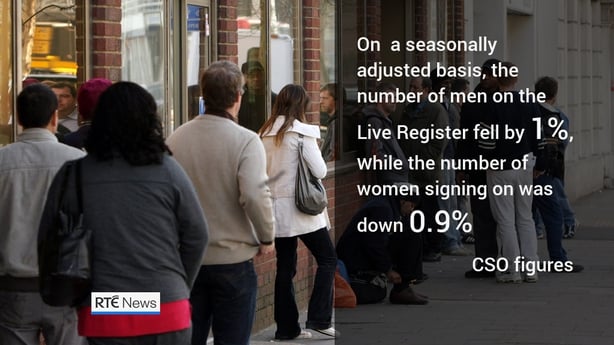
The latest figures indicate that the number of claimants on the Live Register dropped by 3,600 in January. As a result, the seasonally adjusted register, which includes casual and part-time workers, stood at 367,100.
In unadjusted terms there were 358,672 people signing on the Live Register in January 2015. This represents an annual decrease of 40,958 (-10.2%).
The figures, compiled by the Central Statistics Office, shows long-term unemployment decreased by 16,482 (-9.1%) in the month.
The number of male long term claimants decreased by 15,840 (-12.8%) in the year to January 2015, while females decreased by 642 (-1.1%).
In the year to January 2015, the number of persons aged under 25 on the Live Register decreased by 11,248 (-18.6%). Annual decreases in persons aged under 25 have occurred in all months since July 2010. The percentage of persons aged under 25 on the Live Register now stands at 13.7% for January 2015, down from 15.1% in January 2014 and 15.9% in January 2013.
There were 72,085 casual and part-time workers on the live register last month which represents 20.1% of the total Live Register.

Search engine ‘Coc Coc’ just got funding to challenge Google across Southeast Asia


Vietnam is one of a handful of markets around the world where Google faces a respectable competitor in search. That’s because a startup that emerged in 2013 claims to have surpassed Google as the top search service in the nation.

That startup, Coc Coc, revealed today that it has secured an undisclosed amount of funding to help with its growth and technology. The investment comes from Germany-based company Hubert Burda Media.
Co-founder and CEO Victor Lavrenko says that the money will help the upstart search engine “roll out to the rest of Southeast Asia.” No specific plan has been revealed yet.
A Coc Coc representative tells Tech in Asia that the search engine got an average of 2.9 million searches per day in Vietnam in December, which grew to a daily median of 3.7 million in January. That’s up from about one million per day when we last asked in October 2013. The search engine now claims to have 8.7 million monthly active users, which is backed up by ComScore’s numbers showing eight million monthly active users. We’ve contacted Google to try elicit such figures for Vietnam.
Alexa’s rankings indicate that Coc Coc is the number one website in Vietnam, having surpassed Google a while ago. But such rankings are not a sure-fire way of gauging a site’s true popularity – especially as there are many alternative ways to access Google searches rather than just visiting the Google homepage.

Shift to mobile

Just like Google, Coc Coc has other products, such as a desktop-based web browser and an advertising platform. A Coc Coc representative says that the Coc Coc browser, available for Windows and OS X, now pulls in 4.1 million searches each day via its search box, but some of those go to other search engines if a user changes the default settings.

Irish scientists develop €25 bowel cancer test breakthrough


The new affordable, non-invasive blood test will spot bowel cancer at its earliest stage and could save thousands of lives worldwide

Irish scientists have developed a miracle breakthrough in diagnosing bowel cancerthat will cost just €25.
The new affordable, non-invasive blood test will spot bowel cancer at its earliest stage, which could save thousands of lives not only here but worldwide.
The disease is Ireland’s second biggest cancer killer – causing 1,000 deaths a year.
Dr Sinéad Walsh of the Irish Cancer Society said they were “very excited” by the results of the research.
The collaboration between researchers from the Biomedical Diagnostics Institute at Dublin City University (DCU) and Irish biotech firm Randox promises that the test will be available for widespread use by the end of next year.
The test promises to identify cancer missed by existing screening methods, ruling out the need for more intrusive testing.
Professor Richard O’Kennedy, DCU’s Scientific Director of Biomedical Diagnostic Institute explained: “The aim of this new test is to find the cancer at the earliest possible stage, when it is easier to treat, improving outcomes for patients.
“This new, quick and non-invasive test will help in identifying patients with bowel cancer earlier, so they are sent for colonoscopy and thus treated more effectively.
“Survival rates from bowel cancer are closely associated with the stage at diagnosis.
“More than half of people with bowel cancer are diagnosed in the later stages, requiring more complex treatment, with a poorer chance of survival.”
Currently, bowel cancer places a huge burden on our healthcare system.
Stage one treatment costs are estimated at €18,550 a patient, while stage three costs are more than double that, at €45,000.
Current methods of testing for the disease have proved slow and unreliable.
The nature of the sample required for these tests has also resulted in worryingly low levels of patient uptake.
Discussions with the HSE on the roll-out of the new blood test have now begun and are in the early stages.
Dr Sinéad Walsh, Irish Cancer Society researcher added: “We are very excited by the results of this research as it will help us move another step forward in our strategy towards a future without cancer.
“The earlier bowel cancer can be detected, the better the outcome for patients.
“This, coupled with the ability to personalise treatments for bowel cancer patients, will contribute to better outcomes for people with bowel cancer.”

This octopus has some serious camouflage skills


Lucky snorkeller gets rare footage of an octopus changing colour after camouflaging itself against a coral reef.

A man snorkelling in the Caribbean has captured a relatively rare sight of an octopus shedding its camouflage.
In the video, the octopus is barely visible while camouflaged against the backdrop of the reef.
It is only when the camera draws nearer that the octopus transforms and begins to pulse a bright electric blue.
Like a chameleon, certain species of octopus can change their skin tone and colour.
This is down to specialised skin cells called chromatophores.
However unlike chameleons, which use chemical signals to change the colour of their skin, octopuses control their colour changes using a complex network of nerves and muscles.
As the octopus is a soft-tissue invertibrate vulnerable to predators, it’s camouflage is primarily understood as a form of protection and defence.   

Thursday, June 7, 2012

Donie's Thursday news Ireland update Blog


Ireland’s Unemployment hits 14.8 % – and that’s 309,000 people

Dole queue  
Above a typical Irish dole queue?. Now that’s nothing to smile about Enda Kenny

The latest figures in Ireland reveal that unemployment is  now at 14.8 per cent of the population – that’s 309,000 out of work.

The CSO found that employment fell by 1 per cent, or 18,100 since the same time last year, while there’s been an increase of 0.3 per cent in the numbers out of work since the last quarter of 2011.
Employment fell by 7,300 between January and March of this year, after an increase of 11,100 in the last three months of last year.
The number of long term unemployed has risen from 7.8 per cent to 8.9 per cent in the past year.
Employment fell in nine of the fourteen economic sectors over the year, with the professional, scientific and activities sector seeing the greatest rate of decline.
In terms of the 309,000 people out of work, the number of men unemployed increased over the year by 1.8 per cent to 205,400, while female unemployment rose by 10.4 per cent to 103,600.

Achill Man dies in Garda car after arrest in Castlebar Mayo

The Garda Ombudsman is investigating the incident


The Garda Síochána Ombudsman Commission is investigating the death of a man who fell unresponsive in the back of a Garda car and later died. The incident occurred in Castlebar, Co Mayo.

The dead man has been named as Pauraic O’Donnell, a 39-year-old from Achill Sound, Co Mayo. He was a single man and had one child.
Mr O’Donnell was arrested after gardaí were called to investigate a disturbance at Cox’s Bar in Castlebar at 1am this morning.
When gardaí arrived at the scenem, they arrested Mr O’Donnell outside the pub and restaurant and put him into their Garda car after he had apparently been ejected from the premises by staff.
He was then driven the short distance to Castlebar Garda station where he was to be detained.
However, when gardaí tried to take him from the car into the station, he was unresponsive. Gardaí performed CPR on Mr O’Donnell in the Garda car until an ambulance arrived to  take him to Castlebar General Hospital, where he was pronounced dead.
The Garda informed the Garda Síochána Ombudsman Commission of the death, as it is legally obliged to in any case where death or injury to a person occurs while in Garda custody or during any other form of contact with a member of the force.
The ombudsman  has appealed for anyone who was in Cox’s Bar last night or may have seen Mr O’Donnell in the area to come forward and assist its investigation.
Deputy State Pathologist Dr Michael Curtis is due to carry out a postmortem on the dead man’s remains this afternoon.

Orca/killer whales filmed off the Donegal coast

A killer whale off Inishowen, captured by wildlife ranger Emmett Johnston     

Donegal onlookers were treated and delighted yesterday to witness a visit by orca whales – also known as killer whales – off the Donegal coast.

The whales were first spotted off the Banba’s Crown early on Wednesday morning, and were then photographed and filmed as they swam over the course of the day ,DonegalNow.com reports.
This particular pod of orca whales are reportedly a regular sight off the Scottish coast.