Pages

Showing posts with label Octopus. Show all posts

Thursday, February 5, 2015

Donie's Ireland daily news BLOG

Continuing A&E overcrowding problem still exists as 523 patients on trolleys today


Ambulances outside Beaumont Hospital in Dublin as the overcrowding problems in Irish hospitals continue

Some 523 patients were waiting on trolleys in Irish hospitals today, the Irish Nurses and Midwives Organisation has confirmed.
“The overcrowding problem continues unabated,” Liam Doran, INMO General Secretary said this morning.
Our Lady of Lourdes Hospital, Drogheda was the worst affected hospital today with 40 patients waiting on trolleys, while 38 patients were on trolleys in Beaumont Hospital. The third worst affected hospital this morning was Dublin’s Connolly Hospital Blanchardstown with 37 patients on trolleys
Some 518 patients were waiting on trolleys in Irish hospitals yesterday.
“The trolley situation contains to be very, very bad and care continues to be compromised,” Mr Doran told RTE’s Morning Ireland.
The capacity to move patients waiting to be discharged to other care facilities “is still not adequate”, he stressed.360p high0:32
Mr Doran said the INMO “does acknowledge” that the influenza outbreak has taken its toll on hospital resources. A percentage of the delayed planned admissions are also now turning up at A&E because they’re worried about their condition, he said.
“They’re concerned about their condition. A manifest of that is happening at the moment.”
The INMO is in talks with the HSE this week about opening 173 around the country.
“It’s not about throwing rocks at one another… In Naas, Tallaght, and Limerick, local managements have agreed to get more staff.”
“[Hospitals] ran below safe levels of staff and we’ve got to bring back more nurses from the UK that were forced to emigrate in recent times,” he said.
The problem is “one about bed capacity and staff capacity”, he said.
February and March are typically bad times for Irish hospitals, Mr Doran said.

HSE to give cutting-edge drug to rare blood disorder patients


John and Aileen Duggan from Bellewstown, Co Meath who launched an online petition to lobby the Government and the HSE to fund the treatment John requires for the terminal blood condition PNH.

A small group of patients have won their battle to get a cutting-edge, potentially life-saving drug costing €434,000 per person a year.
The HSE has relented to pressure to give the drug Soliris to patients who are deemed in clinical need.
Around 17 patients  would benefit from the drug which treats  diseases Paroxysmal Nocturnal Hemoglobinuria (PNH) and atypical Haemolytic Uraemic (aHUS).The  conditions  cause the destruction of blood cells, leading to anaemia , fatigue, blood clots and kidney failure.
It can lead to a death in five years for some patients but the new drug can allow them have relatively normal lives.
John Duggan (33) suffers from Paroxysmal Nocturnal Haemoglobinuria (PNH) and was first diagnosed with PNH in 2010. He now requires a blood transfusion every six weeks.
Speaking on the Six:One news about the decision, he said:
“They were battling hard to get me on to this drug, but they (HSE) were saying no and that it was too expensive.
“It’s a life changer. That’s exactly what it is. It just means I’m going to have a total better quality of life and do things I haven’t been able to do for a long time.
“I’m still in shock that it was passed today. I want to thank everyone for all they’ve done in the last three or four weeks to get this campaign to where it is.”
Welcoming the decision Deputy Jerry Buttimer, chair of the  Oireachtas Committee on Health and Children said the move by the HSE to extend access to Eculizumab (Soliris) will come as a relief to people  who desperately need it.
“The decision of the HSE to extend access to Eculizumab to people diagnosed with PNH and aHUS will come as a relief.  There have been protracted efforts by patients, their representatives and public representatives to get the HSE to make this decision.  I would like to thank the HSE for taking this decision which will make a huge difference to the day to day lives of people with these rare diseases.
“Everyone’s efforts to bring about this decision again bring into focus the issue of the cost of medicines.  Eculizumab costs €430,000 per patient per year and efforts to get the manufacture to reduce its price were unsuccessful.  We need to examine closely how our drug purchasing model work and what can be done to reduce the costs to taxpayers.  Doing this can have two effects, it can save money and it can allow resources to diverted to other areas of the health service.
“Over the next few months the health committee will be examining these broader policy issues.  I hope that this will allow us to ask why drug companies can in effect hold the HSE and Department of Health to ransom.”

Unemployment rate falls to 10.5% for January 2015 in Ireland
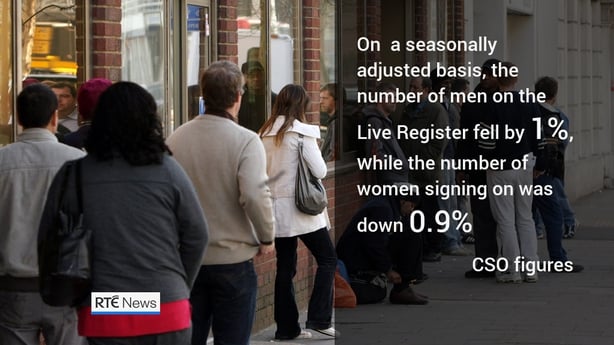
 

Numbers signing on Live Register decrease as labour market continues to improve

The State’s unemployment rate dropped to 10.5% last month, as conditions in the labour market continued to improve.
The latest figures indicate that the number of claimants on the Live Register dropped by 3,600 in January. As a result, the seasonally adjusted register, which includes casual and part-time workers, stood at 367,100.
In unadjusted terms there were 358,672 people signing on the Live Register in January 2015. This represents an annual decrease of 40,958 (-10.2%).
The figures, compiled by the Central Statistics Office, shows long-term unemployment decreased by 16,482 (-9.1%) in the month.
The number of male long term claimants decreased by 15,840 (-12.8%) in the year to January 2015, while females decreased by 642 (-1.1%).
In the year to January 2015, the number of persons aged under 25 on the Live Register decreased by 11,248 (-18.6%). Annual decreases in persons aged under 25 have occurred in all months since July 2010. The percentage of persons aged under 25 on the Live Register now stands at 13.7% for January 2015, down from 15.1% in January 2014 and 15.9% in January 2013.
There were 72,085 casual and part-time workers on the live register last month which represents 20.1% of the total Live Register.

Search engine ‘Coc Coc’ just got funding to challenge Google across Southeast Asia


Vietnam is one of a handful of markets around the world where Google faces a respectable competitor in search. That’s because a startup that emerged in 2013 claims to have surpassed Google as the top search service in the nation.

That startup, Coc Coc, revealed today that it has secured an undisclosed amount of funding to help with its growth and technology. The investment comes from Germany-based company Hubert Burda Media.
Co-founder and CEO Victor Lavrenko says that the money will help the upstart search engine “roll out to the rest of Southeast Asia.” No specific plan has been revealed yet.
A Coc Coc representative tells Tech in Asia that the search engine got an average of 2.9 million searches per day in Vietnam in December, which grew to a daily median of 3.7 million in January. That’s up from about one million per day when we last asked in October 2013. The search engine now claims to have 8.7 million monthly active users, which is backed up by ComScore’s numbers showing eight million monthly active users. We’ve contacted Google to try elicit such figures for Vietnam.
Alexa’s rankings indicate that Coc Coc is the number one website in Vietnam, having surpassed Google a while ago. But such rankings are not a sure-fire way of gauging a site’s true popularity – especially as there are many alternative ways to access Google searches rather than just visiting the Google homepage.

Shift to mobile

Just like Google, Coc Coc has other products, such as a desktop-based web browser and an advertising platform. A Coc Coc representative says that the Coc Coc browser, available for Windows and OS X, now pulls in 4.1 million searches each day via its search box, but some of those go to other search engines if a user changes the default settings.

Irish scientists develop €25 bowel cancer test breakthrough


The new affordable, non-invasive blood test will spot bowel cancer at its earliest stage and could save thousands of lives worldwide

Irish scientists have developed a miracle breakthrough in diagnosing bowel cancerthat will cost just €25.
The new affordable, non-invasive blood test will spot bowel cancer at its earliest stage, which could save thousands of lives not only here but worldwide.
The disease is Ireland’s second biggest cancer killer – causing 1,000 deaths a year.
Dr Sinéad Walsh of the Irish Cancer Society said they were “very excited” by the results of the research.
The collaboration between researchers from the Biomedical Diagnostics Institute at Dublin City University (DCU) and Irish biotech firm Randox promises that the test will be available for widespread use by the end of next year.
The test promises to identify cancer missed by existing screening methods, ruling out the need for more intrusive testing.
Professor Richard O’Kennedy, DCU’s Scientific Director of Biomedical Diagnostic Institute explained: “The aim of this new test is to find the cancer at the earliest possible stage, when it is easier to treat, improving outcomes for patients.
“This new, quick and non-invasive test will help in identifying patients with bowel cancer earlier, so they are sent for colonoscopy and thus treated more effectively.
“Survival rates from bowel cancer are closely associated with the stage at diagnosis.
“More than half of people with bowel cancer are diagnosed in the later stages, requiring more complex treatment, with a poorer chance of survival.”
Currently, bowel cancer places a huge burden on our healthcare system.
Stage one treatment costs are estimated at €18,550 a patient, while stage three costs are more than double that, at €45,000.
Current methods of testing for the disease have proved slow and unreliable.
The nature of the sample required for these tests has also resulted in worryingly low levels of patient uptake.
Discussions with the HSE on the roll-out of the new blood test have now begun and are in the early stages.
Dr Sinéad Walsh, Irish Cancer Society researcher added: “We are very excited by the results of this research as it will help us move another step forward in our strategy towards a future without cancer.
“The earlier bowel cancer can be detected, the better the outcome for patients.
“This, coupled with the ability to personalise treatments for bowel cancer patients, will contribute to better outcomes for people with bowel cancer.”

This octopus has some serious camouflage skills


Lucky snorkeller gets rare footage of an octopus changing colour after camouflaging itself against a coral reef.

A man snorkelling in the Caribbean has captured a relatively rare sight of an octopus shedding its camouflage.
In the video, the octopus is barely visible while camouflaged against the backdrop of the reef.
It is only when the camera draws nearer that the octopus transforms and begins to pulse a bright electric blue.
Like a chameleon, certain species of octopus can change their skin tone and colour.
This is down to specialised skin cells called chromatophores.
However unlike chameleons, which use chemical signals to change the colour of their skin, octopuses control their colour changes using a complex network of nerves and muscles.
As the octopus is a soft-tissue invertibrate vulnerable to predators, it’s camouflage is primarily understood as a form of protection and defence.   

Sunday, February 16, 2014

Donie's Ireland daily news update BLOG

Saturday 15th February 2014

Joan Burton puts pressure on hospitals to prove their compliance on salaries?


Social Protection Minister Joan Burton has heaped pressure on the bosses of five under-fire hospitals and agencies to prove that they are compliant with the government’s pay rules.

The Irish Independent revealed today that the hospitals, which include St James’s and St Vincent’s in Dublin, face the prospect of having their funding cut by 20% in one weeks time.
St John Of God, Brothers of Charity Southern Services, and Brothers of Charity Services South East have also been told that their funding will be slashed.
In a statement released last night the HSE said the five agencies are deemed non-compliant as they have not made business cases for their pay levels.
They are also required to submit the necessary detailed business cases.
Speaking at the Labour Partyconference in Enfield, Co Meath, Ms Burton heaped pressure on the agencies to become fully compliant with the government-imposed pay rules.
She also expressed concern that vulnerable patients may feel “frightened” as a result of the potential funding cut.
“I think what is important here is that the five organisations, whom I think have been identified by the HSE, as not being in compliance, not giving in the information -  I think it really is incumbent on them to actually go to the HSE, sit down and actually settle it,” she said.
“At the end of the day, government policy in relation to policy is quite clear. And those organisations will have to be accountable to the HSE. And I do not think the issue should be used to frighten people who are particularly vulnerable in terms of medical needs or in terms of disability,” she added.
The HSE said the reduction in cash funding is not a budget cut and therefore should, under no circumstances, impact on the provision of services to patients or clients.
A total of 10 agencies are compliant with pay policy and further 27 have presented 88 business cases for additional allowances to be paid to senior staff.
An internal review panel of senior staff within the HSE has now been appointed to examine the business cases.
The review comes after a detailed audit of Section 38 agencies and whether or not they were in compliance with pay policy began last December.
As a result, some organisations stopped paying top-ups to senior staff while others are in the process of submitting a “business case” to the HSE outlining why they feel they should be maintained.
The cuts in funding for the five hospitals and agencies is the latest development in the top-up scandal which came to a head last year with revelations surrounding details of payments at the Central Remedial Clinic (CRC).

AIB silent on bonus plan for their top executives

IRISH GOVERNMENT SAYS POLICY HAS NOT CHANGED


AIB declined to comment if they held discussions with government about changing compensation policy for top bankers.

The department of Finance Michael Noonan  said that the government “has not changed its policy position” in relation to compensation of Irish bankers in bailed-out banks.
Bloomberg reported today that the Allied Irish Bank (AIB), which needed a €21 billion bailout from the tax-payer, approached the government in relation to setting up an incentive plan to retain top executives.
Awards for senior staff
It is reported that chairman David Hodgkinson had discussions with officials at the Department of Finance on reintroducing long-term awards for senior staff at the bank when it returns to profit.
When asked about the plans for an “incentive plan” for executives and whether representations were made to government in relation to the proposal, AIB said they had “no comment”.
No change
A spokesperson for the Department of Finance said that “no discussions” are underway about AIB’s idea to incentivise executives to stay in the job.
The salaries of those working in the bank were capped and bonuses scrapped after the bank’s rescue by the State.
Minister for Finance Michael Noonan said last week that the state may seek to sell a stake in AIB before the next general election in 2016.

Noonan says Irish bank debt deal cannot be actively pursued until 2015


The Minister for Finance met with the head of the Eurozone’s permanent bailout fund, Klaus Regling, (pic above right with Michael Noonan) who reiterated his own view that any retrospective deal is not likely at the moment.

Irish Minister Michael Noonan has said that any active pursuit of retroactive re-capitalisation of Ireland’s banking system cannot be done until 2015.
Noonan was speaking after a meeting with the head of the eurozone’s permanent bailout fund, the European Stability Mechanism (ESM), Klaus Regling who repeated his beliefthat he currently cannot foresee unanimous consent to Ireland getting a deal on its bank debt.
The government has been pushing for the use of the ESM to retrospectively recapitalise its pillar banks, AIB and Bank of Ireland, which received billions of euro in State funding at the height of the financial crisis.
Regling has previously indicated that such recapitalisation using the fund that he heads “doesn’t seem very likely” and said today: “There is just a general reluctance in a number of countries to provide financing retroactively, because it’s based then on the past.”
Crucial to any retroactive recapitalisation is the establishment of a Single Supervisory Mechanism for the eurozone which is not likely until November of this year.
“We’ll continue to pursue retroactive recapitalisation of the banks and we will do that actively as soon as the instrument is in place, which means 2015, and at all levels in government we will pursue that as an objective,” Noonan said.
‘Something for the medium or long-term’
The Minister reiterated the commitment made by European leaders on 29 June 2012 to break the link between the banking debt and the sovereign and said this had been reinforced by subsequent statements from the French and German leaders.
He said: “Obviously we will continue to explore the possibilities of delivering on these commitments but until the instrument is put in place, to which Mr Regling referred, it doesn’t arise. So it’s something for the medium or long-term.”
Noonan said that the State is “not going to wait around” for a deal and will continue to bring down its cash buffers as well as purse any possibilities to sell its estimated €11-12 billion worth of shares in the banks.
“We’re not flying on one wing and simply waiting for European assistance. We have an active policy for dealing with our debt as well.” he said.
Regling congratulated Ireland on its recent emergence from the Troika programme but said that this successful exit did not mean that it would be more difficult for Ireland to get a bank debt deal.
He said that although he does not see consensus on giving Ireland debt relief there are “many other developments [that are] moving in the right direction and will help reduce the debt burden for the Irish economy and the Irish budget”.

Pre-conception drinking by fathers can damage their developing foetus


Drinking during pregnancy has long been touted as off-limits for mums-to-be but research shows dads who drink pre-conception may jeopardise the health of future offspring.

A study in which male mice were exposed to varying concentrations of alcohol prior to mating showed some of the foetuses they helped conceive suffered abnormal organ development and/or brain development. The male mice in the study not exposed to alcohol sired normal foetuses.
The authors of the study — published in Animal and Cell Systems, the official journal of the Korean Society for Integrative Biology — concluded that alcohol consumption affects genes in sperm which are responsible for normal foetal development.
One group of mice was given normal saline and the mice given alcohol were given a dose twice daily “to minimise the deleterious effects of binge alcohol drinking”.
After seven weeks of alcohol exposure, mice were relaxed for one week and were then mated with non-treated females. Foetal stage analysis was subsequently carried out after the females were euthanised and embryos removed. The number of embryos per mouse was counted and embryo body weights measured. The study’s authors found “severe foetal abnormalities”, including a disorder where the brain is located outside the skull. The researchers said the incidence of developmental abnormalities by alcohol treatment was “statistically significant”.
They concluded that paternal alcohol exposure prior to conception causes developmental defects in the next generation at pre- and post-natal stage.
Also, specific abnormalities such as exencephaly (brain located outside skull) were determined at the foetal stage. Transgenerational toxicity — a health effect that occurs when a pollutant or toxic substance passes from a parent to an offspring — caused by paternal alcohol exposure “is possibly mediated through alcohol-induced changes in sperm at the level of the sperm genome”.
Mums-to-be drinking alcohol during pregnancy is a known risk and cause of foetal alcohol syndrome. These children can suffer retarded intellect, stunted growth and nervous system abnormalities, social problems and isolation.
Until now fathers have not had a causal link to such disabilities. According to this research, it provides the first definitive evidence that fathers’ drinking habits pre-conception can cause significant foetal abnormalities.
Unfair Arm Wrestling Match: Octopus Tries to Grab Diver’s Camera
A pair of scuba divers filming off Carmel, Calif., got a great big surprise when a giant Pacific octopus suddenly put an arm lock on one of their cameras.
NBC affiliate KSBW in Monterey reported that the encounter occurred when Warren Murray and David Malvestuto were diving in Bluefish Cove off of Point Lobos in Carmel. They were in about 80 feet of water when the normally shy cephalopod approached them and took a fancy to Murray’s camera.
As Malvestuto kept his video camera rolling, the octopus wrapped its arms around the camera and tried to pull it away from the diver.
The Octopus Tries to steal the Diver’s Camera
The wrestling match continued for a few tense moments before Murray flashed the camera’s lights, causing the light-sensitive octopus to beat a hasty retreat.
The report did not say when the encounter occurred.
Giant Pacific octopuses, which have powerful suction cups dotting their legs and can grow up to 30 feet in length, are normally extremely shy, but they also are “agile, smart (and) sneaky,” according to the Monterey Bay Aquarium.
“Octopuses are very intelligent animals that can learn to open jars, play with toys, and interact with their handlers,”the aquarium says on its website. “Giant Pacific octopuses spend most of their lives alone. Scientists long thought that animals were unlikely to evolve intelligence unless they were social, so the octopus’s clever, lonely life is something of a mystery.”

I want to take a Selfie?

As a Octopus tries to grab a Scuba Diver’s camera

  
The Octopus Tries to steal the Diver’s Camera in the above shots.

A pair of scuba divers filming off Carmel, Calif., got a great big surprise when a giant Pacific octopus suddenly put an arm lock on one of their cameras.

NBC affiliate KSBW in Monterey reported that the encounter occurred when Warren Murray and David Malvestuto were diving in Bluefish Cove off of Point Lobos in Carmel. They were in about 80 feet of water when the normally shy cephalopod approached them and took a fancy to Murray’s camera.
As Malvestuto kept his video camera rolling, the octopus wrapped its arms around the camera and tried to pull it away from the diver.
The wrestling match continued for a few tense moments before Murray flashed the camera’s lights, causing the light-sensitive octopus to beat a hasty retreat.
The report did not say when the encounter occurred.
Giant Pacific octopuses, which have powerful suction cups dotting their legs and can grow up to 30 feet in length, are normally extremely shy, but they also are “agile, smart (and) sneaky,” according to the Monterey Bay Aquarium.
“Octopuses are very intelligent animals that can learn to open jars, play with toys, and interact with their handlers,”the aquarium says on its website. “Giant Pacific octopuses spend most of their lives alone. Scientists long thought that animals were unlikely to evolve intelligence unless they were social, so the octopus’s clever, lonely life is something of a mystery.”