Pages

Showing posts with label search engines. Show all posts

Thursday, February 5, 2015

Donie's Ireland daily news BLOG

Continuing A&E overcrowding problem still exists as 523 patients on trolleys today


Ambulances outside Beaumont Hospital in Dublin as the overcrowding problems in Irish hospitals continue

Some 523 patients were waiting on trolleys in Irish hospitals today, the Irish Nurses and Midwives Organisation has confirmed.
“The overcrowding problem continues unabated,” Liam Doran, INMO General Secretary said this morning.
Our Lady of Lourdes Hospital, Drogheda was the worst affected hospital today with 40 patients waiting on trolleys, while 38 patients were on trolleys in Beaumont Hospital. The third worst affected hospital this morning was Dublin’s Connolly Hospital Blanchardstown with 37 patients on trolleys
Some 518 patients were waiting on trolleys in Irish hospitals yesterday.
“The trolley situation contains to be very, very bad and care continues to be compromised,” Mr Doran told RTE’s Morning Ireland.
The capacity to move patients waiting to be discharged to other care facilities “is still not adequate”, he stressed.360p high0:32
Mr Doran said the INMO “does acknowledge” that the influenza outbreak has taken its toll on hospital resources. A percentage of the delayed planned admissions are also now turning up at A&E because they’re worried about their condition, he said.
“They’re concerned about their condition. A manifest of that is happening at the moment.”
The INMO is in talks with the HSE this week about opening 173 around the country.
“It’s not about throwing rocks at one another… In Naas, Tallaght, and Limerick, local managements have agreed to get more staff.”
“[Hospitals] ran below safe levels of staff and we’ve got to bring back more nurses from the UK that were forced to emigrate in recent times,” he said.
The problem is “one about bed capacity and staff capacity”, he said.
February and March are typically bad times for Irish hospitals, Mr Doran said.

HSE to give cutting-edge drug to rare blood disorder patients


John and Aileen Duggan from Bellewstown, Co Meath who launched an online petition to lobby the Government and the HSE to fund the treatment John requires for the terminal blood condition PNH.

A small group of patients have won their battle to get a cutting-edge, potentially life-saving drug costing €434,000 per person a year.
The HSE has relented to pressure to give the drug Soliris to patients who are deemed in clinical need.
Around 17 patients  would benefit from the drug which treats  diseases Paroxysmal Nocturnal Hemoglobinuria (PNH) and atypical Haemolytic Uraemic (aHUS).The  conditions  cause the destruction of blood cells, leading to anaemia , fatigue, blood clots and kidney failure.
It can lead to a death in five years for some patients but the new drug can allow them have relatively normal lives.
John Duggan (33) suffers from Paroxysmal Nocturnal Haemoglobinuria (PNH) and was first diagnosed with PNH in 2010. He now requires a blood transfusion every six weeks.
Speaking on the Six:One news about the decision, he said:
“They were battling hard to get me on to this drug, but they (HSE) were saying no and that it was too expensive.
“It’s a life changer. That’s exactly what it is. It just means I’m going to have a total better quality of life and do things I haven’t been able to do for a long time.
“I’m still in shock that it was passed today. I want to thank everyone for all they’ve done in the last three or four weeks to get this campaign to where it is.”
Welcoming the decision Deputy Jerry Buttimer, chair of the  Oireachtas Committee on Health and Children said the move by the HSE to extend access to Eculizumab (Soliris) will come as a relief to people  who desperately need it.
“The decision of the HSE to extend access to Eculizumab to people diagnosed with PNH and aHUS will come as a relief.  There have been protracted efforts by patients, their representatives and public representatives to get the HSE to make this decision.  I would like to thank the HSE for taking this decision which will make a huge difference to the day to day lives of people with these rare diseases.
“Everyone’s efforts to bring about this decision again bring into focus the issue of the cost of medicines.  Eculizumab costs €430,000 per patient per year and efforts to get the manufacture to reduce its price were unsuccessful.  We need to examine closely how our drug purchasing model work and what can be done to reduce the costs to taxpayers.  Doing this can have two effects, it can save money and it can allow resources to diverted to other areas of the health service.
“Over the next few months the health committee will be examining these broader policy issues.  I hope that this will allow us to ask why drug companies can in effect hold the HSE and Department of Health to ransom.”

Unemployment rate falls to 10.5% for January 2015 in Ireland
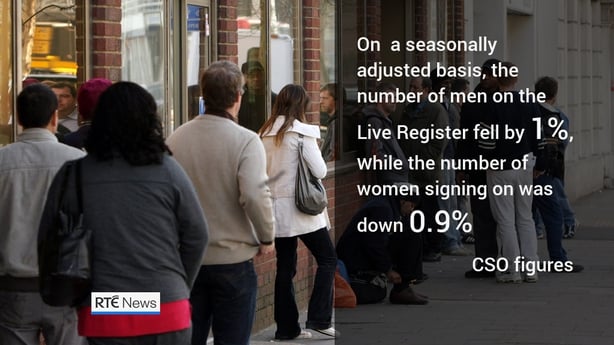
 

Numbers signing on Live Register decrease as labour market continues to improve

The State’s unemployment rate dropped to 10.5% last month, as conditions in the labour market continued to improve.
The latest figures indicate that the number of claimants on the Live Register dropped by 3,600 in January. As a result, the seasonally adjusted register, which includes casual and part-time workers, stood at 367,100.
In unadjusted terms there were 358,672 people signing on the Live Register in January 2015. This represents an annual decrease of 40,958 (-10.2%).
The figures, compiled by the Central Statistics Office, shows long-term unemployment decreased by 16,482 (-9.1%) in the month.
The number of male long term claimants decreased by 15,840 (-12.8%) in the year to January 2015, while females decreased by 642 (-1.1%).
In the year to January 2015, the number of persons aged under 25 on the Live Register decreased by 11,248 (-18.6%). Annual decreases in persons aged under 25 have occurred in all months since July 2010. The percentage of persons aged under 25 on the Live Register now stands at 13.7% for January 2015, down from 15.1% in January 2014 and 15.9% in January 2013.
There were 72,085 casual and part-time workers on the live register last month which represents 20.1% of the total Live Register.

Search engine ‘Coc Coc’ just got funding to challenge Google across Southeast Asia


Vietnam is one of a handful of markets around the world where Google faces a respectable competitor in search. That’s because a startup that emerged in 2013 claims to have surpassed Google as the top search service in the nation.

That startup, Coc Coc, revealed today that it has secured an undisclosed amount of funding to help with its growth and technology. The investment comes from Germany-based company Hubert Burda Media.
Co-founder and CEO Victor Lavrenko says that the money will help the upstart search engine “roll out to the rest of Southeast Asia.” No specific plan has been revealed yet.
A Coc Coc representative tells Tech in Asia that the search engine got an average of 2.9 million searches per day in Vietnam in December, which grew to a daily median of 3.7 million in January. That’s up from about one million per day when we last asked in October 2013. The search engine now claims to have 8.7 million monthly active users, which is backed up by ComScore’s numbers showing eight million monthly active users. We’ve contacted Google to try elicit such figures for Vietnam.
Alexa’s rankings indicate that Coc Coc is the number one website in Vietnam, having surpassed Google a while ago. But such rankings are not a sure-fire way of gauging a site’s true popularity – especially as there are many alternative ways to access Google searches rather than just visiting the Google homepage.

Shift to mobile

Just like Google, Coc Coc has other products, such as a desktop-based web browser and an advertising platform. A Coc Coc representative says that the Coc Coc browser, available for Windows and OS X, now pulls in 4.1 million searches each day via its search box, but some of those go to other search engines if a user changes the default settings.

Irish scientists develop €25 bowel cancer test breakthrough


The new affordable, non-invasive blood test will spot bowel cancer at its earliest stage and could save thousands of lives worldwide

Irish scientists have developed a miracle breakthrough in diagnosing bowel cancerthat will cost just €25.
The new affordable, non-invasive blood test will spot bowel cancer at its earliest stage, which could save thousands of lives not only here but worldwide.
The disease is Ireland’s second biggest cancer killer – causing 1,000 deaths a year.
Dr Sinéad Walsh of the Irish Cancer Society said they were “very excited” by the results of the research.
The collaboration between researchers from the Biomedical Diagnostics Institute at Dublin City University (DCU) and Irish biotech firm Randox promises that the test will be available for widespread use by the end of next year.
The test promises to identify cancer missed by existing screening methods, ruling out the need for more intrusive testing.
Professor Richard O’Kennedy, DCU’s Scientific Director of Biomedical Diagnostic Institute explained: “The aim of this new test is to find the cancer at the earliest possible stage, when it is easier to treat, improving outcomes for patients.
“This new, quick and non-invasive test will help in identifying patients with bowel cancer earlier, so they are sent for colonoscopy and thus treated more effectively.
“Survival rates from bowel cancer are closely associated with the stage at diagnosis.
“More than half of people with bowel cancer are diagnosed in the later stages, requiring more complex treatment, with a poorer chance of survival.”
Currently, bowel cancer places a huge burden on our healthcare system.
Stage one treatment costs are estimated at €18,550 a patient, while stage three costs are more than double that, at €45,000.
Current methods of testing for the disease have proved slow and unreliable.
The nature of the sample required for these tests has also resulted in worryingly low levels of patient uptake.
Discussions with the HSE on the roll-out of the new blood test have now begun and are in the early stages.
Dr Sinéad Walsh, Irish Cancer Society researcher added: “We are very excited by the results of this research as it will help us move another step forward in our strategy towards a future without cancer.
“The earlier bowel cancer can be detected, the better the outcome for patients.
“This, coupled with the ability to personalise treatments for bowel cancer patients, will contribute to better outcomes for people with bowel cancer.”

This octopus has some serious camouflage skills


Lucky snorkeller gets rare footage of an octopus changing colour after camouflaging itself against a coral reef.

A man snorkelling in the Caribbean has captured a relatively rare sight of an octopus shedding its camouflage.
In the video, the octopus is barely visible while camouflaged against the backdrop of the reef.
It is only when the camera draws nearer that the octopus transforms and begins to pulse a bright electric blue.
Like a chameleon, certain species of octopus can change their skin tone and colour.
This is down to specialised skin cells called chromatophores.
However unlike chameleons, which use chemical signals to change the colour of their skin, octopuses control their colour changes using a complex network of nerves and muscles.
As the octopus is a soft-tissue invertibrate vulnerable to predators, it’s camouflage is primarily understood as a form of protection and defence.   

Tuesday, July 29, 2014

Donie's Ireland daily news BLOG update

Irish Consultant’s may get 25% pay increases

“NOW NECESSARY TO TACKLE CRISIS IN RETAINING SENIOR DOCTORS”


A consultant is defending proposals that could see senior doctors offered pay rises of nearly 25%.

Reports at the weekend claimed that revised pay and career structures were put forward by the HSE and government departments last week.
Entry-level consultants who work exclusively in a public hospital are currently paid €116,000.
Dublin-based consultant ophthalmologist Michael O’Keeffe says something has to be done to keep doctors in Ireland.
“Irish doctors are well-qualified and well-regarded abroad. We have a situation where 25% of the jobs in Ireland are unfilled,” he said.
“We’re increasingly putting locums in to fill some of the jobs. We have a crisis and whether we like it or not, we have to solve it if we are to maintain our heath system.”

Dublin and the commuter belt are in line for a property tax cut


MINISTER BRENDAN HOWLIN CONFIRMS SEVERAL COUNCILS HAVE ‘SURPLUSES’ TO FUND REDUCTIONS

House owners in Dublin are in line for a full 15% cut in their property tax next year.
In another eight areas around the country, householders can also expect a cut, according to draft calculations for the Government.
A cut of up to 15% in the rate will be possible in Meath, Kildare, Wicklow, Cork city, Cork County, Galway city, Kerry and Clare.
The proceeds of the property tax will go directly to councils next year, when local authorities will have the power to cut or increase their property tax rates by 15pc. The 12 councils can cut the rate because they will have a surplus of funding in 2015, when the benefits of the property tax are felt locally.
The other 19 councils will have the same amount of money as this year, so won’t be able to cut their property tax rate.
Public Spending Minister Brendan Howlin has confirmed to the Irish Independent that a number of local authorities will have enough funds from the property tax to cut the rate for homeowners.
“Those that generate sufficient surpluses will be able to do it,” he said.
Although he declined to list the individual areas, he did confirm the rate could be cut in up to a dozen areas.

“YES. OF THAT ORDER,” HE SAID.

However, the Irish Independent seems to have established the identity of the 12 areas from government sources.
Mr Howlin said some of the councils with a surplus won’t have enough to cut by the full 15pc. The minister also said a few councils will have more than enough funds to cut by 15pc, “and still have significant flushness after that”.
Nobody will have to increase the rate in 2015 as the Coalition has ensured no council will be worse off than this year.
The average cost of a Dublin home now stands at €349,000, while the average cost of a home outside the capital is €154,000.

A 15% REDUCTION ON THE PROPERTY TAX WOULD MEAN:

* The property tax on a house worth €150,000-€200,000 would fall from €315 to €268.
* The property tax on a house worth €300,000-€350,000 would reduce from €585 to €497 – a saving of €88.
* The property tax on a house worth €500,000-€550,000 would reduce from €945 to €803 – a saving of €142.
The Government has worked out how much each local authority will receive next year when the property tax goes direct to the local authorities.
The first €4 out of every €5 collected will go straight into the area where it is collected.
The remaining €1 out of every €5 collected will go into a pot to be distributed among the poorer councils.
The exact formula for the distribution of funding is still to be decided.
The final figures will affect which local authorities can cut by the full 15pc without affecting services.
But the four local authorities in Dublin – Dublin City, South Dublin, Fingal and Dun Laoghaire – will be able to cut by 15pc, due to the large population and higher property prices. Indeed, Dun Laoghaire and Fingal county councils will still have several million euro left over.
There was a dispute in the Coalition over the manner in which central funding for councils was being cut as local authorities were benefiting from the property tax.
But these matters have now been resolved and councils will learn in the coming weeks how much money they are in line to get next year.
Mr Howlin said it was appropriate for councils to benefit from the property tax revenues. “What is this about? This is about taking back into the central exchequer the motor tax, which was the main sourcing base for local government fund and replacing it with a true local generated source of funding – the local property tax,” he said
“So it is obviously helping the exchequer at central level by freeing up the motor tax to be deployed centrally and allowing a flexible new source of funding at local level, which I think will bed down over time,” he said.
Mr Howlin said the property tax will give councils more say in how they are funded.
“Local councils have the capacity to spend but not raise money in any real terms, except around the edges.

Internet search engines are both an aid and a danger for people at risk of suicide


If someone is thinking about suicide, the Internet often serves as a source of information. The dangerous thing about this is that content containing harmful information that can potentially encourage suicide ranks higher in search engines’ hit lists than sources of help.

These are the findings of a recent study by Benedikt Till and Thomas Niederkrotenthaler from the Institute of Social Medicine at the MedUni Vienna’s Centre for Public Health.
The study, which was published in the August issue of the highly respected “Journal of Clinical Psychiatry”, investigated which websites can be found by searching for information on suicides using popular search engines (Google, Bing/Yahoo) in Austria or the USA.
The positive news about the results is that information of a more protective nature is significantly more plentiful than harmful information, both in Austria and in the USA. In fact the ratio is around 2:1. Consequently, there is on the whole more protective information for those seeking help.
“However the type of website and quality of information found depends greatly on what search terms are used. There is considerably more potentially harmful web content available when method-based search terms are used (such as “how do I hang myself?”) and more potentially protective content with help-orientated terms (e.g. “suicide help”),” notes Thomas Niederkrotenthaler. “People at greater risk of suicide probably use method-based terms, which is why it is extremely relevant what appears in the search lists,” continues Niederkrotenthaler.
“Websites also appear much earlier in the search list – i.e. they are ranked higher in the search engine results – the more harmful and less positive characteristics they have,” adds Benedikt Till. According to the study’s authors, this is dangerous for affected individuals because information with harmful content is generally easier to find in search engines than information with a more protective character. The ratio of harmful to protective content is therefore only positive at first glance.
Specific improvements can be achieved using simple means
The study also makes it clear that, in terms of suicide prevention on the Internet – especially in Austria – there is still room for improvement in relation to user-friendliness and rankings. By way of a specific improvement, the study authors recommend that operators of prevention websites improve the rankings of their own websites for searches performed using method-oriented search terms. This can be achieved partly by enabling ads for their website to appear when search terms of this kind are entered, but also by enhancing their own website with suitable meta tags (e.g. suicide methods).
Integration of social media and active collaboration with search engines can be useful
The integration of social media (e.g. Facebook, Twitter) or a higher number of links leading to the website (e.g. through cooperation with other aid organisations) can help to further improve an organisation’s ranking in the search engines. According to the two researchers, talks are also currently ongoing with Google about ways to rank websites about suicide prevention more effectively. In some countries, Google already allows the pop-up of prevention websites when certain terms are entered. “In Austria, for example, a search for “suicide” returns a link to the crisis intervention centre. These links also need to be used more frequently for other terms,” says Till.
Results of relevance to the entire German-speaking region
The study’s significance also lies in the fact that the relevance of the study results goes way beyond the comparison of the USA and Austria. This is because 66.6% of the websites in the Austrian results were from Germany, 2.4% from Switzerland and only 21.2% came from Austria. In searches using US search engines, 80.6% of the results came from the USA, 5.6% came from the UK, 4.5% from Australia and 2.8% from Canada. This study is therefore a comparison between the English and German-speaking regions. The study was part of a project sponsored by the FWF (Austrian Science Fund) entitled “Representations and Impacts of Suicide-Related Websites” (project leader: Thomas Niederkrotenthaler).

A SUGAR-FREE DIET ALERT:

Yes, sugar is bad for you… but cutting it out totally “could kill you, experts warn”


•  UN has warned sugar could be ‘new tobacco’ because of risks to health
•  But group of scientists has dismissed trendy sugar-free anti-ageing plan
•  Dieters can forgo sugar in yoghurt, ready meals, dessert and biscuits
•  But cutting all sugar from your diet ‘would be very difficult to achieve’
With the UN warning sugar could be ‘the new tobacco’ because of its risks to health through obesity, you might think a diet that cuts it out  would get the thumbs up from experts.
But a group of scientists has just consigned a trendy sugar-free anti-ageing plan to a list of fad diets it dismisses as a waste of time and money, and potentially dangerous.
While dieters can forgo sugar in yoghurt, ready meals, dessert and biscuits, for example, having none at all is almost impossible.
Cubes: While dieters can forgo sugar in yoghurt, ready meals, dessert and biscuits, for example, having none at all is almost impossible
‘Cutting all sugar from your diet would be very difficult to achieve,’ said biochemist Leah Fitzsimmons, who even warned that such a drastic approach could be fatal.
‘Fruits, vegetables, dairy products and dairy replacements, eggs, alcohol and nuts all contain sugar, which would leave you with little other than meat and fats to eat – definitely not very healthy.’
The sugar-free diet was one of five assessed by dieticians, biochemists and other experts for the charity Sense About Science.
They also dismissed the caveman diet, said to be favoured by actor Matthew McConaughey, which holds that because we evolved eating a limited number of foods, we should return to our evolutionary roots and eat berries, vegetables and lean meat, while eschewing modern fare such as cereals, lentils, beans and dairy products.
But archaeologist Erika Nitsch said: ‘While it is true that fluffy white loaves of sandwich bread won’t have been known to our hunter-gatherer ancestors, if you are worried about a healthy diet, have lentil soup, but skip the Mars bar.’
Also rejected were diets that claim to selectively slim parts of the body by influencing hormones. For instance, it is said love handles are caused by an insulin imbalance and can be shrunk by eating less sugar.2
Basics: Dieticians, biochemists and other experts also dismissed the caveman diet, said to be favoured by actor Matthew McConaughey (pictured), which says we should eat berries, vegetables and lean meat
However, biochemist Madeline Burke said: ‘There is no evidence linking hormone synchronisation and weight loss.’
Meal-replacement drinks were also found wanting. Rob Hagan, a biomolecular scientist, said we need variety, not least to avoid ‘losing your enjoyment of food’ and becoming depressed.
‘Cutting all sugar from your diet would be very difficult to achieve’ says Leah Fitzsimmons, biochemist
The bizarre clay diet was also considered a health risk. Its followers believe a spoon of clay a day detoxifies the body, boosts the immune system and balances acidity levels.
However, dieticians warn it can cause problems from constipation to poisoning and say ‘detoxing’ is a marketing myth.
Sense About Science, which has created an online quiz on the issue called Spoof Diets, says: ‘People actually introduce malnutrition through overly restrictive diets… and they lose heart following unsustainable diets.’

Mileage on Ireland’s cars’  to be printed on NCT certs for first time  


The mileage on our cars is to be printed on NCT certificates under changes being introduced to the system from today.

The new odometer readings are being introduced as a consumer protection measure in a bid to prevent drivers being ripped off with clocked second-hand cars.
A maximum of three odometer readings will appear on the NCT certs of the future.
But the readings will give motorists planning on buying a second hand car, more information about a car’s useage and history over the course of its previous three NCT tests.
Meanwhile, car owners and traders who wish to present vehicles for inspection earlier than the previous norm of 90 days before the NCT due date, will now be allowed to do so.
The move has been introduced following lobbying by the motor retail industry and will allow a vehicle to receive a two-year certificate – or one-year for decade old and older vehicles – from the date it passes the test.
It will also benefit motorists whose cars are coming up to their tenth anniversary inspection.
Those presenting early for the tenth anniversary inspection will get a two-year rather than the one-year certificate, provided the vehicle passes the test.
“In order for a vehicle to be considered as presented voluntarily early, it must currently have an in-date, valid NCT test certificate or be younger than four years-90 days,” operators Applus said in a statement.
“This change is being introduced as members of the retail trade have lobbied for it as they see an advantage in being able to sell a vehicle with a full two year (or one year) certificate,” Applus added.
Meanwhile, in future, only a trade fob or driving licence will be deemed acceptable as a form of identification for traders looking for a short notice booking appointment.
“This measure is being introduced to bring greater transparency to transactions carried out in the test centre,” Applus said.

Trees save more than 850 lives a year in the USA,

A FOREST SERVICE STUDY STATES

  
A new study puts a definite number on the value of trees to human health. U.S. Forest Service scientists and collaborators calculate that trees, by removing air pollution as they respirate, save more than 850 lives a year in the U.S. and prevent 670,000 incidences of acute respiratory symptoms.
The study assessed the impact of trees on four pollutants for which the U.S. Environmental Protection Agency has established air quality standards: nitrogen dioxide, ozone, sulfur dioxide and fine particles (less than 2.5 microns in diameter).
The researchers calculated that trees remove less than 1 percent of air pollution — but say that even that seemingly small amount has substantial health impacts. The study, “Tree and Forest Effects on Air Quality and Human Health in the United States,” was published recently in the journal Environmental Pollution and is available online.
Not everything comes up roses when it comes to trees. Astudy published last year found that trees can add to air pollution by giving off a compound that helps produce lung-damaging particulate matter.