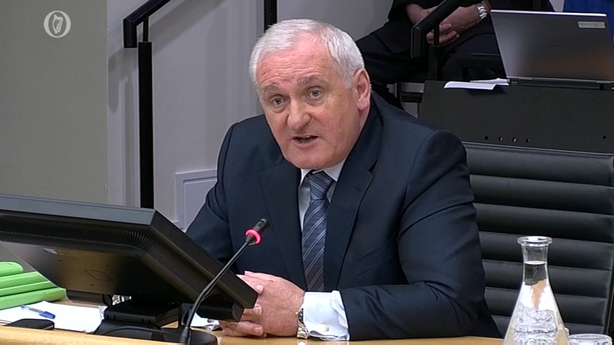
Bertie Ahern said in the banking inquiry today?
‘He did make mistakes’
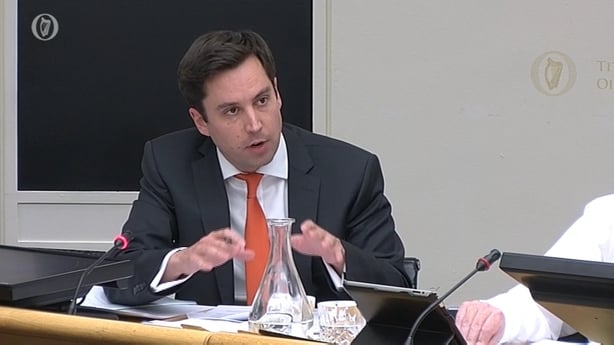
The Fine Gael TD Eoghan Murphy (pic above) asked if Mr Ahern missed warnings in OECD report.
The former Taoiseach Bertie Ahern says his governments did not squander Celtic Tiger boom.
Bertie gives a good defence of his Taoiseach years in the banking inquiry under tough questioning by Pearse Doherty and others.
Former Taoiseach Bertie Ahern said he made some mistakes during his period in office but said it was a period when Ireland “finally caught up with and then surpassed average EU living standards”.
Mr Ahern, who served as Taoiseach between 1997 and 2008, is giving evidence before the Oireachtas banking inquiry.
He rejected suggestions that his governments “squandered” the Celtic Tiger boom, saying 10 of 11 budgets during his time as Taoiseach recorded surpluses.
He said: “All the time, as Taoiseach, what I wanted to do with budgets was to improve the quality of life for ordinary people and to provide services that our country did not have before.
“Those who say we squandered the boom forget that in my time as Taoiseach we actually recorded budget surpluses in 10 of our 11 budgets.”
He also said he wished the housing bubble had not happen and would, in hindsight, have done things differently.
Mr Ahern said that in 2009, the International Monetary Fund (IMF) said the housing bubble “caused mainly by cheap credit due to low interest rates, along with rising incomes and a strong demand for housing”.
He said: “There is no doubt that this created a structural weakness in the economy and the international downturn ensured this has turned from a soft landing into a very hard one.
“I wish this didn’t happen and with hindsight, of course, I would have done things differently.
‘I apologise’
“I did make mistakes, I admit that but so does everyone who governs. I know that during my time as Taoiseach, while I did not get everything right, I can honestly put my hand on my heart and say I did try my very best to do the right thing by the Irish people. Of course, I apologise for my mistakes, but I am also pleased that I did get a lot of things right.”
He said the “winds of the greatest international recession since 1929 did batter our country after my departure”.
“But now as that storm abates, it will become increasingly clear that a lot of the progress the Irish people made in the first decade of the 21st century, such as in modernising our infrastructure, investing in our roads, our schools and our hospitals, have not been washed away.”
However, he said the recession “did have a very hard impact on individuals and families, especially those who lost their jobs, and of course that saddened me and I wish the recession did not happen”.
He said: “However, it is disingenuous to suggest that all the gains this country made have been wiped out. Between 1997 and 2008, this country thrived and not only did Ireland enjoy record economic growth, but Irish living standards were raised across the board, and this drove social progress.
“This rising tide was essential in lifting hundreds of thousands of our people out of poverty, to reversing forced emigration, to significantly increasing pensions and child benefit, to modernising schools, health facilities, roads and communications infrastructure around our country, and in creating well paid jobs for our young people at home.
‘Regenerating’
“I am glad that government allocated huge amounts of money in this period into regenerating traditional areas of poverty such as Ballymun, Fatima Mansions in Rialto, and parts of Limerick, Cork, Waterford and other cities. I am glad we put money into the islands, improving the electricity supply, the sewage system, and building new piers.
“Throughout the country, people now drive on better and safer roads. The motorway network that government supported during my tenure has cut journey times and is a vital economic and social artery for our people. People also travel on better trains. Our schools and hospitals have more staff working in better buildings.”
He said his aim with budgets introduced by his governments was to improve the quality of life for ordinary people and to provide services that the country did not have before.
“I want to remind younger members of the Oireachtas that when I first came into this House in 1977 and for right through the 1980s, our national debt was an unsustainable millstone around the neck of taxpayers,” he said. “It was a barrier to national progress as huge sums of revenue had to service interest payments.”
He said: “In 1997, the year I became Taoiseach, 20% of all taxes raised in the State were used to service the national debt. In 2007, my last full year as Taoiseach, that figure stood as low as 4.3%. During my time as Taoiseach, we continued to pay into the national pension fund so that when the downturn came we had €20 billion saved, which provided some protection when the recession came.”
He said there is “zero credibility in suggesting that an open economy like ours could withstand a global recession and the collapse of the global investment banking system”.
“This was not just an Irish experience,” he said. “It was a worldwide recession that affected America, Japan, Britain, China and most of the developed economies in the world.”
He also acknowledged there were “some warnings” about over-reliance on property.
“But it is important to be clear about the record. In October 2004, the IMF alluded to a possible overheating in the housing market even though, subsequently, they themselves and other economic commentators implied there was no bubble,” he said.
Fundamentals
Mr Ahern said he believed the fundamentals of the economy were sound when he handed over to Brian Cowen. However, he also said: “I was quite clear the level of indebtedness and lending to the property sector was growing dangerously.”
He was asked by chairman Ciarán Lynch if he had seen a Department of Finance memo from 2003 warning “the period of exceptional economic growth enjoyed by Ireland is over”.
Mr Ahern said similar warnings had been made from 1999 onwards, adding: “The ups and downs were always there. I went through the current crisis when I was minister for finance, I went through the dot com [crisis].”
His view during his time in office was that public spending was extremely conservative by EU and OECD standards: “I felt we were safe enough, that we were taking a conservative view.”
However, in retrospect he said he “would have battened down the hatches in 1997 and said no to everything”. Such an approach, he said, would have allowed Ireland record huge surpluses and weather the crisis like Germany.
When asked by Sinn Féin’s Pearse Doherty why parts of his opening statement were word for word copies of extracts from his 2009 autobiography, Mr Ahern said his views had not changed since then.
Mr. Doherty also asked about the relationship between Fianna Fáil and property developers. Mr. Ahern said he mainly dealt with organisations such as the Construction Industry Federation, which he encountered during social partnership negotiations.
He said it was “no secret” Fianna Fáil had a tent at the Galway Races, as well as the Listowel Races, but said these were social events.
“There was no big deal between the connections in the Fianna Fáil tent and the construction industry. It was a social occasion.”
He told Mr Doherty: “You seem to have a bit of an obsession about the Fianna Fáil tent.”
However, he said he wished he had been able to influence some people he met on those occasions.
“I wish I had known the extent of the exposure of some of those people, that they had to the banks. I don’t believe I personally had much interaction with property developers.”
Mr Ahern also said he always tried to maintain a positive message on the Irish economy and said he immediately apologised for a 2007 comment in which he said he didn’t know how people “sitting on the sidelines, cribbing and moaning . . . don’t commit suicide”.
He said he had two friends who took their own lives and apologised immediately.
Opposition proposals
Under questioning from Fine Gael’s Eoghan Murphy, Mr Ahern said he thought public spending in 2007 may have been too high but claimed he would have spent three times as much if he had listened to proposals from the Opposition.
He also said it was “ghastly” that about a quarter of taxation was directly related to residential property.
“The amount of taxation related to property was too high. It was too high, and I accept responsibility as head of government.”
He also said that although he had personal relationships with people such as former European Central Bank president Jean-Claude Trichet, and could have put a “lean” on them during the crisis, he felt he could not have done any better than Mr Cowen as Taoiseach.
“I don’t think Brian Lenihan or Brian Cowen made any mistakes. They did their very best in the circumstances.”
Mr Ahern said he apologised “mainly to all the people who suffered as an end result” of the property crash.
He thought construction activity would decrease but did not anticipate the subsequent crash and believed public spending was sustainable given such forecasts.
Asked about public spending on the back of construction-related tax receipts by Fianna Fáil’s Michael McGrath, Mr. Ahern said: “Was it wise? No, it wasn’t. Was it dangerous? Yes, it was.”
In a reference to lending by banks, he said: “I can’t apologise for issues I have no control over but I do apologise myself that I didn’t know about them.”
His government was influenced by difficulties encountered by young people in buying houses, which he was told about “non-stop and everywhere I went”.
Mr Ahern also said the investigations of the Mahon tribunal did not affect his day-to-day work but he “certainly would have stayed on for another 18 months” had it not been for the tribunal’s work.
He said it was a mistake to abolish property tax when Fianna Fáil took office in 1997.
Mr Ahern also said, as Taoiseach, he never met the financial regulator formally but may have done so at the annual dinner of the Irish Financial Services Centre Clearing House Group.
He told the inquiry financial regulation was “non-existent”, adding: “There was hardly any regulation as far as I can see.”`
Woman battling cancer for 11 years feels ‘worthless’
As government refuses to pay for her drugs


A terminally ill woman has said that the state’s refusal to pay for her cancer treatment drug has made her feel “worthless”.
Margaret Reidy, who has been valiantly batting cancer for the past 11 years, said that a drug called T-DM1 is her best chance in her ongoing fight.
“My survival instinct is really strong and this really is my last option,” she said.
Ms Reidy said she is angry that cancer patients who would benefit from T-DM1 are being denied the treatment while the government continue with negotiations with manufacturers.
“It makes being terminally ill more difficult to know that you are approaching the end of the road and there’s something that could help that you aren’t getting the opportunity to try,” she told Newstalk’s Lunchtime.
The T-DM1 drug is designed to seek out and destroy cancerous cells while sparing healthy tissue from unnecessary damage.
As a result, Ms Reidy explained that the patient can experience less hair loss, nausea and diarrhea.
“It’s a very expensive drug. It costs between €65,000 and €85,000 depending on the weight of the patient and the stage that the illness is at,” she said.
Health Minister Leo Varadkar answered a question relating to Ms Reidy’s case yesterday.
“It would be wrong for me as a minister to intervene to change scientific fact that can’t be overturned,” he said.
In response to Mr Varadkar’s comments, Ms Reidy said: “All I asked him to do was to find out why it’s taken so long for this medicine to be introduced.”
Getting emotional, she explained how she copes with cancer in the long term.
“You get your treatment and try to forget about the cancer and live your life,” she said.
“You get as much as you possibly can out of life. I set myself a goal of 5 years at the start.
“Then I was doing well so I said I’ll aim for another three or four years.
“I have my 60th birthday in April next year and I hope to be here for that,” she added.
A spokeswoman for the HSE told Independent.ie today:
“The drug in question is being considered under the national medicines pricing and reimbursement assessment processes.
“As the process is still on-going the HSE cannot discuss potential outcomes at this time.”
Your smartphone can tell if you’re depressed


Smartphones can track fitness, sleep and nutrition, and they might be able to detect depression, too.
A small Northwestern Medicine study tracked the smartphone use and GPS locations of 28 adults, finding that the more time you spend using your phone and the fewer places you visit, the more likely you are to be depressed.
To collect their data, researchers first administered a standardized questionnaire that commonly measures depression symptoms to the participants. They found that half of the study participants did not have any signs of depression, and the other half had symptoms that ranged from mild to severe depression.
Then, the researchers used information collected from the participants’ phone sensors over a two week period to see if depression scores matched the questionnaire. They tracked text messaging, app usage and location throughout the day. They also asked participants, via a daily pop up message, to rate their feelings of sadness on a scale of ten.
When they compared the scores to see how accurately the phone data mirrored the more traditional assessment tool, the researchers found that the sensor data could estimate depression scores with 87 percent accuracy.
What’s more, tracking behavior via these sensors was more accurate at determining depression levels than the single daily question about mood.
The phone sensors showed that people who have a more irregular schedule — like, say, leaving for work at 9 a.m. on one day and at 1 p.m. on another — were more likely to be depressed, according Dr. Sohrob Saeb, the study’s lead author and a research fellow at the Feinberg School of Medicine. Additionally, the GPS tracker linked depression with people who spent most of their time in one location, typically their homes.
Phone use behavior was also revealing: Depressed participants spent an average of 68 minutes on their phones each day, while non-depressed individuals averaged 17 minutes. Previous studies have found a link between excessive cell phone use with depression, stress and sleep issues, though more research is needed to understand the relationship, according to Saeb.
“The theories say that depressed people tend to have this ‘avoidance behavior,'” Saeb told The Huffington Post. “In order to avoid actual situations and real things out there in the world, they distract themselves by using their phone.”
This is not the first time researchers have used smartphones to track mental health. An app developed in 2014 by University of Michigan researchers, for instance, monitored vocal changes during phone conversations to detect mood swings in people with bipolar disorder.
Smartphone monitoring is attractive to clinicians who want more accurate and less invasive ways to monitor their patients. “We now have an objective measure of behavior related to depression. And we’re detecting it passively. Phones can provide data unobtrusively and with no effort on the part of the user,” said senior author David Mohr, director of the Center for Behavioral Intervention Technologies at Northwestern University Feinberg School of Medicine, in a statement.
“We can detect if a person has depressive symptoms and the severity of those symptoms without asking them any questions,” he added.
Glaxo Smith Klyne creating some 50 new jobs in Sligo


Global healthcare company GSK is recruiting 50 permanent and temporary staff in Sligo this year, the company has announced.
The roles will vary across a range of disciplines including engineering, quality, technical, logistics, finance and project management.
Half of whom have already been hired, with the remaining 25 to be recruited before the end of the year.
This recruitment drive will increase the total headcount at the site to 250 by the end of the year.
GSK Sligo manufactures a wide range of quality skin healthcare products including Physiogel, Oilatum and Driclor for over 70 markets globally.
Announcing the jobs, Kevin Wright site director of GSK Sligo, said: “It is fantastic to be celebrating our 40th year in Sligo with such positive news on the jobs front.
“It is thanks to the dedicated staff here in Sligo that the business is growing.
“We believe in recruiting and investing in top quality people and offer competitive packages to ensure that we can achieve this.”
NASA releases a closeup image of Pluto’s large moon Charon


Closeup image of an area on Pluto’s largest moon Charon. (NASA-JHUAPL-SwRI)
NASA has released a closeup image of Pluto’s largest moon Charon, the latest picture from the New Horizons spacecraft’s historic flyby of the dwarf planet this week.
The image reveals what NASA describes as a “captivating feature” of Charon – a depression on the moon’s surface with a peak in the middle. Few craters are visible in the image, which shows an area of about 240 miles from top to bottom.
In its statement, NASA said that the image was taken at approximately 6:30 a.m. ET on Tuesday, when New Horizons was about 49,000 miles from Pluto’s surface, an hour-and-a-half before its closest approach to the dwarf plant.
The agency described the depression as Charon’s ‘Mountain in a Moat’ in a tweet on Thursday, noting that the image is a preview of future closeups.
NASA will hold a briefing Friday to unveil new images of Pluto and discuss new science findings from the flyby.
The agency released the first of New Horizons’ eagerly-anticipated flyby images Wednesday. These included the first closeup of Pluto, which showed a range of mountains rising as high as 11,000 feet above the dwarf planet’s icy surface.
A stunning Charon image was also released, clearly showing a swath of cliffs and troughs stretching about 600 miles across the moon’s surface.
Imaging obtained by New Horizons and transmitted to Earth early Wednesday morning also shed light on Pluto’s outermost moon Hydra. Since its discovery in 2005, Hydra has been known only as a fuzzy dot of uncertain shape, size, and reflectivity, according to NASA, although New Horizons’ Long Range Reconnaissance Imager (LORRI) reveals the moon’s irregularly shaped body.
The spacecraft’s flyby took it within 7,750 miles of Pluto’s surface Tuesday, roughly the distance between New York and Mumbai.
Confirmation of the successful flyby came late Tuesday, when New Horizons contacted scientists back on Earth, 3 billion miles from Pluto.
Pluto has fascinated astronomers since 1930, when it was discovered by Clyde Tombaugh using the Lowell Observatory in Flagstaff, Ariz. Some of Tombaugh’s ashes are aboard New Horizons.
New Horizons is the first-ever space mission to explore a world so far away from Earth, according to NASA.


