Ireland regains its coveted A grade credit rating as expected
MOODY’S SAYS THAT BUDGET DEFICIT SHOULD CONTINUE TO FALL UNDER NEW GOVERNMENT GUIDELINES?


Moody’s has maintained a B rating on Irish debt for much longer than other agencies.
The new Government received a boost last night as the last of three major credit rating agencies assigned an A-grade on Irish debt for the first time in five years.
One week after Taoiseach Enda Kenny returned to office, the move by Moody’s marks a public assertion of confidence in his minority administration and its broad economic plan.
Early on Saturday morning Moody’s upgraded Ireland’s long-term government to an A-grade rating , saying that the recent election of a Government gave confidence that the budget deficit would continue to fall. It also said that the outlook remained “positive”, indicating that further upgrades might be possible. It has upgraded Ireland’s rating to an A3 from a Baa1.
In a statement, the agency said that Ireland’s debt position continued to improve more rapidly than expected, with the debt ratio falling to 94 per cent of GDP by the end of last year. It said that the risk of a reversal of course on budget policy looked small, following the election of a Government led by Fine Gael, which had established a strong record of budget management in recent years.
In an upbeat assessment, Moody’s said Ireland was poised for further growth which would lead to continued improvements in its public finances.It pointed to the risk of a British exit from the EU but said that even if this happens the situaiton should be “manageable”for Ireland.
In its statement the agency said: “In Moody’s view, the risk of a reversal of the fiscal consolidation seen over the past several years is low. The recent political agreement between the two largest parties in parliament and the recent election of a minority goverment led by Fine Gael, which has established a strong track record of fiscal management over the past several years, give comfort that the budget deficit wil be reduced further in coming years.”
The Minister for Finance, Michael Noonan, said the move proved Ireland was progressing in the right direction. “That progression will carry on under the new Government. The decison shows that Moody’s are confident that the Programme for Government, published earlier this week, will reinforce that upward trend.”
The upgrade was also welcomed by the National Treasury Management Agency. Frank O’Connor, NTMA’s director of funding and debt management said: “Moody’s upgrade represents further affirmation of Ireland’s fiscal and economic recovery. While the rating is still two notches below Ireland’s highest rating it is encouraging that the “positive outlook was maintained, allowing potential for more upgrades.”
He said that while an eventual uplift to a A-grade had already been discounted by many investors, “the formal upgrade will assist our ongoing efforts to broaden the market for Irish sovereign debt, particularly to those who are obliged to use the lowest ratings across the major rating agencies.”
LAST TO UPGRADE
Moody’s had previously refused to follow rivals Standard & Poor’s and Fitch when they upgraded their assessments of Ireland’s debt to the A level in light of the advancing economic recovery.
Any A-grade on a sovereign bond increases its appeal to risk-averse investors, who accept lower interest payments in return for greater security.
Although the State has large post-crash debts, the fact that each of “big three” global rating agencies now have A-grades on Irish bonds will underpin investor confidence. This should help maintain lower borrowing costs, which is of benefit to the public finances.
The upgrade by Moody’s, the most conservative of the rating agencies, also expands the range of potential buyers of Irish bonds. Some low-risk investors insist on an A-grade from all three big agencies as the minimum requirement to take a position in any sovereign debt. Fiscal rules
The development comes despite uncertainty over the durability of the minority Government and its adoption of many uncosted promises in its political programme. But the Government also pledged to uphold stringent fiscal rules set out in domestic and EU law, a crucial declaration to financial markets of its intent to maintain spending discipline.
The Government has also pledged to take “all necessary action” to tackle high variable mortgage rates but earlier in the week Minister for Finance Michael Noonan insisted nothing would be done to undermine the banks.
Moody’s had been seen as an outlier by markets as Standard & Poor’s has an A+ rank on Ireland’s debt and Fitch has an A. As a result, some analysts have cast its anticipated action as a “catch-up” manoeuvre to put it on the same footing as its rivals.
Growing anticipation of an upgrade by Moody’s drove Irish 10-year borrowing costs down in Friday’s trading session.
The bonds changed hands at 0.8439 per cent as markets opened in the morning. By the close in Dublin the yield was at 0.8009 per cent, a mark of confidence in some quarters that an upgrade might be imminent.
Investors in Irish debt have been encouraged by swift economic growth and the restoration of order in the public finances. At the same time, intensive bond market interventions by the European Central Bank have also helped to cut the cost at which the State borrows.
Such trends are significant as Ireland’s large post-crash debt imposes very heavy costs on the public finances. The State spent €6.98 billion last year to service the debt.
With €22.93 billion in debt to mature in the next three years, maintaining investor confidence in the debt is a priority for the Government.
State service MABS writes off millions in debt for people struggling in Ireland


THE STATE’S FREE MONEY ADVICE SERVICE HAS SECURED MILLIONS OF EURO IN DEBT WRITE-OFFS SINCE JANUARY FOR PEOPLE STRUGGLING WITH PROBLEM DEBT.
New figures show that the Money Advice and Budgeting Service (Mabs) has used the debt relief notice (DRN) scheme to secure €238,000 in debt write-offs for 17 qualifying clients who engaged with its Cork City service alone in the first quarter of the year.
It is one of the highest rates of DRN write-offs in the country. The individual write-offs ranged from €3,000 for one client to €32,000 for another.
Cork Mabs co-ordinator Margaret O’Neill described the DRN scheme as a “golden ticket” for people struggling with unsecured debt.
“It really is a once-in-a-lifetime golden ticket. You can simply walk away from the debts. There are no hidden strings. This is a means to a fresh start,” she said. “We all know the symptoms of carrying problem debt. When this kind of unsecured debt becomes unmanageable, people need support.
“This scheme is aimed at people trying to get their life back on track, and can provide for full relief of burden debt up to a maximum of €35,000.”
The DRN scheme is part of the Government’s insolvency legislation introduced in 2012.
It is designed for people who have less than €35,000 in qualifying debt such as Revenue, credit card and utility bills, bank, credit union, or money lender loans, and other forms of unsecured debt, and who have few assets and a low income.
Applicants cannot have an interest in property, and must be living in rented accommodation or with their parents. Ms O’Neill said people who apply to Mabs to avail of the scheme will meet with one of their ‘approved intermediaries’ who assess each case individually.
Subject to certain criteria, successful applicants must agree to certain obligations for three years, after which the debts are simply written off, thanks to an agreed protocol with the Irish Banking Federation Institute.
Ms O’Neill said the DNR scheme is just one of the many free and confidential debt solutions provided by Mabs.
“We are the gateway to debt solutions. For some people, the DRN is the perfect solution, but there are others,” she said.
New figures show that Mabs is also negotiating with lenders on behalf of 1,440 long-term mortgage arrears householders.
Mabs staff have been attending all repossession hearings since last October 1 and are now seeing more referrals from the courts to their dedicated mortgage arrears advice team.
Mabs national development officer Michael Culloty said these specialist mortgage advisers are giving people in mortgage distress a “fighting chance”.
“It is evident that even at a late stage, deals can be put in place that will keep people in their homes,” he said.
However, he said that, in other cases, lenders need to “get real” in terms of their expectations and demands.
“Unfortunately, some lenders and credit servicing firms have their eye only on the rising property market and, where there is an amount of equity in the property, some seem fixated on getting their hands on an appreciating asset no matter what the cost to the homeowner,” he said.
Big Oil companies on a borrowing binge as price point rates fall
SO WHAT DO OIL COMPANIES DO WHEN THEIR PRICE POINT IS PLUMMETING? THEY BORROW,


Oil rigs in the Golf of Mexico. The price of oil has gone through the floor in the past three years
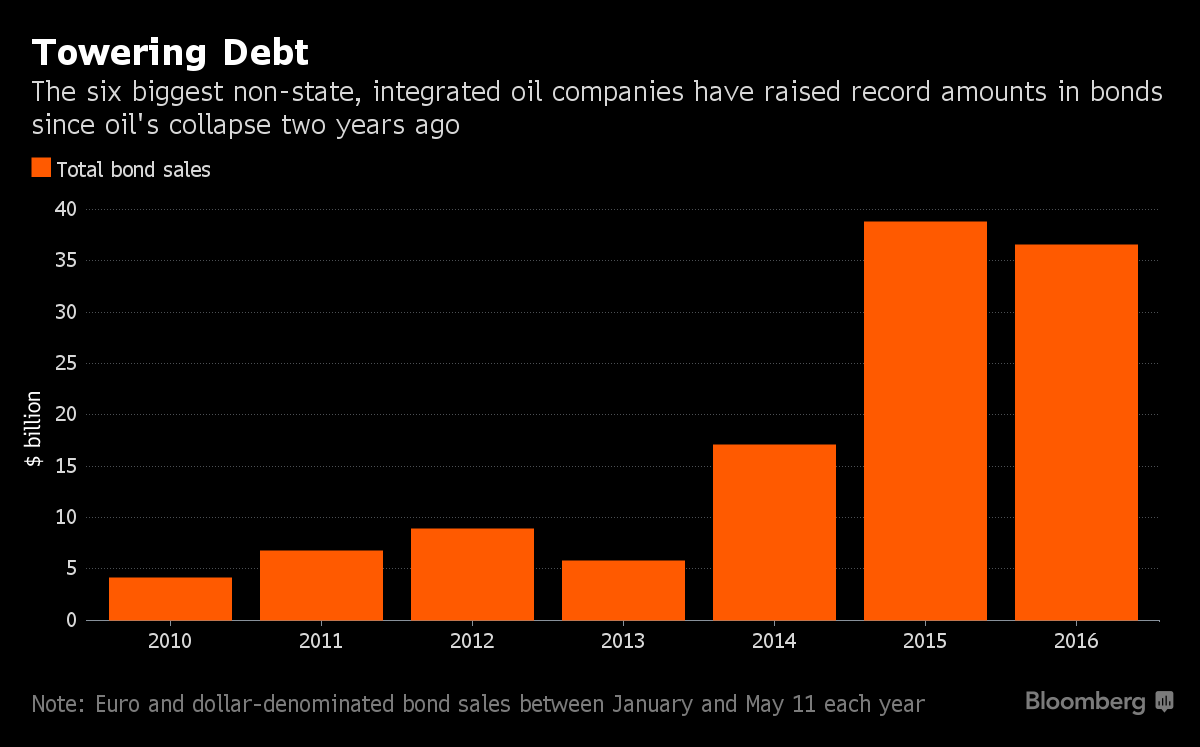
THE WORLD’S BIGGEST OIL COMPANIES ARE BORROWING RECORD AMOUNTS OF MONEY TO COPE WITH A SLUMP IN CRUDE PRICES. LUCKILY, THERE’S RARELY BEEN A BETTER TIME TO GO ON A DEBT BINGE.
Exxon Mobil, Royal Dutch Shell, Chevron, Total, BP and Eni have together sold the equivalent of $37bn of bonds this year, about double the amount issued in the period before oil prices plunged, according to data compiled by Bloomberg. While this is stretching their balance sheets and even resulting in credit-rating downgrades, the lowest debt costs in a year are softening the blow.
“They’re making hay while the sun shines,” benefiting from improved investor sentiment as oil prices have recovered, said Alex Griffiths, a London-based managing director at Fitch Ratings. “Treasurers are making use of good market conditions to maintain liquidity buffers.”
Even though oil has increased from the lows of January as a global surplus diminished, prices are still less than half their level two years ago. The world’s biggest companies have sought to keep investors happy through the downturn by maintaining dividend payouts and investing for the future at the same time. With profit and revenue sharply down, the only way to do that is borrow more money.
Debt markets are opening up for companies worldwide as central banks in the US and Europe keep benchmark borrowing rates low. Investors currently demand a return of 3.09% to hold dollar-denominated debt of companies with an investment-grade rating, the lowest level in a year, according to data from Bank of America Merrill Lynch. For euro securities, they seek 1.01%, close to the record low of 0.93% in March 2015, the data shows.
Oil companies have further benefited from the recovery in prices. Brent Crude, the global benchmark, has increased 70pc since January, aided by supply disruptions from Canada to Nigeria and falling production in the US. This has seen the 20-company Stoxx Europe 600 Oil & Gas Index rebound 3.8pc in 2016 following two years of declines.
At the same time, the premiums for credit default swaps for the biggest US and European oil companies, which investors use to protect against defaults, have dropped from the highest level in at least five years.
Shell sold $1.5bn of five-year bonds this month, which were priced to yield 1.99%, data compiled by Bloomberg show. A $2bn five-year debt sold by the company about a year ago yielded 2.13% on the first day of trading, the data shows.
BP sold $1.25bn of 10-year notes last month with a 3.12% coupon, versus 3.51% for a similar issue in March 2015. Both bonds were sold at face value. Chevron issued $1.35bn of five-year notes this month with a yield that was 32 basis points, or 0.32 of a percentage point, lower than a sale in November.
Shell’s net borrowing has increased to about $70bn and its gearing (the ratio of net debt to total capital) has risen to above 26pc from 14pc at the end of last year. In addition to the plunge in oil prices, the $54bn acquisition of BG Group added to Shell’s debt, prompting Fitch to cut the company’s credit rating in February. BP’s gearing was 23.6% at the end of the last quarter compared with 21.6% in December.
“The majors still have strong balance sheets to raise debt at competitive rates so they can manage their capital agenda, for example, to maintain dividends and strategic capital investments,” said Jon Clark, leader for oil and gas transaction-advisory services in Europe, the Middle East and Africa at Ernst & Young. “It’s also a good opportunity to refinance more expensive debt.”
Oil’s slide has forced companies to cut billions of dollars of spending, delay or cancel projects and renegotiate contracts – yet they continue to make dividends their top priority.
Shell hasn’t cut its payments to investors since at least the Second World War. Exxon even increased its pay out a day after losing its coveted AAA credit rating last month.
Shell, BP, Eni, Total, Exxon and Chevron will together pay out about $14bn for the first quarter, according to data compiled by Bloomberg. Some of those companies may pay a portion of these dividends in shares rather than cash.
Jim Chanos, founder of Kynikos Associates, said on Thursday that he is shorting Shell and Chevron’s shares because they have negative free cash flow and are relying on borrowed money to pay dividends.
“What that means is the CEOs have convinced the boards that they should borrow to pay their dividend,” Chanos said in an interview with Bloomberg. “How long that will be sustainable, we don’t know.”
Last February, BP chief executive Bob Dudley said he was happy to let the company’s debt rise this year to maintain dividends.
Debt and gearing is “something that I might lose sleep about, but not just yet,” Shell’s CFO Simon Henry said earlier this month.
“You’ve recently seen an easing of bond market risk aversion and a higher oil price,” Fitch’s Griffiths said. “That makes it a good time for Big Oil to tap the market.”
Man diagnosed with terminal cancer left stunned after friend secretly renovates his entire home
Keith Ellick asked for his fence to be fixed and never expected an army of volunteers would transform his whole home?



THE MAN KEITH ELLICK (PICTURED ABOVE WITH HIS FAMILY RIGHT) WAS GIVEN JUST A YEAR TO LIVE AND WAS LEFT SPEECHLESS AFTER HIS BOSS ORGANISED A TEAM OF VOLUNTEERS TO RENOVATE HIS HOUSE
Keith Ellick, 41, broke the news to his boss Addam Smith by telling him he might not last a year and could not even afford to pay for a funeral.
But when Mr Ellick asked his boss, who owns a landscaping and fencing company, if he would help mend his fence, his friend went a step further and organised a team of volunteer builders to give his home a makeover.
After sending Mr Ellick and his family away for a week, Mr Smith got to work with a team of builders from the Facebook group Builders Talk and used donated supplies to get the job done.
“I had the opportunity to work with the SAS of the building world… the best lads I’ve ever met,” Mr Smith said of the team of volunteers. “They’re he best lads I’ve ever met.”
But Mr Smith didn’t stop there, and is now fundraising extra money to help his friend buy the house for his family to live in, get his affairs in order, and send him to a specialist in London.
On his fundraising page, Mr Smith wrote: “This is for my mate Keith Ellick, a hard working loving family man. Keith has just been diagnosed with terminal cancer and been given a year to live, let’s get him and his family on holiday and sort him out with a few quid to get his affairs in order.”
Having seen his newly renovated family home, Mr Ellick shared his own thank you message with those who had helped on the fundraising page.
“I’ve been through a rough few months, but this is not about me, this is about me telling all you people thank you for what you’ve done for me and my family,” the brave father said in a video.
“What you’ve done for me is like wow, you people you’re kind decent amazing people. I was never even taught there were people out there like you.
“All I wanted them to do was finish off my fence and he decided to do this and I’m like wow and he even got the charity to take me down to London to see this professor… all I can say is thank you very much, I appreciate everything,” he added tearfully.
Row over plan to save extinct white rhino’s by advanced reproductive technology



‘Other creatures that might benefit from this new technology could include the kouprey, an ox-like creature from Cambodia, and the buffalo-like anoa, from Sulawesi and many more.
Under the watchful eyes of a group of heavily armed guards, three rhinos graze on the grassland of the Ol Pejeta Conservancy in Kenya. Most of the world knows that the rhinoceros is threatened, but the status of these animals is in another league. They are the planet’s last three northern white rhinos. None is capable of breeding. The northern white, which once roamed Africa in its thousands, is in effect extinct. The three rhinos named Sudan, Najin and Fatu now are the last of their kind?
In a few months, however, a group of scientists from the US, Germany, Italy and Japan will attempt the seemingly impossible task to rescue the northern white rhino somewhat smaller and hairier than its southern cousin from the jaws of extinction. In October, they plan to remove the last eggs from the two female northern whites and by using advanced reproductive techniques, including stem cell technology and IVF, create embryos that could be carried to term by surrogate rhino mothers. The northern white could then be restored to its former glory. The procedure would be a world first.
It is an audacious plan -and a controversial one. Many conservation experts believe the resources being used to create northern white embryos would be better spent on saving other rhino species by providing them with protection in the wild. Why try to restore the species if the cause of its extinction has still not been tackled, they ask. Others say that taking a hi-tech approach to species preservation could lull the conservation movement into thinking it would always be able to fall back on science to help reproduce a species once it gets into trouble.
These points are rejected by project scientists. “Unless we act now, the northern white rhino will go extinct. And don’t forget that, once we have developed IVF and stem cell technologies to save it, we will then be able to use them to rescue other threatened species,” said one of the project’s leading scientists, Professor Thomas Hildebrandt, of the Leibniz Institute for Zoo and Wildlife Research in Berlin. “For example, there are only three or four rhinoceros from Borneo left in captivity and none known in the wild,” said Hildebrandt. “We could use this technology to rescue them.”
Other creatures that might benefit from this technology include the kouprey, an ox-like creature from Cambodia, and the buffalo-like anoa, from Sulawesi.
But not everyone agrees with the hi-tech approach.
“We put millions of dollars into protecting the northern white rhino in Garamba national park in the Democratic Republic of Congo,” said Susie Ellis, of the International Rhino Foundation.
“However, the species was lost there when the park became a conflict zone and we had to pull out to ensure the safety of our staff. If there is no political will, there is only so much that organisations like ours can do.”
“We need to take a multifaceted approach to this challenge, and hi-tech science is certainly one of them,” added Ellis.
“In fact, there is no easy answer regarding the northern white rhino. It is now functionally extinct.


