The LÉ Róisín Irish vessel helps and saves more lives in rescue of 688 migrants off Libyan coast


THE LÉ RÓISÍN RESCUES 123 MIGRANTS OFF THE COAST OF LIBYA.
SOME 668 MIGRANTS WERE SAVED FROM BOATS IN DISTRESS IN THE MEDITERRANEAN OFF LIBYA ON SATURDAY, OFFICIALS SAY.
They were rescued by Italian coast guard and navy ships, aided by Irish and German vessels and humanitarian organisations, Italian and Irish officials said.
The rescues are the latest by a multi-national patrol south of Sicily that has saved thousands this week.
The Defence Forces said the vessel Le Roisin, deployed earlier this month in the humanitarian search and rescue mission, saved 123 migrants from a 12-metre-long dinghy and recovered a male body.
Immediately afterwards, the LÉ Róisín was re-tasked to rendez-vous with an Italian ship, ‘Bettica’, and a further 101 migrants were transferred it to the LÉ Róisín.
Then the German ship ‘Karlsruhe’ asked the LÉ Róisín to transfer a further 123 migrants onboard the LÉ Róisín.
A spokesperson said all three taskings have now been completed and the LÉ Róisín currently has 347 migrants on-board.
The LÉ Róisín left Haulbowline, Cork on May 2 to help the Italian Authorities with humanitarian search and rescue operations in the Mediterranean.
A German ship, part of the EU Navfor Med deployment on patrol for migrant smugglers’ boats, was also involved in what was a total of four separate rescue operations, the Italian coast guard said.
Meanwhile, with migrant shelters filling up in Sicily, the Italian navy vessel Vega headed toward Reggio Calabria, a southern Italian mainland port, taking 135 survivors, along with 45 bodies, from a rescue a day earlier. The Vega was due to dock on Sunday.
Under a European Union deal, tens of thousands of those rescued at sea and seeking asylum were supposed to be relocated to other EU nations from Italy and Greece, whose shores have received most of the migrants in recent years. But with resentment building in some European countries about taking in migrants, the plan never really took off, and only a small percentage have actually been moved.
At the Vatican on Saturday, Pope Francis told several hundred children, among them many migrants, who came from the Italian south to see him, that migrants “aren’t a danger but they are in danger”.
The pontiff held a red life vest, given to him recently by a volunteer, and told the children it was the vest used by a Syrian girl who died while trying to reach the Greek island of Lesbos. “She’s in heaven, she’s watching us,” Francis told his young audience.
Among those in the audience was a Nigerian youth, who lost his parents in 2014 as the family tried to reach Italy by sea. Francis has repeatedly expressed dismay that some European nations have refused to accept migrants fleeing poverty or war, and have even thrown up fences and other barriers to thwart the arrivals from journeying northward after reaching the continent’s southern shores.
Electricity prices In Ireland way above the EU average “So says Eurostat”


ELECTRIC IRELAND REDUCED ITS STANDARD RATES BY 6% FROM THIS MONTH AFTER ITS PARENT COMPANY, ESB, MADE OPERATING PROFITS OF €630M LAST YEAR.
Householders here pay the third highest electricity prices in the European Union, despite having seven suppliers in the market.
And new figures from Eurostat also show that domestic electricity charges here are the second highest in the EU, once taxes and levies are stripped out.
The European Union’s statistics agency found that prices here were way higher than the average across 28 countries.
A statement from the European Commission office in Dublin confirmed the new figures show that Irish households pay more for their electricity than anywhere else in the EU except Germany and Denmark.
When taxes are excluded, Irish households pay more than anywhere in Europe, except the UK.
The EC spokeswoman said: “The picture is somewhat better for gas, with Irish households coming in ninth place in the rankings.
“When taxes are discounted, domestic Irish gas prices are the sixth highest in the EU.”
However, the figures for the second half of 2015 show that domestic energy prices here fell in contrast to many EU countries.
Electricity prices fell by 3.2% in the second half of last year compared with the same six months in 2014. Gas prices were down 2.8%.
Energy companies have been heavily criticised for failing to cut prices more at a time when wholesale gas prices, the main input here, have fallen by half.
Electric Ireland reduced its standard rates by 6% from this month, in a move that will save the average household €58 a year. It came after its parent company, ESB, made operating profits of €630m last year.
But the other six suppliers have yet to announce price cuts.
Mark Whelan of price comparison site Bonkers said: “This news will undoubtedly lead to more calls for suppliers to cut their prices. However, suppliers will likely point to the statistic that Ireland actually had the third largest decrease in electricity prices in 2015, at 3.2%.”
He said householders can save €235 by switching electricity suppliers, but 1.9 million electricity customers didn’t do so.
Former Tánaiste Ray MacSharry defends Irish politicians’ pensions
THE EX- FF MINISTER SAYS HE IS IN RECEIPT OF ‘QUITE A NUMBER’ OF PAYMENTS IN A NEW INTERVIEW


The former Fianna Fáil tánaiste Ray MacSharry has said he has “quite a number” of pensions and he does not begrudge retired politicians the money they are paid.
Mr MacSharry, who served as a minister for finance and an EU commissioner during a 30-year career in politics, was in receipt of a State pension just in excess of €41,000 as of 2014.
He also has a separate “small” income from Europe.
In an interview on Saturday, he was asked how many pensions he was currently receiving.
“Oh quite a number. I am doing fine. I am very happy,” he said.
“But I can say this. I would not begrudge the Taoiseach, the Ministers, or all the TDs and Senators the monies they are getting because let’s face facts.
“The fact is that every TD . . . there is something going on in all the parishes in his or her constituency, the first person asked to support the £100 raffle or the £50 raffle is the TD.”
Speaking on the Marian Finucane Show on RTÉ Radio 1, Mr MacSharry said politicians paid taxes on their salaries.
“And what they have left, they have to live,” he said.
Mr MacSharry was also questioned on the issue of the Ansbacher accounts?
Mr MacSharry was named as an Ansbacher account holder under Dáil privilege by Sinn Féin TD Mary Lou McDonald in 2015, following claims in the disputed “Ansbacher dossier” that former ministers had used offshore accounts to evade tax.
Mr MacSharry had subsequently instructed his lawyers to write to the Public Accounts Committee (Pac) seeking access to the dossier in question.
“I didn’t know ever about Ansbacher accounts. I don’t know really where theCayman Islands are,” he said.
“I can say from my point of view it was rubbish and untrue. And I’ll say to Deputy Mary Lou MacDonald or anybody else that if they can find an account associated in any way with me, anywhere in the world, I’ll gladly give it to charity,” he said. “I know it doesn’t exist.”
Innuendo
Mr MacSharry said there was a broader issue of innuendo and falsities being applied to those in public life.
“Obviously there are always people running around making up stories and rumour and gossip and innuendo becomes established as fact . . . particularly in relation to public figures,” he said.
“Those who know the people concerned know that most of that rumour, gossip and innuendo is not fact, it’s nothing but lies.”
Irish farmers paid the sixth highest R3 heifer price in Europe


IRISH FARMERS WERE PAID THE SIXTH HIGHEST R3 HEIFER PRICE IN EUROPE LAST WEEK, ACCORDING TO FIGURES FROM THE EUROPEAN COMMISSION.
During the week ending May 22, Irish R3 heifers made 406c/kg, almost €1/kg cheaper than the highest priced market.
Swedish beef farmers were paid 504c/kg for R3 heifers last week, while R3 heifers in Greece made 442.9c/kg.
However, when compared to the lowest priced market, Latvia, Irish farmers where paid 221c/kg more for R3 heifers than farmers in the eastern European state.
Gap Widens Between Irish And UK Heifers
The price gap between Irish and UK R3 heifers widened last week, figures from the European Commission show.
Last week, an Irish R3 heifer traded at 406.9c/kg, while UK farmers received 416.3c/kg for the same heifer.
Over the past month, UK heifers were cheaper than Irish heifers on a number of occasions,mainly due to a weaker Sterling and lower UK beef prices.
But, there are some signs that the UK market is starting to stabilise, with European Commission figures showing a 11.4c/kg price increase last week.
Northern Irish Heifer Price
The price gap between Northern Irish and Irish heifers narrowed last week.
The narrowing of the beef price has occurred as Northern Irish farmers seen the price paid for R3 heifers jump by 9.41c/kg last week.
During the week ending May 22, Irish R3 heifers made 9.4c/kg more than Northern Irish heifers, on a 280kg heifer carcass this is a price difference of €26.
However, back in the last week of April a 280kg Irish heifer carcass was €42 dearer than a Northern Irish heifer carcass.
Some Movement On The Continent
There has been some movement in the main European beef markets in terms of R3 heifer price, with German and Italian R3 heifers falling by 2.8c/kg and 3.5c/kg respectively.
But there was little movement in the Spanish R3 heifer markets with prices unchanged, while prices in Poland declined by 0.1c/kg.
Contradictory nutritional advice gives consumers food for thought


IT APPEARS THAT THE BEST APPROACH TO BEING THE PERFECT HOME MAKER IN THIS MODERN AGE IS TO COMPLETE A DOCTORATE IN FOOD NUTRITION.
How else to responsibly nourish yourself and your family given the masses of conflicting advice that exists, varying almost from day to day, and added to this week by a UK report which appeared to turn much of what we have previously been told over decades on it’s head.
Fat is now actually your friend apparently. The old advice to stick to a low fat diet in order to lower your cholestrol is “flawed science” and has resulted in “disastrous health consequences” according to the report from the National Obesity Forum (NOF) and the Public Health Collaboration. Rather than the desired result this advice, the report argued, had actually seen an increase in the amount of carbohydrates and junk food consumed.
Our fridges and cupboards should be stocked with “whole foods” such as fish, meat, and dairy, as well as healthy, high fat foods like avocados. In further contradiction of the advice that has been shoved down out throats for years we were told that saturated fat does not in fact cause heart disease, while full fat dairy products such as milk, yoghurt, and cheese, can actually protect the heart. Recommendations, they rather appealingly suggest, should focus on the health benefits of eating food in its natural form. This was no sooner in the public space than it was massively contradicted.
There was the sound of crashing plates as nutritionists, scientists, doctors, and other experts had a highly serious disagreement. Public Health England thundered that the advice in the report was “irresponsible and misleads the public” and most of the public health establishment agreed with that. The public as ever was left in a state of confusion, even for something as basic as whether we should now be opting for full butter on our morning toast, or a low fat spread?
There is a pattern here. Who will forget the shambolic manner in which the World Health Organisation last October announced the cancer risks from eating processed meats and red meat? The combination of poor communication and a media looking to hype dangers meant we saw headlines equating the risk of eating two rashers a day with smoking.
On top of all of that was the news this week that we are not apparently eating enough salt. In our house the salt cellar is kept on the top shelf, but it turns out this may now actually be poor parenting. A study published in the Lancet, which was co authored by Prof Martin O’Donnell of NUI Galway, is a further example of traditional advice being turned on its head. it suggests that most people are actually consuming the right amount of salt and actually warns against the dangers of low salt diets saying they may increase the risk of heart disease and death.
On the same day I saw the Professor of Food and Health at UCD, Mike Gibney argue that a tax on fizzy drinks is a waste of time in terms of curbing obesity. If you look at the data around national food intake, he says, you see that in terms of foods with added sugar it is the contribution of table sugar and jams that is usually the main culprit in driving high intakes.
The quantity contributed by carbonated sugary beverages shows little variation as a proportion, no matter how great or small a person’s sweet tooth, he argued. “So where is the risk-assessment report that looks at all sources of added sugars and, taking everything into account, opts to focus solely on sugar-sweetened beverages for taxation? None exists.”
We are planning on introducing such a tax here, says Prof Gibney, simply because it is a global fashion built on dubious science and popular prejudice. Mexico did introduce such a sugar tax but according to The Wall Street Journal just 18 months later faced a return to pre-tax soda intakes.
Prof Gibney expressed his concern about public health nutrition credibility being set back decades by a sugar tax. He makes a strong and cogent argument. But the problem here for the punters, who feel powerless in the face of all of this conflicting information, is just who to believe and exactly what to put in our mouths.
Prof Gibney also touched on an aspect of all this which really shocked me when I first read of it elsewhere earlier this month.
It is the fact that the body defends its prevailing weight vigorously, which is why conscious weight loss through dieting is so hard to maintain. It turns out that the problem is not our will power, or lack of it, but in fact it is down to neuroscience.
A study released in the US earlier this month, concentrating on the contestants on the reality TV show Biggest Loser, over a six year period, added futher to the evidence that in the long run dieting is rarely effective. It is frightening to see the manner in which the body battles against weight loss. The brain uses metabolic suppression to keep the body within a certain weight range, called the set point. That range is determined by genes and life experience. If you drop below that weight not only do you burn fewer calories but you also produce more hunger inducing hormones and want to eat more.
In their contentious report the chairman of The National Obesity Forum Professor David Haslam pointed out that current efforts to reduce and prevent obesity have failed and the proof of that is obesity levels are higher than they have ever been, and show no chance of reducing despite the best efforts of government and scientists. But it is also fair to point out that maybe the current guidelines are failing because not enough people are following them.
The controversial UK report also touches on how vested interests have been responsible for the spreading of poor dietary advice. The food lobby internationally is massively powerful, as is the diet industry which would go out of existence if we were all at our ideal weight.
Even the introduction of something like a traffic light system which would make it easier for us shoppers to tell at a glance which foods on the supermarket shelves are healthiest are blocked.
The Australian Government censored a Global Climate report

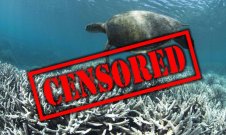
IT’S NO SECRET THAT THE GREAT BARRIER REEF IS IN THE MIDST OF A MASS DIE-OFF, NOR THAT SCIENTISTS BELIEVE THE CORAL BLEACHING EVENT IS RELATED TO CLIMATE CHANGE. BUT APPARENTLY, AUSTRALIA COULD NOT BEAR THE THOUGHT OF PUTTING THESE INCONVENIENT FACTS TOGETHER ON PAPER. THE COUNTRY’S DEPARTMENT OF ENVIRONMENT CENSORED A MAJOR GLOBAL CLIMATE REPORT JUST BEFORE PUBLICATION THIS WEEK.
The report, “World Heritage and Tourism in a Changing Climate” was a joint collaboration between Unesco, the UN environment program, and the Union of Concerned Scientists. Given that Australia is home to some of the most celebrated World Heritage sites on the planet—including the Great Barrier Reef and Tasmania’s old growth rainforests—you might expect some mention of how these ecosystems are faring in a changing climate. Oddly enough, Australia is mentioned nowhere in the entire document.
But when the Australian Department of Environment saw a draft of the report, it objected, and every mention of Australia was removed by Unesco. Will Steffen, one of the scientific reviewers of the axed section on the reef, said Australia’s move was reminiscent of “the old Soviet Union”.
No sections about any other country were removed from the report. The removals left Australia as the only inhabited continent on the planet with no mentions.
Explaining the decision to object to the report, a spokesperson for the environment department told Guardian Australia: “Recent experience in Australia had shown that negative commentary about the status of world heritage properties impacted on tourism.”
Ah, okay! So Australia was concerned that people might not be so keen to go scuba diving if they knew that a post-apocalyptic scene awaited their eyes.
A Nightmare Is Unfolding in the Great Barrier Reef
If scuba diving in the Great Barrier Reef is on your bucket list, you might want to book tickets…Read more
The thing is, it takes a special kind of willful ignorance to pretend that your land isn’t on fire when people can see the smoke from a thousand miles away. Gizmodo and many other outlets reported on fires that devastated Tasmania’s World Heritage Forests earlier this year, which most scientists agree were made more likely by climate change. About a month later, the worst global coral bleaching event on record hit the Great Barrier Reef, causing more than 90 percent of the northern reef to turn a ghostly white. Much of the reef isgoing to have difficulty recovering. This news, too, has been broadcast far and wide.
But sadly, Australia’s latest actions are far from an isolated event: less than a year ago, the government lobbied Unesco not to list the Great Barrier Reef as a “World Heritage Site in Danger,” perhaps so that it could proceed with a plan to turn the reef into a shipping lane for one of the world’s largest coal mineswithout the international community raising eyebrows.
If you were hoping to read the censored section of the report on the Great Barrier Reef, Guardian Australia obtained a copy of it late yesterday.