Pages

Showing posts with label Attitudes. Show all posts

Saturday, January 30, 2016

Donie's Ireland daily news BLOG update

Irish Labour party promises to slash taxes by a third if returned to power?
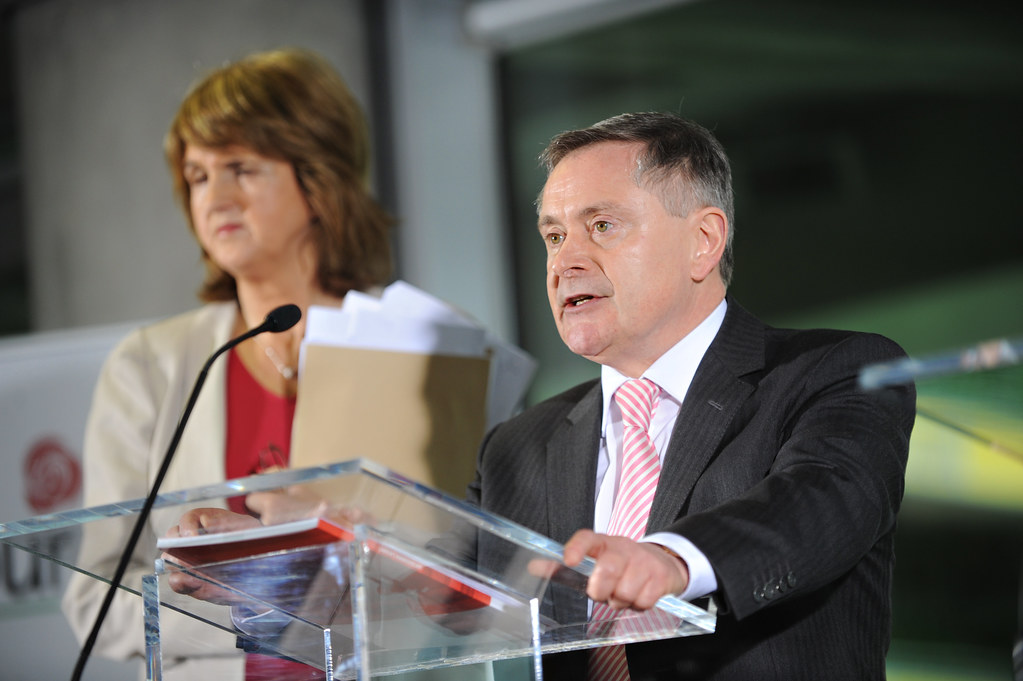
    

THE IRISH LABOUR HAS PROMISED TO REDUCE TAXES FOR WORKERS ON €25,000 BY AS MUCH AS A THIRD AS PART OF A €3BN TAX REFORM PACKAGE IF IT IS RETURNED TO POWER.

Workers on up to €50,000 would also see their taxes reduced by up to 15% under the promised reforms.
Public Expenditure Minister Brendan Howlin unveiled the tax-cut promise yesterday evening in Mullingar, ahead of Labour’s conference here today.
The plan would put more than €1,000 a year back into the pocket of a worker on €25,000. However, a high earner on €120,000 or more would not see any reductions in their tax obligations.
As part of the pre-election promise, Labour says USC would be abolished on incomes up to €72,000. Workers would also pay less PRSI once their income amounts to less than €704 a week.
Any gains under the changes for higher earners would be clawed back by adjusting their tax.
Announcing the changes, Mr Howlin said the USC was the “most draconian of the charges” introduced during the recession. However, Labour still wanted to keep a broad tax base and would limit reductions.
For more election news, analysis and general banter join us HERE
Under the proposals, a worker on €25,000 would see joint reductions in USC and PRSI result in a €1,132 saving annually, or €22 per week.
A worker on €50,000 would see €2,043 saved a year or €39 per week . Someone on a salary of €72,000 makes a saving of €3,302 or €63 per week.
Labour stressed that higher earners would see gains clawed back.
Someone on €120,000 might see USC reductions of €3,302 but these would be cancelled out by income tax-related increases.
Mr Howlin also responded to calls for the next government to have a “rainy day” fund, saying that Labour had financial plans, though this was an unallocated amount, if Ireland faced future economic challenges.
The minister would not be drawn though on what exactly these funds were, or how much.
The Irish Fiscal Advisory Council yesterday warned that the projections for increased spending by the next government were incorrect, and were several billion euro short of what was being promised by parties wanting to be in government.
With just days to go before the expected announcement of the election, Labour TDs and delegates will today discuss jobs and healthcare, among other issues, before party leader Joan Burton gives the main address at the conference tonight.

Minister Lynch rows back on inquiry into a contentious HSE sexual abuse case

CIRCUMSTANCE INVOLVES WOMAN ALLEGEDLY ABUSED IN a SOUTHEAST CARE HOME


KATHLEEN LYNCH: “THE SETTING UP OF A COMMISSION OF INQUIRY WOULD REQUIRE A GOVERNMENT DECISION AND A VOTE BY THE OIREACHTAS.”

Minister of State Kathleen Lynch has pulled back from apparently conceding that a commission of inquiry should take place into how the HSE handled allegations of serious sexual abuse at a foster home in the southeast.
In a statement last night she said serious consideration must be given before any decision was made about establishing a commission of inquiry to look at all aspects of what happened.
The Minister with responsibility for social care said a definitive judgment on this should not be made in advance of seeing a report by barrister Conor Dignam who she formally appointed on December 7th to undertake a review of two reports already completed on the matter.
“The setting up of a commission of inquiry would require a Government decision and a vote by the Oireachtas,” said Ms Lynch.
The Minister pointed out that, on first hearing of this matter in April 2014, her immediate concern was to ensure that no person was currently at risk. She received that assurance and was informed that no new admissions had been made to this private foster home since 1995, with the last resident being removed in 2009.
“The critical question of why this young vulnerable person was left in the foster home until 2009, even though the most serious concerns had been raised about her, remains the central issue.
“It is important to note that the Devine and Resilience Ireland reports, once published, may answer some of the questions that currently remain unanswered.
“The ongoing Garda investigation since 2010 has prevented publication of these two reports. It has not, however, prevented the HSE from implementing the recommendations in the Conal Devine report including a national foster care audit, which is welcome.”
In relation to the controversy about the issuing of an apology to this vulnerable person, Ms Lynch said the confusion and lack of clarity was very regrettable, and that it was important now to clearly establish the facts of what had occurred.
An in-depth investigation?
Earlier yesterday, in a radio interview, Ms Lynch said an independent inquiry into the issue might be required. She said that when she received correspondence from the Public Accounts Committee she had commissioned a “desktop review” by Mr Dignam.
Ms Lynch told RTÉ’s News at One that, after this review, Mr Dignam had suggested a more in-depth investigation take place. “I have never ruled out an independent inquiry and I do believe that’s where we are heading,” she said.
The controversy centres on how an 11-year-old girl with disabilities was placed in a foster home, despite the facility being subject to serious sex abuse allegations.
During the week the Public Accounts Committee (PAC) accused the HSE of lying to it in correspondence last December when it said a meeting had been arranged at which the alleged victim of over a decade of abuse in the foster home was to receive an apology.
HSE director general Tony O’Brien yesterday promised to give a comprehensive answer to PAC on Tuesday. Mr O’Brien said he had asked the HSE’s social care division to look very carefully at the accusations so it could “get to the bottom of it” and give a comprehensive answer to the committee.

Minister Donohoe refuses to rule out Fine Gael relying on Lowry to support a new Government

HIGH COURT FOUND TIPPERARY TD ENGAGED ‘A LITANY OF FALSIFICATION AND DECEPTION’


THE MINISTER FOR THE ENVIRONMENT ALAN KELLY SAID HE RARELY SAW THE TIPPERARY TD MICHAEL LOWRY IN EITHER THE DÁIL OR THEIR SHARED CONSTITUENCY.

Minister for Transport Paschal Donohoe has again declined to rule out the possibility of relying on Independent TD Michael Lowry for support to form a coalition government.
Speaking on Thursday, following a High Court ruling that dismissed the former minister’s appeal against a decision by the Moriarty Tribunal to only award him one-third of his legal costs, Mr Donohoe said the Government’s position was that it did not want to have to do a deal with any independents after the general election.
Reports last week suggested that initial talks had been held by Fine Gael with a number of Independents , including the TD from Tipperary, about the possibility of supporting the next government.
Taoiseach Enda Kenny has repeatedly declined to rule out the possibility of a post-election agreement with Mr Lowry.
On Wednesday, the High Court found that Mr Lowry engaged in “a litany of falsification and deception” – including the falsification of a solicitor’s files – in his failure to co-operate with the tribunal.
On Thursday Eoghan Murphy, The Fine Gael TD for Dublin South East, said he is not contemplating requesting the support of Independents. Mr Murphy said he agreed with Taoiseach’s belief that returning the Fine-Gael and LabourCoalition was the best option for the country.
Earlier in the week, Fine Gael Minister for Foreign Affairs Charlie Flanagansaid his party should not deal with any Independents, while Labour Minister for the Environment Alan Kelly launched an attack on Mr Lowry, saying he rarely saw the TD in either the Dáil or their shared constituency.
Mr Kelly said he did not believe it would be necessary to do any business with Independent TDs after the general election. “My ambition is to see this Government re-elected and I believe it will be re-elected,” he said.
Asked what his objection to Mr Lowry was, Mr Kelly said: “I don’t pay much attention to Deputy Lowry. I note I rarely ever see him in the constituency and I rarely ever see him in the Dáil, so I don’t pay much attention to him whatsoever.”
Tánaiste Joan Burton of Labour said earlier in the week that she believed Mr Lowry’s involvement in supporting the next government was “not appropriate”.

Our attitudes to ageing are impacting on our health "So says new findings"

NEGATIVITY LINKED TO POORER COGNITION.


HOW PEOPLE FEEL ABOUT AGEING APPEARS TO HAVE A DIRECT IMPACT ON THEIR HEALTH, A NEW IRISH RESEARCH HAS SHOWN.

According to the findings, those with a negative attitude to ageing have poorer mental and physical health.
The research was based on the latest data from the Irish Longitudinal Study on Ageing (TILDA) in Trinity College Dublin. TILDA is an ongoing study of people over the age of 50 in Ireland.
The study found that over a two-year period, those with a positive attitude to ageing had better cognitive abilities. However, those with a negative attitude had worse cognitive abilities and a slower walking speed.
These results stood even when others factors were taken into account, such as health changes which took place during the two years, medication, mood and other changes in life circumstances.
The study also found that a negative attitude towards ageing affected the interaction of different health conditions. The researchers pointed out that frail older adults have an increased risk of many health problems, including cognitive issues.
However, they found that among participants in this study, frail adults with a negative attitude had worse cognition compared to non-frail participants, but frail participants with a positive attitude had the same cognitive abilities as their non-frail peers.
“The way we think about, talk about and write about ageing may have direct effects on health. Everyone will grow older and if negative attitudes towards ageing are carried throughout life, they can have a detrimental, measurable effect on mental, physical and cognitive health,” commented lead researcher, Dr Deirdre Robertson.

How our plastic planet waste is the scourge of the whole World

SCIENTISTS WARN THAT THE ABILITY TO PLASTER THE PLANET IN PLASTIC IS ALARMING


HUMANS HAVE MADE ENOUGH PLASTIC SINCE THE SECOND WORLD WAR TO COAT THE EARTH ENTIRELY IN CLING FILM, AN INTERNATIONAL STUDY HAS REVEALED.

This ability to plaster the planet in plastic is alarming, say scientists – for it confirms that human activities are now having a pernicious impact on our world.
The research, published in the journal Anthropocene, shows that no part of the planet is free of the scourge of plastic waste.
Everywhere is polluted with the remains of water containers, supermarket bags, polystyrene lumps, compact discs, cigarette filter tips, nylons and other plastics. Some are in the form of microscopic grains, others in lumps. The impact is often highly damaging.
“The results came as a real surprise,” said the study’s lead author, Professor Jan Zalasiewicz, of Leicester University.
“We were aware that humans have been making increasing amounts of different kinds of plastic – from Bakelite to polyethylene bags to PVC – over the last 70 years, but we had no idea how far it had travelled round the planet. It turns out not just to have floated across the oceans, but has sunk to the deepest parts of the sea floor. This is not a sign that our planet is in a healthy condition either.”
Marker for a new epoch?
The crucial point about the study’s findings is that the appearance of plastic should now be considered as a marker for a new epoch.
Zalasiewicz is the chairman of a group of geologists assessing whether or not humanity’s activities have tipped the planet into a new geological epoch, called the Anthropocene, which ended the Holocene that began around 12,000 years ago.

HUMANS CAUSING CATASTROPHIC ECOSYSTEM SHIFTS: STUDY.

THE HOT TOPIC OF CLIMATE CHANGE.

WORLD’S OCEANS CLOGGED BY MILLIONS OF TONNES OF PLASTIC TRASH.

Most members of Zalasiewicz’s committee believe the Anthropocene has begun and this month published a paper in Science in which they argued that several postwar human activities show our species is altering geology.
In particular, radioactive isotopes released by atom bombs left a powerful signal in the ground that will tell future civilisations that something strange was going on.
In addition, increasing carbon dioxide in the oceans, the massive manufacture of concrete and the widespread use of aluminium were also highlighted as factors that indicate the birth of the Anthropocene. Lesser environmental impacts, including the rising use of plastics, were also mentioned in passing.
But Zalasiewicz argues that the humble plastic bag and plastic drink container play a far greater role in changing the planet than has been realised.
“Just consider the fish in the sea,” he said. “A vast proportion of them now have plastic in them. They think it is food and eat it, just as seabirds feed plastic to their chicks. Then some of it is released as excrement and ends up sinking on to the seabed. The planet is slowly being covered in plastic.”
In total, more than 300 million tonnes of plastic is manufactured every year, states the paper, The Geological Cycle of Plastics and Their Use as a Stratigraphic Indicator of the Anthropocene.
“In 1950, we virtually made none at all. It is an incredible rise,” added Zalasiewicz. “That annual total of 300 million tonnes is close to the weight of the entire human population of the planet. And the figure for plastic manufacture is only going to grow. The total amount of plastic produced since the Second World War is around 5 billion tonnes and is very likely to reach 30 billion by the end of the century. The impact will be colossal.”
As the paper makes clear, plastic is already on the ocean floor, remote islands, buried underground in landfill sites and in the food chain.
Even the polar regions, generally considered still to be pristine zones, are becoming affected. In 2014, researchers found “significant” amounts of plastic granules frozen in the Arctic Sea, having been swept there from the Pacific Ocean.
In some cases, wildlife adapts to the spread of plastic. For example, on islands such as Diego Garcia, hermit crabs have taken to using plastic bottles as homes. However, most of the impact on wildlife is harmful.
Creatures ranging from seabirds to turtles become entangled in plastic and drown or choke to death. “The trouble is that plastic is very slow to degrade, so we are going to be stuck with this problem for a long time,” said Zalasiewicz.

Saturday, January 11, 2014

Donie's Ireland daily news BLOG Friday

The Irish Government does not care a damn about people like us "it seems"


Spinal injury sufferer Mary Carey was refused a grant to adapt her Navan home in Co Meath.

Mary Carey (64), (above picture) who has had a spinal injury for 20 years and cannot walk unaided, lives with her husband John (72) in a small house just off the Dublin road, in Navan, Co Meath.
He sleeps upstairs while she, unable to get up the stairs, sleeps in a single bed in a back room where the couple also eat meals. She needs help getting into and out of the tiny downstairs toilet and has no access to a bath or shower.
“I wash myself with this basin,” she says, showing a blue, plastic basin on the bed containing a sponge, a plastic cup and shampoo. “It is embarrassing. You want to be able to do things like wash yourself, by yourself. It might seem silly to some people, but it means a lot to me.”
She no longer likes visitors coming to the house. “They’d be passing through the room where I sleep. Especially in the summer, people want to go to the garden. I have no privacy.”
The couple, who have a combined income of €376 a week, applied to Meath County Council last April for a home adaptation grant to install a stair lift, an accessible shower and ramp into the house.
The estimated cost of the works is €12,000. A public health nurse visited in May to assess their needs and reported to the council.
‘Medical priority 1′
Their application was categorised as ‘Medical Priority 1’, as Mary is “fully or mainly dependent on family or carer” and the “alterations/ adaptations would facilitate discharge from hospital or alleviate the need for hospitalisation in the future”.
On June 5th, however, they received a letter from the council telling them “all available funding [for grants] for 2013 has now been allocated” and so it was with “regret” that they were being turned down. In October, the council wrote again to them, advising them to fill in a review form to enable consideration of their application in the 2014 budget.
Meath County Council’s allocation for all housing adaptation and mobility grants has been cut severely by the Department of the Environment since 2011 when it was €1.4 million, to €997,208 in 2012, to just €487,123 last year.
A council spokeswoman said as of December 31st it still had applications for €1.3 million worth of grants on hand.
“Included in these unapproved applications are 35 Priority 1 applications to a value of €479,634,” she said. Funding for this year has not been announced.
‘Fulfil all criteria’
Local Sinn Féin TD Peadar Tóibín has been advocating for the couple. “This couple fulfil all the criteria for this grant. If it was any other entitlement they would have it. The budget for these grants should be based on need, not on an auditing exercise.”
Asked what it would mean to get the grant, Mary closes her eyes. “Oh, it would mean so much. It would mean I could fall asleep beside John again. With his heart condition sometimes I don’t sleep because I worry he might have died in the night. It would mean so much, not just physically, but in here too,” she says, laying her hand over her chest.
‘It’s horrible’
John worries what will happen to Mary if something happened to him. “It is hard, and getting harder by the day. I’d do anything for that woman,” he says smiling towards Mary. “But it’s horrible. They say the economy is rising and yet we are being banged down and down. It feels like this Government doesn’t care a damn about people like us.”

Commander Chris Hadfield the Singing spaceman to promote Irish tourism


Commander Chris Hadfield became an internet sensation when he sang David Bowie’s Space Oddity on the ISS

The former commander of the International Space Station, Chris Hadfield, is to promote the island of Ireland as a tourist destination.
The retired Canadian astronaut made fans around the world by posting videos and pictures from his final space mission on social media last year.
He has agreed to make a series of short promotional films with Tourism Ireland.
He arrived in Ireland on Thursday, and will visit Dublin, Belfast, Armagh, the Glens of Antrim and County Donegal.
On his Twitter account, the astronaut said: “Good Morning, Ireland! Happily headed to Dublin and Belfast, hoping to learn a cúpla focal (a couple of words).”
Gaelic translation
Cmdr Hadfield gained a significant Twitter following in Ireland after he became the first person to tweet from space using the Irish language.
At the time he said he had been given help with the Irish translation by friends of his daughter, who is a university student in Dublin.
The astronaut is now set to take more lessons in speaking Irish during his trip to County Donegal.
Cmdr Hadfield will also learn how to play the Irish sport of hurling when he visits Dublin’s Croke Park, the headquarters of the Gaelic Athletic Association (GAA).
Tourism Ireland said it will create three short films of his five-day visit and use them to showcase Ireland’s “spectacular scenery”, Gaelic games and major visitor attractions, such as Titanic Belfast and the Guinness Storehouse in Dublin.
They said they would use the films in an “extensive publicity and PR campaign”.
‘Space Oddity’
During his final space mission, Cmdr Hadfield tweeted aerial pictures of various places on Earth from his perspective on the International Space Station – many of them were of Ireland.
He also sang the Irish ballad Danny Boy on the station to celebrate St Patrick’s Day, but it was his version of David Bowie’s Space Oddity that gained most attention.
The video went viral on the internet and propelled the singing spaceman to worldwide attention.
He now has more than a million followers on Twitter.
Tourism Ireland’s chief executive, Niall Gibbons, said: “We are delighted to welcome Chris Hadfield to Ireland. I would like to personally thank him for his tremendous generosity in agreeing to help us promote the island of Ireland around the world.
‘Great ambassador’
“Of course, he already began promoting Ireland last year, with the dramatic photos he tweeted from the International Space Station to his huge Twitter fanbase.
“Chris is an enormously popular, global figure and I am confident that our films of his visit to Ireland will be seen and shared by millions of potential holidaymakers around the world – inspiring them to come and sample the destination for themselves.”
Irish Tourism Minister, Leo Varadkar, said: “Having seen Ireland from space, it’s great to be able to give Chris Hadfield a closer look at what Ireland has to offer on the ground.
“His enthusiasm and energy make him a great ambassador for Irish tourism, and should help to persuade many more to come and see Ireland close up in 2014. I’m really delighted he has agreed to help us out.”
Cmdr Hadfield retired in July 2013 and returned to live in Canada.
During his trip to Ireland, the astronaut will also attend the BT Young Scientist Exhibition in Dublin and is due to sign copies of his book in Belfast and Londonderry.

Knock Airport predicts a busier year for 2014


The number of passengers using Knock airport reached 665,000 last year

Knock Airport is predicting this year will be its busiest ever year, with passenger numbers expected to exceed 700,000 for the first time.
The annual number of passengers using Ireland West Knock reached 665,000 last year – the second highest traffic figures at the airport since it opened in 1986.
The Gathering tourism promotion provided a major boost for passenger numbers in 2013, according to the airport, particularly from key markets in the UK, Italy and Germany.
There was a 7 per cent increase in traffic on London services, a 28 per cent increase in traffic from the German market on Lufthansa’s Dusseldorf service and a 23 per cent increase in traffic from the Italian market on Ryanair’s Milan service.
New destinations for 2014 include a new twice weekly service from Eindhoven in Holland which commences at the beginning of April. In addition Ryanair will commence new direct services, three times weekly, to Glasgow, from June.
“We are looking forward to the year ahead being the busiest year in the airports history with four new services being launched, extra capacity on our key London services and the Wild Atlantic Way project getting underway,” airport managing director Joe Gilmore said

Scientists discover itching is linked with feelings of praise and love


Scientists in Japan have discovered that when you scratch an itch it activates the same brain mechanism that creates feelings of praise and falling in love.

Researchers have said that the blood flow in the striatum and midbrain increased, making these regions more active, when the subjects scratched areas near the itchy parts.
A group of researchers, including Hideki Mochizuki, a special-appointment assistant professor of neurophysiology, and Ryusuke Kakigi, a professor of neurophysiology, carried out the study on sixteen men and women.
Using electric stimuli they produced an itchy feeling on the subjects wrists. The subjects were then told to scratch near the itchy area. The researchers found that scratching the itchy areas activates “the reward system”, the nickname given to the midbrain and striatum collectively.
Activation of the “reward system” produces feelings of comfort. Despite the reaction generated scientists have warned against overstimulating the “reward system”.
“If the workings of the reward system are curbed, people will stop scratching their itchy areas so much, and their symptoms will improve,” Kakigi said.

Dublin student wins Young Scientist for maths project


The winner of the 50th BT YSTE Paul Clarke shows off his trophy!

Research on attitudes to older people in workforce wins group prize for Kinsale students

A Dublin student who found answers to previously unsolved mathematical problems has won the 50th BT Young Scientist and Technology Exhibition at the RDS. Paul Clarke undertook months of research into complex mathematical theory to become the young scientist of the year.
A project by students from Kinsale seeking to understand people’s attitudes to older people in the work force took the prize for best group. The runner up individual award went to a Dublin student who developed a laboratory management system and the runner up group prize was claimed by students from Mayo who designed and built a gumshield communication device for managers and players.
Paul Clarke of St Paul’s College Dublin wanted to do something new, solve mathematical problems linked to a concept known as cyclic graph theory. “I am looking at a number of unsolved problems in graph theory,” the 17-year-old fifth year explained. Graph theory provides a mathematical way to look at structured data, structured in the way data points are captured in a graph.
While graph theory is difficult it is extremely useful in a number of ways, Paul explained. It helps computers build complex models of experimental drugs or proteins, and can be used to solve puzzles like the “travelling salesman” that optimises the route that should be taken to visit a number of points in the least possible distance.
“It was demanding and needed dedication and motivation,” he acknowledged. For example he might pursue a possible answer but discover a month on that it would not work, particularly because the problems were “unsolved and hard”.
Paul received the BT Young Scientist of 2014 perpetual trophy, a cheque for €5,000 and the chance to represent Ireland at the European Union Contest for Young Scientists.
Gauging people’s response to working with older people as the retirement age rises was the goal of Cathy Hynes, 13, and Eve Casey, 12, first year students in Kinsale Community College and helped them win the best group prize. “People will have to work with more older people because of the changing retirement age,” Eve explained. They wanted to know how people felt about that and whether there was any negative response to it.
They undertook a survey of almost 1,150 people in age categories ranging from 15 years through 89. They asked a series of questions, weighted for example from strongly agree to strongly disagree. They had to use advanced statistical techniques to process the data and this helped them come up with interesting conclusions. For example, while people did not seem to have a problem with more older people in the general workforce they didn’t want to have more elderly in their own workplace.
Cathy and Eve as best group winners receive a BT perpetual trophy and €2,400.
Shane Curran, 13, a second year from Terenure College Dublin claimed the runner up individual prize with a project that involved writing software and building a system to help run a laboratory. He already has plans underway to commercialise his product, Chemical.io, and to make it available to laboratory managers.
The project involved creating a web page and a doing a significant amount of programming to provide services such as monitoring supplies of chemicals, cataloguing lab equipment and even keeping tabs on experiments. He had 150 people test the system and make suggestions about the services needed by them and he worked these into his package. “Their response was really positive,” he said.
He built the system to use the cloud rather than having to build the software package on a local computer, a decision that would save lab managers thousands of euro, he said. Shane receives a BT trophy and €1,200.
The runner up group award went to three Transition Year students from St Gerald’s College, Mayo. Conor Gillardy, Evan Heneghan and Calum Kyne also have a product with commercial potential, a gumshield that has a build-in communication system that allows a player on the pitch to hear instructions coming from the coach on the sideline.
The device is a conventional gumshield but with a tiny build-in power supply, electronic circuitry and a vibration motor, Calum explained. The motor rests safely against the back teeth and uses them to conduct sounds to the ear through the jaw.
All components are safe and placed so that they don’t have any impact on the player, said Conor. They tested it on players involved in sports where gunshields are obligatory including GAA and rugby. They are already looking for a manufacturer in China and have plans to develop and sell their product at home and abroad. They receive a BT trophy and €1,200.
The exhibition remains open to the public until Saturday afternoon, with tickets costing €12 for adults and €6 for students. Family tickets cost €25.